TL;DR(Too Long; Did not Read)
Will Switzerland's sector-specific AI rules beat an EU-style AI Act for Swiss SMEs by 2027? CEO guide to ratification, compliance, and strategy in 2026.
Switzerland's AI Convention Ratification: Will Sector-Specific Rules Beat an EU-Style AI Act for Swiss SMEs by 2027?
Last updated: October 12, 2026 · 12 min read
Quick Answer:
Switzerland is not building an EU-style standalone AI Act. Instead, it will ratify the Council of Europe AI Convention (signed 27 March 2025) and amend existing sector-specific laws, with a consultation draft expected by early 2027 (spring 2027 per the Swiss SME portal). For most Swiss SMEs operating domestically, this proportional approach will likely reduce compliance costs, but any SME selling into the EU must still comply with the EU AI Act's extraterritorial obligations, creating a two-track reality by 2027.
Table of Contents
- 1. Where Switzerland Stands Right Now
- 2. The 2026-2027 Regulatory Timeline
- 3. Swiss Convention Model vs EU AI Act: Core Differences
- 4. What Sector-Specific Rules Mean for Swiss SMEs
- 5. Why the EU AI Act Still Reaches Swiss Companies
- 6. Sector-by-Sector Compliance Outlook
- 7. The Shadow AI Problem CEOs Underestimate
- 8. Swiss AI Adoption Data: Where SMEs Actually Are
- 9. CEO Playbook: Preparing for 2027
- 10. Compliance Cost Scenarios
- 11. Frequently Asked Questions
- 12. Conclusion and Next Steps
Free Download: Not sure if your SME falls under Swiss, EU, or both regimes?
Download NowWhere Switzerland Stands Right Now
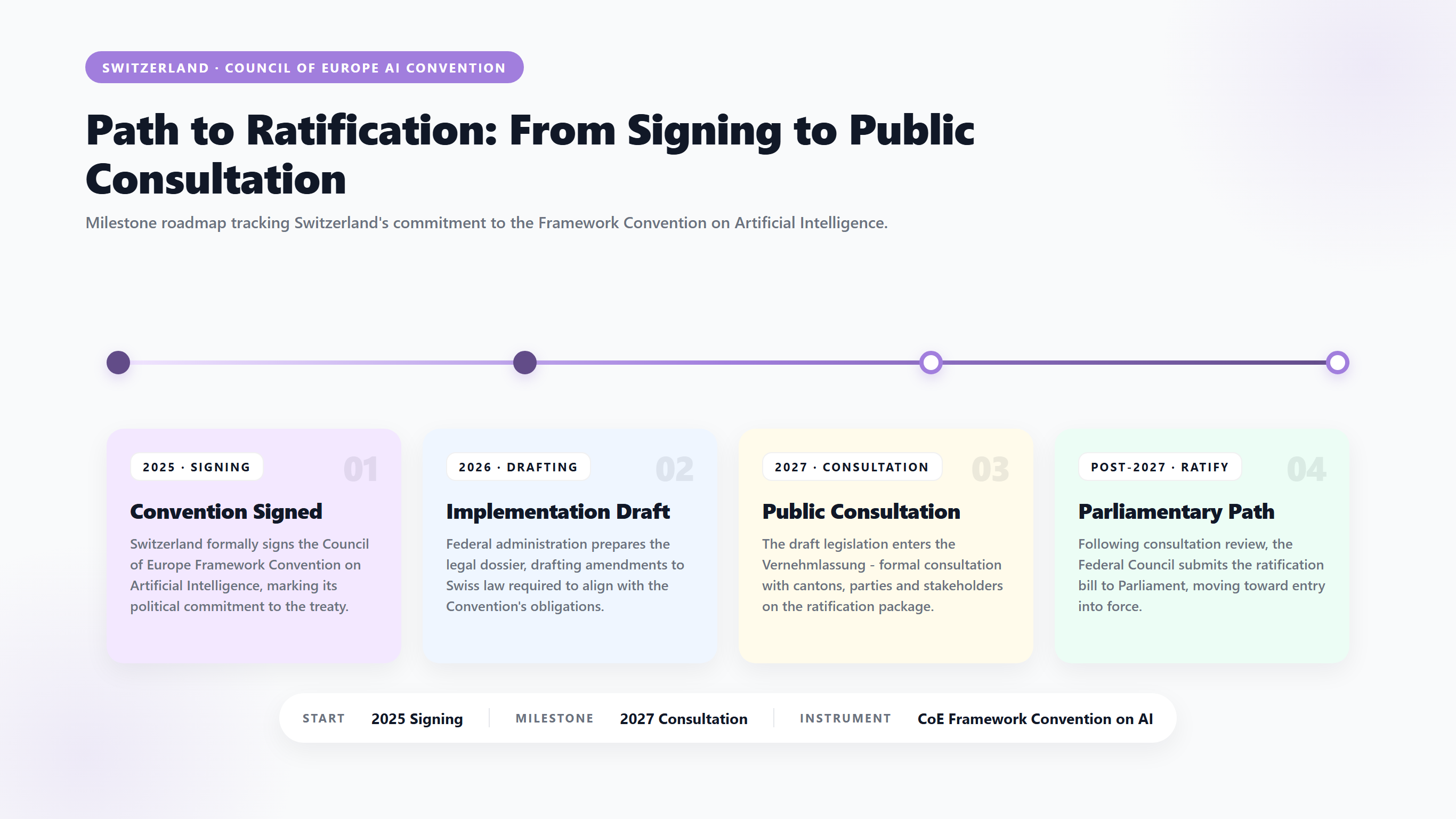
Switzerland signed the Council of Europe AI Convention on 27 March 2025 but has not yet ratified it. Signature is a political commitment; ratification is the legally binding step that triggers domestic implementation [Source: https://ai-risk.ch/en/ai-act-switzerland/]. On 12 February 2025, the Federal Council formally decided to pursue ratification and amend domestic law where needed, rather than draft a horizontal AI statute mirroring Brussels [Source: https://ai-risk.ch/en/ai-act-switzerland/].
For CEOs of Swiss SMEs, the operational reality today is simple: there is no comprehensive, cross-sector AI statute in Switzerland. AI is governed through existing instruments, including the Federal Act on Data Protection (revFADP), employment law, consumer protection, product liability, and sector-specific regulation across finance, health, and transport [Source: https://ai-risk.ch/en/ai-act-switzerland/].
The Convention's Guiding Principles
The Swiss approach will emphasize transparency, data protection, non-discrimination, respect for human rights, and human oversight. Crucially, the Swiss approach rejects a single horizontal risk-classification regime of the kind that defines the EU AI Act [Source: https://ai-risk.ch/en/ai-act-switzerland/]. This is a deliberate policy choice, not an oversight.
Why the "Light-Touch" Label Is Partially Misleading
Commentators describe the Swiss model as "light-touch," but that framing can mislead a CEO into complacency. Existing Swiss laws already impose substantial obligations on how AI is deployed, particularly around personal data, employment decisions, and consumer-facing outputs [Source: https://peopleofinternet.com/articles/switzerland-s-light-touch-ai-strategy-is-credible-but-only.html]. The Convention adds a human-rights and accountability overlay on top of these existing rules.
💡 Expert Insight
The mechanism to understand: Switzerland is not choosing less regulation - it is choosing distributed regulation. Every obligation the EU AI Act bundles into one statute will still exist in Swiss law, but spread across revFADP, employment law, Swissmedic rules, FINMA circulars, and sectoral product-safety regimes. The trade-off is not burden vs. no burden; it is one interpretive lens vs. many.
The 2026-2027 Regulatory Timeline
A Swiss consultation draft is expected by early 2027, and the latest SME portal notice says spring 2027. Timing is the single most important variable for board-level planning. The Federal Department of Justice is expected to prepare a consultation draft by the end of 2026 under one official timetable, while a separate SME-government notice refers to a draft expected by early 2027 [Source: https://ai-risk.ch/en/ai-act-switzerland/] [Source: https://www.kmu.admin.ch/fr/un-avant-projet-visant-a-reglementer-lia-sera-elabore-dici-debut-2027]. The more recent notice (23 September 2026) points to spring 2027, so plan for a consultation window in the first half of 2027.
| Date | Milestone | Jurisdiction |
|---|---|---|
| 12 February 2025 | Federal Council decision to ratify and amend Swiss law | Switzerland |
| 27 March 2025 | Switzerland signs the Council of Europe AI Convention | Switzerland |
| 2 August 2026 | EU AI Act Article 50 transparency duties became applicable | European Union |
| End of 2026 | Earlier DOJ timetable for a consultation draft | Switzerland |
| Spring 2027 | Consultation draft per the Swiss SME portal (23 September 2026) | Switzerland |
| 2 December 2027 | EU AI Act Annex III high-risk obligations apply | European Union |
| 2 August 2028 | EU AI Act Annex I high-risk product deadlines | European Union |
Note that as of today, Switzerland has not formally ratified the Convention. Signature is a political commitment; ratification is the legally binding step that triggers domestic implementation [Source: https://ai-risk.ch/en/ai-act-switzerland/].
What "Consultation Draft" Means in Practice
In Swiss federal practice, a consultation draft (Vernehmlassungsentwurf) is circulated to cantons, political parties, umbrella associations, and interested organizations for formal feedback. The subsequent legislative process typically takes 18-36 months before entry into force. This means CEOs should expect binding Swiss AI-related amendments to arrive meaningfully later than the EU AI Act's high-risk deadlines.
💡 Pro Tip
Mark the EU AI Act Annex III deadline (2 December 2027) in your board calendar before the Swiss consultation deadline. For most mid-market Swiss SMEs with any EU customer base, this is the earlier binding constraint - and the one that will drive 2027 budget decisions.
Swiss Convention Model vs EU AI Act: Core Differences
The EU AI Act is a comprehensive, prescriptive regulation with risk tiers; the Swiss model is principle-based and distributed across sectoral laws. Understanding the structural divergence between the two frameworks is essential for strategic planning.
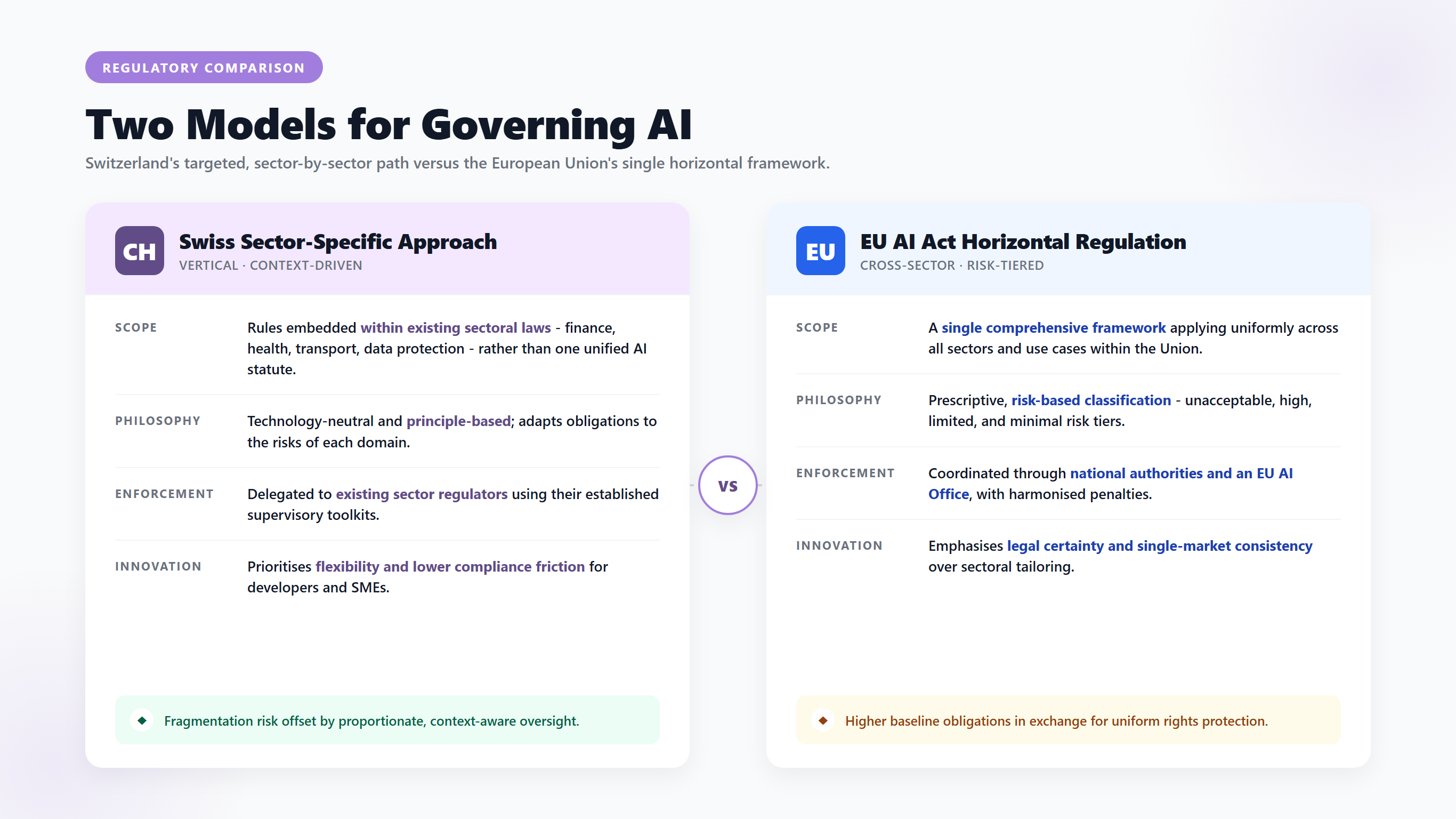
| Dimension | Swiss Convention Approach | EU AI Act |
|---|---|---|
| Regulatory architecture | Sector-specific amendments to existing laws | Horizontal, standalone regulation |
| Risk classification | Risk assessed in context (sector by sector) | Four-tier model: unacceptable, high, limited, minimal |
| Governing principles | Human rights, democracy, rule of law, oversight | Safety, fundamental rights, risk management |
| Scope of general-purpose AI | Not explicitly addressed in current plan | Specific GPAI obligations with transparency duties |
| Enforcement structure | Existing sectoral regulators (FINMA, Swissmedic, FDPIC) | National competent authorities plus EU AI Office |
| Penalties | Determined by amended sectoral laws | Up to EUR 35 million or 7% of global turnover |
| Likely entry into force | Post-2028 for Swiss amendments | Phased 2025-2028 |
The Risk-Classification Divide
The EU AI Act's defining feature is its risk-based taxonomy. Prohibited practices (such as social scoring by public authorities) are banned outright. High-risk systems in Annex III (including recruitment, credit scoring, education, and critical infrastructure) must satisfy risk management, data governance, documentation, transparency, human oversight, accuracy, and cybersecurity requirements before market placement [Source: https://ai-risk.ch/en/ai-act-switzerland/].
Switzerland's Convention-driven model does not replicate this grid. Instead, a healthcare AI tool will be assessed under medical device rules, a hiring tool under employment and data-protection law, and a credit-scoring tool under financial supervision. The Swiss approach can be more precise or more fragmented depending on how a given SME uses AI.
What Sector-Specific Rules Mean for Swiss SMEs
Quick Answer: Are sector-specific rules better for Swiss SMEs?
For domestic Swiss SMEs with low-risk AI use cases, yes - in the short term. Proportionality lowers compliance cost and leverages existing data-protection and sectoral compliance functions. For multi-sector or EU-facing SMEs, the sector-specific model adds fragmentation and interpretive uncertainty.
For domestic Swiss SMEs, the sector-specific model probably wins in the short term, but not universally. The benefit is proportionality: obligations attach to actual business context rather than being imposed through a single framework covering every AI system [Source: https://ai-risk.ch/en/ai-act-switzerland/].
Consider a mid-size Zurich accounting firm that uses generative AI for document drafting, meeting summaries, and client correspondence. Under the Swiss model, the primary obligations flow from revFADP, professional secrecy, and client-engagement contracts. Under an EU-style framework, that same firm might need to classify tools, maintain conformity documentation, and prove human-oversight procedures.
The Trade-Off: Lower Burden, Higher Uncertainty
The predictable advantages of the Swiss approach for SMEs include:
- Lower initial compliance burden for domestic, low-risk users
- Less regulatory duplication for firms already under specialized supervision
- Greater reliance on existing compliance functions, particularly data protection
- Reduced legal fees for horizontal classification work
The predictable disadvantages:
- Greater legal uncertainty for novel or multi-sector applications
- Fragmentation when a single company spans multiple regulated domains
- Open questions about general-purpose AI, foundation model liability, and vendor allocation
- Higher complexity for exporters navigating both regimes
📥 Download Our Swiss SME AI Readiness Checklist
40-point checklist covering data protection, vendor review, sector-specific duties, and 2027 readiness planning.
Why the EU AI Act Still Reaches Swiss Companies
Quick Answer: Does the EU AI Act apply to Swiss SMEs?
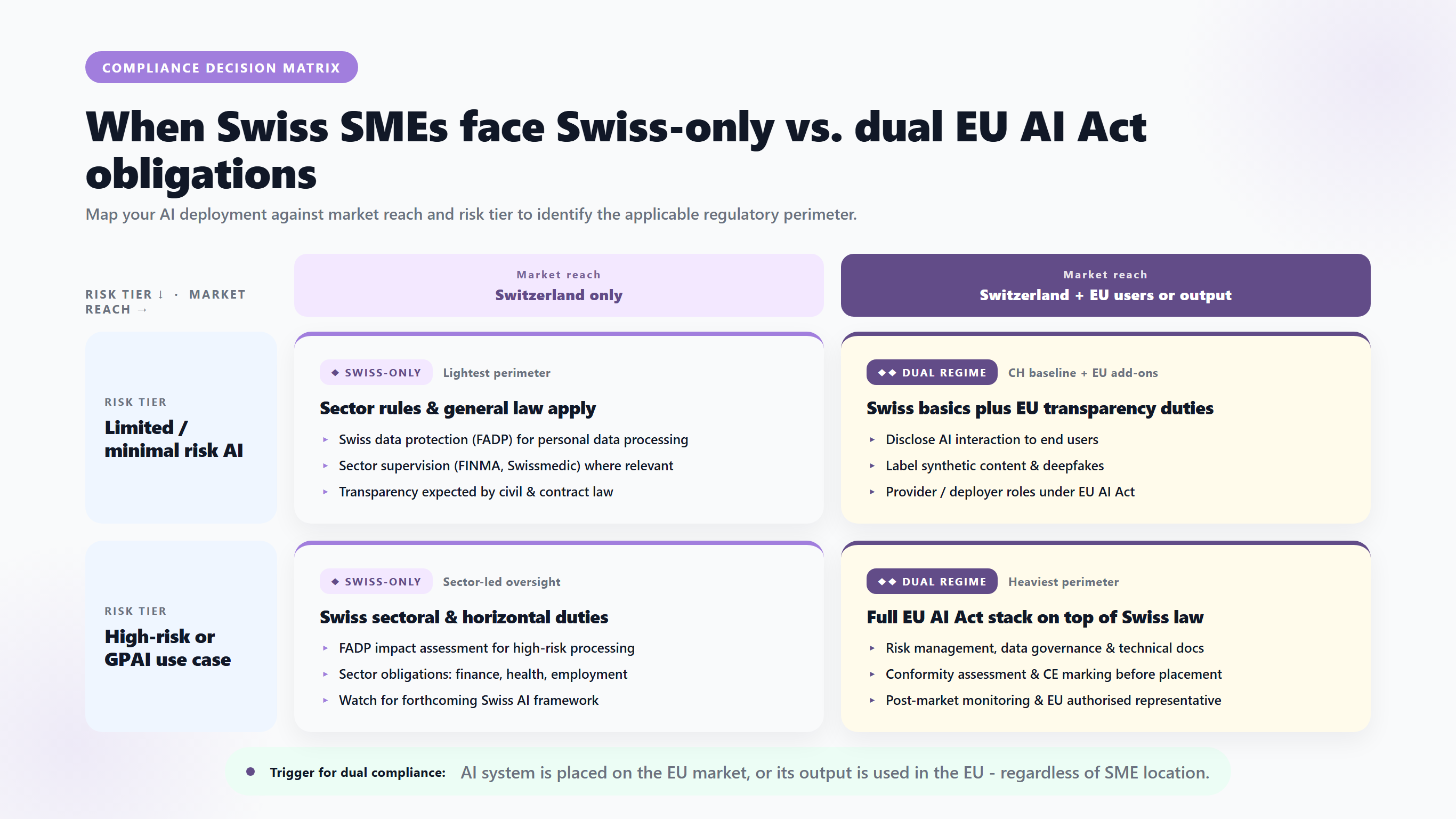
Yes, under four triggers: placing an AI system on the EU market, operating through an EU subsidiary, importing or exporting AI infrastructure into the EU, or producing outputs used in the EU. The output-in-EU trigger is the broadest and captures many Swiss SaaS and professional-services firms.
CEOs often assume that because Switzerland is not an EU member, Swiss companies escape the EU AI Act. That assumption is wrong. A Swiss company can be captured by the EU AI Act without being established in the EU. Exposure arises where a Swiss business places an AI system on the EU market, operates through an EU subsidiary, imports or exports relevant AI infrastructure into the EU, or produces outputs used in the EU [Source: https://thestratedge.ai/blog/practical-ai-governance-switzerland] [Source: https://agenticsis.ch/blog/switzerland-ai-convention-ratification-swiss-sme-2027/].
The last trigger - output used in the EU - is particularly broad. A Swiss SaaS vendor whose AI-driven analytics are consumed by a German customer may fall within scope. This extraterritorial reach mirrors the GDPR architecture that Swiss firms already know.
💡 Expert Insight: The Hidden EU Trigger Most Swiss CEOs Miss
In practice, the "output used in the EU" trigger activates far earlier than most legal teams expect. A Swiss analytics dashboard viewed by a Munich-based client, a chatbot embedded on a page accessed by French users, or an AI-generated report delivered to an Italian subsidiary - each can plausibly fall in scope. The compliance test is not where the server sits; it is where the output is consumed. Build your inventory accordingly.
The Two-Track Compliance Reality by 2027
By 2027, most Swiss SMEs will operate in one of two tracks:
Track 1 - Swiss-only operations: Primary focus on revFADP, employment law, consumer rules, sectoral requirements, and the forthcoming Convention-driven amendments.
Track 2 - EU-facing operations: Full EU AI Act compliance including documentation, transparency controls, risk management systems, and provider or deployer duties, layered on top of Swiss domestic obligations [Source: https://thestratedge.ai/blog/practical-ai-governance-switzerland].
For many Swiss mid-market firms, Track 2 is the realistic path because of the economic weight of the EU as an export market. One 2026 Swiss business analysis reports that approximately 40% of surveyed companies supported alignment with the EU AI Act for international legal certainty, while 28% favored maintaining an independent Swiss approach [Source: https://thestratedge.ai/blog/practical-ai-governance-switzerland].
The Export-Competitiveness Angle
If a Swiss industrial automation firm sells to German or French manufacturers, EU AI Act conformity may become a tender requirement. Procurement teams in the EU will increasingly treat AI Act documentation as table stakes. Swiss suppliers who cannot demonstrate it risk being filtered out of RFPs, regardless of Swiss law.
Sector-by-Sector Compliance Outlook
The strength of the Swiss sectoral approach is that it dovetails with regulators and risk frameworks firms already know. The weakness is that each sector carries its own interpretive baggage.
Healthcare and Medical Technology
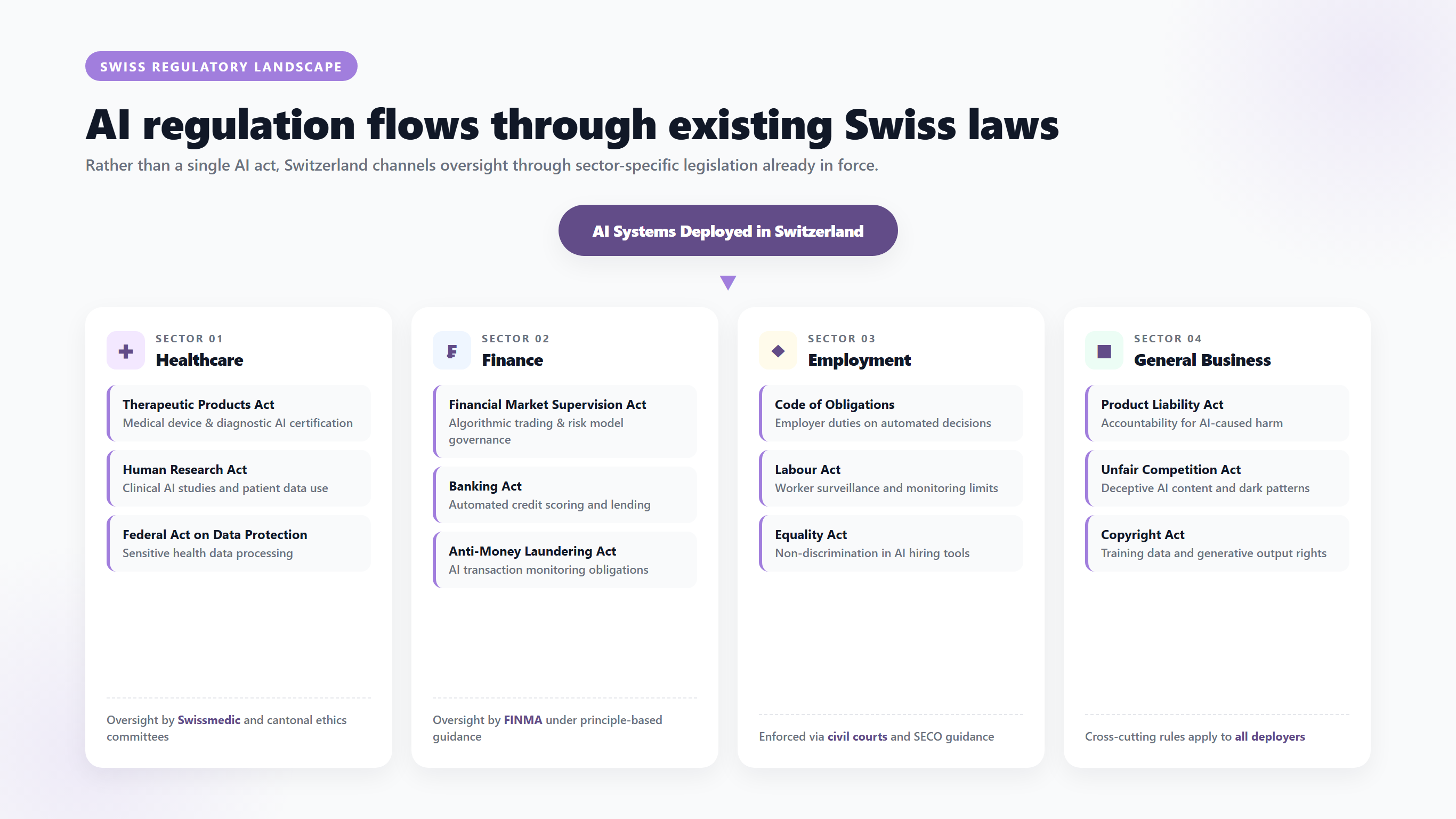
Medical AI will remain governed primarily through medical-device rules (MedDO/IvDO) and healthcare laws, with additional obligations from data protection, patient safety, explainability, and professional responsibility [Source: https://agenticsis.ch/blog/switzerland-ai-convention-ratification-swiss-sme-2027/]. For a Swiss medtech SME, the sectoral approach integrates well with Swissmedic certification pathways.
Financial Services
Banks, insurers, and asset managers will handle AI through banking law, outsourcing requirements, operational-risk controls, and FINMA-related supervisory expectations rather than a single AI statute [Source: https://agenticsis.ch/blog/switzerland-ai-convention-ratification-swiss-sme-2027/]. The advantage is governance continuity; the disadvantage is that smaller financial firms need specialized model-risk expertise that is expensive to source.
Employment and Recruitment
AI used for hiring, worker evaluation, scheduling, or performance monitoring engages employment law and the revFADP. SMEs should expect scrutiny of discrimination, transparency, lawful processing, human review, and explainability of consequential decisions [Source: https://agenticsis.ch/blog/switzerland-ai-convention-ratification-swiss-sme-2027/]. Employment is the area where Swiss SMEs are most likely to encounter friction, because off-the-shelf HR tech vendors rarely provide Swiss-specific documentation.
General Business Use
For ordinary office productivity, customer service, translation, coding, and document processing, the Swiss compliance focus is data protection, confidentiality, intellectual-property risk, output accuracy, and human oversight rather than a new licensing regime [Source: https://ai-risk.ch/en/ai-act-switzerland/] [Source: https://www.kmu.admin.ch/fr/un-avant-projet-visant-a-reglementer-lia-sera-elabore-dici-debut-2027].
Critical Infrastructure
Energy, telecoms, transport, and water sector AI deployments will likely attract heightened obligations under existing critical-infrastructure and cybersecurity frameworks, with additional expectations around resilience and oversight.
The Shadow AI Problem CEOs Underestimate
Quick Answer: What is shadow AI?
Shadow AI (or "shadow agents") refers to AI tools and automated workflows adopted by employees without formal approval. The risks include confidential data exposure, uncontrolled vendor access, unauthorized decisions, and inability to answer regulator or client questions about data processing.
The most under-appreciated risk in Swiss SMEs is not regulatory. It is operational. Recent Swiss compliance commentary highlights "shadow agents": AI agents or automated workflows adopted by employees or business units without formal approval. These systems can create risks involving confidential data exposure, unauthorized decisions, uncontrolled vendor access, and unclear accountability [Source: https://ai-outsourcing.ch/insights/shadow-agents-the-new-compliance-challenge-for-smes].
A typical pattern: a marketing manager connects a generative AI tool to the company CRM via a browser extension. Customer data flows through an unvetted vendor. No one on the executive team knows. When a customer asks under revFADP where their data has been processed, the firm cannot answer.
Five Controls Every Swiss SME Should Implement Now
- Approved-tools register: A living list of AI tools authorized for business use, with sign-off from legal and IT
- Data-entry ban for unapproved systems: Explicit prohibition on entering confidential, personal, or regulated data into non-approved tools
- Human review requirement: Mandatory human review for customer-facing, employment, financial, and legal AI outputs
- Vendor records: Documentation covering model use, hosting location, data retention, security certifications, and subprocessors
- Incident reporting and audit: Basic procedures to log AI incidents and support internal or regulatory audit
These controls work under either the Swiss or EU model. They are also the baseline that FINMA, the Federal Data Protection and Information Commissioner (FDPIC), and EU regulators will expect.
Example: Before and After Shadow AI Governance
Consider an illustrative 80-person Swiss professional services firm. Before: employees use six different generative AI tools informally, no vendor contracts exist, client data has been pasted into free-tier models, and the CEO has no inventory. After governance implementation: three enterprise tools are approved, DPAs are signed with each vendor, confidential prompts are blocked at the browser level, and the firm can respond to client AI due-diligence questionnaires within 48 hours. Compliance posture improves; so does the firm's ability to win enterprise tenders.
Free Download: Schedule a Swiss AI Governance Assessment
Download NowSwiss AI Adoption Data: Where SMEs Actually Are
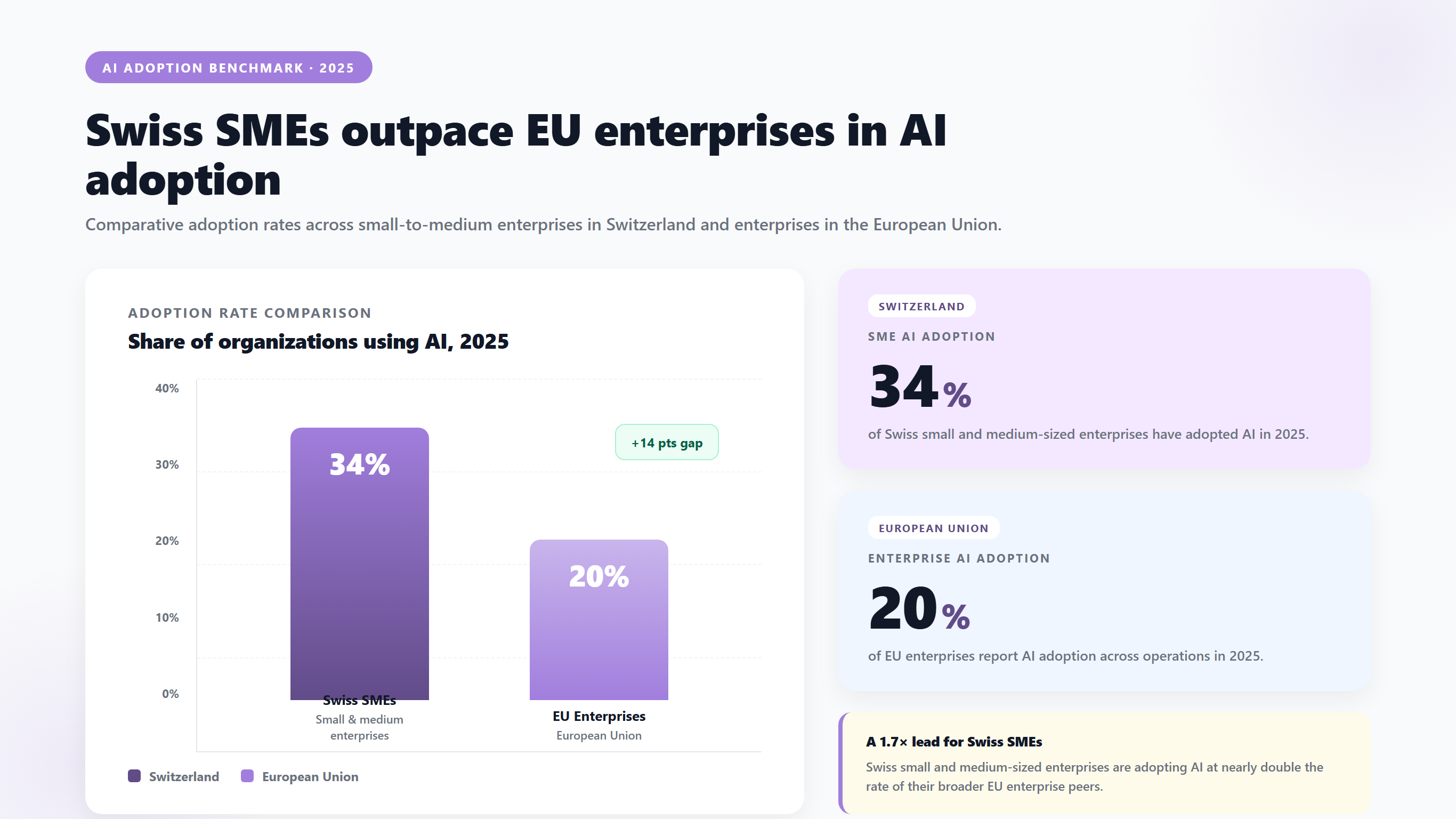
Approximately 34% of Swiss SMEs had integrated AI into their processes according to a 2025 AXA/Sotomo survey, compared to roughly 20% of EU enterprises with at least 10 employees [Source: https://scionos.ch/en/]. Policy debates often outrun operational reality, but Swiss SMEs are adopting AI faster than their EU peers - with uneven governance maturity.
This gap matters: Swiss firms have more at stake in a workable regulatory framework because more of them already depend on AI tools.
What Swiss Businesses Actually Want from Regulation
A 2026 Swiss business analysis found that around 40% of surveyed companies supported dedicated programs to help SMEs adopt AI, a similar share considered alignment with the EU AI Act important for international legal certainty, and 28% favored maintaining an independent Swiss approach [Source: https://thestratedge.ai/blog/practical-ai-governance-switzerland]. This is not a mandate for one direction. It is a divided business community trying to balance competitiveness, legal certainty, and sovereignty.
The Deployment, Not Development, Reality
Most Swiss SMEs are not building foundation models. They are deploying third-party generative AI tools, automation platforms, and workflow software. This shifts the compliance center of gravity from development risk to vendor management, data-location decisions, employee policies, access controls, and output verification [Source: https://ai-outsourcing.ch/insights/shadow-agents-the-new-compliance-challenge-for-smes].
CEO Playbook: Preparing for 2027
Quick Answer: What should Swiss SME CEOs do in the next 90 days?
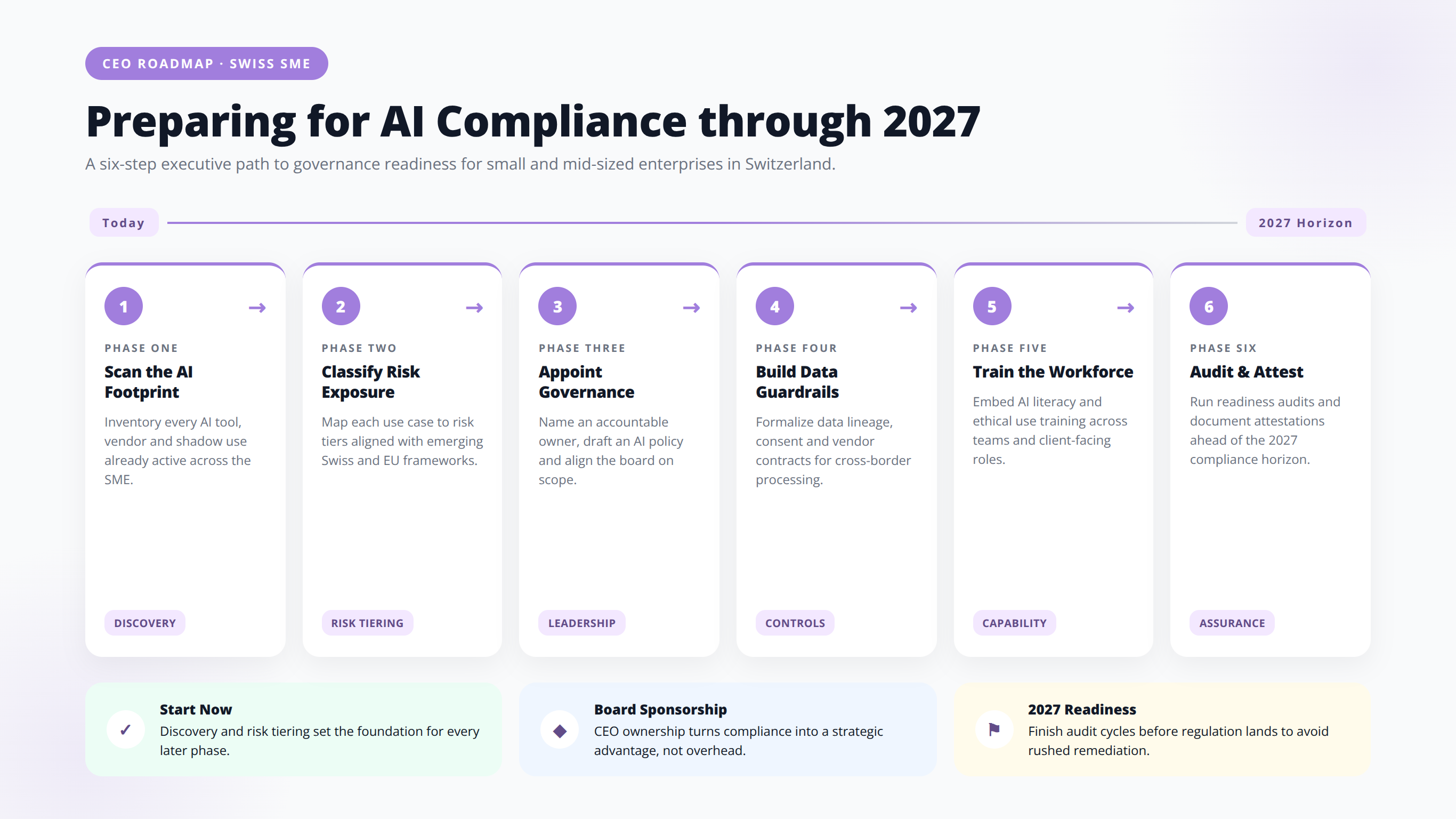
Commission an AI inventory, classify each use case by jurisdictional exposure (Swiss-only vs EU-facing), map use cases to sectoral regulators (FINMA, Swissmedic, FDPIC, SECO), implement five minimum-viable governance controls, monitor the Federal Department of Justice consultation, and budget for 2027-2028 legal and documentation work.
With a consultation draft expected by early 2027 (spring 2027 per the latest notice), CEOs have a narrow planning window. The following playbook translates regulatory uncertainty into concrete executive actions.
Step 1: Build an AI Inventory
Within 90 days, every CEO should commission an inventory of every AI tool in use, who uses it, what data flows through it, and what decisions it influences. This single document underpins every subsequent compliance step and is the first thing a regulator or acquirer will ask for.
Step 2: Classify by Jurisdictional Exposure
For each use case, determine whether it falls under Track 1 (Swiss-only) or Track 2 (EU-exposed). Any system producing output consumed in the EU is Track 2 regardless of where the server sits [Source: https://thestratedge.ai/blog/practical-ai-governance-switzerland].
Step 3: Map to Sectoral Regulators
Identify which Swiss regulators have authority over each use case: FINMA for financial, Swissmedic for medical devices, FDPIC for personal data, SECO for employment. Each has distinct expectations even today.
Step 4: Implement Minimum Viable Governance
Deploy the five shadow-AI controls described above. These are the baseline that will satisfy the Convention's principles when ratified and the EU AI Act's deployer obligations.
Step 5: Monitor the Consultation
Assign someone on the executive team to track the Federal Department of Justice consultation. Industry associations (economiesuisse, SwissHoldings, SATW) will produce position papers during the consultation window [Source: https://ai-risk.ch/en/ai-act-switzerland/].
Step 6: Budget for 2027-2028
Set aside budget for legal review, vendor renegotiation, and documentation work. For a 50-person Swiss SME with moderate AI exposure, realistic preparation spend is in the five-figure CHF range; for firms with EU exposure or high-risk sectors, it is substantially more.
💡 Expert Insight: Why Step 1 Matters More Than Steps 2-6
Every Swiss SME we have seen attempt AI governance without a complete inventory ends up re-doing the work twelve months later. Vendor contracts cannot be renegotiated for tools you do not know exist. Shadow AI cannot be governed if it stays in the shadows. The inventory is not administrative hygiene - it is the foundation that determines whether every subsequent step is accurate or theatrical.
Compliance Cost Scenarios
To make the trade-off concrete, consider five illustrative Swiss SME profiles and their likely compliance posture under each framework.
| SME Profile | Swiss Convention Model (illustrative) | EU AI Act Equivalent (illustrative) |
|---|---|---|
| 30-person Zurich accounting firm, domestic clients, generative AI for drafting | revFADP alignment, professional secrecy policies, vendor DPAs | Limited-risk transparency duties plus deployer documentation |
| 120-person Basel medtech, AI diagnostic feature, exports to Germany | Swissmedic certification, revFADP, Convention human-oversight principles | Full Annex III high-risk conformity assessment and documentation |
| 60-person Geneva fintech, credit scoring, Swiss and EU customers | FINMA supervision, revFADP, sectoral risk management | High-risk credit-scoring obligations, provider duties, EU representative |
| 200-person Lausanne industrial SaaS, EU customers only | Minimal Swiss AI-specific obligations | Full EU AI Act scope depending on use case |
| 15-person Bern consultancy, domestic only, Microsoft Copilot usage | revFADP, employment confidentiality, acceptable-use policy | Limited-risk transparency duties for AI content |
The Fragmentation Tax
Multi-sector SMEs will pay what can be called a fragmentation tax under the Swiss model. A single firm providing AI-enabled services across HR, finance, and healthcare must interpret three regulatory regimes separately. The EU AI Act, for all its burden, provides one interpretive lens.
The Export Premium
Conversely, Swiss-only firms benefit from an export premium of regulatory arbitrage, provided they resist the temptation to expand into EU markets without preparing documentation first. The moment EU revenue becomes material, the premium disappears.
💡 Pro Tip
If EU revenue is above 15% of your top line, assume Track 2 by default and build to EU AI Act documentation standards. The marginal cost of over-complying is small; the cost of being filtered out of a German or French RFP for missing documentation is a lost deal.
🧮 Calculate Your Dual-Compliance Exposure
Estimate your SME's combined Swiss and EU AI compliance burden based on sector, headcount, and EU revenue share.
Frequently Asked Questions
Has Switzerland ratified the Council of Europe AI Convention?
A: No. Switzerland signed the Convention on 27 March 2025, but as of the latest available information, ratification has not occurred. The Federal Council decided on 12 February 2025 to pursue ratification and amend Swiss law accordingly, with a consultation draft expected by early 2027 (spring 2027 per the Swiss SME portal) [Source: https://ai-risk.ch/en/ai-act-switzerland/].
Will Switzerland adopt its own EU-style AI Act?
A: Current plans say no. Switzerland is pursuing targeted amendments to existing laws rather than a comprehensive horizontal statute. The approach emphasizes transparency, data protection, non-discrimination, human rights, and oversight without creating a new risk-classification regime [Source: https://ai-risk.ch/en/ai-act-switzerland/].
Does the EU AI Act apply to Swiss SMEs?
A: It can. A Swiss company falls within the EU AI Act's scope if it places AI systems on the EU market, operates through an EU subsidiary, imports or exports relevant AI infrastructure into the EU, or produces outputs used in the EU. The output-in-EU trigger is broad and captures many SaaS and professional-services firms [Source: https://thestratedge.ai/blog/practical-ai-governance-switzerland].
When do EU AI Act obligations start biting?
A: Article 50 transparency duties became applicable on 2 August 2026. Obligations for many Annex III high-risk systems are scheduled to apply on 2 December 2027, and Annex I high-risk product deadlines fall on 2 August 2028 [Source: https://ai-risk.ch/en/ai-act-switzerland/].
What is a "shadow agent" and why should CEOs care?
A: A shadow agent is an AI agent or automated workflow adopted by employees without formal approval. The risks include confidential data exposure, unauthorized decisions, uncontrolled vendor access, and unclear accountability. CEOs should implement an approved-tools register, data-entry controls, human-review requirements, vendor records, and incident reporting procedures [Source: https://ai-outsourcing.ch/insights/shadow-agents-the-new-compliance-challenge-for-smes].
How many Swiss SMEs already use AI?
A: Approximately 34% of Swiss SMEs had integrated AI into their processes according to a 2025 AXA/Sotomo survey, compared to roughly 20% of EU enterprises with at least 10 employees in the cited comparison [Source: https://scionos.ch/en/]. Swiss adoption is ahead of the EU average, which raises the stakes for workable regulation.
Which Swiss regulator will enforce AI rules?
A: Enforcement is likely to remain distributed across existing sectoral regulators. The FDPIC handles data protection, FINMA covers finance, Swissmedic covers medical devices, and SECO covers employment matters. No single AI authority is planned under the current Convention-driven approach [Source: https://ai-risk.ch/en/ai-act-switzerland/].
What should CEOs do before the consultation draft arrives?
A: Build an AI inventory, classify use cases by jurisdictional exposure, map to sectoral regulators, implement minimum viable governance including vendor DPAs and approved-tools registers, monitor the consultation, and budget for 2027-2028 compliance work. These steps are robust under either the Swiss or EU model.
Are there penalties under the Swiss Convention approach?
A: Penalties will be determined by the specific sectoral laws amended during ratification, rather than through a single AI-penalty regime. By contrast, the EU AI Act imposes fines of up to EUR 35 million or 7% of global annual turnover for the most serious violations [Source: https://ai-risk.ch/en/ai-act-switzerland/].
What about general-purpose AI and foundation models under Swiss law?
A: This is one of the open uncertainties. The current Swiss plan does not explicitly address GPAI or foundation models in the way the EU AI Act does. SMEs using tools like enterprise GenAI platforms should rely on vendor contracts, revFADP compliance, and the Convention's general principles while the gap is clarified [Source: https://ai-risk.ch/en/ai-act-switzerland/].
Will the Swiss approach create a competitive advantage?
A: For purely domestic, low-risk Swiss SMEs, probably yes in the short term. The lower compliance burden frees capital for product and go-to-market investment. For exporters, the advantage disappears because EU AI Act obligations attach regardless of the Swiss baseline [Source: https://thestratedge.ai/blog/practical-ai-governance-switzerland].
What is the main risk of sector-specific rules for multi-domain SMEs?
A: Fragmentation. A firm spanning healthcare, finance, and employment must interpret three regulatory regimes separately. Legal fees, interpretive uncertainty, and the cost of specialized expertise all rise. The EU AI Act, despite its weight, provides one interpretive framework [Source: https://ai-risk.ch/en/ai-act-switzerland/].
Does the Convention cover public sector AI?
A: Yes, the Council of Europe Convention is particularly focused on protecting human rights, democracy, and the rule of law in the context of AI used by or on behalf of public authorities. Swiss ratification will trigger adjustments to how federal and cantonal administrations deploy AI [Source: https://ai-risk.ch/en/ai-act-switzerland/].
Will there be a Swiss national AI referendum?
A: The Swiss direct-democracy process could in principle be triggered on AI-related legislation, and discussion of this possibility has occurred in Swiss policy circles [Source: https://takeoff.watch/questions/national-referendum-on-ai]. However, no referendum is currently scheduled, and the ratification path proceeds through standard parliamentary channels.
How does Swiss AI sovereignty intersect with EU alignment?
A: Business opinion is divided. Approximately 40% of surveyed Swiss companies support alignment with the EU AI Act for international legal certainty, while 28% favor an independent Swiss approach that preserves regulatory sovereignty [Source: https://thestratedge.ai/blog/practical-ai-governance-switzerland]. The ratification process will likely produce a hybrid: Convention-based principles with sectoral precision and partial EU interoperability.
Related reading
- Switzerland AI Convention ratification: a guide for Swiss SMEs: the ratification path in detail
- Switzerland AI regulation vs the EU AI Act: the 2027 outlook for Swiss SMEs
- How Swiss SMEs are putting AI into production in 2026: what actually reaches production, and why
Conclusion and Next Steps
Switzerland's AI Convention ratification is not a story about doing less than the EU. It is a story about doing it differently. By 2027, Swiss SMEs will operate under a Convention-driven, sector-specific framework that is likely to be more proportionate for domestic low-risk users but will not eliminate complexity for cross-sector or EU-facing businesses.
Key takeaways for CEOs:
- Switzerland signed the Council of Europe AI Convention on 27 March 2025 but has not yet ratified
- A consultation draft is expected by early 2027 (spring 2027 per the Swiss SME portal)
- The Swiss model relies on sector-specific amendments, not a horizontal AI Act
- The EU AI Act still reaches Swiss SMEs through extraterritorial triggers
- 34% of Swiss SMEs already use AI, ahead of the EU 20% figure
- Shadow AI governance is the most urgent operational priority, independent of regulation
- Two-track compliance is the realistic 2027 baseline for most mid-market Swiss firms
- The CEO's six-step playbook starts with an AI inventory in the next 90 days
The window to prepare is narrow. The firms that treat the 2026-2027 consultation period as a planning opportunity, not a wait-and-see moment, will enter the ratified regime with documentation, vendor controls, and governance already in place. Those that wait will spend 2028 catching up while competitors win EU tenders and avoid regulatory surprises.
If you are a CEO navigating this transition, the next concrete step is to commission an AI inventory and jurisdictional-exposure review within your organization. From there, every subsequent compliance decision becomes materially easier.
Free Download: Ready to Start Your 90-Day AI Inventory?
Download Now⚠️ Disclaimer
This article provides general information about Swiss and EU AI regulation and does not constitute legal advice. Dates, deadlines, and regulatory expectations may change as the Swiss consultation process progresses. Readers should consult qualified Swiss and EU legal counsel before making compliance decisions. All statistics and regulatory references are sourced to the cited publications as of October 2026.

About the Author
Agenticsis Team - Zurich-based AI consultancy founded by Sofía Salazar Mora, partnering with companies across Switzerland, the European Union, and Latin America to mainstream artificial intelligence into business operations. Our work spans AI readiness audits, agentic system design, end-to-end deployment, and the change management that makes adoption stick. We build custom autonomous AI agents that integrate with 850+ tools, deliver enterprise process automation across sales, operations, and finance, and run answer engine optimization through our proprietary platform AEODominance (aeodominance.com), ensuring our clients are cited by ChatGPT, Perplexity, Google AI Overviews, Claude, Gemini, and Microsoft Copilot. Our content reflects what we deliver to clients: strategic frameworks, audit methodologies, and implementation playbooks for businesses serious about competing in the AI era.
Last updated: October 12, 2026