TL;DR(Too Long; Did not Read)
Will Switzerland's sector-specific AI rules outpace the EU AI Act by 2027? Analysis of nFADP, FINMA and compliance paths for Swiss SMEs in 2026.
Switzerland AI Regulation vs EU AI Act: Will Sector-Specific Rules Win by 2027?
Last updated: 1 September 2026 · Published by Agenticsis
Quick Answer:
Switzerland is not adopting a single AI-specific law like the EU AI Act. Instead, it layers existing sector rules (finance, health, insurance) on top of the nFADP and its March 2025 signature of the Council of Europe AI Convention. For Swiss SMEs, compliance obligations for agentic AI are currently defined more by data-processing and sector conduct rules than by a horizontal risk-classification regime.
Table of Contents
- Introduction: Two Divergent Regulatory Paths
- Regulatory Timeline to 2027: EU AI Act vs Switzerland
- Switzerland's Sector-by-Sector AI Oversight Architecture
- Why the Swiss Model Can Outpace the EU AI Act
- What the nFADP Requires for AI-Driven Data Processing Today
- Do Swiss SMEs Need to Comply with the EU AI Act?
- Agentic AI: Where Sector Supervisors Have the Advantage
- Head-to-Head: Switzerland AI Regulation vs EU AI Act
- A Practical 2026-2027 Compliance Roadmap for Swiss SMEs
- What to Watch Out For
- Will Switzerland Eventually Adopt Its Own AI Act?
- Frequently Asked Questions
- Conclusion and Next Steps
Introduction: Two Divergent Regulatory Paths
The debate over Switzerland AI regulation vs EU AI Act is often framed as a choice between a comprehensive horizontal statute and a regulatory vacuum. That framing is wrong. Switzerland has chosen a deliberate, technology-neutral, sector-specific approach that already produces enforceable obligations for AI systems today, while the EU AI Act's most impactful provisions for SME-heavy use cases are only fully binding from 2 December 2027 after the Digital Omnibus Regulation (EU) 2026/1744 postponed Annex III high-risk obligations by 16 months.
For Swiss decision-makers deploying agentic AI in 2026, this distinction is not academic. It changes which regulator you answer to, which documents you produce, which timelines you plan against, and how quickly you receive corrective feedback on a live model. It also changes the cost of compliance: horizontal AI regimes require new vocabulary, new roles, and new tooling; sectoral regimes reuse the risk management, outsourcing, and impact-assessment practices your compliance team already runs.
This article makes a contrarian argument. By the end of 2027, Swiss SMEs operating in finance, health and insurance will have been subject to enforceable, sector-specific AI oversight for years, primarily through the FADP (revised in September 2023 as the nFADP), FINMA Guidance 08/2024, Swissmedic under the Medical Devices Ordinance (MepV) and Therapeutic Products Act (HMG), and the transversal principles of the Council of Europe Framework Convention on AI, Human Rights, Democracy and the Rule of Law (STCE No. 225), which Switzerland signed on 27 March 2025. EU counterparts, by contrast, will still be scaling up implementation of Annex III high-risk obligations.
Need your agentic AI system to produce compliance evidence?
Agenticsis designs agentic AI systems with the human oversight, decision logging and audit trails your compliance assessment depends on. We build the technical controls; your counsel determines which obligations apply.
Book a discovery callRegulatory Timeline to 2027: EU AI Act vs Switzerland
Quick Answer:
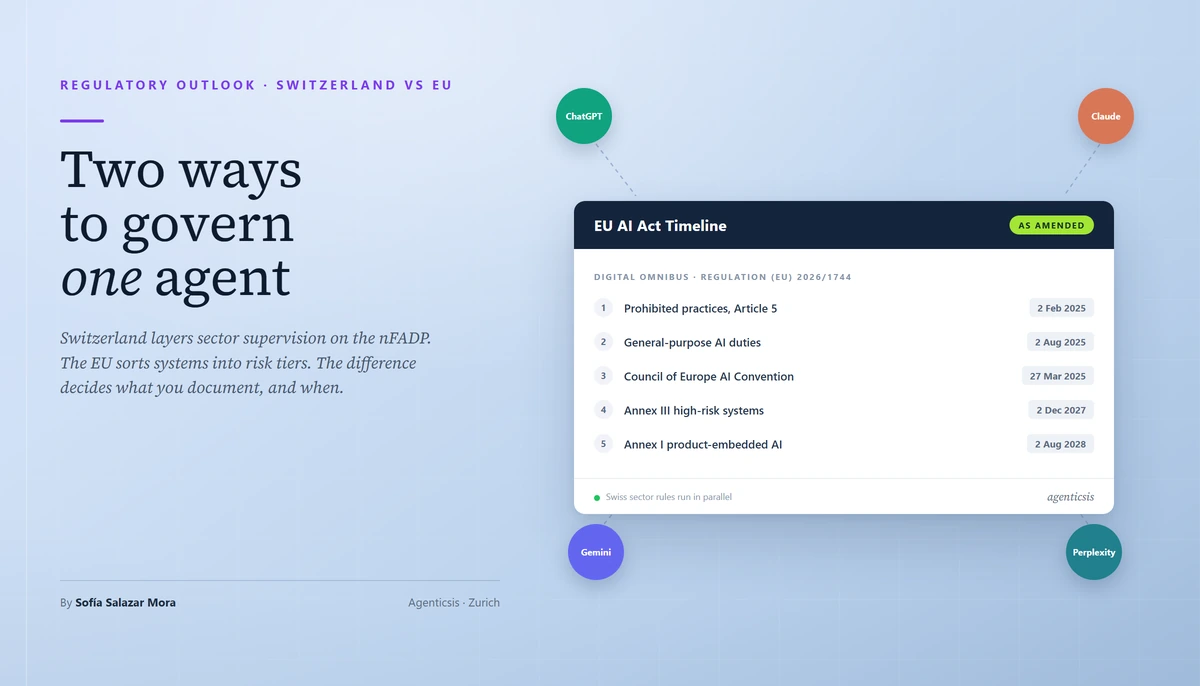
The EU AI Act rolls out in five waves between February 2025 and August 2027. The Digital Omnibus Regulation (EU) 2026/1744 pushed Annex III high-risk obligations to 2 December 2027, but Article 27 FRIA duties for credit and insurance scoring still apply from August 2026. Switzerland is not planning a horizontal AI Act before 2028 and will continue regulating AI sector by sector.
How does the EU AI Act roll out in five waves?
The EU AI Act (Regulation (EU) 2024/1689) entered into force on 1 August 2024 with obligations applying in five waves between February 2025 and August 2027. Wave 1 (February 2025) banned unacceptable-risk practices such as social scoring and manipulative subliminal techniques, and introduced an AI literacy duty under Article 4, later softened to a best-efforts obligation by the Digital Omnibus. Wave 2 (August 2025) activated Chapter V obligations for general-purpose AI models. [Source: artificialintelligenceact.eu]
Why were high-risk obligations postponed to December 2027?
Wave 3, covering Annex III stand-alone high-risk systems (employment, credit scoring, insurance pricing, education, biometrics), was originally scheduled for 2 August 2026 but was postponed to 2 December 2027 by the Digital Omnibus Regulation (EU) 2026/1744, a delay of 16 months. Some specific obligations, notably the fundamental rights impact assessment (FRIA) for credit and life or health insurance scoring under Article 27, remain tied to August 2026. Wave 4 covers embedded high-risk AI in regulated products (medical devices, industrial machinery) and applies from August 2027 or 2028 depending on the product category.
Why does Switzerland have no horizontal AI Act on the roadmap?
In parallel, the Swiss Federal Council has explicitly confirmed that work will continue on the regulation of AI in specific sectors such as healthcare and transport, signalling a continued sectoral strategy rather than a single horizontal act. Domestic Swiss AI legislation beyond the current patchwork is not expected before 2028. What already applies in Switzerland today: the nFADP (in force since September 2023), the Code of Obligations, FINMA law and Guidance 08/2024, the MepV and HMG under Swissmedic supervision, and anti-discrimination rules. Switzerland's signature of the Council of Europe AI Convention on 27 March 2025 adds a transversal fundamental-rights baseline that sector regulators will implement through their existing supervisory tools.
Expert Insight
The 16-month delay to Annex III of the EU AI Act is often read as a win for EU industry. For Swiss SMEs it has a subtler effect: it widens the window in which Swiss firms operate under a mature, enforceable sectoral regime while EU competitors are still translating horizontal AI Act concepts into operational controls. First-mover compliance advantage in finance, health and insurance is measured in supervisory relationships, not statutes.
Switzerland's Sector-by-Sector AI Oversight Architecture
How does FINMA already regulate AI in financial services?
FINMA's framework, reinforced by FINMA Guidance 08/2024, explicitly governs AI used by banks, insurers and asset managers. The guidance focuses on governance and risk management for AI models, outsourcing and third-party management, and model controls and validation. Industry-driven initiatives such as Swiss Fintech Innovations' 2024 Scalable Framework for Implementing AI in Swiss Financial Institutions extend these principles into practical patterns for credit scoring, trading and customer analytics.
How does Swissmedic supervise AI in healthcare and medical devices?
In healthcare, AI systems that qualify as software medical devices fall under the Medical Devices Ordinance (MepV) and the Therapeutic Products Act (HMG), with Swissmedic as regulator. That means safety, performance and post-market surveillance obligations attach to a radiology decision-support AI or an agentic triage assistant regardless of whether a Swiss AI-specific statute exists.
How is AI in insurance and essential services supervised?
Insurers using AI for underwriting, dynamic pricing and claims handling are supervised by FINMA for solvency and conduct, and by the nFADP for profiling and sensitive data. Notably, Annex III of the EU AI Act specifically classifies life and health insurance scoring as high-risk, but Swiss insurers already face equivalent expectations through non-discrimination principles, DPIA duties and FINMA guidance.
Why is the nFADP the connective tissue of Swiss AI oversight?
The nFADP, in force since 1 September 2023, applies to any processing of personal data including AI systems. It requires a data protection impact assessment (DPIA) where processing is likely to result in high risk to fundamental rights, and it imposes obligations on data minimisation, transparency, accuracy and security that map directly onto AI training and inference pipelines.
Why the Swiss Model Can Outpace the EU AI Act
Quick Answer:
Swiss sector regulators already enforce AI governance, model validation and DPIAs today. EU high-risk obligations for the same sectors only fully arrive on 2 December 2027. Swiss SMEs therefore reach operational compliance earlier, with less conceptual overhead and faster supervisory feedback.
Earlier, clearer obligations for SME-heavy sectors
Finance, health and insurance are exactly the sectors where EU AI Act high-risk obligations are delayed until December 2027, and where Swiss sector regulators already have live, enforceable rules. FINMA Guidance 08/2024 is already binding on banks and insurers. Swissmedic already supervises AI in medical devices. The nFADP's DPIA obligation already applies to high-risk profiling in insurance and health. Swiss SMEs are running model validation, governance and DPIAs in 2025 and 2026; many EU SMEs will still be in implementation for Annex III when 2 December 2027 arrives.
Less conceptual overhead, more direct enforcement
The EU AI Act introduces a new compliance vocabulary: high-risk AI system, Annex III category, FRIA, GPAI obligations. Swiss firms mostly reuse existing regulatory processes (FINMA circulars, Swissmedic approvals, nFADP DPIAs), which means AI is treated as another technology subject to known oversight rather than as a separate compliance domain. Regulators already know the sector and can audit AI with on-site inspections, model risk reviews and documentation checks.
Faster feedback loops for agentic AI
Agentic AI amplifies operational and conduct risk. Autonomous portfolio adjustments, automated client communications, dynamic underwriting and claims handling all sit inside FINMA's and Swissmedic's existing remit. Sector supervisors can issue guidance, run thematic reviews and demand remediation quickly. Under the EU AI Act, enforcement for many agentic high-risk use cases depends on market surveillance authorities and notified bodies scaling capacity for AI-specific assessments, and that scaling will realistically be uneven across member states before 2028.
Pro Tip
If your Swiss SME operates only domestically, do not rebuild your compliance stack around EU AI Act vocabulary. Anchor documentation in nFADP DPIA templates and the applicable FINMA or Swissmedic requirements. You can always add a mapping layer to Annex III categories later if EU exposure emerges, but starting with sectoral compliance keeps your evidence base regulator-ready today.
What the nFADP Requires for AI-Driven Data Processing Today
When does the nFADP require a DPIA for AI?
The nFADP requires a data protection impact assessment whenever processing, including AI-based profiling, is likely to result in a high risk to the fundamental rights of data subjects. For agentic AI this typically means credit decisions, insurance underwriting, employee screening, health triage and any system making decisions with significant legal or similarly significant effects. The DPIA must document the processing purpose, necessity and proportionality, risks to data subjects, and mitigation measures.
Transparency, minimisation and accuracy duties
The nFADP requires data subjects to be informed about profiling and automated individual decisions, and it imposes duties of data minimisation and accuracy that apply directly to AI training datasets. For agentic systems that ingest logs, tool outputs and third-party data, these obligations translate into pipeline-level controls: input filtering, provenance tracking, and structured deletion routines.
What is the FDPIC's role in AI oversight?
The Federal Data Protection and Information Commissioner (FDPIC) supervises nFADP compliance and has the authority to investigate and issue orders. For AI systems, the FDPIC has focused public communications on transparency, purpose limitation and the risks of using personal data to train large models without adequate legal basis. Firms should treat FDPIC guidance as the operational baseline for AI data governance in Switzerland.
Building an agentic AI system your DPIA has to cover?
Agenticsis engineers the technical evidence a DPIA relies on: human-in-the-loop approval gates, per-decision logging, documented data flows and data-residency choices. Your DPO or counsel owns the assessment itself.
Get an architecture reviewDo Swiss SMEs Need to Comply with the EU AI Act?
Quick Answer:
The EU AI Act reaches a Swiss SME if it places an AI system on the EU market, if outputs are used in the EU, or if it processes or evaluates people located in the EU. If none of these apply, the nFADP and Swiss sector rules remain the operative framework.
Three tests that trigger extraterritorial reach
The EU AI Act reaches a Swiss SME if it places an AI system on the EU market, if the output of the AI system is used in the EU, or if it processes or evaluates people located in the EU. If none of those apply, the EU AI Act does not attach to your operations and the nFADP plus sector rules remain the operative framework.
What are the dual-regime implications?
EU-facing Swiss SMEs run a dual regime. They must satisfy FINMA, Swissmedic and the nFADP domestically, and layer EU AI Act obligations on top for EU-linked activities. In practice this means maintaining Annex III risk management systems, technical documentation, human oversight procedures and robustness metrics alongside FINMA governance evidence and nFADP DPIAs. The overlap is substantial but not identical, and mapping tables between the two regimes are becoming standard compliance artefacts.
What triggers Annex III for a Swiss firm?
The most common Annex III triggers for Swiss SMEs are employment and worker management AI (recruitment scoring, performance evaluation), credit scoring for EU consumers, life and health insurance scoring under Article 27, education access decisions, and biometric categorisation. Each triggers a fundamental rights impact assessment obligation, with the credit and insurance FRIAs due from August 2026 even as broader Annex III obligations wait until December 2027.
Agentic AI: Where Sector Supervisors Have the Advantage
Operational risk lives inside sector remits
Agentic systems that plan and execute actions autonomously create risks that sector regulators are already equipped to supervise. FINMA has long-standing experience with model risk, algorithmic trading controls and outsourcing governance. Swissmedic has post-market surveillance and vigilance systems for software medical devices. These supervisory tools translate directly to agentic AI without waiting for a horizontal AI regime to mature.
Human oversight in an agentic context
Human oversight in agentic AI is not a checkbox. It requires defined intervention points, reversibility of actions, and audit trails that let a supervisor reconstruct the agent's decisions. FINMA Guidance 08/2024 already expects institutions to demonstrate this level of control for AI-driven processes, which puts Swiss financial SMEs ahead of counterparts still designing Annex III human oversight procedures.
Expert Insight
Agentic AI creates a subtle liability chain: the model recommends, a tool executes, and a downstream system commits an action. In a horizontal regime, allocating responsibility across this chain requires interpreting AI Act definitions of provider, deployer and importer. Under Swiss sectoral rules, liability follows existing outsourcing and product responsibility doctrines, which are more mature and more predictable in litigation.
Head-to-Head: Switzerland AI Regulation vs EU AI Act
| Dimension | Switzerland (sectoral + nFADP) | EU AI Act (horizontal) |
|---|---|---|
| Legal instrument | nFADP (Sep 2023), FINMA law, MepV/HMG, sector rules | Regulation (EU) 2024/1689 (in force 1 Aug 2024) |
| Approach | Technology-neutral, sector-specific | Horizontal risk-tier classification |
| High-risk obligations live | Already binding via sector rules (2024-2026) | Annex III fully binding 2 Dec 2027 |
| Primary regulators | FDPIC, FINMA, Swissmedic | National market surveillance + AI Office |
| DPIA / FRIA | nFADP DPIA already required | FRIA for credit/insurance from Aug 2026 |
| GPAI oversight | Via nFADP + sector rules | Chapter V (from Aug 2025) |
| Council of Europe Convention | Signed 27 Mar 2025 | Signed by EU |
Compliance load for a mid-size Swiss insurer
| Compliance element | Swiss sectoral path | EU AI Act path (if EU exposure) |
|---|---|---|
| Model governance | FINMA Guidance 08/2024 | Article 9 risk management system |
| Impact assessment | nFADP DPIA | Article 27 FRIA (from Aug 2026) |
| Documentation | Existing FINMA and Swissmedic files | Annex IV technical documentation |
| Human oversight | Sector supervisory expectations | Article 14 human oversight |
| Post-market monitoring | Existing conduct supervision | Article 72 post-market monitoring plan |
Illustrative use cases
| Use case | Swiss regulator | EU AI Act status |
|---|---|---|
| Credit scoring for retail loans | FINMA + nFADP | Annex III high-risk; FRIA Aug 2026 |
| Radiology decision-support AI | Swissmedic (MepV/HMG) | Annex I embedded high-risk; 2027-2028 |
| Agentic underwriting for life insurance | FINMA + nFADP | Annex III; FRIA Aug 2026 |
| HR resume screening | nFADP + anti-discrimination law | Annex III; full obligations Dec 2027 |
| Customer service chatbot (non-decisional) | nFADP transparency | Limited-risk transparency duty |
A Practical 2026-2027 Compliance Roadmap for Swiss SMEs
Quick Answer:
Domestic-only SMEs should anchor compliance in nFADP DPIAs plus applicable FINMA or Swissmedic guidance. EU-facing SMEs should additionally prepare Article 27 FRIAs by August 2026 and Annex III technical documentation, human oversight and post-market monitoring by 2 December 2027.
Roadmap for domestic-only SMEs
If you do not serve EU customers, do not use AI outputs in the EU, and do not process or evaluate people in the EU, focus on three pillars. First, run nFADP DPIAs for any agentic AI involving significant profiling. Second, implement the applicable sector guidance: FINMA Guidance 08/2024 for financial services, Swissmedic device controls for health tech. Third, anticipate Council of Europe Convention principles being incorporated into sector guidance after Swiss ratification.
Roadmap for EU-facing SMEs
Build a dual-regime programme. Between 2025 and 2026, implement unacceptable-risk bans, AI literacy programmes and prepare Article 27 FRIAs for credit and insurance. Between 2026 and 2027, build or adapt risk management, technical documentation, human oversight and transparency frameworks for Annex III high-risk systems ahead of 2 December 2027. Align product-embedded AI with Annex I timelines running August 2027 and 2028.
Illustrative example: a Swiss asset manager
Consider a mid-size Swiss asset manager deploying an agentic portfolio-monitoring AI that flags client positions for review. Under the Swiss path, the firm applies FINMA Guidance 08/2024 (model governance, outsourcing controls), runs an nFADP DPIA covering client profiling, and integrates human oversight through the existing investment committee. Under the EU AI Act path (if it serves EU clients), the same firm additionally maintains Annex IV technical documentation, Article 14 oversight procedures and Article 72 post-market monitoring, mapped explicitly to the FINMA evidence base to avoid duplication.
What to Watch Out For
Even a mature sectoral regime has failure modes. Swiss SMEs deploying agentic AI should monitor the following risk areas throughout 2026 and 2027:
- Silent EU exposure. Cross-border marketing, an EU-based partner using your AI outputs, or profiling of visitors located in the EU can pull you into the EU AI Act without a formal EU establishment. Reassess exposure whenever channels, partners or use cases change.
- GPAI vendor drift. If your agentic system relies on a third-party foundation model, upstream provider changes (new terms, model versions, region restrictions) can shift your Chapter V and downstream obligations. Track model provenance in your DPIA.
- Missing Article 27 FRIA. The August 2026 FRIA deadline for credit and life or health insurance scoring was not postponed by the Digital Omnibus. Treat it as a separate workstream from Annex III.
- Undocumented human oversight. Sector supervisors will not accept oversight that exists only in a slide deck. Log intervention points, reviewer competency and reversibility of automated actions.
- Training-data legal basis. The FDPIC has been explicit about the risks of training on personal data without a valid legal basis. Do not assume public availability equals permitted use.
- Convention ratification timing. Once Switzerland ratifies the Council of Europe AI Convention, expect FINMA, Swissmedic and FDPIC guidance updates. Build a horizon-scanning routine into your compliance function.
Will Switzerland Eventually Adopt Its Own AI Act?
Federal Council signals point to sectoral continuation
The Federal Council has explicitly stated that work will continue on the regulation of AI in specific sectors such as healthcare and transport. That framing is consistent with Switzerland's long-standing preference for technology-neutral legislation and against horizontal digital regimes. Any horizontal Swiss AI law is unlikely before 2028 given federal consultation and parliamentary timelines.
The Council of Europe Convention as ceiling
Switzerland's 27 March 2025 signature of the Council of Europe AI Convention (STCE No. 225) provides a fundamental-rights ceiling that sector regulators must respect. Ratification will trigger targeted amendments to FINMA circulars, Swissmedic guidance and FDPIC recommendations rather than a single new statute. This keeps Switzerland aligned with pan-European standards while preserving sectoral flexibility.
What could trigger a Swiss AI Act?
Two scenarios could push Switzerland toward a horizontal AI law. First, significant divergence between Swiss and EU rules that damages Swiss exporters. Second, a high-profile domestic AI incident that exposes gaps between sector regulators. Neither is imminent, but both are worth monitoring in strategic planning to 2028.
Disclaimer
This article provides general information on Swiss and EU AI regulation as of September 2026 and does not constitute legal advice. Regulatory timelines, including the Digital Omnibus adjustments to the EU AI Act, may evolve. Swiss SMEs should consult qualified Swiss counsel and, where relevant, EU counsel before finalising compliance decisions for agentic AI deployments.
Frequently Asked Questions
Q: How is Switzerland's AI regulation different from the EU AI Act?
A: Switzerland regulates AI through existing sector rules (FINMA for finance, Swissmedic for medical devices, insurance supervision) layered on top of the nFADP and the Council of Europe AI Convention it signed in March 2025. The EU AI Act is a single horizontal regulation classifying AI systems by risk tier with staggered obligations to December 2027. Switzerland's model is already enforceable in regulated sectors; the EU's most impactful high-risk provisions arrive later.
Q: Will Switzerland eventually adopt its own AI Act?
A: Not before 2028 at the earliest. The Federal Council has confirmed that regulation will continue sector by sector, particularly in healthcare and transport. Switzerland's signature of the Council of Europe AI Convention in March 2025 will drive amendments to existing sector rules rather than a new horizontal statute, unless divergence from the EU or a domestic incident forces a shift.
Q: What does the nFADP require for AI-driven data processing today?
A: The nFADP, in force since 1 September 2023, requires a data protection impact assessment (DPIA) for high-risk profiling, transparency to data subjects, data minimisation, accuracy and security controls, and information duties for automated individual decisions. For agentic AI this translates into pipeline-level controls on inputs, outputs and logs, plus documented risk assessments before deployment.
Q: Do Swiss SMEs using agentic AI need to comply with the EU AI Act if they serve EU clients?
A: Yes. The EU AI Act applies extraterritorially if a Swiss SME places an AI system on the EU market, if its outputs are used in the EU, or if it processes or evaluates people in the EU. Those SMEs operate a dual regime: FINMA, Swissmedic and nFADP domestically, plus EU AI Act obligations (Annex III by December 2027, credit and insurance FRIAs by August 2026) for EU-linked activities.
Q: What is FINMA Guidance 08/2024 and who does it cover?
A: FINMA Guidance 08/2024 sets supervisory expectations for AI used by FINMA-supervised entities: banks, insurers and asset managers. It focuses on governance, risk management, outsourcing and third-party controls, and model validation. It is already binding on Swiss financial SMEs and is often cited as an example of live, enforceable sectoral AI regulation ahead of comparable EU AI Act obligations.
Q: When must Swiss firms run a fundamental rights impact assessment under the EU AI Act?
A: The Article 27 FRIA obligation for deployers of AI used in credit scoring and in life and health insurance scoring applies from August 2026 and was not postponed by the Digital Omnibus. Swiss firms with EU exposure must therefore prepare FRIAs on that timeline, even though broader Annex III obligations shifted to 2 December 2027.
Q: How does the Council of Europe AI Convention affect Swiss SMEs?
A: Switzerland signed the Convention on 27 March 2025. Once ratified, it will require Swiss sector regulators to align guidance with fundamental-rights principles: human dignity, non-discrimination, transparency, accountability, and rule of law. In practice, expect targeted amendments to FINMA, Swissmedic and FDPIC guidance rather than a new statute, and expect audits to place more weight on human-rights impacts.
Q: Is AI in Swiss medical devices already regulated?
A: Yes. AI systems that qualify as software medical devices fall under the Medical Devices Ordinance (MepV) and the Therapeutic Products Act (HMG), supervised by Swissmedic. Requirements include safety, performance, clinical evaluation and post-market surveillance. Swiss medtech SMEs therefore face live AI oversight through device regulation, independent of any horizontal AI statute.
Q: What is a DPIA under the nFADP and when do I need one for AI?
A: A DPIA is a documented assessment of processing purpose, necessity, proportionality, risks and mitigations. Under the nFADP it is required when processing is likely to result in high risk to fundamental rights. For AI, that threshold is typically crossed by automated decisions with legal or similarly significant effects: credit, insurance, employment, health triage, and profiling of vulnerable groups.
Q: Does the EU AI Act cover general-purpose AI models used by Swiss SMEs?
A: Chapter V obligations for general-purpose AI models applied from August 2025 and target providers of GPAI models placed on the EU market. Swiss SMEs deploying third-party GPAI (for example integrating an LLM into an agentic assistant) are generally deployers, not providers, but they still inherit downstream obligations on transparency, human oversight and, where applicable, Annex III high-risk controls.
Q: What is the Digital Omnibus Regulation and why does it matter?
A: The Digital Omnibus Regulation (EU) 2026/1744 amended the EU AI Act to postpone full obligations for Annex III high-risk systems by 16 months, to 2 December 2027, and softened the AI literacy duty under Article 4 to a best-efforts obligation. It did not postpone the Article 27 FRIA obligation for credit and insurance scoring, which still applies from August 2026.
Q: How should Swiss SMEs document human oversight for agentic AI?
A: Document defined intervention points, reversibility of automated actions, escalation procedures, competency requirements for reviewers, and audit trails that let a supervisor reconstruct decisions. FINMA Guidance 08/2024 expects this level of control for financial AI. The same documentation typically satisfies Article 14 of the EU AI Act if EU exposure exists, minimising duplication.
Q: Can a Swiss SME use one compliance framework for both regimes?
A: Yes, with a mapping layer. Anchor the base framework in nFADP DPIAs and applicable sector guidance (FINMA, Swissmedic), then map each control to the equivalent EU AI Act article. This avoids running two parallel evidence bases and lets you demonstrate compliance to Swiss and EU auditors from the same underlying documentation.
Q: What happens if my agentic AI takes an incorrect autonomous action?
A: Liability follows existing Swiss doctrines: contract, tort, product responsibility, and sector-specific rules on outsourcing and conduct. FINMA-supervised firms remain accountable for AI-driven decisions in the same way they are accountable for human decisions. Ensure your contracts with AI vendors, your outsourcing controls, and your incident-response procedures explicitly cover agentic actions and reversibility.
Q: Should I wait until December 2027 to build EU AI Act compliance?
A: No. The Article 27 FRIA for credit and insurance applies from August 2026, GPAI obligations already apply, and building an Annex III compliance system takes 12 to 18 months for most SMEs. Waiting until 2027 leaves no room for internal review, external audit or remediation before enforcement. Start mapping now against your existing Swiss sectoral controls.
Q: Where does the FDPIC fit into AI oversight?
A: The Federal Data Protection and Information Commissioner supervises nFADP compliance across all sectors, including AI. The FDPIC can investigate, issue orders and publish recommendations. Its public communications on AI have focused on transparency, purpose limitation and lawful basis for training data, which should be treated as operational baselines for any Swiss AI deployment involving personal data.
Conclusion and Next Steps
The Switzerland AI regulation vs EU AI Act comparison rewards a closer look than the headlines suggest. Switzerland's sector-specific, nFADP-anchored model is not a regulatory gap; it is a mature, enforceable regime that already binds financial services, health tech and insurance today, while the EU AI Act's most impactful obligations for those same sectors arrive between August 2026 and December 2027. For Swiss SMEs deploying agentic AI, the sectoral model offers faster feedback loops, less conceptual overhead and clearer allocation of liability.
Key takeaways:
- Swiss sector regulators (FINMA, Swissmedic, FDPIC) already supervise AI in the highest-risk domains, with FINMA Guidance 08/2024 as a leading example.
- The nFADP requires DPIAs, transparency and data minimisation for AI-driven data processing today, no new statute needed.
- The EU AI Act reaches Swiss SMEs only via market, output or data-subject links; domestic-only SMEs can rely on Swiss rules.
- Digital Omnibus Regulation (EU) 2026/1744 postponed Annex III to 2 December 2027, but Article 27 FRIAs still apply from August 2026.
- Switzerland's 27 March 2025 signature of the Council of Europe AI Convention will shape sector guidance rather than trigger a horizontal Swiss AI Act.
Ready to scope your agentic AI system?
Agenticsis designs agentic AI systems for Swiss SMEs with data residency, human oversight and auditability built in from the start, so your compliance review has something concrete to assess.
Talk to AgenticsisSources
Background reading and data sources consulted for this article.
- cms.law/en/int/expert-guides/ai-regulation-scanner/switzerland
- sidd.swiss/en/insights/ai-regulation-switzerland
- ai-karma.ch/en/conseils/ai-act-pme-suisse
- iapmesuisse.ch/en/blog/ai-act-eu-pme-suisse-conformite-2026
- admin.ch/en/nsb
- sidd.swiss/en/insights/eu-ai-act-phases-deadlines
- lenzstaehelin.com/news-and-insights/browse-thought-leadership-insights/insights-detail/...
- digital-opua.ch/en/blog/eu-ai-act-fuer-schweizer-unternehmen-2026
- zuerich.ai/guides/ai-regulation-switzerland
- compliance-kit.eu/en/knowledge/eu-ai-act-compliance-roadmap
- coe.int/en/web/artificial-intelligence/-/switzerland-signs-the-council-of-europe-s-glob...
- muellerpaparis.ch/en/wissen-tools/news-artikel/eu-ai-act-fristen-schweizer-unternehmen
- admin.ch/en/nsb
- swissfintechinnovations.ch/wp-content/uploads/2024/10/White-Paper_AI-Scalable-Framework...
- hegyon.ai/en/blog/the-swiss-ai-governance-gap-why-waiting-until-2027-could-cost-you-the...