TL;DR(Too Long; Did not Read)
The 2026 nDSG compliance checklist for AI agents in Swiss SMEs: governance, DPIAs, vendor DPAs, transfers, security, and a 90-day rollout plan.
nDSG Compliance Checklist for AI Agents in Swiss SMEs: A Practical Playbook for 2026
By the Agenticsis Team · Last Updated: October 13, 2026
Quick Answer:
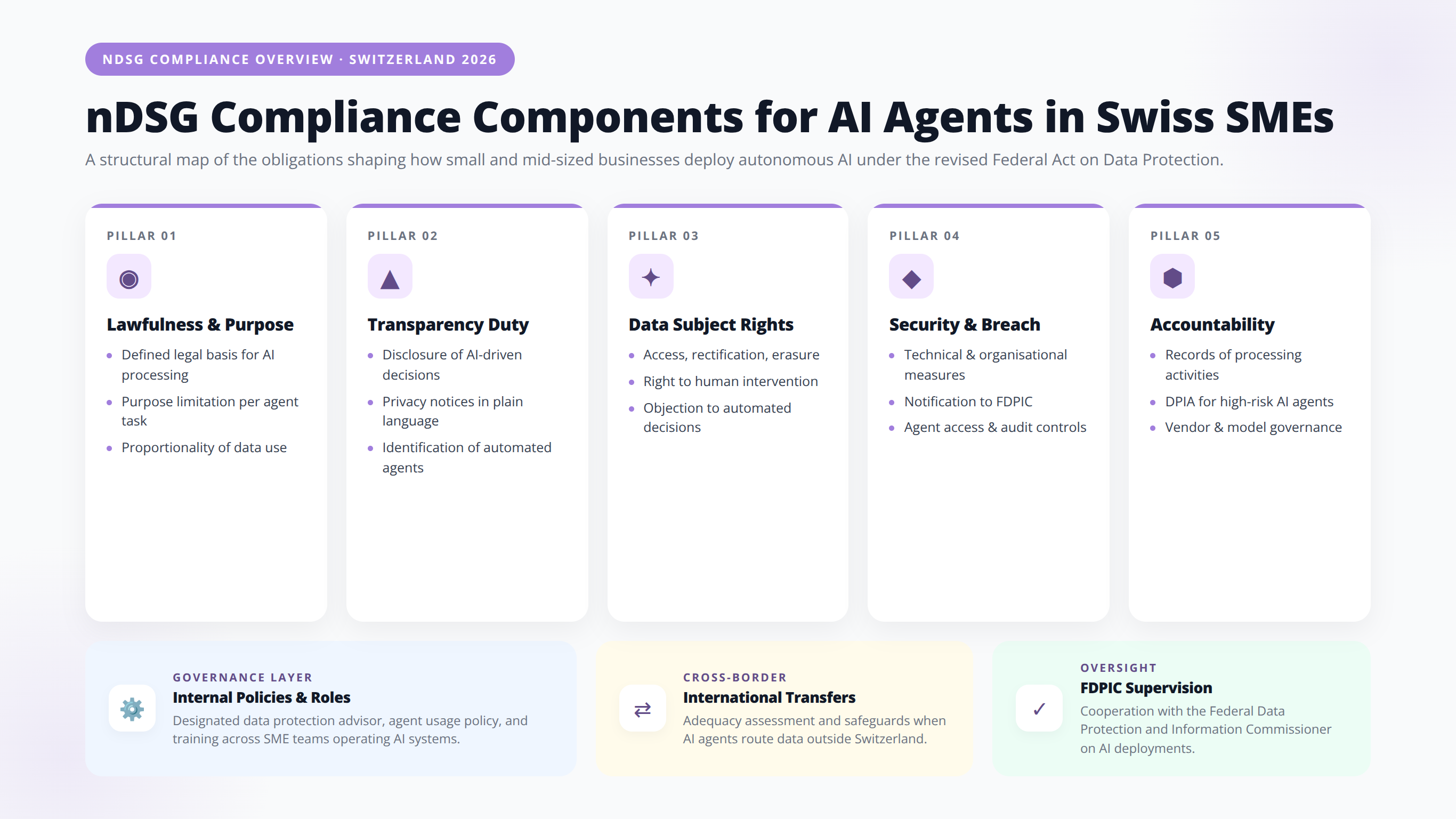
In 2026, Swiss SMEs deploying AI agents must comply with the revised Federal Act on Data Protection (nDSG/FADP), because Switzerland still has no overarching AI law in force and the Federal Council's AI-regulation consultation draft is only expected by early 2027. A defensible nDSG compliance checklist covers governance and ownership, lawful purpose and data minimisation, DPIAs for high-risk use, vendor and processing agreements, international transfer assessments, transparency, least-privilege technical controls, and adversarial testing before go-live.
Table of Contents
- Why 2026 Is the Decisive nDSG Year for AI Agents
- The 2026 Swiss Regulatory Map for AI Agents
- The nDSG Compliance Checklist at a Glance
- Step 1: Governance, Ownership and the AI Inventory
- Step 2: Lawful Purpose and Data Minimisation
- Step 3: Data Protection Impact Assessment (DPIA)
- Step 4: Vendor Due Diligence and Processing Agreements
- Step 5: International Data Transfer Assessment
- Step 6: Transparency, Human Oversight and Data-Subject Rights
- Step 7: Technical Security Controls for Agentic Systems
- Step 8: Pre-Production Testing and Continuous Monitoring
- The 90-Day Implementation Plan
- Common CEO Mistakes to Avoid
- FAQ
Why 2026 Is the Decisive nDSG Year for AI Agents
For a Swiss CEO, 2026 is not an abstract compliance year. It is the year in which AI agents moved from experimental chat tools into systems that read your CRM, send emails on behalf of your staff, approve expenses, and interact with customers in regulated contexts. And it is also the year in which the only enforceable, cross-sector legal framework governing that activity in Switzerland remains the revised Federal Act on Data Protection, commonly called the nDSG or FADP.
Switzerland still has no comprehensive AI Act in force. The Federal Council has indicated that a consultation draft to regulate AI will be drawn up by early 2027, which means 2026 is a transition year where governance built on the nDSG must also anticipate incoming transparency, accountability, and risk-management requirements [Source: https://www.kmu.admin.ch/en/a-consultation-draft-to-regulate-ai-will-be-drawn-up-by-early-2027]. The practical consequence is simple: whatever compliance posture you build this year will be the one audited, challenged, or exploited first.
This article is a practical nDSG compliance checklist for AI agents in Swiss SMEs. It consolidates the current obligations under the nDSG with the implementation realities of autonomous agents that invoke tools, consume retrieval sources, write to systems of record, and communicate externally. It is written for CEOs who need a defensible, operational framework rather than a legal essay.
⚠️ Disclaimer
This article provides strategic and operational guidance based on publicly available Swiss regulatory sources. It is not legal advice. Specific implementations should be validated with qualified Swiss data-protection counsel, particularly for sector-regulated activities (FINMA, FOPH) or cross-border processing.
Free Download: Not sure where your AI agents stand against the 2026 nDSG baseline?
Download NowThe 2026 Swiss Regulatory Map for AI Agents
Before approving a single AI agent in production, you need a clean mental model of the legal environment. The map in 2026 has four layers that interact.
Layer 1: The nDSG as the central framework
The revised FADP is the base obligation for any processing of personal data in Switzerland, regardless of whether a human or an AI agent executes that processing. It demands lawful purpose, data minimisation, security proportionate to risk, transparency, support for data-subject rights, and in high-risk cases, a Data Protection Impact Assessment [Source: https://www.sidd.swiss/en/insights/data-protection-with-ai-checklist-compliance/].
Layer 2: Sector-specific rules
FINMA circulars for financial services, FOPH and cantonal rules for health, professional-secrecy obligations for lawyers and medical professionals, and employment law protections for monitoring and profiling all continue to apply. Swiss companies remain subject to the FADP and these sector-specific rules in the absence of a horizontal AI law [Source: https://www.admin.ch/fr/newnsb/uj3obgFHSuVW].
Layer 3: International exposure
A Swiss SME can be affected by EU rules when its AI system or services reach the EU market, process EU-related operations, or interact with EU-regulated customers. Swiss governance programmes are increasingly combining FADP controls with EU AI Act readiness [Source: https://utxoag.com/eu-ai-act]. Separately, the Council of Europe AI Convention is becoming relevant to Swiss governance planning, particularly for high-impact systems and fundamental-rights safeguards [Source: https://thestratedge.ai/blog/practical-ai-governance-switzerland].
Layer 4: The incoming Swiss AI framework
With a Swiss AI-regulation consultation draft expected by early 2027, SMEs should build governance that can absorb future transparency, accountability, and risk-management requirements without rebuilding from scratch [Source: https://www.kmu.admin.ch/en/a-consultation-draft-to-regulate-ai-will-be-drawn-up-by-early-2027].
💡 Expert Insight
These four layers are not sequential - they stack. A customer-service agent in a Swiss insurance brokerage simultaneously triggers nDSG (personal data), FINMA circulars (financial services), potentially the EU AI Act (if servicing EU residents), and future Swiss AI rules (design-forward governance). The right question is never "which layer applies?" but "how do we design controls that satisfy all layers in one architecture?"
The nDSG Compliance Checklist at a Glance
Quick Answer: What does the 2026 nDSG baseline for AI agents require?
No personal-data AI agent should go live without: (1) an identified business owner, (2) a defined purpose, (3) a data-flow map, (4) a vendor DPA, (5) a transfer assessment, (6) a risk classification, (7) a human-oversight design, (8) least-privilege controls, (9) testing evidence, and (10) a documented rollback or shutdown procedure.
Below is the complete checklist in a single comparison view, organised by domain and by whether the control is a legal baseline, an operational control, or a governance control. The remainder of this article explains how to implement each line.
| Compliance Domain | Core Requirement | Owner | Minimum Evidence |
|---|---|---|---|
| Governance | Named owner, documented purpose, inventory entry | Business owner + DPO | Inventory record, approval memo |
| Lawful purpose | Defined purpose, minimised data, exclusions for sensitive data | Business owner | Purpose statement, data-flow map |
| DPIA | Impact assessment for high-risk uses | DPO | Signed DPIA with residual risks |
| Vendor | DPA, subprocessor list, training opt-out | Procurement + Legal | Executed DPA, vendor file |
| Transfers | Mapped destinations and legal mechanism | DPO + IT | Transfer register |
| Transparency | Privacy notice, AI disclosure, human review path | Legal + Product | Updated notice, UI copy |
| Security | Least privilege, logging, approval gates, encryption | CISO / IT lead | Access matrix, log samples |
| Testing | Adversarial testing, monitoring, change reapproval | Engineering + Security | Test report, monitoring dashboard |
📥 Download the nDSG AI Agent Compliance Checklist (2026)
A printable 40-point checklist mapping every nDSG obligation to concrete controls, owners, and evidence for Swiss SMEs.
Step 1: Governance, Ownership and the AI Inventory
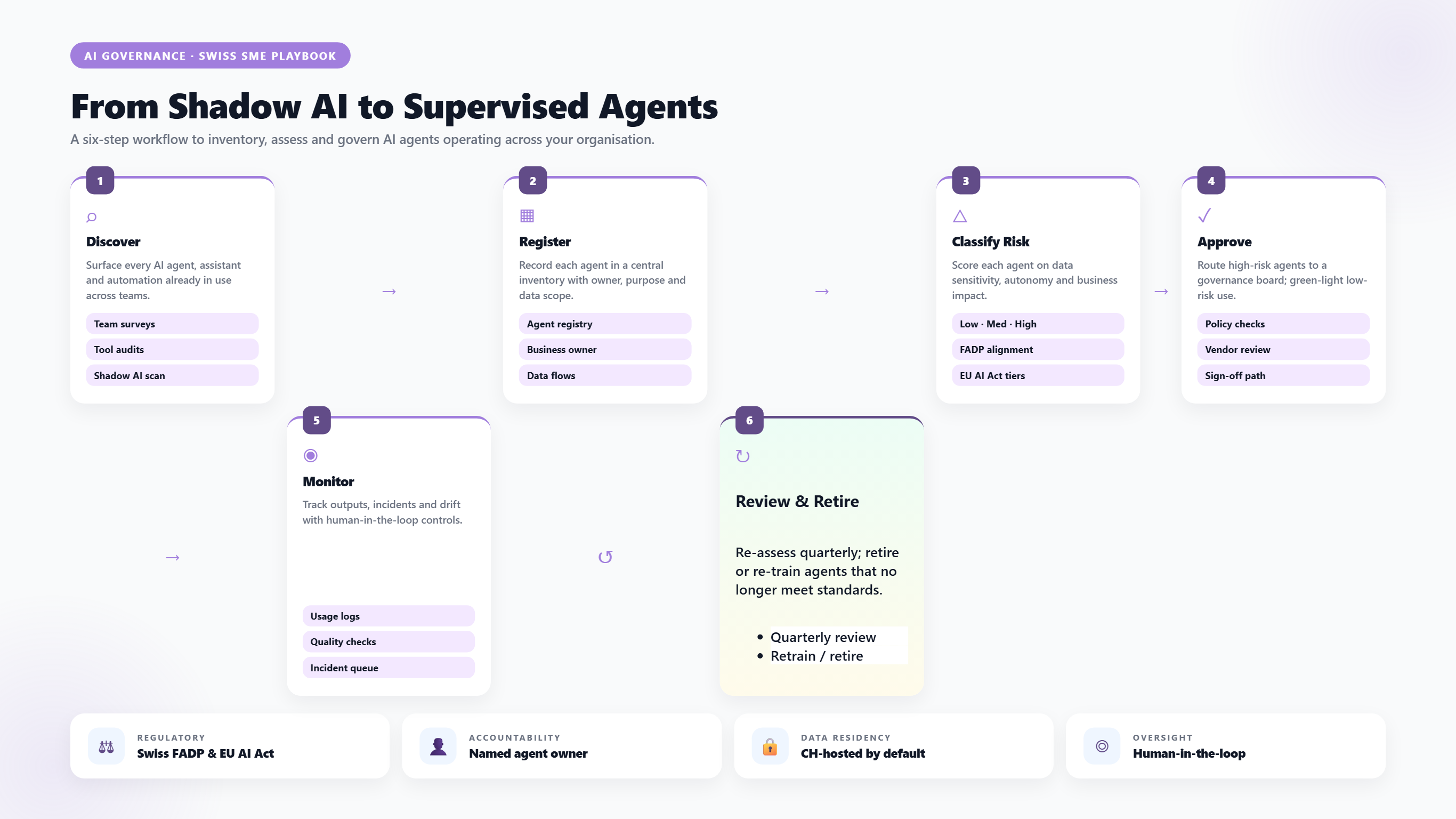
Every AI agent in your organisation must have one accountable business owner and one inventory entry. If you cannot answer the question "who owns this agent and what is it allowed to do," you do not have a compliance programme. You have a liability.
How do you appoint accountable owners for an AI agent?
For each agent, document the purpose, scope, permissions, data sources, and human-approval points. Define prohibited uses, escalation procedures, incident reporting, retention periods, and a process for disabling the agent [Source: https://www.sidd.swiss/en/insights/data-protection-with-ai-checklist-compliance/]. The SME remains responsible for compliant processing even when an external AI provider operates the underlying model [Source: https://transformwerk.ch/en/2026/09/20/ai-and-data-protection-in-switzerland-what-the-revised-fadp-means-for-smes/].
How do you build a real inventory, not a wish list?
Swiss practitioner guidance is converging on a difficult truth: AI use in SMEs includes privately created accounts, AI functions embedded in existing business software, and informal employee workflows, not just centrally purchased chatbots. Organisations are discovering that shadow AI is far broader than their initial estimates [Source: https://www.rautaki.ch/en/wissen/ki-tools-datenschutz-vereine-stiftungen]. Your inventory must cover approved tools, embedded AI features, employee experiments, private accounts, APIs, and autonomous agents.
Record of processing activities
Where personal data is processed, include the agent in your records of processing activities. This is not optional paperwork. It is the artefact a regulator, insurer, or acquirer will ask for first.
💡 Pro Tip
Run an inventory sprint by combining three data sources: (1) SSO logs for sanctioned apps, (2) expense reports filtered for AI vendor names, and (3) a confidential employee amnesty survey. The gap between the three is your shadow AI footprint - and it is almost always larger than central IT believes.
Step 2: Lawful Purpose and Data Minimisation
The nDSG is purpose-driven. The agent must do a defined thing, with the minimum data required, for a lawful reason. CEOs often skip this step because the technology makes it easy to pipe entire databases into a model. That convenience is precisely where liability accumulates.
Specify the purpose before deployment
Define, in writing, what business problem the agent solves and what it is explicitly not allowed to do. Do not use an agent for broad, undefined surveillance or profiling.
Minimise data in and data out
Use only the minimum personal data needed for the task. Exclude particularly sensitive personal data such as health, personnel, application, or financial information unless the use has undergone enhanced legal and risk review. Prevent agents from receiving unrestricted access to email, CRM, HR, finance, source-code, or document repositories. Use separate environments and access controls for testing and production.
Illustrative scenario: the "helpful" sales agent
Consider a mid-size Swiss industrial supplier that gives its sales agent full read access to the CRM "so it can be more helpful." The agent is then prompted by a user to "summarise everything we know about prospect X," and returns personal notes, pricing exceptions granted to other customers, and internal commentary from account managers. The exposure is not a model failure. It is a scoping failure that would have been prevented by a documented purpose and a least-privilege data boundary.
Step 3: Data Protection Impact Assessment (DPIA)
Quick Answer: When is a DPIA mandatory for an AI agent?
A DPIA is required under the nDSG whenever processing is likely to create a high risk to individuals' rights. For AI agents, this includes automated decisions on hiring, credit, insurance, pricing or access; large-scale monitoring; processing of sensitive data; and any agent with high autonomy, tool use, or write permissions.
A DPIA is required under the nDSG where processing is likely to create a high risk to individuals' personality or fundamental rights [Source: https://agenticsis.ch/blog/switzerland-ai-convention-ratification-swiss-sme-2027/]. For AI agents, this threshold is reached more often than most SMEs assume.
When a DPIA is mandatory for AI agents
- Automated decisions affecting hiring, credit, insurance, pricing, access, or employment.
- Large-scale monitoring or profiling.
- Processing of sensitive personal data.
- Agents with high autonomy, tool use, external communication, or write access.
What a credible AI DPIA covers
Beyond standard privacy risks, an AI-specific DPIA must assess hallucination, discrimination, prompt-injection, data-exfiltration, and excessive-permission risks. It must also evaluate the quality of human review and the consequences of erroneous outputs [Source: https://www.sidd.swiss/en/insights/data-protection-with-ai-checklist-compliance/]. Document residual risks, mitigations, approval authority, and the date of the next review.
DPIA depth by risk tier
| Risk Tier | Typical Use Case | DPIA Depth | Review Cadence |
|---|---|---|---|
| Low | Internal summarisation, no personal data | Lightweight screening memo | Annual |
| Medium | Customer-service copilot with human in loop | Short-form DPIA | Semi-annual |
| High | Autonomous outbound comms, hiring, credit, pricing | Full DPIA with legal sign-off | Quarterly + after each change |
| Prohibited | Automated adverse decisions without oversight on sensitive data | Do not deploy | N/A |
💡 Expert Insight
The strongest DPIAs for AI agents are rewritten, not reviewed, after each material change - new model version, new connector, new retrieval source, new business purpose. A DPIA that is "approved once, filed forever" fails the implementing ordinance's requirement to review safeguards throughout processing, not only at the start.
Step 4: Vendor Due Diligence and Processing Agreements
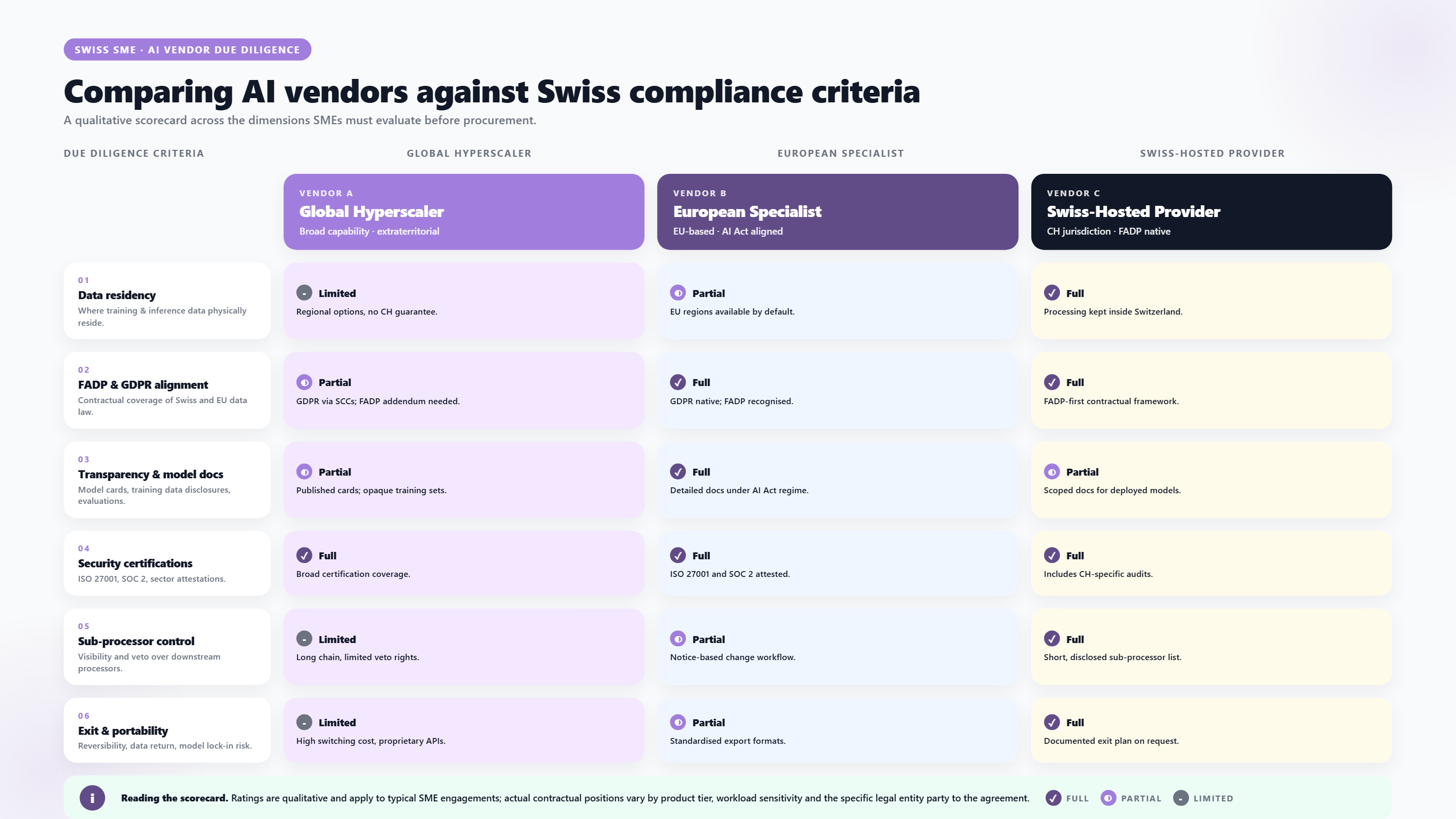
In 2026, vendor due diligence has moved from a legal afterthought to a procurement gate. Current Swiss guidance for smaller organisations specifically recommends an AI-tool inventory, vendor DPAs, DPIAs for high-impact uses, and a written internal policy governing permitted tools and data [Source: https://agenticsis.ch/blog/switzerland-ai-convention-ratification-swiss-sme-2027/].
What to confirm before enabling the agent
- The exact provider legal entity and role as processor.
- A written data-processing agreement suitable for Swiss requirements.
- Processing locations and subprocessors.
- Whether prompts, uploaded files, outputs, or telemetry are used for model training.
- Retention, deletion, export, logging, and account-termination mechanisms.
- Security controls, breach notification, access management, and audit rights.
- Whether the provider offers organisational rather than consumer accounts.
The organisational-account rule
Quick Answer: Can we use consumer ChatGPT, Claude, or Gemini accounts for business purposes?
Not for personal data. Swiss guidance explicitly recommends organisational accounts with contracts, and advises disabling provider training where available. Consumer accounts generally lack the DPAs, admin controls, logging, and training opt-outs required to make personal-data processing defensible under the nDSG.
Swiss practitioner guidance is converging on a simple principle: use organisational accounts and contracts, avoid personal accounts for personal data, and disable provider training where the setting exists [Source: https://www.rautaki.ch/en/wissen/ki-tools-datenschutz-vereine-stiftungen]. If an employee is pasting client data into a free consumer account, you do not have a vendor relationship. You have an incident waiting to be reported.
Illustrative vendor evaluation
Consider a Zurich-based wealth-management SME evaluating two AI providers. Provider A offers an EU-hosted organisational tenant, a signed Swiss-compatible DPA, model-training opt-out by default, and a complete subprocessor list. Provider B offers only a US consumer account with training enabled by default and no DPA option. For personal data processing, only Provider A is viable, regardless of model quality.
Step 5: International Data Transfer Assessment
Most AI agents trigger international data transfers. Not just the main prompt, but telemetry, logs, support access, and backups. Each flow must be mapped.
Map every transfer
Document transfers to model providers, hosting providers, analytics and telemetry services, support personnel, subprocessors, and backup and disaster-recovery systems. Record the destination country and the legal transfer mechanism, such as adequacy, recognised certification, or standard contractual safeguards. Repeat the transfer assessment when the provider changes infrastructure or subprocessors [Source: https://www.rautaki.ch/en/wissen/ki-tools-datenschutz-vereine-stiftungen].
The transfer register
| Flow | Data Category | Destination Country | Legal Mechanism |
|---|---|---|---|
| Prompt to model API | Customer identifiers, free text | EU region | Adequacy / SCCs |
| Telemetry | Usage metadata | US | SCCs + supplementary measures |
| Support access | Conversation samples | Various | DPA + confidentiality |
| Backups | Encrypted system state | EU | Adequacy |
Step 6: Transparency, Human Oversight and Data-Subject Rights
Transparency obligations under the nDSG are not satisfied by a buried paragraph in a cookie banner. For AI agents, they must be visible, specific, and operational.
What privacy notices must now explain
- The purpose of the AI-assisted processing.
- Categories and sources of personal data.
- The role of the AI agent.
- Recipients and international transfers.
- Retention periods.
- Whether automated decisions are involved.
- How individuals can exercise their rights or request human review.
Disclose AI interaction where users could reasonably believe they are communicating with a person. Do not allow an agent to make legally or materially significant decisions without meaningful human review [Source: https://transformwerk.ch/en/2026/09/20/ai-and-data-protection-in-switzerland-what-the-revised-fadp-means-for-smes/].
What does meaningful human oversight actually look like?
Quick Answer: What is meaningful human oversight for an AI agent?
Meaningful human oversight exists only when the reviewer has sufficient information, authority, time, and expertise to detect and reject unsafe outputs. A reviewer with twenty seconds and no context is not oversight - it is theatre. Oversight must be designed into workloads, not just interfaces.
The relevant question is not merely whether a human is nominally present, but whether that person has sufficient information, authority, time, and expertise to detect and reject unsafe outputs [Source: https://transformwerk.ch/en/2026/09/20/ai-and-data-protection-in-switzerland-what-the-revised-fadp-means-for-smes/]. A reviewer with twenty seconds per decision is not meaningful oversight.
Supporting data-subject rights at agent speed
Access, rectification, deletion, and objection rights do not pause because an AI agent processes faster than a person. Design the agent so that logs are retrievable per data subject, deletions propagate across retrieval indexes and caches, and automated-decision explanations can be produced on request.
Step 7: Technical Security Controls for Agentic Systems
The FADP requires security appropriate to the risk, and the implementing ordinance requires protection needs and safeguards to be reviewed throughout processing rather than assessed only once [Source: https://www.sidd.swiss/en/insights/data-protection-with-ai-checklist-compliance/]. For AI agents, this translates into a specific set of controls that differ meaningfully from classical application security.
Baseline controls for every agent
- Least-privilege permissions.
- Separate read and write credentials.
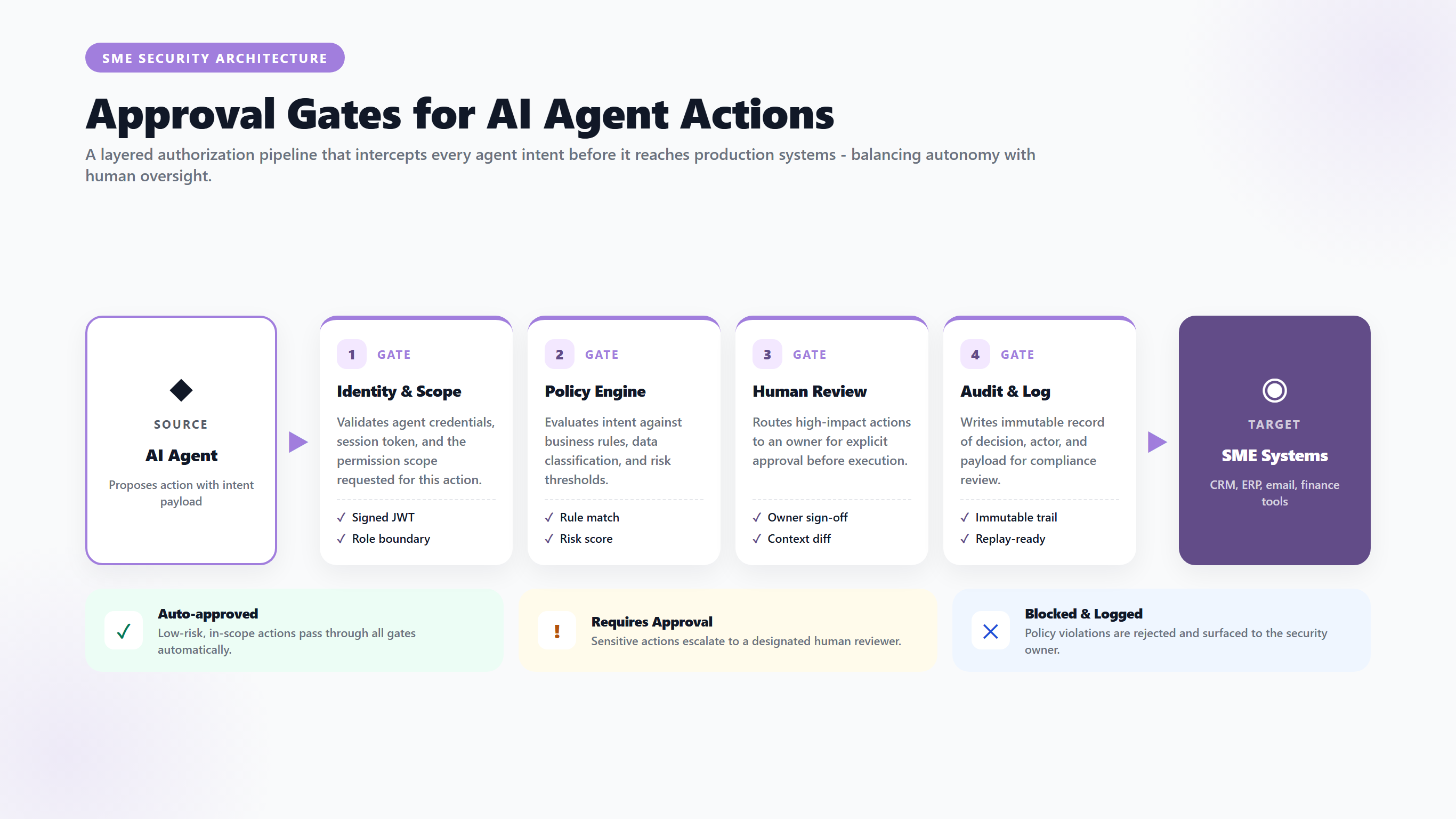
- Approval gates for external messages, payments, record deletion, and contract changes.
- Strong authentication and secret rotation.
- Encryption in transit and at rest.
- Prompt-injection and indirect-instruction defenses.
- Input and output filtering.
- Retrieval-source allowlists.
- Immutable audit logs.
- Rate limits and spending limits.
- Sandboxed code execution.
- Monitoring for abnormal tool calls and data extraction.
- Tested backup, restoration, revocation, and shutdown procedures.
Approval gates by action type
| Agent Action | Approval Model | Rationale |
|---|---|---|
| Read internal document | No approval, logged | Low risk if scoped |
| Send internal message | Post-hoc review | Reversible, bounded impact |
| Send external email | Human pre-approval | Reputational and legal exposure |
| Modify CRM record | Human pre-approval for sensitive fields | Data integrity |
| Initiate payment | Mandatory dual approval | Financial fraud risk |
| Delete records | Blocked without ticket | Irreversible impact |
💡 Expert Insight
Approval gates should be mapped to blast radius, not to feature list. The right design question is "what is the worst thing this action can do if the agent is wrong or compromised?" A read with the wrong scope can exfiltrate an entire customer list; a well-scoped write can be reversed by lunchtime. Permission design should follow consequence, not convenience.
Step 8: Pre-Production Testing and Continuous Monitoring
Policies that are only documented are not controls. Current expert commentary stresses system inventory, risk-based controls, restoration tests, permission reviews, vulnerability assessments, and penetration testing [Source: https://www.sidd.swiss/en/insights/data-protection-with-ai-checklist-compliance/].
Adversarial test categories
- Accuracy and hallucination.
- Bias and discriminatory outcomes.
- Sensitive-data leakage.
- Prompt injection.
- Unauthorised tool use.
- Cross-tenant or retrieval leakage.
- Insecure output handling.
- Failure under ambiguous instructions.
- Behaviour after model or provider changes.
Version control for AI systems
Record model, system-prompt, retrieval-index, connector, and policy versions. Reapprove the system after material changes. For procurement, record the literal provider-displayed name, model ID, release date or snapshot date, API version, region, and deployment configuration in the SME's inventory and vendor file.
Illustrative monitoring scenario
Consider a Swiss insurance brokerage running a claims-triage agent. Monitoring reveals a sudden spike in tool calls to the document-export API outside working hours. Investigation shows a prompt-injection payload embedded in a submitted PDF attempted to exfiltrate claim histories. Because the agent had an outbound allowlist and spending cap, the attack was contained; because logs were immutable, the forensic trail was complete.
💡 Pro Tip
Treat every model-provider snapshot change as a trigger for regression testing. A silent model update behind the same API endpoint can shift tone, factual accuracy, and refusal behaviour overnight. If you cannot name the exact snapshot your agent is calling today, you cannot defend its behaviour tomorrow.
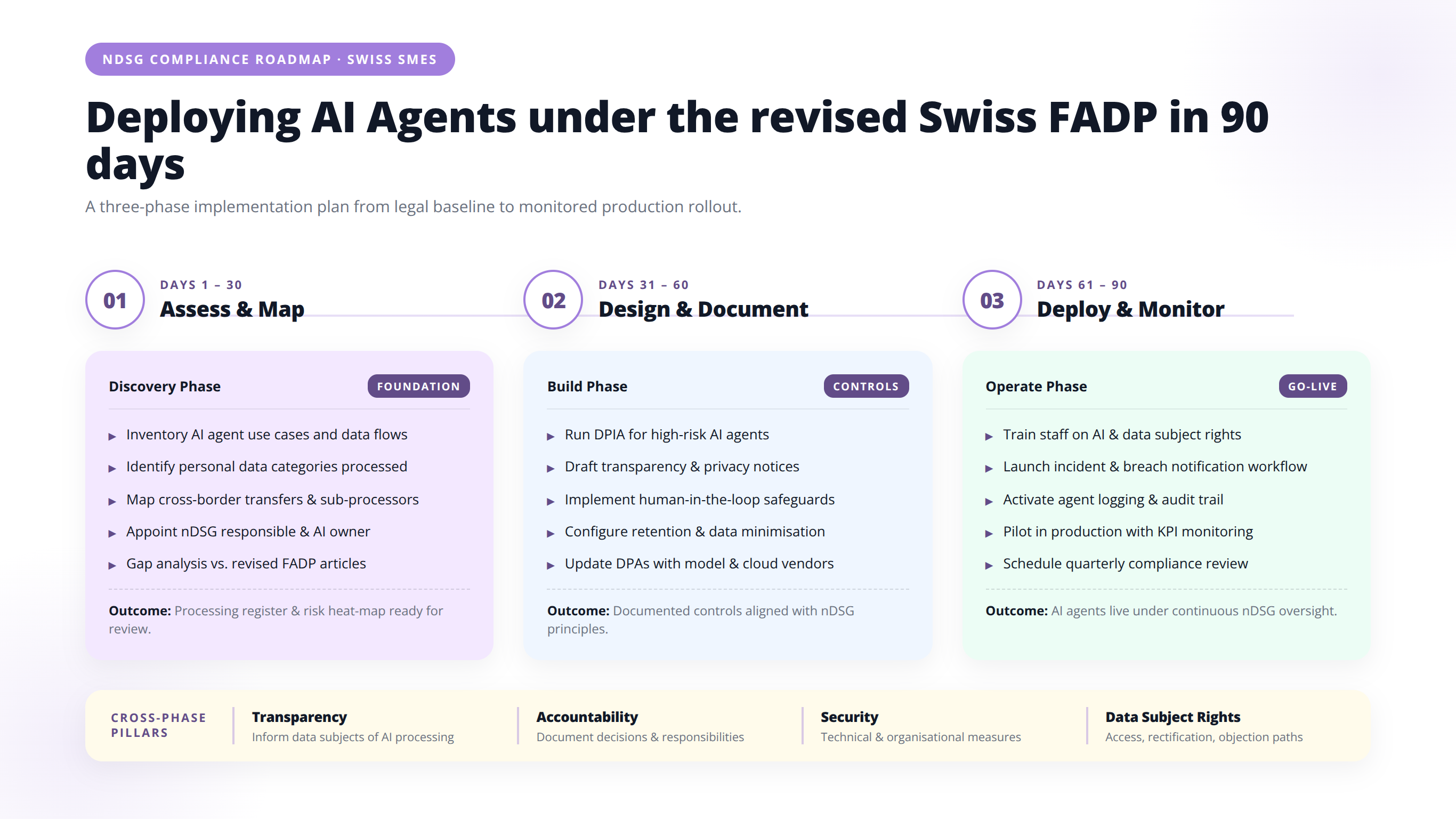
The 90-Day Implementation Plan
A CEO does not need another framework. A CEO needs a sequence that produces defensible controls within one quarter.
First 30 days: freeze and inventory
- Freeze unapproved AI-agent deployments involving personal data.
- Inventory tools, accounts, connectors, models, data sources, and subprocessors.
- Classify each use case by data sensitivity, autonomy, affected individuals, and decision impact.
- Publish interim rules: no sensitive personal data in consumer AI accounts; no autonomous external communication or destructive actions.
Days 31-60: contracts and controls
- Complete vendor and transfer assessments.
- Execute DPAs.
- Perform DPIAs for high-risk use cases.
- Configure least privilege, logging, retention, training opt-outs, and human approvals.
- Update privacy notices and employee guidance.
Days 61-90: test and formalise
- Conduct adversarial and privacy testing.
- Run an incident and shutdown exercise.
- Approve only agents with documented owners and measurable controls.
- Establish quarterly reviews and mandatory reassessment after model, provider, connector, or purpose changes.
Free Download: Need to translate this 90-day plan into your organisation's reality?
Download NowCommon CEO Mistakes to Avoid
Treating "no Swiss AI law" as "no obligations"
The absence of a horizontal AI Act in Switzerland does not create a regulatory holiday. The nDSG, sector rules, employment protections, and professional-secrecy obligations all apply today [Source: https://www.admin.ch/fr/newnsb/uj3obgFHSuVW]. CEOs who delay governance until the 2027 consultation draft will be building controls under enforcement pressure, not strategic planning.
Confusing shadow AI with low adoption
Many Swiss CEOs believe their AI exposure is low because central procurement shows few line items. In reality, Swiss SMEs are discovering that AI use includes privately created accounts, embedded features in existing software, and informal workflows [Source: https://www.rautaki.ch/en/wissen/ki-tools-datenschutz-vereine-stiftungen]. An honest inventory typically multiplies the known footprint several times over.
Delegating "AI governance" to IT alone
AI agents cross legal, HR, product, security, and operations boundaries. Housing governance exclusively in IT produces policies no business owner follows and risks no legal team can defend.
Over-permissioning agents to accelerate pilots
Giving an agent broad read-write access during a pilot is the fastest way to generate a reportable incident. The market is shifting from experimentation to workflow integration precisely because Swiss SMEs are learning to restrict write-back permissions while still measuring productivity, quality, compliance, and adoption [Source: https://agenticsis.ch/blog/ai-experimentation-to-strategic-integration-swiss-sme-framework/].
Treating human oversight as a UI checkbox
If reviewers lack time, context, or authority to override, you have theatre rather than oversight. Build oversight into workloads, not just into interfaces.
Frequently Asked Questions
Q: Does the nDSG apply to AI agents even if the model provider is outside Switzerland?
A: Yes. The SME remains responsible for compliant processing even when an external AI provider operates the underlying model [Source: https://transformwerk.ch/en/2026/09/20/ai-and-data-protection-in-switzerland-what-the-revised-fadp-means-for-smes/]. You cannot outsource accountability. You must sign a suitable data-processing agreement, assess international transfers, and ensure the provider's defaults match your obligations under Swiss law.
Q: Is a DPIA mandatory for every AI agent we deploy?
A: No, but it is mandatory where processing is likely to create a high risk to individuals' rights [Source: https://agenticsis.ch/blog/switzerland-ai-convention-ratification-swiss-sme-2027/]. In practice, any agent that makes or materially influences decisions on hiring, credit, pricing, insurance, or access, that processes sensitive data, or that acts autonomously with write permissions, should trigger a full DPIA.
Q: When will Switzerland have a dedicated AI law?
A: A Swiss AI-regulation consultation draft is expected by early 2027 [Source: https://www.kmu.admin.ch/en/a-consultation-draft-to-regulate-ai-will-be-drawn-up-by-early-2027]. That means 2026 is a transition year. Governance built now should be modular enough to absorb incoming transparency, accountability, and risk-management requirements without being rebuilt.
Q: Can we use consumer AI accounts for business purposes?
A: Not for personal data. Swiss guidance explicitly recommends organisational accounts and contracts, and advises disabling provider training where the setting exists [Source: https://www.rautaki.ch/en/wissen/ki-tools-datenschutz-vereine-stiftungen]. Consumer accounts generally lack the DPAs, admin controls, logging, and training opt-outs that make personal-data processing defensible.
Q: Does the EU AI Act apply to us as a Swiss SME?
A: It can. A Swiss SME may be affected by EU rules when its AI system or services reach the EU market, process EU-related operations, or interact with EU-regulated customers [Source: https://utxoag.com/eu-ai-act]. Swiss governance programmes are increasingly combining FADP controls with EU AI Act readiness to serve both markets efficiently.
Q: What is "meaningful" human oversight for an AI agent?
A: It is oversight where the reviewer has sufficient information, authority, time, and expertise to detect and reject unsafe outputs [Source: https://transformwerk.ch/en/2026/09/20/ai-and-data-protection-in-switzerland-what-the-revised-fadp-means-for-smes/]. A dropdown confirming "approve" without context is not meaningful. Oversight must be designed into the workflow, including surfaced reasoning, escalation paths, and realistic review time.
Q: How often should we reassess an approved AI agent?
A: The implementing ordinance requires protection needs and safeguards to be reviewed throughout processing rather than only at the start [Source: https://www.sidd.swiss/en/insights/data-protection-with-ai-checklist-compliance/]. A practical baseline is quarterly review for high-risk agents, semi-annual for medium, annual for low, plus mandatory reassessment after any model, provider, connector, or purpose change.
Q: What should we do about employees already using unapproved AI tools?
A: Freeze net-new unapproved deployments involving personal data, then run an inventory covering shadow use, embedded features, and informal workflows. Convert useful tools into sanctioned organisational-account deployments with DPAs and training opt-outs; retire the rest. Punishing adoption without providing an approved alternative drives shadow AI deeper, not away.
Q: Do we need to disclose that a customer is interacting with an AI agent?
A: Yes, where users could reasonably believe they are communicating with a person [Source: https://transformwerk.ch/en/2026/09/20/ai-and-data-protection-in-switzerland-what-the-revised-fadp-means-for-smes/]. Disclosure should be clear, specific to the AI role, and placed at the point of interaction, not only in a privacy notice. Combine it with a visible path to human support.
Q: How should we handle vendor subprocessors we did not approve?
A: Your DPA should require advance notice of material subprocessor changes and the right to object. If a provider adds subprocessors without that discipline, reassess the vendor rather than quietly accepting the change. Repeat the international transfer assessment when the provider changes infrastructure or subprocessors [Source: https://www.rautaki.ch/en/wissen/ki-tools-datenschutz-vereine-stiftungen].
Q: Can an AI agent make hiring or pricing decisions?
A: Not without meaningful human review. Do not allow an agent to make legally or materially significant decisions without meaningful human review [Source: https://transformwerk.ch/en/2026/09/20/ai-and-data-protection-in-switzerland-what-the-revised-fadp-means-for-smes/]. These use cases also trigger DPIA obligations, transparency duties, and documentation of the logic involved.
Q: What should go into our AI agent inventory beyond the tool name?
A: Record the literal provider-displayed name, model ID, release or snapshot date, API version, region, deployment configuration, business owner, purpose, data categories, connectors, subprocessors, approval level, last DPIA date, and shutdown procedure. Generic entries like "enterprise AI" or "latest model" are not defensible to a regulator or an insurer.
Q: Are logs really that important for AI agents?
A: Yes. Immutable audit logs are essential for incident response, data-subject-rights fulfilment, and demonstrating accountability. They also allow you to reconstruct what an agent did when a model version, retrieval index, or connector changes behaviour unexpectedly. Without logs, you cannot prove compliance and you cannot debug incidents.
Q: Should we treat the Council of Europe AI Convention as binding?
A: It is becoming relevant to Swiss governance planning, particularly for high-impact systems and fundamental-rights safeguards [Source: https://thestratedge.ai/blog/practical-ai-governance-switzerland]. Even before formal domestic implementation, aligning governance with its principles reduces rework when transposition occurs.
Q: What is the single most common gap you expect regulators to find in Swiss SMEs?
A: The gap between documented policy and operational reality: inventories that miss shadow AI, DPIAs that do not reflect current agent permissions, DPAs that were signed but never read, and human-oversight procedures that reviewers cannot realistically perform. Testing effectiveness rather than merely documenting assertions is the current benchmark [Source: https://www.sidd.swiss/en/insights/data-protection-with-ai-checklist-compliance/].
Q: How do we handle an AI agent incident under the nDSG?
A: Treat it like any personal-data breach: contain the incident, preserve logs, assess the risk to data subjects, document the facts, notify the FDPIC and affected individuals where required, and apply remediation. For AI agents specifically, also version-freeze the model, system prompt, retrieval index, and connectors so that the incident can be reproduced and the root cause isolated.
Related reading
- Switzerland AI regulation vs the EU AI Act: the wider regulatory picture
- How Swiss SMEs are putting AI into production in 2026: the controls that make production possible
- From AI experimentation to strategic integration: a framework for a sequenced rollout
- What is agentic AI and how does it apply to workflows in 2026?: the definitions behind the checklist
Conclusion: The 2026 CEO Standpoint
The defensible 2026 baseline is straightforward and non-negotiable: no personal-data AI agent goes live without an identified owner, a defined purpose, a data-flow map, a vendor DPA, a transfer assessment, a risk classification, a human-oversight design, least-privilege controls, testing evidence, and a documented rollback or shutdown procedure.
Key takeaways for Swiss CEOs:
- The nDSG is enforceable now. Waiting for the 2027 AI consultation draft is a strategic error, not a timing choice.
- Inventory is the foundation. You cannot govern agents you have not catalogued, and shadow AI is almost certainly larger than your current estimate.
- Vendor DPAs and organisational accounts are procurement gates. Consumer accounts are not an option for personal data.
- DPIAs are the right instrument for high-risk use cases. They convert vague AI concerns into documented, mitigated risks.
- Human oversight is operational, not cosmetic. Reviewers need time, context, and authority.
- Testing beats paperwork. Adversarial tests, access reviews, restore tests, and incident exercises are the 2026 standard of proof.
CEOs who build this baseline in 2026 will be ready for the Swiss AI framework when it arrives, for EU market expectations when they tighten, and for the next generation of autonomous agents when their blast radius grows.
Free Download: Schedule an nDSG AI Governance Workshop for Your Executive Team
Download Now
About the Author
Agenticsis Team. Zurich-based AI consultancy founded by Sofía Salazar Mora, partnering with companies across Switzerland, the European Union, and Latin America to mainstream artificial intelligence into business operations. Our work spans AI readiness audits, agentic system design, end-to-end deployment, and the change management that makes adoption stick. We build custom autonomous AI agents that integrate with 850+ tools, deliver enterprise process automation across sales, operations, and finance, and run answer engine optimization through our proprietary platform AEODominance (aeodominance.com), ensuring our clients are cited by ChatGPT, Perplexity, Google AI Overviews, Claude, Gemini, and Microsoft Copilot. Our content reflects what we deliver to clients: strategic frameworks, audit methodologies, and implementation playbooks for businesses serious about competing in the AI era.