TL;DR(Too Long; Did not Read)
A practical 2026 framework for Swiss CEOs to evaluate, score, and select the right AI consultancy for business automation, FADP, and EU AI Act readiness.
How to Choose the Best AI Consultancy for Business Automation in Switzerland: A Practical Framework
Last updated: October 13, 2026 · Reading time: ~18 min
Quick Answer:
Choose an AI consultancy for business automation in Switzerland by scoring firms against eight weighted criteria: business-case quality (20%), systems integration (15%), AI engineering (15%), FADP security (15%), EU AI Act readiness (15%), delivery track record (10%), operating model (5%), and commercial transparency (5%). Reject any firm that cannot show production references, map data flows under the revised Swiss Federal Act on Data Protection, or provide a dated bill of materials with exact model versions and hosting regions.
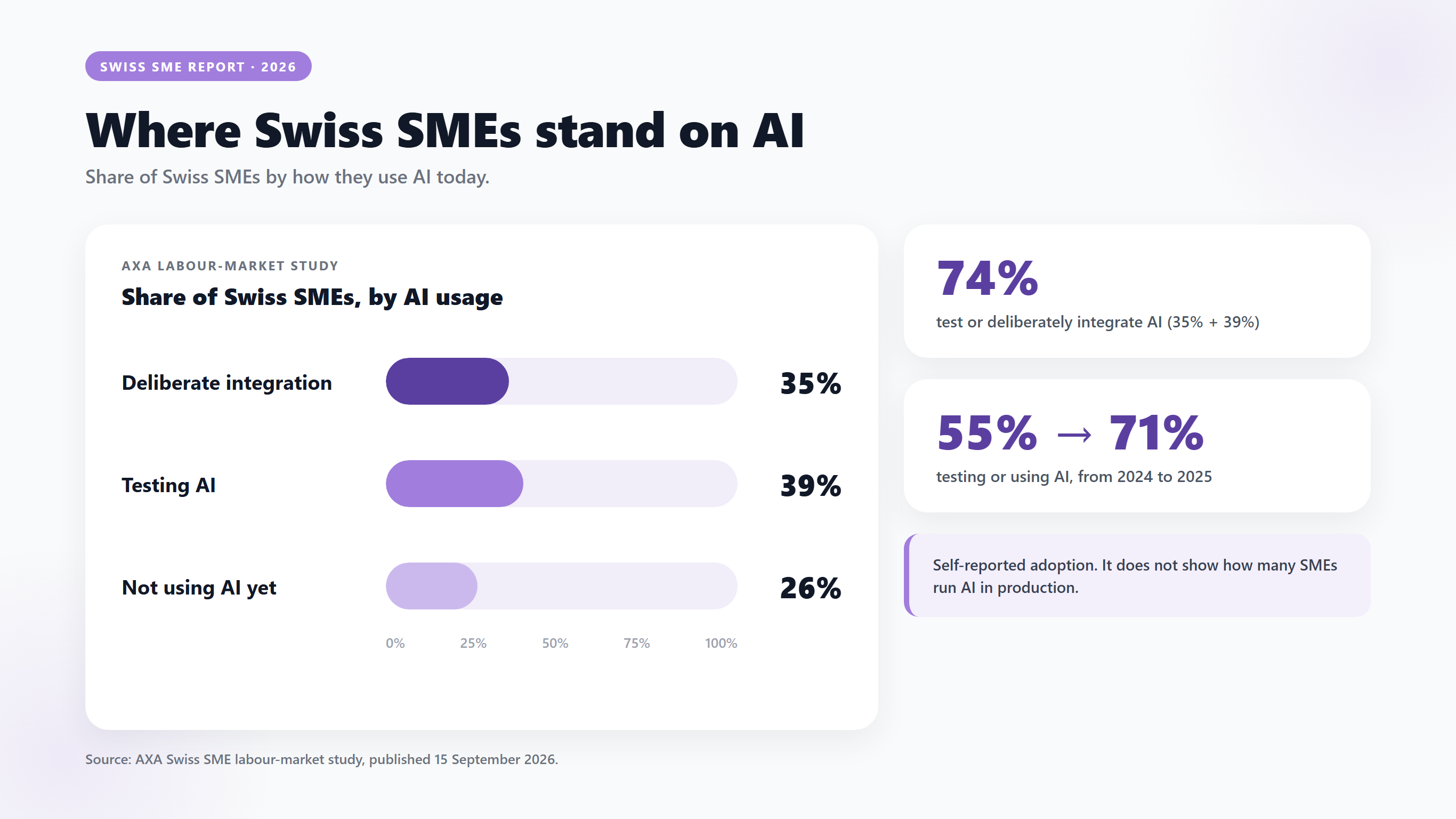
Switzerland's AI market is no longer an experiment. A 2026 survey of 336 Swiss SMEs found that 74% were either actively using or testing AI, with 35% already deployed in operations [Source: https://suizanoticias.ch/2026/09/16/pymes-suizas-inteligencia-artificial-empleo/]. Microsoft's September 2026 data placed Switzerland's AI adoption rate at 39.1%, up from 37.8% the previous quarter and ranked 15th globally [Source: https://news.microsoft.com/source/emea/2026/09/nouvelles-donnees-de-microsoft-ladoption-de-lia-continue-de-progresser-la-suisse-reste-largement-au-dessus-de-la-moyenne-mondiale/?lang=fs]. For CEOs, the question has shifted from "should we adopt AI" to "which consultancy can actually deliver measurable automation under Swiss and EU rules."
Free Download: Shortlisting consultancies right now?
Download NowTable of Contents
- 1. Swiss Market Signals CEOs Should Weigh in 2026
- 2. The Eight-Criteria Selection Framework
- 3. Regulatory Requirements to Test During Procurement
- 4. What to Demand from Shortlisted Firms
- 5. Market Trends That Should Shape Your Scope
- 6. Architecture and Model-Portability Questions
- 7. Product and Model-Version Precision
- 8. Five Illustrative Procurement Scenarios
- 9. Comparing Consultancy Types in Switzerland
- 10. Recommended Decision Process
- 11. Red Flags and Deal-Breakers
- 12. Frequently Asked Questions
1. Swiss Market Signals CEOs Should Weigh in 2026
Before choosing an AI consultancy for business automation in Switzerland, map the market context your decision sits inside. Three data points define the current environment.
First, adoption breadth: 74% of surveyed Swiss SMEs are using or experimenting with AI, with 35% deployed in operations and 39% testing [Source: https://suizanoticias.ch/2026/09/16/pymes-suizas-inteligencia-artificial-empleo/]. If your competitors are moving from pilot to production, procurement that still accepts "innovation theatre" deliverables is a strategic risk.
Second, use-case concentration: internal process optimization was reported by 35% of surveyed firms and data analysis by 34% [Source: https://suizanoticias.ch/2026/09/16/pymes-suizas-inteligencia-artificial-empleo/]. The commercial payoff is clustering around back-office automation and governed analytics, not generic chatbots.
Third, trajectory: Microsoft's 2026 Swiss adoption figure of 39.1% keeps the country well above the global average [Source: https://news.microsoft.com/source/emea/2026/09/nouvelles-donnees-de-microsoft-ladoption-de-lia-continue-de-progresser-la-suisse-reste-largement-au-dessus-de-la-moyenne-mondiale/?lang=fs]. Supply of competent firms is expanding, so CEOs can afford to be selective and competitive on price.
What this means for the buying committee
The practical implication is that consultancy differentiation has moved away from basic access to foundation models and toward implementation quality, governance, integration, and measurable value. Marketing claims about "generative AI expertise" are now table stakes. Ask instead what the firm has pushed into production, where the data physically sits, and how they manage model substitution when a provider changes pricing or policy.
💡 Expert Insight
When adoption rates cross the 30% threshold in a market, the competitive advantage shifts from having AI to operating AI reliably. Switzerland is now past that threshold, which means the firms worth hiring are no longer the ones who can demo a chatbot - they are the ones who can show you a six-month incident log, a model-version migration they handled last quarter, and a signed data-processing addendum compliant with the revised FADP.
2. The Eight-Criteria Selection Framework
Score each candidate consultancy from 1 to 5 against the following weighted criteria. The weights reflect how often each dimension determines success or failure in Swiss business automation programs.
| Criterion | What to Verify | Weight |
|---|---|---|
| Business-case quality | Baseline metrics, benefits model, payback period, process redesign | 20% |
| Systems integration | SAP, Microsoft, Salesforce, ServiceNow, ERP, CRM, APIs, identity and data platforms | 15% |
| AI engineering | Retrieval-augmented generation, agents, workflow orchestration, evaluation, monitoring | 15% |
| Security and privacy | Swiss FADP/DSG controls, encryption, access management, logging, data residency | 15% |
| EU AI Act readiness | Risk classification, transparency, documentation, human oversight, provider obligations | 15% |
| Delivery track record | Comparable Swiss-sector references and production outcomes | 10% |
| Operating model | Training, change management, managed services, incident response | 5% |
| Commercial transparency | Fixed discovery scope, implementation assumptions, usage costs, exit terms | 5% |
Why business-case quality carries the most weight
A technically brilliant deployment that automates the wrong process still destroys business value. The 20% weighting on business case forces vendors to prove they can baseline a current workflow in hours, cost, and error rate, model the benefits honestly, and defend a payback period under scrutiny from the CFO.
Why integration beats novelty
Business automation in Switzerland rarely fails on the model layer. It fails because the consultancy cannot connect AI output back to SAP, ServiceNow, Abacus, or a legacy underwriting system. Fifteen percent of the score is reserved specifically for proven integration patterns against the systems your organization actually runs.
💡 Pro Tip
Before the first vendor presentation, lock the eight weights with your CFO, CIO, and DPO. If weights move after you have seen the pitches, you are reverse-engineering the scorecard to justify a preferred vendor - which is how AI programs quietly become compliance liabilities.
📥 Download Our Swiss AI Consultancy Scoring Template
Weighted eight-criteria scorecard with evidence prompts, interview questions, and reject thresholds ready for your procurement team.
3. Regulatory Requirements to Test During Procurement
Quick Answer:
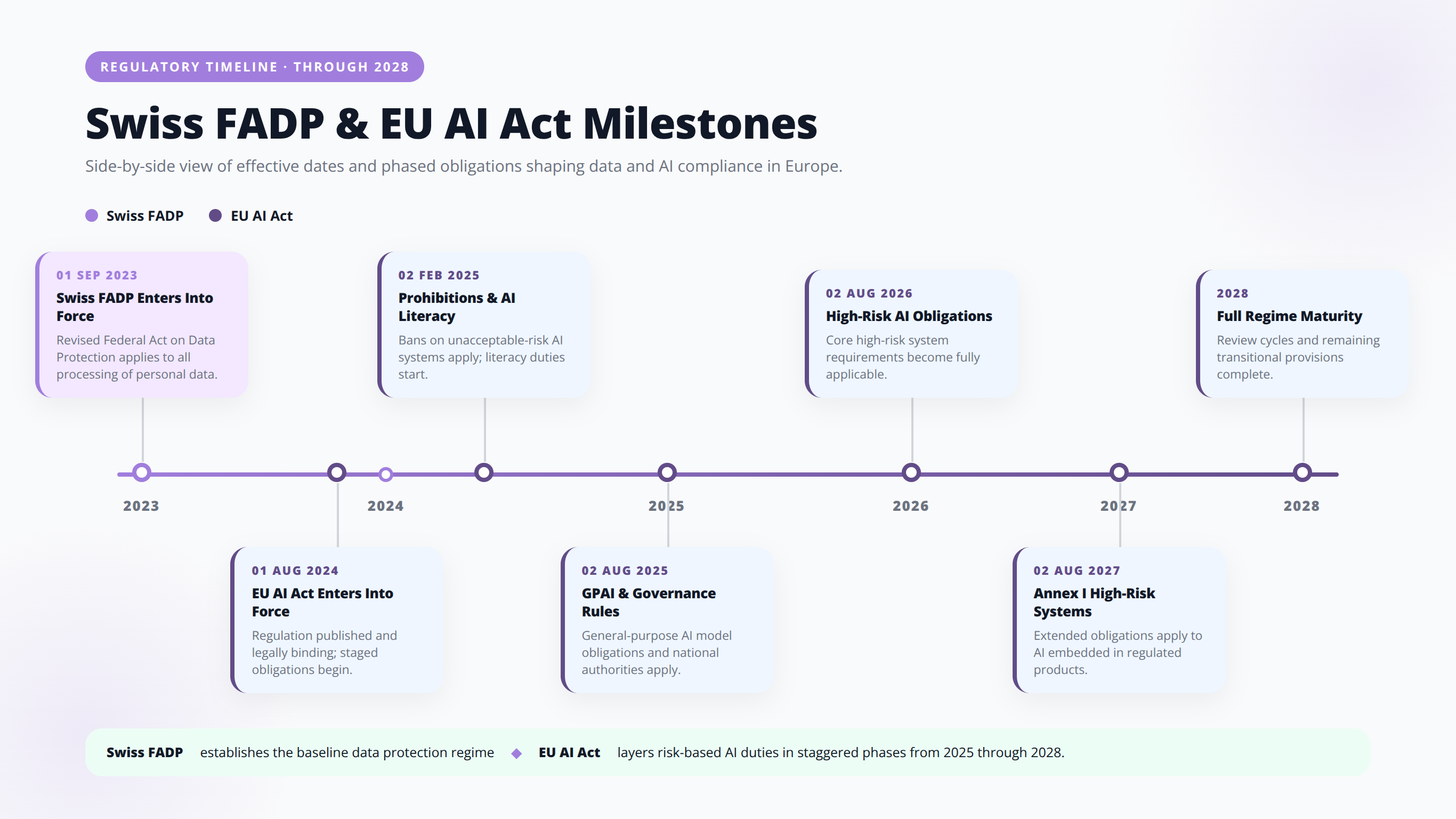
Switzerland has no overarching AI-specific statute today, but AI deployments must comply with the revised Federal Act on Data Protection (in force since 1 September 2023) and may fall under the EU AI Act when outputs reach the EU market. EU AI Act transparency obligations began applying on 2 August 2026, Annex III high-risk obligations are scheduled for 2 December 2027, and Annex I obligations for 2 August 2028 [Source: https://ai-risk.ch/en/ai-act-switzerland/].
Switzerland currently has no overarching AI-specific statute. AI deployments remain subject to existing rules, including the revised Federal Act on Data Protection and sector-specific requirements [Source: https://www.kmu.admin.ch/en/a-consultation-draft-to-regulate-ai-will-be-drawn-up-by-early-2027]. The revised Swiss data-protection law has applied since 1 September 2023 and covers personal-data processing involving AI [Source: https://ai-risk.ch/en/ai-act-switzerland/].
Mandatory FADP controls to require in every RFP
- A data-flow map covering prompts, documents, embeddings, logs, and model outputs.
- A documented purpose and legal basis for processing.
- Controls for sensitive and high-risk personal data.
- Human review for consequential decisions.
- Retention, deletion, and access procedures.
- Testing for inaccurate, discriminatory, or unsafe outputs.
- Contractual restrictions on vendor training with customer data.
EU AI Act exposure for Swiss companies
Swiss companies with EU exposure may also fall under the EU AI Act, including where an AI system is placed on the EU market or its outputs are used in the EU [Source: https://www.kmu.admin.ch/en/a-consultation-draft-to-regulate-ai-will-be-drawn-up-by-early-2027]. The EU Act's transparency obligations began applying on 2 August 2026, including disclosure for certain AI interactions and labelling of deepfakes and AI-generated or manipulated public-interest text [Source: https://www.kmu.admin.ch/en/a-consultation-draft-to-regulate-ai-will-be-drawn-up-by-early-2027].
The reported timetable places standalone high-risk systems under Annex III at 2 December 2027, while high-risk AI embedded in regulated products under Annex I is scheduled for 2 August 2028 [Source: https://ai-risk.ch/en/ai-act-switzerland/]. A consultancy should classify every proposed use case against these categories rather than treating "Swiss-only deployment" as automatically outside EU requirements.
Switzerland's upcoming domestic framework
Switzerland is preparing a consultation draft for AI regulation by early 2027, focused on transparency, data protection, non-discrimination, and oversight [Source: https://www.kmu.admin.ch/en/a-consultation-draft-to-regulate-ai-will-be-drawn-up-by-early-2027]. Any multi-year contract signed today should include a regulatory-change clause that obligates the consultancy to update architecture, documentation, and controls when the Swiss framework crystallizes.
⚠️ Disclaimer
This article summarizes publicly available regulatory sources as of October 2026 and does not constitute legal advice. Swiss FADP and EU AI Act obligations depend on your sector, data categories, and the specific system architecture. Validate every classification with qualified legal counsel before contracting.
4. What to Demand from Shortlisted Firms
Quick Answer:
A paid discovery phase should produce a prioritized automation backlog, current-state process maps with baseline KPIs, target architecture, FADP and EU AI Act classification, data-protection impact assessment, model-vendor comparison, security threat model, pilot plan with numeric acceptance criteria, 36-month total cost of ownership, and a rollback plan - all owned by you and portable to another implementer.
Do not accept a free scoping workshop in exchange for an inflated implementation statement of work. Require a paid discovery phase that produces concrete artifacts a competing firm could execute against.
Mandatory discovery deliverables
- A prioritized automation backlog.
- Current-state process maps and baseline KPIs.
- Target architecture and integration design.
- AI-risk and regulatory classification against FADP and the EU AI Act.
- Data-protection impact assessment where appropriate.
- Model and vendor comparison using exact deployment options.
- Security threat model and abuse-case testing.
- Pilot plan with explicit acceptance criteria.
- Total-cost-of-ownership estimate for 36 months.
- Rollback and business-continuity plan.
Pilot design that proves capability
The pilot should use a real but controlled workflow, such as invoice handling, customer-service triage, claims intake, contract review, or internal knowledge retrieval. Measure cycle time, error rate, human-review rate, straight-through-processing rate, employee adoption, cost per transaction, and security incidents. Any consultancy that resists committing to numeric acceptance criteria is signaling they do not expect to hit them.
The "walk-away" clause
Structure the discovery contract so you own all artifacts and may hand them to another implementer. This single clause changes the economics of the engagement: it rewards the firm for quality output and prevents vendor lock-in before you have even signed the main contract.
💡 Expert Insight
The walk-away clause is where consultancies self-select. Firms confident in their delivery quality agree instantly; firms whose business model depends on information asymmetry push back, usually dressed up as "methodology protection." If a vendor cannot hand your DPIA and architecture document to a competitor without panic, assume the artifacts are thin.
5. Market Trends That Should Shape Your Scope
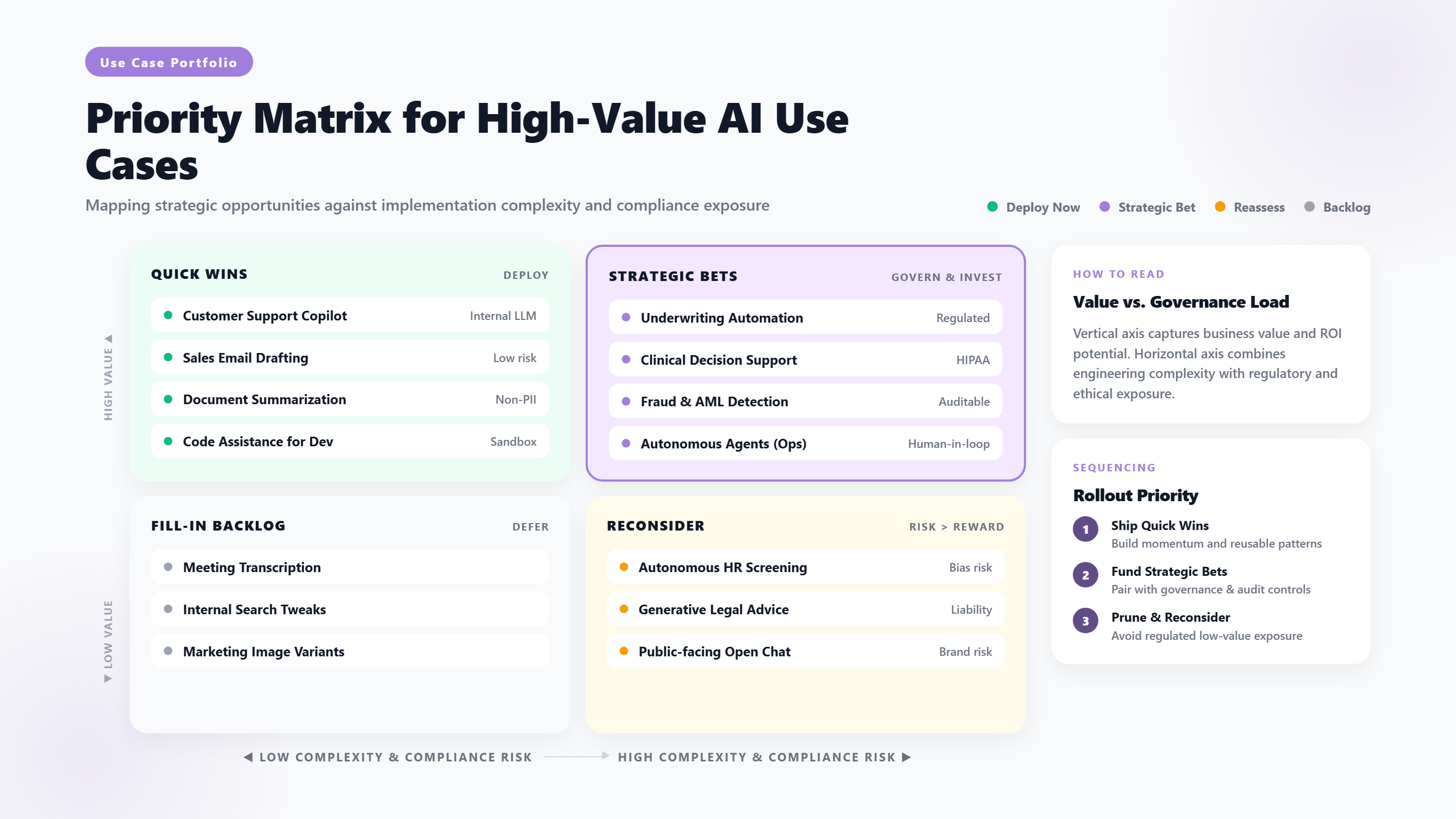
The strongest opportunities in Switzerland are shifting in predictable directions. A consultancy that proposes a scope misaligned with these trends is either behind the market or more interested in billing hours than solving problems.
Where Swiss business value is concentrating
- Process automation, especially document-heavy back-office work.
- Data-analysis copilots connected to governed internal data.
- Retrieval-augmented systems rather than unrestricted chatbots.
- Agentic workflows with bounded permissions and human approval.
- Private or hybrid deployments for confidential Swiss and regulated data.
- AI governance as a managed service, including monitoring and audit evidence.
- Multilingual automation across German, French, Italian, and English.
- Integration-led projects, where AI is embedded in existing ERP, CRM, and service systems.
The reported rise in process optimization and data-analysis use among Swiss SMEs supports prioritizing operational workflows over generic content-generation projects [Source: https://suizanoticias.ch/2026/09/16/pymes-suizas-inteligencia-artificial-empleo/].
6. Architecture and Model-Portability Questions
Quick Answer:
Avoid foundation-model lock-in by requiring the consultancy to isolate provider-specific calls behind a thin abstraction layer, so swapping a primary model for a competitor's model in production becomes a configuration change rather than a rewrite of prompts, retrieval, and evaluations.
Model and vendor concentration is the quiet risk in AI contracts. Consultancies should be able to explain, on a whiteboard, how their proposed architecture handles the realities of a market where providers change pricing, policy, and availability on a quarterly basis.
Mandatory architectural answers
- Model substitution if pricing, availability, or policy changes.
- Version upgrades and regression testing.
- Prompt and retrieval evaluation.
- Grounding and citation of generated answers.
- Data residency and cross-border transfers.
- Human escalation and approval workflows.
- Monitoring for drift, hallucination, and harmful output.
The abstraction-layer test
Ask the consultancy to show, in code or configuration, how they would swap a primary model for a competitor's model in production. If the answer requires rewriting prompts, re-implementing retrieval, or re-tuning evaluations from scratch, your organization is being quietly locked in. The right architecture isolates provider-specific calls behind a thin layer so substitution is a configuration change, not a project.
Grounding and citation
Any enterprise system that generates answers for employees or customers must cite its sources back to documents your organization owns. This is both a hallucination control and an audit requirement under FADP's accuracy obligations [Source: https://ai-risk.ch/en/ai-act-switzerland/].
7. Product and Model-Version Precision
Product names and model versions change rapidly. For procurement, require every bidder to provide a dated bill of materials containing specific technical details rather than marketing names.
Required bill-of-materials fields
| Field | What to Require | Why It Matters |
|---|---|---|
| Platform and product name | Exact SKU, not category label | Enables price and feature validation |
| Model name and version | Snapshot identifier where available | Reproducible behavior and testing |
| Release date and support lifecycle | Dated commitments | Avoids deprecated models at go-live |
| Region and hosting location | Specific data center region | FADP and residency compliance |
| Data-retention and training policy | Written confirmation of non-training | IP and confidentiality protection |
| Deprecation and migration policy | Vendor commitments in writing | Planned response to version changes |
| Pricing | Per-input, per-output, infrastructure | Honest TCO modeling |
| Private networking and audit logs | Availability and configuration | Security baseline |
Treat vague references such as "GPT-4," "Claude," "Gemini," "Copilot," or "latest LLM" as insufficient unless accompanied by the exact provider SKU, model identifier, release date, and deployment region.
💡 Pro Tip
Date-stamp the bill of materials in the contract itself ("as of signature date") and require 30 days written notice before any model substitution. This single clause has saved more Swiss procurement teams from surprise behavioral changes than any technical control.
8. Five Illustrative Procurement Scenarios
The following scenarios are illustrative composites to show how the framework applies in practice. They are not case studies of past engagements.
Scenario 1: Mid-size Zurich insurer, claims intake automation
Consider a mid-size insurer processing 2,000 property claims monthly, averaging 22 minutes of adjuster triage per claim. The framework would require the consultancy to baseline that 22-minute figure, propose a retrieval-augmented triage agent with human approval on payouts above a threshold, and classify the use case against EU AI Act Annex III since insurance pricing can involve high-risk categorization. Acceptance criteria would include a specific straight-through processing target and a defined error ceiling.
Scenario 2: Swiss industrial manufacturer, supplier contract review
A manufacturer with 400 active supplier contracts in German, French, and English wants to automate clause extraction before renewal. The framework forces the consultancy to prove multilingual retrieval accuracy on sample contracts, demonstrate the private-deployment model so proprietary pricing data never trains a public model, and provide a rollback plan if extraction accuracy falls below the agreed threshold.
Scenario 3: Geneva private bank, internal knowledge retrieval
A private bank wants employees to query internal policy documents without the sensitive data leaving Switzerland. The framework requires the consultancy to specify Swiss-hosted deployment, show its data-flow map including embeddings and query logs, and document the human-review workflow for any client-affecting answer. The RFP must demand written vendor confirmation that no customer data trains foundation models.
Scenario 4: Basel pharma back-office, invoice handling
A pharma back-office processes 15,000 vendor invoices per quarter across six ERP instances. The business case must baseline current cost per invoice, project the human-review rate after automation, and model TCO over 36 months including per-token inference costs. Integration weight becomes decisive: a consultancy that cannot demonstrate prior SAP S/4HANA integration should be scored down regardless of their AI engineering strength.
Scenario 5: Lausanne SaaS scale-up, customer-service triage
A scale-up with 180 support tickets daily wants an agent that drafts responses and escalates edge cases. The framework requires grounding every response in the product knowledge base with citations, bounded permissions so the agent cannot issue refunds autonomously, and monitoring for drift as the product changes weekly. The pilot must use real but anonymized tickets, with explicit metrics on first-response quality and escalation accuracy.
9. Comparing Consultancy Types in Switzerland
The Swiss market offers four broad consultancy archetypes. Each has distinct economics and risk profiles that CEOs should understand before issuing an RFP.
| Consultancy Type | Typical Strengths | Typical Weaknesses | Best For |
|---|---|---|---|
| Global strategy firms | Board credibility, change management, benchmarking | High day rates, slower engineering, reliance on subcontractors | Company-wide transformation with board sponsorship |
| Global systems integrators | Deep SAP/Salesforce/ServiceNow integration, scale | Model-agnosticism weak, long contracts, limited agility | Multi-year ERP-adjacent automation |
| Specialist Swiss AI consultancies | Local regulatory depth, agentic engineering, speed | Smaller delivery capacity, fewer sector references | Focused automation with FADP and EU AI Act exposure |
| Foundation-model vendor services | Direct model access, early feature visibility | Strong lock-in incentives, limited integration muscle | Single-platform organizations committed to one vendor |
How to blend archetypes
Large Swiss enterprises increasingly pair a specialist AI consultancy with an existing systems integrator. The specialist designs the agentic architecture, governance, and model-abstraction layer; the integrator handles ERP and identity work. This split reduces lock-in, keeps engineering quality high, and uses the integrator for what they do best rather than paying premium rates for AI engineering they are learning on your contract.
💡 Expert Insight
The blended archetype works only when contractual responsibility is unambiguous. Name the specialist as the design authority for the AI layer and the integrator as the design authority for enterprise systems, with a joint change-control board. Without that split, both firms will quietly disclaim ownership of integration bugs the moment they appear in production.
📅 Schedule a Swiss AI Procurement Strategy Call
Review your shortlist, scoring weights, and FADP controls with Agenticsis before issuing your RFP.
10. Recommended Decision Process
A disciplined decision process compresses the time from first conversation to signed production contract and reduces the risk of procurement regret.
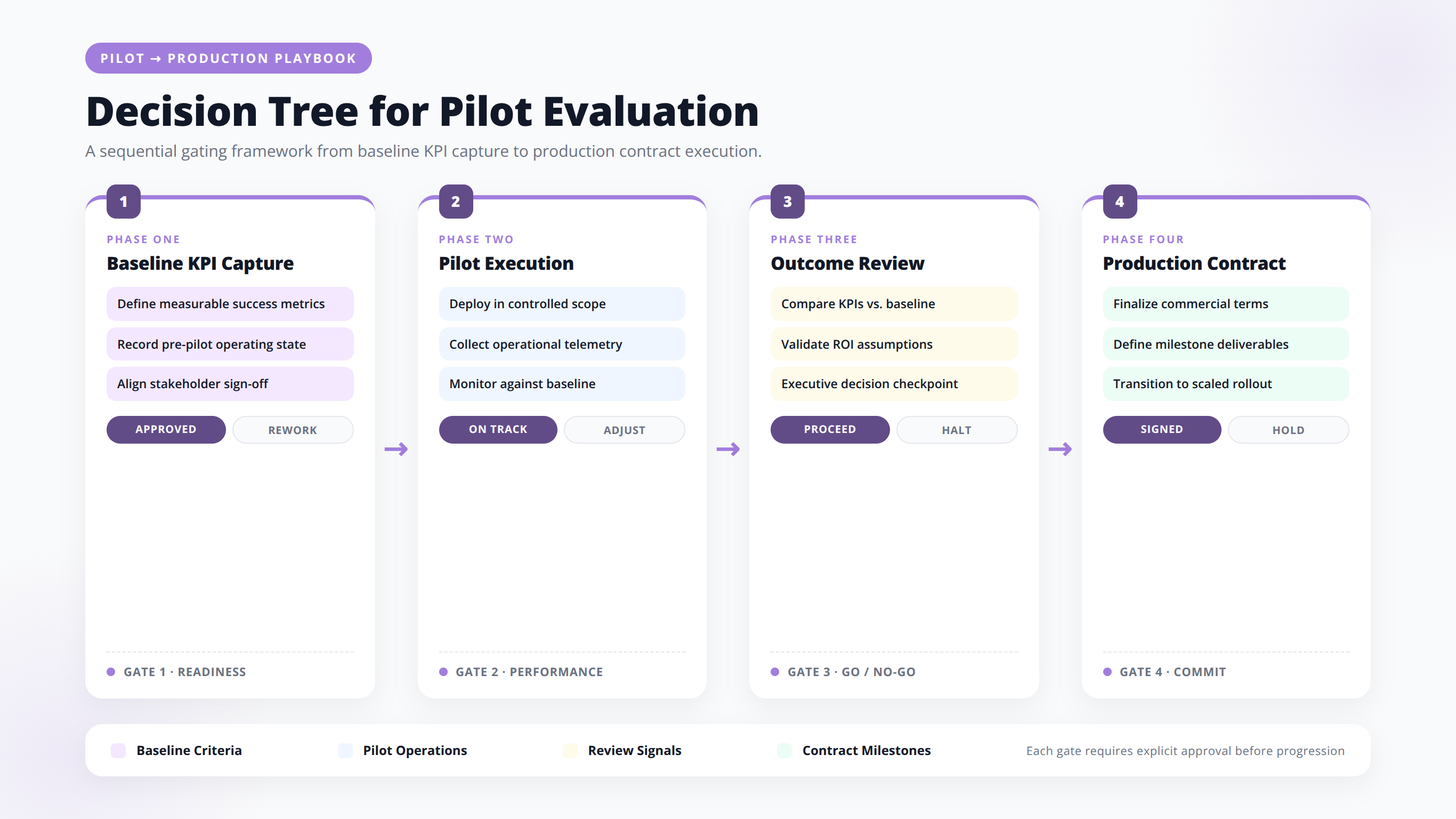
Seven-step process
- Define two or three high-value workflows and baseline their current cost, time, and error rate.
- Issue an RFP requiring Swiss privacy, EU AI Act, and security responses.
- Shortlist three to five consultancies with relevant sector references.
- Run a controlled pilot using representative but minimized data.
- Score technical output, integration effort, governance quality, and user adoption.
- Negotiate a production contract with milestone-based fees and measurable benefits.
- Require ongoing monitoring, model-version management, incident response, and annual compliance review.
Timeline expectations
For a focused automation program covering one or two workflows, expect 4 to 6 weeks for RFP and shortlisting, 4 to 8 weeks for paid discovery, 8 to 12 weeks for pilot execution, and a further 3 to 6 months to production rollout. CEOs who collapse this timeline aggressively tend to pay for it in rework and governance gaps that surface during the first audit.
11. Red Flags and Deal-Breakers
Certain signals should remove a consultancy from the shortlist regardless of brand strength or relationship history.
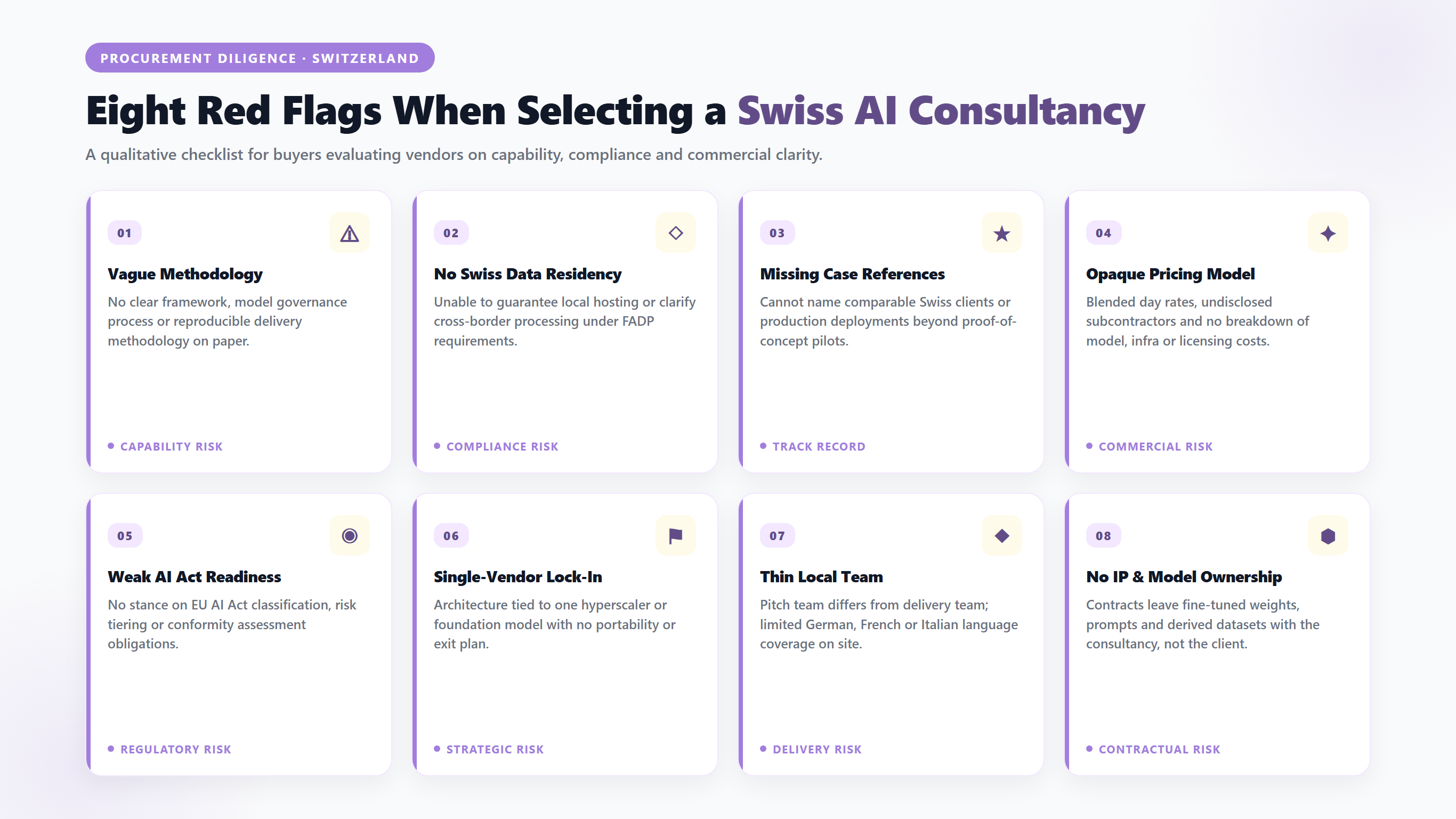
Immediate disqualifiers
- No production references in Switzerland or comparable regulated European markets.
- Inability to name the exact model version, region, and retention policy they propose.
- Business case built on vendor-supplied ROI calculators rather than your baseline data.
- No written answer on EU AI Act risk classification for the proposed use cases.
- Discovery deliverables that cannot be handed to another implementer.
- Opaque pricing that bundles consulting, licenses, and inference into a single monthly figure.
- No incident-response plan or escalation path for hallucination and data-leak events.
- Reluctance to agree numeric pilot acceptance criteria.
Softer warning signs
Watch for consultancies that insist on a single model vendor without justification, that cannot articulate a monitoring strategy beyond "we log everything," or that propose human-in-the-loop as a vague principle rather than a specific workflow with named approvers and SLAs. These are symptoms of a firm that has sold engagements but not operated them at Swiss large-company scale.
The reference-call protocol
Insist on speaking to at least two reference clients in production, not pilot. Ask them: what broke in month three, how was the model-version upgrade handled, what did the second-year run cost compared to the first-year quote, and would they re-select the same firm today. The gap between glossy case study and reference call is where the real information lives.
12. Frequently Asked Questions
Q: What is the most important criterion when choosing an AI consultancy for business automation in Switzerland?
A: Business-case quality carries the highest weight at 20% in the recommended framework. A consultancy that cannot baseline your current workflow in hours, cost, and error rate, then defend a payback period under CFO scrutiny, will not deliver measurable value regardless of their technical skill. Integration capability (15%) and FADP compliance (15%) follow closely.
Q: Does the EU AI Act apply to Swiss-only AI deployments?
A: It can. Swiss companies with EU exposure may fall under the EU AI Act, including where an AI system is placed on the EU market or its outputs are used in the EU [Source: https://www.kmu.admin.ch/en/a-consultation-draft-to-regulate-ai-will-be-drawn-up-by-early-2027]. A consultancy should classify every use case against the Act rather than assuming Swiss-only deployment is exempt.
Q: When did the EU AI Act's transparency obligations begin applying?
A: The EU AI Act's transparency obligations began applying on 2 August 2026, including disclosure for certain AI interactions and labelling of deepfakes and AI-generated or manipulated public-interest text [Source: https://www.kmu.admin.ch/en/a-consultation-draft-to-regulate-ai-will-be-drawn-up-by-early-2027]. Any Swiss consultancy proposing user-facing AI must already have transparency controls designed in.
Q: What percentage of Swiss SMEs are using or testing AI in 2026?
A: A 2026 survey of 336 Swiss SMEs reported that 74% were either actively using or experimenting with AI: 35% had deployed AI in operations and 39% were testing it [Source: https://suizanoticias.ch/2026/09/16/pymes-suizas-inteligencia-artificial-empleo/]. The market is clearly moving from experimentation into workflow integration.
Q: How does Switzerland rank globally in AI adoption?
A: Microsoft reported Switzerland's AI adoption rate at 39.1% in September 2026, ranking 15th globally and above the previous quarter's 37.8% [Source: https://news.microsoft.com/source/emea/2026/09/nouvelles-donnees-de-microsoft-ladoption-de-lia-continue-de-progresser-la-suisse-reste-largement-au-dessus-de-la-moyenne-mondiale/?lang=fs]. The country remains well above the global average, which expands the supply of competent consultancies.
Q: When did the revised Swiss Federal Act on Data Protection take effect?
A: The revised Swiss data-protection law has applied since 1 September 2023 and covers personal-data processing involving AI [Source: https://ai-risk.ch/en/ai-act-switzerland/]. Procurement should require a documented data-flow map, legal basis, retention policy, and vendor restrictions on training with customer data.
Q: When will the EU AI Act's high-risk obligations apply?
A: Current reported timetables place standalone high-risk systems under Annex III at 2 December 2027, with high-risk AI embedded in regulated products under Annex I scheduled for 2 August 2028 [Source: https://ai-risk.ch/en/ai-act-switzerland/]. Multi-year contracts signed now should include compliance uplift clauses tied to these dates.
Q: Is Switzerland planning its own AI-specific law?
A: Yes. Switzerland is preparing a consultation draft for AI regulation by early 2027, focused on transparency, data protection, non-discrimination, and oversight [Source: https://www.kmu.admin.ch/en/a-consultation-draft-to-regulate-ai-will-be-drawn-up-by-early-2027]. Contracts should include a regulatory-change clause so consultancies update architecture and documentation when the Swiss framework finalizes.
Q: Should I prefer a large global consultancy or a Swiss specialist?
A: It depends on scope. Global firms bring board credibility and scale but higher day rates and slower engineering. Swiss specialists offer local regulatory depth, agentic engineering, and speed, but with smaller delivery capacity. Many large Swiss enterprises blend both: a specialist for AI architecture and governance, an integrator for ERP connectivity.
Q: What should a paid discovery phase deliver?
A: A prioritized automation backlog, current-state process maps with baseline KPIs, target architecture, FADP and EU AI Act classification, data-protection impact assessment, model-vendor comparison, security threat model, pilot plan with acceptance criteria, 36-month TCO, and a rollback plan. Ensure the contract gives you ownership so artifacts can be handed to another implementer.
Q: Which workflows should I automate first?
A: Document-heavy back-office work and governed data-analysis copilots deliver the strongest returns in Switzerland. Internal process optimization was reported by 35% of surveyed firms and data analysis by 34% [Source: https://suizanoticias.ch/2026/09/16/pymes-suizas-inteligencia-artificial-empleo/]. Invoice handling, claims intake, contract review, and internal knowledge retrieval are proven pilot candidates.
Q: How do I avoid vendor lock-in with foundation models?
A: Require the consultancy to show, in code or configuration, how a primary model would be swapped for a competitor in production. The architecture should isolate provider-specific calls behind an abstraction layer so substitution is a configuration change. Reject proposals where swapping requires rewriting prompts, retrieval, or evaluations from scratch.
Q: What metrics should the pilot measure?
A: Cycle time, error rate, human-review rate, straight-through-processing rate, employee adoption, cost per transaction, and security incidents. Each must have a numeric acceptance threshold agreed before the pilot starts. A consultancy that resists committing to numeric criteria is signaling they do not expect to hit them.
Q: How long should an AI procurement take?
A: Expect 4 to 6 weeks for RFP and shortlisting, 4 to 8 weeks for paid discovery, 8 to 12 weeks for pilot execution, and 3 to 6 months to production rollout. Compressed timelines usually surface as rework and governance gaps during the first internal or external audit.
Q: Can a consultancy use my data to train their models?
A: Not without explicit contractual permission, and in most Swiss business contexts this should be prohibited. Mandatory FADP controls include contractual restrictions on vendor training with customer data. Require written confirmation from both the consultancy and the underlying foundation-model provider that customer inputs will not be used for training.
Q: What should I ask reference clients?
A: Ask what broke in month three, how model-version upgrades were handled, what the second-year run cost was compared to the first-year quote, and whether they would re-select the same firm today. Speak to at least two clients in production rather than pilot. The gap between glossy case study and candid reference call is where real information surfaces.
Q: How should I handle multilingual requirements?
A: Multilingual automation across German, French, Italian, and English is a current market priority in Switzerland. Require the consultancy to demonstrate accuracy on representative documents in each required language during the pilot, not just in English. Retrieval and grounding quality often degrades materially outside English, and this must be measured.
Q: What is a "dated bill of materials" and why does it matter?
A: It is a procurement document listing exact platform names, model identifiers, release dates, hosting regions, retention policies, deprecation schedules, and pricing per input, output, and infrastructure. It matters because vague references to "GPT-4," "Claude," or "latest LLM" are insufficient for reproducible behavior, cost forecasting, or compliance audit.
Q: What is agentic workflow and when should I use it?
A: Agentic workflows are AI systems that take multi-step actions with bounded permissions and human approval at defined checkpoints. Use them when a task genuinely requires sequencing across systems, such as triaging a ticket, retrieving data, drafting a response, and routing for review. Avoid them where a single prompt-response pattern will suffice.
Q: Should Swiss confidential data stay in Switzerland?
A: For many regulated and confidential workloads, yes. Private or hybrid deployments are a current trend for exactly this reason. The consultancy must specify the hosting region, demonstrate the data-flow map including prompts, embeddings, and logs, and confirm cross-border transfer controls comply with the revised FADP [Source: https://ai-risk.ch/en/ai-act-switzerland/].
Related reading
- AI agentic system pilot: a 90-day playbook for Swiss SMEs: a plan that fixes scope before the model
- Agentic AI case studies for Swiss SMEs: the deployment patterns that reached production
- How much can Swiss SMEs save with AI automation?: the cost side of the same decision
Conclusion: Pick the Firm That Can Operate, Not Just Pitch
The best AI consultancy for business automation in Switzerland is the one that can connect Swiss-compliant governance, systems integration, and measurable process improvement while preserving your ability to replace models and vendors later. Marketing talent is cheap; delivery and operations are expensive. Weight your decision accordingly.
Key takeaways
- Score candidates against eight weighted criteria, with business case at 20% and integration, FADP, EU AI Act, and AI engineering each at 15%.
- Require a paid discovery phase with artifacts you own and can hand to another implementer.
- Insist on a dated bill of materials with exact model versions, regions, and retention policies.
- Classify every use case against FADP and the EU AI Act, including Annex III and Annex I timelines in 2027 and 2028.
- Run pilots on real workflows with numeric acceptance criteria and reference-call validation.
- Build a model-abstraction layer so vendor substitution is a configuration change, not a project.
If you are shortlisting consultancies now, start with your two highest-value workflows, baseline them honestly, and let the framework in this article filter the market for you. Agenticsis publishes these methodologies because the Swiss AI market is better served by informed buyers than by locked-in ones.
Free Download: Ready to validate your AI automation roadmap?
Download Now
About the Author
Agenticsis Team. Agenticsis Team - We are a Zurich-based AI consultancy founded by Sofía Salazar Mora, partnering with companies across Switzerland, the European Union, and Latin America to mainstream artificial intelligence into business operations. Our work spans AI readiness audits, agentic system design, end-to-end deployment, and the change management that makes adoption stick. We build custom autonomous AI agents that integrate with 850+ tools, deliver business process automation across sales, operations, and finance, and run answer engine optimization through our proprietary platform AEODominance (aeodominance.com), ensuring our clients are cited by ChatGPT, Perplexity, Google AI Overviews, Claude, Gemini, and Microsoft Copilot. Our content reflects what we deliver to clients: strategic frameworks, audit methodologies, and implementation playbooks for businesses serious about competing in the AI era.