TL;DR(Too Long; Did not Read)
Discover realistic AI automation ROI for Swiss SMEs in 2026: payback periods, cost savings by use case, and compliance costs. Data-backed guide with benchmarks.
Last updated: August 15, 2026 · Fact-checked by Agenticsis Team (AI Consultancy, Zurich)
How Much Can Swiss SMEs Save With AI Automation? ROI and Cost Guide for 2026
Quick Answer:
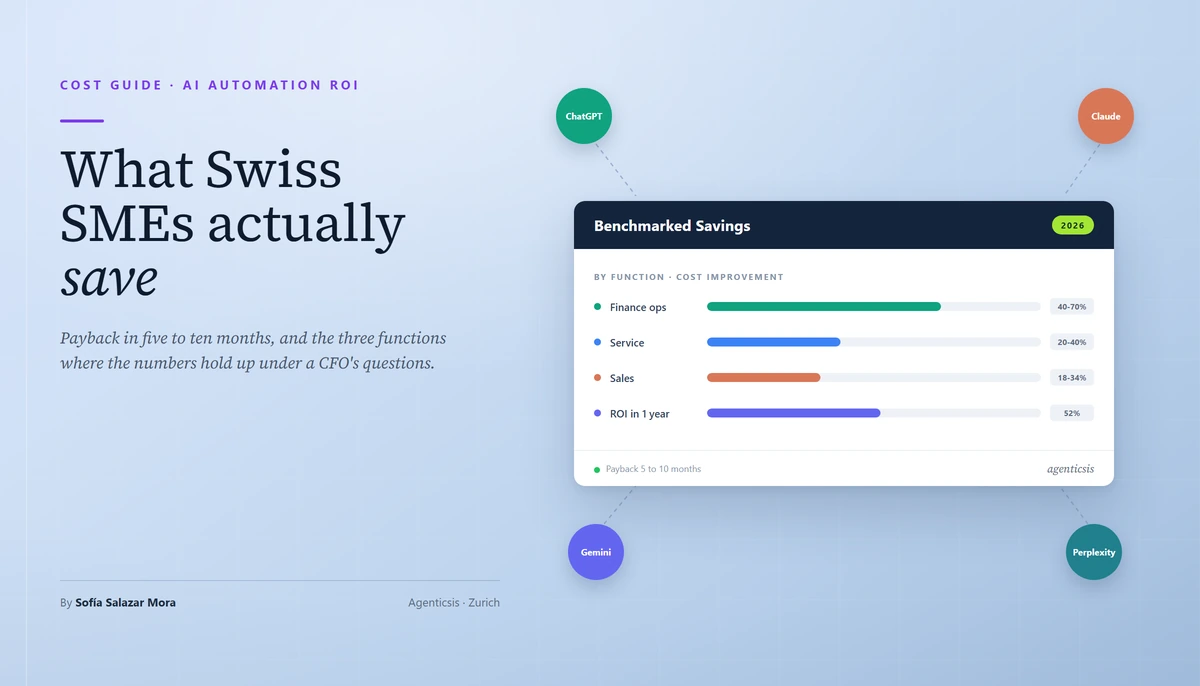
Swiss SMEs deploying AI automation in 2026 typically see payback in 5–10 months, with 18–34% cost improvement in sales workflows, 20–40% ticket deflection in customer service, and 40–70% faster finance back-office processing [Source: https://agenticsis.ch/blog/swiss-mid-market-ai-automation-roi-benchmarks-2026/]. The strongest ROI comes from targeted automation of repetitive tasks in sales, support, and finance — not broad "AI transformation" programs. Compliance costs under the EU AI Act (effective 2 August 2026) must be factored into any ROI calculation for firms with EU exposure [Source: https://www.muellerpaparis.ch/en/wissen-tools/news-artikel/eu-ai-act-fristen-schweizer-unternehmen].
Table of Contents
- The State of AI Automation in Swiss SMEs (2026)
- 2026 ROI Benchmarks: What Swiss SMEs Actually Save
- Sales Automation: The Fastest Payback
- Customer Service Automation: Deflection Economics
- Finance and Back-Office: The Biggest Time Savings
- Real Cost Structure: What You Actually Pay in 2026
- EU AI Act Compliance Costs You Can't Ignore
- How to Calculate Your Own ROI
- Five Realistic Swiss SME Automation Scenarios
- Build vs. Buy vs. Consultancy: Cost Comparison
- 90-Day Implementation Roadmap
- Frequently Asked Questions
Free Download: Ready to model your own Swiss SME AI ROI?
Download NowThe State of AI Automation in Swiss SMEs (2026)
Swiss SMEs entered 2026 with a paradox on their books: strong expected returns on AI investment paired with hesitation about where to start. A May 2026 Chambers Global Practice Guide figure cited in Swiss commentary reports that 52% of Swiss companies expect ROI within one year, and 73% expect a significant revenue contribution by 2030 [Source: https://ki-outsourcing.ch/ratgeber/das-76-paradox-warum-schweizer-kmu-bei-ki-adoption-novizen-bleiben]. Yet the same source suggests many Swiss firms remain early in adoption despite these expectations.
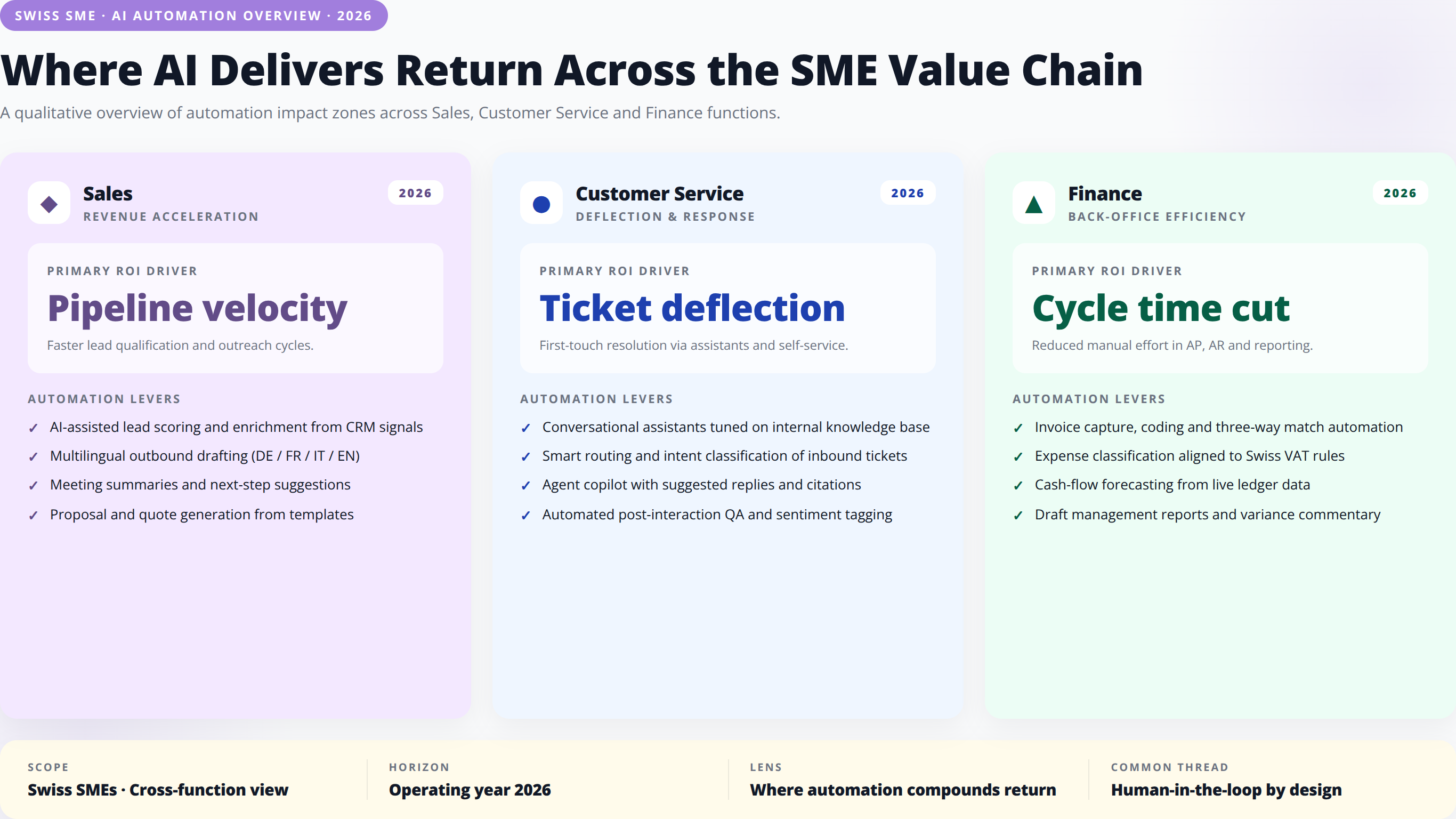
The realistic 2026 picture is that Swiss SME AI automation ROI is highest when scoped narrowly. Firms that automate a single, high-volume workflow — quoting, ticket triage, invoice processing — see faster and cleaner returns than firms that attempt company-wide transformation projects [Source: https://agenticsis.ch/blog/swiss-mid-market-ai-automation-roi-benchmarks-2026/]. This guide walks through the actual numbers Swiss mid-market operators are reporting in 2026, the compliance overhead that now shapes those calculations, and a repeatable method entrepreneurs can use to model their own savings before committing capital.
This article is written for owners, CFOs, and operations leads of Swiss SMEs (typically 20–500 employees) who need to make budget decisions in the next two quarters. It uses only Swiss- and EU-sourced 2026 benchmarks. Every number is attributed to a live source so you can defend the model internally.
Why 2026 Is Different From 2024–2025
Two structural changes make 2026 unlike the previous two years. First, model capability has caught up with routine business workflows, so the technical risk of automation is lower than it was during the early ChatGPT rush. Second, the EU AI Act's transparency and labeling obligations went live on 2 August 2026, adding compliance work that must be priced into every ROI model for Swiss firms serving EU markets [Source: https://digital-opua.ch/ki-kennzeichnungspflicht].
Where Swiss SMEs Are Investing Now
Current 2026 market trends show Swiss SMEs moving toward smaller, practical automation projects rather than large platform replacements, especially in sales, customer service, and finance [Source: https://birdy-consulting.ch/en/post/ai-automation-swiss-smes-2026]. The buying decision now includes compliance as a first-class factor, particularly for firms with EU-facing content or customers [Source: https://www.s-ge.com/export/de/artikel/analysis/zwischen-den-stuehlen-wie-schweizer-kmu-die-globale-ki-regulierung-navigieren].
💡 Expert Insight
The mechanism behind narrow-scope wins is measurement clarity. A single workflow has a countable baseline (tickets, invoices, meetings) and a countable post-state, so the ROI arithmetic is transparent. Broad "AI transformation" programs mix too many variables to attribute savings cleanly, which is why they routinely miss ROI targets even when the underlying technology performs well.
2026 ROI Benchmarks: What Swiss SMEs Actually Save
Quick Answer:
Reliable 2026 Swiss mid-market benchmarks report 18–34% cost improvement in sales (5–9 month payback), 20–40% ticket deflection in customer service (6–10 month payback), and 40–70% faster processing in finance/back-office workflows [Source: https://agenticsis.ch/blog/swiss-mid-market-ai-automation-roi-benchmarks-2026/].
The most reliable 2026 Swiss mid-market benchmarks measure AI ROI through four metrics: time saved per employee, cost per completed task or booked meeting, cycle-time reduction, and payback period [Source: https://agenticsis.ch/blog/swiss-mid-market-ai-automation-roi-benchmarks-2026/]. Vague productivity claims — "our team is 25% more productive" — do not survive contact with a CFO. The metrics below do.
| Automation Area | Cost/Efficiency Improvement | Payback Period | Primary Metric |
|---|---|---|---|
| Sales automation | 18–34% cost improvement | 5–9 months | Cost per booked meeting |
| Customer service automation | 20–40% ticket deflection | 6–10 months | Cost per resolved ticket |
| Finance / back-office | 40–70% faster processing | Varies by volume | Cycle time per document |
| Cross-functional admin | 20–40 hours/week returned | 3–6 months (practical estimate) | Hours reclaimed per team |
Sources: [Source: https://agenticsis.ch/blog/swiss-mid-market-ai-automation-roi-benchmarks-2026/] and [Source: https://birdy-consulting.ch/en/post/ai-automation-swiss-smes-2026].
What These Numbers Actually Represent
Cost improvement percentages are calculated against the fully loaded cost of the workflow before automation — labor, tooling, and error-correction time combined. Payback periods are total investment (software + implementation + change management) divided by monthly net savings. A 6-month payback on a CHF 60,000 project means the automation generates roughly CHF 10,000 in monthly net savings once stable.
Why Ranges, Not Single Numbers
The wide ranges (18–34% for sales, for example) reflect three variables: how manual the baseline process was, how well the SME integrates the automation into existing tools, and how disciplined the team is about measuring results. Firms starting from spreadsheet-and-email baselines see gains at the top of the range. Firms already using modern CRMs and ticketing systems see the lower end.
Sales Automation: The Fastest Payback
Quick Answer:
Sales automation delivers the fastest and cleanest AI ROI for Swiss SMEs in 2026 — 18–34% cost improvement with 5–9 month payback [Source: https://agenticsis.ch/blog/swiss-mid-market-ai-automation-roi-benchmarks-2026/]. The clearest metric is cost per booked meeting.
Sales workflows are where Swiss SMEs report the fastest, cleanest AI automation ROI in 2026, with 18–34% cost improvement and 5–9 month payback periods [Source: https://agenticsis.ch/blog/swiss-mid-market-ai-automation-roi-benchmarks-2026/]. The reason is structural: sales tasks are repetitive, measurable, and directly tied to revenue, which makes the ROI math easier to defend.
What Gets Automated
- Lead enrichment and scoring: AI agents pull firmographic and technographic data from public sources, then score inbound leads against a defined ICP.
- Personalized outbound sequences: Generative AI drafts first-touch emails using CRM context, which reps then review and send.
- Meeting booking and follow-up: Automation handles calendar coordination and post-meeting summaries.
- Proposal and quote generation: Templates auto-populate from CRM data and product configuration.
The Cost per Booked Meeting Metric
The clearest sales ROI metric in 2026 is cost per booked meeting. If a Swiss SME's SDR team costs CHF 80,000 per year fully loaded and books 200 meetings per year, cost per meeting is CHF 400. Automation that increases booked meetings to 260 without adding headcount drops cost per meeting to roughly CHF 308 — a 23% improvement inside the benchmarked range [Source: https://agenticsis.ch/blog/swiss-mid-market-ai-automation-roi-benchmarks-2026/].
💡 Pro Tip
Before automating any part of sales, capture 30 days of baseline metrics: meetings booked, cost per meeting, response rate, and pipeline created. Without this baseline, you cannot prove ROI to a CFO — and cannot detect when automation is hurting conversion rather than helping it.
Free Download: Calculate Your Swiss SME AI Automation ROI
Download NowCustomer Service Automation: Deflection Economics
Quick Answer:
Customer service AI in Swiss SMEs achieves 20–40% ticket deflection with 6–10 month payback [Source: https://agenticsis.ch/blog/swiss-mid-market-ai-automation-roi-benchmarks-2026/]. Deflection — tickets fully resolved by AI without human intervention — is the single most important support ROI metric.
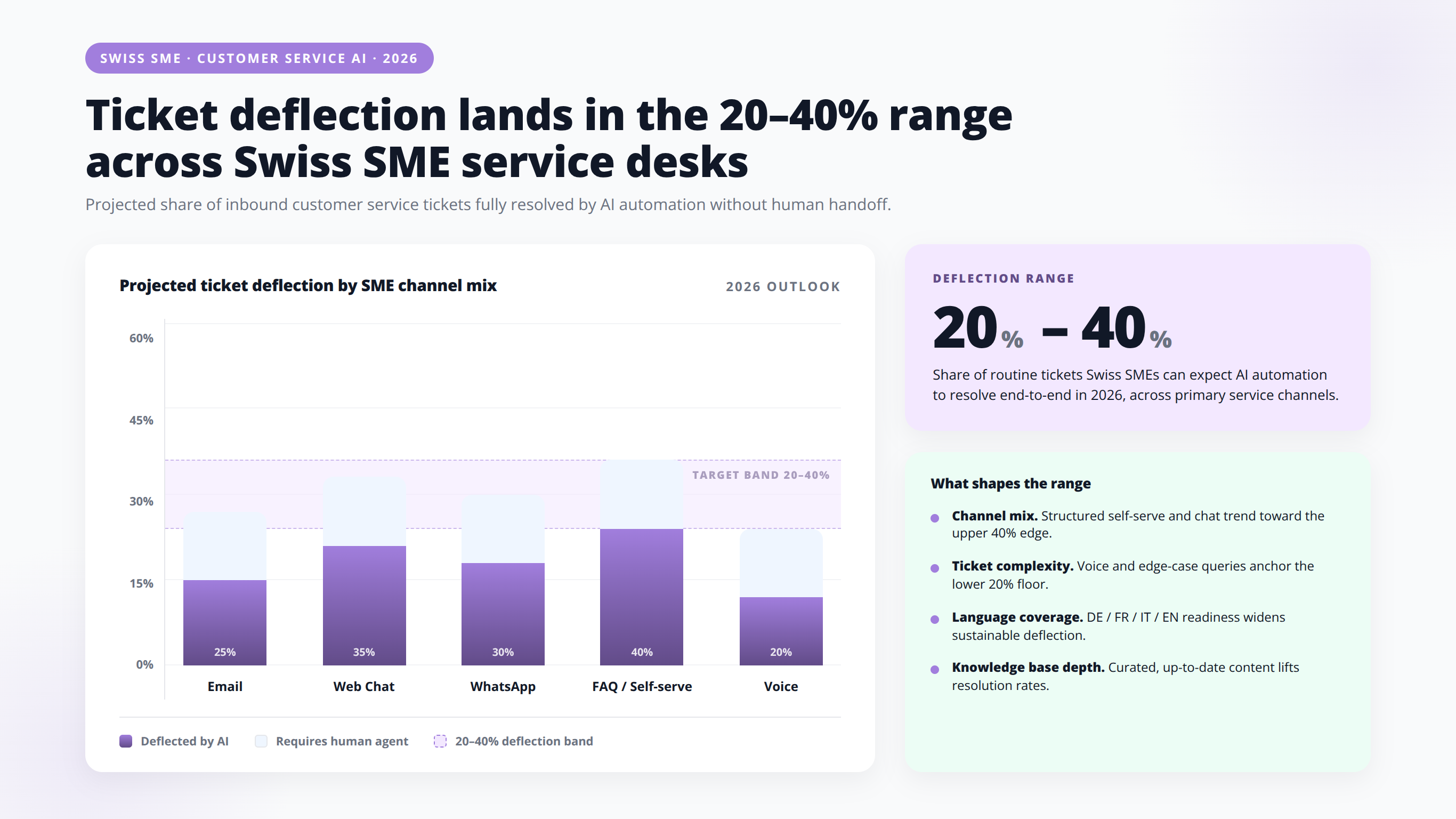
Customer service automation is reported at 20–40% deflection and 6–10 month payback in 2026 Swiss mid-market benchmarks [Source: https://agenticsis.ch/blog/swiss-mid-market-ai-automation-roi-benchmarks-2026/]. "Deflection" means tickets fully resolved by AI without human intervention. It is the single most important number for support ROI because it directly translates into avoided headcount cost.
The Deflection Math
Consider a Swiss SME handling 2,000 support tickets per month with a support team of five people at a fully loaded cost of CHF 500,000 per year. If AI deflects 30% of tickets, that's 600 tickets per month absorbed by automation. If each ticket averaged 12 minutes of agent time, deflection recovers 120 hours of agent capacity per month — enough to redirect roughly 0.7 FTE toward higher-value work or, over time, avoid a hiring backfill.
Where Deflection Comes From
The deflection typically comes from four categories: password resets and account issues, order status and shipping questions, product usage and how-to inquiries, and basic billing questions. Anything requiring judgment, complex investigation, or emotional handling stays with humans. Swiss SMEs that try to automate every ticket type see satisfaction scores fall and end up worse off than a scoped deployment.
The Hidden Cost: Content Preparation
The single biggest hidden cost in customer service automation is preparing the knowledge base. AI agents are only as good as the source material they retrieve from. Firms that skimp on this step see deflection rates at the bottom of the range or below. Budget 40–80 hours of subject-matter-expert time to structure and clean the knowledge base before launch.
💡 Expert Insight
The mechanism to understand is retrieval-augmented generation: the AI agent's answer quality is bounded by the corpus it can retrieve from. A well-structured, deduplicated knowledge base with clear titles, canonical answers, and updated dates typically doubles deflection rates versus a raw export of existing help center content. This is why knowledge base prep — not model choice — is usually the highest-leverage investment.
Finance and Back-Office: The Biggest Time Savings
Finance and back-office automation is reported to reduce processing time by 40–70% in 2026 Swiss benchmarks [Source: https://agenticsis.ch/blog/swiss-mid-market-ai-automation-roi-benchmarks-2026/]. This is the widest efficiency gain of any category because the baseline processes are frequently manual, paper-based, and error-prone.
The Highest-ROI Finance Workflows
- Accounts payable and invoice processing: OCR + AI extracts vendor, amount, PO reference, and GL code; ERP posts automatically after human approval.
- Expense report processing: Receipts photographed, categorized, and matched to policy automatically.
- Reconciliation: Bank statements matched to ledger entries with anomaly flagging.
- Financial reporting drafts: Monthly management commentary drafted from variance data.
Why the Efficiency Range Is So Wide
The 40–70% range depends on document complexity and vendor consistency. A Swiss SME with 50 vendors sending standard invoice formats will hit the top of the range. One dealing with hundreds of small suppliers using inconsistent invoice layouts sits lower until the AI accumulates enough training examples.
Practical Time Savings
A 2026 Swiss SME automation source estimates that small workflows embedded into existing tools can return 20–40 hours per week to a team, framing this as a practical estimate rather than a formal benchmark [Source: https://birdy-consulting.ch/en/post/ai-automation-swiss-smes-2026]. For a finance function of three people, reclaiming 30 weekly hours is roughly the equivalent of adding 0.75 FTE of capacity without hiring.
Real Cost Structure: What You Actually Pay in 2026
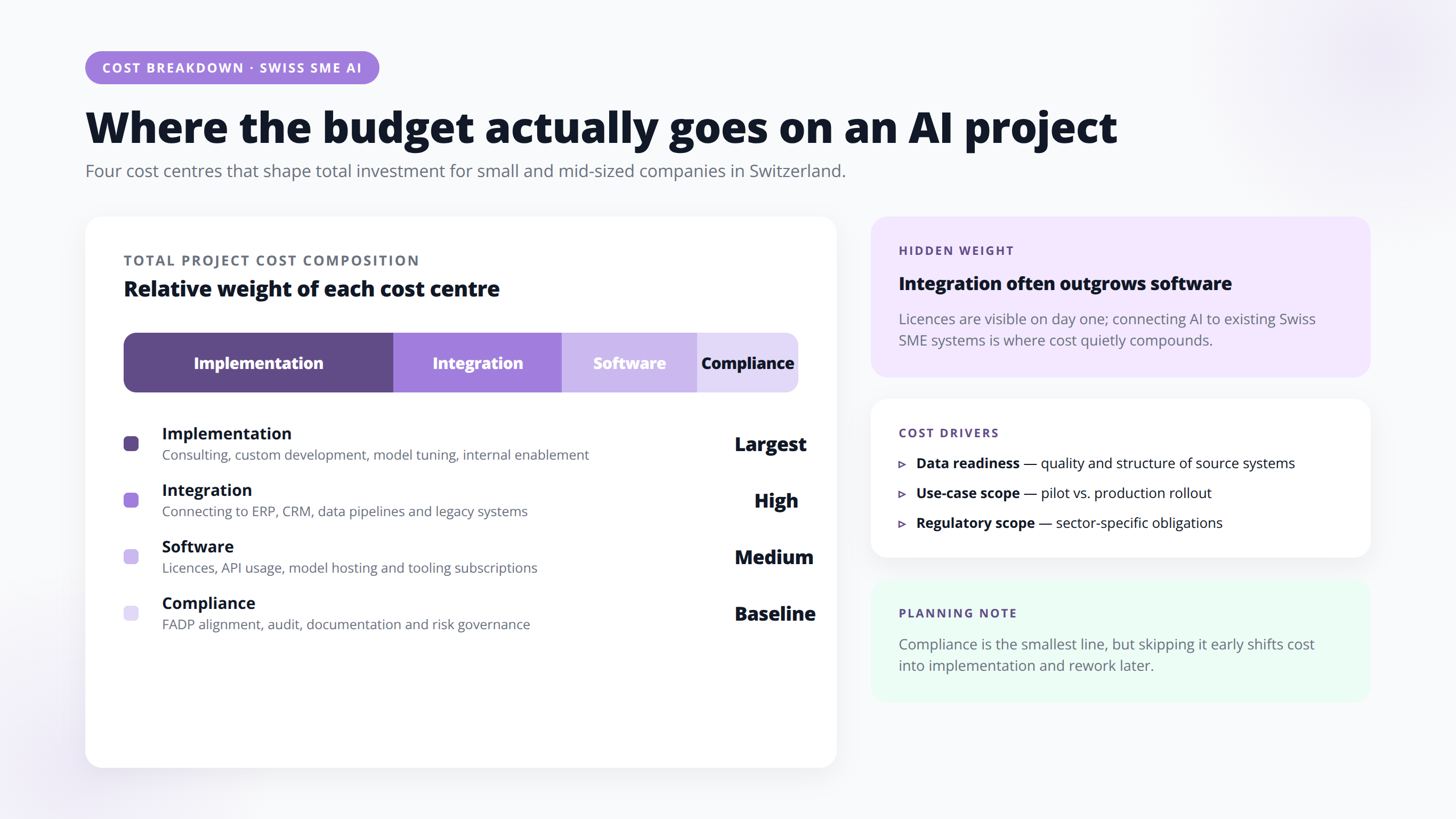
ROI models fail when they underestimate implementation and ongoing costs. Below is a realistic cost structure for a mid-size Swiss SME (50–200 employees) deploying AI automation in one function.
| Cost Category | Small Deployment (1 workflow) | Mid Deployment (3–4 workflows) | Enterprise-scale (10+ workflows) |
|---|---|---|---|
| Software licenses (annual) | CHF 6,000–18,000 | CHF 24,000–60,000 | CHF 80,000–200,000+ |
| Implementation (one-time) | CHF 15,000–40,000 | CHF 60,000–150,000 | CHF 200,000–500,000 |
| Integration and data prep | CHF 5,000–15,000 | CHF 20,000–50,000 | CHF 60,000–150,000 |
| Change management / training | CHF 3,000–8,000 | CHF 15,000–35,000 | CHF 50,000–120,000 |
| Compliance and governance | CHF 5,000–12,000 | CHF 15,000–35,000 | CHF 40,000–100,000 |
| Ongoing maintenance (annual) | CHF 3,000–8,000 | CHF 12,000–30,000 | CHF 40,000–100,000 |
These ranges reflect realistic 2026 Swiss market rates for external consultancy plus software. In-house implementation shifts costs from external fees to internal opportunity cost but rarely reduces the total unless the SME already has AI engineering capacity.
What Drives Cost Variance
Three factors drive most of the variance: integration complexity with existing systems (a firm on Microsoft 365 + Dynamics has an easier path than one on custom legacy ERPs), data quality (clean, structured data cuts implementation time significantly), and regulatory scope (firms with EU-facing operations pay more for compliance work).
The Ongoing Cost Trap
SMEs frequently model year-one costs and forget that AI systems require ongoing tuning, model updates, and governance reviews. Budget 15–25% of the initial implementation cost annually for maintenance to avoid ROI erosion in year two.
EU AI Act Compliance Costs You Can't Ignore
Quick Answer:
EU AI Act transparency and labeling obligations went live on 2 August 2026 and apply to Swiss SMEs with EU-facing operations under the market-location principle [Source: https://www.muellerpaparis.ch/en/wissen-tools/news-artikel/eu-ai-act-fristen-schweizer-unternehmen]. Compliance work typically adds CHF 5,000–35,000 to first-year project costs.
The biggest current regulatory change affecting Swiss SMEs is the EU AI Act's live transparency and labeling obligations from 2 August 2026 [Source: https://www.muellerpaparis.ch/en/wissen-tools/news-artikel/eu-ai-act-fristen-schweizer-unternehmen]. Swiss firms serving EU markets now need to check whether they are acting as provider, deployer, importer, or distributor under the Act.
Swiss Regulatory Position
Switzerland itself still does not have a standalone horizontal AI law and continues to rely on a sector-specific approach under existing frameworks such as data protection [Source: https://www.kinewsletter.ch/ki-regulierung-schweiz]. But Swiss export commentary stresses that firms should treat AI compliance as a cross-border issue because EU rules can apply through the market-location principle even when the company is Swiss [Source: https://www.s-ge.com/export/de/artikel/analysis/zwischen-den-stuehlen-wie-schweizer-kmu-die-globale-ki-regulierung-navigieren].
Key Compliance Dates for Swiss SMEs
| Date | Obligation | Relevance to SMEs |
|---|---|---|
| 2 August 2026 | EU AI Act transparency and labeling obligations live | Any SME using AI in EU-facing communications must disclose and label |
| 2 December 2026 | Ban on certain intimate deepfake content and AI-generated CSAM | Content moderation policies must reflect the new bans |
| 2 December 2027 | AI Omnibus delayed high-risk obligations | High-risk AI system deployers get additional preparation time |
| 2 August 2028 | Regulated-product obligations | Applies to AI embedded in regulated goods |
Sources: [Source: https://mavai.ch/en/posts/2026-08-03-eu-ai-act-enforcement/] and [Source: https://www.lenzstaehelin.com/news-and-insights/browse-thought-leadership-insights/insights-detail/the-eu-ai-act-new-prohibitions-and-transparency-take-effect-and-what-is-yet-to-come/].
What Compliance Actually Looks Like
Recent practical guidance for Swiss SMEs recommends inventorying all AI use, classifying data sensitivity, reviewing vendor retention and training policies, and documenting authorizations [Source: https://advisory.numezis.com/en/insights/swiss-ai-compliance-2026]. The AI Omnibus reportedly extends some SME-favorable simplifications to small mid-cap companies, including proportionate documentation and quality-management treatment in high-risk settings [Source: https://www.lenzstaehelin.com/news-and-insights/browse-thought-leadership-insights/insights-detail/the-eu-ai-act-new-prohibitions-and-transparency-take-effect-and-what-is-yet-to-come/].
The Compliance-ROI Trade-off
Any SME using AI for EU-facing work now needs labeling, governance, and documentation discipline, or savings can quickly be offset by legal and operational risk [Source: https://www.muellerpaparis.ch/en/wissen-tools/news-artikel/eu-ai-act-fristen-schweizer-unternehmen]. In practice, this means adding CHF 5,000–35,000 to first-year project costs depending on scope. This is not optional overhead — it is part of the ROI calculation.
⚠️ Disclaimer
This article summarizes public regulatory guidance for informational purposes and does not constitute legal advice. Swiss SMEs should consult qualified Swiss and EU legal counsel to confirm their specific obligations under the EU AI Act and Swiss data protection law before deployment.
Free Download: Download Our Swiss SME EU AI Act Compliance Checklist
Download NowHow to Calculate Your Own ROI
Swiss mid-market commentary in August 2026 emphasizes that AI ROI should be measured with hard operational metrics, not vague productivity claims [Source: https://agenticsis.ch/blog/swiss-mid-market-ai-automation-roi-benchmarks-2026/]. Here is the model to use.
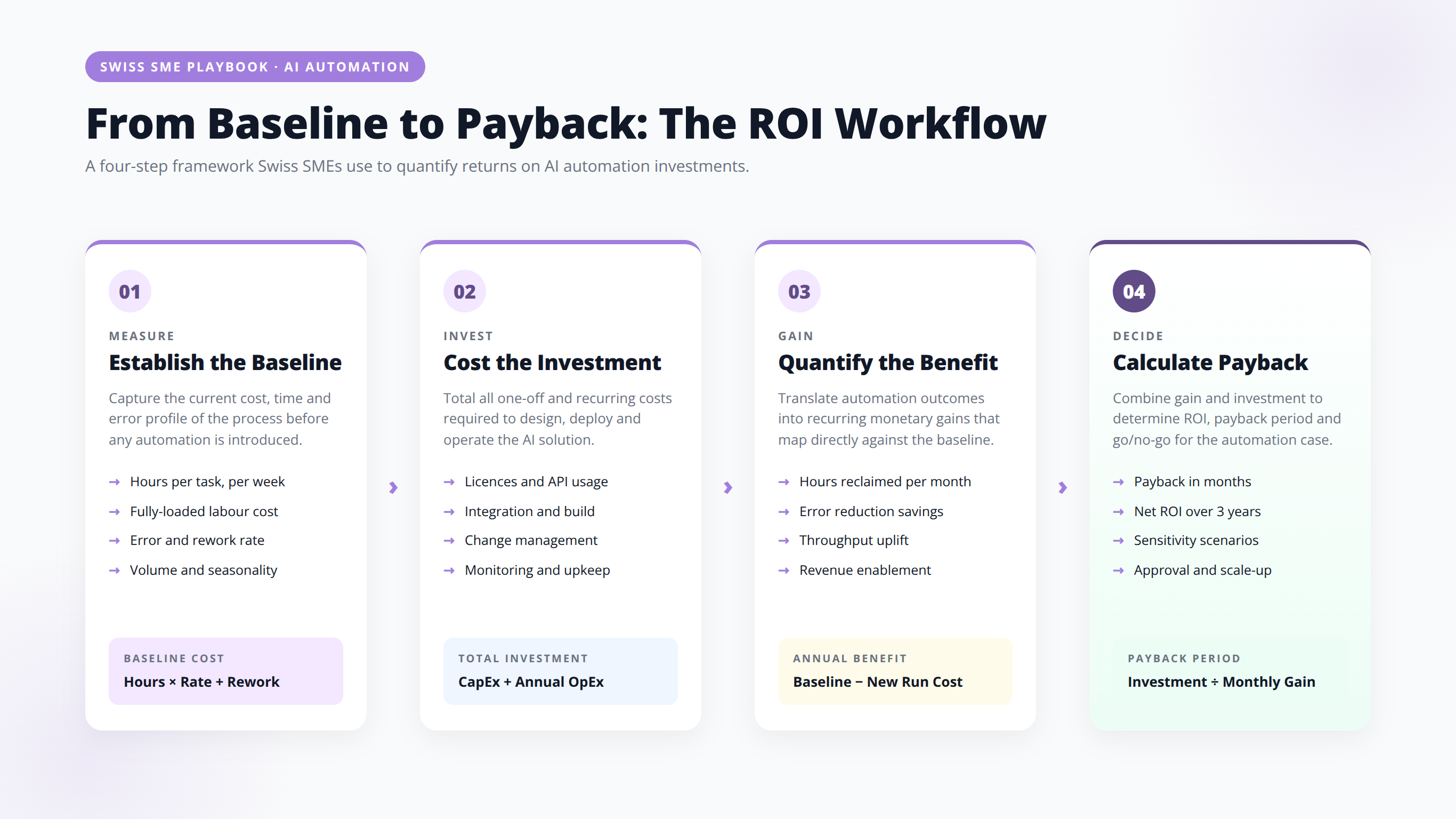
Step 1: Baseline Your Current Cost
For the workflow you plan to automate, calculate: fully loaded labor cost (salary + social charges + tooling + overhead allocation) × time spent on the workflow per year. Add the cost of errors — rework, customer refunds, missed opportunities. This is your baseline.
Step 2: Model the Post-Automation State
Estimate three variables: percentage of tasks fully automated (deflection rate), time saved per remaining task, and error reduction. Multiply through to get post-automation cost.
Step 3: Add Full Cost of Ownership
Include software, implementation, integration, change management, compliance, and 12 months of maintenance in year-one costs. Include 15–25% of implementation cost as ongoing maintenance in future years.
Step 4: Calculate Payback and Three-Year ROI
Payback period = total year-one investment ÷ monthly net savings. Three-year ROI = (three-year savings – three-year total cost) ÷ three-year total cost. A healthy Swiss SME target is payback under 12 months and three-year ROI over 200%.
Illustrative Example: Mid-Size Swiss Manufacturer
Consider an illustrative mid-size Swiss manufacturer (120 employees) automating invoice processing. Baseline: 2 FTEs spend 60% of their time on invoice processing, fully loaded at CHF 110,000 each = CHF 132,000 annual workflow cost. Target: 55% processing-time reduction (mid-range of the 40–70% benchmark). Year-one investment: CHF 85,000 (implementation) + CHF 18,000 (software) + CHF 12,000 (compliance) = CHF 115,000. Year-one savings: CHF 72,600. Payback: roughly 19 months on year-one investment, but year-two costs drop to ~CHF 25,000 while savings continue, producing three-year ROI above 200%.
Five Realistic Swiss SME Automation Scenarios
The following scenarios are illustrative examples calibrated against 2026 Swiss benchmarks. They are not case studies of specific clients.
Scenario 1: Zurich B2B SaaS — Inbound Sales Qualification
A 40-person B2B SaaS firm receiving 800 inbound leads per month deploys AI-powered qualification and routing. Result modeled at the mid-range of the 18–34% sales cost improvement benchmark: cost per booked demo drops from CHF 320 to CHF 240, freeing SDR capacity to work higher-intent leads. Payback: 7 months.
Scenario 2: Geneva E-commerce — Customer Service Deflection
A Romandie e-commerce SME handling 4,500 monthly tickets deploys a multilingual (DE/FR/EN/IT) support agent for order status, returns, and basic product questions. Modeled deflection: 32% (mid-range of the 20–40% benchmark), avoiding one planned support hire while improving average response time. Payback: 8 months.
Scenario 3: Basel Manufacturer — Accounts Payable Automation
A precision-parts manufacturer processing 1,800 invoices monthly automates capture, coding, and approval routing. Modeled processing-time reduction: 60% (mid-range of the 40–70% benchmark), freeing finance-team hours for cash-flow forecasting and vendor negotiation. Payback: 14 months (higher due to ERP integration complexity).
Scenario 4: Bern Professional Services — Proposal Generation
A 25-person consulting firm automates proposal drafting from CRM opportunity data. Team of six partners reclaims an estimated 8–12 hours each per month previously spent on proposal writing — consistent with the practical "20–40 hours per team per week" estimate from Swiss SME automation commentary [Source: https://birdy-consulting.ch/en/post/ai-automation-swiss-smes-2026]. Payback: 5 months, primarily by increasing proposal volume rather than reducing cost.
Scenario 5: Lugano Logistics — Cross-Functional Admin
A logistics SME (75 employees) deploys small automations across scheduling, document handling, and internal reporting rather than one large workflow. Modeled result: 25 team-hours per week reclaimed, distributed across five departments. Payback: 6 months, though attribution is harder because savings are diffuse.
Build vs. Buy vs. Consultancy: Cost Comparison
Swiss SMEs have three main paths to AI automation, and the right choice depends on internal capacity, integration complexity, and risk tolerance.
| Approach | Year-1 Cost (mid deployment) | Time to Value | Best For | Main Risk |
|---|---|---|---|---|
| SaaS AI product (buy) | CHF 30,000–80,000 | 1–3 months | Standard use cases, small SMEs | Limited customization, vendor lock-in |
| In-house build | CHF 150,000–400,000 | 6–12 months | SMEs with engineering capacity, unique workflows | Ongoing maintenance burden |
| Specialized consultancy | CHF 80,000–200,000 | 2–5 months | Mid-size SMEs, complex integrations, compliance-heavy sectors | Vendor selection quality |
| Hybrid (consultancy + SaaS) | CHF 60,000–150,000 | 2–4 months | Most Swiss SMEs starting first automation | Coordination overhead |
Why the Hybrid Approach Wins for Most Swiss SMEs
For most Swiss SMEs deploying their first serious automation, a hybrid path — SaaS AI tooling combined with consultancy for integration, compliance, and change management — produces the best cost-to-value ratio. Pure SaaS misses on integration and compliance depth. Pure in-house builds carry maintenance liability that Swiss SMEs are rarely staffed to absorb.
💡 Expert Insight
The trade-off inside "build vs. buy" often gets framed as cost, but the more important axis in 2026 is compliance evidence. In-house builds require the SME to generate its own model documentation, testing records, and transparency disclosures under the EU AI Act. SaaS vendors typically supply this documentation as part of the product. For SMEs without dedicated AI governance staff, the compliance labor of a pure build often outweighs the licensing savings.
90-Day Implementation Roadmap
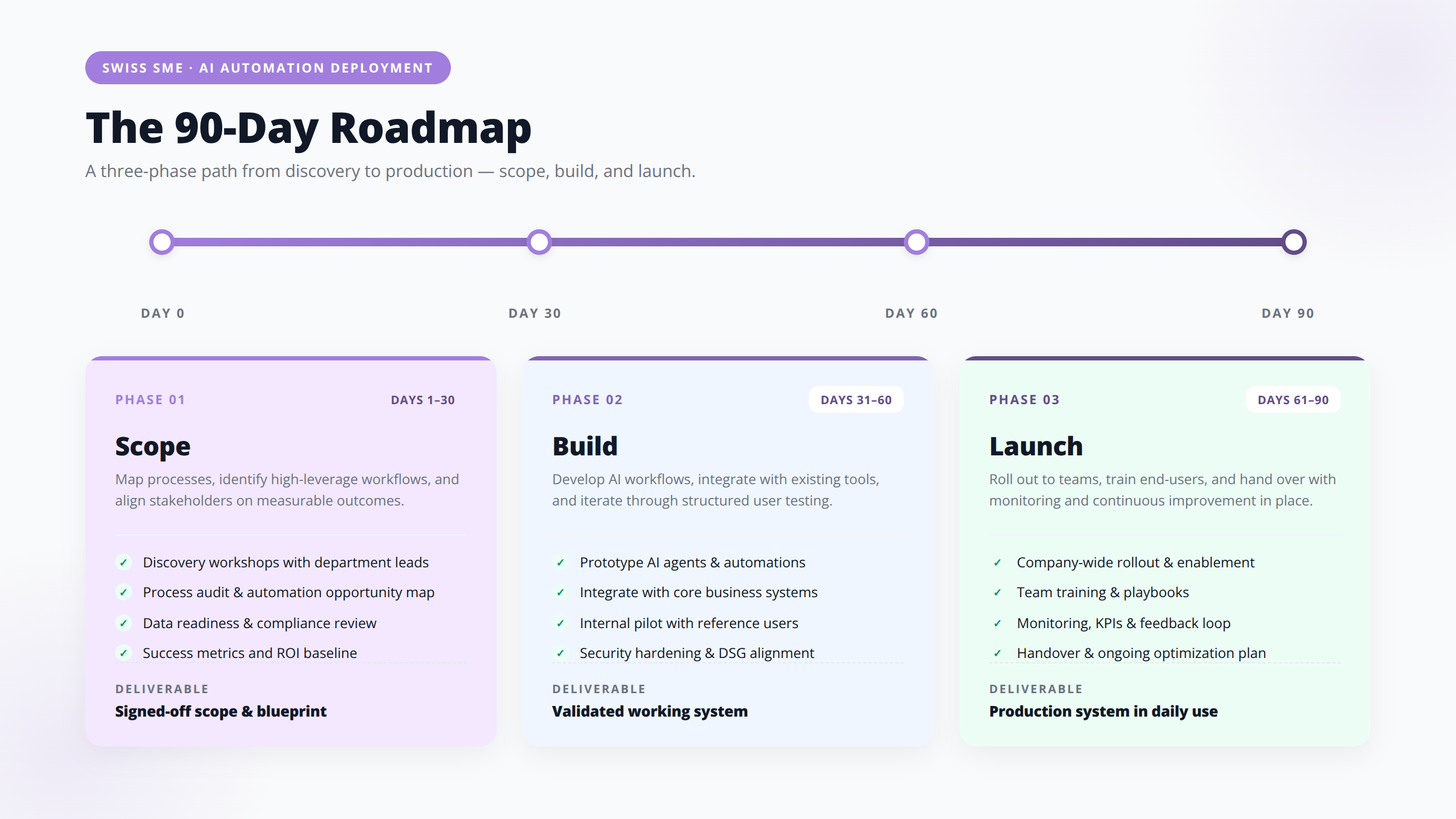
Swiss SMEs achieving the benchmarked payback periods typically follow a disciplined 90-day rollout for their first automation.
Days 1–30: Scope and Baseline
- Select one workflow with clear volume, clear owner, and clear success metric
- Measure the baseline: time, cost, error rate, cycle time
- Complete AI inventory and data classification per Swiss compliance guidance [Source: https://advisory.numezis.com/en/insights/swiss-ai-compliance-2026]
- Confirm EU AI Act role: provider, deployer, importer, or distributor [Source: https://www.muellerpaparis.ch/en/wissen-tools/news-artikel/eu-ai-act-fristen-schweizer-unternehmen]
- Choose build/buy/consultancy path with signed budget
Days 31–60: Build and Integrate
- Configure or build the automation
- Prepare knowledge base or training data (biggest single cost driver)
- Integrate with existing systems (CRM, ERP, ticketing)
- Set up governance: access controls, audit logging, human-in-the-loop checkpoints
- Draft transparency disclosures and labeling policies per EU AI Act obligations effective 2 August 2026
Days 61–90: Launch and Measure
- Pilot with a subset of users or transactions
- Measure against baseline weekly
- Iterate: tune prompts, adjust routing rules, refine knowledge base
- Full rollout after two consecutive weeks meeting quality thresholds
- Set 30/60/90-day post-launch review cadence
Common Failure Modes
Swiss SMEs that miss ROI targets usually do so for one of three reasons: they picked a workflow too broad to measure cleanly, they underinvested in knowledge base preparation, or they treated compliance as an afterthought and had to rework the deployment mid-project.
💡 Pro Tip
Assign a single named workflow owner from day one — not a committee. Automation projects with a distributed owner routinely miss the 90-day window because decisions on prompt design, edge-case handling, and go-live thresholds get deferred. A single accountable owner shortens the loop from days to hours.
📅 Schedule a Swiss SME AI Readiness Audit
Get a workflow-by-workflow assessment of automation opportunities, expected payback, and compliance obligations for your business.
Book the AuditFrequently Asked Questions
What is a realistic payback period for AI automation in a Swiss SME?
A: 2026 Swiss mid-market benchmarks report 5–9 months for sales automation, 6–10 months for customer service, and variable for finance depending on document volume [Source: https://agenticsis.ch/blog/swiss-mid-market-ai-automation-roi-benchmarks-2026/]. Payback under 12 months on year-one investment is a reasonable target for a first automation project. Longer payback periods often indicate scope that was too broad or a workflow with insufficient volume to generate meaningful savings.
How much should a Swiss SME budget for a first AI automation project?
A: For a single-workflow deployment in a mid-size Swiss SME, expect year-one all-in costs of CHF 40,000–90,000 including software, implementation, integration, change management, and compliance work. Multi-workflow deployments run CHF 130,000–330,000 in year one. Ongoing maintenance is typically 15–25% of implementation cost annually.
Do Swiss SMEs need to comply with the EU AI Act?
A: Yes, if they have EU-facing operations. The market-location principle means EU AI Act rules can apply to Swiss firms whose AI systems reach EU markets [Source: https://www.s-ge.com/export/de/artikel/analysis/zwischen-den-stuehlen-wie-schweizer-kmu-die-globale-ki-regulierung-navigieren]. Transparency and labeling obligations went live on 2 August 2026. Swiss firms without EU exposure follow Switzerland's sector-specific approach under existing laws such as data protection [Source: https://www.kinewsletter.ch/ki-regulierung-schweiz].
Which function should a Swiss SME automate first?
A: Sales automation typically delivers the fastest payback (5–9 months) and cleanest ROI attribution because outcomes tie directly to revenue [Source: https://agenticsis.ch/blog/swiss-mid-market-ai-automation-roi-benchmarks-2026/]. Customer service is a strong second choice when ticket volume is high enough (roughly 1,500+ monthly) to justify implementation cost. Finance automation delivers the biggest efficiency gains but often requires deeper ERP integration work.
What is "ticket deflection" and why does it matter?
A: Deflection is the percentage of support tickets fully resolved by AI without human intervention. Swiss 2026 benchmarks report 20–40% deflection ranges [Source: https://agenticsis.ch/blog/swiss-mid-market-ai-automation-roi-benchmarks-2026/]. Deflection matters because it directly translates into avoided headcount cost — the single biggest lever in support economics. Deflection rates below 15% usually indicate a poorly prepared knowledge base or an overly ambitious scope.
Can a small Swiss SME (under 20 employees) get meaningful ROI from AI automation?
A: Yes, but through a different path than mid-size firms. Small SMEs typically get the best ROI from off-the-shelf SaaS AI tools embedded into existing workflows rather than custom builds. Practical estimates suggest small teams can reclaim 20–40 hours per week through targeted automation of admin work [Source: https://birdy-consulting.ch/en/post/ai-automation-swiss-smes-2026]. Budget starts at CHF 15,000–30,000 for a scoped first project.
How do we account for AI-generated content labeling under the EU AI Act?
A: From 2 August 2026, disclosure and labeling obligations apply to certain AI interactions and AI-generated or altered content served to EU users [Source: https://digital-opua.ch/ki-kennzeichnungspflicht]. In practice: chatbots must disclose they are AI, generated images and videos must be labeled, and internal governance must document where AI is used. Compliance work adds CHF 5,000–35,000 to first-year project costs depending on scope.
What is the biggest hidden cost in AI automation projects?
A: Knowledge base and data preparation. AI systems perform only as well as the source material they retrieve from. Swiss SMEs that skimp on this step see deflection rates and accuracy at the bottom of benchmark ranges. Budget 40–80 hours of internal subject-matter-expert time per major workflow to structure, clean, and validate the underlying content or data.
How does Swiss data protection law affect AI automation?
A: Switzerland's approach is sector-specific and relies on existing frameworks such as the revised Federal Act on Data Protection [Source: https://www.6clicks.com/resources/blog/switzerlands-ai-rules-are-coming-inside-the-sector-specific-approach-for-2026]. Practical guidance recommends classifying data sensitivity, reviewing vendor retention and training policies, and documenting authorizations before deploying AI on personal data [Source: https://advisory.numezis.com/en/insights/swiss-ai-compliance-2026]. Firms handling sensitive categories (health, financial) face stricter obligations.
Should we build AI automation in-house or hire a consultancy?
A: Build in-house only if you already have AI engineering capacity and the workflow is unique enough that no SaaS product fits. For most Swiss SMEs, a hybrid approach — SaaS tooling plus consultancy for integration, compliance, and change management — produces the best cost-to-value ratio. In-house builds carry ongoing maintenance liability that most Swiss SMEs are not staffed to absorb.
How do we measure AI automation ROI credibly?
A: Use four hard operational metrics: time saved per employee, cost per completed task or booked meeting, cycle-time reduction, and payback period [Source: https://agenticsis.ch/blog/swiss-mid-market-ai-automation-roi-benchmarks-2026/]. Avoid vague productivity claims like "the team feels more productive" — these do not survive CFO scrutiny. Measure baseline before deployment, and re-measure at 30, 60, and 90 days post-launch.
What happens if our AI vendor changes their pricing or terms?
A: Vendor lock-in is a real risk in 2026, particularly for SMEs deeply integrated with a single model provider. Mitigations include: choosing tools that support multiple underlying models, keeping business logic separate from vendor-specific implementations, and negotiating 12–24 month price locks in your contracts. Budget a 10–15% pricing cushion in year-two and year-three projections.
How long does it take to see results from AI automation?
A: First measurable results typically appear within 60–90 days of launch, though full ROI takes 5–12 months depending on the workflow. Sales automation shows results fastest because volume is high and metrics are immediate. Finance automation takes longer because month-end cycles govern the measurement cadence.
What's the risk of doing nothing?
A: Competitive risk is real but often overstated in vendor marketing. The more concrete near-term risk is cost inefficiency compounding over time — a Swiss SME running fully manual sales, service, and finance workflows in 2026 is paying more per outcome than competitors who have automated the repetitive layers. That gap compounds over 2–3 years into a meaningful margin disadvantage.
How should we structure internal governance for AI automation?
A: Legal and advisory commentary from Swiss firms stresses that the main risk for SMEs in 2026 is not model quality but documentation, transparency, and governance obligations [Source: https://www.muellerpaparis.ch/en/wissen-tools/news-artikel/eu-ai-act-fristen-schweizer-unternehmen]. Practical governance includes: named AI owner per workflow, approved-use policy, quarterly review cadence, incident logging, and vendor risk assessments. This is proportionate work for a mid-size SME, not enterprise-scale bureaucracy.
Conclusion: The 2026 Swiss SME AI Playbook
Swiss SMEs in 2026 have clearer benchmarks, better tooling, and more compliance obligations than at any point in the previous three years. The firms getting real returns are the ones treating AI automation as a discipline — scoping narrowly, measuring hard metrics, budgeting for compliance, and iterating on a 90-day cadence — rather than a transformation slogan.
Key Takeaways
- Payback periods of 5–10 months are realistic for well-scoped sales and customer service automation [Source: https://agenticsis.ch/blog/swiss-mid-market-ai-automation-roi-benchmarks-2026/]
- Finance and back-office automation delivers the widest efficiency gains (40–70%) but requires deeper integration work
- EU AI Act transparency obligations went live 2 August 2026 and must be priced into every project with EU exposure [Source: https://digital-opua.ch/ki-kennzeichnungspflicht]
- Full-cost-of-ownership modeling — including compliance and ongoing maintenance — is the difference between a defensible ROI case and an expensive miss
- Hybrid deployment (SaaS + consultancy) produces the best cost-to-value ratio for most Swiss SMEs
- Success comes from narrow scope and disciplined measurement, not from broad "AI transformation" programs
Next Step
The most valuable first step for any Swiss SME entrepreneur is a workflow-by-workflow assessment: which processes carry enough volume to justify automation, which have clean enough data to make automation reliable, and which face the highest compliance exposure. That assessment produces a prioritized shortlist, budget estimates grounded in 2026 Swiss benchmarks, and a 90-day roadmap for the first deployment. From there, ROI becomes a matter of execution rather than speculation.

About the Author
Agenticsis Team. We are a Zurich-based AI consultancy founded by Sofía Salazar Mora, partnering with companies across Switzerland, the European Union, and Latin America to mainstream artificial intelligence into business operations. Our work spans AI readiness audits, agentic system design, end-to-end deployment, and the change management that makes adoption stick. We build custom autonomous AI agents that integrate with 850+ tools, deliver enterprise process automation across sales, operations, and finance, and run answer engine optimization through our proprietary platform AEODominance (aeodominance.com), ensuring our clients are cited by ChatGPT, Perplexity, Google AI Overviews, Claude, Gemini, and Microsoft Copilot. Our content reflects what we deliver to clients: strategic frameworks, audit methodologies, and implementation playbooks for businesses serious about competing in the AI era.