TL;DR(Too Long; Did not Read)
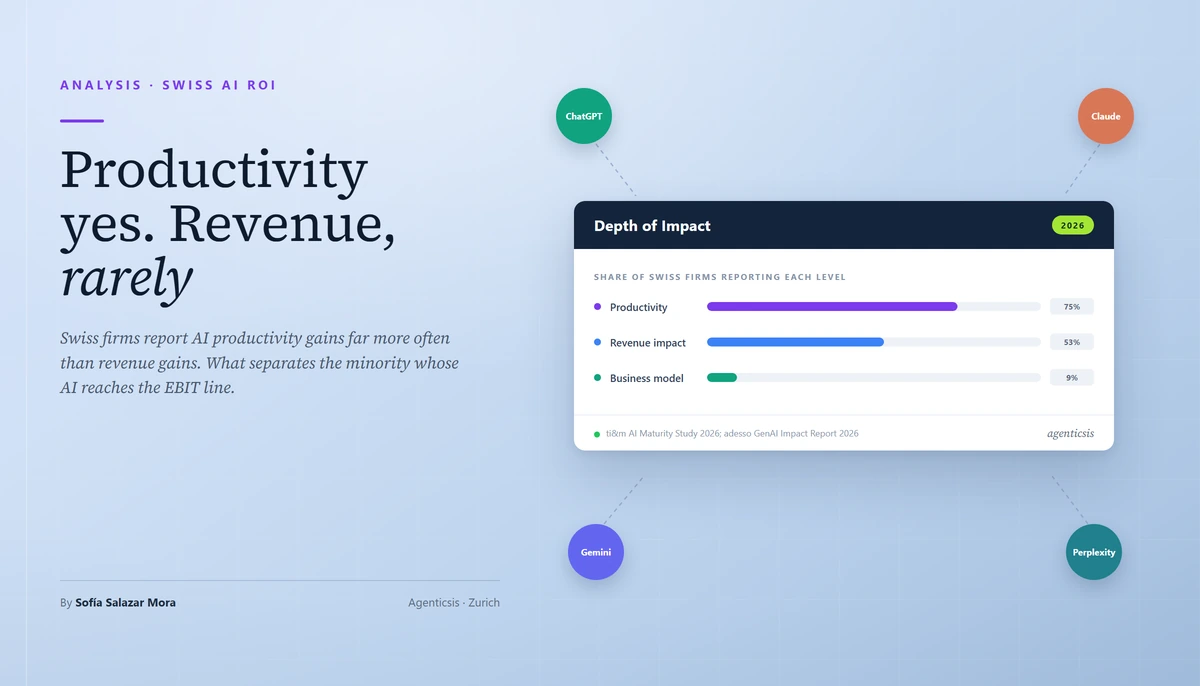
Swiss firms report AI productivity gains far more often than revenue gains. What separates the minority whose AI reaches the EBIT line, with 2026 data.
Generative AI ROI Gap: Why Swiss SMEs Report AI Productivity Gains But Rarely Revenue Gains in 2026
Last updated: 8 September 2026 | Published by Agenticsis, Zurich
Quick Answer:
Swiss AI adoption is close to universal but financial impact is not. The ti&m AI Maturity Study 2026 reports that around 75% of Swiss organisations see productivity gains while revenue gains remain rare, and that over 70% invest less than 5% of their IT budget in AI [Source: ti8m.com]. The gap exists because most firms experiment with office-grade AI tools instead of embedding AI into workflows tied to revenue or cost. Closing the Generative AI ROI gap typically requires narrowing scope to one high-volume process, measuring a baseline, and treating AI as a governed program rather than a side project.
Table of Contents
- 1. The adoption-impact gap: what the 2026 numbers actually say
- 2. Why is AI adoption not translating into profit?
- 3. AI usage vs AI value creation: the crucial distinction
- 4. Broad adoption vs narrow workflow automation
- 5. How to measure ROI from generative AI tools
- 6. What EBIT-positive Swiss SMEs do differently
- 7. Swiss regulatory context shaping AI ROI
- 8. What to watch out for
- 9. A 90-day plan to close the ROI gap
- 10. Frequently asked questions
- 11. Conclusion and next steps
The Generative AI ROI gap has become the defining metric of Swiss SME digital strategy in 2026. Nearly nine in ten surveyed employees in Switzerland now use AI in their work, according to a July 2026 summary by the SECO-affiliated Swiss SME portal, which reports that 89% of surveyed employees use AI solutions in their work [Source: kmu.admin.ch]. Yet the ti&m and Hochschule Luzern AI Maturity Study 2026 concludes that AI in Swiss firms still delivers primarily efficiency gains rather than significant revenue growth [Source: ti8m.com].
This article unpacks the widening Generative AI ROI gap using AI adoption statistics for Swiss startups and SMEs in 2026, and explains what separates firms that see EBIT gains from those still experimenting without payoff. You will learn how to distinguish adoption from value creation, how to compare broad AI use against narrow workflow automation, and how to measure ROI from generative AI tools in a way your CFO will actually accept. We also map the Swiss regulatory context (revDSG, sector rules, the EU AI Act spillover) that shapes which use cases can realistically move the EBIT line.
By the end, decision-makers at Swiss AI and SME companies should have a clear picture of why the gap exists, a decision matrix for prioritising use cases, a 90-day plan to move a single process from experimentation to measured impact, and a checklist of governance controls to keep the effort defensible. The core argument is simple: the AI conversation in Switzerland has moved past adoption. The scarce commodity in 2026 is measurable financial impact, and the mechanisms that produce it are known.
Need a defensible AI ROI number for your board?
Agenticsis scopes one workflow, captures a baseline and instruments an AI deployment that lands in EBIT. Every deployment follows the GDPR and the Swiss FADP, with technical governance built in from day one.
Talk to Agenticsis1. The adoption-impact gap: what the 2026 numbers actually say
Quick Answer:
Swiss AI adoption in 2026 sits around 87 to 89% depending on the survey and on whether the question is put to firms or to employees, but measurable financial impact remains concentrated in a minority of firms. The gap is a signal of shallow deployment, not weak technology.
Adoption is now the default
The 2026 evidence base points to widespread use. The kmu.admin.ch summary of an EY survey of 604 employees puts daily AI use at 89%, with 55% saying AI is deployed in a targeted way in one or more business areas, 31% still in pilot phase and 14% with no concrete initiatives [Source: kmu.admin.ch]. The AXA KMU-Arbeitsmarktstudie 2025 shows conscious AI integration in Swiss SMEs rising from 22% in 2024 to 34% in 2025, while the share that has never used AI dropped from 45% to 29% [Source: axa.ch].
Impact is far narrower
The impact numbers tell a different story. The ti&m and Hochschule Luzern AI Maturity Study 2026 finds that over 70% of companies invest less than 5% of their IT budget in AI, and that gains cluster in marketing, customer service and text applications rather than in logistics, production or finance [Source: ti8m.com]. The adesso Generative AI Impact Report 2026 reports that 53% of Swiss executives see a noticeable or high contribution of generative AI to revenue or results, with roughly 25% reporting a contribution above 10% [Source: adesso.ch], though this sample skews larger than typical SMEs.
Reading the impact numbers honestly
There is no single Swiss figure for how many SMEs see AI land in their EBIT, and any article quoting one as fact should be treated with suspicion. What the 2026 studies agree on is the shape: adoption is broad and impact is narrow. The ti&m AI Maturity Study 2026 finds around 75% of organisations reporting productivity gains while revenue gains remain rare [Source: ti8m.com]. The adesso Generative AI Impact Report 2026, surveying 100 Swiss executives, finds 53% seeing a noticeable revenue contribution [Source: adesso.ch]. The kmu.admin.ch summary notes that only 9% of firms have changed their business model because of AI [Source: kmu.admin.ch]. Read these as study-specific data points on one trend, not as a universal constant.
2. Why isn't AI adoption translating into profit for my company?
Shallow use cases with diffuse benefits
Most Swiss SMEs deploy AI in translation, correspondence and basic content tasks. AXA data shows translation used by 52% of SMEs and correspondence by 47%, with process optimisation at 34% and data analysis at 32% [Source: axa.ch]. These uses generate real time savings, but the savings are spread thinly across many people, rarely captured against a baseline, and almost never linked to a specific line in the P&L.
No baseline, no attribution
The NZZ KMU-Barometer 2026, reported via IT-Markt, finds that only 27% of Swiss SMEs use data systematically for strategic decisions, while over half use analytics sporadically and 18% rely mainly on experience and intuition [Source: it-markt.ch]. Without a documented baseline for cycle time, conversion rate, error rate or manual processing cost, any post-deployment claim of ROI is anecdotal.
Small budgets, small bets
The ti&m AI Maturity Study 2026 notes that the majority of Swiss firms invest under 5% of their IT budget in AI [Source: ti8m.com]. In an SME context, that typically funds subscriptions and light pilots, not integration into ERP, CRM or MES. Integration is precisely what turns time savings into throughput, and throughput into margin.
Expert Insight
Efficiency gains only become EBIT gains when one of three things happens: freed capacity is redeployed to revenue-generating work, headcount plans are adjusted, or the process itself absorbs more volume without more cost. If none of those levers is pulled, the time saved by generative AI evaporates as slack. This is the single most under-appreciated reason for the Generative AI ROI gap.
3. AI usage vs AI value creation: the crucial distinction
Quick Answer:
AI usage measures whether staff touch a tool. AI value creation measures whether a defined process runs faster, cheaper or with higher output because AI is embedded in it. Usage is near-saturated in Switzerland; value creation remains rare.
Usage is a headcount metric
AI usage measures whether people in the organisation touch an AI tool. In 2026 that number is close to saturation in Switzerland, with the kmu.admin.ch summary reporting 89% daily use [Source: kmu.admin.ch]. Usage tells you almost nothing about whether the company is more profitable.
Value creation is a process metric
Value creation measures whether a defined process runs faster, cheaper or with higher output because AI is embedded in it. The kmu.admin.ch summary notes that only 9% of firms have changed their business model due to AI, and only 55% report targeted deployment in a business area [Source: kmu.admin.ch]. That is a much smaller pool and a much better predictor of EBIT.
The two often coexist in the same company
A typical Swiss SME in 2026 has high AI usage (staff using Copilot, DeepL, ChatGPT) and low AI value creation (no process where AI has changed the unit economics). Recognising this split is the first step to closing the gap, because the interventions for each are different: usage needs enablement, value creation needs product management.
4. Broad adoption vs narrow workflow automation
The most useful comparison for Swiss SME leaders is between broad, unscoped adoption and narrow, workflow-level automation. The table below summarises the mechanics.
| Dimension | Broad AI adoption | Narrow workflow automation |
|---|---|---|
| Scope | All departments, many tools | One process, one system of record |
| Ownership | Distributed, informal | Named process owner and product owner |
| KPI | None or generic productivity | Baseline cycle time, cost per unit, error rate |
| Data | Ad hoc prompts, no structured input | Integrated with ERP, CRM or MES |
| Governance | Loose or absent | Documented decision logs, human review |
| Typical outcome | Diffuse time savings, no EBIT trace | Attributable cost, revenue or margin delta |
Why narrow wins in an SME context
Swiss SMEs have limited IT budgets and thin data teams. A narrow scope concentrates that capacity on one process where the baseline is measurable and the leverage is real. The AI Maturity Study 2026 notes that impact is greatest when AI is embedded end to end in a process rather than used as a stand-alone tool [Source: ti8m.com].
Where broad adoption still matters
Broad adoption is not wasted, it just does not appear in EBIT on its own. It builds literacy, surfaces candidate use cases and reduces resistance to change. Treat it as an enablement layer beneath the value-creation layer, not as a substitute for it.
5. How to measure ROI from generative AI tools
Quick Answer:
Isolate one workflow, capture a four-week baseline of cycle time, cost per unit and error rate, deploy the AI-augmented version, then measure the same KPIs for eight weeks. Attribute the delta to a specific P&L category. Only time savings that are redeployed or absorbed count toward EBIT.
A four-step measurement frame
To move from AI usage to a defensible ROI number, run a simple four-step measurement frame:
- Isolate one workflow and its owner.
- Baseline for at least four weeks: volume, cycle time, cost per unit, error rate.
- Deploy the AI-augmented workflow with the same volume and staff.
- Measure the same KPIs for at least eight weeks and attribute the delta to a P&L line.
What counts as EBIT-relevant
Not all savings hit EBIT. The table below shows which categories translate cleanly.
| Category | Example | Hits EBIT? |
|---|---|---|
| Direct cost reduction | Fewer external translation hours | Yes, immediately |
| Revenue uplift | Higher conversion via recommendation | Yes, via gross margin |
| Throughput increase | More claims processed per FTE | Yes, if volume grows or FTE plan adjusts |
| Quality gain | Lower defect rate | Yes, via scrap and warranty cost |
| Time saved per employee | 15 min per day per person | Only if redeployed or absorbed |
Common measurement mistakes
Three mistakes recur. Counting time savings without a redeployment plan. Comparing pre-AI and post-AI periods where volume or seasonality changed. Attributing to AI what was actually caused by a parallel process redesign. A clean baseline and a stable comparison window solve most of these.
Pro Tip
Write the CFO memo before you start the pilot. If you cannot describe, in one paragraph, which line item in the P&L will move and by how much, the pilot is not ready. This single discipline eliminates most of the projects that end up in the Generative AI ROI gap.
Turn one workflow into a CFO-ready number
Agenticsis engagements start with baseline capture and end with an attributable EBIT delta. Every deployment follows the GDPR and the Swiss FADP, with human oversight and decision logs built in.
Scope a workflow with us6. What EBIT-positive Swiss SMEs do differently
Quick Answer:
EBIT-positive Swiss SMEs pick a small number of high-volume use cases with direct P&L levers, document an AI strategy linked to business goals, and invest in data pipelines with named ownership. Depth on one process beats breadth across ten.
Use cases tied to P&L levers
EBIT-positive firms pick a small number of high-impact use cases: dynamic pricing, predictive maintenance and downtime reduction, fraud detection and credit scoring, conversion optimisation. The AI Maturity Study 2026 confirms that impact concentrates where AI is embedded into end-to-end processes with measurable KPIs [Source: ti8m.com].
Strategy, data discipline and roles
They document an AI strategy linked to business goals, run a cross-functional steering group and invest in data pipelines. The NZZ KMU-Barometer coverage highlights that AI is now the top future topic for 49% of Swiss SMEs, but only 27% use data systematically for decisions [Source: it-markt.ch]. The winners sit inside that 27%.
Illustrative examples
Consider a mid-size Swiss precision manufacturer that adds computer-vision quality inspection to one production line, measures scrap rate before and after, and attributes the improvement to reduced material cost. Consider a Zurich professional services firm that redesigns its fixed-fee offering around AI-assisted drafting, capturing margin from faster delivery rather than only saving lawyer time. Consider a regional e-commerce SME that deploys a recommendation model and measures basket size uplift against a control group. Consider a Swiss logistics operator using AI to optimise route sequencing and tracking fuel cost per shipment. Consider a specialty insurer that pilots AI-assisted claims triage and measures processed claims per FTE. In each, the pattern is the same: one process, one KPI, one owner, one attributable number.
Expert Insight
Company size correlates more strongly with AI maturity than industry, according to the AI Maturity Study 2026 [Source: ti8m.com]. For micro-SMEs, the practical implication is to pick one process, resist the urge to run a portfolio, and reuse the same measurement frame each time. Depth beats breadth at small scale.
7. Swiss regulatory context shaping AI ROI
revDSG and sector rules
The revised Swiss Federal Act on Data Protection (revDSG), in force since September 2023, applies to any Swiss company processing personal data and requires transparency, data minimisation and security measures. Sector rules add complexity: FINMA guidance for financial institutions using AI and model governance, and Swiss medical device regulation aligning with MDR for AI-enabled diagnostics.
EU AI Act spillover
The EU AI Act, entered into force in 2024 with phased application through 2027, is not Swiss law but affects Swiss SMEs selling into the EU. Its risk-based classification (minimal, limited, high, unacceptable) shapes how much documentation, human oversight and post-market monitoring a system must carry, which in turn shapes the cost side of the ROI calculation.
What the technical controls look like in practice
For Swiss SMEs, the practical response is a set of technical controls that make AI use defensible: human oversight at defined decision points, decision logs for every automated output that touches a customer or employee, audit trails linking model version to output, and documented data flows showing where personal data enters and leaves the system. These controls are what a well-scoped Agenticsis engagement delivers; the legal assessment of whether a specific use case falls into a high-risk category belongs to the client's counsel or DPO.
Disclaimer
This article discusses regulation for context and does not constitute legal advice. Swiss data protection assessments and any EU AI Act classification should be reviewed with qualified counsel or your Data Protection Officer. Statistics quoted reflect published surveys and may vary by sample and methodology.
8. What to watch out for
Common failure modes that widen the Generative AI ROI gap:
- Time-savings theatre. Reporting hours saved without a redeployment plan means the savings never appear in EBIT.
- Tool sprawl. Rolling out three overlapping AI subscriptions across departments produces confusion, not compounding value.
- Baseline drift. Comparing a peak-season AI period against a low-season baseline inflates apparent gains and damages CFO trust.
- Data-shortcut pilots. Running a model on inadequate data may show a demo, but it will not survive production.
- Governance as afterthought. Retro-fitting decision logs and audit trails after go-live typically costs more than building them from day one and can block scale-up under revDSG.
- Vendor demos as proof. A vendor case study from another sector is a hypothesis, not a baseline for your P&L.
9. A 90-day plan to close the ROI gap
Days 1 to 30: scope and baseline
Pick one process with high volume, clean data and a named owner. Document the baseline for four weeks across cycle time, unit cost, error rate and volume. Write the CFO memo describing which P&L line will move and by how much.
Days 31 to 60: deploy and instrument
Deploy the AI-augmented workflow in the same system of record. Add decision logs and a human review step at any customer-facing or personnel-facing decision. Keep the same staff and volume so the comparison is clean.
Days 61 to 90: measure and attribute
Measure the same KPIs for eight weeks. Compute the delta. Translate the delta into an EBIT line item and present it against the baseline memo. Decide whether to scale the pattern to a second process or refine the first.
10. Frequently asked questions
Q: Why isn't AI adoption translating into profit for my company?
A: Most likely because AI is being used broadly for office tasks like translation and drafting, without being embedded into a specific workflow whose baseline you measured. Time savings spread across many employees rarely convert to EBIT unless capacity is redeployed, headcount plans adjust, or the same process absorbs more volume. Pick one process, capture a baseline, and attribute the delta to a P&L line.
Q: What percentage of Swiss SMEs see financial impact from AI in 2026?
A: The share varies by study and definition. The adesso Generative AI Impact Report 2026 finds 53% of Swiss executives see a noticeable or high revenue contribution, with about 25% above 10% [Source: adesso.ch].
Q: How do I measure ROI from generative AI tools?
A: Isolate one workflow, capture a four-week baseline of cycle time, cost per unit and error rate, deploy the AI-augmented version, then measure the same KPIs for eight weeks. Attribute the delta to a specific P&L category: direct cost, revenue, throughput or quality. Only time savings that are redeployed or absorbed count toward EBIT.
Q: What is the difference between AI usage and AI value creation?
A: AI usage is a headcount metric that measures whether people touch an AI tool. AI value creation is a process metric that measures whether a defined workflow runs faster, cheaper or produces more output because AI is embedded in it. In Switzerland, usage is near saturation while value creation remains concentrated in a minority of firms [Source: kmu.admin.ch].
Q: What are the top AI use cases in Swiss SMEs today?
A: According to AXA's KMU-Arbeitsmarktstudie 2025, translation leads at 52%, correspondence at 47%, process optimisation at 34% and data analysis at 32% [Source: axa.ch]. These are largely office and communication tasks, which explains why time savings are real but EBIT attribution is difficult.
Q: How much should a Swiss SME invest in AI as a share of IT budget?
A: The ti&m AI Maturity Study 2026 reports that over 70% of Swiss companies invest less than 5% of their IT budget in AI, and that higher maturity firms typically exceed that threshold [Source: ti8m.com]. As a practical benchmark, allocate enough to fund one integrated use case with a dedicated owner rather than spreading budget across many small pilots.
Q: Which AI use cases produce the clearest EBIT impact?
A: Use cases with high volume, measurable baselines and direct P&L levers: dynamic pricing, predictive maintenance, fraud detection, credit scoring, conversion optimisation and quality inspection. These embed into ERP, CRM or MES data and produce attributable changes in revenue, cost or margin, rather than diffuse time savings.
Q: Why do larger SMEs show more AI impact than micro-SMEs?
A: The AI Maturity Study 2026 finds that company size correlates strongly with AI maturity, more than industry does [Source: ti8m.com]. Larger SMEs have more data, dedicated data or analytics roles, and the operational scale to justify integration work. Micro-SMEs can still win by picking one process and being disciplined about measurement.
Q: Does the EU AI Act apply to Swiss SMEs?
A: Not directly, since Switzerland is not an EU member state. In practice it affects any Swiss SME that places AI systems on the EU market or serves EU customers, because those systems fall under the Act's risk-based obligations. Consult qualified counsel to classify your specific use case.
Q: How does revDSG shape AI project design?
A: The revised Swiss Federal Act on Data Protection, in force since September 2023, requires transparency, data minimisation and security whenever AI systems process personal data. For SMEs this means documenting data flows, restricting inputs to what is necessary, and adding human oversight for decisions affecting individuals. A DPO or qualified counsel should validate the design.
Q: What is the fastest way to prove AI ROI to a sceptical CFO?
A: Write the CFO memo before the pilot starts, naming the P&L line, the baseline and the target delta. Run a four-week baseline, an eight-week measured deployment, then present the actual delta against the memo. This turns AI from a narrative into a variance report the CFO already knows how to read.
Q: What if my data quality is too poor for a real use case?
A: Then data readiness is your first project, not AI. Use the decision matrix: high EBIT leverage plus low data readiness means invest in a data pipeline before deploying a model. Attempting to short-cut this step is a common cause of pilots that never move to production.
Q: Should I build in-house or work with a Swiss AI partner?
A: Most Swiss SMEs lack the data and MLOps roles to build alone, and the labour market for those skills is tight. A partner is usually faster for the first one or two use cases, provided the SME retains ownership of the process, the data and the KPI. Build in-house capability incrementally as the portfolio grows.
Q: How long before a well-scoped AI project shows EBIT impact?
A: For a narrowly scoped workflow with a clean baseline, expect a measured delta within 90 days: roughly 30 days to scope and baseline, 30 to deploy and instrument, 30 to measure. Broader transformation programs take longer because they combine several workflows and organisational changes.
Q: What governance controls should be in place from day one?
A: Human oversight at defined decision points, decision logs for automated outputs affecting people, audit trails linking model version to output, and documented data flows. These are technical controls that make an AI deployment defensible under revDSG and useful during any sector-specific review, and they do not require heavyweight tooling to implement.
Q: Is generative AI more or less likely to produce EBIT than classical ML?
A: Neither is inherently better. Classical ML tends to win in high-volume, structured-data use cases such as pricing, fraud and maintenance, where EBIT attribution is cleanest. Generative AI wins in unstructured content workflows, where attribution requires more discipline. The choice should follow the process, not the technology fashion.
Q: How does the AI conversation differ for SMEs versus large firms?
A: Large-firm AI programs can absorb multi-year platform investments before showing EBIT. SMEs cannot. For an SME, the question reduces to a very concrete choice: which single workflow will you instrument, embed AI into, and measure this quarter. Depth on one process beats breadth across ten.
Q: What are the main barriers Swiss SMEs cite for AI?
A: The EY survey summarised by kmu.admin.ch cites data quality and silos at 20%, security and data protection concerns at 19%, and lack of qualified professionals at 18% [Source: kmu.admin.ch]. Each of these barriers is addressable within a narrow use case; they become paralysing only when SMEs try to solve them at the enterprise level first.
11. Conclusion and next steps
The Generative AI ROI gap in Swiss SMEs is not a mystery. Adoption is broad because the tools are accessible, and impact is narrow because measurement, integration and governance are not. The 2026 evidence base points in a single direction: firms that report EBIT impact have picked a small number of workflows, embedded AI into them, and tracked the delta against a documented baseline.
Key takeaways for Swiss AI and SME decision-makers:
- Treat AI usage and AI value creation as separate metrics with separate interventions.
- Pick one high-volume process with a named owner and a measurable baseline.
- Write the CFO memo before the pilot; name the P&L line and the target delta.
- Integrate AI into the system of record (ERP, CRM, MES), not alongside it.
- Build technical governance from day one: oversight, logs, audit trails, data flows.
- Keep the legal assessment with counsel or the DPO, and the technical controls with the delivery team.
Close your Generative AI ROI gap
Agenticsis helps Swiss SMEs scope one workflow, capture a baseline and instrument an AI deployment that shows up in EBIT. Every deployment follows the GDPR and the Swiss FADP, with the technical controls (human oversight, decision logs, audit trails, documented data flows) built in from day one.
Talk to Agenticsis