TL;DR(Too Long; Did not Read)
How Switzerland's sector-specific AI rules compare to the EU AI Act. What Swiss SME CEOs must do before the 2027 consultation draft.
Switzerland's AI Convention Ratification: Will Sector-Specific Rules Beat an EU-Style AI Act for Swiss SMEs by 2027?
Last updated: September 29, 2026 · Fact-checked by Agenticsis regulatory research team · 12-minute read
Quick Answer:
Yes—based on the Federal Council's confirmed direction, Switzerland's sector-specific approach will beat an EU-style AI Act for domestic Swiss SMEs by 2027. On 23 September 2026, the Swiss government confirmed that a consultation draft to regulate AI will be drawn up by early 2027, implementing the Council of Europe AI Convention through targeted amendments to existing law—not a horizontal statute [Source: https://www.kmu.admin.ch/en/a-consultation-draft-to-regulate-ai-will-be-drawn-up-by-early-2027]. However, Swiss SMEs selling AI systems or general-purpose models into the EU still face the full EU AI Act, whose transparency provisions took effect in August 2026.
Table of Contents
- The State of Play: Where Switzerland Stands in September 2026
- What the AI Convention Ratification Actually Means
- Sector-Specific vs. Horizontal: The Regulatory Philosophy Split
- Swiss Model vs. EU AI Act: Side-by-Side for SME CEOs
- The FADP Baseline: What Already Applies to Your AI Today
- EU Market Spillover: When the EU AI Act Reaches Swiss SMEs
- Sector Triggers: Healthcare, Transport, HR, and Finance
- The CEO Roadmap: 2026–2027 Compliance Priorities
- Five SME Scenarios: How the Rules Play Out
- Risks of the Sector-Specific Approach
- Turning Regulatory Fragmentation into Competitive Advantage
- Frequently Asked Questions
Free Download: Preparing for the 2027 Swiss AI Consultation Draft?
Download NowThe State of Play: Where Switzerland Stands in September 2026
On 23 September 2026, the Swiss government confirmed what many CEOs had been waiting to hear: a consultation draft to regulate AI will be drawn up by early 2027, implementing the Council of Europe Framework Convention on Artificial Intelligence [Source: https://www.kmu.admin.ch/en/a-consultation-draft-to-regulate-ai-will-be-drawn-up-by-early-2027]. Crucially, that draft will not be an EU-style AI Act. It will be a package of targeted amendments to existing Swiss law, plus non-binding measures like self-regulation and voluntary guidance.
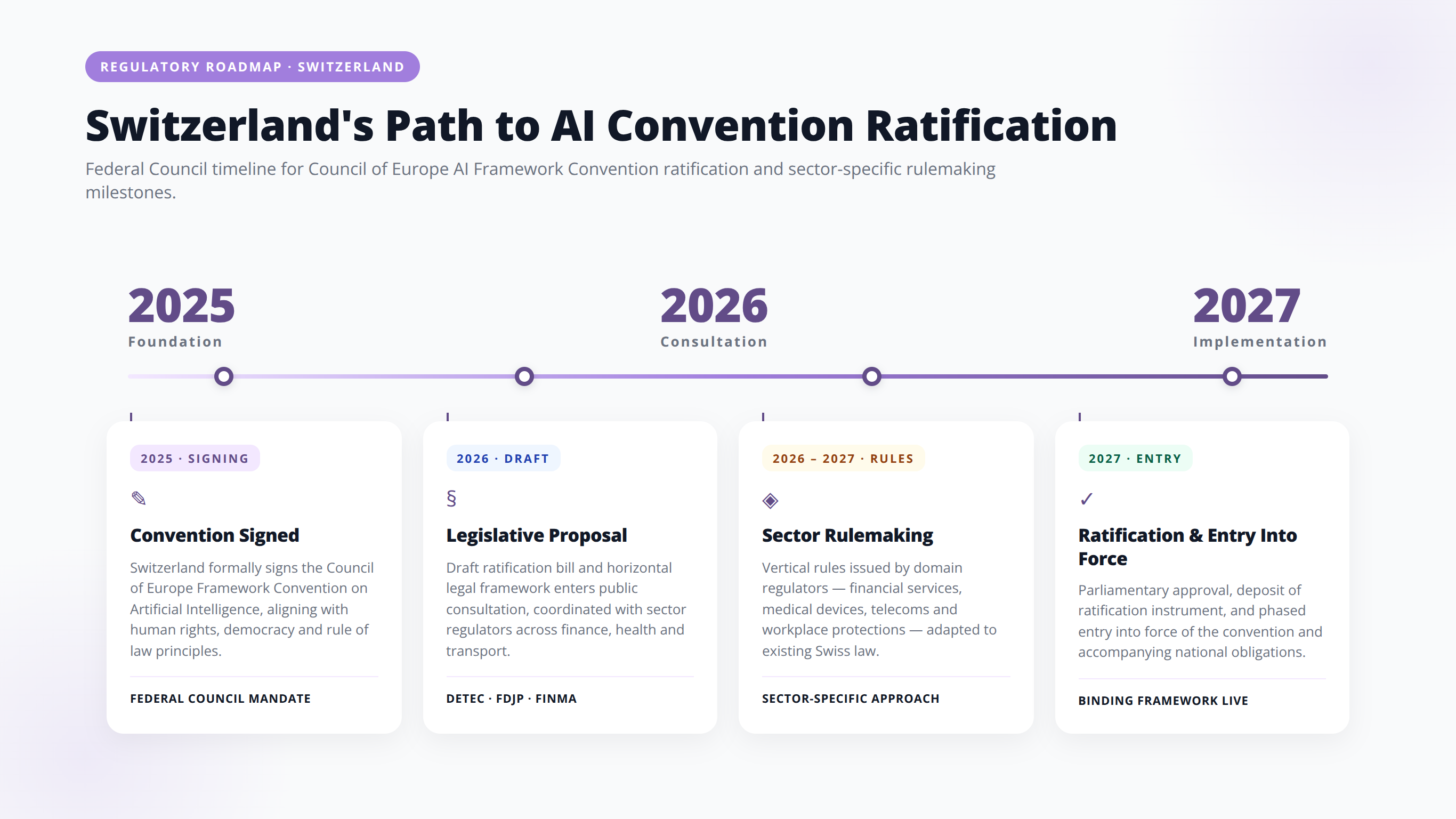
For Swiss SMEs, this is a pivotal moment. Switzerland currently has no overarching AI law in force. AI is governed by existing rules—principally the revised Federal Act on Data Protection (FADP) and sector-specific regulations covering finance, healthcare, transport, and employment [Source: https://www.kmu.admin.ch/en/a-consultation-draft-to-regulate-ai-will-be-drawn-up-by-early-2027]. The Federal Council's policy direction, set in February 2025, remains the framework: ratify the Convention, adjust specific laws where needed, avoid a single horizontal regime [Source: https://aipolicytracker.org/jurisdictions/switzerland].
Why This Matters for CEOs Right Now
The temptation is to wait. Draft not published, law not passed, no immediate action required. That reading is wrong for three reasons. First, existing law already applies—the FADP, sector rules, and general Swiss civil and contract law govern how your AI systems handle data and make decisions today. Second, if any part of your business touches the EU market, the EU AI Act already reaches you, with transparency provisions live since August 2026 [Source: https://www.kmu.admin.ch/en/a-consultation-draft-to-regulate-ai-will-be-drawn-up-by-early-2027]. Third, the consultation phase in 2027 is the moment where Swiss businesses can shape the sector-specific rules that will govern them for the next decade.
💡 Expert Insight
The single most misunderstood aspect of Switzerland's AI posture is the false equivalence between "no horizontal AI Act" and "no AI rules." The FADP already imposes concrete obligations on automated decision-making, cross-border transfers to non-adequate countries (including most US AI vendors), and DPIAs for high-risk processing. CEOs who wait for a "Swiss AI Act" are ignoring the obligations that bite today.
The Federal Council's Stated Priorities
The Swiss government has publicly identified four areas where future rules are likely to concentrate: transparency, data protection, non-discrimination, and supervision [Source: https://www.exporis.ch/switzerland-prepares-for-ai-regulation/]. Additional sector-specific measures are anticipated in healthcare and transport [Source: https://www.exporis.ch/switzerland-prepares-for-ai-regulation/]. These are the compliance vectors that CEOs should be mapping into their AI governance work now—not after the draft lands.
What the AI Convention Ratification Actually Means
Quick Answer:
Ratifying the Council of Europe AI Convention obliges Switzerland to ensure AI systems respect human rights, democracy, and the rule of law throughout the AI lifecycle. Unlike the EU AI Act, the Convention is principles-based—it does not prescribe technical requirements, risk tiers, or conformity assessments. Switzerland will implement it through targeted amendments to existing sector laws, with a consultation draft expected by early 2027.
The Council of Europe Framework Convention on Artificial Intelligence is the first international treaty on AI. Switzerland signed it in 2026, and the pending consultation draft will translate its obligations into Swiss law [Source: https://www.kmu.admin.ch/en/a-consultation-draft-to-regulate-ai-will-be-drawn-up-by-early-2027]. Unlike the EU AI Act, the Convention is a principles-based instrument. It focuses on protecting human rights, democracy, and the rule of law throughout the AI lifecycle—leaving each ratifying state to implement those principles through its own legal architecture.
Principles Over Prescription
The Convention obliges signatories to ensure that AI systems respect human dignity, individual autonomy, equality, non-discrimination, privacy, transparency, accountability, and reliability. It requires effective remedies for people harmed by AI and procedural safeguards for high-impact decisions. What it does not do is prescribe specific technical requirements, conformity assessments, or a risk-tier taxonomy.
This gives Switzerland flexibility. Rather than replicating the EU's four risk tiers (unacceptable, high, limited, minimal), Swiss lawmakers can insert AI-specific obligations into existing sector laws where they are most needed—updating the Medical Devices Ordinance for clinical AI, for example, or amending employment law for hiring algorithms.
The Ratification-to-Implementation Gap
Signing the Convention does not create binding domestic obligations overnight. Switzerland must first pass implementing legislation. The consultation draft expected by early 2027 is the first formal step in that process [Source: https://www.kmu.admin.ch/en/a-consultation-draft-to-regulate-ai-will-be-drawn-up-by-early-2027]. Consultation typically runs three to six months, followed by parliamentary debate, potential referendum periods, and final enactment. Realistically, binding Swiss AI-specific rules are unlikely to be in force before 2028 or 2029.
For CEOs, that gap is both an opportunity and a risk. Opportunity: time to build governance frameworks that will comfortably absorb whatever emerges. Risk: complacency about existing FADP obligations and EU market exposure that already bite.
Sector-Specific vs. Horizontal: The Regulatory Philosophy Split
The single biggest question for Swiss SME CEOs is not "when will the law arrive?" but "what shape will it take?" The Federal Council has answered clearly: sector-specific, not horizontal [Source: https://aipolicytracker.org/jurisdictions/switzerland]. Understanding what that means in practice determines how you allocate compliance budget over the next 18 months.
The Horizontal Approach (EU AI Act)
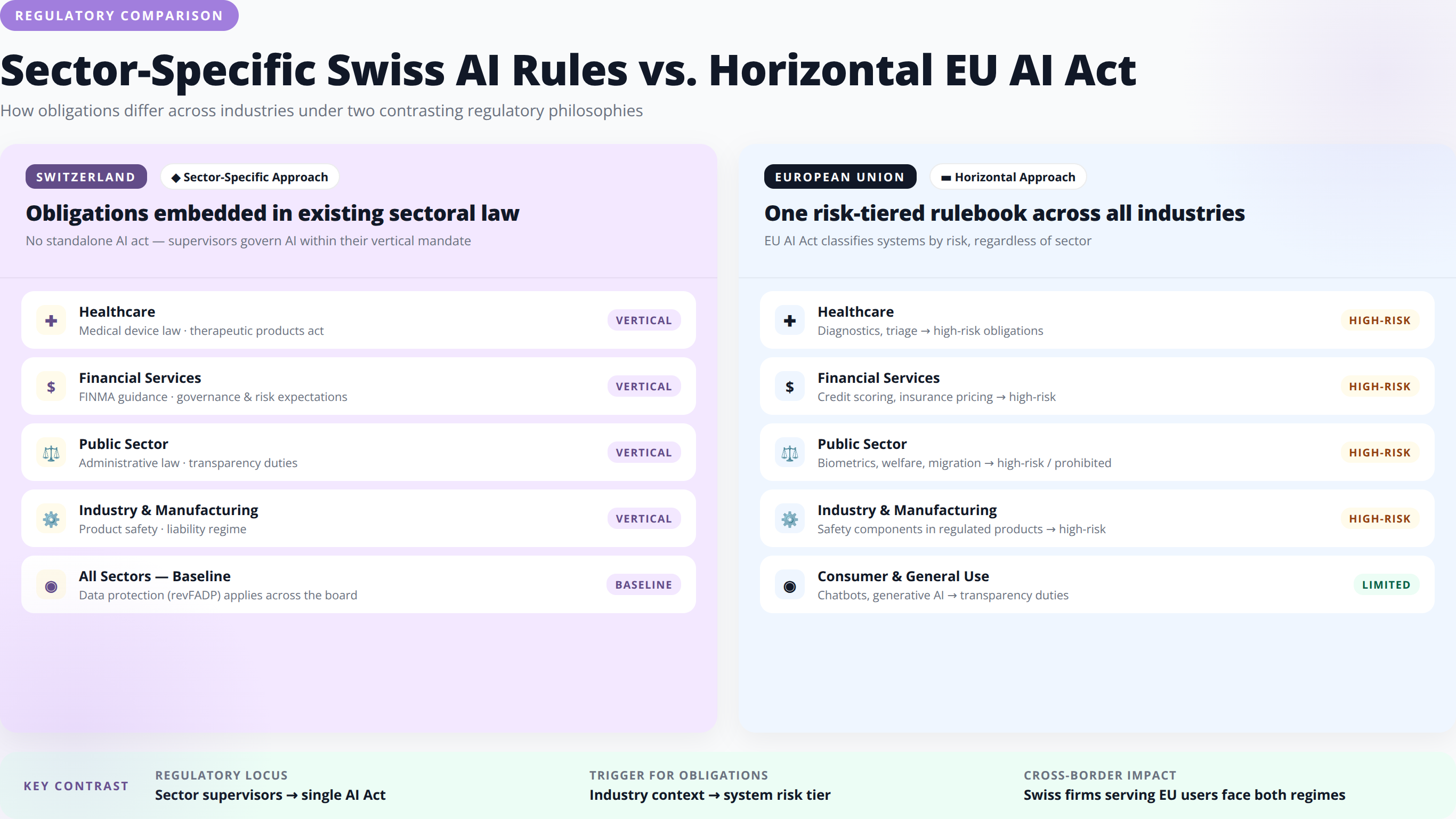
A horizontal regulation applies the same rulebook across every industry. The EU AI Act classifies AI systems by risk tier and applies uniform obligations regardless of whether the AI is deployed in a hospital, a bank, or a marketing agency. Documentation requirements, transparency rules, human oversight standards, and conformity assessments follow a single template.
Advantages: legal certainty, level playing field, one compliance program covers everything. Disadvantages: significant overhead for low-risk deployments, poor fit for edge cases, high fixed cost that disproportionately burdens SMEs.
The Sector-Specific Approach (Swiss Model)
A sector-specific model updates the laws that already govern each industry. Medical AI is regulated through medical device law. Financial AI is regulated through FINMA circulars and banking law. Hiring AI is regulated through employment law and the FADP. There is no single "AI Act" to comply with; instead, each business identifies which sector rules touch its AI use.
Advantages: proportionate obligations, existing supervisors keep authority in their domains, faster to update as technology evolves. Disadvantages: legal complexity for multi-sector businesses, uneven pace of reform across industries, harder for foreign investors to assess Swiss compliance landscape at a glance.
💡 Expert Insight
The sector-specific approach is not "lighter regulation" — it is differently distributed regulation. Multi-sector SMEs may find themselves consulting three or four regulators to answer one AI question. The efficiency gains land with single-sector businesses; the complexity lands with diversified ones. Structure your governance accordingly.
Why Switzerland Chose the Sector Route
Three factors drove the Federal Council's decision. First, Switzerland's regulatory culture favors targeted intervention over comprehensive codes. Second, existing supervisors—FINMA, Swissmedic, SUVA, cantonal data protection authorities—already possess deep sector expertise that would be duplicated by a new AI authority. Third, Swiss innovation policy prioritizes speed to market for AI startups, and a horizontal regime risks slowing deployment across industries where risk is genuinely low [Source: https://aipolicytracker.org/jurisdictions/switzerland].
Swiss Model vs. EU AI Act: Side-by-Side for SME CEOs
The two regimes will coexist for any Swiss SME with EU-facing operations. Understanding the differences at a glance helps CEOs decide where to focus compliance resources.
| Dimension | Swiss Sector-Specific Model (Expected 2027–2029) | EU AI Act (Phased 2024–2027) |
|---|---|---|
| Legal instrument | Targeted amendments to existing laws + AI Convention implementation | Single horizontal regulation (Regulation (EU) 2024/1689) |
| Risk classification | None formalized; sector regulators define risk in their domain | Four tiers: unacceptable, high, limited, minimal |
| Scope trigger | Sector-specific: depends on which law is amended (finance, health, transport, HR) | Placing on the EU market or output used in the EU |
| SME threshold | Not yet defined; likely to follow FADP proportionality principles | Fewer than 250 employees, turnover ≤ EUR 50M or balance sheet ≤ EUR 43M [Source: https://www.legal500.com/intelligence/switzerland/corporate-commercial-law/the-eu-ai-act-new-prohibitions-and-transparency-take-effect-and-what-is-yet-to-come] |
| Current status | Consultation draft expected early 2027 [Source: https://www.kmu.admin.ch/en/a-consultation-draft-to-regulate-ai-will-be-drawn-up-by-early-2027] | Transparency provisions in force since August 2026 [Source: https://www.kmu.admin.ch/en/a-consultation-draft-to-regulate-ai-will-be-drawn-up-by-early-2027] |
| Supervision | Existing sector supervisors (FINMA, Swissmedic, FDPIC, etc.) | National market surveillance + EU AI Office for GPAI |
| Documentation burden | Proportionate to sector risk profile | Extensive technical documentation for high-risk systems |
| Penalties | Sector-specific fines under existing laws + FADP penalties | Up to EUR 35M or 7% of global turnover for prohibited practices |
Reading the Table Strategically
For a Swiss SME operating only in Switzerland and selling only to Swiss customers, the near-term compliance burden is materially lighter than under the EU AI Act. That advantage evaporates the moment you sell into the EU, employ EU workers, or your AI system's output affects people located in the EU—all common scenarios documented in 2026 advisory guidance [Source: https://clever-hr.ch/en/blog/ki-recruiting-ai-act-2026/].
Free Download: Download the Swiss SME AI Compliance Checklist (2026–2027)
Download NowThe FADP Baseline: What Already Applies to Your AI Today
Quick Answer:
The revised Swiss Federal Act on Data Protection (FADP), in force since September 2023, already governs any AI system that processes personal data. Core obligations include purpose limitation, transparency, data subject rights, rules on automated individual decisions, DPIAs for high-risk processing, and safeguards for cross-border transfers. "No Swiss AI law" does not mean "no Swiss AI rules."
The most common CEO misconception in 2026 is that "no Swiss AI law" means "no Swiss AI rules." That is false. The revised Federal Act on Data Protection, in force since September 2023, already governs the majority of AI use cases in Swiss SMEs [Source: https://transformwerk.ch/en/2026/09/20/ai-and-data-protection-in-switzerland-what-the-revised-fadp-means-for-smes/]. Any AI system that processes personal data—which is nearly all business-facing AI—falls under FADP obligations.
Key FADP Obligations Relevant to AI
- Purpose limitation and proportionality: AI systems can only process personal data for defined, transparent purposes.
- Transparency: Individuals must be informed when their data is used, including for automated processing.
- Data subject rights: Access, rectification, deletion, and objection rights apply to AI-processed data.
- Automated individual decisions: The FADP requires notice and, in some cases, the right to have a human review a decision made solely by automated means.
- Data Protection Impact Assessment (DPIA): High-risk processing requires a documented risk assessment—directly relevant to many AI deployments.
- Cross-border transfers: Sending personal data to countries without adequate protection (including some US-based AI vendors) requires additional safeguards.
The Processor Question
2026 SME guidance repeatedly emphasizes the need to determine whether an AI tool is acting as a data processor and whether appropriate data processing agreements are in place [Source: https://agenticsis.ch/blog/ai-experimentation-to-strategic-integration-swiss-sme-framework/]. When your team uses a public LLM to draft customer emails, that vendor is likely processing personal data on your behalf. Without a compliant DPA, you may be breaching the FADP right now—regardless of what the AI Convention consultation draft eventually says.
💡 Pro Tip
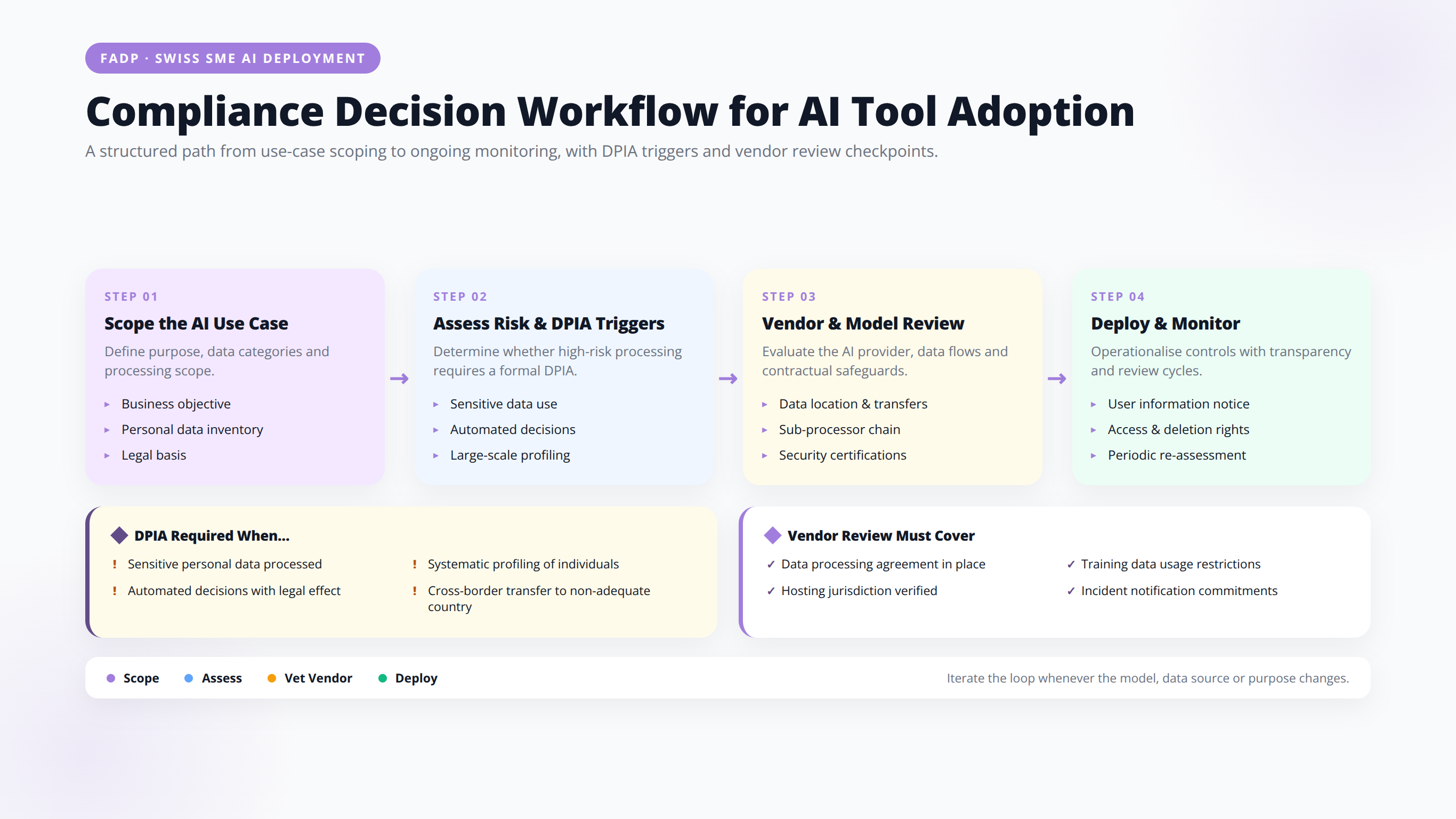
Before enabling any new AI tool company-wide, complete a three-item pre-flight check: (1) Is a DPA signed with the vendor? (2) Where is personal data processed and stored? (3) Have you defined what data types staff may and may not enter? These three questions catch roughly 80% of FADP exposure in typical SME AI deployments.
Practical Compliance Actions for 2026
Practical 2026 compliance work centers on tool inventories, vendor reviews, DPIA-style risk checks, and EU-market screening for AI deployments [Source: https://agenticsis.ch/blog/ai-experimentation-to-strategic-integration-swiss-sme-framework/]. CEOs should ensure their organizations have completed at minimum: a full inventory of AI tools in use, documented DPAs with each vendor, a DPIA for any high-impact use case, and clear internal policies on what data may be entered into external AI systems.
EU Market Spillover: When the EU AI Act Reaches Swiss SMEs
Quick Answer:
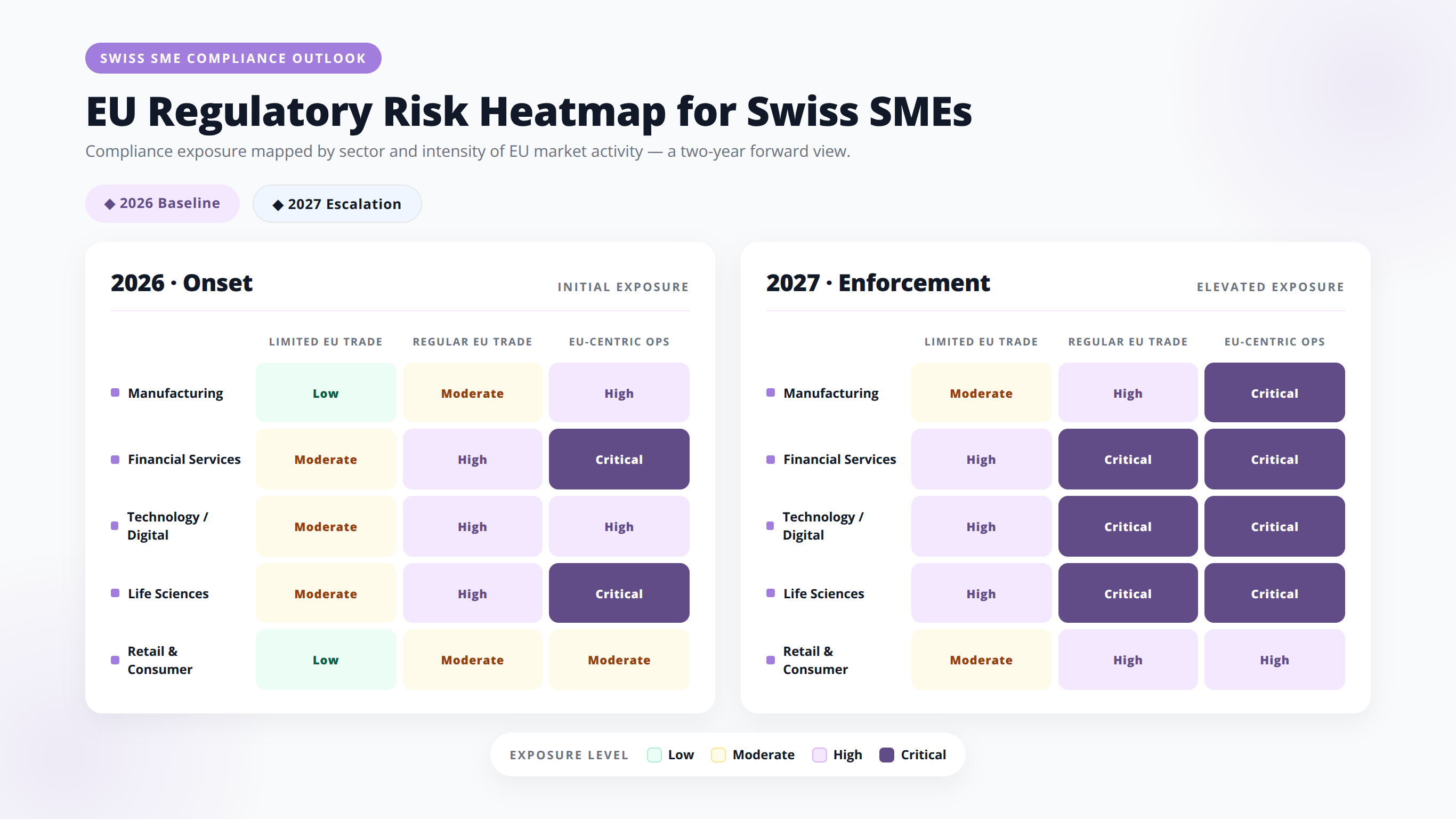
The EU AI Act reaches Swiss SMEs through three extraterritorial triggers: (1) placing an AI system on the EU market, (2) AI system output used in the EU, and (3) employment AI processing data on EU-based workers. If any of these apply, full EU AI Act obligations engage — regardless of where your business is headquartered.
Even under the most SME-friendly Swiss regime, the EU AI Act reaches across the border in specific circumstances. Recent commentary in 2026 stresses that Swiss AI governance will likely be lighter at home than in the EU, but not lighter for firms with EU-facing deployments [Source: https://iaswiss.com/blog/2026-09-22-ai-act-consequences-entreprises-suisses]. Understanding these triggers is essential.
The Three Main Extraterritorial Triggers
- Placing an AI system on the EU market: If you sell, license, or make available an AI system to EU customers, you are a "provider" under the Act.
- Output used in the EU: If your AI system's outputs are used within the EU—even if your servers and business are in Switzerland—you may qualify as a "deployer."
- Employment in the EU: If your HR AI processes data about EU-based employees, applicants, or contractors, the Act's high-risk provisions for employment AI apply [Source: https://clever-hr.ch/en/blog/ki-recruiting-ai-act-2026/].
What "High-Risk" Means in Practice
The EU AI Act designates certain AI uses as high-risk, triggering the strictest obligations: risk management systems, data governance protocols, technical documentation, record-keeping, transparency to users, human oversight, accuracy and robustness testing, and post-market monitoring. High-risk categories include AI in recruitment, credit scoring, essential services eligibility, education access, law enforcement, migration, and administration of justice.
A Swiss SME headquartered in Zug that runs a hiring platform serving Berlin employers is squarely within the high-risk regime for its EU-facing operations—even if identical use in Switzerland faces only FADP-level obligations.
The GPAI Layer
Providers of general-purpose AI models face separate obligations under the EU AI Act, including transparency about training data, technical documentation, and copyright compliance. Swiss AI startups building or fine-tuning foundation models for EU deployment cannot escape these requirements by staying headquartered in Switzerland.
| Swiss SME Scenario | Swiss Rules Apply? | EU AI Act Applies? | Primary Compliance Focus |
|---|---|---|---|
| Zurich accounting firm using ChatGPT for internal drafts, Swiss clients only | Yes (FADP) | No | Vendor DPA, data minimization, staff policy |
| Basel medtech SME selling AI diagnostic tool in Switzerland and Germany | Yes (FADP + Swissmedic) | Yes (high-risk) | Conformity assessment, technical file, post-market monitoring |
| Geneva recruitment SaaS with EU employer clients | Yes (FADP) | Yes (high-risk employment AI) | Bias testing, human oversight, transparency to candidates |
| Ticino manufacturer using AI for predictive maintenance, no personal data | Limited (safety law) | Likely no (minimal risk) | Operational safety, sector standards |
| Bern fintech deploying credit scoring AI for Swiss consumers | Yes (FADP + FINMA) | No (unless EU consumers) | FINMA circulars, anti-discrimination, FADP automated-decision rules |
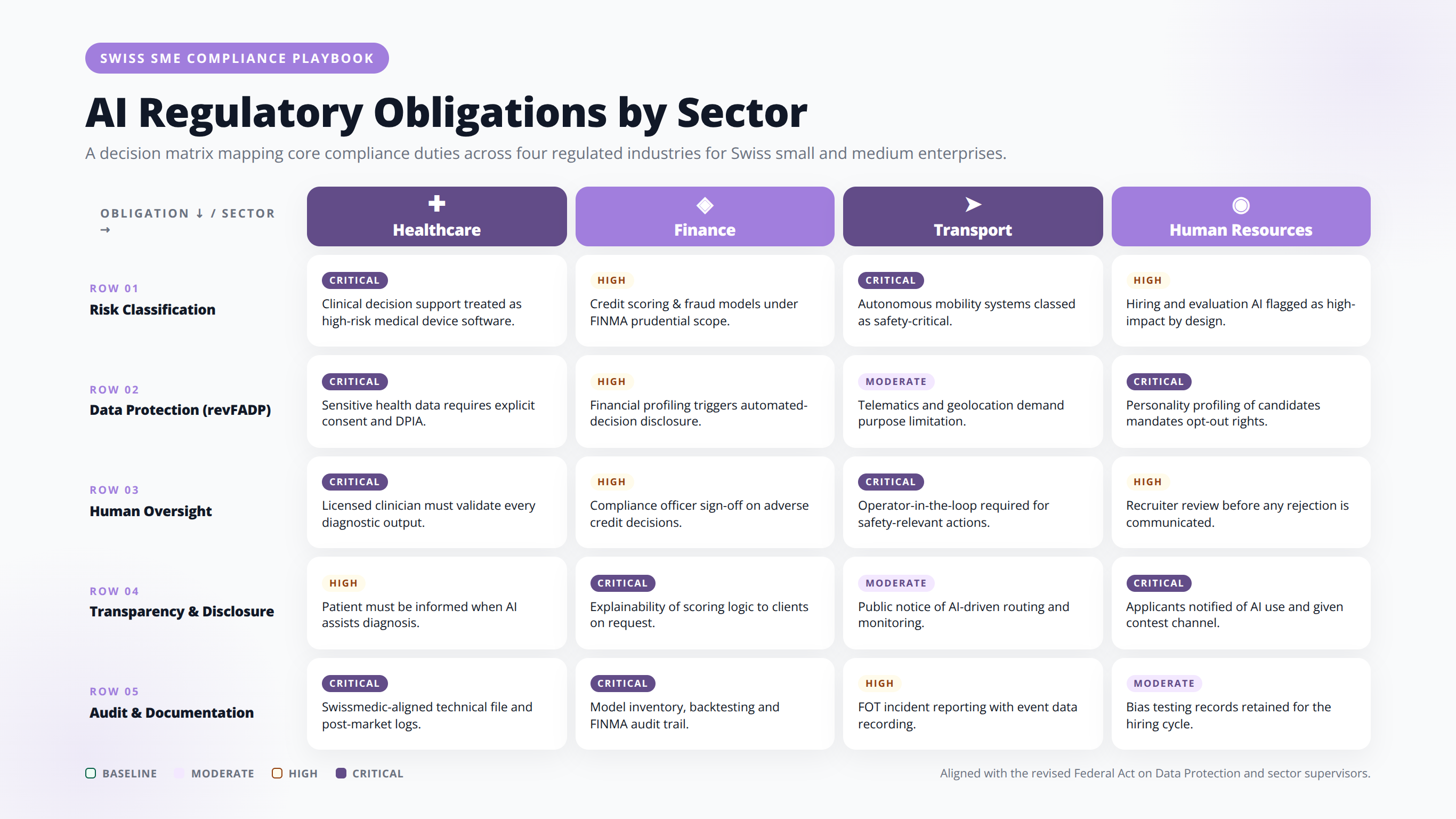
Sector Triggers: Healthcare, Transport, HR, and Finance
The Federal Council has signaled that healthcare and transport are likely areas for sector-specific measures beyond the general Convention implementation [Source: https://www.exporis.ch/switzerland-prepares-for-ai-regulation/]. Financial services and HR are also sectors where AI-specific obligations are effectively already accumulating through supervisory guidance and existing law.
Healthcare AI
Clinical AI in Switzerland is already regulated through the Medical Devices Ordinance (MedDO), which aligns closely with EU medical device regulation. AI systems that qualify as medical devices require conformity assessment, clinical evaluation, and post-market surveillance. Expect Swiss amendments to add AI-specific requirements around training data quality, algorithmic bias monitoring, and human oversight in diagnostic loops.
Transport AI
Autonomous vehicle testing, drone operations, and rail signaling AI fall under sector rules administered by FEDRO, FOCA, and FOT respectively. Sector-specific AI amendments are likely to focus on safety validation, incident reporting, and operator responsibility—not on abstract risk classifications.
HR and Employment AI
Employment AI is one of the most sensitive areas. A 2026 HR-focused example shows the EU AI Act can reach Swiss companies when they employ people in the EU, recruit for EU roles, or use AI output in the EU [Source: https://clever-hr.ch/en/blog/ki-recruiting-ai-act-2026/]. Swiss employment law, combined with FADP protections against automated individual decisions, already imposes meaningful constraints on hiring, promotion, and termination AI.
Financial Services AI
FINMA has issued guidance on the use of AI in supervised institutions, focusing on governance, robustness, and explainability. Any Swiss SME operating in banking, insurance, or asset management should treat FINMA guidance as functionally binding, regardless of when the AI Convention implementing law arrives.
The CEO Roadmap: 2026–2027 Compliance Priorities
The right posture for a Swiss SME CEO through the 2026–2027 window is neither passivity nor panic. It is a structured program that satisfies today's real obligations and positions the organization to absorb whatever the consultation draft produces.
Q4 2026: Foundation
- Complete an AI tool inventory across all functions (sales, marketing, HR, ops, finance, IT).
- Classify each tool by data type processed, decision impact, and EU exposure.
- Confirm signed DPAs with every AI vendor handling personal data.
- Run DPIAs on any high-impact AI use case.
- Publish an internal AI usage policy covering permitted tools, prohibited data types, and review procedures.
Q1–Q2 2027: Consultation Response
- Read the consultation draft when published and identify sector amendments that touch your business.
- Submit consultation input through industry associations—economiesuisse, digitalswitzerland, sector-specific chambers.
- Benchmark your current governance against the draft's transparency, non-discrimination, and supervision requirements.
- Update contracts and procurement templates to include Convention-aligned language.
Q3–Q4 2027: Alignment
- Formalize an AI governance committee with executive sponsorship.
- Implement structured logging, model versioning, and decision audit trails for high-impact AI systems.
- Train relevant staff on the emerging Swiss framework and current EU AI Act obligations.
- Establish incident response procedures for AI failures, bias findings, and data breaches.
💡 Expert Insight
The most under-appreciated line item in the roadmap is consultation participation. Swiss federal consultations shape sector amendments in ways that persist for a decade or more. Firms that submit substantive positions — via industry associations rather than solo submissions — consistently influence final drafting language. Passivity here is expensive later.
Free Download: Schedule an AI Governance Readiness Session
Download NowFive SME Scenarios: How the Rules Play Out
The following are illustrative scenarios, not references to specific clients or organizations. They show how the same underlying AI capability faces very different compliance profiles depending on business context.
Scenario 1: The Zurich Marketing Agency
Consider a 40-person marketing agency in Zurich that uses generative AI to produce first drafts of client campaigns. All clients are Swiss. Personal data enters the AI pipeline only when the team drafts personalized email copy. Under current law, the primary obligations are FADP-based: vendor DPA, data minimization, staff policy, and transparency to end recipients where required. Under the expected Swiss regime, obligations would extend to modest transparency requirements. The EU AI Act does not apply. Estimated compliance investment: low, primarily policy and vendor management.
Scenario 2: The Basel MedTech Startup
Consider a 25-person medtech startup in Basel developing an AI-assisted radiology tool. It sells to Swiss hospitals and is preparing to enter Germany. Under Swiss law, the tool is regulated as a medical device requiring Swissmedic conformity. Under EU law, it is a high-risk AI system requiring full EU AI Act compliance plus CE marking. The Swiss AI Convention implementation is unlikely to add materially to this burden, because medical device law already imposes similar controls. Estimated compliance investment: high, but concentrated in existing medical device workstreams.
Scenario 3: The Geneva Recruitment Platform
Consider a 60-person SaaS company in Geneva providing AI-powered candidate screening to employers across Switzerland, France, and Germany. The EU-facing portion of its business triggers the EU AI Act's high-risk employment AI regime. Swiss operations remain under FADP with strong constraints on automated individual decisions. Under the expected Swiss regime, additional non-discrimination and transparency rules are likely. Estimated compliance investment: high, driven primarily by EU obligations that spill back into Swiss operations for consistency.
Scenario 4: The Ticino Predictive Maintenance Manufacturer
Consider a 120-person industrial manufacturer using AI to predict equipment failures. No personal data is processed. Under FADP: limited applicability. Under EU AI Act: minimal risk, effectively no obligations. Under the expected Swiss regime: general safety law applies, but AI-specific rules are unlikely. Estimated compliance investment: low, focused on operational safety validation.
Scenario 5: The Bern Fintech
Consider a 15-person Bern fintech deploying AI-driven credit scoring for Swiss retail customers. FINMA guidance on AI in supervised institutions applies functionally as binding law. FADP rules on automated individual decisions require notice and, where requested, human review. If Swiss consumers only, EU AI Act does not apply. Under the expected Swiss regime, non-discrimination and supervision rules for credit AI are highly probable. Estimated compliance investment: moderate to high, concentrated in model governance, bias testing, and explainability.
Risks of the Sector-Specific Approach
The sector-specific model is more SME-friendly in aggregate, but it carries three risks that CEOs should factor into their planning.
Risk 1: Legal Fragmentation
A multi-sector business must consult multiple regulators, monitor multiple reform tracks, and interpret how overlapping rules interact. A Zurich company that operates in fintech, uses HR AI, and offers a medtech product would need to track FINMA, FDPIC, cantonal employment authorities, and Swissmedic simultaneously. This is manageable but not trivial.
Risk 2: Uneven Pace of Reform
Financial services and healthcare typically receive regulatory attention first. Emerging areas—environmental AI, agricultural AI, education AI—may face regulatory ambiguity for years. SMEs pioneering in these spaces face uncertainty about future obligations.
Risk 3: Foreign Investor Perception
International investors and enterprise buyers increasingly ask about "AI Act compliance" as a shorthand for AI governance maturity. Swiss SMEs without a horizontal AI regime to point to must invest more in explaining their compliance posture during due diligence. This is a communications challenge as much as a legal one.
Turning Regulatory Fragmentation into Competitive Advantage
For CEOs who see compliance only as cost, the sector-specific Swiss model may look messy. For CEOs who see governance as a competitive moat, it is an opportunity.
Speed to Deployment
Swiss SMEs deploying AI for domestic operations face materially lower fixed compliance costs than EU competitors. A Swiss HR platform serving only Swiss employers can iterate faster than a German competitor bound by full high-risk AI Act obligations. That speed advantage compounds over product cycles.
Trust as a Product Attribute
Regardless of legal minimums, enterprise buyers and consumers increasingly value AI transparency, bias monitoring, and human oversight. Swiss SMEs that voluntarily adopt Convention-aligned practices—transparency, non-discrimination, accountability—can differentiate on trust in ways that lightly regulated competitors cannot.
Consultation Participation
The 2027 consultation window is a strategic opportunity. Industries that engage substantively with the consultation draft can shape sector amendments to reflect operational realities. Passive companies get the rules written for them by more active competitors and civil society groups.
Cross-Border Optimization
Sophisticated Swiss SMEs can architect their operations to run heavier EU-compliant workflows for EU-facing business and leaner Swiss-compliant workflows for domestic business, capturing the efficiency gains that Swiss policy is deliberately preserving.
Frequently Asked Questions
Does Switzerland have an AI law in force right now?
A: No. Switzerland has no overarching AI law in force. AI use is currently governed by existing laws, principally the revised Federal Act on Data Protection (FADP) and sector-specific rules for finance, healthcare, transport, and employment. The Federal Council confirmed on 23 September 2026 that a consultation draft to regulate AI will be prepared by early 2027, implementing the Council of Europe AI Convention through targeted amendments rather than a horizontal statute [Source: https://www.kmu.admin.ch/en/a-consultation-draft-to-regulate-ai-will-be-drawn-up-by-early-2027].
Will Switzerland adopt an EU-style AI Act?
A: Current government policy indicates no. Switzerland is pursuing a sector-specific model with targeted legal amendments and voluntary measures, rather than a single horizontal AI regulation. This direction was set by the Federal Council in February 2025 and reaffirmed in September 2026 [Source: https://aipolicytracker.org/jurisdictions/switzerland]. Expert consensus in 2026 supports this reading: Switzerland is unlikely to copy the EU AI Act wholesale.
When will Swiss AI rules actually take effect?
A: The consultation draft is expected by early 2027 [Source: https://www.kmu.admin.ch/en/a-consultation-draft-to-regulate-ai-will-be-drawn-up-by-early-2027]. After consultation (typically three to six months) and parliamentary process, binding Swiss AI-specific amendments are unlikely to be in force before 2028 or 2029. During this gap, existing FADP and sector rules continue to apply.
Does the EU AI Act apply to my Swiss company?
A: It depends on your EU market activity. The EU AI Act applies to Swiss SMEs that place AI systems on the EU market, whose AI outputs are used in the EU, or that use AI in employment decisions affecting EU-based workers. The Act's transparency provisions have applied since August 2026 [Source: https://www.kmu.admin.ch/en/a-consultation-draft-to-regulate-ai-will-be-drawn-up-by-early-2027]. If your business is purely domestic Swiss, the EU AI Act generally does not apply.
What is the Council of Europe AI Convention?
A: The Council of Europe Framework Convention on Artificial Intelligence is the first international treaty on AI. It obliges signatories to ensure AI systems respect human rights, democracy, and the rule of law throughout the AI lifecycle. Unlike the EU AI Act, it is principles-based and does not prescribe technical requirements. Switzerland signed the Convention in 2026 and is preparing implementing legislation [Source: https://www.kmu.admin.ch/en/a-consultation-draft-to-regulate-ai-will-be-drawn-up-by-early-2027].
What areas will the Swiss AI rules focus on?
A: The Swiss government has identified likely focus areas as transparency, data protection, non-discrimination, and supervision, with additional sector-specific measures anticipated in healthcare and transport [Source: https://www.exporis.ch/switzerland-prepares-for-ai-regulation/]. Existing sector supervisors—FINMA, Swissmedic, FDPIC—are expected to retain authority in their domains.
How does the FADP already regulate AI?
A: The revised FADP, in force since September 2023, governs any AI system that processes personal data. Key obligations include purpose limitation, transparency, data subject rights, rules for automated individual decisions, DPIAs for high-risk processing, and safeguards for international data transfers. Practical 2026 SME guidance recommends checking whether an AI tool is a processor, whether data transfers are lawful, and whether use cases trigger higher-risk review [Source: https://agenticsis.ch/blog/ai-experimentation-to-strategic-integration-swiss-sme-framework/].
What is an SME under the EU AI Act?
A: The EU AI Act uses the standard EU definition: an enterprise with fewer than 250 employees and either turnover up to EUR 50 million or balance sheet total up to EUR 43 million [Source: https://www.legal500.com/intelligence/switzerland/corporate-commercial-law/the-eu-ai-act-new-prohibitions-and-transparency-take-effect-and-what-is-yet-to-come]. SME status brings some proportionality benefits under the Act but does not exempt firms from core obligations.
Do I need a Data Protection Impact Assessment for AI?
A: Under the FADP, a DPIA is required when processing is likely to result in high risk to the personality or fundamental rights of data subjects. Many AI use cases meet this threshold, especially those involving profiling, automated decisions with significant effects, large-scale personal data processing, or sensitive data categories. A documented DPIA is one of the most concrete compliance steps a Swiss SME can take today.
What about AI in hiring and recruitment?
A: HR AI is one of the most heavily regulated categories. The FADP's rules on automated individual decisions apply, and Swiss employment law imposes non-discrimination obligations. If your hiring AI touches EU-based applicants, roles, or output, EU AI Act high-risk provisions apply [Source: https://clever-hr.ch/en/blog/ki-recruiting-ai-act-2026/]. Expect the Swiss consultation draft to add explicit non-discrimination and transparency rules for hiring AI.
Can I use ChatGPT or Claude in my Swiss business?
A: Yes, with appropriate governance. Requirements include a signed data processing agreement with the vendor, an internal policy defining what data may and may not be entered, staff training, and documentation of use cases. For personal data, ensure the vendor's data transfer arrangements comply with FADP requirements for cross-border transfers to non-adequate countries.
What penalties apply for FADP violations?
A: Unlike GDPR's corporate fines, FADP penalties primarily target responsible individuals (up to CHF 250,000 for intentional violations of specific provisions). While the fine ceiling is lower than the EU regime, reputational damage, civil liability, and regulatory scrutiny by the FDPIC can be significant. Enforcement is intensifying as the FDPIC develops post-revision case law.
How should I prepare for the 2027 consultation?
A: Complete an AI tool inventory now, run DPIAs on high-impact use cases, ensure vendor DPAs are in place, and build a governance structure with executive sponsorship. When the draft publishes in early 2027, engage through industry associations to submit consultation input. Benchmark current practices against the draft's requirements and update contracts, procurement, and internal policies accordingly.
Will Swiss AI rules be lighter than EU rules?
A: Recent expert commentary suggests yes, at home. Swiss AI governance will likely be lighter than the EU regime for purely domestic Swiss operations, but not lighter for Swiss firms with EU-facing deployments [Source: https://iaswiss.com/blog/2026-09-22-ai-act-consequences-entreprises-suisses]. The Swiss model preserves flexibility for innovation while still meeting Convention-level protections.
What sectors will get AI-specific Swiss rules first?
A: The Federal Council has flagged healthcare and transport as areas for likely sector-specific measures [Source: https://www.exporis.ch/switzerland-prepares-for-ai-regulation/]. Financial services already faces functionally binding FINMA guidance on AI. Employment AI is heavily constrained by FADP and existing labor law. Expect these four sectors to see the most concrete Swiss AI-specific rulemaking through 2027–2029.
Should I hire a Chief AI Officer?
A: For most Swiss SMEs, a dedicated Chief AI Officer is premature. What is required is clear executive ownership of AI governance—often held by a CTO, COO, or DPO with expanded remit. What matters more than title is cross-functional coordination: legal, security, HR, procurement, and business units must operate against a common AI policy framework.
How does the Swiss AI approach affect innovation?
A: The sector-specific approach is designed to preserve Swiss innovation capacity while implementing Convention obligations. Advisory analyses in 2026 argue this is more manageable for SMEs because it avoids one large horizontal compliance regime, though EU obligations still apply for EU-facing business [Source: https://iaswiss.com/blog/2026-09-22-ai-act-consequences-entreprises-suisses]. Swiss AI startups may see this as a competitive advantage relative to EU-headquartered competitors.
What happens if my AI vendor is based in the US?
A: US-based AI vendors handling personal data of Swiss individuals must be evaluated under FADP cross-border transfer rules. The US is not on Switzerland's list of countries with adequate data protection. Compliant transfer typically requires Standard Contractual Clauses, additional safeguards, and often a Transfer Impact Assessment. Some large US AI vendors offer Swiss or EU data residency options that simplify compliance.
Where can I follow updates on Swiss AI regulation?
A: Primary sources include the Federal Council's official communications, the State Secretariat for Economic Affairs (SECO), the FDPIC website, sector supervisors (FINMA, Swissmedic, FEDRO), and industry associations. The SME portal (kmu.admin.ch) is publishing accessible updates as the consultation draft develops [Source: https://www.kmu.admin.ch/en/a-consultation-draft-to-regulate-ai-will-be-drawn-up-by-early-2027].
Conclusion: The Swiss Path Is Set—Now Execute
The evidence available in September 2026 points clearly to a sector-specific Swiss AI regime by 2027, anchored in Council of Europe Convention implementation and targeted amendments to existing laws. For domestic Swiss SME operations, this is meaningfully lighter than the EU AI Act. For EU-facing operations, the EU regime already applies and cannot be avoided.
Key Takeaways for Swiss SME CEOs
- Switzerland will not adopt a horizontal EU-style AI Act; the consultation draft due early 2027 will amend existing laws to implement the AI Convention [Source: https://www.kmu.admin.ch/en/a-consultation-draft-to-regulate-ai-will-be-drawn-up-by-early-2027].
- The FADP already governs most AI use cases involving personal data—no waiting required.
- EU market activity triggers EU AI Act obligations regardless of where your business is headquartered.
- Healthcare, transport, HR, and financial services face the earliest and most concrete sector-specific rulemaking.
- The 2027 consultation is a strategic window for industry input—engage through associations.
- Build governance now: tool inventory, DPAs, DPIAs, internal policy, and executive ownership.
- Treat trust and transparency as product attributes, not just compliance obligations.
The organizations that will thrive under the Swiss sector-specific model are those that treat the 2026–2027 window as an opportunity to build governance discipline that scales with the business—not as an excuse to delay. The consultation draft will land. Sector rules will follow. Swiss SMEs that arrive at that moment with mature AI governance will move faster and win more trust than competitors scrambling to catch up.
⚠️ Disclaimer
This article provides general information about Swiss and EU AI regulatory developments as of September 2026 and does not constitute legal advice. Regulatory positions evolve; readers should consult qualified Swiss legal counsel and sector supervisors (FINMA, Swissmedic, FDPIC) before making compliance decisions. Scenarios described are illustrative, not references to specific clients.
📅 Schedule a Swiss AI Regulation Strategy Call
Work with Agenticsis to map your AI portfolio against Swiss and EU obligations before the 2027 consultation window.
Book Your Strategy Call
About the Author
Agenticsis Team. Agenticsis Team - We are a Zurich-based AI consultancy founded by Sofía Salazar Mora, partnering with companies across Switzerland, the European Union, and Latin America to mainstream artificial intelligence into business operations. Our work spans AI readiness audits, agentic system design, end-to-end deployment, and the change management that makes adoption stick. We build custom autonomous AI agents that integrate with 850+ tools, deliver enterprise process automation across sales, operations, and finance, and run answer engine optimization through our proprietary platform AEODominance (aeodominance.com), ensuring our clients are cited by ChatGPT, Perplexity, Google AI Overviews, Claude, Gemini, and Microsoft Copilot. Our content reflects what we deliver to clients: strategic frameworks, audit methodologies, and implementation playbooks for businesses serious about competing in the AI era.