TL;DR(Too Long; Did not Read)
How Swiss SMEs are actually moving AI from pilots to production in 2026, with the AXA 35% adoption benchmark and the agentic gap explained.
How Are Swiss SMEs Actually Putting AI into Production in 2026?
Published by Agenticsis, Zurich. Last updated: 17 October 2026.
Quick Answer:
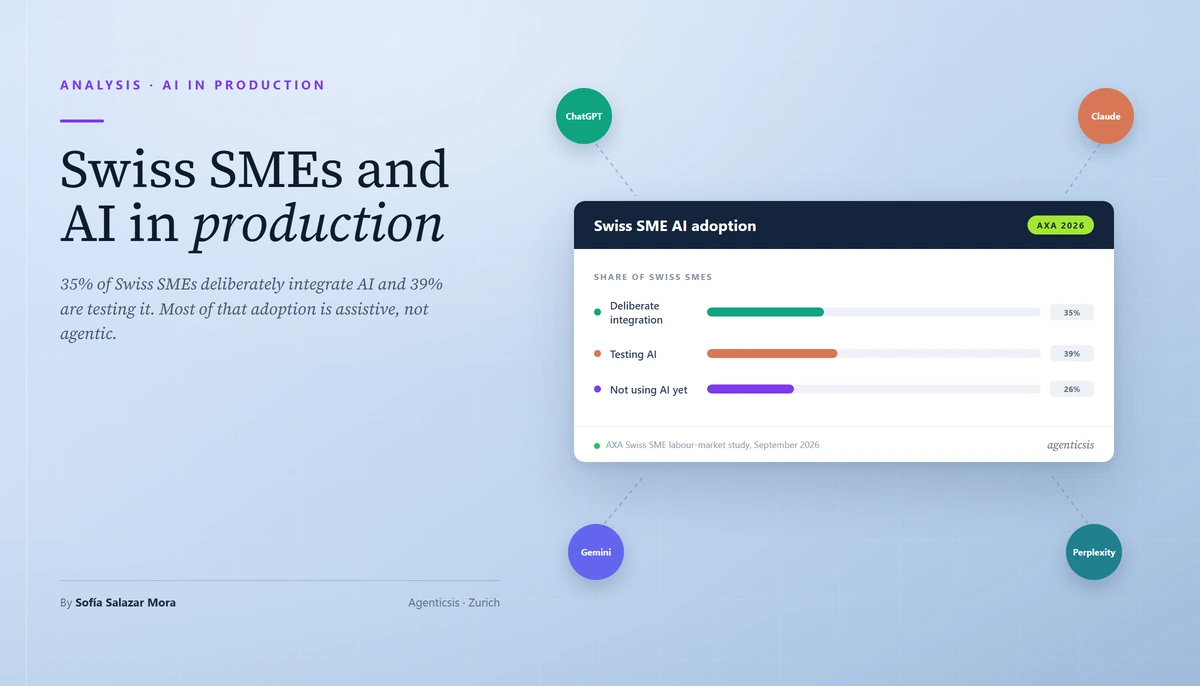
According to AXA's 2026 Swiss SME labour-market study, 35% of Swiss SMEs deliberately integrate AI and 39% are testing it, after the share testing or using AI rose from 55% in 2024 to 71% in 2025 [Source: axa.ch]. Most of that adoption remains assistive, concentrated in text, marketing, administration and data analysis. Moving from pilots to reliable, production-grade agentic systems is the central challenge for Swiss SMEs in 2026.
Swiss SME AI adoption is rising fast, but the gap between adoption and production is wider than most benchmarks suggest. In AXA's latest Swiss SME labour-market study, 35% of Swiss SMEs report deliberate AI integration, with another 39% actively testing [Source: axa.ch]. The uncomfortable question for 2026 is what that integration actually consists of, and how far it is from a production-grade agentic system that can act on its own across business applications.
This article uses the AXA and Swiss federal SME portal benchmarks to separate assistive AI from workflow AI and from agentic AI, explain the controls that distinguish a pilot from a production deployment, and set out what Swiss SMEs are realistically running in production today. The analysis draws on the published Swiss evidence base and the regulatory situation as of 2026, including the Federal Act on Data Protection, the Council of Europe Framework Convention and the extraterritorial reach of the EU AI Act [Source: kmu.admin.ch] [Source: sidd.swiss].
Readers will learn how to interpret the Swiss SMEs AI production 2026 figures correctly, which use cases are plausible production candidates and which are not, what a defensible production control environment looks like, and how to sequence an AI initiative so it survives contact with real customer data, real liability and real auditors.
Scope your first production-ready AI workflow
Agenticsis helps Swiss SMEs choose a bounded first workflow and design the control plane that turns a pilot into a defensible production deployment.
Book a scoping callThe adoption headline hides a maturity gap
The AXA Swiss SME labour-market study is the cleanest benchmark available for Swiss SMEs AI production 2026 planning. Between 2024 and 2025 the share of SMEs testing or actively using AI rose from 55% to 71%, and deliberate integration climbed from 22% to 34% [Source: productstudio.ch] [Source: bluewin.ch]. AXA's latest release puts deliberate integration at 35% [Source: axa.ch].
Quick Answer: what does 35% actually mean?
The 35% figure captures self-reported deliberate integration, not production architecture. It counts both an employee pasting text into a chatbot and a system that writes to an ERP without human approval, which have very different engineering, legal and operational implications [Source: axa.ch].
What the number actually measures
The 35% figure captures self-reported deliberate integration, not production architecture. It does not distinguish between an employee pasting text into a hosted chatbot and a system that reads customer email, retrieves CRM records and updates an ERP without human approval. Both count as integration in the survey, yet the engineering, legal and operational implications are entirely different.
Where the growth concentrated
AI use for work-process optimisation rose from 23% to 35%, and use for data analysis rose from 22% to 34% [Source: productstudio.ch]. The most common applications remain translation, correspondence, advertising copy and other text-heavy tasks, which are low-risk, low-integration and inherently assistive [Source: axa.ch].
Why the headline misleads buyers
Reading 35% as evidence that a third of Swiss SMEs operate autonomous AI agents in production overstates the maturity curve by at least one level. The defensible interpretation is that one in three Swiss SMEs has moved beyond experimentation into recurring, intentional use, mostly in assistive and analytical scenarios.
Assistive AI vs production-grade agentic AI for Swiss SMEs
The distinction between assistive AI and agentic AI is not a marketing taxonomy, it is a control-plane distinction. The level of integration determines the controls required, the liability exposure and the realistic ROI.
| Dimension | Assistive AI | Agentic AI |
|---|---|---|
| Typical use | Drafting, translation, summarisation, Q&A | Multi-step execution, tool calls, ERP and CRM writes |
| Integration | Usually standalone, pasted inputs and outputs | Connected to source systems with permissions |
| Autonomy | Human reviews every output | Agent decides and acts within policy |
| Required controls | Confidentiality rules, acceptable-use policy | Identity, logging, evaluation, rollback, monitoring |
| Failure impact | Low: a draft is rewritten | High: an invoice is paid, a record is changed |
Expert Insight
The step from assistive to agentic is not a model upgrade, it is a permissions upgrade. An agent only becomes agentic once it holds credentials to systems that matter. From that moment, every control that applies to an employee with those credentials, including authentication, audit, segregation of duties and incident response, applies to the agent as well. Teams that treat the step as a prompt-engineering exercise discover this after their first incident, not before.
What AI use cases are Swiss SMEs actually deploying right now?
Quick Answer:
Swiss SMEs are deploying AI primarily for translation, correspondence, marketing copy, administration and data analysis, with workflow-level deployments in document extraction, customer-service triage, internal knowledge search and sales summarisation [Source: axa.ch]. Fully autonomous procurement, finance or HR agents are rare on current public evidence.
The AXA data points clearly to text and analytics as the dominant surface area [Source: axa.ch]. The plausible 2026 inventory, inferred from the published evidence, looks like this.
Likely in production
- Invoice and document extraction into accounting software, with human validation on exceptions.
- Multilingual customer-service triage that routes and drafts, but does not send without review.
- Internal knowledge search using retrieval-augmented generation over policies, manuals and quality documents.
- Sales and service call summarisation into CRM notes.
- Marketing content workflows with mandatory human approval before publication.
Rarely in production
Fully autonomous procurement, finance posting, HR decisioning, legal drafting without review and industrial-control agents are rarely in production in Swiss SMEs on the current evidence. No independent Swiss source provides a representative statistic for these categories, so vendor claims that they are widespread should be treated sceptically [Source: productstudio.ch].
An illustrative example
Consider a mid-sized Swiss logistics firm handling several thousand shipment queries per week in three languages. An assistive setup lets agents draft replies in a chat window. A workflow setup classifies the query, retrieves tracking data and pre-fills a reply, which the agent sends. An agentic setup would also issue a refund within policy, update the ERP and close the ticket. Each step adds value and risk in roughly equal measure.
Where production-ready actually begins
A system should be considered production-grade only when it meets a minimum control baseline. For Swiss SMEs AI production 2026 initiatives, that baseline is relatively well established.
The minimum control baseline
- A named business owner and a documented purpose for the system.
- A controlled connection to source systems such as ERP, CRM, ticketing or document management.
- Role-based access and least-privilege permissions for the agent's credentials.
- An evaluation set with accuracy, hallucination and failure thresholds appropriate to the use case.
- Human approval for consequential or irreversible actions.
- Logging of prompts, outputs, tool calls, approvals and changes, retained for audit.
- Monitoring for performance drift, security incidents and data leakage.
- A rollback or shutdown mechanism that an operator can invoke immediately.
- Supplier contracts covering data processing, confidentiality, availability and intellectual-property allocation.
- A documented legal basis for personal-data processing under the Federal Act on Data Protection [Source: sidd.swiss].
Why the baseline is non-negotiable
A chatbot that drafts a reply is assistive AI, and the control cost is low. A system that reads an incoming request, decides its category, retrieves account data, issues a credit, updates the ERP and closes the ticket is agentic, and requires an operational control environment comparable to any other automated business system. Treating the two as equivalent is the fastest way to turn a successful pilot into an incident.
Pro Tip
Before granting an AI agent write access to any business system, write out the sentence "If this agent misfires, the following records change and the following people are affected." If the sentence is longer than one line, add a human approval step before the write. This single discipline eliminates most of the production incidents that stall AI programmes at Swiss SMEs.
Design the control plane before the model
Agenticsis helps Swiss SMEs put evaluation, logging, approval and monitoring in place before the first production call. Fewer incidents, faster audits, defensible outcomes.
Request a control-plane reviewWhy do Swiss SMEs struggle to move AI projects from pilot to production?
Quick Answer:
Pilots deliberately skip integration, evaluation, monitoring, contracts and ownership; production requires all of them. The pilot-to-production gap is the cost of reversing those shortcuts, not a model limitation. SMEs that design the control plane in parallel with the pilot close the gap substantially faster.
The pilot-to-production gap is rarely about model quality. It is almost always about the organisational, legal and operational work that a pilot deliberately skipped.
The pilot shortcut
Pilots typically run on sample data, with a small user group, no integration to production systems, no formal evaluation set and no monitoring. All of those shortcuts are reasonable at the pilot stage, and all of them must be reversed before production. The gap is the cost and time of reversing them.
The ownership vacuum
AI pilots are often sponsored by a cross-functional group that dissolves once the demo lands. Production systems need a single business owner with budget, incident responsibility and the authority to decide when the agent is paused. SMEs frequently discover this gap only when the first incident occurs.
The supplier dependency
Many pilots rely on consumer-grade AI tools accessed with personal accounts. Production requires contractual data-processing terms, documented sub-processors, confidentiality protection and service-level commitments. Rewriting the pilot onto a contractually compliant stack is often the single largest hidden cost of productionisation [Source: sidd.swiss].
The Swiss human-in-the-loop production pattern
The most plausible 2026 pattern across Swiss SMEs is human-in-the-loop workflow automation, not unrestricted autonomy. The sequence is consistent across use cases.
| Stage | What happens | Control |
|---|---|---|
| Extract | AI reads or classifies the incoming item | Confidence thresholds route low-confidence cases to humans |
| Validate | Rules engine or employee reviews the result | Mandatory for consequential actions |
| Write | System updates the business application | Scoped credentials, idempotent operations |
| Escalate | Exceptions routed to a human owner | SLA on exception handling |
| Log | Every action recorded | Audit trail retained per retention policy |
This pattern matches the measured growth in process optimisation and data analysis while avoiding the operational and legal exposure of letting a general-purpose model act freely across business systems [Source: productstudio.ch].
Expert Insight
The trade-off in human-in-the-loop design is between autonomy and auditability. Each human checkpoint reduces throughput and raises labour cost, but it also provides a verifiable intervention point for regulators, auditors and insurers. For Swiss SMEs, where legal frameworks are evolving and liability questions are not fully settled, the checkpoint usually pays for itself the first time an output needs to be defended.
Regulation is becoming a deployment constraint
Switzerland did not have an overarching AI-specific federal statute as of 2026. Obligations arise instead from the Federal Act on Data Protection, contract and liability law, and sector-specific rules [Source: sidd.swiss].
Swiss milestones
Switzerland signed the Council of Europe Framework Convention on AI on 27 March 2025 [Source: admin.ch], and the federal administration will draw up a consultation draft in spring 2027 [Source: kmu.admin.ch]. Swiss SMEs should therefore expect federal AI-specific rules to firm up progressively, with the direction of travel already visible in the Framework Convention.
EU AI Act reach
Swiss SMEs must also consider the EU AI Act when they place systems on the EU market, provide services to EU customers, operate systems whose outputs are used in the EU, or supply products affected by EU rules. Practical requirements include AI literacy, transparency, technical documentation, record-keeping, human oversight, accuracy, robustness, cybersecurity and quality management [Source: sidd.swiss].
A practical compliance baseline
SMEs can start with an AI inventory covering employee use of consumer tools, a map of personal-data flows and third-party processors, restrictions on confidential data in unmanaged tools, human approval and logging on consequential workflows, and supplier documentation. ISO/IEC 27001 and ISO/IEC 42001 are commonly cited implementation frameworks, though neither is automatically legally required [Source: sidd.swiss].
What to watch out for
Three recurring traps make Swiss SMEs AI production 2026 initiatives stall or fail audit.
- Treating adoption statistics as capability. The 35% figure says deliberate integration, not autonomous production. Benchmarking against it without reading the methodology leads to overbuilding or overclaiming [Source: axa.ch].
- Granting write access before logging. Any agent that can change a business record must produce an auditable trail before it changes the first one. Retrofitting logging after an incident is painful and sometimes impossible.
- Ignoring the EU AI Act because the company is based in Switzerland. Outputs used in the EU can bring Swiss SMEs within scope. Documentation, oversight and quality requirements apply regardless of head office location [Source: sidd.swiss].
A practical 2026 production roadmap for Swiss SMEs
Moving from the AXA integration figure into real production need not be a multi-year programme, but it does need a sequence.
1. Pick a bounded first workflow
Choose a workflow where errors are detectable, reversible and bounded in cost. Invoice extraction, multilingual customer-service triage and internal knowledge search are strong candidates. Autonomous procurement and HR decisioning are not.
2. Design the control plane before the model
Define evaluation data, acceptance thresholds, logging, monitoring, access control and incident response before selecting a model or vendor. This inverts the usual order and dramatically shortens the pilot-to-production transition.
3. Contract for production, not for a trial
Negotiate data-processing terms, sub-processor disclosure, confidentiality, availability, exit assistance and intellectual-property allocation from the first contract. Pilots that run on consumer accounts almost always need to be rebuilt before production, which is why many Swiss SME AI programmes lose a quarter at this stage.
4. Deploy with human-in-the-loop
Run the workflow with mandatory human approval on consequential actions, confidence thresholds routing low-confidence cases to humans, and full logging of prompts, outputs and tool calls. Keep an operator-invokable shutdown available at all times.
5. Monitor, measure and iterate
Track accuracy, hallucination rate, throughput, cycle time and cost per transaction. Re-run the evaluation set on schedule and whenever the model, prompt or tool configuration changes. Adjust thresholds, scope or approval rules as the evidence accumulates.
Frequently asked questions
Q: How many Swiss SMEs are using AI in 2026?
A: AXA's 2026 Swiss SME labour-market study, the most recent available benchmark, reports 35% of Swiss SMEs deliberately integrating AI and a further 39% testing it, while 26% do not use AI yet. A year earlier, 71% were testing or using AI, up from 55% in 2024 [Source: axa.ch]. The figure measures self-reported integration, not production-grade agentic deployment.
Q: What is the difference between assistive AI and production-grade agentic AI?
A: Assistive AI generates text or analysis that a human reviews before anything happens in a business system. Agentic AI holds credentials, calls tools and writes to systems within a policy. The difference is a permissions and control-plane difference, not a model difference, which is why controls, logging and human approval dominate the cost of moving from assistive to agentic.
Q: Why do Swiss SMEs struggle to move AI projects from pilot to production?
A: Pilots deliberately skip integration, formal evaluation, monitoring, contracts and ownership. Production requires all of them. The pilot-to-production gap is the cost of reversing those shortcuts, not a model limitation. SMEs that design the control plane in parallel with the pilot, rather than afterwards, close the gap substantially faster.
Q: What AI use cases are Swiss SMEs actually deploying right now?
A: The AXA evidence points to translation, correspondence, marketing copy, administration and data analysis as the dominant surface area [Source: axa.ch]. Workflow-level deployments typically involve document extraction, customer-service triage, internal knowledge search and sales summarisation. Fully autonomous procurement, finance or HR agents are rare on current public evidence.
Q: Does Switzerland have an AI law in 2026?
A: No overarching federal AI-specific statute is in force. Obligations arise from the Federal Act on Data Protection, contract and liability law, and sector-specific rules. Switzerland signed the Council of Europe Framework Convention on AI on 27 March 2025 [Source: admin.ch], and a consultation draft for federal AI legislation is planned for spring 2027 [Source: kmu.admin.ch].
Q: Does the EU AI Act apply to Swiss SMEs?
A: It can apply when a Swiss SME places AI systems or general-purpose AI models on the EU market, provides services to EU customers, operates systems whose outputs are used in the EU, or supplies affected products. In those cases, requirements include AI literacy, transparency, documentation, record-keeping, human oversight, accuracy, robustness and quality management [Source: sidd.swiss].
Q: What is a realistic first production use case?
A: Invoice extraction with human validation, multilingual customer-service triage with human send, or internal knowledge search over policies and manuals. Each has detectable errors, bounded cost of failure and a clear human checkpoint, which keeps the control burden manageable while delivering measurable throughput improvements.
Q: How should SMEs handle employee use of consumer AI tools?
A: Inventory existing use, define what data may and may not be entered into unmanaged tools, provide a sanctioned alternative with contractual data-processing terms, and train employees on acceptable use. Unmanaged consumer AI usage is often the single largest source of unlogged data exposure in a Swiss SME, and it must be addressed before any agentic deployment [Source: sidd.swiss].
Q: What logging should a production AI system have?
A: Prompts, model outputs, tool calls, approvals, user identity and system changes should all be logged and retained in line with retention policy. Logs serve audit, incident response and model-evaluation purposes. Without them, defending an output to a regulator, customer or insurer becomes very difficult, and model drift is detected far too late.
Q: What is ISO/IEC 42001 and is it required?
A: ISO/IEC 42001 is the international standard for AI management systems. It is commonly cited as an implementation framework alongside ISO/IEC 27001 for information security. Certification is not automatically legally required for Swiss SMEs, but adopting the control structures helps meet regulatory expectations and supplier-assurance questions [Source: sidd.swiss].
Q: How should Swiss SMEs scope data for AI use?
A: Map personal-data flows and third-party processors, identify the legal basis under the Federal Act on Data Protection, apply least-privilege access to AI agents and avoid confidential or personal data in unmanaged public tools. Where cross-border processing occurs, document the transfer basis and the sub-processors involved [Source: sidd.swiss].
Q: What should an evaluation set contain?
A: Representative inputs across the real distribution of the workflow, including edge cases and known failure modes, with ground-truth labels. Accuracy, hallucination and failure thresholds should match the business risk. The evaluation set is run before deployment, on a schedule in production and whenever the model, prompt or tool configuration changes.
Q: When should a human approval step be mandatory?
A: Whenever the action is consequential, irreversible or externally visible. Sending a message to a customer, posting to a ledger, issuing a refund, changing a master record or publishing content are all candidates for mandatory human approval. For reversible and internal-only actions, approval can be waived with monitoring, but the decision should be documented.
Q: How do SMEs measure ROI on production AI?
A: Compare throughput, cycle time, error rate and cost per transaction before and after deployment, net of licence, integration, monitoring and human-review costs. Honest ROI accounts for the control-plane costs that pilots exclude. Workflow AI with human validation often shows positive ROI faster than fully autonomous agents because the control overhead is lower.
Q: Is agentic AI realistic for Swiss SMEs in 2026?
A: Narrowly scoped agentic workflows are realistic where the action set is small, errors are reversible and the control plane is in place. Open-ended agents with broad write access across business systems are not realistic for most Swiss SMEs in 2026, both because the control burden is high and because the regulatory environment is still forming.
Q: What is the biggest hidden cost of productionisation?
A: Replacing a pilot built on consumer-grade tools with a contractually compliant stack that includes data-processing terms, logging, monitoring and incident response. Pilots that chose the stack for speed often need to be substantially rebuilt. Starting the pilot on a production-capable stack avoids this cost, even if the initial setup takes longer.
Key takeaways
- About one in three Swiss SMEs (35%) deliberately integrate AI, but most of that adoption is assistive, not agentic [Source: axa.ch].
- The pilot-to-production gap is a control-plane gap, not a model gap.
- Human-in-the-loop workflow AI is the dominant 2026 pattern and the most defensible one.
- Swiss regulation is firming up through the Council of Europe Framework Convention and a planned 2027 consultation draft [Source: kmu.admin.ch].
- Narrowly scoped agentic workflows are realistic; broad autonomous agents are not.
Related reading
- From AI experimentation to strategic integration: a framework for taking one pilot to a sequenced rollout
- Agentic AI case studies for Swiss SMEs: the deployment patterns that reached production
- What is agentic AI and how does it apply to enterprise workflows?: the definitions behind the assistive vs agentic distinction
- Switzerland AI regulation vs the EU AI Act: the 2027 outlook for Swiss SMEs
- Model cost compression and AI agent platform choice: why cheaper models do not make the platform decision irrelevant
Plan your 2026 AI production roadmap
Agenticsis helps Swiss SMEs move from assistive AI to defensible production-grade workflows. Scope a bounded first workflow, design the control plane, and get a realistic sequence from pilot to production.
Talk to AgenticsisDisclaimer
This article provides general information on AI adoption and deployment practices for Swiss SMEs. It is not legal, regulatory or compliance advice, and it does not constitute a data-protection impact assessment or a legal opinion on the EU AI Act, the Federal Act on Data Protection or any sector-specific rules. Decisions on AI deployment, contracts, data processing and regulatory classification should be taken with qualified Swiss legal counsel and your own data-protection function.