TL;DR(Too Long; Did not Read)
Will Claude Opus 5.5 and GPT-6 make AI agent platform choice irrelevant for Swiss SMEs by 2027? Pricing analysis, compliance and 2026 forecast.
Model Cost Compression: Will Claude Opus 5.5 and GPT-6 Make AI Agent Platform Choice Irrelevant for Swiss SMEs by 2027?
Published by Agenticsis, Zurich. Last updated 17 October 2026.
Quick Answer:
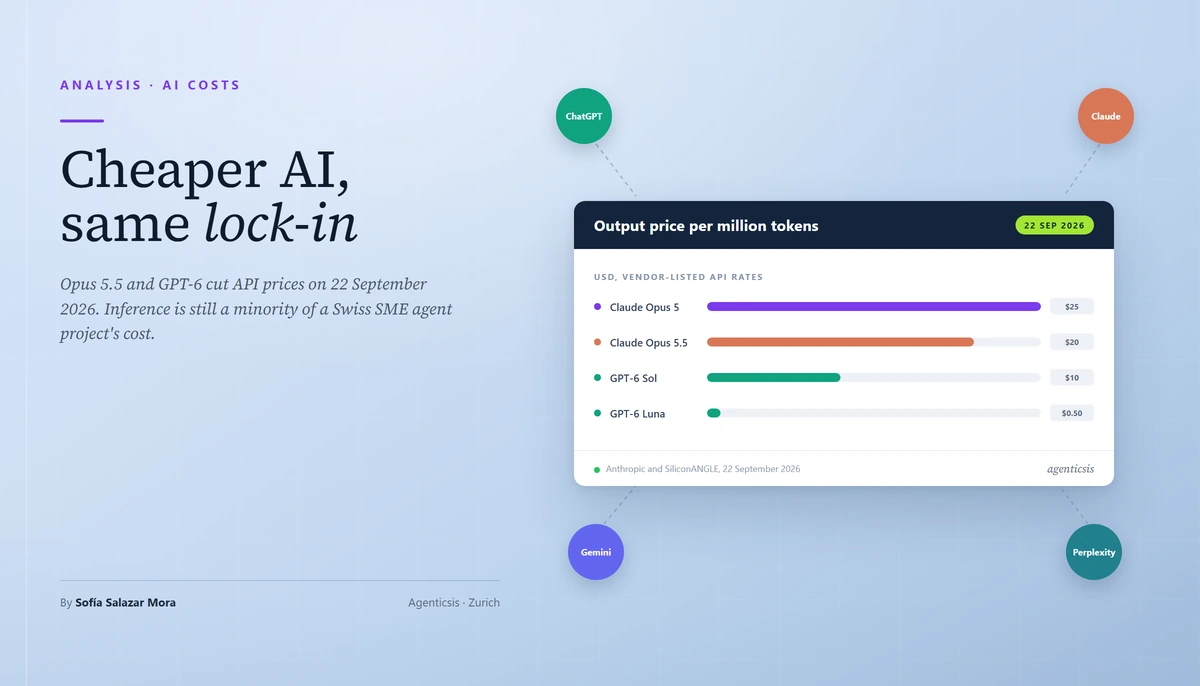
Frontier launches on 22 September 2026 have cut headline API pricing sharply, with Claude Opus 5.5 at $4/$20 per million tokens and GPT-6 Luna reported at $0.10/$0.50. For Swiss SMEs this compresses inference costs but does not make platform choice irrelevant, because integration, governance and compliance traceability now dominate total cost of ownership by 2027.
Table of Contents
- The September 2026 pricing reset
- What AI agent platform cost compression actually means
- Claude Opus 5.5 vs GPT-6 Sol/Luna for Swiss SMEs
- Why Switzerland changes the calculation
- Where platform lock-in still lives
- The real 2027 differentiators
- Building a portable multi-model architecture
- How SME procurement teams should respond
- Frequently asked questions
- Conclusion and next step
The September 2026 pricing reset
On 22 September 2026 Anthropic released Claude Opus 5.5 at $4 per million input tokens and $20 per million output tokens, a 20% reduction on Opus 5 headline pricing [Source: anthropic.com]. On the same day OpenAI released GPT-6 Sol at a reported $2 input and $10 output per million tokens, and GPT-6 Luna at $0.10 and $0.50 respectively [Source: siliconangle.com]. Anthropic also cut cache-read pricing from $0.50 to $0.20 per million tokens, a 60% reduction that matters heavily for coding and agent workloads [Source: anthropic.com].
For Swiss SME decision-makers, the headline story is that the marginal cost of running an intelligent agent has collapsed inside twelve months. That reality drives the central question of this article: if inference is nearly free, does AI agent platform cost compression finally make the platform decision unimportant, or does it simply shift the decision to a new layer of the stack?
The short version is that the decision moves, it does not disappear. Anthropic itself says its tests show Opus 5.5 costing about 40% less than Opus 5 on typical workloads at default settings [Source: anthropic.com]. That is a vendor estimate rather than an audited benchmark. Even taken at face value, a 40% cut on a cost line that represents a minority of a Swiss SME agent project produces a much smaller total saving.
Not sure how the September 2026 price cuts affect your project?
Agenticsis reviews one Swiss SME workflow and shows where cost compression genuinely lowers your bill and where it does not.
Request a scoped assessmentWhat AI agent platform cost compression actually means
Quick Answer:
Cost compression is the rapid, sustained fall in per-token model prices combined with efficiency gains per token. It shrinks one line item on an SME invoice, not the whole invoice, because integration, retrieval, human review and monitoring costs remain unchanged.
Inference is one line item, not the whole invoice
Cost compression in agentic AI describes a rapid, sustained fall in the per-token price of frontier models, combined with efficiency gains that let each token do more work. The 22 September 2026 launches are the clearest data point yet, with three tiers of pricing arriving simultaneously across two providers [Source: 9to5google.com].
Why token savings shrink at the project level
A Swiss SME automating an invoice-processing workflow pays for far more than model calls. Costs include ERP and accounting integration, identity and access management, retrieval infrastructure, human review of exceptions, monitoring, incident response and legal review. If inference is 15% of the operating cost of that workflow, a 40% reduction in inference lowers total operating cost by roughly 6%, assuming everything else holds steady. That is meaningful but not transformative.
Where compression bites hardest
The savings concentrate in workflows that are repetitive, high volume, heavily cached, easy to evaluate automatically and tolerant of occasional human review. Think document classification, first-line support triage, structured data extraction from PDFs and internal knowledge search. In those cases the 60% cache-read cut alone can visibly change unit economics [Source: anthropic.com]. In regulated cross-border workflows the effect is much weaker, because integration and supervision costs dominate.
Expert Insight
Cost compression is often confused with cost elimination. The mechanism at work is competitive pricing pressure between two providers releasing on the same day, not a fundamental change in what an agent needs to do reliably. The tasks around the model, retrieval, tool orchestration, guardrails and human sign-off, are still where most of the engineering effort and most of the invoice sit.
Claude Opus 5.5 vs GPT-6 Sol/Luna for Swiss SMEs
Reported pricing side by side
| Model | Input $/M tokens | Output $/M tokens | Positioning |
|---|---|---|---|
| Claude Opus 5.5 | $4 | $20 | High-capability general and agentic work |
| GPT-6 Sol | $2 | $10 | Coding and agent workflows |
| GPT-6 Luna | $0.10 | $0.50 | High-volume, lower-cost tasks |
Sources for these figures are the launch coverage of 22 September 2026 [Source: resultsense.com] and Anthropic's own product page [Source: anthropic.com]. Independent standardised evaluations at this pricing had not been established at time of writing, so Claude Opus 5.5 vs GPT-6 comparisons should treat performance claims cautiously.
Does the choice still matter for routine work?
For classification, extraction and high-volume support triage, the honest answer for Swiss SMEs is: increasingly, no. Any of the three tiers above will comfortably handle a well-designed prompt with structured output, and the price gap between GPT-6 Luna and Opus 5.5 is now large enough that routing routine tasks to the cheaper tier can cut inference bills by more than 90%.
Where the choice still matters
For complex reasoning over messy internal data, for coding-heavy agent chains and for tasks where a refusal or a fabrication has real business cost, model quality still varies enough that the choice matters. Windows-oriented coverage of the launches emphasised that both providers positioned their new tiers explicitly at coding agents, which suggests that gap will keep narrowing [Source: windowsforum.com].
Why Switzerland changes the calculation
Quick Answer:
Switzerland's multilingual market, sector confidentiality rules, revised Federal Act on Data Protection and extraterritorial exposure to the EU AI Act make the cheapest model a poor proxy for the lowest total cost of ownership for Swiss SME AI agents.
A fragmented, regulated, multilingual market
Swiss SMEs operate across German, French, Italian and English, often with Swiss German variation in customer communications. Data may need to be processed in Switzerland, the European Economic Area or the United States depending on the customer contract. Sector rules in banking, insurance and healthcare add confidentiality requirements that vendors cannot resolve on their own.
The current Swiss legal baseline
As of May 2026, Switzerland had no dedicated federal AI law [Source: sidd.swiss]. That does not mean AI is unregulated. The revised Federal Act on Data Protection, contractual confidentiality obligations, employment law, sector rules and general liability principles all apply to AI systems. Swiss companies serving EU customers also face extraterritorial exposure to the EU AI Act where their systems are placed on the EU market or produce outputs used in the EU.
Why cheapest model is a poor proxy
For a Zurich fintech supplier to a German bank, the relevant question is not whether GPT-6 Luna beats Opus 5.5 on a benchmark. It is whether the full application can demonstrate what data entered the system, which model version generated an output, which tools and retrieval sources were used, who approved the result and whether the process is reproducible. None of that is delivered by a lower token price.
Disclaimer
This article is general information about market and pricing dynamics, not legal advice. Swiss and EU regulatory obligations depend on the specific system, its risk classification and the jurisdictions where it is deployed. Agenticsis does not provide legal opinions, data protection impact assessments or EU AI Act compliance certifications. Consult qualified Swiss legal counsel for regulatory questions specific to your business.
Where platform lock-in still lives
Five layers of lock-in that outlast token pricing
Falling model prices make it easier to swap models, but lock-in exists at layers well above the API. Understanding those layers is central to interpreting AI agent platform cost compression honestly.
| Layer | Why switching is hard |
|---|---|
| Model API | Prompt formats, tool-calling schemas, context limits and safety behaviour differ between providers |
| Agent runtime | Planning, memory, retries and permissions are often proprietary to the platform |
| Data layer | Embeddings, vector indexes and evaluation datasets rarely transfer cleanly |
| Cloud platform | Identity, networking, logging and regional processing controls create sunk costs |
| Business application | Users and processes become dependent on one vendor's interface and approval flow |
The paradox of cheap models with expensive migrations
A Swiss SME can end up paying $0.50 per million output tokens and still face a migration bill that outweighs the token savings because business logic is embedded in one vendor's opaque prompt format, evaluation traces sit in a proprietary store and workflows are wired into that vendor's tool schema. Cost compression at the model layer therefore raises, not lowers, the strategic value of an architecture designed for portability.
The real 2027 differentiators
Quick Answer:
The four differentiators for Swiss SME agent projects in 2027 are workflow design, compliance traceability, model portability with routing, and rigorous evaluation with observability. None of these are delivered by a lower token price.
Workflow design
The strongest advantage in 2027 comes from selecting the right tasks and redesigning them around clear decision boundaries. High-value agent workflows have a defined business objective, reliable source data, explicit permissions, structured intermediate states, clear escalation rules and a named human owner for exceptions. A badly designed workflow stays unreliable no matter how cheap or capable the underlying model becomes.
Compliance traceability
For Swiss SMEs, traceability is becoming a commercial requirement as much as a legal one. Banks, insurers, healthcare organisations and public-sector buyers now routinely ask suppliers to document how AI is used. A durable audit trail should record the initiating user, the data sources consulted, the model and version, the prompt version, the tools invoked, any confidence signals, human approvals and overrides, the final output and its retention status.
Model portability and routing
SMEs should separate business logic from model-specific syntax wherever possible. A portable architecture can send different task types to different models: a premium model for complex reasoning, a cheaper model for classification and extraction, a private model for sensitive data, and a deterministic rules engine for high-consequence decisions.
Evaluation and observability
The relevant question is not which model tops a public benchmark. It is which configuration performs best on your own work. Every SME running agents in 2027 needs a representative evaluation set covering typical cases, difficult edge cases, multilingual inputs, sensitive information, adversarial prompts and failure scenarios, scored on accuracy, latency, cost, refusal behaviour, data leakage risk and human review burden.
Pro Tip
Build the evaluation harness before the agent. Fifty representative examples with expected outputs and edge cases give you the leverage to switch models the day a cheaper tier ships, without hoping the swap did not break anything. Without a harness, cost compression becomes a source of hidden risk instead of savings.
Building a portable multi-model architecture
Five illustrative Swiss scenarios
Consider a mid-size Zurich logistics operator processing 40,000 shipment documents per month. Routing extraction tasks to GPT-6 Luna at $0.10 input and $0.50 output per million tokens reduces inference spend dramatically compared with sending every document to Opus 5.5 [Source: resultsense.com]. The savings are only realised if the extraction pipeline is model-agnostic.
Consider a Geneva private bank building an internal research assistant. Sensitive client data cannot leave a controlled processing environment, so a cheaper external model is not automatically the right choice. The architecture must route based on data classification, not price.
Consider a Basel life-sciences SME summarising regulatory correspondence in three languages. Multilingual accuracy on Swiss French and Italian technical text matters more than headline pricing, and the evaluation harness must cover all three languages before any model swap is authorised.
Consider a Lucerne insurance broker automating claims triage. The dominant costs are integration into the policy administration system and human review of borderline cases. If inference is around 15% of the cost, a 40% inference cut moves the total project cost by roughly six percentage points.
Consider a Bern e-commerce SME automating customer support triage. This is exactly the workload where agentic AI pricing Switzerland compression pays off, because volume is high, tasks are repetitive and errors are easy to catch on review.
Design a workflow that can switch models cleanly
Agenticsis works with Swiss SMEs to design portable agent workflows within a CHF 1,500 to 80,000 project range, plus a CHF 60 per month Visibility Program for ongoing observability.
Plan your architectureHow SME procurement teams should respond
Contract for switching, not for loyalty
Procurement clauses should assume the model market keeps moving. Ask for export of prompts, evaluation traces and audit logs in open formats. Ask for explicit data-use terms and subprocessor lists. Ask for model retirement notice periods and support for controlled substitution.
Assess vendor resilience
The September 2026 launches show how quickly tiers appear and prices move [Source: simonwillison.net]. Assess vendor financial and operational stability, service-level commitments, regional availability, independent security certifications and support for incident investigation. A cheap model from an unstable vendor is not cheap once you have migrated twice.
Budget for the parts that did not get cheaper
Workflow design, integration, evaluation and human oversight did not benefit from the 22 September 2026 price cuts. Budgets should reflect that reality rather than assume vendor price cuts flow through evenly to project totals.
Expert Insight
The best signal of a mature AI agent project in 2027 is not which model it uses, it is how quickly the team can swap that model out without breaking anything. If a proof of concept locks you into one provider's tool schema and prompt format, cost compression works against you: every future price cut you cannot capture is a competitor's advantage.
Frequently asked questions
Q: Will AI model prices keep falling in 2027 and does that matter for my business?
A: Prices are likely to keep falling for routine workloads, driven by competition between frontier vendors and by tiered product lines like GPT-6 Sol and Luna [Source: siliconangle.com]. It matters, but less than headlines suggest, because inference is a minority of Swiss SME project costs. The businesses that benefit most have workflows designed to route tasks to the cheapest capable tier.
Q: Should Swiss SMEs choose Claude Opus 5.5 or GPT-6 for agentic workflows?
A: For most routine SME work in 2027, either family works, and GPT-6 Luna at $0.10 input and $0.50 output per million tokens will often win on unit economics [Source: resultsense.com]. For complex reasoning, coding-heavy chains and high-stakes decisions, run your own evaluations. Design the architecture so switching between them takes hours, not weeks.
Q: Does cheaper AI mean agentic automation projects will get simpler?
A: No. Cheaper inference makes experimentation less costly, but it does not simplify integration with Swiss ERP, banking or insurance systems, and it does not simplify governance. If anything, cheaper models encourage teams to deploy more agents, which increases the need for auditable workflows, evaluation harnesses and clear human oversight.
Q: What will differentiate AI consultancies once model costs converge?
A: Workflow design, compliance traceability, evaluation practice and integration depth. Once any consultancy can access frontier models at similar prices, the differentiator becomes the ability to design agents that pass a customer audit and keep working when the underlying model is swapped. That is where Agenticsis focuses.
Q: How much of a Swiss SME agent project is actually inference cost?
A: It varies by workflow. In our illustrative example inference is a minority line item at around 15%, once integration, human review, monitoring and change management are counted. That means even a 40% inference cut translates to a much smaller total saving. The figure is illustrative, not a Swiss market statistic.
Q: Is the 40% Opus 5.5 cost saving reliable?
A: It is Anthropic's own estimate of typical workload savings versus Opus 5, from its tests at default settings [Source: anthropic.com]. Treat it as a vendor claim, not an independently audited benchmark. Confirm the effect on your own evaluation set before repricing internal projects.
Q: Does Switzerland have an AI law like the EU AI Act?
A: As of May 2026, Switzerland had no dedicated federal AI law [Source: sidd.swiss]. Existing rules on data protection, confidentiality, employment and liability still apply. Swiss SMEs selling into the EU can face EU AI Act obligations depending on how their systems are used across the border, and should take qualified legal advice.
Q: What is a realistic total project budget for a Swiss SME agent in 2027?
A: Agenticsis works within a CHF 1,500 to 80,000 project range for AI SME engagements, with a monthly Visibility Program at CHF 60. The right figure depends on workflow complexity, integrations and governance needs. Cost compression at the model layer does not necessarily lower this range, because the dominant costs sit elsewhere.
Q: Can I just pick GPT-6 Luna for everything to minimise cost?
A: No. Cheaper tiers trade capability for price, and using them for tasks that need deeper reasoning produces silent quality regressions. The right pattern is model routing: send each task type to the cheapest tier that meets your evaluation threshold, and re-run the evaluation whenever a new tier ships.
Q: What is cache-read pricing and why does it matter?
A: Cache-read pricing is what you pay to reuse previously processed context, such as a large document or long system prompt. Anthropic cut Opus 5.5 cache-read pricing from $0.50 to $0.20 per million tokens, a 60% reduction [Source: anthropic.com]. For coding agents and document-heavy workflows this can matter more than the headline input price.
Q: How should I evaluate models against each other for my own workflows?
A: Build a representative evaluation set of 50 to 200 examples covering typical cases, edge cases, multilingual inputs, sensitive data and adversarial prompts. Score each model on accuracy, latency, cost per task, refusal behaviour and human review burden. Rerun the harness on every new model release. This is the single most valuable engineering asset an SME can own.
Q: What audit trail should an SME keep for regulated agent workflows?
A: Log the initiating user or system, the data sources consulted, the model and version, the prompt or policy version, the tools invoked, any confidence or validation results, human approvals and overrides, the final output and its downstream effect, and retention status. This is the minimum a Swiss bank or insurer supplier is likely to be asked to produce.
Q: Will agent platforms consolidate around one vendor by 2027?
A: Unlikely. The 22 September 2026 dual launch shows two credible frontier providers competing directly on price and capability, with more entrants in adjacent tiers [Source: 9to5google.com]. The realistic 2027 picture is a fragmented market where the winning architecture is multi-model and policy-controlled rather than tied to any one vendor.
Q: How does data residency affect model choice in Switzerland?
A: Data residency can constrain which models you can legitimately use, especially in banking, health and legal work. The cheapest model may not be an option if its processing regions or subprocessors do not meet contractual requirements. Assess residency and confidentiality before pricing, not after.
Q: What is the biggest mistake SMEs make when reacting to price cuts?
A: Rebuilding around one vendor because a specific price looks attractive today. The 22 September 2026 launches will not be the last repricing event, and the next one will reward architectures that can switch. Design for portability first, then capture the price cuts as they arrive.
Q: When does model choice genuinely still matter?
A: It matters most in complex reasoning over messy internal data, in coding-heavy agent chains, in multilingual technical work and in high-consequence decisions where refusals or fabrications carry real business cost. For those workloads, run structured evaluations rather than trusting a benchmark or a launch blog post.
Conclusion and next step
The September 2026 pricing reset is real and consequential, but the framing that AI agent platform cost compression makes platform choice irrelevant for Swiss SMEs by 2027 is overstated. Cost compression moves the decision, it does not remove it.
- Frontier model prices dropped sharply on 22 September 2026, with tiers now ranging from $0.10 to $4 per million input tokens.
- Inference is a minority of Swiss SME agent project costs, so headline vendor savings do not flow through evenly.
- Platform lock-in persists at the runtime, data, cloud and business-application layers even when models are cheap.
- Workflow design, compliance traceability, evaluation practice and model portability are the 2027 differentiators.
- Swiss SMEs should design multi-model architectures with strong audit trails and contract for switching, not loyalty.
Related reading
- How Swiss SMEs are putting AI into production in 2026: what actually reaches production, and why
- The generative AI ROI gap for Swiss SMEs: why reported productivity gains do not reach the P&L
- AI agentic system pilot: a 90-day playbook for Swiss SMEs: a step-by-step plan that fixes the scope before the model
- How much can Swiss SMEs save with AI automation?: the cost side of the same decision
Design an agent your future self can still swap
Agenticsis helps Swiss SMEs build auditable, portable agentic workflows that capture model price cuts without vendor rewrites. Start with a scoped assessment of one workflow.
Talk to Agenticsis