TL;DR(Too Long; Did not Read)
Swiss SMEs guide to autonomous AI agent compliance in 2026: FADP, EU AI Act, NIST AI RMF, ISO 42001, and practical governance controls for CEOs.
Standards and Compliance Frameworks for Autonomous AI Agents: What Swiss SMEs Need to Know
By Agenticsis Team · Published October 13, 2026 · Last updated October 13, 2026
Quick Answer:
Switzerland has no horizontal AI law in 2026, but Swiss SMEs deploying autonomous AI agents are already subject to the revised Federal Act on Data Protection (FADP), sectoral regulation, employment law, contract law, and potentially the EU AI Act when operating in EU markets. A defensible baseline combines the FADP, NIST AI Risk Management Framework 1.0, NIST AI 600-1 for generative AI, ISO/IEC 42001 management controls, and agent-specific identity, authorization and human-approval mechanisms.
Table of Contents
- Why Autonomous Agents Are a Different Compliance Problem
- The 2026 Swiss Regulatory Landscape
- The FADP: What CEOs Must Operationalize
- When the EU AI Act Reaches Swiss SMEs
- NIST AI Risk Management Framework for Agents
- ISO/IEC Standards: 42001, 23894, 27001, 27701
- Agent-Specific Control Areas
- Third-Party and Supply-Chain Risk
- Agent Identity and Authorization
- Recommended SME Compliance Baseline
- Illustrative SME Scenarios
- 2026 Market Trends CEOs Should Act On
- Frequently Asked Questions
- Conclusion and Next Steps
1. Why Autonomous Agents Are a Different Compliance Problem
A recent 2026 survey found that 72% of AI business leaders believe their organizations are failing to comply with new or emerging AI-specific regulations, and 81% are concerned that third-party-enabled cyberattacks could compromise their AI tools [Source: https://www.zdnet.com/innovation/ey-survey-unauthorized-ai-agents-governance/]. For Swiss SMEs, this governance gap is not a theoretical issue. It is a direct exposure to data-protection, contractual and reputational risk.
Autonomous AI agents are not chatbots. They are software systems with delegated authority: they plan, retrieve information, call external tools, write to systems of record, and in many deployments initiate actions that touch customers, employees, suppliers and finances. The compliance implication is that an agent is simultaneously a data processor, a decision-maker, a user of third-party services, and in some sense an acting entity inside the business.
CEOs typically ask one of two questions. The first is "which standard do we certify to?" The second is "what do we actually need to do before go-live?" The honest answer in 2026 is that no single certification covers the full agent surface area. The practical answer is to combine the FADP, the EU AI Act where applicable, the NIST AI RMF, ISO-aligned management controls, and conventional cybersecurity. This article walks through each layer and what it means for a Swiss SME shipping an autonomous agent this quarter.
💡 Expert Insight
The decisive difference between a chatbot and an agent is not intelligence; it is consequence. A chatbot that hallucinates produces a wrong answer. An agent that hallucinates can send a wrong email, approve a wrong refund, or write a wrong record to a production database. Compliance frameworks designed for predictive AI (bias, accuracy, explainability) are necessary but no longer sufficient when the system can take actions.
2. The 2026 Swiss Regulatory Landscape
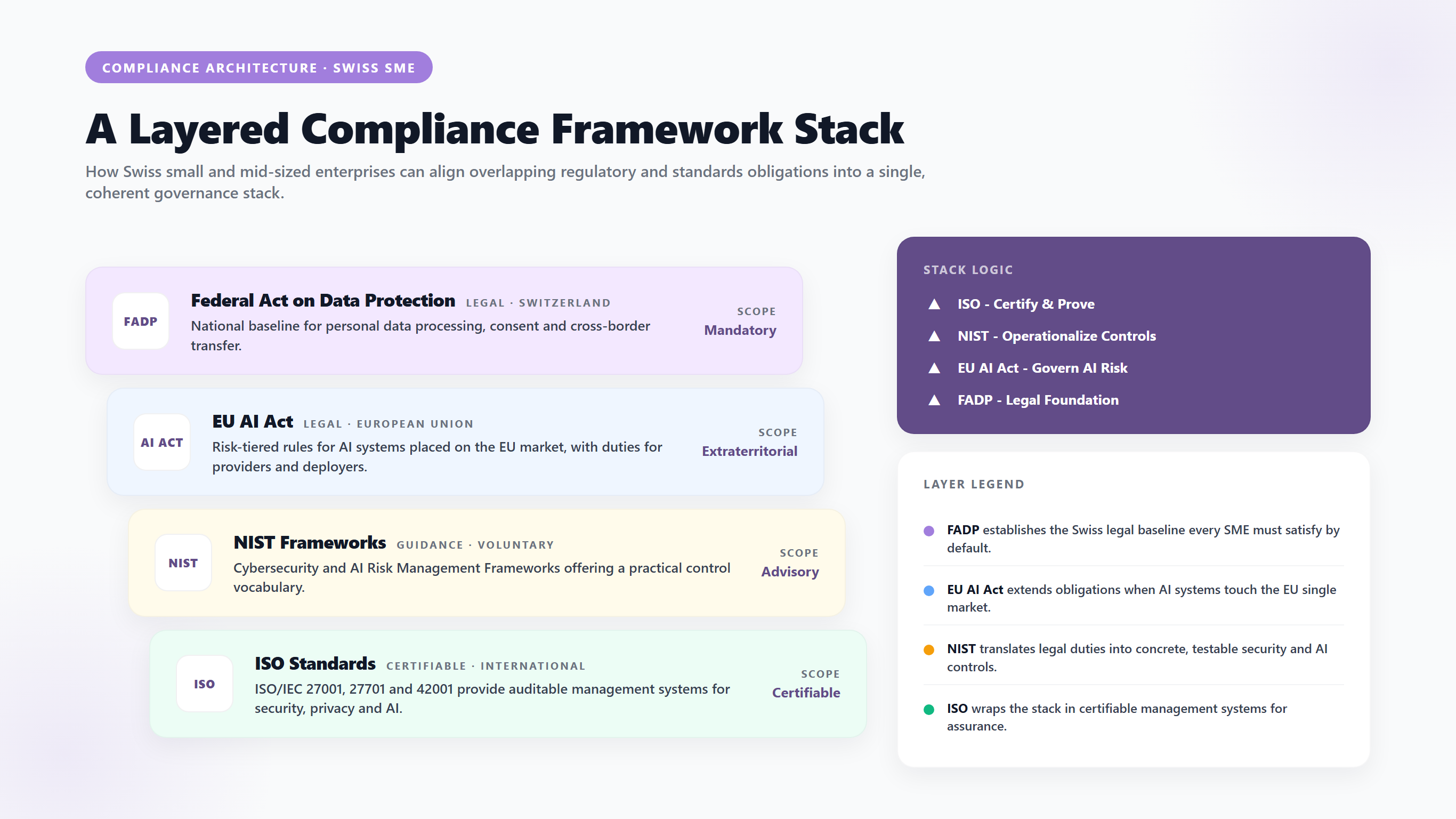
Switzerland does not currently have a single, horizontal AI statute [Source: https://www.kmu.admin.ch/en/a-consultation-draft-to-regulate-ai-will-be-drawn-up-by-early-2027]. The Federal Council intends a sector-oriented approach and plans to incorporate the Council of Europe AI Convention into Swiss law. A consultation draft covering transparency, data protection, non-discrimination and supervision is expected by early 2027 (spring 2027 per the Swiss SME portal) [Source: https://www.kmu.admin.ch/en/a-consultation-draft-to-regulate-ai-will-be-drawn-up-by-early-2027].
What this means in practice
Waiting for a future Swiss AI Act is not a compliance strategy. Existing law already applies to autonomous agents, including the revised FADP, employment law, intellectual-property law, contract law and sector-specific regulation such as FINMA guidance for financial-services firms [Source: https://ai-risk.ch/en/ai-act-switzerland/]. For a CEO, the first question is not "which future regulation will bind us" but "which current obligations are already triggered by the agent we are about to deploy."
Sector-specific overlays
Financial services, healthcare, insurance, telecommunications and critical infrastructure in Switzerland each carry additional supervisory expectations. These are not replaced by AI-specific regulation; they are layered on top of it. An agent that recommends a credit decision, triages a medical query or interacts with insured persons will be subject to its sector's existing rules regardless of whether a Swiss AI Act is in force.
The Council of Europe AI Convention angle
Because Switzerland intends to incorporate the Council of Europe AI Convention, SMEs that align now with transparency, human oversight and non-discrimination principles will be well-positioned for the Swiss draft expected in late 2026 or early 2027 [Source: https://www.kmu.admin.ch/en/a-consultation-draft-to-regulate-ai-will-be-drawn-up-by-early-2027]. Building these controls now avoids costly retrofits.
3. The FADP: What CEOs Must Operationalize
Quick Answer: Does the FADP apply to my AI agent?
Yes, in almost every case. The revised FADP is technology-neutral and applies whenever an autonomous agent processes personal data - which covers internal productivity agents (employee data), customer-facing agents (client data), and operational agents (supplier and prospect data). A DPIA is required when processing creates a high risk to personality or fundamental rights.
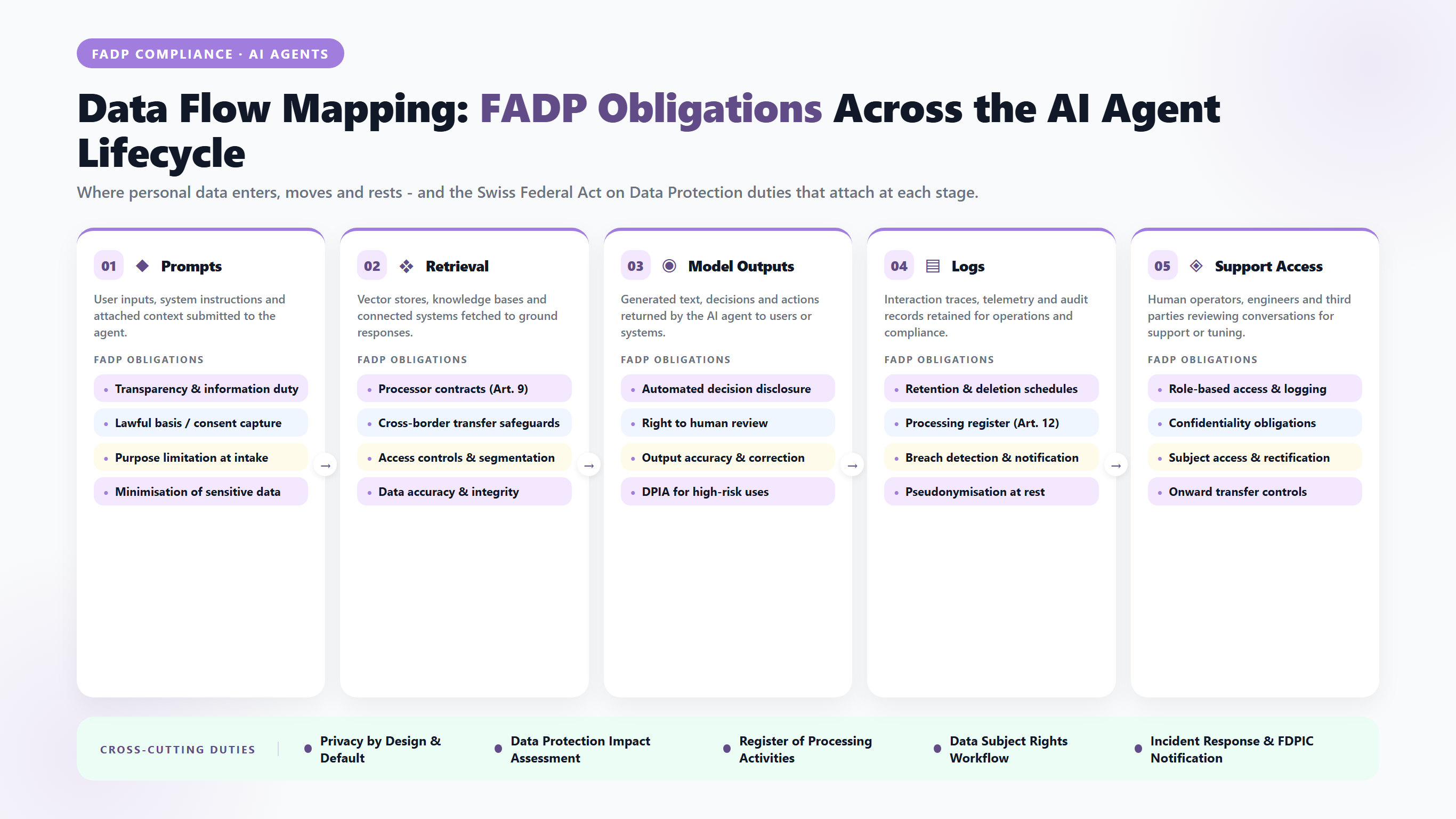
The revised Federal Act on Data Protection is technology-neutral and applies whenever an autonomous agent processes personal data [Source: https://productstudio.ch/blog/ai-agents-swiss-data-protection-fadp/]. In practical terms, this covers almost every meaningful deployment: internal productivity agents handle employee data, customer-facing agents handle client data, and operational agents touch supplier and prospect data.
Documenting the full data flow
A compliant deployment must document prompts, retrieved documents, model outputs, logs, feedback mechanisms and support access [Source: https://productstudio.ch/blog/ai-agents-swiss-data-protection-fadp/]. CEOs frequently underestimate the "logs" element: when an agent writes verbose reasoning traces to a monitoring tool hosted outside Switzerland, that monitoring tool becomes part of the data-protection surface.
Sensitive data and personality profiles
The FADP has specific requirements where processing involves sensitive personal data, employee data, or information that could create a personality profile [Source: https://productstudio.ch/blog/ai-agents-swiss-data-protection-fadp/]. An agent that aggregates performance notes, calendar data, email content and CRM entries about a single employee may be constructing a personality profile even if no individual input is "sensitive" in isolation.
Data Protection Impact Assessment
A DPIA is required when processing is likely to create a high risk to personality or fundamental rights [Source: https://productstudio.ch/blog/ai-agents-swiss-data-protection-fadp/]. Agents with high autonomy, broad access, or decision-making consequences generally cross this threshold. The DPIA is not a bureaucratic artifact; it is the document that will be reviewed first if something goes wrong.
Automated decisions with significant effects
Where an automated decision has legal consequences or significantly affects an individual, the FADP requires information and meaningful human review [Source: https://productstudio.ch/blog/ai-agents-swiss-data-protection-fadp/]. "Meaningful" is the operative word. A rubber-stamp approval queue where humans click "approve" without reviewing is not meaningful human review and will not survive supervisory scrutiny.
💡 Pro Tip
Design your human-approval UI so the reviewer must actively engage with the agent's reasoning: show the top three retrieved sources, surface any contradicting signals, and require a brief justification (free-text or dropdown) for approvals above a defined threshold. This single UX change converts a rubber-stamp queue into a defensible "meaningful human review" record.
4. When the EU AI Act Reaches Swiss SMEs
Quick Answer: EU AI Act 2026 timeline
Article 50 transparency duties (deepfake labeling, AI-generated content disclosure) became applicable on 2 August 2026. The 2 December 2026 deadline requires labeling of certain AI-generated content for systems already on the EU market. High-risk Annex III obligations apply from 2 December 2027; embedded Annex I from 2 August 2028.
Swiss SMEs can be affected by the EU AI Act when they place AI systems or general-purpose AI models on the EU market, or provide systems used within the Act's territorial scope [Source: https://www.kmu.admin.ch/en/a-consultation-draft-to-regulate-ai-will-be-drawn-up-by-early-2027]. For an exporting SME, this is not optional.
Current EU AI Act timeline
| Date | Obligation |
|---|---|
| 2 August 2026 | Article 50 transparency duties became applicable [Source: https://ai-risk.ch/en/ai-act-switzerland/] |
| 2 December 2026 | Deadline for labeling certain AI-generated content from systems on the market before 2 August 2026 [Source: https://ai-risk.ch/en/ai-act-switzerland/] |
| 2 December 2027 | High-risk obligations for stand-alone systems under Annex III scheduled to apply [Source: https://ai-risk.ch/en/ai-act-switzerland/] |
| 2 August 2028 | High-risk obligations for AI embedded in regulated products under Annex I scheduled to apply [Source: https://ai-risk.ch/en/ai-act-switzerland/] |
Transparency and labeling in 2026
The transparency requirements that became applicable on 2 August 2026 include clear labeling of deepfakes and AI-generated or AI-manipulated text concerning matters of public interest [Source: https://www.kmu.admin.ch/en/a-consultation-draft-to-regulate-ai-will-be-drawn-up-by-early-2027]. For a Swiss SME running an agent that generates customer-facing content in the EU, labeling and disclosure obligations are already live.
Risk classification is use-case driven
SMEs should not assume an agent is low-risk because it is an "internal productivity tool." Risk under the EU AI Act depends on the use case, the people affected, the degree of autonomy, and the consequences of the agent's actions. An internal HR screening agent, for example, may fall into high-risk categories even though it is never customer-facing.
Free Download: Download the Swiss SME AI Agent Compliance Checklist
Download Now5. NIST AI Risk Management Framework for Agents
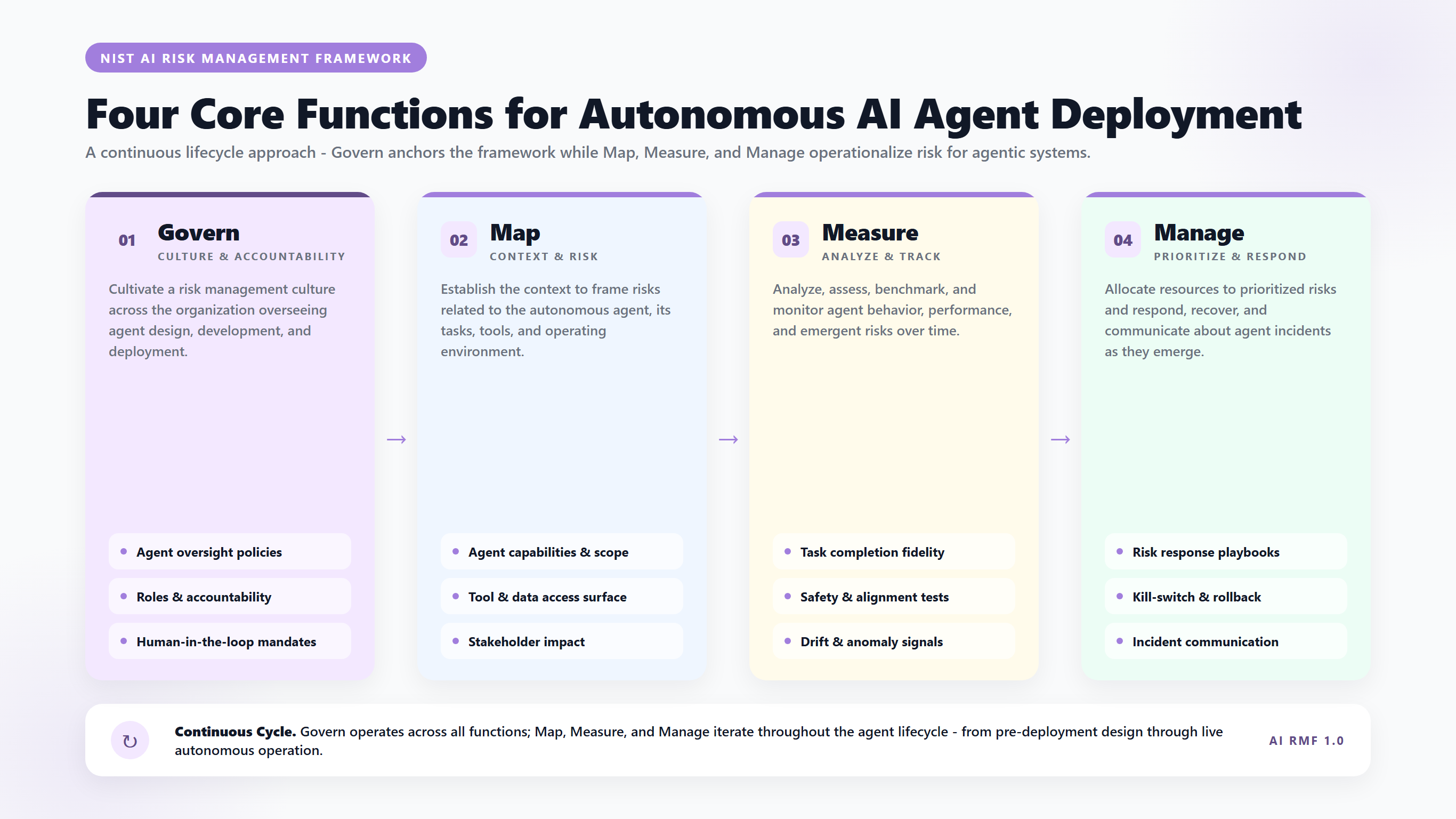
The NIST AI Risk Management Framework 1.0, published in January 2023, remains the most widely referenced structural framework for AI risk [Source: https://ai-risk.ch/en/ai-act-switzerland/]. Its four core functions are Govern, Map, Measure and Manage [Source: https://ai-risk.ch/en/ai-act-switzerland/]. NIST AI 600-1 extends the framework to generative AI risks [Source: https://ai-risk.ch/en/ai-act-switzerland/].
Govern
Assign accountability, policies, risk appetite and oversight. For an SME, this typically means naming a single executive sponsor, a technical owner and a compliance owner per agent, and establishing a written policy that defines which categories of actions require human approval.
Map
Identify intended use, stakeholders, context, data and foreseeable harms. An agent "map" should answer four questions: what is the agent allowed to do, what data can it see, what tools can it call, and what happens if it is wrong.
Measure
Test performance, security, privacy, bias, robustness and reliability. For agents specifically, measurement must extend beyond model accuracy to include tool-use correctness, prompt-injection resistance, retrieval contamination and multi-step reasoning failure modes.
Manage
Prioritize, mitigate, monitor and document risks. Monitoring is where most SMEs under-invest. A one-time pre-launch test is not sufficient when the underlying model, retrieved documents or tool permissions change weekly.
The 2026 NIST AI Agent Standards Initiative
NIST launched an AI Agent Standards Initiative on 17 February 2026 [Source: https://justinmckelvey.com/blog/ai-governance-framework]. Early work included requests for information on agent security, a draft concept paper on agent identity and authorization, and sector listening sessions [Source: https://justinmckelvey.com/blog/ai-governance-framework]. SMEs should treat this as directional: the next generation of agent standards will center on identity, authorization and operational accountability, not just model accuracy.
6. ISO/IEC Standards: 42001, 23894, 27001, 27701
ISO-aligned management systems provide auditable structure. Certification is not automatically required for Swiss SMEs, but alignment can materially reduce procurement friction, especially when selling into enterprise or EU buyers.
| Standard | Scope | When It Applies to Agents |
|---|---|---|
| ISO/IEC 42001 | AI management system | When the SME wants an auditable AI governance structure covering roles, policies and controls |
| ISO/IEC 23894 | AI risk management | When operationalizing risk assessment and treatment specifically for AI systems |
| ISO/IEC 27001 | Information security management | Always relevant for agents that process business data or access production systems |
| ISO/IEC 27701 | Privacy information management | When demonstrating privacy controls aligned to FADP and GDPR expectations |
SMEs should verify the current edition and national adoption status of any standard before using it as a formal compliance claim. "Aligned to" is defensible; "certified to" requires a formal audit.
Choosing between full certification and alignment
For most Swiss SMEs under 250 employees, full ISO 42001 certification is a significant undertaking. A pragmatic path is to align the governance structure to 42001, maintain existing 27001 certification if already held, and document FADP-specific privacy controls in a 27701-style register. This provides evidence of maturity without the audit cost of a full certification program.
💡 Expert Insight
The trade-off between alignment and certification is primarily commercial, not technical. If your buyers are enterprise procurement teams asking for "evidence of an AI management system," alignment with a documented control register is often enough. If buyers require certified attestation in their supplier questionnaires, the audit cost may be justified. Choose based on who signs your contracts.
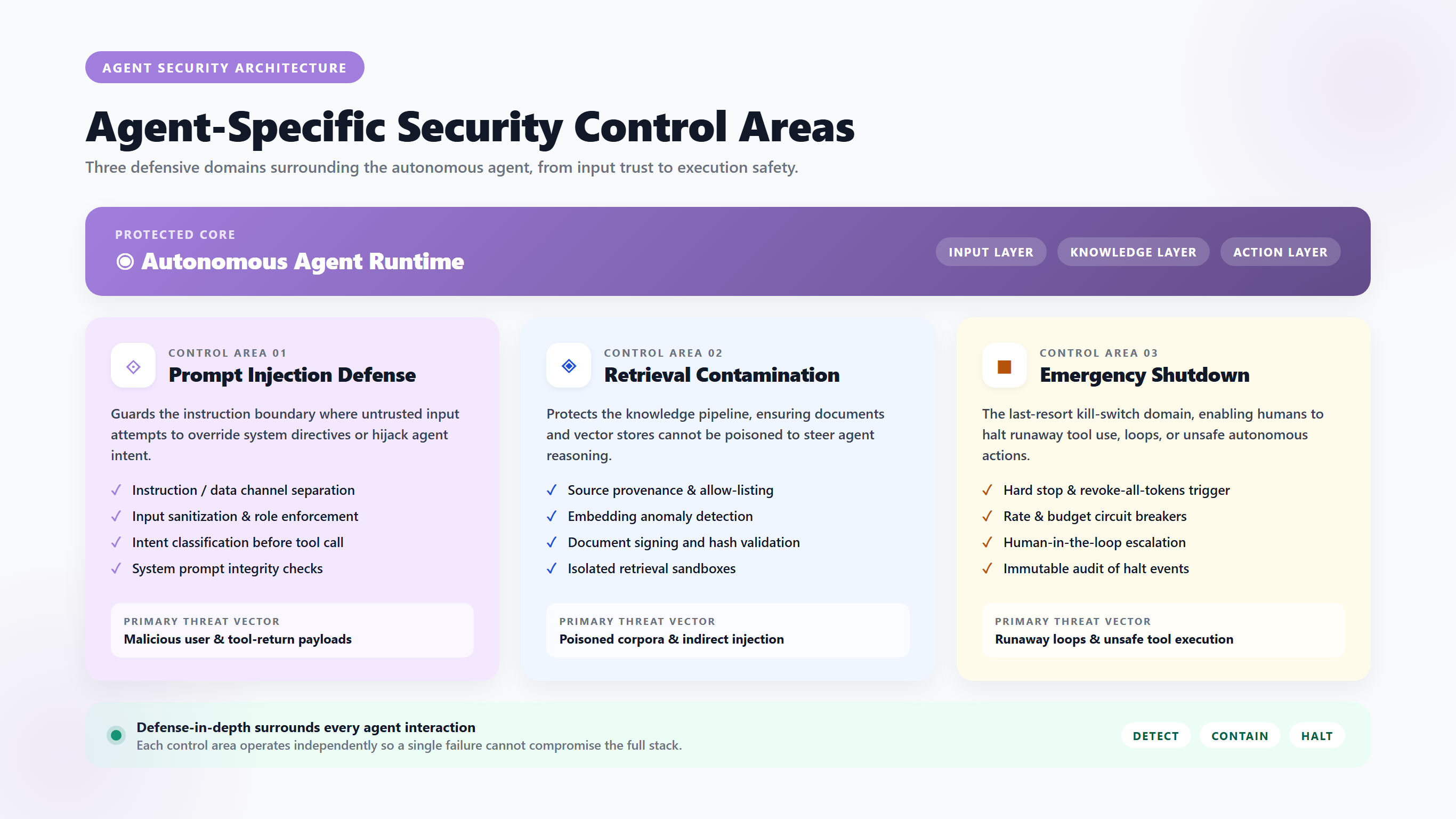
7. Agent-Specific Control Areas
Quick Answer: What is the single most important agent control?
Separation of read, draft and execute permissions, combined with mandatory human approval for consequential actions. This one pattern eliminates the majority of worst-case outcomes while preserving the productivity value of the agent.
Traditional AI governance focuses on model accuracy, bias and explainability. Autonomous agents introduce control areas that model-level evaluation does not fully address.
Prompt injection and indirect prompt injection
A document retrieved by the agent, an email it reads or a tool response it receives can contain instructions that override the agent's intended behavior. This is not a theoretical attack. Any agent that reads untrusted input must be tested against prompt-injection scenarios before go-live.
Retrieval contamination
Vector stores and knowledge bases can be poisoned with malicious documents. If an attacker (or a careless internal user) can upload content to a corpus the agent retrieves from, they can indirectly influence the agent's outputs and actions.
Multi-agent escalation
When agents call other agents, authority can escalate across the chain. The CEO-level question is whether an action requiring human approval at the top of the chain can be executed by a downstream sub-agent without that approval. The answer must be no.
Secrets and credential handling
Agents often need API keys, database credentials and OAuth tokens. These must be stored in a secrets manager, rotated regularly, and scoped to the minimum required permissions. An agent that holds a cloud administrator credential is a single prompt-injection away from a serious incident.
Rollback and emergency shutdown
Every agent should have a documented kill switch: a single administrative action that disables the agent, revokes its credentials and preserves logs. If this cannot be executed in minutes, the agent is not production-ready.
8. Third-Party and Supply-Chain Risk
The 2026 survey finding that 81% of AI business leaders are concerned about third-party-enabled cyberattacks on AI tools reflects the reality that modern agents are built on long supplier chains [Source: https://www.zdnet.com/innovation/ey-survey-unauthorized-ai-agents-governance/]. A typical SME agent depends on a foundation-model provider, an orchestration framework, a vector database, multiple plugin providers, a cloud host and a monitoring vendor.
The vendor data checklist
Before procurement, the SME should obtain and record from each vendor:
- Exact product and model name
- Exact version, release or snapshot identifier
- Initial release date and latest update date
- Deprecation and support dates
- Hosting region and subprocessors
- Training and retention policy
- Security certifications
- Agent and tool permissions
- Logging and audit capabilities
- Incident-notification commitments
- Export, deletion and portability mechanisms
Cross-border data transfer
The FADP requires assessment of international transfers [Source: https://productstudio.ch/blog/ai-agents-swiss-data-protection-fadp/]. If the foundation model is served from a US region and the vector store is hosted in the EU, the SME must document both transfers, confirm adequacy or safeguards, and reflect this in privacy notices.
9. Agent Identity and Authorization
The 2026 NIST agent initiative's early focus on agent identity and authorization reflects a broader market shift [Source: https://justinmckelvey.com/blog/ai-governance-framework]. Organizations need to know which agent acted, under whose authority, using which credentials, against which data, and with what approval.
Separate read, draft and execute permissions
A proven FADP-aligned control pattern is to separate read, draft and execute permissions [Source: https://productstudio.ch/blog/ai-agents-swiss-data-protection-fadp/]. An agent may retrieve information and prepare a recommendation without being allowed to send, purchase, delete, approve or change records automatically. This single control eliminates a large category of worst-case outcomes.
Non-human identity
Agents should have their own identity, not borrow a human user's credentials. This enables precise audit trails, scoped permissions and clean revocation. If an agent operates "as" a specific employee, every action it takes is attributed to that employee, which is both a compliance and an HR problem.
Rogue agents
A substantial proportion of organizations reportedly cannot detect unauthorized or "rogue" AI agents in their environments [Source: https://www.zdnet.com/innovation/ey-survey-unauthorized-ai-agents-governance/]. For Swiss SMEs, an agent inventory is the foundational control. If the CEO cannot list every agent running against company data this week, the governance posture is incomplete.
💡 Pro Tip
Give every agent its own service account with a naming convention like agent-[purpose]-[environment]. This makes audit trails trivially filterable and makes credential revocation a single administrative action. Avoid the common anti-pattern of letting agents inherit an engineer's personal credentials.
10. Recommended SME Compliance Baseline
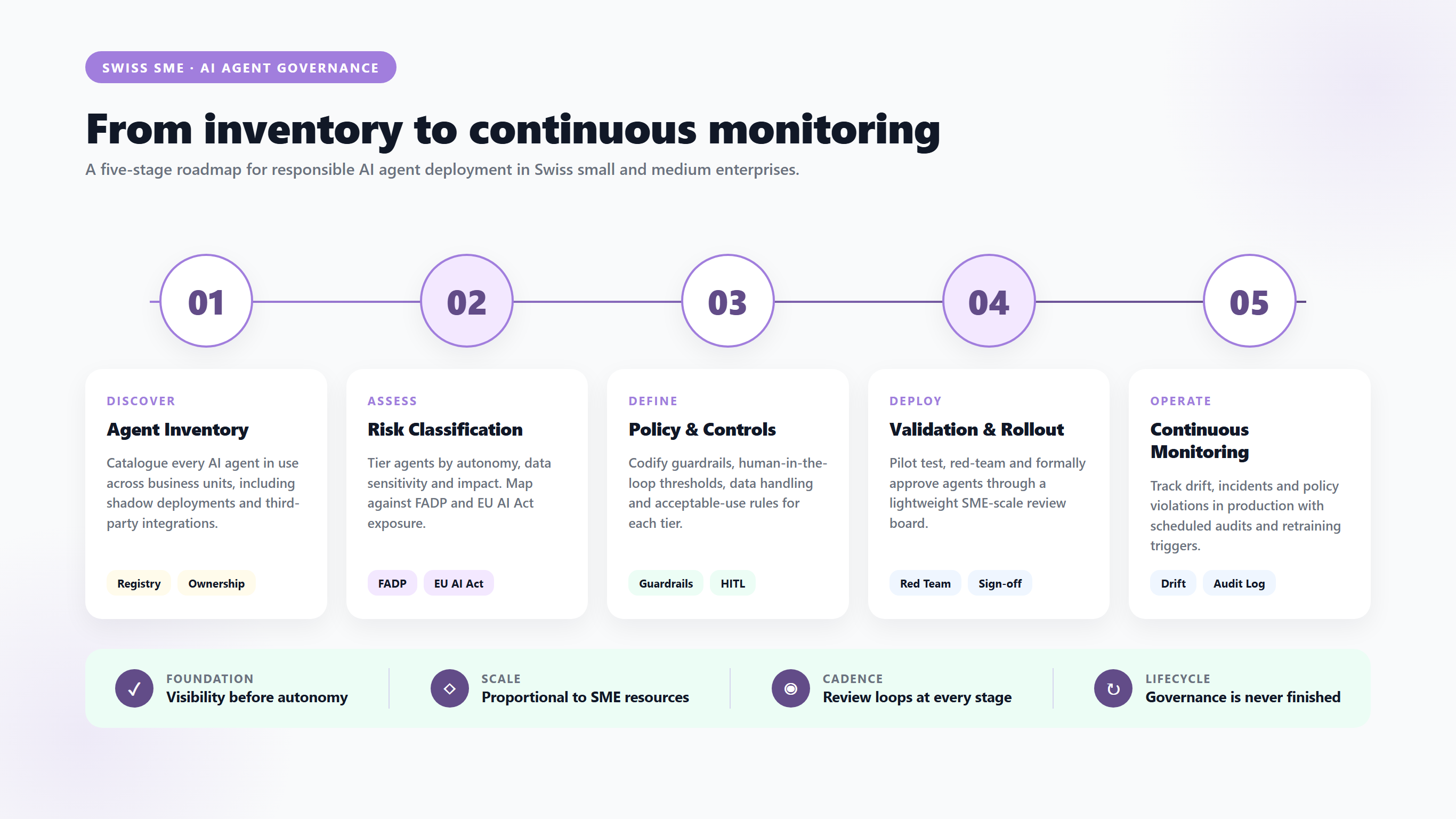
Combining the FADP, the EU AI Act where applicable, NIST AI RMF, ISO-aligned management controls and agent-specific controls yields a practical 12-step baseline.
- Create an inventory of every agent, model, plugin, connector and automated workflow.
- Assign a business owner, technical owner and compliance owner to each agent.
- Classify the agent by data sensitivity, autonomy and potential impact.
- Map all data flows, subprocessors, storage locations and retention periods.
- Apply least privilege and separate read, draft and execute permissions.
- Require human approval for payments, employment decisions, legal commitments, customer-impacting decisions and destructive actions.
- Log prompts, retrieved sources, tool calls, approvals, outputs, errors and final actions.
- Test for prompt injection, data leakage, unauthorized tool use and unsafe escalation.
- Establish emergency shutdown, rollback and credential-revocation procedures.
- Review contracts and privacy notices under the FADP.
- Determine whether the EU AI Act applies to the company, product, customer or market.
- Reassess the system whenever the model, tools, prompts, data sources or permissions change.
Framework comparison for Swiss SMEs
| Framework | Mandatory for Swiss SMEs? | Primary Value | Typical Effort |
|---|---|---|---|
| FADP | Yes, when personal data is processed | Legal baseline for data processing | Medium: DPIA, data flow mapping, privacy notices |
| EU AI Act | Only when operating in or placing on EU market | EU market access and transparency compliance | Medium to high depending on risk tier |
| NIST AI RMF 1.0 | No, voluntary | Structured governance across Govern, Map, Measure, Manage [Source: https://ai-risk.ch/en/ai-act-switzerland/] | Medium: policy and process build-out |
| ISO/IEC 42001 | No, voluntary | Auditable AI management system | High: certification requires formal audit |
| ISO/IEC 27001 | No, but often contractually required | Information security foundation | High if not already certified |
11. Illustrative SME Scenarios
The following scenarios are illustrative, not case studies of real client deployments. They are designed to show how the frameworks interact in practice.
Scenario 1: A Zurich professional-services firm deploys a document-drafting agent
A 60-person consultancy wants an internal agent that drafts client memos from historical templates. Because the agent processes client data and generates documents attributed to the firm, the FADP applies. The firm maps data flows, confirms the foundation-model vendor's EU hosting region, applies read and draft permissions only (no autonomous send), and requires partner approval before any document leaves the firm. A DPIA is completed because the memos may create personality profiles of client contacts.
Scenario 2: A Geneva fintech runs a KYC triage agent
The agent reviews onboarding documents and flags cases for human review. Because the output significantly affects individuals (approval or rejection of a financial relationship), the FADP's automated-decision provisions apply, FINMA sectoral expectations overlay, and meaningful human review is mandatory [Source: https://productstudio.ch/blog/ai-agents-swiss-data-protection-fadp/]. The firm logs every retrieved document, every reasoning step and every reviewer decision for seven years.
Scenario 3: A Basel manufacturer sells an EU product with embedded AI
The product includes an AI component that interacts with end users in the EU. The EU AI Act applies. Depending on the use case, high-risk obligations under Annex I may trigger by 2 August 2028 [Source: https://ai-risk.ch/en/ai-act-switzerland/]. The manufacturer begins conformity preparation now rather than at the deadline.
Scenario 4: A Lausanne e-commerce SME deploys a customer-service agent
The agent answers questions and can issue refunds up to CHF 100 autonomously. The firm applies the read-draft-execute separation but makes an informed exception for low-value refunds, with daily rate limits, per-customer caps, full logging and a monthly audit. Refunds above the threshold require human approval. EU AI Act transparency labeling is applied to the chat interface for EU customers [Source: https://www.kmu.admin.ch/en/a-consultation-draft-to-regulate-ai-will-be-drawn-up-by-early-2027].
Scenario 5: A Bern logistics operator pilots a multi-agent workflow
Three agents coordinate: one classifies shipping documents, one updates the ERP, one notifies customers. The firm's governance team recognizes the multi-agent escalation risk and requires that any ERP write triggered by the classification agent still passes through a human-approval queue. Each agent has its own identity, its own credentials and its own scoped permissions.
Free Download: Schedule an AI Agent Compliance Audit
Download Now12. 2026 Market Trends CEOs Should Act On
Three trends define the 2026 governance landscape and should shape SME CEO priorities.
Governance is operational, not documentary
Recent 2026 commentary emphasizes visibility across the full AI estate, clear accountability for autonomous activity, controls embedded in deployment workflows, and recurring evidence that systems behave as intended [Source: https://www.ey.com/en_us/insights/assurance/ai-governance-has-entered-its-next-phase-closing-the-confidence-gap]. A policy document in a shared drive is not governance. Enforced controls in the deployment pipeline are governance.
Deployment is outpacing oversight
A 2026 EY survey found that autonomous AI implementation is outpacing oversight, producing a measurable AI governance gap [Source: https://www.ey.com/en_us/newsroom/2026/09/ey-survey-finds-that-autonomous-ai-implementation-outpaces-oversight-yielding-an-ai-governance-gap]. CEOs should treat an "AI inventory audit" as a quarterly standing agenda item.
Formal assurance is becoming a norm
In the same 2026 data, 98% of surveyed organizations reported conducting a formal AI-assurance review at least annually [Source: https://www.ey.com/en_us/newsroom/2026/09/ey-survey-finds-that-autonomous-ai-implementation-outpaces-oversight-yielding-an-ai-governance-gap]. For Swiss SMEs, annual assurance review is becoming an expected practice regardless of whether a specific regulation mandates it.
13. Frequently Asked Questions
Does Switzerland have an AI law in 2026?
A: No. Switzerland has no horizontal AI-specific law in 2026. A consultation draft is expected by early 2027 (spring 2027 per the Swiss SME portal) and will likely incorporate the Council of Europe AI Convention [Source: https://www.kmu.admin.ch/en/a-consultation-draft-to-regulate-ai-will-be-drawn-up-by-early-2027]. However, the FADP, employment law, contract law and sector-specific rules already apply to autonomous AI agents today.
Does the EU AI Act apply to my Swiss SME?
A: It applies when you place AI systems or general-purpose AI models on the EU market, or when your system is used within the EU AI Act's territorial scope [Source: https://www.kmu.admin.ch/en/a-consultation-draft-to-regulate-ai-will-be-drawn-up-by-early-2027]. If you have EU customers, EU employees using the system or an EU subsidiary deploying the agent, assume applicability and confirm with counsel.
Do I need to certify to ISO 42001?
A: No certification is automatically required. ISO/IEC 42001 provides an auditable AI management system structure that can simplify enterprise procurement and demonstrate maturity. Many SMEs choose to align without pursuing full certification, which requires formal audit effort disproportionate to a small team.
What is the single most important control for an AI agent?
A: Separation of read, draft and execute permissions, combined with mandatory human approval for consequential actions [Source: https://productstudio.ch/blog/ai-agents-swiss-data-protection-fadp/]. This one pattern prevents the majority of worst-case outcomes while allowing the agent to deliver productivity value.
When is a DPIA required for an AI agent?
A: Under the FADP, a DPIA is required when processing is likely to create a high risk to personality or fundamental rights [Source: https://productstudio.ch/blog/ai-agents-swiss-data-protection-fadp/]. Agents with broad data access, high autonomy, or consequential decision-making typically meet this threshold. When in doubt, complete the DPIA; it is also the strongest defense in a supervisory review.
What is the NIST AI RMF and should we use it?
A: The NIST AI Risk Management Framework 1.0 (January 2023) is a voluntary framework structured around Govern, Map, Measure and Manage [Source: https://ai-risk.ch/en/ai-act-switzerland/]. It is widely adopted internationally and provides a practical structure for SMEs regardless of jurisdiction. For generative AI specifically, NIST AI 600-1 is the companion profile [Source: https://ai-risk.ch/en/ai-act-switzerland/].
How do I handle an agent that calls external tools?
A: Each tool must have scoped permissions, its own audit log and a documented purpose. High-impact tools (payments, deletions, external communications) should require explicit human approval per call or per batch. Credentials used by the agent should be stored in a secrets manager and rotated regularly.
What is a rogue AI agent?
A: A rogue agent is an AI system operating against company data or systems without the governance team's knowledge or authorization. A substantial proportion of organizations cannot detect them [Source: https://www.zdnet.com/innovation/ey-survey-unauthorized-ai-agents-governance/]. A current agent inventory, egress monitoring and SaaS access reviews are the primary defenses.
Does hosting in Switzerland eliminate FADP transfer concerns?
A: Only if the entire stack, including the foundation model, vector store, monitoring and support access, is in Switzerland. Most commercial AI stacks include non-Swiss subprocessors. The FADP requires that these transfers be assessed and documented regardless of where the primary application is hosted [Source: https://productstudio.ch/blog/ai-agents-swiss-data-protection-fadp/].
What does meaningful human review actually require?
A: The reviewer must have the authority, the information and the time to overturn the agent's decision. A reviewer who sees only the agent's recommendation and clicks "approve" to clear a queue is not providing meaningful review. The design should surface the key inputs, dissenting signals and an easy path to reject or escalate.
What should be in an AI agent inventory?
A: For each agent: name, business purpose, business owner, technical owner, compliance owner, data categories accessed, tools called, model and vendor, hosting region, risk classification, DPIA status, last review date and kill-switch procedure. This should be a living document reviewed at least quarterly.
What happens if we deploy without a DPIA and something goes wrong?
A: The absence of a required DPIA is itself a FADP violation and significantly worsens the organization's position in any supervisory review or civil claim. The DPIA is also the artifact that demonstrates the organization considered the risks in good faith. Skipping it is both a compliance and a litigation risk.
How often should AI agents be reassessed?
A: Whenever the underlying model changes, when tools or permissions are modified, when prompts are updated, when data sources change, when retention or hosting changes, and at minimum annually. Many SMEs underestimate how often model vendors update behavior, which can silently change agent outputs.
What are prompt injection attacks and why do they matter?
A: Prompt injection is when input to the agent (a document, email, retrieved page) contains instructions that override the agent's intended behavior. For an agent with execute permissions, this can translate into unauthorized actions. Any agent that reads untrusted input must be tested against prompt injection before go-live and continuously thereafter.
Should we build or buy our AI agent governance tooling?
A: Most Swiss SMEs should start with a spreadsheet inventory, a documented approval workflow in existing tooling (ticketing, HR system, finance system) and native logging from the agent framework. Dedicated AI governance platforms are valuable at scale but are not a prerequisite for a defensible baseline.
Who should own AI agent compliance in a 50-person SME?
A: A named executive sponsor (often the CEO or COO), supported by whoever currently owns data protection and information security. For most SMEs, this is not a new hire; it is a defined responsibility added to existing roles with a clear reporting line to the executive sponsor.
💡 Expert Insight
The question SME CEOs ask most often is "how much governance is enough?" A defensible rule of thumb: your governance is sufficient when a Swiss supervisor could ask "show me what this agent did last Tuesday, who approved it, and why" and you could produce a complete answer within one business day. If that reconstruction is not possible, your logging and approval records are the first gap to close.
Related reading
- Switzerland AI regulation vs the EU AI Act: the legal frame behind the frameworks
- Agentic AI case studies for Swiss SMEs: how governed agents look in practice
- How Swiss SMEs are putting AI into production in 2026: what reaches production, and why
14. Conclusion and Next Steps
Swiss SMEs are deploying autonomous AI agents faster than they are deploying the governance to supervise them. In 2026, this gap is not a theoretical risk; it is reflected in survey data showing 72% of leaders concerned about regulatory compliance and 81% concerned about third-party AI tool compromise [Source: https://www.zdnet.com/innovation/ey-survey-unauthorized-ai-agents-governance/]. The response is neither to wait for a Swiss AI Act that will not land until 2027 at earliest, nor to pursue a maximalist certification program that stalls deployment.
The defensible middle path is a risk-based combination of the FADP, the EU AI Act where applicable, NIST AI RMF 1.0 structure, ISO-aligned management controls and agent-specific controls around identity, authorization, human approval and continuous monitoring [Source: https://ai-risk.ch/en/ai-act-switzerland/].
Key takeaways for CEOs
- Treat agents as software with delegated authority, not as chatbots
- Build an agent inventory this quarter and review it quarterly
- Separate read, draft and execute permissions as a default pattern
- Require meaningful human approval for consequential actions
- Complete a DPIA for any agent with broad access or decision impact
- Confirm EU AI Act applicability if any part of the business touches EU markets
- Align governance to NIST AI RMF Govern-Map-Measure-Manage without necessarily certifying
- Treat vendor and subprocessor due diligence as a continuous practice
The organizations that will come through the 2026-2028 regulatory transition in the strongest position are those that build governance as an operational discipline now, not those waiting for a specific law to compel them. For CEOs ready to move, the next step is simple: inventory every agent in the business this week, classify it, assign ownership and schedule the first assurance review within 60 days.
Free Download: Ready to Build Your AI Agent Governance Baseline?
Download Now⚠️ Disclaimer
This article provides general information about Swiss and EU AI compliance frameworks as of October 2026. It is not legal advice. Regulatory interpretations, deadlines and sector-specific obligations change frequently. Swiss SMEs should obtain qualified legal counsel before relying on this material for a specific deployment, particularly where FADP sanctions, EU AI Act conformity, or sectoral supervisory obligations may apply.

About the Author
Agenticsis Team. Agenticsis Team - We are a Zurich-based AI consultancy founded by Sofía Salazar Mora, partnering with companies across Switzerland, the European Union, and Latin America to mainstream artificial intelligence into business operations. Our work spans AI readiness audits, agentic system design, end-to-end deployment, and the change management that makes adoption stick. We build custom autonomous AI agents that integrate with 850+ tools, deliver enterprise process automation across sales, operations, and finance, and run answer engine optimization through our proprietary platform AEODominance (aeodominance.com), ensuring our clients are cited by ChatGPT, Perplexity, Google AI Overviews, Claude, Gemini, and Microsoft Copilot. Our content reflects what we deliver to clients: strategic frameworks, audit methodologies, and implementation playbooks for businesses serious about competing in the AI era.