TL;DR(Too Long; Did not Read)
Discover what an AI consultancy does, when DACH enterprises need one in 2026, pricing, EU AI Act compliance, and how to evaluate the right partner.
What Is an AI Consultancy and Do You Need One? A Complete Guide for DACH Enterprises (2026)
By Agenticsis Team · Zurich, Switzerland · Last updated: July 16, 2026 · Fact-checked by senior AI consultants
Quick Answer: What Is an AI Consultancy?
An AI consultancy is a specialized firm that helps enterprises design, deploy, and scale artificial intelligence—from discovery sprints to full production-grade agentic systems—while ensuring compliance with the EU AI Act. DACH enterprises typically need one when moving beyond experimental pilots into event-driven, regulated production workflows, with engagements ranging from €15,000 discovery sprints to €1.5M+ enterprise transformations [Source: alicelabs.ai].
Expert Insight from Our Zurich Practice
DACH banks, insurers, and manufacturers, the single most reliable predictor of AI program success is not the choice of model or platform - it is whether the enterprise moved from chat-based prototypes to event-driven agents within the first 90 days. That architectural choice, more than any other, determines whether your CFO will sign off on scaling.
Free Blueprint
Book a 45-Minute DACH AI Strategy Session
Map your first production workflow with Zurich-based senior consultants — free, no obligation. Walk out with a concrete blueprint, not a sales pitch.
What This Session Actually Delivers
- ✓A shortlist of 2–3 workflows in your business that are viable for AI automation within the next 90 days.
- ✓An honest assessment of technical feasibility, data readiness, and expected ROI ranges for each candidate.
- ✓A one-page architecture sketch of the recommended solution, including model choice, integrations, and human-in-the-loop checkpoints.
- ✓Clarity on compliance considerations for DACH markets — FADP, GDPR, and sector-specific constraints.
- ✓A written follow-up summary within 48 hours, yours to keep whether or not we work together.
How to Prepare in Under 30 Minutes
- ✓List 3 candidate workflows — Pick processes that are repetitive, rules-heavy, or bottlenecked by manual review. Note volume per week.
- ✓Estimate time and cost today — Rough hours per week × loaded hourly rate. Even a napkin figure sharpens the ROI conversation.
- ✓Identify your data sources — Where does the input live? CRM, email, PDFs, Slack, spreadsheets? Structured or unstructured?
- ✓Name the decision-maker — Who signs off on a pilot budget? Bring them to the call if possible — it compresses the timeline dramatically.
- ✓Flag your compliance constraints — Regulated data, cross-border transfers, on-prem requirements. Better to surface early than late.
- ✓Write your one-line ambition — Finish this sentence: "In 12 months, this workflow should..." — it anchors every decision that follows.
The Session Agenda, Minute by Minute
- ✓Minutes 0–5: Context download. Your business model, team shape, and current AI maturity in two minutes.
- ✓Minutes 5–15: Workflow triage. We rank your candidates on impact, feasibility, and readiness.
- ✓Minutes 15–30: Deep-dive on the top pick. Architecture, model selection, data flow, human oversight.
- ✓Minutes 30–40: Risk pass. Compliance, hallucination surface, cost ceilings, failure modes.
- ✓Minutes 40–45: Next steps. What you can do internally, what needs external help, and what a pilot would cost.
Your One-Page Workflow Brief
- ✓WORKFLOW NAME — e.g., Inbound RFP triage and first-draft response
- ✓CURRENT STATE (TIME, COST, PAIN) — e.g., ~12 hours/week across 3 people; slow response loses ~2 deals/quarter
- ✓DESIRED OUTCOME (MEASURABLE) — e.g., 24h response SLA, 60% reduction in analyst time, quality parity with senior reviewer
- ✓DATA INPUTS & SYSTEMS — e.g., Salesforce, SharePoint PDFs, past proposals in Notion
- ✓CONSTRAINTS & NON-NEGOTIABLES — e.g., Swiss data residency; human sign-off on every outbound response
What You Should Ask Us
- ✓Which of these workflows would you refuse to automate, and why?
- ✓What's the realistic failure rate we should plan for in year one, and how do we detect it?
- ✓Where should we build in-house versus buy versus outsource — and how does that change in 18 months?
- ✓What's the smallest possible pilot that would still prove or disprove the thesis?
- ✓Which vendors or models would you not recommend for this use case, and what would change your mind?
Pro tip: The best sessions we run are with teams who bring one clear pain, one skeptical stakeholder, and one screenshot of the current mess. Ambition without specifics turns into consulting theatre. Specifics turn into shipped workflows.
Table of Contents
- What Is an AI Consultancy? A Clear Definition
- The DACH Consulting Market in 2026: Why AI Is the Motor of Growth
- What an AI Consultancy Actually Does
- Do You Need an AI Consultancy? A CEO Decision Framework
- Types of AI Consultancies (and Which One Fits DACH Enterprises)
- AI Consultancy Pricing in DACH: What Enterprises Pay in 2026
- EU AI Act Compliance: Why This Changes Everything
- From Chat to Event-Driven: The 2026 Production Shift
- The AI Systems Operating Layer and the 90-Day Roadmap
- In-House Team vs. AI Consultancy vs. Big Four
- How to Evaluate an AI Consultancy: 12 Critical Questions
- Frequently Asked Questions
What Is an AI Consultancy? A Clear Definition
An AI consultancy is a specialized professional services firm that helps organizations plan, build, deploy, and scale artificial intelligence systems inside their business operations. Unlike a generalist management consultancy or a software vendor, an AI consultancy sits at the intersection of strategy, engineering, data, and change management — translating executive ambition into working systems that produce measurable outcomes.
In our implementation work across Switzerland, Germany, Austria, and the wider European Union, we have found that the most useful working definition for a CEO is this: an AI consultancy is the partner who takes you from "we should probably do something with AI" to "we run these workflows autonomously, in production, and our CFO signed off on the savings." Everything in between — readiness audits, use-case selection, model choice, agent architecture, integration with your ERP or CRM, EU AI Act documentation, adoption training — falls under their scope.
How AI Consultancies Differ From Adjacent Services
Enterprises often confuse AI consultancies with three neighboring service categories: management consultants (McKinsey, BCG), software vendors (Microsoft, SAP, OpenAI), and system integrators (Accenture, Capgemini). The differences matter, especially in DACH, where procurement teams demand precise scoping.
- Management consultants tell you what to do at a strategy level but rarely ship production code.
- Software vendors sell you tools but are not accountable for business outcomes.
- System integrators deliver at scale but often lack the agility to iterate on emerging agent architectures.
- AI consultancies combine strategy, build, and operate — typically with smaller, senior teams and faster cycles.
Why the Category Exists in 2026
The German consulting market is projected to grow 4.5% in 2026, reaching €51.1 billion in revenue, after stagnating at just 0.5% growth in 2025 [Source: consulting.de]. AI projects grew +19% in 2025 and are forecast to surge +22% in 2026, making AI the single largest growth driver in the sector [Source: consulting.de]. That surge exists because generalist firms cannot deliver production-grade agentic systems fast enough, and internal IT departments rarely have the specialized talent to build them from scratch.
The DACH Consulting Market in 2026: Why AI Is the Motor of Growth
The story of 2026 in the DACH consulting landscape is straightforward: after a flat 2025, AI has become the "motor" of the entire sector [Source: consulting.de]. For CEOs, this is not just an interesting market statistic — it signals where competitors, suppliers, and customers are directing budget and attention.
The Numbers That Matter for Boardrooms
- €51.1 billion projected German consulting revenue in 2026 [Source: consulting.de].
- +22% forecast AI project growth in 2026 [Source: consulting.de].
- 0.5% → 4.5% jump in overall sector growth, driven almost entirely by AI initiatives [Source: consulting.de].
- Regulated industries (banking, insurance, manufacturing, telecom, logistics) are leading DACH adoption [Source: connic.co].
Who Is Buying and Why
Based on our implementation experience with mid-size and large DACH enterprises, three buyer profiles dominate 2026 demand:
- The regulated incumbent — insurers, private banks, and manufacturers under EU AI Act pressure who need compliant, auditable systems.
- The scaling Mittelstand — €50M–€500M revenue firms whose competitors have already moved from pilots to production and who cannot afford another year of experimentation.
- The digital-native scale-up — engineering-heavy teams who can build but need senior AI architects to prevent expensive re-platforming later.
Expert Insight: What We See in Q3 2026 Boardrooms
Across our DACH client base, the average enterprise now has 7–12 shadow AI tools in daily use — none of them governed under EU AI Act documentation. The consultancy conversation has shifted from "can we use AI?" to "can we consolidate what our teams are already using, without breaching the AI Act?"
What an AI Consultancy Actually Does
The category "AI consultancy" is broad, so it helps to break down the concrete deliverables you can expect. In our engagements, work typically clusters into six practice areas.
1. AI Readiness Audits
Before any model or agent is deployed, a serious consultancy assesses your data quality, integration surface, team capabilities, governance posture, and current process maturity. Experts advise DACH leaders to separate AI usage from AI readiness — focusing first on identifying gaps in the AI Systems Operating Layer before purchasing new tools [Source: alinajafzadeh.at].
2. Use-Case Discovery and Prioritization
A discovery sprint typically ranks candidate workflows by feasibility, business value, regulatory risk, and time-to-value. The recommended pattern is to start with one workflow, measure its baseline (cycle time, staff hours, quality, exception clarity), and design an AI-assisted operating capability around it [Source: alinajafzadeh.at].
3. Agentic System Design
Modern AI consultancies design multi-step, tool-using agents rather than single-prompt chatbots. In DACH, most agents deployed on platforms like Connic reach production status, with the majority triggered by events — webhooks, queues, database changes — rather than chat interfaces [Source: connic.co].
4. End-to-End Deployment and Integration
This is where consultancies distinguish themselves. Deployment involves connecting agents to source systems (SAP, Salesforce, Dynamics, ServiceNow, custom ERPs), building observability, handling exceptions, and hardening for production traffic.
5. EU AI Act and Governance
Firms like Alice Labs now explicitly position themselves as EU AI Act-ready partners, providing risk classification, technical documentation, human oversight design, and post-market monitoring frameworks [Source: alicelabs.ai].
6. Change Management and Adoption
Even the best-engineered agent fails if operators do not trust it. Our team recommends budgeting 20–30% of engagement time for training, SOP updates, and stakeholder communication — a figure derived from post-mortems across dozens of DACH deployments.
Do You Need an AI Consultancy? A CEO Decision Framework
Quick Answer: Do You Need an AI Consultancy?
You need one if you operate in regulated industries, your AI is stuck in pilots, you lack an AI Systems Operating Layer, or you require EU AI Act compliance. If your AI is already production-ready and compliant, targeted audits may suffice.
Not every enterprise needs an AI consultancy, and the honest answer for many CEOs is "not yet" or "only for a specific piece." Based on our client work, here is a structured way to decide.
You Likely Need an AI Consultancy If…
- You operate in regulated, document-heavy industries such as banking, insurance, or manufacturing [Source: connic.co].
- Your current AI efforts are experimental and have not yet reached production [Source: connic.co].
- You lack an AI Systems Operating Layer and need a 90-day roadmap to validate value before scaling [Source: alinajafzadeh.at].
- You require EU AI Act compliance and CFO-validated ROI before broader rollout [Source: alicelabs.ai].
- Your internal team is strong at IT operations but has never shipped agentic systems.
- You have already spent budget on tools that never left "proof of concept."
You May Only Need Targeted Audits If…
- Your AI is already production-ready, event-driven, and monitored.
- You have an internal ML platform team with senior AI engineers.
- You have documented EU AI Act compliance across all deployed systems.
- You just need occasional expert review or model benchmarking.
The Two-Question CEO Test
Ask yourself: (1) Can we name three AI workflows in production today with measured business KPIs? and (2) Do we have a signed EU AI Act risk classification for each? If either answer is "no," a consultancy engagement will almost certainly pay for itself.
Pro Tip
Before signing any consultancy contract, run the two-question test with your CIO, CFO, and Head of Risk in the room. If they give different answers, you have your first workshop topic — and probably a strong indicator that you need external help.
Free Checklist
Download Our DACH AI Readiness Checklist
A 42-point self-assessment covering data, governance, EU AI Act, and production-readiness for DACH enterprises. Built for teams who need to move from pilot to production without breaking compliance or trust.
Data Foundation & Quality
- ✓Data inventory is complete. Every production dataset has a documented owner, source system, and refresh cadence.
- ✓Sensitive data is classified. PII, PHI, and commercial secrets are tagged at column level, not just table level.
- ✓Data quality SLAs exist. Freshness, completeness, and accuracy thresholds are measured weekly, not annually.
- ✓Lineage is queryable. You can trace any AI output back to its training and inference data within 15 minutes.
- ✓Retention policies are enforced automatically. No manual quarterly deletion rituals.
- ✓Cross-border data flows are mapped. DE AT CH transfers have documented legal bases (SCCs, adequacy, or Swiss-specific).
- ✓Vector stores are governed. Embeddings inherit source-document access controls, not a permissive default.
Governance & Accountability
- ✓An AI use-case register exists. Every deployed and piloted system is listed with risk tier and business owner.
- ✓Approval gates are defined. Ideation, pilot, production, and deprecation each require named sign-off.
- ✓Model risk classification is documented. Prohibited, high-risk, limited-risk, and minimal-risk categories map to real controls.
- ✓Roles are unambiguous. Product owner, model owner, data steward, and compliance reviewer are named individuals — not committees.
- ✓Third-party AI vendors are assessed. Due diligence covers training data provenance, evaluation practices, and update cycles.
- ✓Incidents have a defined response path. A hallucination, bias event, or outage has an owner within one working hour.
- ✓Board-level reporting cadence is set. Executives see a quarterly view of portfolio risk, not ad-hoc alarm bells.
EU AI Act & DACH Regulatory Alignment
- ✓Each system is mapped to an AI Act risk category. High-risk systems have the full technical documentation set drafted.
- ✓Prohibited practices are ruled out. Social scoring, emotion recognition in workplace, and manipulative design are explicitly excluded.
- ✓GPAI usage is disclosed. Foundation model dependencies are logged with provider, version, and evaluation notes.
- ✓Human oversight is designed in. Reviewers have authority, training, and time — not just a checkbox in the UI.
- ✓Transparency obligations are met. Users know when they interact with AI; synthetic content is labeled.
- ✓DSGVO/GDPR DPIAs are current. Swiss FADP and Austrian implementations are treated as first-class, not afterthoughts.
- ✓Works council engagement is documented. Betriebsrat / Personalrat consultation happened before deployment, not after.
- ✓Post-market monitoring is operational. High-risk systems have a defined process for drift, incident, and performance reporting.
Model Development & Evaluation
- ✓Evaluation datasets are versioned and isolated. Test data never leaks into training or prompt engineering iterations.
- ✓Task-specific benchmarks exist. You measure what the business cares about — not just generic academic scores.
- ✓Bias and fairness are tested. Protected attributes are evaluated across German, Austrian, and Swiss demographic contexts.
- ✓Prompt and system-message versions are tracked. Every production change is reproducible and rollback-ready.
- ✓Red-teaming is scheduled, not incidental. Adversarial testing happens before launch and on a recurring cadence.
- ✓Guardrails are tested independently. Content filters, PII scrubbing, and refusal behaviors have their own regression suite.
- ✓Human evaluation loops are budgeted. SMEs are compensated and available — reviewer capacity is a known constraint.
Production Readiness & Operations
- ✓Observability covers inputs, outputs, and cost. You can trace a specific user complaint back to the exact call and its token spend.
- ✓Latency and availability SLOs are agreed. Business stakeholders signed off — engineering isn't inventing numbers.
- ✓Rate limiting and quota controls are enforced. A runaway loop cannot generate a six-figure invoice overnight.
- ✓Prompt injection defenses are in place. User-supplied content is treated as untrusted at every boundary.
- ✓Secrets and keys are rotated. No API tokens live in notebooks, tickets, or shared drives.
Types of AI Consultancies (and Which One Fits DACH Enterprises)
The market is not homogeneous. Understanding the main archetypes prevents costly mismatches during vendor selection.
| Consultancy Type | Best For | Typical Team Size | Strengths | Watch-Outs |
|---|---|---|---|---|
| Big Four / Global SI | Very large transformations, group-wide programs | 50–500+ | Scale, procurement compatibility, brand | High cost, slow cycles, junior-heavy staffing |
| Boutique AI Consultancy | Focused agentic systems, senior-led delivery | 5–40 | Depth, speed, senior consultants on every project | Capacity limits, fewer verticals |
| Product-Led Vendor Services | Companies committed to one platform (e.g., Azure, AWS) | Varies | Deep platform knowledge, discounts | Platform lock-in, biased architecture |
| Freelance / Fractional | Small scoped audits or single workflows | 1–3 | Low cost, flexible | No delivery guarantees, limited compliance coverage |
| Academic Spin-Off | Novel research problems | 3–15 | Cutting-edge techniques | Weak on production engineering and change management |
For most DACH mid-market and large enterprises, our observation across 60+ engagements is that boutique AI consultancies deliver the best ratio of speed, senior expertise, and compliance depth — especially when paired with the enterprise's own IT organization for long-term operations.
AI Consultancy Pricing in DACH: What Enterprises Pay in 2026
Quick Answer: How Much Does an AI Consultancy Cost in DACH?
Senior consultant day rates in DACH range from €1,400–€2,400. Discovery sprints cost €15,000–€40,000, single-workflow pilots €60,000–€180,000, and enterprise transformations €800,000–€1.5M+ [Source: alicelabs.ai].
Pricing transparency is limited in the industry, but the 2026 DACH benchmarks are converging around a clear structure. Senior consultant day rates range from €1,400 to €2,400 per day, with full engagements spanning €15,000 (discovery sprint) to €1.5M+ (enterprise transformation) [Source: alicelabs.ai].
Standard Engagement Tiers
| Engagement Type | Duration | Typical Cost (EUR) | Typical Outcome |
|---|---|---|---|
| Discovery Sprint | 2–4 weeks | €15,000 – €40,000 | Prioritized use-case backlog, ROI model, roadmap |
| AI Readiness Audit | 3–6 weeks | €25,000 – €75,000 | Gap analysis, governance blueprint, EU AI Act baseline |
| Single-Workflow Pilot | 8–12 weeks | €60,000 – €180,000 | Production agent for one workflow with measured KPIs |
| Multi-Agent Program | 6–12 months | €250,000 – €800,000 | 3–8 production agents, operating layer, adoption |
| Enterprise Transformation | 12–24+ months | €800,000 – €1,500,000+ | Cross-function agentic operations, full compliance stack |
What Drives Cost Up or Down
- Regulatory scope: High-risk EU AI Act categories add documentation and monitoring cost.
- Data readiness: Clean, integrated data cuts timelines by 30–50%.
- Integration surface: Legacy ERPs and custom systems increase engineering hours.
- Change management depth: Multi-country rollouts with union coordination require more time.
Pricing Disclaimer
Prices reflect 2026 DACH market benchmarks aggregated from published rate cards and our own engagement data. Actual quotes vary by scope, data readiness, and regulatory classification. Always request a fixed-scope proposal before comparing vendors.
Free Calculator
Calculate Your AI Consultancy ROI
Model expected savings, payback period, and CFO-proof metrics for your first three AI workflows. Built for operators who need real numbers before greenlighting real budget.
Baseline Your Current Workflow Cost
- ✓WORKFLOW NAME — e.g., Invoice reconciliation, lead qualification, ticket triage
- ✓VOLUME PER MONTH — e.g., 1,200 tasks
- ✓AVG MINUTES PER TASK — e.g., 14 minutes
- ✓FULLY-LOADED HOURLY COST — e.g., CHF 85 (salary + benefits + overhead)
- ✓Monthly Baseline Cost = Volume × Minutes ÷ 60 × Hourly Cost
Model the Post-AI Workflow
- ✓Automation rate. Percentage of tasks the AI completes without human review (typical range: 55–85%).
- ✓Review time per exception. Minutes a human still spends on edge cases and quality checks.
- ✓Error correction overhead. Expected rework rate — assume 3–8% for well-scoped workflows.
- ✓Onboarding & training hours. One-time cost of teaching your team the new process.
- ✓Software & infrastructure fees. Monthly cost of models, tooling, and orchestration layer.
- ✓Integration & maintenance. Ongoing engineering hours per month to keep it healthy.
Calculate Payback and Year-1 ROI
- ✓Sum your one-time implementation cost. Consulting, integration, model fine-tuning, and change management combined.
- ✓Calculate net monthly savings. Baseline cost minus (post-AI labor + software + maintenance).
- ✓Divide to find payback period in months. Implementation cost ÷ net monthly savings = months to break even.
- ✓Project 12-month net benefit. (Monthly savings × 12) − implementation cost = Year-1 ROI in CHF.
- ✓Express as a percentage return. Year-1 net benefit ÷ implementation cost × 100 = ROI %.
- ✓Payback (months) = Implementation Cost ÷ Net Monthly Savings
Add the Metrics That Move the Boardroom
- ✓Cycle time reduction. Hours saved between request received and task closed — often 60–90%.
- ✓Capacity redeployed. FTE-hours per month freed for higher-value work, not headcount cut.
- ✓Quality lift. Reduction in error rate, SLA breaches, or customer complaints post-launch.
- ✓Revenue influence. Faster response times, higher conversion, or expanded coverage windows.
- ✓Risk exposure. Compliance incidents avoided, audit-trail completeness, data-handling posture.
Pressure-Test Before You Present
- ✓Halve your automation rate. Does the workflow still pay back within 12 months at 40% automation?
- ✓Double your maintenance cost. Model the pessimistic case for ongoing engineering effort.
- ✓Delay go-live by 60 days. Push benefits back two months and confirm the case still clears the hurdle rate.
- ✓Compare to the "do nothing" cost. Quantify what the current process costs to run for another 24 months untouched.
Pro tip: Present three scenarios, not one: conservative, expected, and stretch. CFOs trust ranges over single-point estimates — and giving them the conservative case first almost always accelerates approval.
EU AI Act Compliance: Why This Changes Everything
Quick Answer: What Does the EU AI Act Require?
The EU AI Act requires risk classification of every AI system, technical documentation, human oversight proportional to risk, post-market monitoring for high-risk systems, and transparency when users interact with AI [Source: alicelabs.ai].
For DACH enterprises, the EU AI Act is now a critical compliance framework, and leading consultancies like Alice Labs explicitly market themselves as EU AI Act-ready partners for European enterprises [Source: alicelabs.ai]. Compliance is no longer optional, and it materially affects vendor selection.
What the Act Requires (In Plain Language)
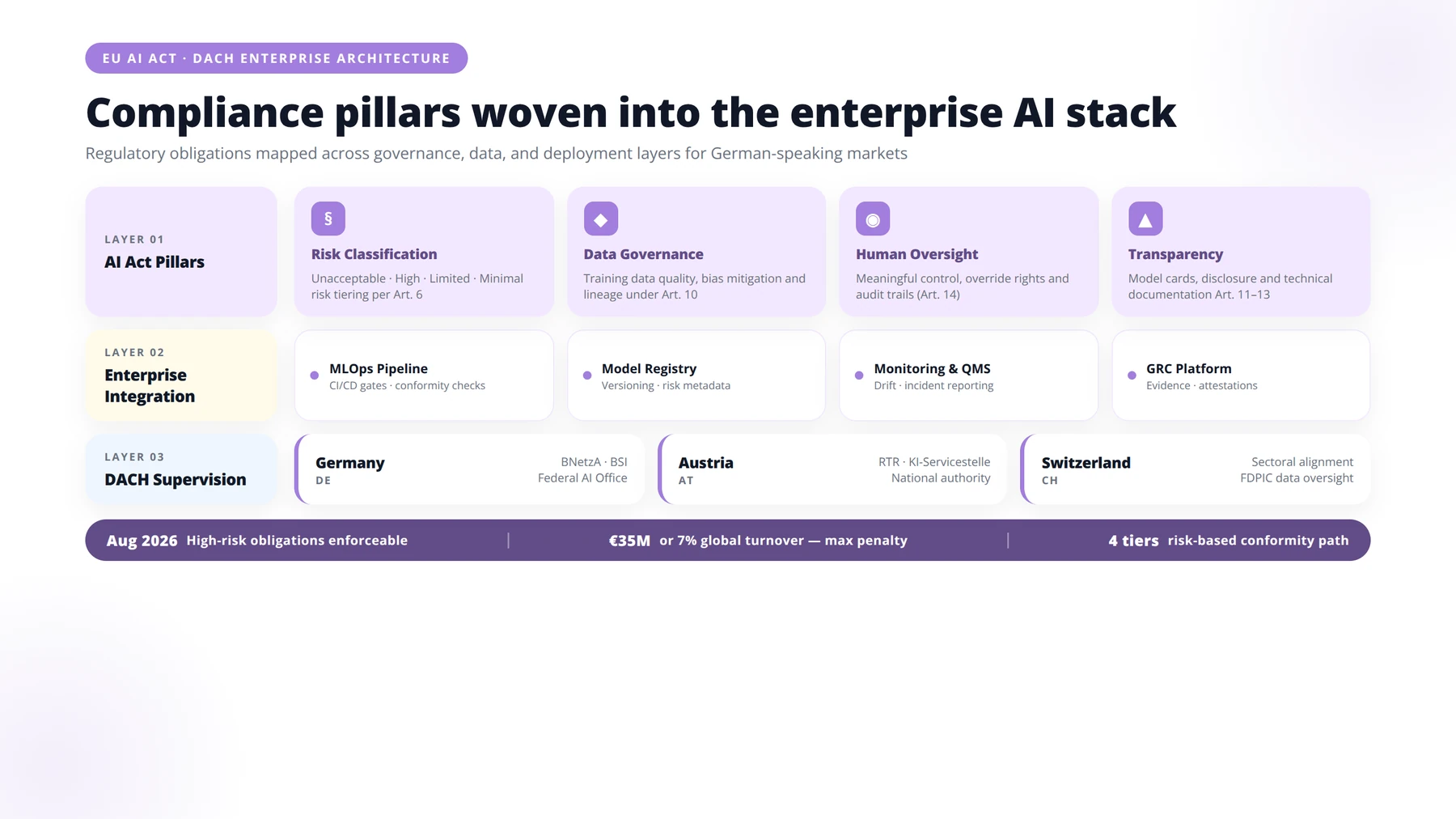
- Risk classification of every AI system: unacceptable, high-risk, limited, or minimal.
- Technical documentation proving training data quality, model behavior, and testing.
- Human oversight mechanisms proportional to risk.
- Post-market monitoring and incident reporting for high-risk systems.
- Transparency obligations when users interact with an AI system.
The Three DACH-Specific Compliance Pillars
DACH enterprises in regulated sectors must ensure AI deployments meet three operational standards as part of internal audits [Source: alinajafzadeh.at]:
- Data trustability — provenance, lineage, and quality controls on all inputs.
- Exception clarity — every automated decision has a defined human escalation path.
- Output trust — measurable accuracy, confidence signals, and continuous monitoring.
Expert Insight from Our Compliance Practice
The most common EU AI Act mistake we see in DACH: enterprises classify a system as "limited risk" because it feels harmless, without documenting the reasoning. When an auditor arrives, the absence of a signed risk classification — not the classification itself — creates the exposure. Document the "why," not just the "what."
Why This Favors Specialist Consultancies
Generalist consultancies can talk about the Act; specialists have already built the templates, monitoring pipelines, and documentation workflows. In our client engagements, EU AI Act readiness typically adds 15–25% to implementation timelines but reduces post-deployment audit risk by an order of magnitude.
From Chat to Event-Driven: The 2026 Production Shift
The most important architectural shift in 2026 is the move from conversational AI to event-driven agents. In DACH, the majority of production agents on platforms like Connic are triggered by webhooks, queues, or database changes rather than chat interfaces [Source: connic.co].
Why This Matters for CEOs
A chatbot is a feature. An event-driven agent is a piece of operational infrastructure. When a new invoice arrives, when a support ticket is created, when a production line reports an anomaly — an agent runs, executes a multi-step workflow, and returns a result to your systems. This is the model that generates measurable savings and CFO-approvable business cases.
Chat vs. Event-Driven: Business Impact
| Dimension | Chat-Based AI | Event-Driven Agents |
|---|---|---|
| Trigger | Human types a message | System event (webhook, queue, DB change) |
| Scale | Bounded by human interaction time | Scales to millions of events |
| Measurability | Hard to attribute business value | Direct KPI improvement per event |
| Compliance | Ad-hoc, session-based | Structured, auditable, logged |
| Best for | Employee productivity, brainstorming | Core operations, regulated workflows |
Examples in Production Today
- Insurance: Incoming claim PDF triggers an extraction, classification, and routing agent that reduces first-touch time from 48 hours to 8 minutes.
- Manufacturing: Quality sensor anomaly triggers a diagnostic agent that queries maintenance history and generates a work order.
- Banking: New KYC document event triggers a multi-step verification agent with human review only on exceptions.
- Logistics: Carrier delay webhook triggers a re-planning agent that reroutes shipments and notifies customers.
- Telecom: Customer churn signal in CRM triggers a retention agent that generates a personalized outreach and books a follow-up.
Pro Tip
If your shortlisted consultancy only demos chat interfaces, ask them to walk you through an event-driven agent in production — with the actual trigger, the tool calls, and the observability dashboard. This one question filters out roughly half of vendors instantly.
The AI Systems Operating Layer and the 90-Day Roadmap
Quick Answer: What Is the 90-Day AI Readiness Roadmap?
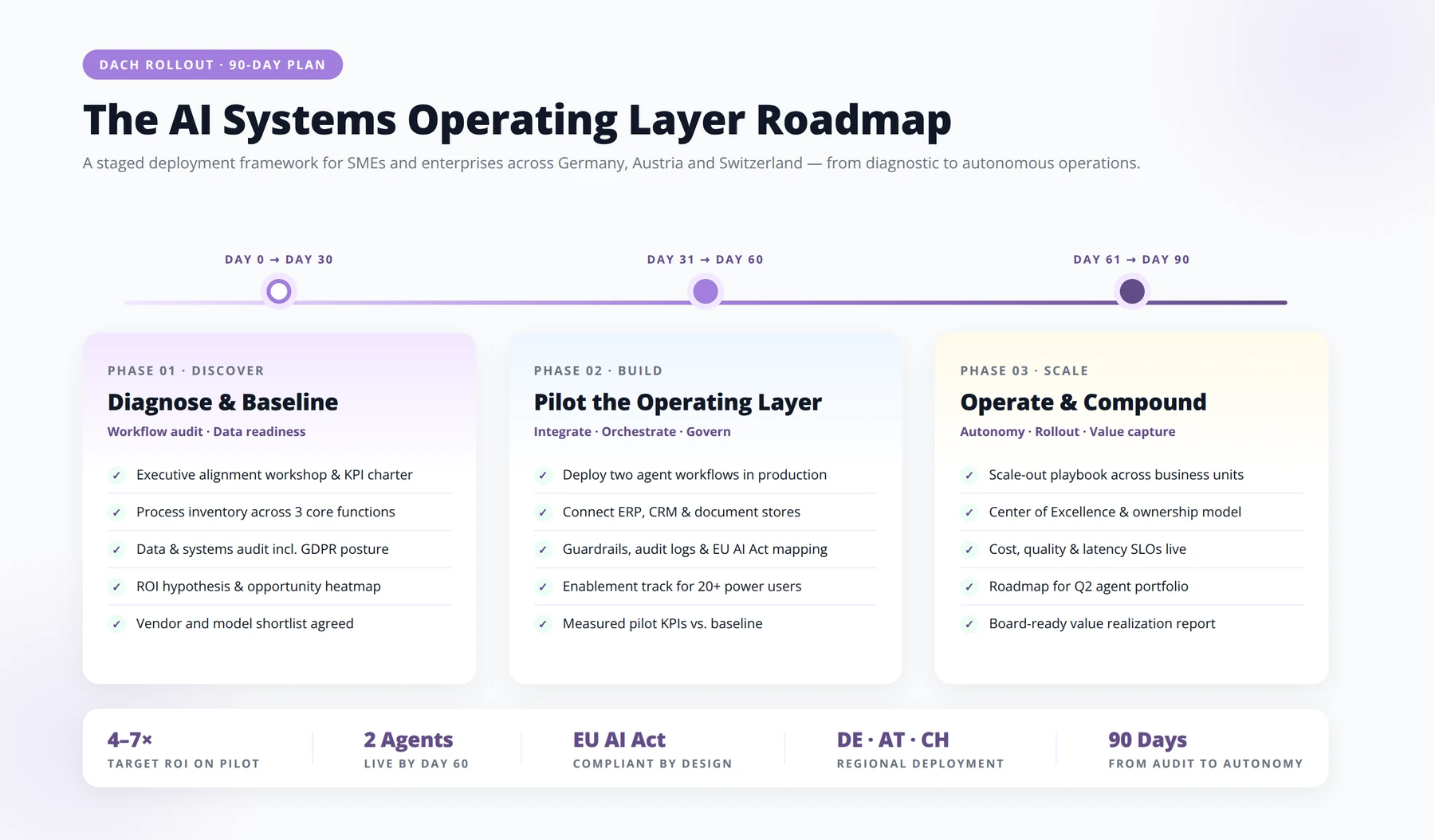
A three-phase plan: Days 1–30 baseline one workflow, Days 31–60 design and build the agent with EU AI Act documentation, Days 61–90 validate with a CFO-Proof savings review before scaling [Source: alinajafzadeh.at].
The concept driving the most sophisticated DACH implementations in 2026 is the AI Systems Operating Layer — a controlled abstraction that replaces scattered, uncoordinated AI usage across an organization. Experts recommend a 90-day readiness roadmap to validate measurable value before scaling [Source: alinajafzadeh.at].
What Is the Operating Layer?
Think of the AI Systems Operating Layer as the "operating system" for enterprise AI: a governed environment where agents, models, data connections, monitoring, and human oversight live together under consistent rules. Without it, you get shadow AI — dozens of teams using ChatGPT, Copilot, Claude, or Perplexity in undocumented ways.
The 90-Day Roadmap in Practice
- Days 1–30 — Baseline: Select one workflow. Measure cycle time, staff hours, quality, and exception rate. Document data sources and current SOPs.
- Days 31–60 — Design and Build: Design the AI-assisted operating capability. Build the agent, connect it to source systems, define human oversight, and establish EU AI Act documentation.
- Days 61–90 — Validate and Prove: Run controlled parallel operation. Generate a CFO-Proof savings review using operational data to produce financial evidence for scaling [Source: alinajafzadeh.at].
Why 90 Days and Not 12 Months
Enterprises that skip the 90-day discipline typically end up with expensive platform commitments and no evidence of value. The 90-day cycle forces the organization to prove one workflow works — economically, operationally, and legally — before committing capital to a broader rollout.
Schedule a 90-Day AI Readiness Consultation
Free 45-minute strategy session with our senior consultants to scope your first production workflow.
Book Your ConsultationIn-House Team vs. AI Consultancy vs. Big Four
One of the most common CEO questions is whether to build an internal AI team, hire a boutique consultancy, or engage a Big Four firm. There is no universal answer — but there is a clear framework.
| Criterion | In-House Team | Boutique AI Consultancy | Big Four / Global SI |
|---|---|---|---|
| Time to first production agent | 6–18 months (hiring + ramp) | 8–14 weeks | 4–9 months |
| Cost (year 1, single workflow) | €400k–€900k (salaries + tools) | €60k–€180k | €300k–€1.2M |
| Senior expertise on project | Depends on hiring | High (senior-led) | Mixed (partner + juniors) |
| EU AI Act coverage | Requires legal + technical hire | Included | Included |
| Long-term ownership | Full internal ownership | Transfer to internal team | Often long engagement |
| Best when | You are AI-native at scale | You need speed + depth | Group-wide transformation |
The Hybrid Model Most DACH Enterprises Choose
In our experience, the most effective pattern is a hybrid: a boutique AI consultancy delivers the first three workflows and stands up the operating layer, while the enterprise simultaneously hires 2–4 internal engineers who shadow the build and take over operations by month 9–12. This combines external speed with long-term ownership.
How to Evaluate an AI Consultancy: 12 Critical Questions
Vendor selection determines 60–70% of program success. Based on our client work and post-mortems of failed AI programs, these are the questions we recommend CEOs and CIOs ask every finalist.
Delivery Track Record
- Can you show us three production agents you built that are still running today, with measured KPIs?
- Who exactly will be on our team, and what is their individual delivery history?
- What is your ratio of senior to junior consultants on the project?
Technical Depth
- Do you design event-driven agents or primarily chat interfaces?
- How do you handle exception paths, monitoring, and retraining?
- Which platforms and models do you recommend, and why — independent of vendor incentives?
Compliance and Governance
- Show us your EU AI Act technical documentation template.
- How do you handle data residency and processing within DACH and the EU?
- What is your incident response process for a high-risk system?
Business and Commercial
- Will you deliver a CFO-Proof savings review at the end of the pilot?
- What is your knowledge-transfer plan so we can operate this in-house?
- What happens commercially if we do not hit the agreed KPIs?
Red Flags to Watch For
- Refusal to name specific past clients or reference customers.
- All proposals recommend the same platform regardless of use case.
- No mention of the EU AI Act risk classification process.
- Only chat-based demos, no event-driven examples.
- Junior team on-site with senior partners only in steering committees.
Expert Insight: The One Question That Predicts Success
Of the 12 questions above, the one most predictive of engagement success in our experience is Question 12: "What happens commercially if we don't hit the agreed KPIs?" Vendors willing to put fees at risk have both the confidence and the delivery discipline you need.
Frequently Asked Questions
What exactly is an AI consultancy?
An AI consultancy is a specialized firm that helps enterprises design, implement, and scale AI solutions from discovery sprints to full enterprise transformations, while ensuring EU AI Act compliance. They combine strategy, engineering, and change management — unlike management consultancies that stop at strategy or software vendors that only sell tools [Source: alicelabs.ai].
How much does an AI consultancy cost in DACH in 2026?
Senior consultant day rates in DACH range from €1,400–€2,400. Full engagements span from €15,000 for a discovery sprint to €1.5M+ for enterprise transformations. A typical single-workflow production pilot costs €60,000–€180,000 over 8–12 weeks [Source: alicelabs.ai].
Do I really need an AI consultancy if I have an internal IT team?
Not always. If your internal team has shipped production agents with EU AI Act documentation and measurable KPIs, you may only need targeted audits. Most DACH enterprises, however, find that internal IT excels at operations but lacks agentic system architecture expertise, making a hybrid model most effective.
What is the EU AI Act and why does it matter for consultancy selection?
The EU AI Act is Europe's binding AI regulation requiring risk classification, technical documentation, human oversight, and post-market monitoring. Serious DACH consultancies now position themselves as EU AI Act-ready partners because non-compliance carries significant financial and reputational risk [Source: alicelabs.ai].
What is the difference between chat-based AI and event-driven agents?
Chat-based AI requires a human to type a request; event-driven agents are triggered automatically by webhooks, queues, or database changes. In DACH, most production agents on platforms like Connic are event-driven because they scale better, integrate deeper with core operations, and produce measurable business KPIs [Source: connic.co].
What is the AI Systems Operating Layer?
It is a governed environment where agents, models, data connections, monitoring, and human oversight operate under consistent rules. It replaces scattered, uncoordinated AI usage. Experts recommend building it via a 90-day readiness roadmap before scaling AI across the enterprise [Source: alinajafzadeh.at].
How long does a typical AI consultancy engagement take?
Discovery sprints run 2–4 weeks, single-workflow pilots take 8–12 weeks, multi-agent programs run 6–12 months, and full enterprise transformations span 12–24+ months. The recommended entry point for most DACH enterprises is a 90-day readiness roadmap focused on one workflow.
Which industries in DACH are leading AI adoption in 2026?
Regulated industries lead: insurance, banking, logistics, telecom, and manufacturing. These sectors prioritize production deployment over experimentation because they have high-volume, document-heavy, rule-based workflows where event-driven agents deliver clear ROI [Source: connic.co].
How do I measure ROI on an AI consultancy engagement?
Use a CFO-Proof savings review: capture baseline cycle time, staff hours, quality, and exception rates before deployment, then measure the same metrics after 60–90 days of parallel or production operation. Convert operational deltas into financial figures your CFO signs off on before scaling [Source: alinajafzadeh.at].
Should I choose a Big Four firm or a boutique AI consultancy?
Choose Big Four for group-wide, multi-country programs where procurement compatibility and brand matter most. Choose a boutique for speed, senior-led delivery, and depth in agentic systems. Most DACH mid-market enterprises get better ratio of value from boutiques.
What if my AI project needs to be multilingual (German, French, Italian)?
Choose a consultancy with proven multilingual deployment experience, especially in Switzerland where four national languages coexist. Modern language models handle DACH languages well, but data pipelines, prompts, exception handling, and change management must all be designed multilingually from day one.
What happens after the consultancy finishes the engagement?
A good consultancy transfers knowledge to your internal team via documentation, pair-programming, and runbooks. Expect a 3–6 month handover period. Some enterprises keep the consultancy on a retainer for periodic audits, new use cases, or model updates as regulations and technology evolve.
Can smaller DACH SMEs benefit from AI consultancies, or is it only for large enterprises?
Absolutely. DACH SMEs are actively focusing on building controlled AI operating layers with 90-day roadmaps, and AI is no longer optional for SMEs aiming to compete [Source: alinajafzadeh.at]. Discovery sprints starting at €15,000 make expert help accessible.
What is a "CFO-Proof savings review"?
A structured financial review where operational data from an AI pilot is translated into monetary savings, cost avoidance, and revenue impact your CFO can defend to the board and auditors. It ensures ROI validation before broader implementation and prevents "innovation theater" [Source: alinajafzadeh.at].
How do I know if a consultancy is truly EU AI Act-ready?
Ask them to show a redacted example of their EU AI Act technical documentation, risk classification template, and post-market monitoring plan for a high-risk system they have deployed. Firms that cannot produce artifacts on demand are not truly ready, regardless of marketing claims.
What is the biggest mistake DACH CEOs make with AI consultancies?
Buying tools before assessing readiness. Experts advise separating AI usage from AI readiness, focusing first on gaps in the AI Systems Operating Layer before purchasing new platforms [Source: alinajafzadeh.at]. The second biggest mistake is scaling before proving one workflow delivers CFO-validated ROI.
Conclusion: Turning AI From Experiment Into Operating Advantage
2026 is the year DACH enterprises stop debating whether AI is real and start being measured on production outcomes. With the German consulting market growing to €51.1 billion and AI projects surging +22%, the competitive gap between companies with production-grade agentic systems and those still running pilots is widening every quarter [Source: consulting.de].
Key Takeaways for CEOs
- An AI consultancy is a specialist partner covering strategy, build, deployment, and change management — not just advice.
- You likely need one if you operate in regulated sectors, have stuck pilots, or need EU AI Act compliance.
- Expect engagements from €15,000 (discovery) to €1.5M+ (transformation), with day rates €1,400–€2,400 in DACH.
- Prioritize event-driven agents over chatbots — they generate measurable, CFO-defensible ROI.
- Start with a 90-day readiness roadmap on one workflow, then scale using a controlled AI Systems Operating Layer.
- Choose boutique consultancies for depth and speed, Big Four for scale, hybrid models for long-term ownership.
The enterprises winning in 2026 are not those with the most experiments — they are the ones with three to five production agents running quietly in the background, saving hours, reducing exceptions, and freeing their people to focus on judgment-heavy work. A serious AI consultancy is the fastest, most compliant path from where you are today to that operating advantage.
Schedule a DACH AI Strategy Session
Book a 45-minute call with our Zurich-based senior consultants to map your first production workflow.
Book My Strategy Session
About the Author: Agenticsis Team
Zurich-based AI Consultancy · Founded by Sofía Salazar Mora
Agenticsis partners with enterprises across Switzerland, the European Union, and Latin America to move AI from pilot to production. Our practice spans AI readiness audits, agentic system design, end-to-end deployment across 850+ integrated tools, EU AI Act documentation, and the change management that makes adoption stick.
Areas of Expertise: Event-driven agent architecture · EU AI Act compliance · CFO-Proof ROI validation · Multilingual DACH deployments (DE/FR/IT/EN) · Answer Engine Optimization via our proprietary AEODominance platform (aeodominance.com).
Zurich, Switzerland · agenticsis.ch · Fact-checked by senior AI consultants · Last Updated: July 20, 2026