TL;DR(Too Long; Did not Read)
Agentic AI explained for Swiss SMEs in 2026: how it differs from chatbots and RPA, vendor red flags, FADP rules, and a buyer's checklist.
What Is Agentic AI? A Complete Guide for Swiss SMEs in 2026
Published by Agenticsis · Last updated 31 August 2026
Quick Answer:
Agentic AI refers to software that can autonomously plan, decide, and execute multi-step tasks across connected systems, unlike chatbots that only converse or RPA that only replays scripts. For Swiss SMEs in 2026, this means AI that can handle end-to-end workflows such as invoice reconciliation or multilingual customer inquiries, while human oversight remains mandatory for payments, legal commitments, and other high-stakes actions under the revised Federal Act on Data Protection (FADP).
Introduction: Why the Word "Agentic" Matters Now
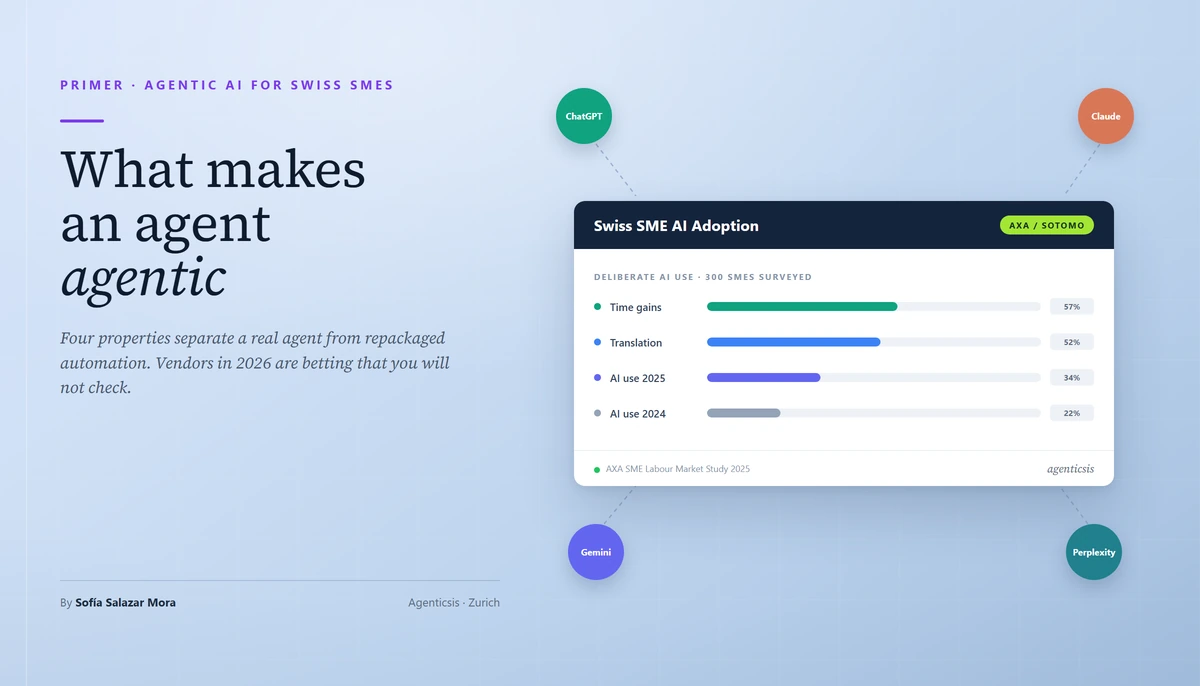
Swiss SME adoption of AI is accelerating. According to the Swiss federal SME portal, 34% of Swiss SMEs consciously used AI in 2025, up from 22% in 2024, and 57% of users reported concrete time savings [Source: https://www.kmu.admin.ch]. At the same time, a term has quietly taken over vendor pitch decks: agentic AI. The word appears attached to chatbots, workflow builders, and rebranded RPA tools, often without the underlying capabilities that make a system genuinely agentic.
This guide is written for decision-makers and technical buyers at Swiss SMEs who need a working definition of agentic AI, a clear separation between agentic systems and adjacent categories, and a practical framework for cutting through marketing language. It draws on current definitions from NIST, the Cloud Security Alliance, and Swiss federal sources, and applies them to the specific context of buying and deploying AI in Switzerland under the revised Federal Act on Data Protection (FADP).
By the end, a reader should be able to: define agentic AI in one sentence; distinguish it from chatbots and RPA in a vendor demo; ask the eight questions that reveal whether a product is truly agentic; identify the regulatory obligations that apply in Switzerland and when EU rules extend across the border; and structure a first agentic AI pilot in a way that protects data, compliance, and budget.
Not sure if your vendor is offering real agentic AI?
Agenticsis runs structured vendor reviews for Swiss SMEs, mapping product claims against the four defining properties of agentic systems.
Request a vendor review1. What Is Agentic AI, Precisely?
Quick Answer:
Agentic AI is software that pursues a goal, decides its next step at runtime, uses tools or connected systems, and acts with limited human supervision under defined guardrails. All four properties must be present: goal-directed, tool-using, adaptive, and autonomous within policy. Otherwise the product is not truly agentic.
Agentic AI is software that pursues a goal, decides the next step, uses tools or connected systems, and acts with limited human supervision. That is the core. The specific model, framework, or vendor is an implementation detail.
Four defining properties
NIST's 2026 agentic AI page describes agentic systems as autonomous agents capable of independently making decisions, learning from interactions, and adapting to changing environments [Source: https://www.nist.gov]. The Cloud Security Alliance describes the same category as software that performs decision-making and initiates autonomous actions using AI and machine learning models [Source: https://cloudsecurityalliance.org]. Combining those sources yields four defining properties:
- Goal-directed: the system is given an outcome, not just a prompt.
- Tool-using: it can call APIs, query databases, or trigger workflows.
- Adaptive: it changes its next step based on the result of the previous one.
- Autonomous within guardrails: it acts under policy, permissions, and monitoring, not without them.
Why the definition matters commercially
The four properties are not optional. A product that lacks runtime decision-making is not agentic, no matter how it is marketed. A product that cannot invoke external systems is a chatbot with extra steps. A product without guardrails is a liability. When a Swiss SME evaluates agentic AI, all four properties should be visible in a technical demonstration.
2. Agentic AI vs Chatbots vs RPA
Quick Answer:
Chatbots talk, RPA repeats scripted actions, and agentic AI plans and executes across systems when conditions change. The decisive test is whether the software chooses what to do next based on the current state, or whether it follows a designer's script written in advance.
The single most useful distinction for Swiss SME buyers is this: chatbots talk, RPA repeats scripted actions, and agentic AI plans and executes across systems when conditions change.
Side-by-side comparison
| Capability | Chatbot | RPA | Agentic AI |
|---|---|---|---|
| Primary role | Conversational interface | Scripted process automation | Goal completion |
| Runtime decisions | Limited | No | Yes |
| Uses external tools | Sometimes | Yes, pre-scripted | Yes, chosen at runtime |
| Adapts to exceptions | Limited | Very limited | Yes |
| Best use case | Q&A, support triage | Repetitive rule-based tasks | Multi-step work across systems |
The overlap that causes confusion
Modern chatbots often include function-calling, and modern RPA platforms often bundle AI classifiers. That overlap is real, but it does not make either category agentic. The test is whether the software decides what to do next based on what it observes, or whether it follows a designer's script with occasional AI-flavoured decorations.
Where copilots fit
Copilots, the drafting assistants embedded in productivity suites, sit between chatbots and agentic AI. Copilots generate content and can call limited tools, but their scope is usually bounded to one application and one user session. That makes copilots useful, but not equivalent to autonomous agents that operate across systems without a human in the seat.
3. How Agentic AI Systems Work in Business
An agentic AI system operates in a loop rather than as a single call. Understanding the loop is what separates buyers who evaluate agentic AI competently from buyers who accept vendor slides at face value.
The core loop
The agentic loop has four stages: receive a goal, plan the next step, use a tool to act, and evaluate the result. If the result matches the goal, the agent stops. If not, the agent revises its plan and tries again. Guardrails wrap every stage: policies define what actions are permitted, permissions define which systems can be touched, and logging records what happened.
What tools an agent uses
Tools are the connective tissue of an agentic system. In a Swiss SME context, common tools include the ERP, the CRM, an email server, a document store, a payment interface, ticketing systems, and databases. A capable agentic system exposes tool permissions explicitly, so a buyer can see that, for example, the agent can read invoices but not initiate payments without human approval.
Where humans stay in the loop
Autonomy is a spectrum. Well-designed agentic systems reserve human approval for high-stakes actions: legal commitments, payments above a threshold, escalations, sensitive HR decisions, and any action affecting a customer complaint. Everything else can run autonomously under confidence thresholds and audit trails.
Expert Insight
The failure mode of an agentic AI system is not usually a wrong answer. The failure mode is a correct-looking action taken in the wrong context, such as sending a routine confirmation email to a customer whose account is actually in a legal dispute. That is why permissions and logging matter more than model quality in most SME deployments. A modest model with tight guardrails outperforms a state-of-the-art model with loose ones.
4. Why This Matters for Swiss SMEs in 2026
Quick Answer:
Swiss SME AI use jumped from 22% in 2024 to 34% in 2025, and vendors are increasingly labelling products as "agentic." That mix of rising adoption and loose terminology creates a procurement risk: budgets get approved for capabilities the product cannot actually deliver.
The Swiss market for AI has moved from experimentation into routine use. The federal SME portal reports that the most common uses of AI among Swiss SMEs are translation, correspondence automation, and data analysis [Source: https://www.kmu.admin.ch]. Those uses are largely non-agentic today, but they are the on-ramp: once translation and correspondence are automated, the pressure to automate the surrounding workflow follows.
Agent adoption claims
Microsoft's 2025 Work Trend Index reported that 52% of Swiss organizations were already using agents to automate business processes, above European and global averages [Source: https://www.microsoft.com]. That figure likely mixes true autonomous agents with a broader set of implementations that vendors have labelled as agents, which is exactly why the vocabulary problem is a real commercial risk.
The buyer's dilemma
Rising adoption plus loose terminology creates a specific problem. An SME procurement team might approve budget for agentic AI, receive a product that is closer to a scripted workflow with an AI classifier, and only discover the gap when the process hits an exception the vendor never scripted for. The fix is not to reject the term, but to verify it against the four defining properties before signing.
5. Swiss and EU Regulatory Context
Switzerland does not currently have a dedicated comprehensive AI law. As of 2026, the country is following a sector-specific, technology-neutral approach and intends to align with the Council of Europe AI Convention [Source: https://www.bakom.admin.ch]. That does not mean AI is unregulated in Switzerland; it means the rules come from data protection, sector regulators, and general obligations rather than from one dedicated AI statute.
The FADP baseline
The primary Swiss baseline is the revised Federal Act on Data Protection (revFADP or FADP), in force since 1 September 2023, which applies directly to AI applications wherever personal data is processed [Source: https://www.edoeb.admin.ch]. For an agentic AI system that reads customer records, drafts correspondence, or updates CRM entries, the FADP applies in full.
When the EU AI Act enters the picture
If a Swiss SME has an EU nexus, through customers, employees, or data subjects located in the EU, the EU AI Act becomes relevant. The key dates:
- 2 February 2025: prohibitions and general provisions apply, including AI literacy duties.
- 2 August 2025: obligations for general-purpose AI apply.
- 2 August 2026: high-risk requirements apply.
Sources for these dates are the EU official journal materials referenced in Swiss legal analyses [Source: https://artificialintelligenceact.eu]. A Swiss SME serving EU customers should assume the Act applies to any high-risk use case involving those customers.
Disclaimer
This article summarises publicly available regulatory information as of August 2026 and does not constitute legal advice. Swiss SMEs evaluating agentic AI deployments that involve personal data, cross-border transfers, or high-risk use cases under the EU AI Act should consult qualified Swiss counsel and, where applicable, the Federal Data Protection and Information Commissioner (FDPIC).
Scoping a pilot that must satisfy FADP from day one?
Agenticsis helps Swiss SMEs design agentic AI pilots with logging, permissions, and data-residency choices aligned to the revised FADP.
Plan a compliant pilot6. Practical Examples for SMEs
The following examples are illustrative scenarios. They describe how agentic AI can operate in a Swiss SME context; they are not case studies of specific companies.
Example 1: Invoice processing at a mid-size distributor
Consider a Swiss distributor receiving 800 supplier invoices per month across email, PDF, and EDI. An agentic system extracts line items, matches them against purchase orders in the ERP, flags mismatches, drafts approval requests for the responsible manager, and files the paid invoice in the document store. Payment execution stays with a human approver. This example is agentic because the system chooses which reconciliation path to follow per invoice.
Example 2: Multilingual customer inquiries
Consider a Swiss e-commerce SME serving customers in German, French, Italian, and English. An agentic system reads inbound messages, classifies the intent, retrieves order data from the shop backend, drafts a response in the customer's language, and either sends it (for routine cases) or escalates to a human agent (for complaints or refunds above a threshold).
Example 3: Sales follow-up in professional services
Consider a Zurich-based consultancy. An agentic system monitors CRM activity, detects stalled opportunities, drafts personalised follow-up emails referencing prior meeting notes, and schedules follow-ups in the sales representative's calendar. Sending remains under human control; drafting and scheduling are autonomous.
Example 4: HR onboarding coordination
Consider a manufacturing SME hiring 30 new employees per year. An agentic system coordinates onboarding: creating accounts across HR, IT, and payroll systems; scheduling training sessions; and tracking document completion. Sensitive decisions such as contract terms remain with HR staff.
Example 5: Compliance monitoring
Consider a fintech SME. An agentic system watches transaction logs, flags anomalies against defined rules, gathers supporting context, and prepares a case file for the compliance officer. The agent never files a regulatory report autonomously; the agent prepares the human's work.
7. A Framework for Evaluating Vendor Claims
The following eight questions are what to ask any vendor whose product is marketed as agentic AI.
The eight questions
- What does the system decide on its own? If every step is hard-coded, the product is not agentic.
- What tools can it actually use? Email, ERP, CRM, ticketing, databases, payment rails, and RPA bridges should be named explicitly.
- How are exceptions handled? Real agents need fallback rules, confidence thresholds, and human escalation.
- What permissions does it have? Read-only, draft-only, and execute permissions should be clearly bounded.
- What logs and traceability exist? A buyer needs to see which step the agent chose, why, and what changed.
- How is it tested? Vendor demos are not enough; sandbox tests on the buyer's own data are.
- Where do humans stay mandatory? Payments, legal commitments, complaints, and sensitive HR decisions usually need approval.
- What data leaves Switzerland? Residency, cross-border transfers, and processor contracts matter under FADP.
Pro Tip
When a vendor answers question one, listen for the word "workflow." If the demonstration shows a designer-drawn flow with branches, the product is workflow automation, not agentic AI. A genuine agent chooses branches at runtime based on the current state of the world, not based on a diagram drawn last month.
8. Red Flags and Buzzword Traps
Certain patterns in a vendor pitch reliably signal that "agentic AI" is being used as a label rather than a description.
Common warning signs
- The "agent" only answers questions inside a chat window.
- The workflow is fixed at design time, with no runtime decision-making.
- The vendor cannot describe tool permissions in specific terms.
- There is no audit trail of the agent's chosen actions.
- Exception handling is described vaguely or referred to human takeover.
- Marketing relies on phrases like "autonomous intelligence" without bounded action examples.
Why the label sticks anyway
Vendors repackage chatbots, copilots, and workflow automation as "agentic AI" because the term is commercially attractive. That is a market dynamic, not a moral failing, but it shifts due diligence onto the buyer. Assume the label is aspirational until proven otherwise in a technical review.
Expert Insight
The trade-off Swiss SMEs actually face is not "agentic AI versus non-agentic AI." The real trade-off is autonomy versus control. Every step of autonomy added to a workflow reduces the number of decisions humans must make, and simultaneously increases the number of decisions the system might get wrong without immediate detection. A useful rule: start with the least autonomous version that still delivers material benefit, then expand only where logs and outcomes justify it.
9. Standards and Governance to Reference
Three governance references are most relevant when evaluating agentic AI vendors from a Swiss SME perspective.
NIST
NIST provides emerging guidance on agentic AI and broader AI risk framing [Source: https://www.nist.gov]. NIST materials are useful for defining what an autonomous agent is and what risks distinguish it from other AI categories.
Cloud Security Alliance
The Cloud Security Alliance publishes governance principles for AI agents and autonomous systems [Source: https://cloudsecurityalliance.org]. Its work is practical for procurement teams because it addresses permissions, logging, and incident handling directly.
ISO/IEC 42001
ISO/IEC 42001 is the AI management-system standard covering organisational governance of AI [Source: https://www.iso.org]. ISO/IEC 42001 is not specific to agentic AI, but a vendor certified against it demonstrates management maturity, which is a useful procurement signal.
10. Getting Started Without Overcommitting
Quick Answer:
A useful first pilot picks a bounded high-volume process, defines success in writing (time saved, error ceiling, escalation path), and enforces full logging from day one. A well-scoped pilot typically runs six to twelve weeks from kick-off to production.
A Swiss SME does not need a strategic transformation to test agentic AI. What an SME needs is a single well-scoped process, a sandboxed environment, and a written definition of success.
Choose a bounded process
Pick a process with high volume, medium complexity, and clear success criteria: invoice reconciliation, tier-one support triage, or lead qualification. Avoid anything that touches customer money or legal obligations in the first pilot.
Define success in advance
Write down what the pilot must achieve to be considered successful. Include a time-savings target, an error rate ceiling, and a clear escalation path. Without a written baseline, every result will feel like progress and no result will feel like enough.
Log everything
Insist on full logging from day one. If a vendor cannot show what the agent did and why, that vendor is not ready for a Swiss SME deployment where FADP obligations may require exactly that record.
Evaluating an agentic AI vendor?
Agenticsis works with Swiss SMEs to separate real agentic capabilities from repackaged automation. Get a structured vendor review before you sign.
Request a vendor review11. Frequently Asked Questions
Q: What is agentic AI in one sentence?
A: Agentic AI is software that pursues a goal, decides its next step at runtime, uses external tools to act, and operates under defined guardrails with limited human supervision. It differs from chatbots and RPA because it makes decisions rather than following a fixed script.
Q: How is agentic AI different from a chatbot?
A: A chatbot provides a conversational interface and typically answers questions or guides users through a fixed flow. Agentic AI pursues an outcome across multiple systems, chooses which actions to take based on real-time information, and can complete multi-step work without a human at the keyboard for every step.
Q: Is agentic AI the same as RPA?
A: No. RPA repeats scripted keystrokes and clicks defined by a designer in advance. Agentic AI decides what action to take next based on the current state, adapts to exceptions, and can invoke tools the designer did not explicitly script for. RPA and agentic AI can be combined, but they are not synonyms.
Q: What are examples of agentic AI for small and medium businesses?
A: Common examples include automated invoice reconciliation, multilingual customer inquiry handling, sales follow-up drafting, HR onboarding coordination across systems, and compliance case preparation. In every case, high-stakes actions such as payments or legal commitments remain under human approval.
Q: Does Switzerland have an AI law?
A: Switzerland does not currently have a dedicated comprehensive AI law. As of 2026, the country follows a sector-specific, technology-neutral approach and intends to align with the Council of Europe AI Convention. The revised Federal Act on Data Protection, in force since 1 September 2023, applies to AI applications processing personal data.
Q: Do Swiss SMEs need to comply with the EU AI Act?
A: If a Swiss SME serves EU customers, processes data of EU-based individuals, or places AI systems on the EU market, the EU AI Act likely applies. Prohibitions took effect on 2 February 2025 and GPAI obligations on 2 August 2025. High-risk requirements were originally set for 2 August 2026, but Regulation (EU) 2026/1744, the Digital Omnibus on AI, postponed Annex III standalone high-risk systems to 2 December 2027 and product-embedded Annex I systems to 2 August 2028. Article 50 transparency duties were not postponed.
Q: How many Swiss SMEs are using AI today?
A: According to the Swiss federal SME portal, 34% of Swiss SMEs consciously used AI in 2025, up from 22% in 2024. Of those users, 57% reported concrete time savings. The most common applications are translation, correspondence automation, and data analysis rather than fully autonomous agents.
Q: Can agentic AI make decisions without any human oversight?
A: Technically yes, but responsibly no. Well-designed agentic systems operate under guardrails: confidence thresholds, permission scopes, and escalation rules that route high-stakes decisions to humans. Full autonomy is appropriate only for low-risk, high-volume tasks where the cost of an error is small and detectable.
Q: What is the difference between an AI copilot and an agentic AI?
A: A copilot assists a human user within a single application, drafting content or suggesting actions the user then approves. An agentic AI system operates across applications and can complete work without a user in the seat. Copilots are bounded by session; agents are bounded by goal and permissions.
Q: How do I evaluate an agentic AI vendor?
A: Ask what the system decides on its own, what tools it can invoke, how exceptions are handled, what permissions apply, what logs are available, how it is tested, where humans remain mandatory, and what data leaves Switzerland. If the vendor cannot answer clearly on all eight, the product is likely not truly agentic.
Q: What are the biggest risks of agentic AI for SMEs?
A: The main risks are actions taken correctly in the wrong context, insufficient audit trails for regulatory review, unbounded permissions that let agents touch systems they should not, and vendor lock-in when tool integrations are proprietary. All four are addressable through procurement discipline and staged rollout.
Q: Does agentic AI replace employees?
A: In practice, agentic AI redistributes work rather than replacing headcount wholesale. Routine multi-step tasks move to the system; employees shift toward exception handling, judgment calls, and higher-stakes decisions. SMEs deploying agentic AI typically report time savings redirected into growth activities rather than immediate role elimination.
Q: Do I need a data protection assessment for agentic AI?
A: If the system processes personal data and the processing carries elevated risk, a data protection impact assessment is generally advisable under the FADP. For higher-risk use cases with EU-person data, the EU AI Act may add further documentation obligations. Consult qualified Swiss counsel for specific cases.
Q: Can agentic AI run on-premises in Switzerland?
A: On-premises and Swiss-hosted deployments are technically feasible in the Swiss market, though model choice is more constrained than in the cloud. Keeping personal data inside Switzerland simplifies FADP compliance, at the cost of operational complexity and, in some cases, reduced model capability. Agenticsis itself deploys on EU-hosted and Swiss-hosted cloud infrastructure rather than on customer premises; where data-residency requirements are stricter, we deploy through partnered cloud environments on Vertex, AWS or Azure.
Q: How long does it take to deploy an agentic AI pilot?
A: A well-scoped pilot on a single process typically runs six to twelve weeks from kick-off to production, including integration, sandbox testing, and logging setup. Longer timelines usually signal scope creep rather than technical complexity, and are worth pushing back on during procurement.
Q: What is the ROI expectation for agentic AI in an SME?
A: Return depends on the process automated. High-volume workflows such as invoice reconciliation and support triage typically deliver measurable time savings within the first quarter of production use. The Swiss SME portal reports that 57% of AI users saw concrete time savings, though that figure covers all AI use rather than agentic AI specifically.
Q: Are there Swiss-specific agentic AI vendors?
A: Several Swiss and DACH-region providers offer agentic AI capabilities, and international platforms operate here as well. Country of origin matters less than data residency options, FADP compliance posture, and the vendor's ability to demonstrate genuine agentic properties in a technical review.
Q: What role does ISO/IEC 42001 play in vendor selection?
A: ISO/IEC 42001 is the AI management-system standard. A vendor certified against it has documented governance processes around AI development and deployment. That certification is not specific to agentic AI, but it is a useful procurement signal alongside evidence of the four defining agentic properties.
Q: Can I combine agentic AI with existing RPA investments?
A: Yes, and this is often the pragmatic path. RPA scripts remain useful for stable, rule-based subtasks. An agentic layer sits above them, deciding when to invoke which script and handling the exceptions that broke RPA in the first place. The combined architecture protects existing investments.
Q: What is the single most common mistake SMEs make with agentic AI?
A: Buying on the label rather than the capabilities. Teams approve budget for agentic AI, receive a scripted workflow with an AI classifier attached, and discover the gap when a real-world exception hits. The fix is the eight-question vendor review before any contract is signed.
12. Conclusion and Next Steps
Agentic AI is a real category with a specific definition: goal-directed, tool-using, adaptive software that operates under guardrails. Agentic AI is not a synonym for automation, and it is not a marketing upgrade for chatbots. For Swiss SMEs entering the market in 2026, the practical work is separating vendors who meet the definition from vendors who have adopted the label.
Key takeaways
- Agentic AI is defined by runtime decision-making, tool use, adaptation, and bounded autonomy.
- Chatbots talk, RPA repeats scripts, agentic AI plans and acts across systems.
- 34% of Swiss SMEs used AI in 2025, up from 22% in 2024, but adoption of true agents is narrower [Source: https://www.kmu.admin.ch].
- The FADP applies to any agentic AI system processing personal data in Switzerland.
- The EU AI Act applies to Swiss SMEs with an EU nexus. Annex III high-risk requirements were postponed to 2 December 2027 by the Digital Omnibus, while transparency and prohibition duties already apply.
- Eight vendor questions separate genuine agentic products from repackaged automation.
- Start with a bounded pilot, written success criteria, and full logging.
Ready to scope your first agentic AI pilot?
Agenticsis helps Swiss SMEs define bounded pilots, evaluate vendors against real agentic criteria, and stay aligned with FADP obligations from day one.
Talk to AgenticsisSources
Background reading and data sources consulted for this article.
- nist.gov/agentic-ai
- labs.cloudsecurityalliance.org/research/csa-research-note-nist-ai-agent-standards-feder...
- labs.cloudsecurityalliance.org/wp-content/uploads/2026/03/governance-nist-ai-agent-stan...
- linkedin.com/pulse/chatbots-vs-rpa-rag-agentic-ai-whats-difference-why-philip-giouzelim...
- cebean.com/ai-agent-vs-chatbot-vs-rpa.html
- aisecurityandsafety.org/en/frameworks/nist-ai-100-5-agentic
- voltuswave.ai/blog/agentic-ai-vs-copilots-vs-chatbots-vs-rpa
- www-cdn.anthropic.com/43ec7e770925deabc3f0bc1dbf0133769fd03812.pdf
- seanbreeden.com/blog/nist-ai-standards-agentic-systems-guide
- aixpertz.ai/agentic-ai-vs-chatbots
- scottmcauley.com/blog/ai-agents-vs-chatbots
- labs.cloudsecurityalliance.org/research/governance-nist-ai-agent-standards-agentic-gove...
- resources.rework.com/vi/libraries/ai-agents/ai-agents-vs-chatbots-rpa-automation
- ieeeusa.org/assets/public-policy/policy-log/2026/IEEE-USA-NIST-RFI-Agentic-AI-030926.pdf
- linkedin.com/posts/ai-universe-today_calling-your-chatbot-an-ai-agent-is-like-activity-...
- agenticsis.ch/blog/swiss-sme-ai-agent-legacy-integration-patterns
- sidd.swiss/en/insights/data-protection-trends-2025-a-deep-insight-for-switzerland
- sidd.swiss/en/insights/eu-ai-act-switzerland-guide
- deloitte.com/ch/en/issues/generative-ai/switzerland-invests-in-ai.html
- news.microsoft.com/de-ch/2025/04/23/2025-work-trend-index-swiss-organizations-lead-in-a...
- vollmer-labs.ch/en/blog/eu-ai-act-schweiz-kmu
- kmu.admin.ch/en/ai-gains-ground-among-swiss-smes
- farland.ch/de/blogs/ai-regulations-in-switzerland-and-eu
- corpin.ch/en/news/ki-agenten-die-revolution-fur-schweizer-kmu---ihr-strategischer-weg-z...
- sidd.swiss/en/insights/artificial-intelligence-and-data-protection-in-switzerland-chall...
- fidav.ch/en/blog/artificial-intelligence-swiss-smes-2026
- zdigitalagency.com/ai-trends-swiss-companies-2025-2026
- farland.ch/en/blogs/ai-regulation-in-switzerland-and-the-eu
- easya.ch/en/blog/agents-ia-entreprise-cabinets-avocats-suisse.html
- swisstechconsult.com/2025/08/04/how-ai-agents-are-transforming-swiss-companies