TL;DR(Too Long; Did not Read)
Agentic AI explained for Swiss finance and M&A teams in 2026: definition, use cases, nDSG compliance and how to pilot on well-defined tasks.
What Is Agentic AI and How Does It Apply to Enterprise Workflows in 2026?
Published by Agenticsis, Zurich. Last updated: 8 September 2026.
Quick Answer:
Agentic AI refers to systems that plan, take multi-step actions and use tools or data to complete a task with limited human intervention, unlike a single-prompt chatbot. Deloitte Switzerland's 2026 survey of 66 Swiss M&A leaders shows firms cautiously piloting agentic AI on well-defined tasks. For Swiss SMEs, the safest entry point is narrow, auditable processes with human oversight and decision logging built in from day one.
Not sure whether your workflow fits an agentic pilot?
Agenticsis scopes narrow, auditable agentic AI pilots for Swiss SMEs, with human oversight and decision logging designed in from the first sprint.
Book a scoping callTable of Contents
- 1. What is agentic AI, in plain terms?
- 2. How is agentic AI different from a chatbot?
- 3. Agentic AI vs traditional rules-based automation
- 4. What does agentic AI look like in enterprise workflows?
- 5. How Swiss finance and M&A teams are using it (Deloitte 2026)
- 6. Well-defined pilot tasks for Swiss firms
- 7. nDSG compliance considerations for agentic AI
- 8. Should your SME pilot on one task before scaling?
- 9. Frequently asked questions
1. What is agentic AI, in plain terms?
Quick Answer:
Agentic AI is software you give a business goal to. It plans the steps, calls tools or data sources, executes actions, checks the result and iterates until the task is done or a human is needed. Three traits recur across 2024 to 2026 definitions: goal-driven autonomy, action in real systems, and a perceive-reason-act loop with tool use.
Agentic AI is software you give a business goal to, and it figures out the steps, uses tools or data sources, executes actions, checks the results, and repeats until the task is complete or it needs a human decision. IBM defines agentic AI as systems that accomplish a specific goal with limited supervision, built from AI agents that show autonomy, goal-driven behaviour and adaptability [Source: ibm.com].
Google's own framing is similar: an advanced form of AI focused on autonomous decision-making, able to set goals, plan and execute tasks with minimal human intervention [Source: cloud.google.com]. The industry site Agentic.ai puts it more directly: agentic AI is AI that acts, taking a goal and calling APIs, editing files, browsing the web or running code to complete it, rather than producing text for a human to act on [Source: agentic.ai].
MIT Sloan describes agentic AI as semi- or fully autonomous systems that perceive, reason and act on their own, integrating with other software to complete tasks with minimal supervision [Source: mitsloan.mit.edu]. The University of Cincinnati, citing Microsoft, calls it an autonomous AI system that plans, reasons and acts to complete tasks with minimal human oversight, contrasting it with current LLM chatbots that need a human prompt for each assignment [Source: uc.edu].
The three defining traits
Across recent 2024 to 2026 definitions, three traits recur: goal-driven autonomy, action in real systems rather than just text, and a perceive-reason-act loop that can use tools. Together they separate an agentic system from a Q&A chatbot or a scripted workflow.
2. How is agentic AI different from a chatbot?
Quick Answer:
A chatbot answers one prompt at a time and produces text. An agentic system runs a loop: it decides what to do, takes a real action such as calling an API or updating a record, observes the result and decides again. The loop is what turns AI output into completed work.
A single-prompt chatbot answers one question at a time and produces text. The human then decides what to do with the answer and takes any real-world action, such as updating a CRM, sending an email, or approving a deal step. Agentic AI closes that loop.
Agentic.ai describes the difference as a running loop: the agent decides what to do next, takes a real action such as calling an API or editing a file, observes the result, then decides again [Source: agentic.ai]. TechTarget adds that agentic AI systems are capable of autonomous action and decision-making, use techniques like reinforcement learning, and pursue complex goals independently [Source: techtarget.com].
Practical contrast in finance
A chatbot in a Swiss bank might summarise a due-diligence report on request. An agentic system built for the same team could identify missing documents, pull fresh financials from an internal data lake, align findings with policy templates, draft risk sections, update the deal tracker and notify the responsible partner, all without a human orchestrating each step.
Why the loop matters for reliability
Because agentic systems observe their own results and iterate, they can catch errors mid-task, retry a failed API call, or escalate when confidence drops. That same loop is also what makes them harder to govern than a chatbot: each action is a decision that regulators and auditors may later want to review.
3. Agentic AI vs traditional rules-based automation
Traditional enterprise automation, such as RPA and BPM workflows, executes predefined sequences. Engineers encode the logic up front and update flows when conditions change. These systems move data and click screens well, but they do not interpret ambiguous documents or reason about trade-offs.
Agentic AI differs on four fronts: dynamic planning instead of fixed scripts, semantic understanding of unstructured content, continuous adaptation, and multi-agent orchestration where several agents coordinate on the same task [Source: mitsloan.mit.edu] [Source: techtarget.com].
| Dimension | Rules-based automation (RPA) | Agentic AI |
|---|---|---|
| Logic | Fixed scripts, if-then rules | Dynamic planning based on the goal |
| Input handling | Structured data, screen coordinates | Documents, emails, unstructured text |
| Change management | Break when the underlying system changes | Adapt to changes in inputs and interfaces |
| Best for | High-volume, stable, repetitive tasks | Variable, judgement-heavy, multi-step work |
| Governance | Well-understood, mature audit patterns | Requires new logging and oversight design |
Expert Insight
RPA and agentic AI are not competitors, they are complementary. RPA is still the right tool for a stable, high-volume task with a fixed interface, because it is predictable and cheap to audit. Agentic AI earns its place when the work involves reading, interpreting or deciding between options. Many Swiss finance workflows are a mix, so a realistic architecture uses RPA for the mechanical steps and an agent to handle the judgement calls between them.
4. What does agentic AI look like in enterprise workflows?
Enterprise-oriented sources describe agentic AI running on knowledge-intensive workflows. ISACA notes that agentic systems can independently perform hypothesis generation, literature review, experimental design and data analysis [Source: isaca.org]. Translated into a finance setting, that maps onto portfolio risk hypotheses, comparative deal analysis and scenario testing.
The 2025 AI Agent Index highlights that agentic systems are characterised by autonomy, goal-directedness and the ability to accomplish complex, long-horizon tasks [Source: arxiv.org]. Long horizon matters because many enterprise processes, such as due diligence or integration planning, unfold over days or weeks, not seconds.
Common patterns across sectors
- Automated research and briefings that stitch together multiple sources into a structured output.
- Workflow coordination across compliance, risk, legal and front-office systems.
- Continuous monitoring for changes, with agents flagging or acting on the exceptions.
Why 2026 is the pilot year, not the scale year
The Associated Press has noted that agentic AI, tech's newest buzzword, sits somewhere between marketing fluff and real promise [Source: ap.org]. That is a fair description of where regulated industries stand: the mechanics work, but trust, oversight and integration are still being built out.
Want a workflow map before you build anything?
Agenticsis produces a concrete process map for your candidate pilot, showing where an agent adds value and where humans stay in the loop, before a line of code is written.
Request a workflow map5. How Swiss finance and M&A teams are using it (Deloitte 2026)
Quick Answer:
Deloitte Switzerland's 2026 survey of 66 Swiss M&A leaders found AI use is rising in support tasks such as research and document review, but not in core valuation and negotiation decisions. Leaders cite regulatory, data-quality and trust concerns as the reason.
Deloitte Switzerland's 2026 report, AI in M&A: Swiss survey on adoption gaps, surveyed 66 Swiss M&A leaders across corporates, private equity and advisory firms between February and April 2026 [Source: deloitte.com] [Source: deloitte.com]. The headline finding on Deloitte's Swiss M&A page is blunt: AI use is rising, yet not where it matters most [Source: deloitte.com].
In practice that means more AI in support functions such as research, documentation and process support, and much less in core valuation and negotiation decisions. Leaders in the survey cite regulatory, data-quality and trust concerns as the barriers to pushing AI deeper into the deal itself, which is consistent with the cautious posture regulated Swiss firms take toward more autonomous systems.
What the survey does and does not say
The Deloitte report uses the broad term AI rather than agentic AI specifically. Many of the described workflows, such as multi-step target screening, cross-corpus document review and integration playbook coordination, share the characteristics of agentic systems, but that mapping is an inference and worth naming as one. The direct finding is that Swiss M&A firms are pushing AI into support tasks and holding it back from central decisions.
Why cautious piloting fits Swiss culture
Swiss finance is characterised by strong client-confidentiality expectations, a small number of high-value deals per team, and a supervisor, FINMA, that expects clear operational accountability. Piloting on narrow, well-defined tasks matches that culture: each pilot has a bounded scope, a measurable output, and a clear human owner.
6. Well-defined pilot tasks for Swiss firms
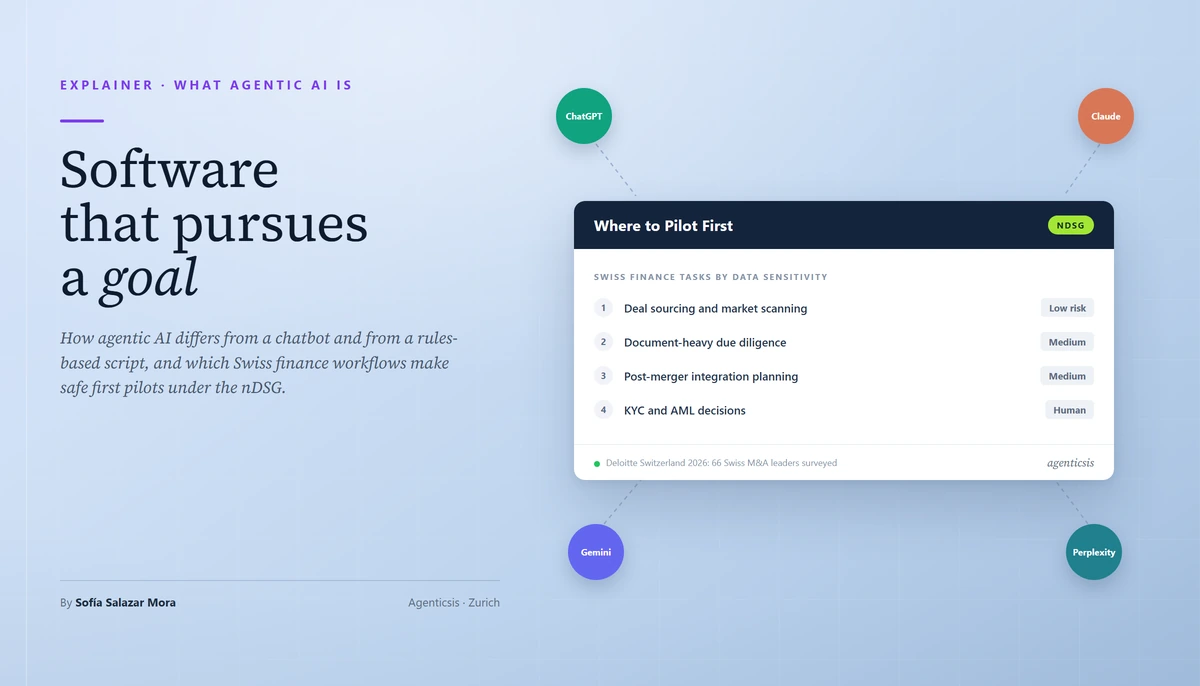
Combining the Deloitte findings with the enterprise definitions above, four categories of task are emerging as sensible early pilots for Swiss finance and M&A teams. The first three are directly consistent with Deloitte's survey; the fourth is a common adjacent use case in Swiss banking.
Deal sourcing and market scanning
Agents translate an investment thesis into filter criteria, search internal CRMs, data providers and news feeds, rank targets, and keep watchlists updated as new information appears. This is low on personal data, low on downside risk, and easy to review, which makes it a natural first pilot.
Document-heavy due diligence support
Agents discover documents in a data room, classify them, extract key clauses and metrics, compare findings against internal checklists, and populate diligence trackers. Deloitte specifically flags document review as an area where Swiss M&A teams are already leaning on AI [Source: deloitte.com].
Post-merger integration planning
Agents read the integration playbook, analyse both organisations' structures and systems, propose workstreams and milestones, and monitor completion in project-management tools. The output is a draft plan, not a binding decision, which keeps human accountability intact.
KYC and AML support (with humans in the loop)
Agents can gather client information, check sanctions lists, pull internal transaction histories and propose risk ratings. In Switzerland, however, any decision with significant effects on a person must remain reviewable by a human, per Art. 21 nDSG, so a human review path must exist [Source: sidd.swiss].
Pro Tip
Pick a first pilot where the output is a draft, not a decision. Draft target lists, draft diligence summaries and draft integration plans all have the same property: a person reviews them before anything binding happens. That single design choice removes most of the regulatory and reputational risk from your first agentic project.
7. nDSG compliance considerations for agentic AI
Quick Answer:
Three nDSG articles shape agentic AI design in Switzerland: Art. 21 (right to human review of significant automated decisions), Art. 25 (right to the logic behind an automated decision) and Art. 22 (Data Protection Impact Assessment for high-risk processing). Build oversight, logging and documented data flows in from the first pilot.
The revised Swiss Data Protection Act, the nDSG, has been in force since 1 September 2023 and shapes how any agentic system that processes personal data can be deployed in Switzerland. Three articles are especially relevant.
Art. 21 nDSG: automated individual decisions
Article 21 regulates automated individual decisions and grants affected persons the right to human review [Source: sidd.swiss]. For agentic AI this means any decision with significant effects on a person, such as a credit refusal, a negative KYC rating or exclusion from a process, must be reviewable by a human. Agentic systems can prepare recommendations and scores; final decisions with client or employee impact stay with a person.
Art. 25 nDSG: right to the logic behind the decision
Article 25 grants a right of access to the logic behind certain automated decisions. Swiss guidance from SIDD stresses that the mere existence of an AI system without explainable logic is in many cases unlawful [Source: sidd.swiss]. Practically, Swiss institutions must be able to trace agent actions, prompts and tool calls, and explain in understandable terms why a particular output was produced.
Art. 22 nDSG: Data Protection Impact Assessments
Article 22 requires a Data Protection Impact Assessment, or DSFA, for high-risk processing, and AI systems generally fall under that obligation. A 2026 Swiss SME compliance blog underlines the practical questions: which AI systems need a DSFA, has it been carried out, and are all AI processing operations with personal data listed in the processing register [Source: digital-opua.ch].
| nDSG article | Requirement | Impact on agentic AI design |
|---|---|---|
| Art. 21 | Right to human review of automated decisions with significant effects | Human-in-the-loop step before any binding decision |
| Art. 25 | Right of access to the logic behind automated decisions | Detailed action and reasoning logs, plain-language explanations |
| Art. 22 | DSFA for high-risk processing | Documented risk assessment before go-live |
Expert Insight
The technical controls that satisfy nDSG (human oversight, decision logging, audit trails and documented data flows) are also what make agentic AI reliable enough to trust. Building them in from day one is not a compliance tax, it is what turns a demo into a production system. The legal assessment of whether a specific use case triggers Art. 21 or Art. 22 belongs to the client's DPO or external counsel, not to the technical build.
Disclaimer
This article summarises publicly available guidance on the nDSG and on agentic AI. It is not legal advice. Whether a specific agentic AI use case triggers Art. 21, Art. 22 or Art. 25 nDSG, or requires a DSFA, should be assessed by qualified counsel or your Data Protection Officer.
8. Should your SME pilot on one task before scaling?
Yes, and the Deloitte Switzerland 2026 survey is essentially a case in point: even sophisticated M&A teams are keeping AI to well-defined support tasks before letting it touch core decisions [Source: deloitte.com]. A single-task pilot lets you measure real impact, exercise your nDSG controls in production, and build internal confidence before widening scope.
What a good first pilot looks like
Choose one bounded process where the output is a draft, the data is contained, and success is measurable in hours saved or errors caught. Give it a named human owner. Instrument it so every agent action is logged. Then run it for two to three months before deciding whether to widen scope or add a second use case.
Common mistakes to avoid
- Starting with a customer-facing decision that triggers Art. 21 nDSG on day one.
- Skipping the DSFA because the pilot feels small.
- Choosing a task where success is hard to measure, so no one can tell if the pilot worked.
Scoping your first agentic AI pilot?
Agenticsis helps Swiss SMEs design narrow, auditable agentic AI pilots with human oversight, decision logging and documented data flows built in from the start. Engagements are scoped per project.
Talk to Agenticsis9. Frequently asked questions
Q: What is agentic AI in one sentence?
A: Agentic AI is software that takes a goal, figures out the steps, uses tools or data to complete them, and iterates on its own until the task is done or a human is needed [Source: agentic.ai].
Q: How is agentic AI different from a chatbot?
A: A chatbot answers one prompt at a time with text. An agentic system runs a loop, taking real actions such as calling APIs, editing files or updating records, and observing the result before deciding what to do next [Source: agentic.ai].
Q: Is agentic AI the same as an AI agent?
A: Closely related. An AI agent is a single autonomous component. Agentic AI usually refers to a system made up of one or more agents pursuing a goal, often orchestrated together, per MIT Sloan [Source: mitsloan.mit.edu].
Q: How are Swiss M&A teams actually using AI in 2026?
A: Deloitte Switzerland's 2026 survey of 66 M&A leaders found AI use is rising in support functions such as research and document review, but not yet in core valuation and negotiation decisions [Source: deloitte.com].
Q: When was the Deloitte Switzerland M&A AI survey run?
A: Deloitte Switzerland surveyed 66 Swiss M&A leaders between February and April 2026 across corporates, private equity and advisory firms [Source: deloitte.com].
Q: Does the nDSG ban fully automated decisions?
A: No, but Art. 21 nDSG gives affected persons the right to human review of automated decisions with significant effects. That means agentic systems can prepare recommendations, but binding decisions in those areas must stay reviewable by a person [Source: sidd.swiss].
Q: What is a DSFA and when do I need one?
A: A DSFA is the Data Protection Impact Assessment required under Art. 22 nDSG for high-risk processing. Swiss guidance treats most AI systems processing personal data as candidates for a DSFA, so plan for one before your pilot goes live [Source: digital-opua.ch].
Q: What does explainability mean under Art. 25 nDSG?
A: Art. 25 gives affected persons a right of access to the logic behind certain automated decisions. SIDD guidance stresses that AI systems without explainable logic can be unlawful, so agentic systems need action and reasoning logs that can be translated into plain language [Source: sidd.swiss].
Q: Can agentic AI replace RPA?
A: Not for stable, high-volume, structured tasks where RPA is already cheap and predictable. Agentic AI adds value on top, handling the judgement steps between the mechanical ones, per TechTarget and MIT Sloan [Source: techtarget.com] [Source: mitsloan.mit.edu].
Q: What is a realistic first pilot for a Swiss SME?
A: A narrow, auditable process where the agent produces a draft that a person reviews. Deal sourcing shortlists, diligence document summaries and internal research briefings are common starting points, all consistent with the support-task pattern Deloitte observed in Swiss M&A [Source: deloitte.com].
Q: Do I need to build my own agent framework?
A: Usually no. Most Swiss SMEs get further by combining an existing model provider with a well-scoped tool set, a clear data boundary and strong logging, rather than by building novel infrastructure. Effort is better spent on process design and oversight.
Q: How do I keep an agent from taking actions it should not?
A: Constrain the tool set the agent can call, require human confirmation for any binding step, and log every action. Agentic systems are only as risky as the tools you connect to them.
Q: Where should the data live?
A: For Swiss finance, data residency and confidentiality usually mean cloud environments hosted in the EU or in Switzerland, or partnered cloud environments on Vertex, AWS or Azure where residency requirements are stricter. Match the hosting to the sensitivity of the data.
Q: How do I measure success in a pilot?
A: Pick two or three metrics before you start: hours saved per task, error rate versus a human baseline, and adoption by the intended users. If any of them are hard to measure, the pilot scope is probably too wide.
Q: What are the biggest failure modes?
A: Overclaiming autonomy, poor data access controls, missing decision logs and skipping the DSFA. Each one can turn a promising pilot into a compliance or trust problem later.
Q: How does agentic AI change work, not just tools?
A: Harvard Business Review argues agentic AI shifts human effort from execution to supervision, review and exception handling [Source: hbr.org]. Teams need new skills around prompting, reviewing agent output and designing guardrails.
Q: Is agentic AI overhyped?
A: Partly. AP reporting has described it as a mix of marketing fluff and real promise [Source: ap.org]. The underlying capability is real, but production deployments in regulated Swiss industries remain narrow and cautious.
Q: Who is accountable when an agent makes a mistake?
A: Legally, the controller of the processing, typically the deploying organisation, remains accountable under the nDSG. That is why human review, logging and a clear owner for each pilot are non-negotiable design choices.
Conclusion and next steps
Agentic AI is not a chatbot with a new coat of paint. It is software that pursues a business goal across multiple steps and tools, and that shift is what makes it valuable and what makes it harder to govern. For Swiss finance and M&A teams in 2026, the Deloitte survey signal is clear: adopt in support functions first, keep humans in the loop for anything binding.
Key takeaways:
- Agentic AI plans, acts and iterates, unlike a single-prompt chatbot or a fixed RPA script.
- Deloitte Switzerland's 2026 survey of 66 Swiss M&A leaders shows AI rising in support tasks, not core decisions.
- Well-defined first pilots include deal sourcing, diligence document review and integration planning.
- The nDSG requires human oversight for significant automated decisions, explainable logic, and a DSFA for high-risk processing.
- Build the technical controls (oversight, logging, audit trails, documented data flows) into your first pilot, not the fifth.
Start small, measure honestly, and let the second use case earn its place based on what the first one taught you.
Ready to move from theory to a scoped pilot?
Agenticsis is a Zurich-based AI agentic systems consultancy founded in January 2026 by Sofía Salazar Mora. We help Swiss SMEs design and ship narrow agentic AI pilots under the GDPR and the Swiss FADP, with the technical controls your DPO expects to see.
Start with Agenticsis