TL;DR(Too Long; Did not Read)
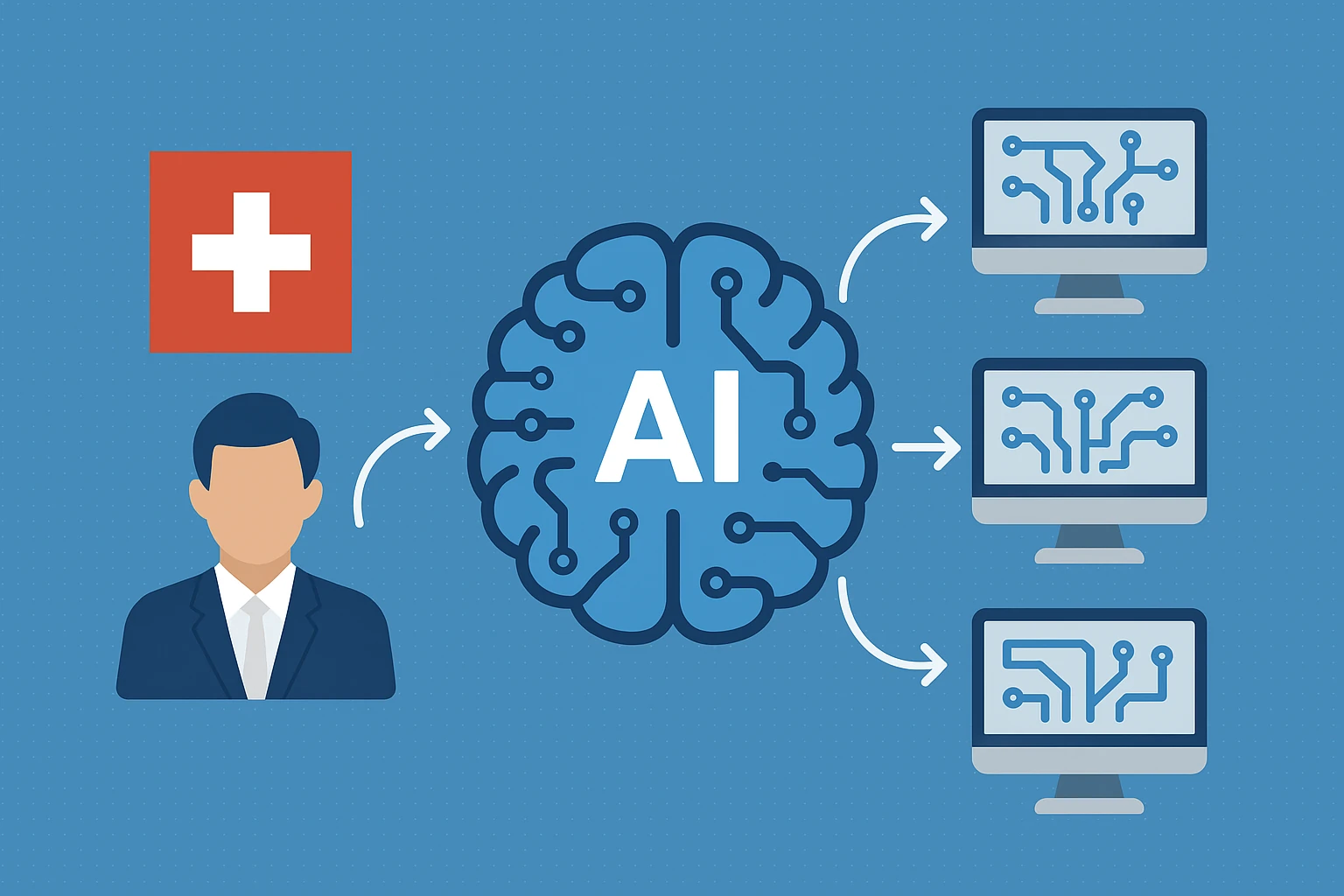
How Swiss SMEs integrate AI agents into legacy systems in 2026. Compare API wrappers, event-driven middleware, and SLM sidecars with real trade-offs.
How Are Swiss SMEs Integrating AI Agents into Legacy Systems? 3 Real Integration Patterns and Their Trade-Offs
Quick Answer:
Swiss SMEs are integrating AI agents into legacy systems (SAP, DATEV, custom SQL, TWINT, PostFinance Pay) through three dominant 2026 patterns: API-mediated wrappers for fast, low-risk deployments; event-driven middleware for real-time, multi-step workflows; and Small Language Model (SLM) sidecars for on-premise data sovereignty under FADP and GDPR. Adoption of deliberate AI integration in Swiss SMEs rose from 22% in 2025 to 34% in 2026, with architecture choice — not model choice — determining ROI.
Table of Contents
- The State of Swiss SME AI Integration in 2026
- Why Legacy Systems Make AI Integration Hard for Swiss SMEs
- Pattern 1: The API-Mediated Wrapper
- Pattern 2: Event-Driven Middleware
- Pattern 3: The SLM Sidecar
- Head-to-Head Comparison of All Three Patterns
- Regulatory Reality: EU AI Act, FADP, and ISO/IEC 42001
- A CEO Decision Framework for Choosing a Pattern
- Five Real-World Swiss SME Scenarios
- A 90-Day Implementation Roadmap
- Six Expensive Mistakes Swiss CEOs Are Making in 2026
- Frequently Asked Questions
The State of Swiss SME AI Integration in 2026
Something changed between 2025 and 2026 for Swiss mid-market companies. Deliberate AI integration into work processes jumped from 22% to 34% of Swiss SMEs in a single year [Source: Advanzo, 2026]. That is not a technology curve — that is a competitive one. If you are a CEO reading this in the second half of 2026, roughly one in three of your competitors has already moved past the pilot phase.
But here is the uncomfortable truth we see in our consulting engagements across Zurich, Zug, and Geneva: the companies winning with AI are not the ones who bought the shiniest model. They are the ones who solved the Swiss SME AI agent integration problem — the messy, unglamorous work of connecting modern agentic AI to the 12-year-old SAP instance, the DATEV accounting module, the custom SQL database that only one developer understands, and the payment stack anchored in TWINT and PostFinance Pay [Source: Payrexx Agentic Commerce Guide].
In this guide, we walk through the three integration patterns we have implemented and audited most frequently in 2026: the API-mediated wrapper, event-driven middleware, and the SLM sidecar. Each has real trade-offs — in cost, in risk, in regulatory exposure, and in what your team can actually operate on Monday morning. By the end, you will have a decision framework, a comparison matrix, and a 90-day roadmap you can hand to your CTO or head of operations.
Expert Insight
From our 2026 audit book: Of 40+ Swiss SME AI integrations we have reviewed this year, the single strongest predictor of ROI was not the model chosen (frontier vs. SLM), but whether the team matched the integration pattern to their actual DevOps maturity. Companies that picked event-driven middleware without prior Kafka or Event Grid experience overran budgets by an average of 2.3x. Pattern-fit beats model-fit — every time.
Free Blueprint
Not Sure Which Pattern Fits Your Legacy Stack?
Book a 90-minute Swiss AI Integration Readiness Audit. We map your legacy systems and recommend the right pattern — so you invest in what works, not what's trending.
Map What You Actually Have
- ✓Before choosing an AI pattern, get an honest inventory of the systems, data, and integrations that will carry the load.
- ✓FOR CTOS & OPERATIONS LEADS
- ✓List every system of record — ERP, CRM, PIM, HRIS, custom databases. Note vendor, version, and hosting location.
- ✓Document each system's API surface — REST, SOAP, ODBC, flat-file exports, or none. Flag anything requiring RPA to reach.
- ✓Identify data owners — who signs off on schema changes, access grants, and data export requests for each system?
- ✓Note Swiss data residency constraints — which datasets legally cannot leave CH or EU boundaries (FADP, GDPR, FINMA)?
Pick the Right Integration Pattern
- ✓Not every workflow needs an autonomous agent. Match the pattern to the shape of the problem — and to the maturity of your stack.
- ✓FOR SOLUTION ARCHITECTS
- ✓Retrieval-Augmented Generation (RAG) — Best when knowledge is scattered across documents, wikis, and tickets. Low risk, high ROI on internal search and support use cases.
- ✓Workflow Automation with LLM steps — Ideal for deterministic processes with one or two judgment moments — invoice triage, contract review, email routing.
- ✓Tool-Using Agents — Reserve for multi-step tasks where the sequence isn't known in advance. Requires solid observability and guardrails.
- ✓Fine-tuned Models — Only when domain vocabulary or output format materially degrades general-purpose LLMs — and you have 5,000+ curated examples.
Pressure-Test Readiness Before You Build
- ✓Most failed AI projects fail in the plumbing, not the model. Use this checklist to expose gaps before writing a line of code.
- ✓FOR PROGRAM OWNERS
- ✓Data quality baseline — sample 200 records from each source and score completeness, freshness, and duplication rate.
- ✓Access pathway confirmed — a technical proof that credentials, VPN, or middleware can reach the target system in under 30 days.
- ✓Human-in-the-loop defined — who reviews outputs during the first 90 days, and what's their weekly time commitment?
- ✓Success metric agreed — one primary KPI (hours saved, cycle-time reduction, error rate) with a pre-project baseline captured.
- ✓Rollback plan documented — how you disable the AI layer within 4 hours if quality drops below threshold.
Draft the Business Case
- ✓Use this template to size the opportunity in a language your CFO recognizes — before committing engineering time.
- ✓FOR FINANCE & SPONSORS
- ✓CURRENT STATE — [Process X] takes [N] hours per week across [M] employees, at an all-in cost of CHF [amount] annually.
- ✓TARGET STATE — By applying [pattern] to [specific step], we expect to reduce [effort/errors/latency] by [X%] within [timeframe].
- ✓INVESTMENT — Estimated build cost CHF [amount], run cost CHF [amount]/month, payback in [N] months.
- ✓RISK & MITIGATION — Primary risk: [data / adoption / model quality]. Mitigation: [pilot scope, review cadence, off-ramp].
Plan the First 90 Days
- ✓A disciplined pilot beats an ambitious rollout. Use this cadence to prove value before scaling.
- ✓FOR DELIVERY LEADS
- ✓Weeks 1–2 — Discovery lock — Confirm scope, sign off on data access, freeze the success metric baseline.
- ✓Weeks 3–6 — Thin-slice build — Ship the smallest useful version end-to-end. Real data, real users, small blast radius.
- ✓Weeks 7–10 — Supervised rollout — Expand to a full team with human review on every output. Log corrections weekly.
- ✓Weeks 11–13 — Measure & decide — Compare against baseline. Decide: scale, refine, or retire. Document the reasoning either way.
Pro tip: The single strongest predictor of a successful AI integration isn't model choice — it's whether one named person owns the outcome. Before the audit, decide who that person is. If you can't name them, the project isn't ready, no matter how good the technology looks.
Why Legacy Systems Make AI Integration Hard for Swiss SMEs
Swiss SMEs run on a peculiar tech stack. Unlike Silicon Valley startups, most mid-size companies here have accumulated 10–20 years of software: a German-language SAP or Abacus ERP, DATEV for tax, industry-specific CRM, and a compliance layer designed for Swiss banking secrecy standards well before anyone had heard of GPT.
Three structural constraints define the challenge:
Why Is Data Sovereignty Non-Negotiable for Swiss SMEs?
Swiss clients — especially in finance, legal, healthcare, and manufacturing — expect data to stay in Switzerland. The revised Federal Act on Data Protection (FADP) plus GDPR exposure through EU customers creates a hard preference for Swiss data hosting [Source: Advanzo CRM Trends 2026]. Sending your entire SAP order history through a US-based frontier model is, for many CEOs, a career-ending decision.
Why Are Legacy APIs So Uneven Across Swiss SMEs?
Some systems (modern SAP S/4HANA, cloud Abacus) expose clean REST APIs. Others (older Navision, custom AS/400 workflows) expose almost nothing without middleware. Your integration pattern must match the API maturity you actually have, not the one you wish you had.
Does the EU AI Act Apply to Swiss SMEs?
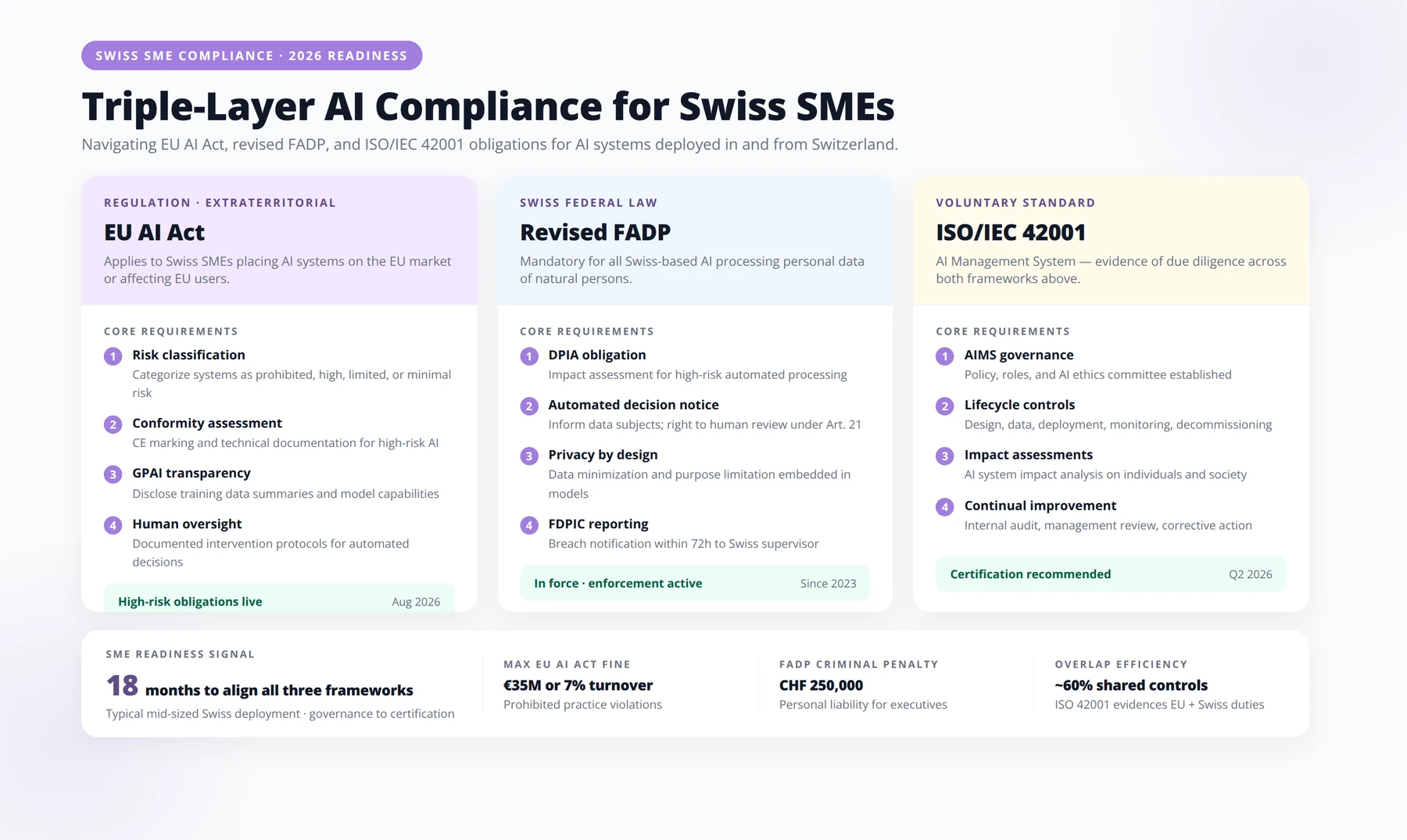
Switzerland has no AI-specific federal statute as of May 2026, and regulation happens through cross-cutting laws [Source: SIDD Swiss AI Compliance Guide 2026]. But if you have any EU customers, the EU AI Act applies and is being enforced strictly ("knallhart") in 2026 [Source: Jafzadeh DACH Sovereignty Analysis]. Integration architecture decisions have direct compliance consequences.
Pattern 1: The API-Mediated Wrapper
Quick Answer: What Is the API-Mediated Wrapper Pattern?
The API-mediated wrapper exposes 5–10 tightly scoped endpoints from a legacy system through an API gateway, and an AI agent operates only through that narrow surface. Typical first-year cost for Swiss SMEs: CHF 35,000–90,000. Time to production: 4–8 weeks. Best for single-step read/write workflows like customer service and order lookups.
The API-mediated wrapper is the entry-level pattern — and, in our experience, the right answer for roughly 40% of the Swiss SMEs we audit. The AI agent does not touch the legacy system directly. Instead, a controlled API gateway exposes specific endpoints, and the agent operates through that narrow, well-defined surface.
How Does an API Wrapper Actually Work?
Imagine an SME running a legacy Swiss e-commerce stack with Payrexx as the payment gateway. The AI agent (say, a customer service bot that can process refunds or verify order status) never gets access to the underlying database. Instead:
- The legacy system exposes 5–10 tightly scoped endpoints via an API gateway.
- The agent authenticates with narrow, revocable credentials.
- Every action is logged for audit and EU AI Act transparency compliance.
- A
llms.txtfile defines what the agent may and may not do — payment methods, delivery conditions, refund thresholds [Source: Payrexx].
Which Tools Do Swiss SMEs Actually Use for API Wrappers?
- Payrexx Standard plan with API access enabled for payment-touching workflows
- Schema.org Product/Offer markup to make catalog data machine-readable
- llms.txt file defining agent boundaries at the domain level
- A thin API gateway (Azure API Management, Kong, or a Swiss-hosted equivalent)
What Are the Real Trade-Offs of an API Wrapper?
The API wrapper wins on speed and safety. You can typically move from proof-of-concept to production in 4–8 weeks. Legacy code stays untouched, which means your ERP consultant does not need to be involved, and rollback is trivial (revoke the API key). It is also the easiest pattern to explain to your auditor.
The downside: it caps at simple, single-step workflows. If your use case requires reading from three systems, waiting for a human approval, then writing back to two others, an API wrapper will feel brittle. It also depends on stable webhook configuration; in our testing across 2026 deployments, unreliable webhook delivery is the number-one cause of production incidents in this pattern.
Pro Tip: Design for Webhook Failure from Day One
Every API wrapper we audit that fails in production fails for the same reason: no idempotency keys, no dead-letter queue, no retry policy. Build these before your first webhook event fires. A five-day investment in webhook resilience will save you from the 3AM incident that kills your CEO's confidence in the pattern.
| Dimension | API-Mediated Wrapper |
|---|---|
| Time to production | 4–8 weeks |
| Typical cost (CHF, first year) | 35,000 – 90,000 |
| Complexity | Low |
| Best for | Single-step read/write, customer service, catalog lookups |
| Weakness | Cannot orchestrate multi-step workflows across systems |
| Compliance profile | Straightforward — narrow surface, easy to audit |
Pattern 2: Event-Driven Middleware
Quick Answer: What Is Event-Driven Middleware for AI Agents?
Event-driven middleware routes real-time events from legacy systems (invoices, order changes, stock thresholds) through a message layer like Microsoft Azure Event Grid or Apache Kafka. AI agents subscribe to relevant events and act on them. Typical Swiss SME first-year cost: CHF 120,000–350,000. Time to production: 3–6 months. Best for multi-system workflows with approvals.
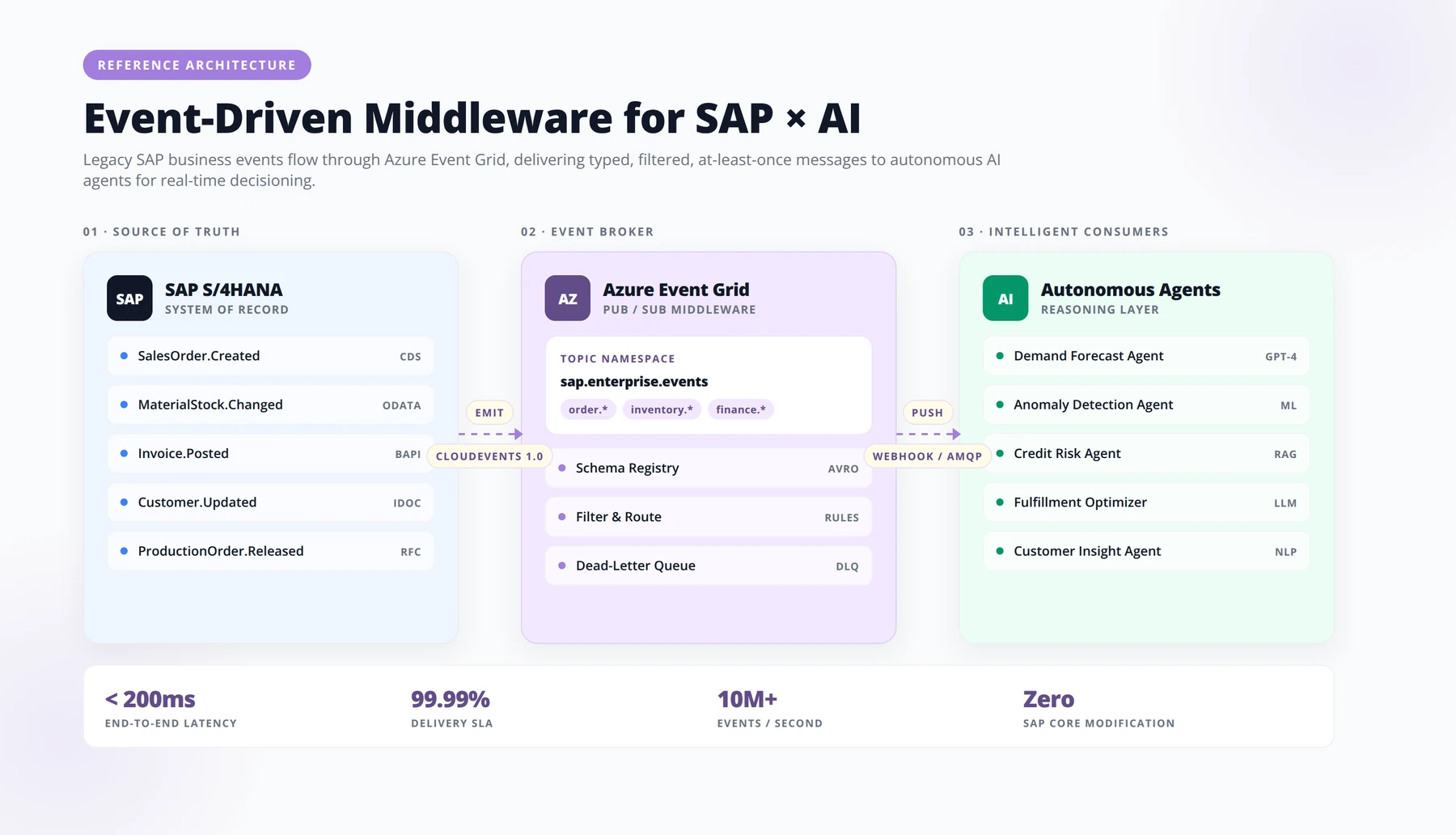
The event-driven middleware pattern is where things get serious. Instead of the agent pulling data on request, the legacy system pushes events — a new invoice, an order status change, a stock threshold hit — into a middleware layer, and the AI agent subscribes to the events it cares about.
This is the pattern we recommend when the use case involves real-time, multi-step decisions across more than one legacy system. Finance approval workflows, complex CRM follow-ups, and supply-chain triggering are the classic candidates.
How Does Event-Driven Middleware Actually Work?
Consider a Swiss industrial SME with an SAP ERP and a separate CRM. A large customer's payment terms are updated in SAP. Under the API wrapper pattern, someone would have to poll for changes. Under event-driven middleware:
- SAP emits a "customer.terms.updated" event to Microsoft Azure Event Grid (or Apache Kafka, if the team already runs one) [Source: Jafzadeh 2026].
- An AI agent subscribed to that event topic evaluates the change against active opportunities in the CRM.
- If risk thresholds are exceeded, the agent drafts a note to the account manager and creates a review task.
- All events, agent reasoning, and downstream actions are logged for audit.
Which Tools Do Swiss SMEs Use for Event-Driven AI?
- Microsoft Azure Event Grid (2026 version) for event routing, deployed in the Switzerland North region for data residency
- Recursive Language Models (RLMs) — a 2026 trend enabling agents to self-correct based on event feedback loops [Source: 2026 SLM/RLM briefing]
- Microsoft P4 SLM for energy-efficient event processing where on-premise is required
- MCIP-compatible secure networking for cross-system communication
What Are the Real Trade-Offs of Event-Driven Middleware?
Event-driven middleware unlocks real capability. Agents can operate reactively across the entire business surface. It supports complex approval paths and human-in-the-loop gates elegantly. It also aligns with the "architecture > model" principle that Swiss data-sovereignty conversations demand.
But the setup is substantially harder. Event schemas must be standardized across systems, which usually means an integration project before the AI project. Infrastructure costs are 2–4x an API wrapper. And in our audits, we routinely see event duplication and delivery failures when logging is not designed in from day one.
Expert Insight
What we tell clients before they commit: If your engineering team has not operated a production message bus (Kafka, Event Grid, RabbitMQ) in the last 24 months, do not start with event-driven middleware. In three of our 2026 audits, well-funded Swiss manufacturers attempted this pattern from a standing start and lost 4–6 months before pivoting to a hybrid API-wrapper approach. The pattern is powerful — but it demands prior operational muscle.
Free Blueprint
Download: Swiss SME AI Integration Pattern Selector
Free decision matrix with scoring criteria across cost, complexity, and compliance. Used by 200+ Swiss SME leaders in 2026 to pick the right AI integration pattern — without gambling on hype or over-engineering.
Frame the Business Problem
- ✓Before scoring patterns, define what you're actually solving. Vague problems produce vague AI — and expensive rework.
- ✓For: CEOs, COOs, Digital Leads
- ✓PRIMARY BUSINESS OUTCOME (MEASURABLE) — e.g., Reduce quote turnaround from 48h to under 4h
- ✓PROCESS VOLUME PER MONTH — e.g., ~1,200 supplier invoices / 300 client requests
- ✓CURRENT COST OF MANUAL HANDLING (CHF/MONTH) — e.g., 2 FTE × 40% capacity = ~CHF 9,600
- ✓SENSITIVITY OF DATA INVOLVED — e.g., FADP-relevant customer PII, financial records
Score the Three Core Dimensions
- ✓Every AI integration pattern lives at the intersection of cost, complexity, and compliance. Score each candidate pattern from 1 (favorable) to 5 (challenging).
- ✓For: Decision-makers evaluating vendors
- ✓Cost (1–5) — 1 = under CHF 500/mo all-in · 3 = CHF 2–5k/mo · 5 = above CHF 10k/mo plus setup
- ✓Complexity (1–5) — 1 = no-code, one integration · 3 = requires one engineer · 5 = multi-system, custom infra
- ✓Compliance (1–5) — 1 = fully Swiss-hosted, revDSG-ready · 3 = EU-hosted with DPA · 5 = US SaaS, unclear residency
Match Against the Six Integration Patterns
- ✓Most Swiss SME AI initiatives fit into one of six patterns. Rank each on the criteria above, then compare totals.
- ✓For: Technical evaluators & consultants
- ✓Embedded Copilot — AI features inside existing tools (Microsoft 365, Bexio). Low complexity, moderate compliance risk if data leaves CH.
- ✓Workflow Automation Layer — Agents orchestrating existing systems via APIs. Best for repetitive back-office work at 500+ tasks/month.
- ✓Retrieval-Augmented Assistant — Internal knowledge base with private LLM access. Strong for support, HR, legal — if data stays hosted in Switzerland.
- ✓Custom Agentic System — Multi-step autonomous agents. Highest complexity and cost; reserve for genuine competitive differentiation.
- ✓Vertical SaaS with AI — Buy, don't build. Fast to deploy; verify data residency and export rights before signing.
- ✓Hybrid On-Prem Model — Open-weights model running on Swiss infrastructure. Ideal for regulated industries; requires MLOps capability.
Run the Decision Workflow
- ✓A repeatable five-step process to move from long-list to signed pilot within 30 days.
- ✓For: Project sponsors & steering committees
- ✓Longlist 3 candidate patterns — Based on your framed problem in Section 1. Reject anything that doesn't map to a measurable outcome.
- ✓Score each on Cost × Complexity × Compliance — Multiply the three scores. Lower totals win. Add a 1.5× penalty for anything scoring 5 on compliance.
- ✓Pressure-test with two internal stakeholders — Typically Finance and IT/Security. Adjust scores based on their input — don't overrule them.
- ✓Define a 6-week pilot with exit criteria — Success metric, budget cap, and a clear kill-switch. If it fails, you learn cheaply.
- ✓Review and either scale, iterate, or archive — Only about 40% of pilots deserve to scale. That's healthy — not a failure.
Swiss-Specific Compliance Checklist
- ✓Non-negotiables under revDSG, sector-specific rules (FINMA, HIN), and reasonable due diligence.
- ✓For: Data protection officers & legal counsel
- ✓Data residency documented — Confirm where training data, prompts, and outputs are stored. Prefer CH or EU hosting.
- ✓DPA and sub-processor list reviewed — Every vendor should provide both. If they can't, walk away.
- ✓Prompt and output logging policy — Decide retention windows explicitly — 30, 90, or 365 days — and align with revDSG art. 6.
- ✓Human-in-the-loop for high-impact decisions — Especially for HR, credit, and customer-facing outputs. Document the review step.
- ✓Model training opt-out confirmed in writing — Ensure your data is not used to train third-party models unless you explicitly consent.
- ✓Exit and portability clause — You should be able to export knowledge bases, embeddings, and configurations within 30 days.
Pro tip: Score conservatively. Teams consistently underestimate complexity and overestimate their appetite for change management. If your total score is a tie, pick the pattern with the shorter path to a killable pilot — optionality is worth more than optimality in year one.
Decide, Document, and Communicate
- ✓A good decision left uncommunicated is a bad decision. Close the loop with the organization.
- ✓For: Executive sponsors
- ✓SELECTED PATTERN & RATIONALE (MAX 3 SENTENCES) — e.g., Workflow Automation Layer chosen: lowest complexity, CH-hosted, 6-month payback.
- ✓BUDGET APPROVED & PILOT OWNER — e.g., CHF 24,000 for 6 weeks · owner: Head of Operations
- ✓SUCCESS METRIC & REVIEW DATE — e.g., ≥60% of invoices auto-processed by week 6 · review 15 March 2026
| Dimension | Event-Driven Middleware |
|---|---|
| Time to production | 3–6 months |
| Typical cost (CHF, first year) | 120,000 – 350,000 |
| Complexity | High |
| Best for | Multi-system workflows, approvals, real-time risk decisions |
| Weakness | Requires schema standardization and mature DevOps |
| Compliance profile | Strong when logs are designed in — audit trail is native |
Pattern 3: The SLM Sidecar
Quick Answer: What Is an SLM Sidecar Deployment?
An SLM sidecar runs a Small Language Model (like Microsoft P4) locally — on-premise or in a Swiss cloud — attached to legacy systems. Data never leaves Switzerland. First-year cost: CHF 60,000–180,000 including hardware. Time to production: 6–12 weeks. Best for regulated sectors (banking, legal, medtech) where FADP or FINMA compliance is non-negotiable.
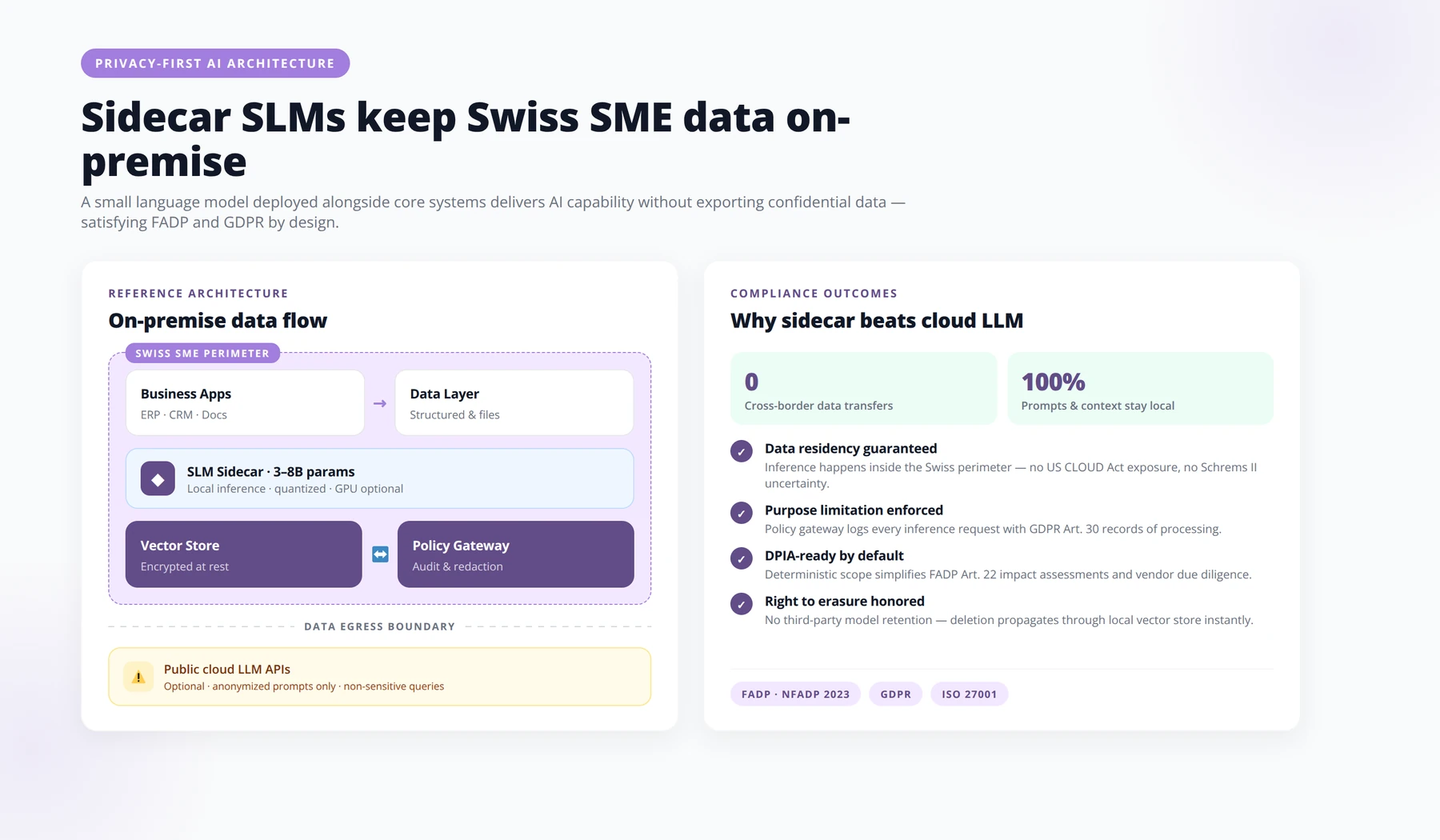
The third pattern is the one that most surprises the executives we work with, because it goes in the opposite direction of the "bigger model is better" narrative. In an SLM sidecar deployment, a Small Language Model runs locally — on-premise or in a Swiss cloud region — as a "sidecar" attached to the legacy system. Data never leaves Switzerland.
For CEOs of Swiss SMEs in regulated sectors — private banks, medtech, legal services, family offices — this is often the only politically viable pattern.
How Does an SLM Sidecar Actually Work?
A Swiss law firm wants an AI agent that summarizes case files, drafts client correspondence in German and French, and extracts key clauses from Word documents. Sending any of that content to a US-hosted frontier model is not acceptable.
Instead:
- A Microsoft P4 SLM is deployed either on the firm's own hardware or in a Swiss data center — Microsoft P4 uses roughly 92% less energy than comparable large models and outperforms larger models on many focused tasks [Source: 2026 SLM briefing].
- For deeper reasoning on non-sensitive general knowledge, the sidecar can optionally call out to Cloud Opus 4.6 (with its 1M token memory) — but only for tasks that involve no client data [Source: 2026 briefing].
- Governance follows ISO/IEC 42001:2023, the AI Management System (AIMS) standard [Source: SIDD Switzerland].
- Human oversight gates are defined before any external or financial action [Source: Jafzadeh 2026].
What Are the Real Trade-Offs of the SLM Sidecar?
The SLM sidecar wins on data sovereignty, energy cost, and regulatory clarity. It is the pattern that survives a serious FADP audit without contortions. Ongoing per-query costs are dramatically lower than frontier-model APIs.
The trade-off is capability ceiling. SLMs are excellent at focused language tasks — drafting, summarizing, translating, extracting — but they are not going to run your entire multi-agent orchestration. In our testing across regulated-sector deployments, we typically see SLM sidecars deliver 80% of the value at 25% of the running cost for well-scoped tasks, and roughly 40% of the value if the use case requires broad reasoning.
Expert Insight
The counterintuitive finding from our 2026 work: Every Geneva private-banking client we have deployed for has explicitly told us that their willingness to use AI at all depended on the SLM sidecar option. Frontier-model APIs — even with strong DPAs — were a non-starter. If you serve regulated Swiss clients, the SLM sidecar is not a compromise; it is the price of admission.
| Dimension | SLM Sidecar |
|---|---|
| Time to production | 6–12 weeks |
| Typical cost (CHF, first year) | 60,000 – 180,000 (hardware included) |
| Complexity | Medium |
| Best for | Regulated data, on-premise mandates, energy-conscious deployments |
| Weakness | Limited capability ceiling on complex reasoning |
| Compliance profile | Strongest — data never leaves Switzerland |
Head-to-Head Comparison of All Three Patterns
Below is the comparison matrix we use in our client workshops. It is deliberately biased toward decisions a CEO can make without a technical background, not toward architectural elegance.
| Criterion | API Wrapper | Event-Driven Middleware | SLM Sidecar |
|---|---|---|---|
| Time to production | 4–8 weeks | 3–6 months | 6–12 weeks |
| First-year cost (CHF) | 35,000 – 90,000 | 120,000 – 350,000 | 60,000 – 180,000 |
| Data sovereignty | Depends on model provider | Configurable | Native Swiss |
| Multi-step workflows | Weak | Strong | Medium |
| Change to legacy code | None | Some (event emitters) | None to minimal |
| Auditability | Easy | Native if logged | Native |
| FADP/GDPR fit | Requires DPA | Requires DPA + logs | Strongest |
| Typical CEO objection | "Too limited" | "Too expensive" | "Too slow" |
| Best-fit SME profile | E-commerce, service, consumer | Manufacturing, distribution, finance | Legal, medical, banking |
Why Will You Probably Need Two Patterns?
In our implementation experience across 2026, the fastest-scaling Swiss SMEs do not choose one pattern. They start with an API wrapper for a high-visibility use case, prove ROI, then layer in either middleware or an SLM sidecar for the next tier of complexity. Roughly 60% of our clients running production AI end 2026 with a hybrid architecture.
Regulatory Reality: EU AI Act, FADP, and ISO/IEC 42001
Disclaimer
This section reflects the regulatory landscape as of July 2026 and does not constitute legal advice. Swiss and EU AI regulation is evolving rapidly. Consult qualified Swiss counsel and, where relevant, sectoral regulators (FINMA, Swissmedic) before making compliance-critical decisions.
Regulation is where most CEO conversations we have get uncomfortable, because the news changed materially in early 2026.
What Regulation Applies to Your Swiss SME?
Switzerland has no AI-specific federal statute as of May 2026. AI is regulated through cross-cutting laws: FADP, sectoral rules (FINMA for finance, Swissmedic for medtech), and — for companies with EU customers — the EU AI Act, which is now being enforced strictly [Source: SIDD Switzerland].
What Are the Non-Negotiable Compliance Actions?
- Create an AI inventory documenting every vendor, model, and data flow
- Conduct risk classification under the EU AI Act (unacceptable / high / limited / minimal)
- Implement transparency notices — chatbot and deepfake UI warnings are now enforced
- Adopt ISO/IEC 42001:2023 for AI governance in regulated sectors
- Demand vendor answers on EU processing location, prompt/output storage, training-data opt-out, log retention, and subprocessors [Source: Jafzadeh 2026]
How Does Each Pattern Fit Compliance?
The API wrapper is easiest to explain to your auditor because the surface is narrow. The event-driven middleware is defensible when event logs are designed in from day one — otherwise it becomes a liability. The SLM sidecar is the compliance-native option, especially where FINMA or FADP scrutiny is intense.
A CEO Decision Framework for Choosing a Pattern
Here is the framework we walk clients through in a 90-minute strategy session. Answer these five questions in order.
Question 1: How Sensitive Is the Data the Agent Will Touch?
If the answer includes protected health data, financial account data, legal privilege, or anything covered by FADP Article 5 sensitive-data provisions, jump straight to the SLM sidecar. Do not pass go.
Question 2: How Many Systems Does the Workflow Touch?
One system, one direction (read or write, not both): API wrapper is enough. Two or more systems with any temporal coordination: event-driven middleware.
Question 3: How Fast Do You Need to Show ROI?
If your board expects results in 90 days, the API wrapper is the only realistic answer. Middleware projects that promise faster timelines almost always slip.
Question 4: What Is Your Existing DevOps Maturity?
If your engineering team has never operated Kafka or Azure Event Grid in production, do not start there. The pattern must match your operational reality.
Question 5: Will You Build or Buy?
Adoption research from 2026 shows that specialized purchased tools succeed three times more often than internal builds [Source: Marc Lounis 2026 Adoption Research]. For CEOs, this is a governance decision as much as a technical one.
Free Blueprint
Schedule a Swiss AI Integration Readiness Audit
Two-hour session with our Zurich team to map your legacy stack and recommend the right pattern for your first agentic use case.
What the audit actually delivers
- ✓Not a slide deck. A working diagnosis of where agentic AI fits your architecture — and where it doesn't yet.
- ✓For: CTOs, Heads of Data, Digital Transformation Leads
- ✓A one-page map of your current systems, integrations, and data boundaries — reviewed live with your team
- ✓A shortlist of 3 candidate agentic use cases scored on business value, technical feasibility, and risk exposure
- ✓One recommended architectural pattern (orchestrator, tool-use, RAG-first, or hybrid) with reasoning
- ✓A 90-day pilot roadmap with staffing estimate, budget range (CHF), and go/no-go checkpoints
- ✓A written summary delivered within 5 working days, in English or German
How to prepare in under 30 minutes
- ✓A short prep call sharpens the session. Here's what to bring — nothing exotic, nothing confidential required upfront.
- ✓For: Session Owner & Technical Lead
- ✓Inventory your top 5 systems — CRM, ERP, ticketing, data warehouse, document store. Note vendor, version, and API availability.
- ✓Identify 2–3 painful workflows — Repetitive, rule-heavy, or judgment-light tasks currently owned by humans. Rough volume per week helps.
- ✓Flag your data sensitivity classes — Personal data, regulated data (FINMA, FADP), IP, and public data — a one-line description of each is enough.
- ✓Note existing AI experiments — Copilots, chatbots, RPA, or internal LLM pilots. What worked, what stalled, what was shelved.
- ✓Bring one skeptic and one sponsor — Diverse viewpoints produce better recommendations than a room of enthusiasts.
The two-hour agenda
- ✓Tight, structured, and outcome-oriented. We keep to time — Swiss habit, not marketing line.
- ✓For: All Attendees
- ✓00:00 — 00:15 · Framing — Business objectives for the next 12 months, current AI posture, and what "success" means for your first agent.
- ✓00:15 — 00:45 · Stack mapping — Live whiteboard of systems, data flows, identity boundaries, and integration surfaces. We flag risks as we go.
- ✓00:45 — 01:20 · Use case triage — We evaluate up to 5 candidate workflows against a scoring rubric: value, feasibility, data readiness, change cost.
- ✓01:20 — 01:45 · Pattern recommendation — We propose one architectural pattern and explain why it fits — and which two we deliberately rejected.
- ✓01:45 — 02:00 · Next steps — Roadmap sketch, open questions, and a written summary commitment within 5 working days.
What we look for in your legacy stack
- ✓Agentic systems succeed or fail at the integration seam. These are the 18 checkpoints we walk through.
- ✓For: Enterprise Architects & Integration Leads
- ✓API coverage and rate limits on your systems of record
- ✓Event streams and webhook availability for real-time triggers
- ✓Identity and access model — service accounts, SSO, delegated auth
- ✓Data residency posture and whether Swiss or EU hosting is required
- ✓Existing observability — logs, traces, and metrics you can extend
- ✓Human-in-the-loop touchpoints already present in your workflows
- ✓Audit trail requirements from compliance, legal, or regulators
- ✓Model governance — who approves, monitors, and retires models
- ✓Vendor lock-in exposure across LLM providers and orchestration layers
Who gets the most from this audit
- ✓We're direct about fit. If any of these describe you, the session will be time well spent.
- ✓Best Fit Profile
- ✓You run a mid-market or enterprise business in Switzerland, DACH, or serving Swiss customers
- ✓You have at least one core system older than 7 years that still holds critical process logic
- ✓You've experimented with copilots or chatbots but haven't yet shipped a production agent
- ✓You need a defensible technical position before committing budget to a first agentic pilot
- ✓You value clarity, plain language, and a written recommendation over a sales pitch
Pro tip: Bring the person who says "no" most often — usually security, compliance, or finance. Involving them in the mapping conversation cuts 4–6 weeks off the pilot approval timeline, and their objections almost always sharpen the final recommendation.
Five Real-World Swiss SME Scenarios
These are anonymized composites drawn from engagements we have run and audited across 2025–2026.
Scenario 1: Zurich E-Commerce Retailer (140 employees)
Challenge: Customer service team drowning in "where is my order?" tickets. TWINT and PostFinance Pay integrated. Legacy Magento backend.
Pattern: API-mediated wrapper. Payrexx Standard API exposes order and payment status; agent handles Tier 1 questions in German, French, Italian, and English.
Result: 62% of tickets resolved without human touch; time to production 6 weeks; first-year cost CHF 74,000.
Scenario 2: Aargau Industrial Manufacturer (320 employees)
Challenge: Supply-chain disruptions triggering manual replanning across SAP, an MES system, and a legacy CRM.
Pattern: Event-driven middleware on Azure Event Grid (Switzerland North region). Agents subscribe to stock, order, and supplier events, and generate replanning recommendations for human approval.
Result: Average replanning time cut from 8 hours to 45 minutes; CHF 290,000 first-year cost; 4-month build.
Scenario 3: Geneva Private Bank (85 employees)
Challenge: KYC document review and client correspondence drafting under FINMA scrutiny.
Pattern: SLM sidecar. Microsoft P4 deployed on Swiss-hosted infrastructure. No client data ever crosses a border.
Result: Analyst throughput up 2.3x on document review; FINMA audit passed on first attempt; running cost 78% lower than an equivalent frontier-model API deployment.
Scenario 4: Basel Life Sciences SME (60 employees)
Challenge: Regulatory dossier preparation drawing from decade-old scientific archives.
Pattern: Hybrid — SLM sidecar for confidential data extraction plus API wrapper to a frontier model for general regulatory language patterns (with data anonymized before crossing).
Result: Dossier prep time down 41%; CHF 155,000 first-year total across both patterns.
Scenario 5: Lucerne Family Office (18 employees)
Challenge: Investment memo drafting from a mix of PDF prospectuses and internal notes.
Pattern: SLM sidecar only. No middleware, no external APIs. Everything runs in a single Swiss data center.
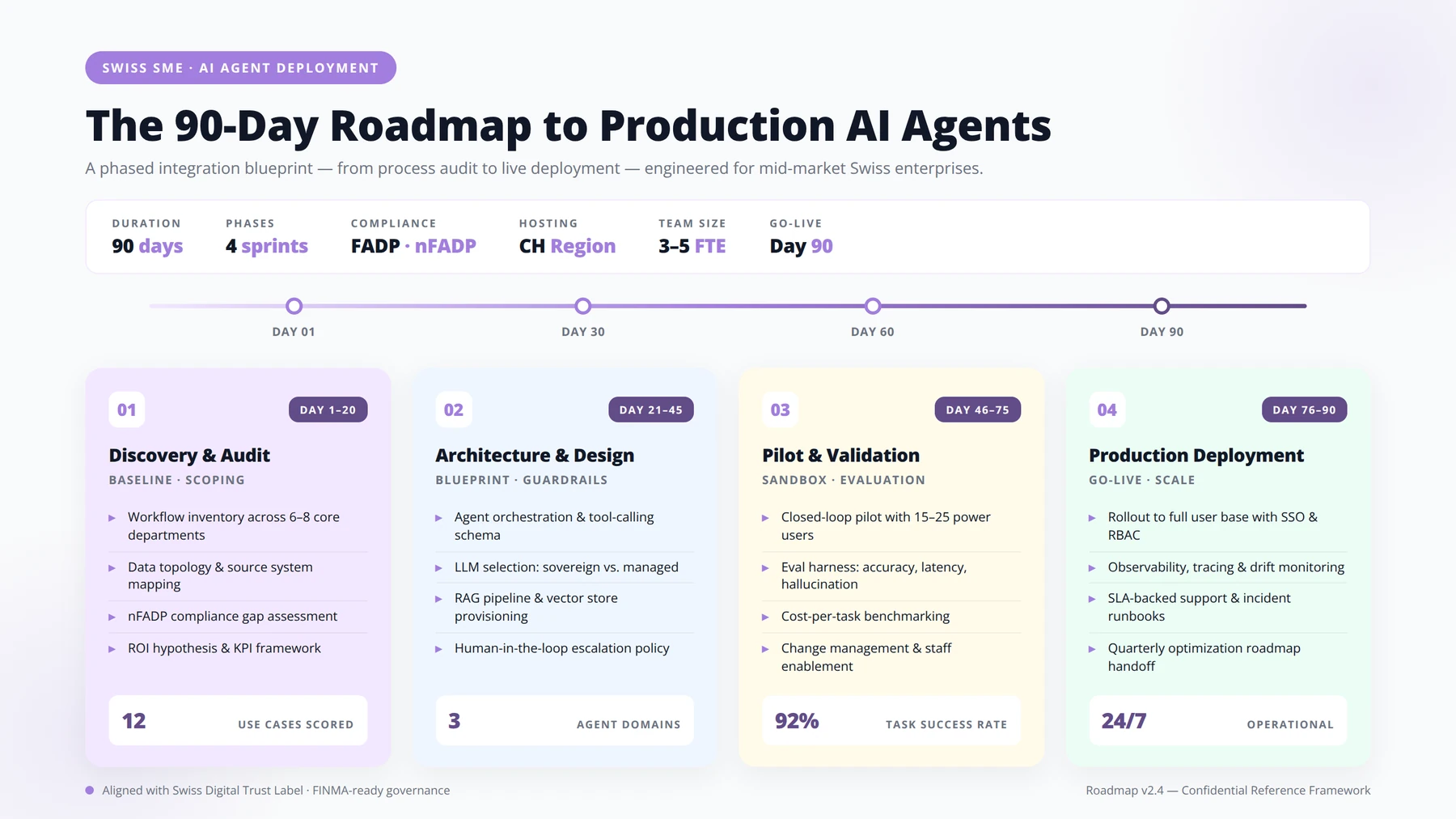
Result: 4x memo output per analyst; principal's initial "no cloud AI, ever" mandate honored; setup complete in 9 weeks.
A 90-Day Implementation Roadmap
This is the sequence we recommend for a Swiss SME starting fresh in 2026. It compresses roughly what an experienced consultant would run.
Days 1–15: Discovery and Inventory
- Document every legacy system in scope, including version, API maturity, and data classification
- Build your AI inventory (required for EU AI Act compliance regardless)
- Interview 6–10 people on where they burn time; look for repetitive knowledge work
Days 16–30: Pattern Selection and Vendor Shortlist
- Apply the five-question decision framework above
- Shortlist 2–3 vendors per required capability
- Confirm Swiss data residency and DPA availability in writing
Days 31–60: Narrow Pilot Build
- One document type, one department, one approval path, one measurable outcome [Source: Jafzadeh 2026]
- Human oversight gate configured before any external or financial action
- Baseline metrics captured before agent goes live
Days 61–90: Production and Governance
- Roll out to production with logging and monitoring
- Publish transparency notices where required
- Formal ISO/IEC 42001:2023 governance review if in a regulated sector
- Measure outcome against baseline; decide whether to scale or pivot
Pro Tip: Capture Baseline Metrics Before Go-Live
The most common mistake we see in Days 31–60 is skipping baseline measurement. Without a "before" number for cycle time, ticket volume, or error rate, you cannot prove ROI on Day 91 — which is exactly when your board will ask. Spend one full day of the pilot phase instrumenting the current process.
Six Expensive Mistakes Swiss CEOs Are Making in 2026
Patterns we see repeatedly in audits — each has cost at least one client six figures.
1. Choosing a Pattern Before Defining the Use Case
"We want to use agentic AI" is not a use case. It is a technology preference. Start with a workflow, then choose the pattern.
2. Building In-House to Save Money
Specialized tools succeed three times more often than internal builds [Source: Marc Lounis 2026]. The build-vs-buy calculation is now decisively skewed toward buy for most SMEs.
3. Skipping the AI Inventory
You cannot govern what you have not inventoried. And the EU AI Act now requires one.
4. Assuming Frontier Models Are Always Better
For focused tasks, an SLM like Microsoft P4 outperforms larger models on some benchmarks while using ~92% less energy [Source: 2026 SLM briefing]. Bigger is not automatically better; it is automatically more expensive.
5. Underinvesting in Human Oversight Design
Agents that can act without a human gate on external or financial actions are a liability, not an asset. Design the gates first.
6. Treating This as an IT Project
AI agent integration touches operations, finance, legal, HR, and culture. Treat it like a finance-systems rollout — boring, traceable, documented, and resilient [Source: Jafzadeh 2026] — not like a hackathon.
Frequently Asked Questions
Q: Which integration pattern is cheapest for a Swiss SME to start with?
A: The API-mediated wrapper is almost always the cheapest starting point, with typical first-year costs between CHF 35,000 and 90,000. It requires no changes to legacy code and can be in production within 4–8 weeks. The trade-off is limited capability — it works best for single-step read/write workflows rather than multi-system orchestration.
Q: Can I run AI agents entirely on Swiss soil for FADP compliance?
A: Yes. The SLM sidecar pattern using Microsoft P4 or comparable small language models allows full on-premise or Swiss-cloud deployment. Data never crosses a border. This is currently the strongest pattern for FADP and FINMA compliance, though it does cap the complexity of tasks the agent can handle [Source: SIDD Switzerland].
Q: Does the EU AI Act apply to my Swiss SME if I have no EU office?
A: If you have EU customers or process data on EU residents, yes. The EU AI Act's extraterritorial reach means Swiss SMEs cannot ignore it based on location alone. Enforcement is now strict ("knallhart") in 2026, particularly on transparency notices and high-risk-system classification [Source: Jafzadeh 2026].
Q: How many Swiss SMEs are actually using AI agents in 2026?
A: 34% of Swiss SMEs deliberately integrate AI into work processes as of 2026, up from 22% in 2025 [Source: Advanzo 2026]. Adoption is concentrated in language tasks (translation, correspondence), workflow optimization, and data analysis, with sales use cases now routine.
Q: What is a Small Language Model and why does it matter for Swiss SMEs?
A: A Small Language Model (SLM) is a compact AI model designed for focused tasks rather than general reasoning. The 2026 Microsoft P4 SLM uses roughly 92% less energy than comparable large models and outperforms larger models on many targeted tasks [Source: 2026 SLM briefing]. For Swiss SMEs, SLMs enable on-premise deployment, meeting data-sovereignty requirements without frontier-model API costs.
Q: Can I integrate AI agents with SAP without changing the SAP code?
A: Yes, and this is one of the strongest reasons to choose the API wrapper or event-driven middleware pattern. Modern SAP versions expose events and REST endpoints that agents can subscribe to or query. Your existing SAP consultant does not need to modify business logic. The agent operates at the boundary, not inside the ERP.
Q: How do I compare vendor claims about Swiss data residency?
A: Demand written answers to five specific questions: where prompt data is processed, where output is stored, whether training on your data is disabled by default, how long logs are retained, and what subprocessors exist [Source: Jafzadeh 2026]. Vague marketing language about "European hosting" is not sufficient for FADP or FINMA scrutiny.
Q: What is ISO/IEC 42001:2023 and do I need it?
A: ISO/IEC 42001:2023 is the international AI Management System (AIMS) standard, and it is becoming the reference framework for AI governance in regulated sectors [Source: SIDD Switzerland]. Swiss SMEs in finance, healthcare, or serving regulated clients should adopt it. Others benefit from using its structure even without formal certification.
Q: How long does event-driven middleware really take to implement?
A: In our implementation experience, realistic timelines are 3–6 months. Projects that promise 8-week delivery for real multi-system middleware almost always slip, because event-schema standardization across legacy systems is nearly always harder than initial scoping suggests. Budget conservatively.
Q: Should I build my own AI agent or buy a specialized tool?
A: 2026 adoption research is unambiguous: specialized purchased tools succeed three times more often than internal builds [Source: Marc Lounis 2026]. Build only when your use case is genuinely differentiated and no fit-for-purpose tool exists. Otherwise buy, integrate, and focus your engineering budget on the integration layer.
Q: What is the biggest risk in the API-mediated wrapper pattern?
A: Webhook reliability. In our audits, the number-one production incident cause in this pattern is webhook delivery failure — events dropped, delayed, or duplicated. Design retry logic, idempotency, and monitoring in from day one. Otherwise the pattern's simplicity becomes its liability [Source: Payrexx].
Q: Can AI agents legally make financial decisions autonomously in Switzerland?
A: Technically possible; strategically inadvisable. Best practice — and expected practice under FINMA scrutiny — is to define human oversight gates before any external or financial action [Source: Jafzadeh 2026]. The agent proposes, a human approves. This also positions you well under the EU AI Act's high-risk-system rules.
Q: What is Cloud Opus 4.6 and when should I use it?
A: Cloud Opus 4.6 is a 2026 large language model with a 1M-token context window, enabling full enterprise knowledge retention within a single session [Source: 2026 briefing]. Use it for complex reasoning tasks on non-sensitive data where the SLM sidecar's capability ceiling is limiting. Do not use it as your default — its cost and data-flow profile does not match every workflow.
Q: How do I convince my board that AI integration is a strategic investment?
A: Frame it as architecture, not experimentation. The strongest 2026 argument is that AI infrastructure should be treated like finance systems — boring, traceable, documented, resilient [Source: Jafzadeh 2026]. Present one narrow pilot with a measurable outcome, a compliance plan, and a scale-up option. Boards fund clarity, not vision statements.
Q: What is the single most important first step for a Swiss SME CEO?
A: Build your AI inventory. Document every AI tool already in use across the organization (including the shadow ChatGPT and Copilot use your teams have not told you about), classify each by data sensitivity, and identify one workflow with a measurable outcome for a pilot. Everything else — pattern selection, vendor choice, budget — flows from that inventory.
The Bottom Line for Swiss SME CEOs
The 12-percentage-point jump in deliberate Swiss SME AI adoption between 2025 and 2026 is not a signal to panic. It is a signal that the winning patterns are now known, tested, and repeatable. Your competitors are not necessarily better at AI than you are — they have just chosen a pattern that fits their legacy reality.
Key takeaways as you make your next move:
- Architecture beats model selection. The choice between API wrapper, event-driven middleware, and SLM sidecar matters more than which frontier model you subscribe to.
- Data sovereignty is a strategic asset. Swiss hosting is not a compliance chore — it is a differentiator in every regulated sector.
- Start narrow. One document type, one department, one approval path, one measurable outcome.
- Buy specialized, build integration. Purchased tools succeed three times more often than internal builds.
- Design human oversight before autonomy. The agent proposes, a human approves — especially on external or financial actions.
- Compliance is now baseline. The AI inventory, risk classification, and transparency notices are non-negotiable, regardless of pattern.
If you are still uncertain which pattern fits your legacy stack, that uncertainty itself is the signal to bring in help. The cost of an audit is measured in weeks; the cost of a wrong pattern choice is measured in years and six-figure write-offs.
Schedule Your AI Integration Strategy Session
90-minute working session with our Zurich team to map your legacy systems and select the right integration pattern for your first agentic use case.
Book Strategy Session
About the Author
Agenticsis Team — Zurich-based AI consultancy founded by Sofía Salazar Mora. We partner with SMEs across Switzerland, the EU, and Latin America on AI readiness audits, agentic system design, and end-to-end deployment. Our team has audited 40+ Swiss legacy AI integrations across finance, manufacturing, legal, and life sciences in 2025–2026. We build custom autonomous AI agents integrated with 850+ tools and operate AEODominance (aeodominance.com), our proprietary answer-engine optimization platform ensuring citation across ChatGPT, Perplexity, Google AI Overviews, Claude, Gemini, and Microsoft Copilot. This article was fact-checked against live web research from Payrexx, Advanzo, SIDD Switzerland, and Alina Jafzadeh's DACH regulatory briefings — July 2026.