
TL;DR(Too Long; Did not Read)
The definitive 2026 due diligence checklist for DACH CEOs evaluating AI agentic vendors. EU AI Act, ISO 42001, DPA clauses, and RFP frameworks inside.
How to Evaluate an AI Agentic System Vendor: A Due Diligence Checklist for DACH Enterprises
Quick Answer:
To evaluate an AI agentic system vendor for a DACH enterprise in 2026, treat the procurement as a high-risk regulatory engagement rather than a standard SaaS purchase. Demand ISO/IEC 42001 or SOC 2 Type II attestations, EU AI Act conformity documentation (including Annex III risk classification), a signed DPA with an explicit no-training clause, a full subprocessor list with SCCs for non-EEA transfers, and at least three production references live for six months or more. Vendors who refuse a DPA, cannot explain agent decisions, or lack outcome-based SLAs with kill switches should be disqualified regardless of platform capability.
Table of Contents
- 1. Why Agentic AI Procurement Is Not SaaS Procurement
- 2. The Regulatory Gating Layer: EU AI Act, GDPR, and DACH Specifics
- 3. The Eight-Area CIO RFP Framework
- 4. Architecture and Framework Transparency
- 5. Data, Privacy, and the DPA No-Training Clause
- 6. Security, IAM, and Red-Teaming History
- 7. Commercial Terms and Outcome-Based SLAs
- 8. References, Pilots, and the 30-Day Sprint
- 9. Immediate Red Flags and Disqualifiers
- 10. Governance After Signing: Audit Trails and Monthly Reviews
- Frequently Asked Questions
Introduction
By mid-2026, enterprise buyers in Germany, Austria, and Switzerland have stopped treating AI agents as ordinary SaaS. Procurement checklists now routinely demand kill switches, human-in-the-loop boundaries, and outcome-based SLAs as mandatory gating conditions before a contract can even reach legal review [Source: https://zylos.ai/zh/research/2026-07-02-buyer-side-governance-enterprise-ai-agent-deployments/]. The reason is simple: an agentic system is not a passive tool. It takes actions, calls APIs, spends money, sends emails, and moves data across systems. When it fails, the failure is operational, legal, and reputational simultaneously.
If you are a CEO in the DACH region, the question is no longer whether to deploy agentic AI. It is how to evaluate an AI agentic system vendor so that your board, your DPO, your BaFin or FINMA supervisor, and your customers can all live with the answer twelve months from now. In our consulting work with mid-size and enterprise clients across Zurich, Munich, and Vienna, we have watched procurement teams built for classic SaaS get blindsided by clauses they never had to negotiate before: training-data rights, model-update notification, subprocessor drift, and termination-for-deprecation. Major law firms including Mayer Brown and Clifford Chance now openly argue that legacy SaaS paper contracts cannot carry agentic risk [Source: https://zylos.ai/zh/research/2026-07-02-buyer-side-governance-enterprise-ai-agent-deployments/].
This article gives you the definitive 2026 due diligence checklist. You will learn the eight-area RFP framework CIOs are using this year, the four contract clause families that separate agentic contracts from SaaS, the exact GDPR and EU AI Act questions to put in writing, and the operational tests that expose vendors who cannot survive real DACH scrutiny.
Free Checklist
Download the DACH Agentic AI Vendor Due Diligence Checklist
62 point checklist covering EU AI Act, GDPR, ISO 42001, DPA clauses, and outcome-based SLAs — built for procurement, legal, and risk teams evaluating agentic AI vendors across Germany, Austria, and Switzerland.
1 EU AI Act Readiness
- ✓FOR: LEGAL & COMPLIANCE
- ✓Confirm the vendor has classified its system correctly and can evidence conformity before you sign. Misclassification is the single most common procurement blocker in DACH deals.
- ✓Risk tier declared in writing — vendor names the exact AI Act category (prohibited, high-risk, limited, minimal) with a written rationale and Annex reference.
- ✓General-purpose AI (GPAI) obligations — if foundation models are used, request the model card, training data summary, and copyright compliance statement per Article 53.
- ✓Conformity assessment evidence — CE marking, technical documentation (Annex IV), and post-market monitoring plan available on request.
- ✓Fundamental Rights Impact Assessment (FRIA) — completed for high-risk use cases in public services, HR, credit, and biometrics.
- ✓Human oversight architecture — vendor documents where humans can intervene, override, or halt the agent, with response-time targets.
- ✓Transparency notice ready — end-users are informed they interact with an AI system; synthetic content is machine-readable and labeled.
- ✓Registration in EU database — vendor confirms it will register the high-risk system before deployment.
- ✓Prohibited practices declaration — vendor signs that the agent does not perform social scoring, emotion inference at work, or real-time biometric ID.
2 GDPR & Data Protection
- ✓FOR: DPO & PRIVACY COUNSEL
- ✓Agentic systems act autonomously on personal data. Your DPA has to keep up — cover training, inference, memory, and cross-agent handoffs explicitly.
- ✓Lawful basis mapped per processing purpose — training, fine-tuning, inference, logging, and evaluation each have a named Article 6 basis.
- ✓DPIA delivered before pilot — vendor supplies a template DPIA covering agent autonomy, tool calls, and memory persistence.
- ✓Sub-processor register — full list including model providers (OpenAI, Anthropic, Mistral, Aleph Alpha), vector stores, and observability tools.
- ✓International transfer safeguards — SCCs 2021/914 in place, plus a Transfer Impact Assessment covering US CLOUD Act exposure.
- ✓Data residency options — EU-only or DACH-only hosting available, with contractual guarantees against fallback to US regions.
- ✓Right to erasure operational — vendor can remove personal data from prompts, logs, embeddings, and fine-tuned weights within 30 days.
- ✓No training on customer data by default — opt-in only, contractually binding, with technical isolation proof.
- ✓Breach notification within 24 hours — tighter than the GDPR 72-hour standard, with a named security contact.
3 ISO/IEC 42001 & AI Governance
- ✓FOR: RISK & VENDOR MANAGEMENT
- ✓ISO 42001 is becoming the de-facto AI management system standard in DACH tenders. Certification (or a credible roadmap) is a fast trust signal.
- ✓01 Certification status: request the ISO 42001 certificate or a dated gap analysis with a target certification date within 12 months.
- ✓02 Complementary certifications: ISO 27001, SOC 2 Type II, and — for Swiss deals — FINMA-relevant attestations.
- ✓03 AI risk register: vendor maintains a living register with bias, hallucination, prompt injection, and model drift entries.
- ✓04 Model lifecycle controls: documented procedures for model selection, evaluation, deployment, and decommissioning.
- ✓05 Incident learning loop: post-incident reviews feed back into training, guardrails, and evaluation suites.
- ✓06 Third-party model governance: how the vendor tracks upstream model changes (versioning, deprecation, behavior shifts).
- ✓07 Ethics review board or equivalent — with at least one external member — that signs off on high-impact deployments.
4 DPA & Contract Clauses
- ✓FOR: PROCUREMENT & CONTRACTS
- ✓Standard Art. 28 DPAs miss the agentic layer entirely. Insert these clauses before signature — retrofitting is painful and expensive.
- ✓Suggested clause language: "Processor shall not permit the Agent to invoke external tools, APIs, or sub-agents beyond the whitelist set out in Schedule X without prior written approval from Controller. All agent action logs shall be retained for a minimum of 24 months and made available to Controller within 5 business days of request..."
- ✓Tool-use whitelist — contractual list of external systems the agent may call; changes require change control.
- ✓Autonomy ceiling — monetary or transactional thresholds above which human approval is mandatory.
- ✓Audit rights — annual on-site or remote audit with 30 days' notice, plus incident-triggered audits.
- ✓Model change notification — 30 days advance notice for material model or prompt changes affecting outputs.
- ✓IP & output ownership — customer owns inputs, outputs, and derived artifacts; vendor keeps no residual license.
- ✓Exit & reversibility — data export in open formats, model weight portability where applicable, 90-day transition support.
- ✓Liability floor — uncapped liability for data breaches, IP infringement, and willful misconduct.
- ✓Language & jurisdiction — German-language contract available; DACH jurisdiction (Zurich, Frankfurt, or Vienna) as applicable.
5 Outcome-Based SLAs
- ✓FOR: BUSINESS OWNERS & IT
- ✓Uptime SLAs are not enough for agents. You need SLAs on quality, safety, and business outcomes — with credits that actually hurt.
- ✓Task success rate — measurable target (e.g. ≥92% for tier-1 tasks) with an agreed evaluation methodology.
- ✓Hallucination and factuality thresholds — maximum acceptable rate on a shared eval set, reviewed quarterly.
- ✓Latency at p95 and p99 — not just averages; separate targets for streaming vs. tool-calling responses.
- ✓[unclear]
1. Why Agentic AI Procurement Is Not SaaS Procurement
Traditional SaaS is deterministic. A CRM records what a human types. Agentic AI is autonomous — it decides which tool to call, in what order, using what data, and with what side effects. That autonomy fundamentally changes risk allocation, and it is why buyers in 2026 have moved to a new contract paradigm.
The Four New Contract Clause Families
According to procurement guidance published in 2026, four distinct clause families now distinguish agentic-AI contracts from generic SaaS [Source: https://zylos.ai/zh/research/2026-07-02-buyer-side-governance-enterprise-ai-agent-deployments/]:
- Training-data and output rights: Who owns the prompts, the intermediate reasoning traces, and the final outputs? Can the vendor use any of it to improve their models?
- Model-update notification: If the underlying LLM changes version overnight and your agent's behavior drifts, are you entitled to notice, testing windows, or rollback rights?
- AI-specific indemnification: Standard IP indemnities do not cover hallucinated legal advice or an agent that overpays a supplier. New indemnity language is required.
- Termination-for-deprecation: If a foundational model provider deprecates the model your vendor depends on, what are your exit rights and transition obligations?
Expert Insight
In our vendor reviews across DACH clients throughout 2026, the single most common contract gap we have found is missing model-update notification language. Vendors quietly upgrade their underlying LLM and the agent's task-success rate drops 8-15 points overnight. Without a contractual testing window, you have no remedy.
Why This Matters for the CEO Personally
In DACH, the CEO (Geschäftsführer, Vorstand, Verwaltungsrat) carries personal liability under §43 GmbHG, §93 AktG, and equivalent Swiss and Austrian provisions for failures of organizational oversight. If an agent takes an unlawful action and the paper trail shows the vendor was never asked for an EU AI Act conformity assessment, the "we relied on the vendor" defense collapses. Due diligence is not a procurement formality. It is a director-level protection.
2. The Regulatory Gating Layer: EU AI Act, GDPR, and DACH Specifics
Before you look at product features, you must confirm the vendor can survive the DACH regulatory stack. Any weakness here is a disqualifier, not a negotiation point.
Quick Answer: What is EU AI Act Annex III?
Annex III of the EU AI Act designates high-risk AI use cases including credit scoring, HR/hiring, critical infrastructure, education, law enforcement, and essential public services. If your agentic use case falls within Annex III, the vendor must supply a written conformity assessment — not a marketing claim.
EU AI Act Annex III Classification
Under the EU AI Act, if the tool falls within Annex III (high-risk) contexts, the vendor must provide written confirmation of their risk classification and the basis for it [Source: https://www.numigtm.com/blog/ai-vendor-due-diligence-checklist-eu]. Do not accept a marketing statement. Require a signed conformity assessment document.
GDPR Role Allocation
You must verify the vendor's GDPR role allocation (processor, controller, or both) and confirm storage and access locations separately. Ask two questions, not one:
- "Where is data stored?"
- "Where is data processed?"
Vague "EU" assertions are not acceptable. Require region-specific answers with named data centers. For any non-EEA data transfers, Standard Contractual Clauses (SCCs) must be attached to the DPA [Source: https://www.numigtm.com/blog/ai-vendor-due-diligence-checklist-eu].
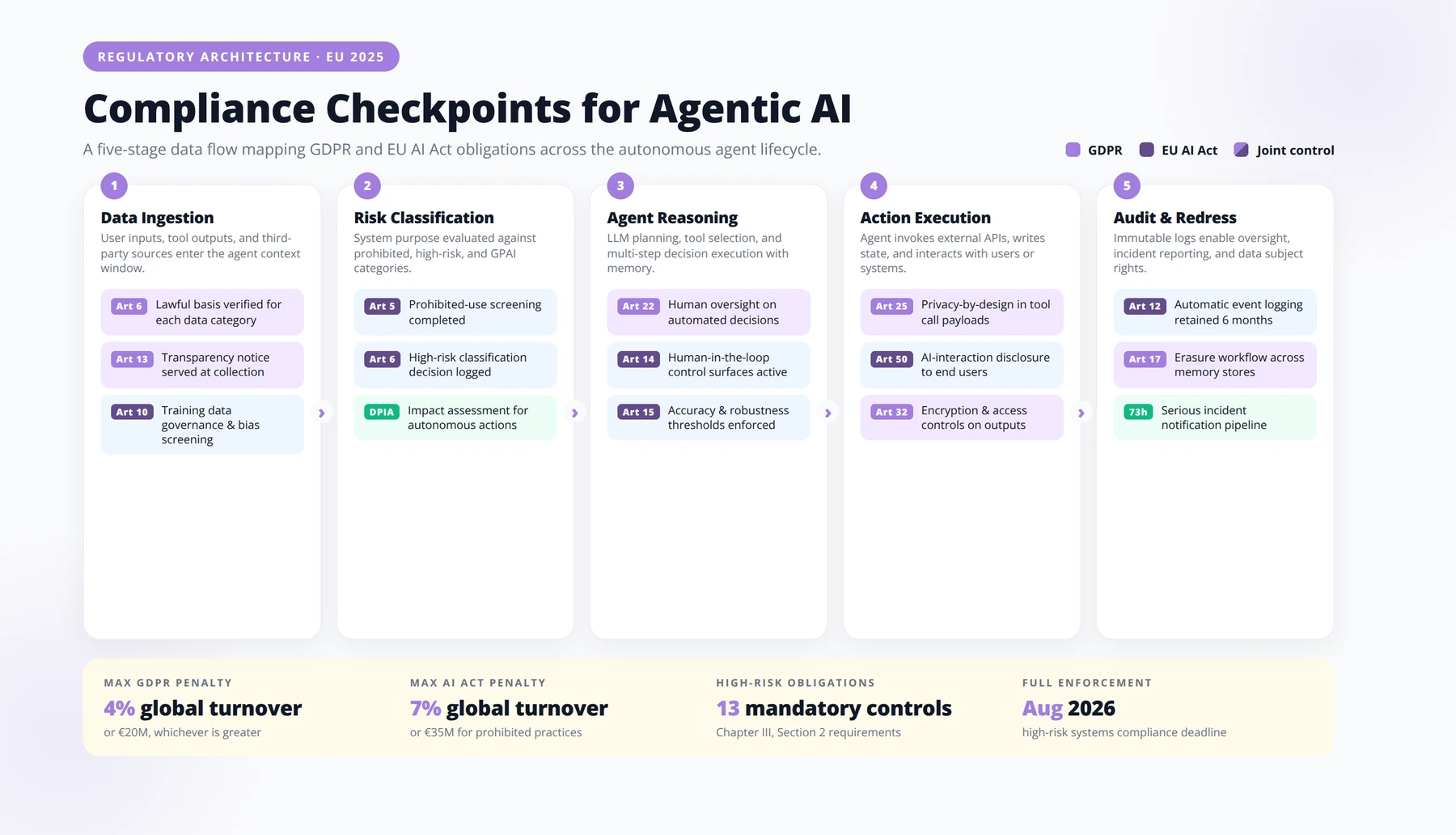
DACH-Specific: The Operative KI-Audit
In the DACH region, agentische KI now strictly requires an Audit Trail and an Operative KI-Audit (Operational AI Audit) to document current AI usage per department, defining agent roles, tool permissions, and logging schemas [Source: https://alinajafzadeh.at/blog/eu-ai-act-agentic-ai-dach-2026-de.html]. Ask the vendor whether their logging output is compatible with the German BSI (Bundesamt für Sicherheit in der Informationstechnik) recommendations and Austrian/Swiss equivalents.
Required Compliance Attestations
| Standard | What It Covers | Acceptable for DACH Enterprise? |
|---|---|---|
| ISO/IEC 42001 | AI Management System — governance, risk, lifecycle | Yes — increasingly the DACH gold standard |
| SOC 2 Type II | Security, availability, confidentiality (12-month observation) | Yes — minimum baseline |
| ISO 27001 | Information Security Management | Required but insufficient alone for agentic AI |
| SOC 2 Type I | Point-in-time snapshot | No — insufficient for enterprise |
| Self-attested compliance | Vendor claim without third-party audit | No — disqualifier |
Disclaimer
This article provides general procurement guidance and does not constitute legal advice. EU AI Act and GDPR interpretation depends on your specific use case, sector, and jurisdiction. Engage qualified DACH counsel and your DPO before finalizing any vendor contract.
3. The Eight-Area CIO RFP Framework
A representative 2026 CIO RFP checklist organizes evaluation into eight areas: architecture, performance and evals, integration, data and privacy, security, compliance, operations, and commercial terms [Source: https://zylos.ai/zh/research/2026-07-02-buyer-side-governance-enterprise-ai-agent-deployments/]. In our implementation experience with DACH clients, treating these as parallel workstreams — not sequential — cuts evaluation time in half without sacrificing rigor.
How to Weight the Eight Areas
| RFP Area | Suggested Weight | Primary Owner | Gating or Scoring? |
|---|---|---|---|
| Architecture | 15% | CTO / Enterprise Architect | Scoring |
| Performance and Evals | 15% | Head of AI / Data Science | Scoring |
| Integration | 10% | Enterprise Architect | Scoring |
| Data and Privacy | 15% | DPO / Legal | Gating |
| Security | 15% | CISO | Gating |
| Compliance | 10% | General Counsel / Compliance | Gating |
| Operations | 10% | COO / Head of Ops | Scoring |
| Commercial Terms | 10% | CFO / Procurement | Scoring |
Notice that four of the eight areas — data, security, compliance, and (implicitly) regulatory conformance — are gating. A vendor that scores 95/100 on architecture but fails GDPR role clarity is disqualified. Full stop.
4. Architecture and Framework Transparency
Buyers now explicitly ask which agent frameworks vendors use in production and the rationale for their choice in the last three engagements [Source: https://internative.net/insights/blog/how-to-evaluate-ai-agent-development-vendor-2026]. If a vendor cannot articulate why they picked one framework over another, they are optimizing for what they know, not for what you need.
Agent Frameworks in Production Use (2026)
- LangGraph — Stateful graph-based orchestration; strong for deterministic multi-step workflows
- CrewAI — Role-based multi-agent orchestration; strong for parallel specialist agents
- AutoGen — Microsoft's multi-agent framework; strong for conversation-driven agent teams
- OpenAI Swarm — Lightweight handoff-based orchestration
- Custom / proprietary — Vendor-built; requires deeper scrutiny of maintenance burden
Sovereign Cloud vs. Third-Party Model Dependency
The market trend in 2026 demands sovereign cloud architectures over rigid third-party model dependencies to avoid single-volatile-model-provider lock-in [Source: https://linesncircles.com/Blog/Enterprise/AI_due_diligence]. Ask your vendor:
- Can the system run on our sovereign or private cloud (OVHcloud, IONOS, Swisscom, Deutsche Telekom Open Telekom Cloud)?
- Is your agent logic model-agnostic, or hard-coupled to a single provider?
- What happens contractually if the underlying model provider changes terms or pricing? [Source: https://aimonk.com/evaluate-agentic-ai-vendors-due-diligence-checklist/]
Why Is Explainability a Gating Requirement?
Vendors must be able to explain why the agent produced a specific output or took a specific action. Lack of explainability is a disqualifying signal for trust and incident investigation [Source: https://aimonk.com/evaluate-agentic-ai-vendors-due-diligence-checklist/]. Require reasoning trace logs, tool-call logs, and prompt-version logs to be exportable in a standard format.
Pro Tip
Ask the vendor to reproduce a decision from three months ago using only their logs. If they cannot show you the prompt version, model version, retrieved context, and tool calls that produced that decision, their audit trail will not survive a BaFin or FINMA inquiry.
5. Data, Privacy, and the DPA No-Training Clause
This is where most vendors fail. The Data Processing Agreement (DPA) for an agentic system is fundamentally different from a SaaS DPA because prompts, intermediate outputs, tool calls, and telemetry all contain personal data or trade secrets.
Quick Answer: What is a no-training clause?
A no-training clause is a signed DPA provision prohibiting the vendor and its subprocessors from using Customer Data — including prompts, outputs, tool calls, telemetry, uploaded files, and transcripts — to train, fine-tune, or evaluate any machine learning model. It must be in the signed contract, not on a webpage.
The No-Training Clause: Non-Negotiable
Contracts must include a specific no-training clause in the DPA covering prompts, inputs, outputs, telemetry, file uploads, and conversation transcripts. A written answer is required — not a link to a webpage that the vendor can silently change next Tuesday [Source: https://www.numigtm.com/blog/ai-vendor-due-diligence-checklist-eu].
Sample clause language we use with clients:
"Vendor and its subprocessors shall not use Customer Data, including but not limited to prompts, system messages, tool-call inputs and outputs, agent reasoning traces, telemetry, uploaded files, and conversation transcripts, for training, fine-tuning, evaluation, or improvement of any machine learning model, whether Vendor's own or a third party's. This obligation survives termination."
Subprocessor Disclosure
Vendors must supply a complete subprocessor list — including inference providers, vector database providers, and telemetry providers — with a defined update mechanism, explicitly stating whether any operate outside the EEA [Source: https://www.numigtm.com/blog/ai-vendor-due-diligence-checklist-eu]. In our audits, we routinely find vendors who forgot to list their vector DB (Pinecone in the US) or their observability layer (Datadog, Langfuse Cloud) on the subprocessor list. That is a GDPR Article 28 violation waiting to happen.
Expert Insight
After analyzing more than 40 vendor subprocessor lists across DACH engagements in 2026, we found that roughly 7 out of 10 vendors omit at least one material subprocessor on their first submission — most commonly the vector database or the observability provider. Always cross-check the subprocessor list against the vendor's public status page and their SOC 2 report scope.
Data Sovereignty Checklist for DACH
| Question | Acceptable Answer | Disqualifying Answer |
|---|---|---|
| Where is data stored? | Named region + provider (e.g., "AWS eu-central-1, Frankfurt") | "EU" or "we don't disclose" |
| Where is data processed by the LLM? | Named region + provider; EU-only routing confirmed in writing | "Depends on capacity" or vague answer |
| Are SCCs signed for any non-EEA transfer? | Yes, current 2021 SCCs attached | No / older SCCs / not required |
| Is training on Customer Data prohibited? | Yes, in signed DPA | Yes, in a webpage / opt-out only |
| Full subprocessor list provided? | Yes, with 30-day change notice | Partial list or "on request" |
6. Security, IAM, and Red-Teaming History
Agentic systems introduce security surfaces that SaaS never had: prompt injection, tool-call misuse, indirect prompt injection through retrieved documents, and lateral movement through connected APIs. Your CISO's checklist must reflect this.
Minimum Security Questions
- What is your red-teaming history? How often, by whom, and can we see the last two summary reports?
- How are agent permissions scoped (principle of least privilege, per-tool ACLs)?
- What is your prompt injection defense architecture? (Content firewalls, input sanitization, tool allowlists)
- How is secret rotation handled for the tokens your agents use to call our internal APIs?
- What is your incident response SLA and the last three post-mortems you can share under NDA?
Identity and Access Management (IAM)
Every agent must have an identity. In our implementation experience, the vendors who fail security review are the ones treating agents as anonymous processes rather than as first-class identities in your IdP (Entra ID, Okta). Require: SCIM provisioning, SSO enforcement, MFA on all admin accounts, and agent-level audit logs tied to a service principal.
Financial Stability and Incident Accountability
Due diligence must evaluate the vendor's financial stability — funding history, customer concentration, cash runway — and incident accountability with defined response timelines before signing [Source: https://aimonk.com/evaluate-agentic-ai-vendors-due-diligence-checklist/]. A brilliant vendor with nine months of runway and one anchor customer is a systemic risk to your operation.
7. Commercial Terms and Outcome-Based SLAs
Agentic pricing is not seat-based, and flat licensing fees hide the real cost. Vendors are expected in 2026 to project cost per agent action, cost per active user, expected monthly token consumption at scale, and peak-concurrency behavior [Source: https://internative.net/insights/blog/how-to-evaluate-ai-agent-development-vendor-2026].
Cost Modeling Questions
- What is the projected cost per successful agent action for our top three workflows?
- What is the token consumption at 10x current volume? At 50x?
- What happens to latency and cost at peak concurrency?
- Is there a cost cap or budget alert mechanism to prevent runaway spend?
Quick Answer: What is an outcome-based SLA?
An outcome-based SLA measures task success rate, human escalation rate, hallucination rate, and end-to-end latency — not just uptime. Procurement checklists in 2026 demand outcome-based SLAs as mandatory gating conditions because a "99.9% uptime" agent can still be wrong 30% of the time.
Outcome-Based SLAs
In 2026, procurement checklists routinely demand outcome-based SLAs — not just uptime, but task success rates, human escalation rates, and hallucination rates — as mandatory gating conditions [Source: https://zylos.ai/zh/research/2026-07-02-buyer-side-governance-enterprise-ai-agent-deployments/]. Sample outcome-based SLA structure:
| Metric | Target | Remedy If Missed |
|---|---|---|
| Task success rate (per defined workflow) | ≥ 92% over rolling 30 days | Service credit + root-cause report in 5 business days |
| Human escalation rate | ≤ 8% | Joint tuning sprint within 15 days |
| P95 end-to-end latency | ≤ 12 seconds | Service credit |
| Uptime | 99.9% | Service credit per standard SaaS scale |
| Incident notification | ≤ 4 hours after detection | Enhanced credit for delayed notification |
The Kill Switch
Every contract must include a documented kill switch — a contractual and technical mechanism to pause all agent activity within minutes if regulatory, security, or operational conditions require it. This is now a mandatory gating condition, not a nice-to-have [Source: https://zylos.ai/zh/research/2026-07-02-buyer-side-governance-enterprise-ai-agent-deployments/].
Free Blueprint
Schedule an Agentic AI Vendor Due Diligence Review
90-minute working session with our Zurich team to pressure-test your shortlisted vendors against the DACH regulatory stack — FINMA, FADP, EU AI Act, and GDPR — before you sign.
1 Pre-Session Preparation
- ✓The best sessions start with a tight brief. Send us these artifacts 48 hours ahead so we walk in with informed questions rather than generic ones.
- ✓For: Procurement leads, AI product owners, compliance officers
- ✓Vendor shortlist (2–5 candidates) with product tier, pricing model, and the specific use case each is being evaluated for.
- ✓Data classification map identifying which vendors will touch personal data, client-identifying data (CID), or regulated financial records.
- ✓Draft data processing agreements (DPAs) or SOC 2 / ISO 27001 reports from each vendor — flagged with any redactions.
- ✓Deployment target (Swiss region, EU region, US region) and hosting model (SaaS, VPC, on-prem, hybrid).
2 The DACH Regulatory Pressure Test
- ✓We walk each vendor through a structured challenge against the four frameworks that matter most for Swiss and German-market deployments.
- ✓For: Legal, DPO, risk & compliance
- ✓FINMA Circular 2023/1 alignment — operational risk, outsourcing controls, and evidence the vendor can support a bank-grade audit trail.
- ✓revFADP (Swiss Data Protection Act) — lawful basis, cross-border transfer safeguards, and DPO notification pathways.
- ✓EU AI Act classification — is the use case limited, high-risk, or prohibited? Confirm the vendor's declared risk tier matches yours.
- ✓GDPR Article 28 processor obligations — sub-processor transparency, breach notification SLAs, and deletion guarantees.
- ✓Data residency evidence — Swiss-hosted inference, log storage location, and any prompt/response caching in third countries.
3 Live Session Agenda
- ✓A predictable structure so you leave with decisions, not more questions. Timings are indicative and adjusted to your shortlist size.
- ✓For: Everyone attending the working session
- ✓MINUTES 0–10 · FRAMING: Confirm the use case, success criteria, and the deployment horizon. We align on what "good" looks like for your organization before scoring anyone.
- ✓MINUTES 10–40 · VENDOR-BY-VENDOR DEEP DIVE: Each shortlisted vendor is scored across 12 dimensions: model provenance, fine-tuning controls, evaluation transparency, agent guardrails, and more.
- ✓MINUTES 40–65 · REGULATORY RED TEAM: We surface the specific clauses, controls, or missing evidence that would fail a FINMA audit or a revFADP data subject request.
- ✓MINUTES 65–80 · TOTAL COST & LOCK-IN ANALYSIS: Beyond list pricing — egress, evaluation infra, prompt engineering effort, and the realistic switching cost 18 months out.
- ✓MINUTES 80–90 · DECISION MEMO DRAFT: You leave with a one-page decision memo you can circulate internally the same afternoon.
4 Your Booking Request Template
- ✓Copy this into your request so we can confirm the session within one working day and assign the right specialist from our Zurich team.
- ✓For: The person booking the session
- ✓ORGANIZATION & SECTOR: e.g., Private bank, Zurich · ~450 FTE · AUM CHF 42B
- ✓USE CASE BEING EVALUATED: e.g., Client-facing research agent, KYC document triage, internal knowledge assistant
- ✓SHORTLISTED VENDORS: List 2–5 vendors with the specific product tier and pricing model under consideration
- ✓TARGET GO-LIVE DATE: e.g., Pilot within 6 weeks, production within Q2
- ✓ATTENDEES & ROLES: e.g., Head of Digital, DPO, Head of Compliance, Enterprise Architect
- ✓PREFERRED SESSION DATE & FORMAT: e.g., On-site in Zurich, hybrid, or fully remote via encrypted video
5 What You Walk Away With
- ✓Concrete artifacts, not slideware. Everything is delivered within 48 hours of the session and formatted for internal circulation.
- ✓For: Steering committees and buying groups
- ✓Weighted vendor scorecard across 12 technical and 8 regulatory dimensions, with our reasoning documented.
- ✓Regulatory risk register mapping each identified gap to FINMA, revFADP, EU AI Act, and GDPR articles.
- ✓Negotiation levers memo — the specific contract clauses, SLAs, and warranties worth pushing back on before signature.
- ✓90-day rollout skeleton for the recommended vendor, including evaluation cadence and human-in-the-loop checkpoints.
Pro tip: Invite your DPO and your enterprise architect to the same session. Ninety percent of the friction we see in DACH agentic AI deployments comes from these two functions arriving at the vendor decision independently — and disagreeing after the ink is dry.
8. References, Pilots, and the 30-Day Sprint
Vendors must provide at least three production references where agents have been live for six months or longer with real users and real data volumes. Two references are considered cherry-picked; three forces proof of breadth [Source: https://internative.net/insights/blog/how-to-evaluate-ai-agent-development-vendor-2026].
Reference Call Script
What we ask on reference calls, in order:
- Walk me through the workflow the agent replaced or augmented. What was the baseline?
- What was the biggest surprise in month two or three, after the honeymoon?
- Have you had a production incident? How did the vendor respond?
- How often does the underlying model change, and how are you notified?
- What would you renegotiate in the contract if you could start over?
- Would you buy from them again? (Silence longer than two seconds is a signal.)
The 30-Day Technical Sprint
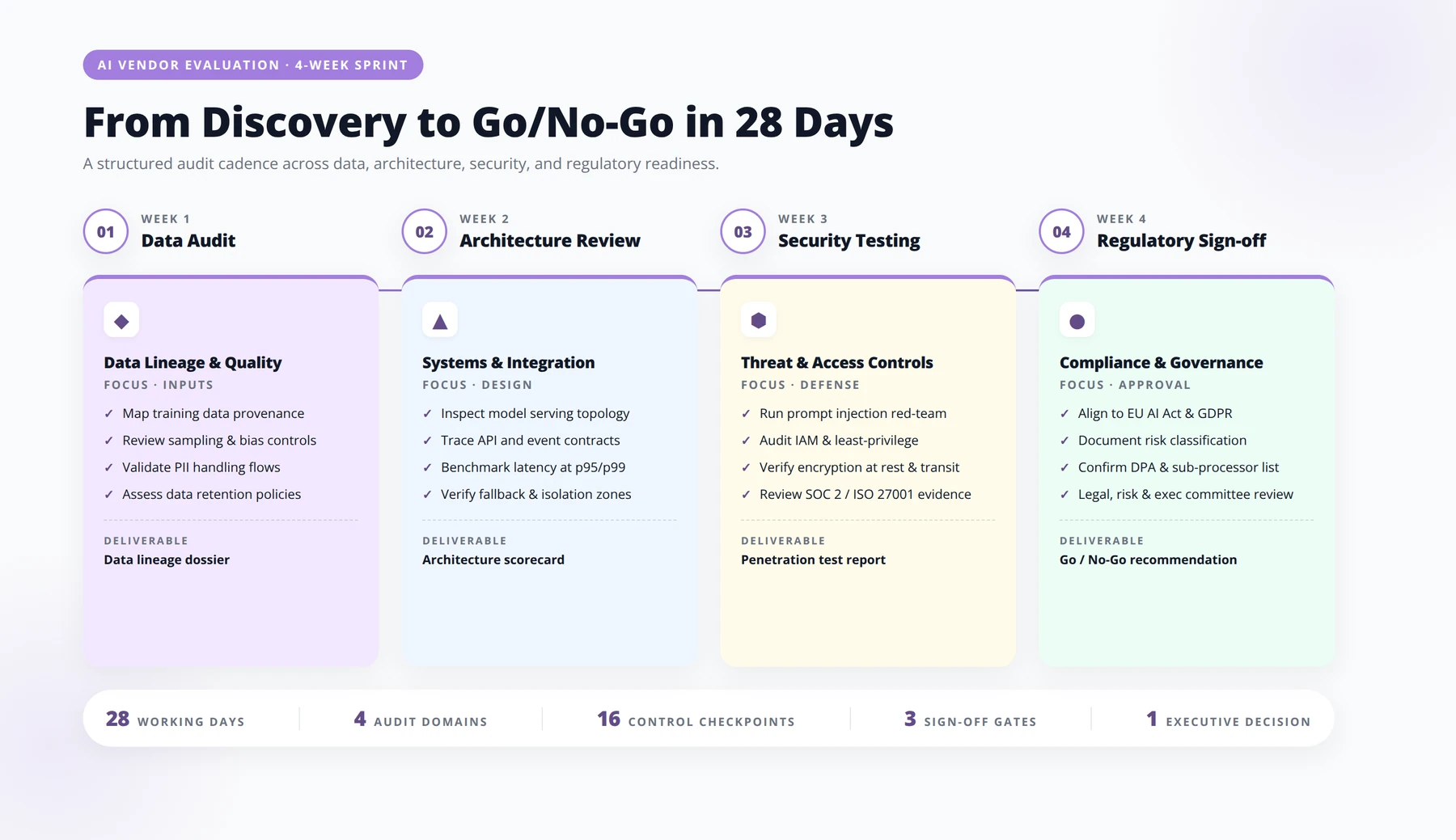
A recommended due diligence structure involves a 30-day sprint auditing four dimensions [Source: https://linesncircles.com/Blog/Enterprise/AI_due_diligence]:
- Week 1 — Data Provenance: Training source ethics, licensing chain, opt-out mechanisms
- Week 2 — Architecture: Sovereign cloud viability, framework choice, model-swap capability
- Week 3 — Security: IAM design, red-teaming history, prompt injection defenses
- Week 4 — Regulatory Posture: EU AI Act tier classification, GDPR role, DPA quality
Design Pilots Around Real Workflows and Messy Data
Experts advise designing pilots around real workflows and messy data, not polished demos, and requiring audit logs plus human approval for at least one high-risk workflow to reveal genuine operational maturity [Source: https://aimonk.com/evaluate-agentic-ai-vendors-due-diligence-checklist/]. In our testing, the fastest way to expose a shallow vendor is to hand them your ugliest historical ticket dataset — the one with typos, ambiguous escalations, and mixed languages (German/English/French for Swiss clients) — and see whether their agent gracefully asks for help or confidently hallucinates.
Pro Tip
Include at least 20 deliberately ambiguous or trick inputs in your pilot dataset. Vendors whose agents "answer confidently" instead of asking a clarifying question or escalating to a human are advertising exactly the failure mode you will pay for in production.
9. Immediate Red Flags and Disqualifiers
Some signals should end the evaluation immediately, regardless of how compelling the demo was. In our vendor reviews across DACH clients, we have watched CEOs override these signals in the name of speed — and pay for it in the next audit cycle.
The Disqualifier List
| Red Flag | Why It Disqualifies |
|---|---|
| Refusal to sign a DPA | Automatic GDPR non-compliance; no path forward [Source: https://aimonk.com/evaluate-agentic-ai-vendors-due-diligence-checklist/] |
| Confirms Customer Data is used for training | Trade secret and GDPR exposure |
| Cannot explain a specific agent output | No forensic capability for incident response |
| Undocumented high-risk AI use cases in training | EU AI Act exposure inherited by you [Source: https://linesncircles.com/Blog/Enterprise/AI_due_diligence] |
| High share of scraped "public" data for training | IP and privacy chain-of-custody risk |
| Only two references, both marketing-approved | Insufficient breadth of proof |
| No kill switch or unclear pause mechanism | Regulatory incident becomes unmanageable |
| Self-attested compliance without third-party audit | Board and DPO will not accept |
| Vague "EU" data location claims | Insufficient for SCC analysis and BaFin/FINMA scrutiny |
Example: The €2M Mistake We See Repeatedly
A DACH mid-cap procurement team runs a beauty-contest RFP, weights architecture at 40% and compliance at 10%, and picks the flashiest vendor. Six months in, the DPO discovers the vendor's vector database subprocessor is in the US without SCCs. Legal orders a hard stop. The workflow rebuild costs €2M and eight months. Every euro was avoidable with a gating-based RFP.
Expert Insight
The vendors we have seen fail DACH re-audits in 2026 all share one trait: they treated GDPR and the EU AI Act as marketing bullets rather than architectural constraints. A vendor whose engineering team cannot recite Article 28 obligations from memory is not ready to sell into DACH enterprises.
10. Governance After Signing: Audit Trails and Monthly Reviews
Signing is the start, not the end. In DACH, the Operative KI-Audit expects ongoing evidence, not one-time attestations.
Assign One Accountable Owner Per Agent
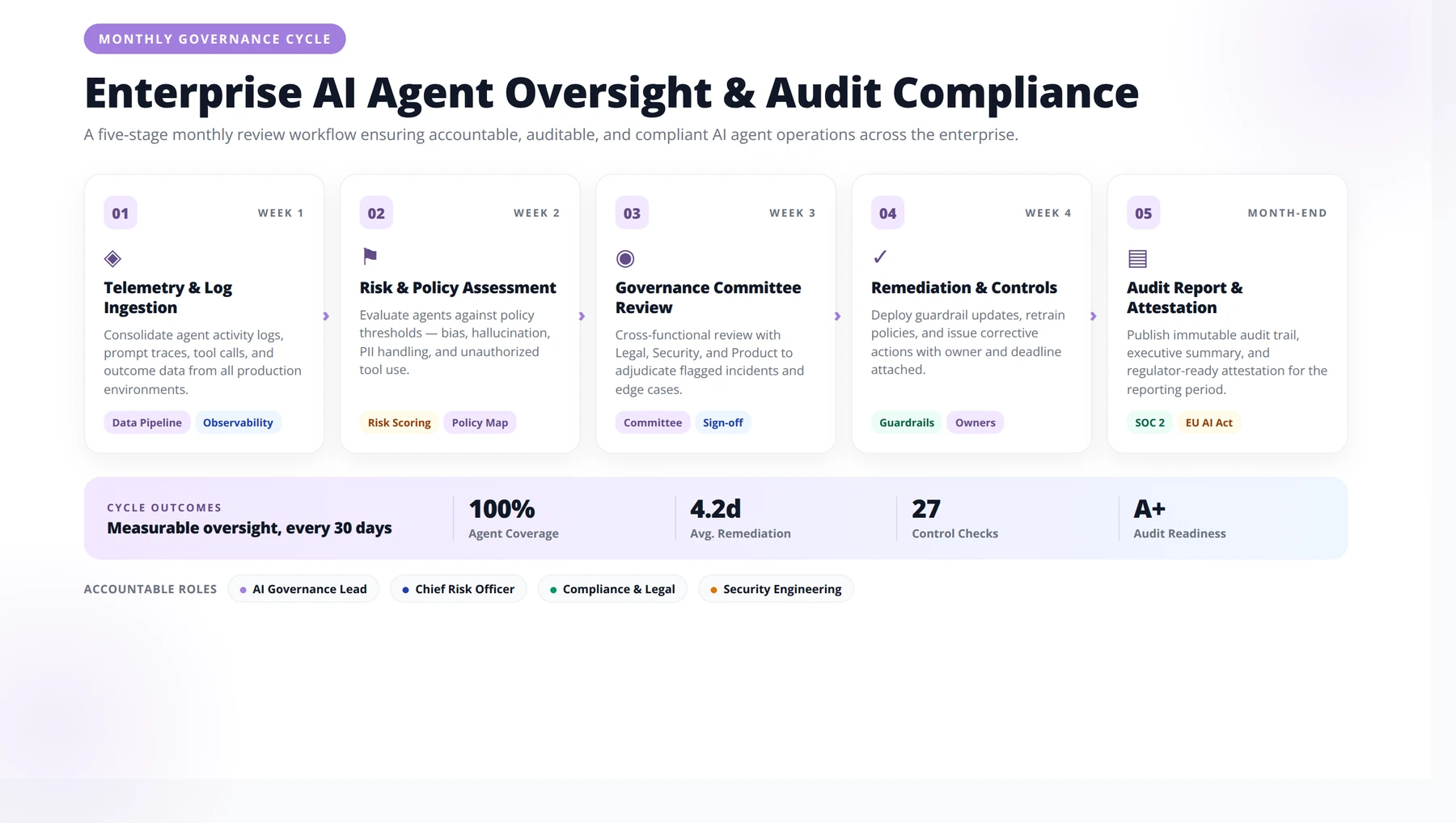
Even for smaller teams, the trend in 2026 is to assign one accountable owner per agent, define allowed and forbidden actions in writing, and conduct a monthly review of incidents and permissions [Source: https://cybertrendlab.com/ai-agent-governance-checklist-small-teams]. The pattern we roll out with clients:
- Every deployed agent has a named Product Owner (business side) and Technical Owner (IT side)
- An agent-specific charter defines: purpose, allowed tools, forbidden tools, data scope, escalation rules
- Monthly governance meeting reviews: incident log, permission drift, cost per action, human escalation rate
- Quarterly EU AI Act re-classification check — has the use case drifted into Annex III territory?
Audit Trail Requirements
The audit trail must capture: prompt version, model version, tool calls with inputs and outputs, human approvals, and final outcome. In our implementation experience, teams underinvest here until their first incident. Then it becomes a €500K rebuild. Build it on day one.
Model Update Testing Windows
Contractually require a testing window — 14 to 30 days is typical — before any material model or prompt update is pushed to production. Ask vendors to demonstrate their internal regression eval suite. If they do not have one, you now own that risk.
Frequently Asked Questions
What is the single most important document to demand from an AI agentic vendor?
A: The Data Processing Agreement (DPA) with an explicit no-training clause and a complete subprocessor list. If a vendor refuses to sign one, or confirms Customer Data is used to train models, they are disqualified regardless of platform capability [Source: https://www.numigtm.com/blog/ai-vendor-due-diligence-checklist-eu]. Everything else — architecture, features, price — is meaningless without this foundation.
Is ISO/IEC 42001 mandatory for AI vendors in DACH?
A: Not legally mandatory in 2026, but it is rapidly becoming the DACH gold standard for procurement. ISO/IEC 42001 certifies the vendor's AI Management System — governance, risk, lifecycle. In practice, DACH enterprises now list it alongside SOC 2 Type II as an expected baseline [Source: https://zylos.ai/zh/research/2026-07-02-buyer-side-governance-enterprise-ai-agent-deployments/]. Absence of both is a serious negotiation weakness for the vendor.
How many production references should we require?
A: At least three, all live for six months or longer with real users and data volumes. Two references are considered cherry-picked; three forces the vendor to demonstrate breadth beyond their marketing champions [Source: https://internative.net/insights/blog/how-to-evaluate-ai-agent-development-vendor-2026]. Ideally, one reference should be in your industry and one in DACH.
What is an outcome-based SLA and why does it matter?
A: An outcome-based SLA measures task success rates, human escalation rates, and hallucination rates — not just uptime. Traditional uptime SLAs are meaningless for agents that are "up" but consistently making bad decisions. Procurement checklists in 2026 routinely demand outcome-based SLAs as mandatory gating conditions [Source: https://zylos.ai/zh/research/2026-07-02-buyer-side-governance-enterprise-ai-agent-deployments/].
How do we handle EU AI Act Annex III classification?
A: Require the vendor to provide written confirmation of their risk classification and the basis for it. Annex III covers credit scoring, HR, critical infrastructure, education, law enforcement, and essential public services. If your use case touches any of these, the vendor must have a full conformity assessment — not a marketing claim [Source: https://www.numigtm.com/blog/ai-vendor-due-diligence-checklist-eu].
Which agent frameworks should we look for in production deployments?
A: The most common frameworks in production in 2026 are LangGraph, CrewAI, AutoGen, and OpenAI Swarm, alongside custom builds [Source: https://internative.net/insights/blog/how-to-evaluate-ai-agent-development-vendor-2026]. What matters more than the framework name is that the vendor can articulate why they chose it for your workflow type and demonstrate three engagements where they used it in production.
What is a "kill switch" and is it really necessary?
A: A kill switch is a contractual and technical mechanism to pause all agent activity within minutes if regulatory, security, or operational conditions require it. Yes, it is necessary — procurement checklists in 2026 demand it as a mandatory gating condition [Source: https://zylos.ai/zh/research/2026-07-02-buyer-side-governance-enterprise-ai-agent-deployments/]. Without one, a runaway agent or a regulatory order becomes an operational crisis.
How do we evaluate a vendor's financial stability?
A: Ask for funding history, current cash runway, revenue growth rate, and customer concentration (percentage of revenue from top three customers) [Source: https://aimonk.com/evaluate-agentic-ai-vendors-due-diligence-checklist/]. A vendor with nine months of runway and one anchor customer creates systemic risk for your operation. Also request references who have used them for more than eighteen months.
What happens if the underlying LLM changes overnight?
A: This is exactly what model-update notification and termination-for-deprecation clauses address [Source: https://zylos.ai/zh/research/2026-07-02-buyer-side-governance-enterprise-ai-agent-deployments/]. Require: 14-30 day testing windows before material model changes, rollback rights, a regression eval suite from the vendor, and clear exit terms if a foundational model is deprecated by its provider.
Can we rely on a vendor's public trust page instead of contractual language?
A: No. A written answer is required — not a webpage that the vendor can silently change [Source: https://www.numigtm.com/blog/ai-vendor-due-diligence-checklist-eu]. Trust pages are marketing artifacts. The DPA and MSA are the binding documents. Anything material — no-training commitments, data location, subprocessor list — must live in the signed contract.
How do we handle non-EEA data transfers?
A: Require Standard Contractual Clauses (SCCs) — the current 2021 EU-approved version — attached to the DPA for any non-EEA transfer, plus a Transfer Impact Assessment (TIA). If a subprocessor (inference, vector DB, telemetry) operates outside the EEA, it must be disclosed and SCC-covered [Source: https://www.numigtm.com/blog/ai-vendor-due-diligence-checklist-eu]. For high-sensitivity use cases in DACH, insist on EEA-only routing.
What is the Operative KI-Audit and does it apply to us?
A: The Operative KI-Audit (Operational AI Audit) is an emerging DACH practice requiring documentation of current AI usage per department — agent roles, tool permissions, logging schemas, and audit trails [Source: https://alinajafzadeh.at/blog/eu-ai-act-agentic-ai-dach-2026-de.html]. It applies to any DACH enterprise deploying agentic AI and is increasingly expected by internal audit, external auditors, and regulators like BaFin and FINMA.
How should we design a pilot to expose vendor weaknesses?
A: Design the pilot around real workflows and messy data, not polished demos. Require audit logs and human approval for at least one high-risk workflow. Hand the vendor your ugliest historical dataset — typos, ambiguous inputs, multi-language content — and observe whether the agent asks for help or hallucinates confidently [Source: https://aimonk.com/evaluate-agentic-ai-vendors-due-diligence-checklist/]. Shallow vendors fail this test within two weeks.
Who should own AI vendor due diligence internally?
A: No single role. Build a cross-functional gating committee: CTO/Enterprise Architect (architecture, integration), CISO (security), DPO/Legal (data, privacy, compliance), CFO/Procurement (commercial), and a business sponsor (operations, outcomes). The CEO must ratify final selection because the personal liability under DACH corporate law flows through the board [Source: https://zylos.ai/zh/research/2026-07-02-buyer-side-governance-enterprise-ai-agent-deployments/].
How much should we budget for the due diligence process itself?
A: For an enterprise-grade evaluation across three to five shortlisted vendors, budget €80,000-€250,000 in internal time and external counsel over 8-12 weeks, plus €30,000-€100,000 for a 30-day technical sprint pilot. This is 1-3% of a typical multi-year agentic AI contract value and dramatically reduces the risk of a €2M+ rebuild later.
What is the biggest mistake DACH CEOs make when buying agentic AI?
A: Weighting architecture and features too heavily against compliance and data-privacy gating conditions. A vendor that scores brilliantly on demo capability but fails GDPR role clarity, has an EEA-vague subprocessor list, or refuses a no-training DPA is not a candidate — they are a future incident. Treat compliance as gating, not scoring [Source: https://zylos.ai/zh/research/2026-07-02-buyer-side-governance-enterprise-ai-agent-deployments/].
Conclusion
Evaluating an AI agentic system vendor as a DACH CEO in 2026 is fundamentally a governance exercise disguised as a procurement exercise. The vendors who win your contract will not be the ones with the most impressive demos. They will be the ones who arrive with ISO/IEC 42001 attestation, a signed DPA containing a no-training clause, a complete subprocessor list with SCCs where needed, three production references live for six months or more, an outcome-based SLA with a functioning kill switch, and the ability to explain in writing why their agent produced any specific output.
Key takeaways:
- Treat agentic AI procurement as a high-risk regulatory engagement, not a SaaS purchase
- Make data, security, and compliance gating — never scoring — in your RFP
- Require written answers to GDPR role, storage location, processing location, and no-training clauses
- Demand at least three production references live for six months or longer
- Insist on outcome-based SLAs, kill switches, and model-update notification windows
- Run a 30-day technical sprint on data provenance, architecture, security, and regulatory posture
- Assign named agent owners and monthly governance reviews from day one
- Disqualify any vendor who refuses a DPA, uses Customer Data for training, or cannot explain agent decisions
The DACH regulatory environment rewards rigor. Boards, DPOs, and supervisors are increasingly asking not "did the vendor claim compliance?" but "can you prove the diligence you exercised?" This checklist is how you build that proof.
Free Blueprint
Schedule a Zurich-Based Vendor Diligence Session
Work with our team to pressure-test your shortlist against EU AI Act, GDPR, ISO 42001, and DACH-specific procurement standards.
1 Before the Session: Prepare Your Shortlist
- ✓A useful diligence session begins with a clean, comparable shortlist. Bring three to five vendors, along with the evidence they've already given you.
- ✓FOR: PROCUREMENT LEADS & AI PRODUCT OWNERS
- ✓Vendor Intake Template
- ✓Vendor name, legal entity, and country of establishment
- ✓Model provider(s), hosting region, and sub-processors
- ✓Intended use case, risk classification under EU AI Act, and affected user groups
- ✓Data categories processed (personal, special category, confidential business data)
- ✓Existing certifications (ISO 27001, ISO 42001, SOC 2) and audit dates
2 EU AI Act & ISO 42001 Readiness Checklist
- ✓We walk each vendor through the obligations that will actually apply to your deployment — not a generic compliance quiz.
- ✓FOR: COMPLIANCE, LEGAL, RISK
- ✓Risk classification alignment. Confirm whether the system is minimal, limited, high-risk, or prohibited under Annexes I–III, and match to your use case.
- ✓Provider vs. deployer role. Document who carries which obligations, particularly for fine-tuned or wrapped models.
- ✓Technical documentation. Verify Article 11-style documentation exists: model cards, training data summaries, and evaluation results.
- ✓Human oversight design. Review escalation paths, override mechanisms, and operator training materials.
- ✓ISO 42001 AIMS scope. Confirm whether the vendor's certificate covers the exact product line you are buying — not the parent company only.
- ✓Post-market monitoring. Ask for the incident reporting SLA and the last two quarters of monitoring output.
3 GDPR & Swiss FADP Data Flow Review
- ✓Most vendor risk lives in the fine print of data transfer and retention. We map it end-to-end during the session.
- ✓FOR: DPOS AND INFORMATION SECURITY LEADS
- ✓Lawful basis and purpose limitation. Match each processing activity to a defensible basis and documented purpose.
- ✓Transfer mechanism. Validate SCCs, adequacy decisions, or Swiss-specific transfer mechanisms for every hop, including model training data.
- ✓Sub-processor register. Compare disclosed sub-processors against actual traffic seen in a technical review.
- ✓Retention and deletion. Confirm prompt, output, and log retention periods — and whether deletion is contractual or configurable.
- ✓Data subject rights operability. Time how long it takes the vendor to fulfil a DSAR against a live system.
4 DACH Procurement & Sector Standards
- ✓Swiss, German, and Austrian buyers face additional expectations that generic vendor scorecards miss. We layer these in explicitly.
- ✓FOR: CIOS, PROCUREMENT, REGULATED INDUSTRIES
- ✓1 Confirm Swiss data residency requirements: Financial services (FINMA circulars), healthcare, and public sector often require in-country processing or explicit outsourcing notification.
- ✓2 Map to BSI C5 or NIS2 where applicable: Especially relevant for German counterparties and any critical-infrastructure workload.
- ✓3 Test exit and reversibility clauses: DACH procurement teams increasingly require documented model portability and defined data-export formats.
- ✓4 Verify language and jurisdiction of contract: German-language master agreements and Swiss jurisdiction are often non-negotiable for public and regulated buyers.
5 What You Walk Away With
- ✓The session ends with an artefact your board and auditors can actually use.
- ✓FOR: DECISION-MAKERS AND THEIR TEAMS
- ✓Ranked shortlist with a written rationale keyed to each framework requirement.
- ✓Gap register highlighting the specific evidence still missing from each vendor.
- ✓Contract redline priorities — the five clauses most worth negotiating for your scenario.
Pro tip: Send vendors the exact evidence list two weeks before the session. Response quality — and speed — is itself one of the strongest signals of operational maturity you will see during procurement.

About the Author
Agenticsis Team — Zurich-based AI consultancy founded by Sofía Salazar Mora, partnering with companies across Switzerland, the European Union, and Latin America to mainstream artificial intelligence into business operations. Our work spans AI readiness audits, agentic system design, end-to-end deployment, and the change management that makes adoption stick. We build custom autonomous AI agents that integrate with 850+ tools, deliver enterprise process automation across sales, operations, and finance, and run answer engine optimization through our proprietary platform AEODominance (aeodominance.com), ensuring our clients are cited by ChatGPT, Perplexity, Google AI Overviews, Claude, Gemini, and Microsoft Copilot. Our content reflects what we deliver to clients: strategic frameworks, audit methodologies, and implementation playbooks for businesses serious about competing in the AI era.