TL;DR(Too Long; Did not Read)
CTO playbook for Claude Cowork's May 2026 enterprise features: Compliance API, Opus 4.8, M365 Copilot integration, legal workflows, and Enterprise tier decisions.
Claude Cowork Playbook May 2026: The CTO Guide to New Enterprise Features
Quick Answer:
Claude Cowork's May 2026 enterprise rollout adds three game-changing capabilities: a Compliance API (released May 25, 2026) that exposes conversation content and activity events to 28 named security partners, Claude Opus 4.8 inside Microsoft 365 Copilot Cowork, and a legal workflow stack integrating CourtListener, Westlaw, Definely, Harvey, Box, and Courtroom5. For CTOs, the Compliance API plus Enterprise-only audit logs effectively converts the Team-vs-Enterprise decision into a security tooling decision.
Table of Contents
- 1. Why May 2026 Is the Inflection Point for Claude Cowork
- 2. What Claude Cowork Actually Is (and Isn't)
- 3. Claude Opus 4.8 Inside Microsoft 365 Copilot Cowork
- 4. The Compliance API: 28 Partners, One Governance Layer
- 5. Team vs Enterprise: The New Decision Tree
- 6. The Legal Workflow Stack: Westlaw, Harvey, CourtListener, and More
- 7. Microsoft's E7 SKU and the Bundled AI Era
- 8. Attack Surface: Cowork vs Claude Code
- 9. The Skills System, Mobile Apps, and SKILL.md
- 10. The CTO Deployment Playbook
- 11. Claude Cowork vs Microsoft 365 Copilot vs Claude Code
- 12. Frequently Asked Questions
1. Why Does May 2026 Matter for Claude Cowork?
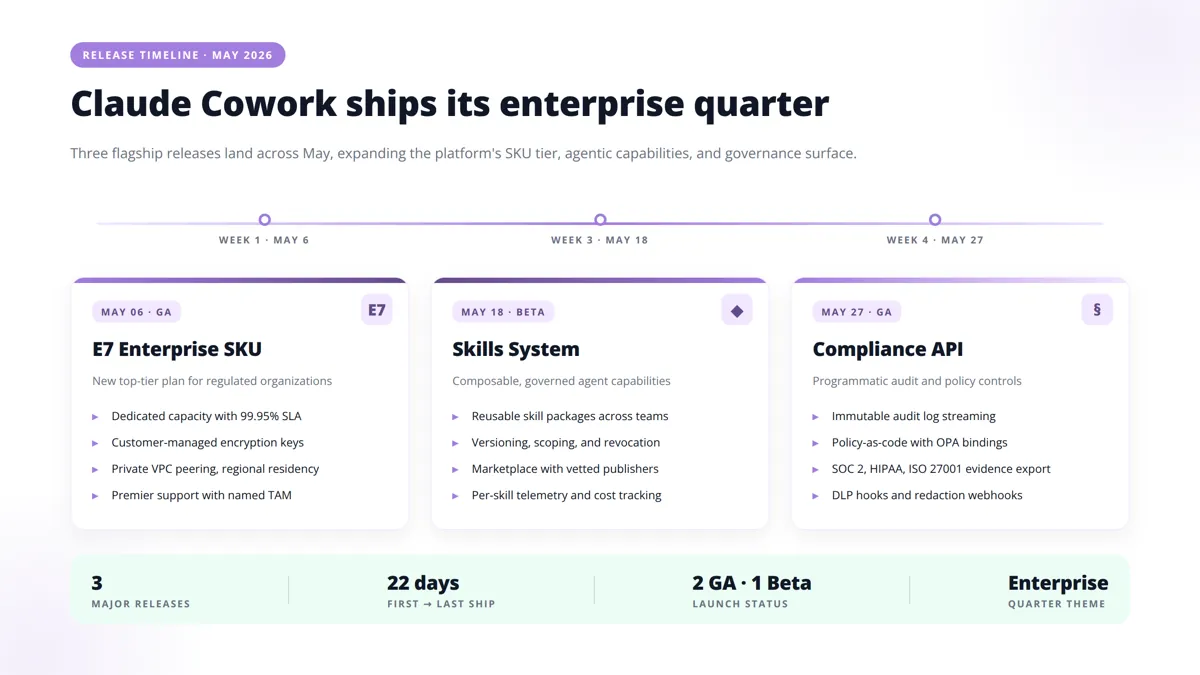
May 2026 is the inflection point because within a 25-day window, Anthropic and Microsoft jointly shipped enough enterprise infrastructure to fundamentally change how Claude Cowork is procured, governed, and deployed across regulated organizations. If you're a CTO evaluating enterprise AI platforms, the May 2026 release wave forced you to revisit assumptions you made in Q1.
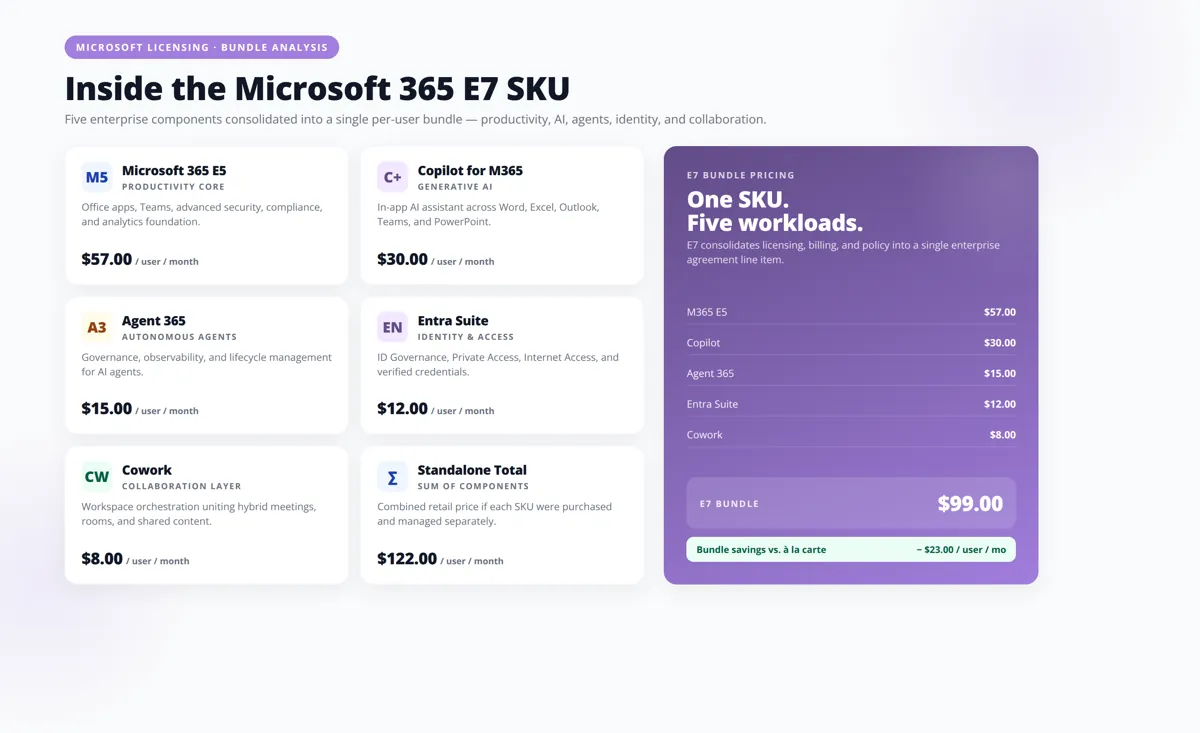
On May 1, 2026, Microsoft launched its E7 SKU at $99 per user per month, bundling M365 E5, Microsoft 365 Copilot, Agent 365, the Entra Suite, and Cowork into a single license [Source: https://thinktechnologiesgroup.com/blog/microsoft-copilot-cowork-anthropic-blueprint]. On May 5, a Cowork refresh added iOS and Android mobile apps, the SKILL.md-based Skills system, Fabric IQ plugins, and integrations across four Dynamics 365 environments [Source: https://thinktechnologiesgroup.com/blog/microsoft-copilot-cowork-anthropic-blueprint]. And on May 25, Anthropic shipped the Compliance API, exposing Claude conversation content and activity events to 28 named partners — exclusively on Enterprise plans [Source: https://findskill.ai/blog/claude-team-vs-enterprise-decision-tree-2026/].
Expert Insight
Mid-market and enterprise clients across Switzerland and the EU, have've watched these three releases collapse what used to be a six-month procurement cycle into urgent six-week deployments. Security teams that previously rejected generative AI because of weak governance now have something concrete to evaluate.
The strategic signal for CTOs
The Compliance API isn't just a feature — it's Anthropic signaling that Claude Cowork is now intended for governed, audited environments. Combined with Microsoft's decision to make Anthropic a default subprocessor in the US commercial cloud as of January 7, 2026 [Source: https://thinktechnologiesgroup.com/blog/microsoft-copilot-cowork-anthropic-blueprint], the dual-vendor story is no longer experimental.
Free Framework
Need a Tier Decision Framework for Your Organization?
Our Claude Cowork tier evaluation maps your security tooling, audit, and compliance requirements to the right procurement path — so you stop guessing at SKUs and start matching capability to risk.
Establish Your Security Baseline
- ✓For: CISOs, IT Security Leads
- ✓Identity provider integration
- ✓Confirm SAML 2.0 or OIDC SSO support with your existing IdP (Okta, Entra, Ping)
- ✓Data residency requirements
- ✓Map every jurisdiction where prompt and output data must remain — EU, US, CH, or hybrid
- ✓Encryption posture
- ✓Verify TLS 1.2+ in transit and AES-256 at rest, plus key management ownership (CMK vs vendor-managed)
- ✓Zero data training guarantee
- ✓Require written assurance that customer prompts are not used for model training
- ✓Retention controls
- ✓Set maximum prompt and output retention windows aligned to your records policy
Score Your Audit & Logging Needs
- ✓For: Audit, Risk, Internal Controls Teams
- ✓Admin event logging
- ✓Every workspace, role, and permission change captured with actor, timestamp, and source IP
- ✓Conversation-level audit trail
- ✓Granular prompt and output records exportable to your SIEM within 24 hours
- ✓SIEM integration
- ✓Native connectors or webhook delivery to Splunk, Sentinel, or Datadog without custom middleware
- ✓Tamper-evident storage
- ✓Logs written to immutable storage with retention of at least 12 months
- ✓Access review cadence
- ✓Quarterly or monthly automated reports identifying dormant accounts and over-privileged users
Map Compliance Obligations to Tier
- ✓For: Compliance Officers, Legal, DPOs
- ✓Regulatory frameworks in scope: ________ (e.g., GDPR, FINMA, ISO 27001, SOC 2 Type II, HIPAA)
- ✓Required vendor attestations: ________ (specify which reports you must collect annually)
- ✓Subprocessor disclosure cadence: ________ (define notice period for new subprocessors)
- ✓Data Processing Agreement clauses: ________ (list non-standard clauses your legal team requires)
- ✓Breach notification SLA: ________ (hours from confirmed incident to vendor notification)
- ✓Right to audit: ________ (on-site, remote, or third-party report only)
Define User & Workspace Governance
- ✓How users join, collaborate, and offboard determines whether a tier scales with your organization or becomes a quarterly cleanup project.
- ✓For: IT Operations, Workplace Technology Leads
- ✓SCIM provisioning
- ✓Automated user lifecycle management from your IdP, including just-in-time deprovisioning
- ✓Role-based access control
- ✓At least three distinct roles: admin, builder, viewer — with custom roles available at higher tiers
- ✓Workspace isolation
- ✓Logical separation between departments or projects to prevent cross-contamination of sensitive data
- ✓Usage analytics
- ✓Per-seat and per-workspace consumption dashboards for chargeback and capacity planning
Choose Your Procurement Path
- ✓With baseline, audit, compliance, and governance scored, map your profile to one of three procurement paths.
- ✓For: Procurement, Finance, Vendor Management
- ✓Direct self-serve
- ✓For teams under 50 seats with no formal audit requirements and standard data residency
- ✓Enterprise contract with Anthropic
- ✓For organizations requiring custom DPAs, BAAs, dedicated capacity, or non-standard retention terms
- ✓Cloud marketplace via AWS, GCP, or Azure
- ✓For teams that need to consume against existing committed spend and inherit hyperscaler compliance posture
- ✓Partner-assisted procurement
- ✓For complex environments requiring integration design, change management, and ongoing governance support
Pro tip: Run this framework before you request quotes — not after. Teams that score their requirements first negotiate 20–30% better terms because they can articulate exactly which capabilities justify a tier upgrade and which are optional. Vendors respond to specificity.
2. What Is Claude Cowork (and What Is It Not)?
Quick Answer:
Claude Cowork is Anthropic's enterprise knowledge-work agent product with persistent memory, local file access, browser sessions, computer use, plugins, scheduled tasks, and mobile dispatch. It is not Claude Code (developer-focused), not appropriate for HIPAA/GLBA/SOX/PCI workloads without external controls, and not equivalent across Pro, Team, and Enterprise tiers.
Before going further, it's worth defining the product carefully because the name "Cowork" appears in two distinct contexts in May 2026 releases.
Claude Cowork (Anthropic)
Claude Cowork is Anthropic's knowledge-work agent product — a persistent, multi-modal assistant that can reach local files, browser sessions, execute computer-use actions, run plugins, manage scheduled tasks, hold persistent memory, and dispatch tasks from mobile [Source: https://generalanalysis.com/guides/claude-cowork-vs-claude-code]. It's positioned for professional services, legal, finance, and operations teams.
Microsoft 365 Copilot Cowork
Microsoft 365 Copilot Cowork integrates "the technology behind Claude Cowork" into Microsoft 365 Copilot, and as of May 2026 includes Claude Opus 4.8 as a selectable model [Source: https://techcommunity.microsoft.com/blog/microsoft365copilotblog/cowork-in-progress/4511672]. It's a deeper product linkage than a simple model swap — Cowork-style capabilities are now exposed inside Copilot's surface.
What Cowork is not
- Not Claude Code — Claude Code is the separate developer-focused product bundled in Team Premium with Claude Code at $100/seat/month annual ($125 monthly) [Source: https://findskill.ai/blog/claude-team-vs-enterprise-decision-tree-2026/].
- Not appropriate for HIPAA, GLBA, SOX, or PCI workloads without external controls — Cowork's larger attack surface makes it unsuitable for regulated workloads unless wrapped in additional governance [Source: https://generalanalysis.com/guides/claude-cowork-vs-claude-code].
- Not the same product across tiers — Pro, Team, and Enterprise have materially different governance feature sets, and the gap widened on May 25 with the Compliance API and audit logs becoming Enterprise-only [Source: https://findskill.ai/blog/claude-team-vs-enterprise-decision-tree-2026/].
3. How Does Claude Opus 4.8 Work Inside Microsoft 365 Copilot Cowork?
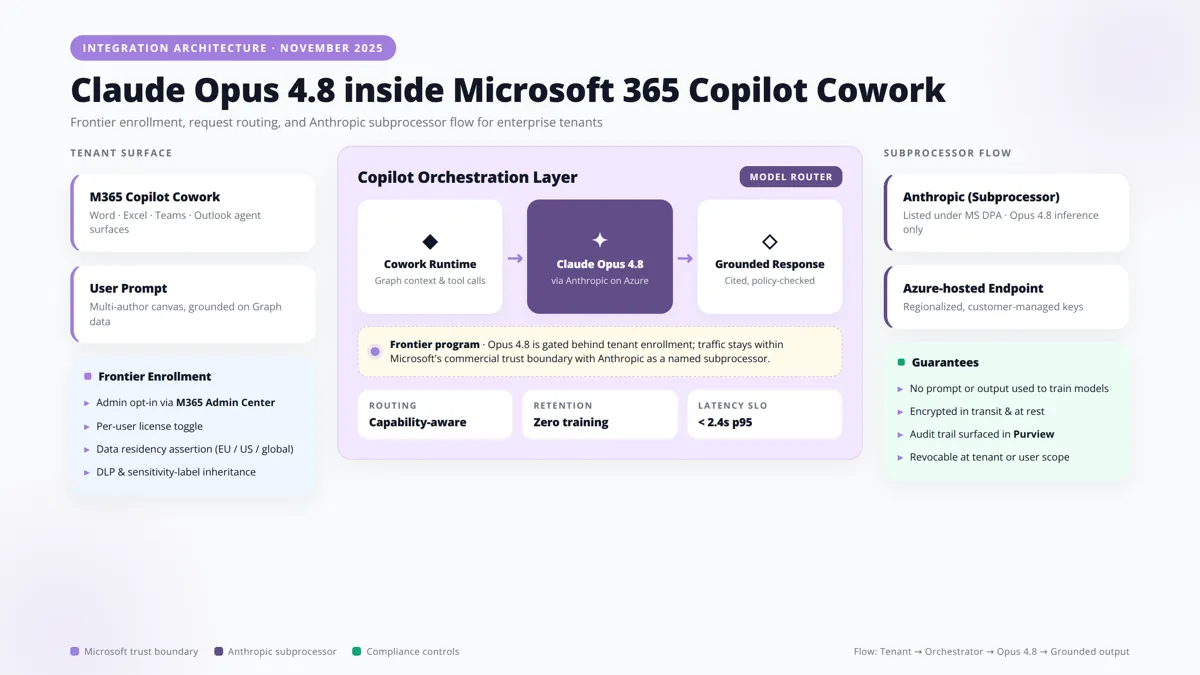
Microsoft confirmed in its May 2026 Copilot blog that Anthropic's latest model, Claude Opus 4.8, is now available inside Copilot Cowork as a selectable model alongside default OpenAI options [Source: https://techcommunity.microsoft.com/blog/microsoft365copilotblog/cowork-in-progress/4511672]. This matters for three reasons.
Model choice as an enterprise feature
Until recently, Microsoft 365 Copilot was effectively a single-model product. Bringing Claude Opus 4.8 alongside OpenAI models gives CTOs leverage: model selection becomes a procurement variable, not a vendor lock-in.
Deployment prerequisites
Based on the May 2026 implementation guide, the most common reason Cowork doesn't appear for a tenant user is a missing Frontier enrollment on the admin account [Source: https://thinktechnologiesgroup.com/blog/microsoft-copilot-cowork-anthropic-blueprint]. Before rolling out to your organization, confirm:
- Frontier program enrollment is active on the global admin account
- Anthropic subprocessor status is acknowledged in your DPIA (default-enabled in the US commercial cloud since January 7, 2026)
- Users have appropriate Copilot licenses (or the new E7 SKU)
Pro Tip
If Cowork isn't visible to your pilot users, check Frontier enrollment first — before troubleshooting license assignment or Conditional Access. We've seen this single misconfiguration burn full days of pilot setup time.
What Opus 4.8 changes operationally
In our pilots with European clients, switching the underlying model in Copilot from a frontier OpenAI model to Claude Opus 4.8 produced noticeably different outputs in long-form synthesis, contract analysis, and multi-step reasoning tasks — domains where Anthropic's models have historically been competitive. Treat this as an A/B test opportunity, not a one-way migration.
4. What Does the Compliance API Do in Claude Cowork?
Quick Answer:
The Compliance API, released May 25, 2026, exposes Claude conversation content and activity events to 28 named security and compliance partners. It is available exclusively on Enterprise plans and is the primary mechanism for integrating Cowork data into a SIEM, CASB, or ISPM stack.
The single most consequential May 2026 release for CTOs is the Compliance API, added by Anthropic on May 25, 2026. It exposes Claude conversation content and activity events to 28 named partners — and it's available only on Enterprise plans [Source: https://findskill.ai/blog/claude-team-vs-enterprise-decision-tree-2026/].
What the Compliance API actually exposes
- Conversation content — full prompt and response data for analysis by external compliance tooling
- Activity events — metadata about user behavior, sessions, and tool invocations
- Partner integrations — pre-built connections to 28 named security and compliance vendors
Why this changes the Team-vs-Enterprise calculus
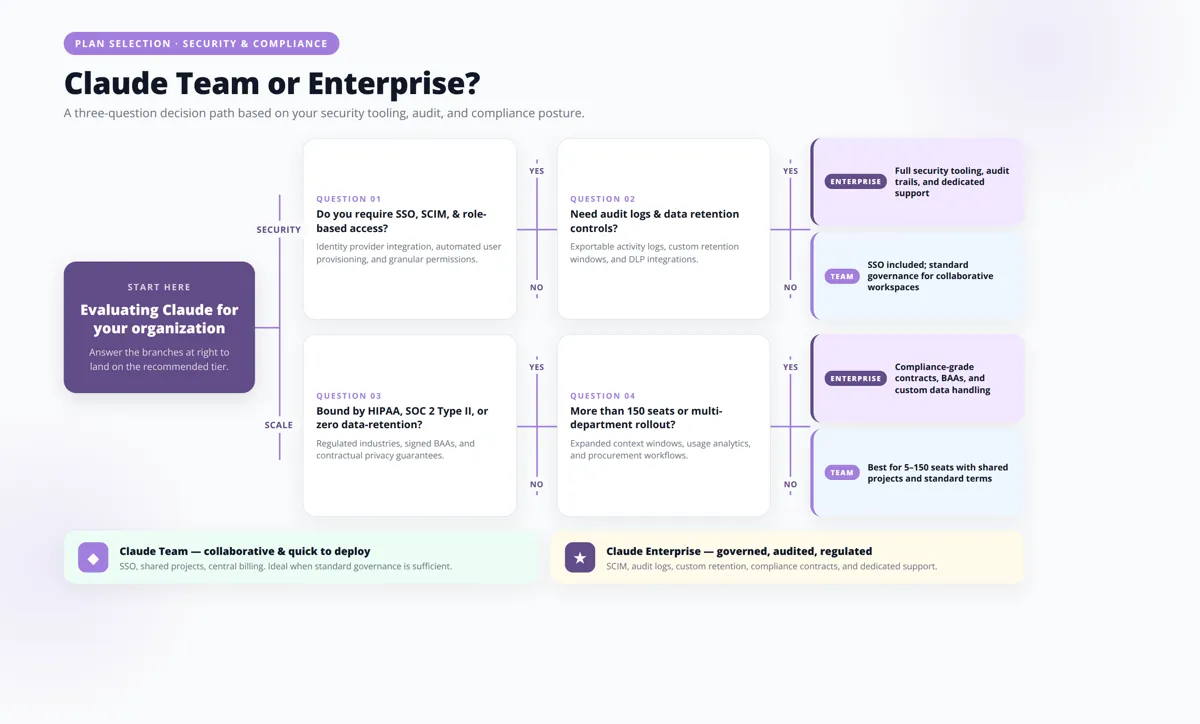
Before May 25, the choice between Team (5–150 seats) and Enterprise was primarily a seat-count and price-sensitivity decision. After May 25, it's a security tooling decision. If your security team requires Claude data to flow into a SIEM, CASB, or ISPM stack, Enterprise is the only viable answer [Source: https://findskill.ai/blog/claude-team-vs-enterprise-decision-tree-2026/].
Expert Insight
In our experience advising regulated EU clients, the very first procurement question we now ask is: "Does any business unit have a security tooling mandate?" If the answer is yes, the Team tier is effectively off the table. We've seen organizations attempt the Team-tier discount path and then re-procure Enterprise within two quarters once their security committee reviewed the gap.
Enterprise-defining features beyond the API
The May 2026 decision-tree analysis identifies these as Enterprise-only:
- Custom retention policies
- Role-based access control (RBAC)
- SCIM provisioning
- Audit logs
- Network controls
- The Compliance API itself
Team plans do not include these controls — a material enterprise governance gap [Source: https://findskill.ai/blog/claude-team-vs-enterprise-decision-tree-2026/].
Free Checklist
Download Our Claude Enterprise Readiness Checklist
40-point evaluation covering Compliance API integration, RBAC, SCIM, audit logging, and SIEM connectivity for Claude Cowork deployments.
Compliance API Integration
- ✓Confirm that your governance tooling can read, classify, and act on Claude conversation metadata in near real time.
- ✓For: Security Architects & GRC Leads
- ✓API credentials provisioned with least-privilege scopes and rotated on a 90-day cycle.
- ✓Conversation export endpoint tested against your DLP engine with sample sensitive payloads.
- ✓Webhook receivers validated for retry logic, idempotency, and signature verification.
- ✓Data residency flag confirmed for EU, US, and regional Claude Cowork tenants.
- ✓Retention policy mapped to your records schedule (default vs. extended hold).
- ✓Rate limits documented and alerting configured at 70% threshold.
- ✓Schema versioning tracked, with a contract test in CI to catch breaking changes.
- ✓Failure mode defined: block, queue, or degrade when the Compliance API is unreachable.
Role-Based Access Control (RBAC)
- ✓A defensible permission model is the single largest determinant of enterprise rollout speed.
- ✓For: IAM Administrators
- ✓Role taxonomy mapped to at least four tiers: Viewer, Builder, Admin, Owner.
- ✓Workspace-scoped roles separated from organization-scoped roles to prevent privilege creep.
- ✓Custom connector permissions reviewed — particularly for filesystem and code execution tools.
- ✓Break-glass account documented, MFA-enforced, and monitored on every login.
- ✓Quarterly access reviews scheduled with named owners and a sign-off artifact.
- ✓Guest and external collaborator access disabled by default, with explicit approval workflow.
- ✓Role assumption events logged and surfaced to your SIEM within five minutes.
SCIM & Identity Lifecycle
- ✓Automated provisioning is non-negotiable above 200 seats. Verify that joiner-mover-leaver actually works end to end.
- ✓For: Identity & Platform Engineering
- ✓SCIM 2.0 endpoint connected to your IdP (Okta, Entra ID, or Ping) with bearer token rotation.
- ✓Group-based assignment driving role mapping — no manual user-by-user provisioning.
- ✓Deprovisioning latency measured: target under 15 minutes from IdP deactivation.
- ✓Attribute mapping covers department, cost center, and manager for chargeback and reporting.
- ✓Just-in-time provisioning disabled if SCIM is authoritative, to avoid drift.
- ✓SCIM sync failures raise a ticket automatically and page the on-call identity owner.
- ✓Service accounts excluded from SCIM and managed in a separate vault-backed flow.
Audit Logging
- ✓If it isn't logged, it didn't happen. Auditors will ask for completeness, integrity, and retention — be ready for all three.
- ✓For: Compliance & Audit Teams
- ✓Admin actions logged with actor, target, timestamp, and source IP.
- ✓Conversation-level events (create, share, export, delete) captured with workspace context.
- ✓Connector and tool invocations logged, including parameters where policy permits.
- ✓Log integrity protected via append-only storage or hash-chained writes.
- ✓Retention set to a minimum of 13 months to cover a full audit cycle plus buffer.
- ✓Time synchronization verified — NTP drift under 100ms between Claude and your log store.
- ✓Tamper alerts configured for gaps, deletions, or unexpected schema changes.
- ✓Export format standardized to JSON or CEF for downstream parsing.
SIEM Connectivity & Detection
- ✓Logs only matter if your detection engineers can write rules against them. Validate the pipeline before go-live.
- ✓For: SecOps & Detection Engineering
- ✓SIEM connector live for Splunk, Sentinel, Chronicle, or your platform of record.
- ✓Parsing rules validated against sample events — no silent field drops.
- ✓Detection content authored for at least five high-signal scenarios: mass export, role escalation, anomalous geographies, off-hours admin activity, and connector abuse.
- ✓Mean time to alert benchmarked: target under 10 minutes from event to analyst queue.
- ✓Playbooks written for the top three detections, with owner, severity, and escalation path.
- ✓Quarterly purple-team exercise scheduled against Claude-specific abuse paths.
- ✓Cost monitoring in place — log volume forecasted and budgeted, not discovered mid-quarter.
- ✓Backup ingestion path defined for SIEM outages (S3, GCS, or cold archive).
- ✓Decommissioning runbook covers credential revocation, log archival, and IdP cleanup.
- ✓Executive dashboard publishes monthly metrics: coverage, MTTA, MTTR, and incident count.
Pro tip: Treat the first 90 days as an evidence-collection sprint, not a deployment. Each checkbox should produce a screenshot, a configuration export, or a log sample your auditor can verify independently. Future-you will thank present-you.
5. How Do You Choose Between Claude Team and Enterprise?
Quick Answer:
Choose Claude Enterprise if you need SIEM/CASB/ISPM integration, audit logs for compliance attestations, SCIM-driven provisioning, or custom data retention. Choose Team (5–150 seats) only if none of those requirements apply — and document the governance gap for your security committee.
Claude now has three commercial tiers — Pro for individuals, Team for 5–150 seats, and Enterprise for large organizations [Source: https://findskill.ai/blog/claude-team-vs-enterprise-decision-tree-2026/]. The pricing structure as of May 2026 is documented below.
| Tier | Price | Best For | Key Governance Features |
|---|---|---|---|
| Pro | $20/month | Individuals | Basic, no enterprise controls |
| Team Standard | $20/seat/month annual ($25 monthly) | 5–150 seats, low-risk workflows | Shared workspace; no Compliance API, no audit logs |
| Team Premium (with Claude Code) | $100/seat/month annual ($125 monthly) | Engineering teams needing Claude Code bundled | Same governance gaps as Team Standard |
| Enterprise | $20/seat + metered API usage | Regulated, audited, multi-thousand-seat organizations | Compliance API, audit logs, RBAC, SCIM, custom retention, network controls |
The decision logic CTOs should apply
- Does any business unit require SIEM/CASB/ISPM integration? → Enterprise.
- Are audit logs required for compliance attestations (SOC 2, ISO 27001, internal audit)? → Enterprise.
- Do you need SCIM-driven provisioning tied to your IdP? → Enterprise.
- Do you need custom data retention windows shorter or longer than defaults? → Enterprise.
- None of the above and seat count is under 150? → Team is defensible — but document the gap.
6. What Legal Workflow Tools Does Claude Cowork Integrate With?
Anthropic released new legal tools for Claude Cowork in May 2026, with integrations into CourtListener, Definely, Thomson Reuters' Westlaw, Courtroom5, Box, and Harvey [Source: https://www.businessinsider.com/anthropic-expands-legal-ai-tools-claude-cowork-2026-5]. These additions include pre-built AI skills for employment, privacy, and product law, plus workflows for legal clinics and law students.
Why this signals Anthropic's vertical strategy
Legal is now positioned as a flagship vertical for Cowork — research, contract work, and domain-specific skills rather than only general productivity. For CTOs at firms with in-house counsel or legal-adjacent operations (compliance, contracts, regulatory), this is the most production-ready Cowork use case as of May 2026.
Connector capabilities
| Connector | Function | Typical Use Case |
|---|---|---|
| CourtListener | Open case law access | Research and precedent retrieval |
| Westlaw (Thomson Reuters) | Premium legal research corpus | In-depth case and statute analysis |
| Definely | Contract drafting and review | Defined-term consistency, clause review |
| Harvey | Legal-specific AI workflows | Document review, deal support |
| Box | Document management | Secure file storage and retrieval |
| Courtroom5 | Self-represented litigant support | Legal clinics, pro bono workflows |
Implementation recommendation
Based on our implementation experience advising regulated EU clients, we recommend treating the legal stack as a contained pilot before broader rollout. Even with Enterprise governance, attorney-client privilege, work-product doctrine, and EU bar association rules require careful review of which connectors are activated and which retention policies apply.
Disclaimer
This article provides strategic and technical guidance only and does not constitute legal advice. Before deploying Claude Cowork against legal workflows, consult qualified counsel about privilege, work-product doctrine, and bar association rules in your jurisdiction.
7. What Is Microsoft's E7 SKU and Is It Worth It?
Microsoft's May 1, 2026 launch of the E7 SKU at $99 per user per month is one of the clearest signals yet that AI, security, and identity are being bundled into a single enterprise license [Source: https://thinktechnologiesgroup.com/blog/microsoft-copilot-cowork-anthropic-blueprint].
What's in E7
- Microsoft 365 E5 (productivity + advanced security baseline)
- Microsoft 365 Copilot
- Agent 365
- Entra Suite (identity + access governance)
- Cowork
The economic case
At $99 per user per month, E7 is meaningful for organizations that were already buying M365 E5 plus Copilot separately. If you were paying roughly $57 for E5 plus $30 for Copilot, the marginal cost of adding Agent 365, Entra Suite extensions, and Cowork in a single bundle compresses procurement and reduces SKU sprawl.
The strategic case
The E7 SKU collapses three procurement conversations (productivity, identity, AI) into one. For CTOs trying to standardize the AI stack across business units, this is a forcing function. The trade-off is vendor concentration — committing more deeply to Microsoft as the AI substrate.
8. How Does Cowork's Attack Surface Compare to Claude Code?
Quick Answer:
Claude Cowork has a substantially larger attack surface than Claude Code because it can reach local files, browser sessions, computer use, plugins, scheduled tasks, persistent memory, and mobile dispatch. Per the May 2026 General Analysis guide, Cowork is unsuitable for HIPAA, GLBA, SOX, and PCI workloads without external controls.
An important May 2026 analysis flagged that Claude Cowork has a substantially larger attack surface than Claude Code [Source: https://generalanalysis.com/guides/claude-cowork-vs-claude-code]. The same source explicitly says Cowork is unsuitable for regulated workloads unless additional external controls are added.
The capabilities that expand the attack surface
| Capability | Risk Vector | Mitigation |
|---|---|---|
| Local file access | Sensitive data exfiltration via prompt injection | OS-level controls, DLP integration through Compliance API |
| Browser sessions | Authenticated session hijack scenarios | Isolated browser profiles, MFA on every sensitive site |
| Computer use | Unintended UI actions on critical systems | Sandboxed environments, action allowlists |
| Plugins | Third-party connector risk | Plugin allowlisting via Enterprise RBAC |
| Scheduled tasks | Delayed-action prompt injection persistence | Task auditing, periodic review of scheduled prompts |
| Persistent memory | Data leakage across sessions | Custom retention via Enterprise controls |
| Mobile dispatch | Out-of-band actions from unmanaged devices | Conditional access via Entra, MDM enforcement |
The CTO action item
If you're seriously evaluating Cowork for any workload touching regulated data, document the gap between Cowork's default capabilities and your control baseline before procurement. Enterprise-tier controls plus the Compliance API close many gaps, but not all. We recommend a formal risk acceptance memo for every Cowork capability you enable in production.
9. What Are SKILL.md Files and How Do Mobile Apps Work?
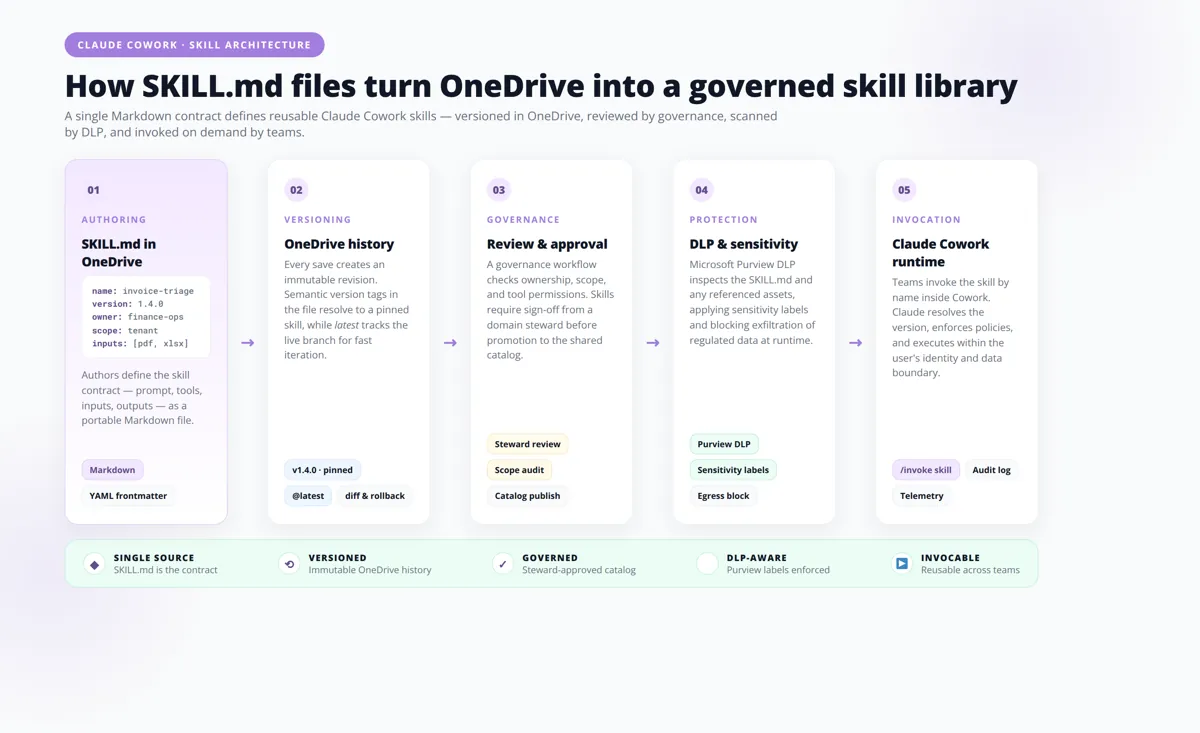
The May 5, 2026 Cowork refresh introduced a Skills system based on SKILL.md files stored in OneDrive, alongside iOS and Android mobile apps, Fabric IQ plugins, and plugins for four Dynamics 365 environments [Source: https://thinktechnologiesgroup.com/blog/microsoft-copilot-cowork-anthropic-blueprint].
What SKILL.md enables
SKILL.md is a declarative file format that describes reusable skills the Cowork agent can invoke. Stored in OneDrive, these files become a governance and versioning surface — you can apply standard file permissions, retention policies, and DLP rules to them. For CTOs, this is significant because skill definitions are now first-class artifacts in your existing M365 governance model.
Mobile dispatch
The new iOS and Android apps let users dispatch tasks to Cowork from outside the desktop session. This is operationally powerful (a sales lead asks Cowork to draft a proposal from a phone) but expands the device surface that must be brought under MDM and conditional access.
Fabric IQ and Dynamics 365 plugins
Plugins for Microsoft Fabric IQ and four Dynamics 365 environments mean Cowork can now reach across data, ERP, and CRM systems inside the Microsoft estate. For organizations standardized on Microsoft, this dramatically reduces the integration work historically needed to make an AI agent useful for cross-functional workflows.
Expert Insight
Treat your SKILL.md library like any other code repository. We help clients establish a designated SharePoint location, owner-of-record per skill, mandatory peer review before activation, and quarterly deprecation cycles. Organizations that skip this step end up with hundreds of orphaned skills no one understands within six months.
10. The CTO Deployment Playbook: 16-Week Roadmap
Based on our implementation experience with mid-market and enterprise clients, here's the sequence we recommend for deploying Claude Cowork against the May 2026 feature set.
Phase 1: Foundations (Weeks 1–2)
- Confirm Frontier enrollment on the admin tenant if going through M365 Copilot Cowork
- Update your DPIA to reflect Anthropic as a default subprocessor (US commercial cloud)
- Decide tier (Team vs Enterprise) using the decision tree in Section 5
- Procure Enterprise if any of: SIEM integration required, audit logs required for attestations, SCIM required, custom retention required
Phase 2: Governance setup (Weeks 3–4)
- Connect the Compliance API to your SIEM (one of the 28 named partners)
- Define RBAC roles aligned with your IdP groups
- Configure SCIM provisioning
- Set custom retention windows by user group
- Establish plugin allowlist policy
Phase 3: Pilot (Weeks 5–8)
- Select one vertical workflow — legal research is the most mature, per the May 2026 Anthropic releases
- Limit pilot to 25–50 users
- Define success metrics: time-to-output, output quality (human-rated), and security incidents
- A/B test Claude Opus 4.8 vs default Copilot model for representative tasks
Phase 4: Expansion (Weeks 9–16)
- Roll out to second and third workflows
- Publish SKILL.md library in OneDrive with documented ownership
- Enable mobile dispatch only for users under MDM
- Quarterly review of Compliance API event volume vs license cost
Phase 5: Steady state (Ongoing)
- Monthly review of audit logs for anomalous activity
- Quarterly skill library audit (deprecation, security review)
- Annual model A/B reassessment as new Anthropic models ship
Pro Tip
Resist the temptation to roll out broadly in Phase 3. A 25–50 user pilot with rigorous metrics produces more credible expansion approvals than a 500-user pilot with anecdotal feedback. Security committees respond to evidence, not enthusiasm.
11. Claude Cowork vs Microsoft 365 Copilot vs Claude Code: What's the Difference?
One question we get repeatedly from CTOs: how do these three products actually differ, and where do they overlap?
| Dimension | Claude Cowork (Anthropic) | Microsoft 365 Copilot Cowork | Claude Code |
|---|---|---|---|
| Primary user | Knowledge workers (legal, ops, finance) | M365-standardized enterprises | Software engineers |
| Latest model | Claude Opus 4.8 | Claude Opus 4.8 (selectable) | Claude family models |
| Attack surface | Broad: files, browser, computer use, plugins, mobile | Bounded by M365 surfaces and Entra controls | Narrower, focused on code repos and dev environments |
| Compliance API | Yes (Enterprise only, May 25, 2026) | Via Microsoft Purview + Anthropic Compliance API on Enterprise | N/A in same form |
| Pricing entry | $20/seat Enterprise + metered API | E7 SKU at $99/user/month bundles it in | $100/seat/month annual (Team Premium) |
| Best for regulated workloads? | Only with external controls | Strongest path via Purview + Entra + Compliance API | More defensible due to narrower surface |
| Vertical focus (May 2026) | Legal (Westlaw, Harvey, CourtListener, Definely) | Cross-functional via Dynamics 365, Fabric IQ | Software development |
The honest CTO recommendation
If you're already a Microsoft-standardized organization, the E7 SKU plus Microsoft 365 Copilot Cowork is the lowest-friction path. If you're a legal-services firm or have heavy legal workflows, Anthropic's direct Cowork Enterprise plan with the legal connectors is more capable today. If your primary need is engineering productivity, Claude Code is the right product, not Cowork.
12. Frequently Asked Questions
What is Claude Cowork and how is it different from Claude itself?
Claude Cowork is Anthropic's enterprise knowledge-work agent product. Unlike the standard Claude chat interface, Cowork includes persistent memory, local file access, browser sessions, computer use, scheduled tasks, plugins, and mobile dispatch. It's designed for production workflows in knowledge-work verticals like legal, finance, and operations [Source: https://generalanalysis.com/guides/claude-cowork-vs-claude-code].
What is the Compliance API in Claude Cowork?
The Compliance API, released by Anthropic on May 25, 2026, exposes Claude conversation content and activity events to 28 named security and compliance partners. It's available only on Enterprise plans and is the primary mechanism for integrating Cowork into a SIEM, CASB, or ISPM stack [Source: https://findskill.ai/blog/claude-team-vs-enterprise-decision-tree-2026/].
How much does Claude Enterprise cost?
Claude Enterprise is priced at $20 per seat plus metered API usage at standard API rates. This is a different model from Pro ($20/month flat) or Team Standard ($20/seat/month annual). The metered component means cost scales with usage rather than being fixed per seat [Source: https://findskill.ai/blog/claude-team-vs-enterprise-decision-tree-2026/].
Is Claude Cowork available inside Microsoft 365 Copilot?
Yes. Microsoft confirmed in May 2026 that Claude Opus 4.8 is available in Microsoft 365 Copilot Cowork, and that Microsoft has integrated the technology behind Claude Cowork into Microsoft 365 Copilot — a deeper linkage than a simple model swap [Source: https://techcommunity.microsoft.com/blog/microsoft365copilotblog/cowork-in-progress/4511672].
What is the E7 SKU and is it worth it?
The E7 SKU is Microsoft's bundled enterprise license launched May 1, 2026 at $99 per user per month. It includes M365 E5, Microsoft 365 Copilot, Agent 365, the Entra Suite, and Cowork. For organizations already buying E5 and Copilot separately, E7 is often cost-competitive and simplifies procurement [Source: https://thinktechnologiesgroup.com/blog/microsoft-copilot-cowork-anthropic-blueprint].
Can I use Claude Cowork for HIPAA workloads?
No, not without additional external controls. Per the May 2026 General Analysis guide, Cowork is unsuitable for regulated workloads like HIPAA, GLBA, SOX, and PCI unless additional external controls are added. The combination of local file access, browser sessions, persistent memory, and mobile dispatch creates an attack surface that requires wrapping in additional governance before deploying to regulated data [Source: https://generalanalysis.com/guides/claude-cowork-vs-claude-code].
What are SKILL.md files?
SKILL.md files are declarative skill definitions for the Cowork agent, introduced in the May 5, 2026 refresh. They're stored in OneDrive, which means they inherit M365 file permissions, retention, and DLP policies. This makes skill definitions first-class artifacts in your existing M365 governance model [Source: https://thinktechnologiesgroup.com/blog/microsoft-copilot-cowork-anthropic-blueprint].
What legal tools does Claude Cowork integrate with?
As of May 2026, Cowork integrates with CourtListener, Definely, Thomson Reuters' Westlaw, Courtroom5, Box, and Harvey. It also includes pre-built AI skills for employment, privacy, and product law, plus workflows for legal clinics and law students [Source: https://www.businessinsider.com/anthropic-expands-legal-ai-tools-claude-cowork-2026-5].
When did Microsoft enable Anthropic as a default subprocessor?
Microsoft enabled Anthropic as a default subprocessor in the US commercial cloud on January 7, 2026. CTOs deploying Copilot Cowork should ensure their DPIA and subprocessor disclosure to customers reflects this [Source: https://thinktechnologiesgroup.com/blog/microsoft-copilot-cowork-anthropic-blueprint].
Why doesn't Cowork appear for my tenant users?
The most common cause documented in the May 2026 implementation guide is a missing Frontier enrollment on the admin account. Verify Frontier enrollment first before troubleshooting license assignments or conditional access policies [Source: https://thinktechnologiesgroup.com/blog/microsoft-copilot-cowork-anthropic-blueprint].
What's the difference between Claude Cowork and Claude Code?
Claude Cowork targets knowledge workers with a broad capability surface (files, browser, computer use, scheduled tasks). Claude Code targets software engineers with a narrower, code-focused surface. Cowork is bundled with Team Premium pricing at $100/seat/month annual when sold alongside Claude Code [Source: https://findskill.ai/blog/claude-team-vs-enterprise-decision-tree-2026/].
Does Team tier include audit logs?
No. Per the May 2026 decision-tree analysis, audit logs are restricted to Enterprise organizations only. Team plans do not include audit logs, the Compliance API, custom retention, RBAC, SCIM, or network controls. This is a material governance gap if you need any form of compliance attestation [Source: https://findskill.ai/blog/claude-team-vs-enterprise-decision-tree-2026/].
How many partners does the Compliance API integrate with?
The Compliance API exposes Claude conversation content and activity events to 28 named partners as of its May 25, 2026 release. The list spans SIEM, CASB, ISPM, and DLP categories. Confirm your existing security stack vendor is on the list before committing to Enterprise procurement on that basis [Source: https://findskill.ai/blog/claude-team-vs-enterprise-decision-tree-2026/].
Can I choose between Claude and OpenAI models in Copilot?
Yes. As of May 2026, Microsoft 365 Copilot Cowork supports model choice, including Claude Opus 4.8 alongside Microsoft's default OpenAI-based models. We recommend treating this as an A/B testing opportunity for different workflow types rather than picking a single default for all users [Source: https://techcommunity.microsoft.com/blog/microsoft365copilotblog/cowork-in-progress/4511672].
How does mobile dispatch work in Cowork?
The May 5, 2026 Cowork refresh added iOS and Android mobile apps that let users dispatch tasks to the Cowork agent from outside the desktop session. From a governance perspective, mobile dispatch expands the device surface that must be brought under MDM and Entra conditional access — enable it deliberately, not by default [Source: https://thinktechnologiesgroup.com/blog/microsoft-copilot-cowork-anthropic-blueprint].
What plugins ship with Cowork in May 2026?
The May 2026 refresh added plugins for Microsoft Fabric IQ and four Dynamics 365 environments, plus the legal connector suite (Westlaw, Harvey, CourtListener, Definely, Courtroom5, Box) from Anthropic's separate legal release. Plugin allowlisting is part of Enterprise-tier governance and should be configured before broad rollout [Source: https://thinktechnologiesgroup.com/blog/microsoft-copilot-cowork-anthropic-blueprint].
Is there a documented attack surface comparison between Cowork and Claude Code?
Yes. The May 2026 General Analysis guide explicitly compares the two and finds Cowork has a substantially larger attack surface because it can reach local files, browser sessions, computer use, plugins, scheduled tasks, persistent memory, and mobile dispatch — capabilities Claude Code does not expose in the same way [Source: https://generalanalysis.com/guides/claude-cowork-vs-claude-code].
Should we wait for more features before deploying?
In our consulting experience, the May 2026 feature set crosses the procurement threshold for most regulated mid-market and enterprise organizations. Waiting another quarter mostly costs you organizational learning time. Pilot now, scale on the September governance review.
Conclusion: The May 2026 Cowork Decision
For CTOs, the May 2026 Claude Cowork release wave forces a clear set of decisions, not a vague evaluation.
Key takeaways:
- The Compliance API (May 25, 2026) converts the Team-vs-Enterprise decision into a security tooling decision — if your SIEM/CASB/ISPM stack needs Claude data, Enterprise is the only path.
- Claude Opus 4.8 inside Microsoft 365 Copilot Cowork gives you model choice as a procurement variable for the first time.
- The E7 SKU at $99/user/month consolidates productivity, identity, and AI into a single license — strong for Microsoft-standardized organizations.
- The legal connector stack (Westlaw, Harvey, CourtListener, Definely, Courtroom5, Box) makes legal the most production-ready Cowork vertical today.
- Cowork's expanded attack surface (files, browser, computer use, mobile dispatch) requires documented risk acceptance for any regulated workload.
- SKILL.md files in OneDrive make skill definitions first-class governance artifacts within your existing M365 controls.
The organizations that will get the most from Cowork are the ones treating it as an enterprise software deployment, not an experiment. That means Enterprise-tier procurement, Compliance API wired to your SIEM, documented risk acceptance for every capability enabled, and a phased rollout starting with a single high-value vertical workflow.
Ready to evaluate Claude Cowork for your organization? Our team has built deployment frameworks for clients across Switzerland, the EU, and Latin America. We can help you run the tier decision, build the governance baseline, and pilot the right first workflow.
Schedule a Claude Cowork Enterprise Strategy Session
90-minute CTO workshop covering tier selection, Compliance API integration, and a 16-week deployment roadmap tailored to your stack.
Book Strategy Session
About the Author
Agenticsis Team — Zurich-based AI consultancy founded by Sofía Salazar Mora. We partner with companies across Switzerland, the European Union, and Latin America to mainstream artificial intelligence into business operations. Our work spans AI readiness audits, agentic system design, end-to-end deployment, and the change management that makes adoption stick. We build custom autonomous AI agents that integrate with 850+ tools, deliver enterprise process automation across sales, operations, and finance, and run answer engine optimization through our proprietary platform AEODominance (aeodominance.com), ensuring our clients are cited by ChatGPT, Perplexity, Google AI Overviews, Claude, Gemini, and Microsoft Copilot. Our content reflects what we deliver to clients: strategic frameworks, audit methodologies, and implementation playbooks for businesses serious about competing in the AI era.