TL;DR(Too Long; Did not Read)
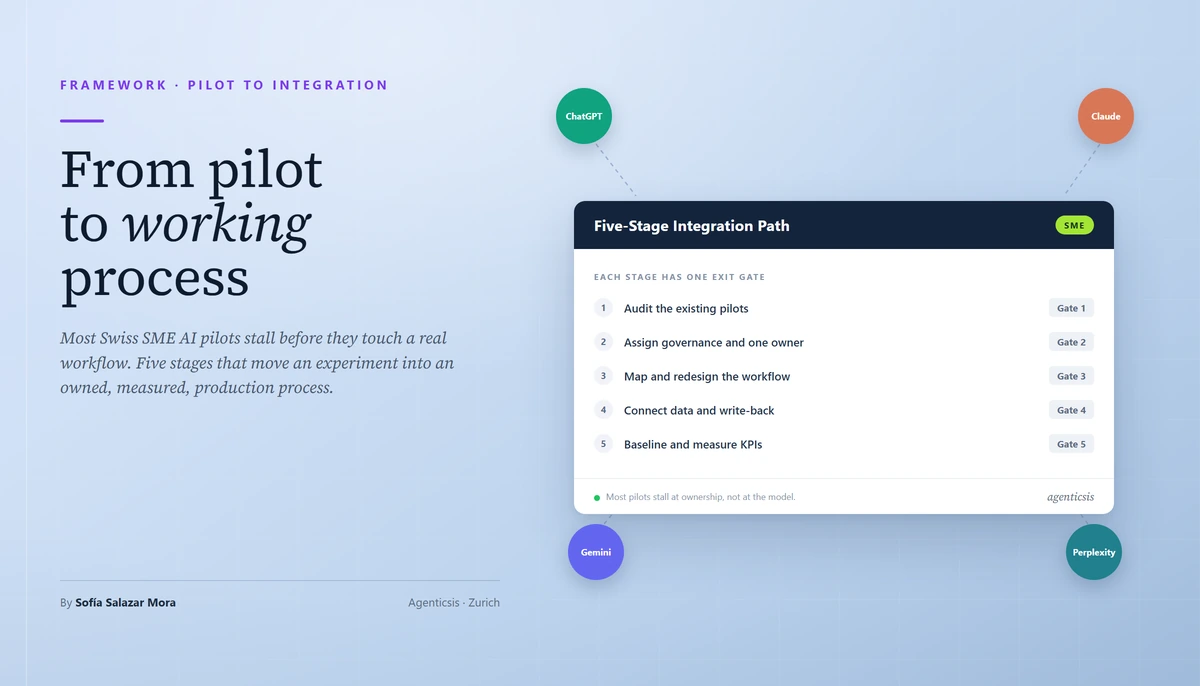
Five-stage framework for Swiss SMEs to move AI pilots into production in 2026: audit, governance, workflow, data integration and KPIs.
How to Move from AI Experimentation to Strategic Integration: A Framework for Swiss SMEs
Published by Agenticsis · Last updated 18 September 2026 · Zurich, Switzerland
Quick Answer:
Swiss SMEs move from AI experimentation to strategic integration by running a five-stage framework: (1) audit every AI pilot including shadow use, (2) assign a single accountable owner with a governance charter aligned to the revised FADP, (3) map and redesign the target workflow around the AI, (4) connect AI to authoritative systems with tightly scoped write-back, and (5) baseline and measure KPIs for efficiency, quality, compliance and adoption. Most pilots stall because they stay isolated from core processes.
Table of Contents
- Why Swiss SMEs Need a Structured Integration Framework
- Stage 1: Audit Existing AI Pilots
- Stage 2: Assign Governance and a Single Owner
- Stage 3: Map and Redesign the Workflow
- Stage 4: Connect Data and Enable Write-Back
- Stage 5: Baseline and Measure KPIs
- Isolated Pilot vs Workflow-Integrated AI
- Why Most AI Pilots Never Scale
- Who Should Own an AI Integration in an SME
- What KPIs Prove an AI Integration Is Working
- Frequently Asked Questions
- Conclusion
Introduction
In Raiffeisen's 2024 sector study, 54% of Swiss SMEs had launched AI pilot projects yet only 9% used AI systematically in operations [Source: fidav.ch]. That gap is where value leaks: pilots impress in demos, then never touch a real workflow, a real customer record or a real KPI. The journey from AI experimentation to strategic integration is what separates firms that talk about AI from firms that operate with it.
This article gives Swiss SMEs a practical, evidence-anchored framework to close that gap. It draws on current Swiss market data from AXA, Sotomo, SECO, PwC, ETH Zurich and Swissmem, and grounds each stage in the revised Federal Act on Data Protection (FADP), in force since 1 September 2023 [Source: ai-karma.ch].
You will learn how to audit scattered AI use across your organisation, assign clear governance and a single owner, map and redesign workflows around AI rather than bolting AI onto them, connect models to authoritative data with safe write-back, and baseline the KPIs that prove integration is working. Automation of specific work steps and data analysis, now used by 34% and 32% of Swiss SMEs respectively, are becoming the leading edge of real integration [Source: kmu.admin.ch]. The goal is a repeatable playbook you can start applying to your own AI portfolio this quarter.
Stuck between pilot and production?
Agenticsis works with Swiss SMEs to turn scattered AI use into governed, workflow-embedded capability.
Talk to AgenticsisWhy Swiss SMEs Need a Structured Integration Framework
Swiss SMEs are past the question of whether to use AI and firmly into the question of how to industrialise it. The AXA-Sotomo SME survey reported that 55% of Swiss SMEs were integrating AI into their business processes as of late 2024, with 22% consciously integrating AI and 33% still trialling it [Source: kmu.admin.ch]. Those numbers describe a market that is broadly aware, partially adopted, and unevenly integrated.
Adoption is accelerating, but so is the divide
A follow-up AXA labour-market study reported by SECO shows the share of SMEs using AI rising from 22% in 2024 to 34% in 2025, while firms that had never used AI fell from 45% to 29% [Source: kmu.admin.ch]. Coverage of the 2026 AXA study indicates around 35% of SMEs actively integrate AI into their processes, 39% are testing, and 26% do not yet use it [Source: bluewin.ch]. The pattern is a stable two-speed landscape: roughly a third integrating, roughly two-fifths experimenting.
Smaller firms carry organisational disadvantages
The ETH Zurich and Swissmem State of AI in the Swiss Tech Industry report highlights that smaller and less profitable companies lag behind in AI adoption and maturity, with implementation challenges linked to organisation and resources [Source: pom.ethz.ch]. The full report details how limited internal capacity and weaker data foundations slow scaling in smaller firms [Source: swissmem.ch].
Regulation adds a structural reason to formalise
Under the revised FADP, any Swiss SME processing personal data through AI must comply with transparency, security and processor rules, and identify uses that may trigger a Data Protection Impact Assessment [Source: ai-karma.ch]. Informal AI use across departments becomes a compliance liability the moment it touches customer, employee or supplier data. A structured integration framework is therefore both an operating discipline and a risk control.
Stage 1: Audit Existing AI Pilots
Quick Answer:
An AI audit builds a single inventory of every AI tool in the company, official or unofficial, mapped to the business process, users, data type and FADP risk. It is the prerequisite for governance because you cannot govern what you cannot see.
The first move in going from AI experimentation to strategic integration is to see what is already in play. Most Swiss SMEs underestimate the number of AI tools employees have adopted on their own initiative, because much of that use is informal and invisible to leadership.
What Swiss usage data tells you to look for
Reported use cases are heavily point-solution oriented. Translations dominate at 47 to 48%, correspondence at 40 to 42%, advertising content around 35 to 36%, images at 21% [Source: kmu.admin.ch]. On the more integration-relevant side, 34% of SMEs use AI to automate specific work steps and 32% for data analysis, up from 23% and 22% the previous year [Source: kmu.admin.ch]. An audit should map both categories: the everyday assistant use and the more embedded automation.
Build a tool and use-case inventory
Legal guidance for Swiss SMEs under the revised FADP explicitly recommends starting with an inventory of AI tools actually used in the company, including unofficial uses [Source: ai-karma.ch]. That inventory should include public LLMs used by staff, embedded AI features inside Office suites, CRM, ERP and marketing platforms, and any bespoke scripts or models running in test or production. For each entry, capture who uses it, for which process, on which data, and whether it is officially sanctioned.
Classify pilots by maturity and risk
Classify each use by business domain (sales, service, finance, operations), maturity (idea, proof of concept, pilot, production), and data type (personal or non-personal, sensitive or non-sensitive under FADP). This classification exposes both technical debt and compliance exposure in a single view.
Expert Insight
Shadow AI is not a discipline problem, it is a design problem. When a translation task takes five minutes with a public LLM and half a day through official channels, staff will choose the LLM. The audit exists to surface that reality without punishment, so the organisation can offer a compliant path that is genuinely faster than the shadow one.
Stage 2: Assign Governance and a Single Owner
Quick Answer:
Assign one named person as AI owner with authority to approve pilots, oversee FADP checks and decide which use cases scale. Publish a short governance charter that references FADP article 9, 16 and 22, and reviews AI use cases on a fixed cadence.
Once the inventory exists, the next question is who is accountable for it. Governance is where most Swiss SME AI programmes are thinnest, because pilots typically emerge from individual departments rather than from a coordinating function.
The regulatory floor: FADP obligations
The revised FADP requires SMEs to update privacy policies, run each AI tool through a processor and data-transfer test under articles 9 and 16, and identify uses that influence decisions about people or pose high risk, potentially triggering a DPIA under article 22 [Source: ai-karma.ch]. Even where a formal register of processing activities is not required for firms under 250 employees, a lightweight registry that unifies AI use cases, data flows and compliance duties is the practical minimum.
Appoint a single AI owner
In a Swiss SME context, the AI owner is typically the Head of Operations, the CIO or IT lead, or in very small firms the CEO. That owner approves new pilots, oversees data protection checks, prioritises which pilots deserve to scale, and aligns AI activity with strategy. Diffuse ownership is the single biggest reason pilots stall: without one accountable person, no one is empowered to kill weak pilots or fund strong ones.
Write a short AI governance charter
The charter should define which AI use cases are pre-approved, which require prior review (particularly profiling, sensitive data or automated decisions about individuals), and what evidence a business unit must provide to move a pilot into production. Reference FADP explicitly so that legal and operational rules stay in one document rather than two competing ones.
Pro Tip
Give the AI owner a standing thirty-minute slot on the executive agenda. Governance that only meets when there is a problem always meets too late. A short, recurring review turns AI from a special project into a normal operating topic.
Stage 3: Map and Redesign the Workflow
Governance without process work still leaves you with a well-catalogued collection of pilots. Stage three is where AI stops being a tool and starts being a step inside a business process.
Start from the process, not the model
Most Swiss SME AI use today is still isolated tasks: translation, correspondence, advertising content [Source: kmu.admin.ch]. Only about a third of SMEs use AI to automate work processes end to end [Source: kmu.admin.ch]. Redesign begins by mapping the target process (order-to-cash, ticket resolution, quote generation, invoice processing) with its current manual steps, data sources and decision points, before deciding where AI belongs.
Locate pilots inside the workflow
Take each pilot from the Stage 1 inventory and place it on the mapped process. An AI used to draft outbound emails becomes a defined step in the communications workflow. An AI used to summarise inbound tickets becomes an explicit classification step feeding routing rules. This placement makes hidden dependencies visible: what data the AI needs, what it hands off, who reviews its output.
Design the hand-offs and controls
For each AI-embedded step, define human review thresholds tied to risk: transaction value, customer segment, or presence of sensitive data. Where AI suggests decisions about individuals, ensure the workflow captures explainability information and audit trails, which is essential if the use case triggers FADP DPIA obligations [Source: ai-karma.ch].
An illustrative mid-size Swiss B2B services firm
Consider an illustrative Swiss B2B services firm with 80 employees running a pilot where AI drafts client proposals. In pilot mode, a consultant pastes requirements into a public LLM, copies the output into Word, edits and sends. In workflow mode, the proposal request is captured in the CRM, the AI drafts against approved templates and past deals, the draft appears inside the CRM opportunity, a partner reviews with tracked changes, and the final version writes back to the deal record. Same model, entirely different operational value.
Need help mapping AI into a real workflow?
Agenticsis designs and implements AI integrations that sit inside your CRM, ERP or ticketing system, with clear governance from day one.
Book a discovery callStage 4: Connect Data and Enable Write-Back
Quick Answer:
Move AI from copy-paste to API-level integration with CRM, ERP and ticketing. Allow narrow, logged write-back for defined fields, require human approval for high-risk changes, and complete FADP article 9 and 16 processor and transfer checks for every vendor.
An AI that reads from copy-paste and writes into a chat window is a productivity aid. An AI that reads from and writes back to core systems is a production capability. Stage four is where most Swiss SMEs face the hardest engineering and governance work.
Where the market currently sits
Swiss SME use of AI for data analysis rose from 22% to 32%, and for work step automation from 23% to 34%, in a single year [Source: kmu.admin.ch]. That momentum points toward deeper integration, but the persistent 9% figure for systematic AI use suggests most firms still lack the pipelines and permissions for write-back at scale [Source: fidav.ch]. Smaller tech firms in particular remain behind larger firms in data infrastructure [Source: pom.ethz.ch].
Connect to authoritative sources
Move AI from ad-hoc exports to integrations with the systems of record: CRM for customer data, ERP for orders and inventory, ticketing for service, HR for staff data. Each connection must respect FADP purpose limitation and security requirements, and each external AI vendor must pass the article 9 and 16 processor and transfer tests [Source: ai-karma.ch].
Define exactly what AI is allowed to write
Write-back is where risk concentrates. Define allowed writes narrowly: an AI assistant may draft CRM notes that a human confirms; it may propose lead scores or category tags; it may not alter contractual terms or pricing without human approval. Every AI-initiated change should be logged with the model, prompt context and reviewer, which supports both operational debugging and FADP accountability [Source: ai-karma.ch].
Comparison: integration depth options
| Integration Depth | Reads From | Writes To | Typical SME Fit |
|---|---|---|---|
| Assistant only | User paste | Chat window | Early experimentation, low-risk drafting |
| Read-only integration | CRM, ERP, docs via API | Chat or dashboard | Data analysis, retrieval, search |
| Suggested write-back | Core systems | Draft records for human approval | Ticket triage, proposal drafting, note-taking |
| Autonomous write-back | Core systems | Direct record updates within policy | Narrow, well-controlled automations only |
Expert Insight
Write-back permissions are best treated like database permissions: default to none, add narrowly, and log everything. The mistake most teams make is granting broad write access to an AI assistant on day one, then trying to restrict it later. Restricting is slow because someone has to prove nothing broke. Expanding from a safe base is fast because every added permission is a controlled decision.
Stage 5: Baseline and Measure KPIs
The final stage turns integration into evidence. Without baselines and KPIs, an integrated AI capability is indistinguishable from a well-marketed pilot.
The Swiss impact picture is mostly perceptual
A synthesis of Swiss SME AI evidence reports that 57% of SMEs experience efficiency gains from AI, up from 46% the previous year, while only 2% reported staff reductions and 10% reported job creation [Source: deepcloud.swiss]. Around 45% of SMEs now see AI as an advantage, up from 35%, and negative perceptions dropped from 20% to 13% [Source: kmu.admin.ch]. These are important signals, but they are perceptions, not measured productivity.
Baseline before you scale
Before rolling an integrated AI capability across a team, measure the current state: average handling time, error and rework rate, throughput per FTE, customer satisfaction, compliance incident count. Baselines converted into simple dashboards give you a defensible comparison later and stop debates about whether the AI is really helping.
Measure the right things after integration
After embedding AI, track efficiency (time to complete, throughput), quality (customer satisfaction, error rate, revisions required), and compliance (AI-related incidents, DPIA-flagged issues). For use cases that require DPIA under FADP, add specific risk KPIs such as false positive and false negative rates and any indicators of discriminatory impact [Source: ai-karma.ch]. Track workforce reallocation as well: given that only 2% of SMEs reported staff reductions, the honest metric is how much routine work has moved to higher-value tasks, not how many jobs disappeared [Source: deepcloud.swiss].
KPI examples by workflow
| Workflow | Baseline KPI | Post-Integration KPI |
|---|---|---|
| Customer service | Average handling time, first-response time | Time saved per ticket, deflection rate, CSAT change |
| Sales proposals | Hours per proposal, win rate | Hours saved per proposal, win rate change, cycle time |
| Finance operations | Invoices processed per FTE, error rate | Throughput change, exception rate, audit findings |
| Marketing content | Assets produced per month, cost per asset | Output change, quality rating, revision cycles |
Isolated Pilot vs Workflow-Integrated AI in a Swiss SME
The clearest way to understand the framework is to compare the two operating states side by side. An isolated AI pilot lives in one person or team's routine; a workflow-integrated AI lives in the process itself and outlives any individual.
| Dimension | Isolated AI Pilot | Workflow-Integrated AI |
|---|---|---|
| Scope | One team or task | End-to-end process with defined boundaries |
| Data access | Manual paste from personal files | API access to CRM, ERP, ticketing under policy |
| Output handling | Copy-paste into another system | Draft or update written back to system of record |
| Governance | Informal, often shadow use | Registered use case, named owner, FADP-aligned |
| Human review | Ad-hoc, at user discretion | Defined thresholds tied to risk and value |
| Measurement | Anecdotal ("it feels faster") | Baseline and post-integration KPIs |
| Failure mode | Silent errors, uncontrolled data exposure | Logged incidents, reviewable audit trail |
| Longevity | Fades when champion leaves | Persists as part of the process |
The gap between these two states is where Swiss SME AI value currently sits. With 54% of SMEs running pilots but only 9% using AI systematically, the arithmetic is unforgiving: for every firm operating AI in production, roughly five have pilots that have not made the crossing [Source: fidav.ch].
Why Most AI Pilots Never Scale
Pilots fail to scale for reasons that are almost never technical. Understanding the pattern shortens the diagnosis for any specific stalled initiative.
No accountable owner for the transition
A pilot is often championed by an enthusiastic individual whose remit does not extend to production systems, data governance or process redesign. When it comes time to industrialise, no one has both the authority and the incentive to carry the pilot across departmental boundaries. This is why Stage 2 comes early in the framework, not late.
The pilot was never designed to touch real data
Many pilots run on synthetic or exported data specifically to avoid FADP complexity. When the time comes to connect to live CRM or ERP data, the processor tests and transfer assessments under FADP articles 9 and 16 have never been done, and the pilot restarts from a compliance perspective [Source: ai-karma.ch]. Designing for compliance from Stage 1 avoids this trap.
Success was never defined
Without a baseline, a pilot cannot prove it works. Sponsors lose interest, budgets get reallocated, and the pilot dies not because it failed but because no one could show that it succeeded. The 57% of SMEs reporting efficiency gains have anecdotes; the ones that scale have measurements [Source: deepcloud.swiss].
The workflow was never redesigned
An AI dropped into an unchanged workflow inherits every inefficiency of that workflow, then adds a new step for prompting and reviewing. Real gains come from removing steps, not adding them. Firms that skip Stage 3 typically deliver marginal improvements that do not justify the change management effort.
Who Should Own an AI Integration in an SME
Quick Answer:
The AI owner in a Swiss SME should have authority over the affected processes, credibility with the technical team, and direct access to the executive that controls the budget. In practice this is the COO, CIO or, in small firms, the CEO.
The right AI owner has three characteristics: authority over the affected processes, credibility with the technical team, and a direct line to the executive that controls the budget. In practice, that maps to a small set of roles in a Swiss SME.
The Head of Operations or COO
This role usually owns the processes AI will change and has natural authority over cross-functional workflow redesign. It is the default choice when AI is primarily automating internal operations. The trade-off is that operational leaders may under-invest in technical foundations.
The CIO or IT lead
The CIO understands data architecture, security and vendor management, which matters heavily at Stage 4 and for FADP compliance [Source: ai-karma.ch]. The trade-off is that IT-led AI programmes can drift toward technology proof-of-concept work rather than process outcomes.
The CEO in small firms
In firms below roughly fifty employees, the CEO often has to be the AI owner because no one else has the cross-functional authority. This works only if the CEO can dedicate real time to it; otherwise it becomes another topic on an overloaded agenda.
Expert Insight
The best ownership structure is not one role but a paired one: an accountable business owner who cares about the outcome, and a technical lead who cares about how the outcome is produced. Neither works alone. When these two people have a shared weekly conversation, integration accelerates; when they only meet in steering committees, it stalls.
What KPIs Prove an AI Integration Is Working
KPIs earn their keep by making trade-offs visible. Good KPIs answer three questions: is the AI-embedded workflow faster, is it at least as accurate, and is it safer than the alternative?
Efficiency KPIs
Track time to complete key tasks, throughput per FTE, and cycle time for end-to-end processes. Compare against the pre-integration baseline captured in Stage 5. The reference point for perceived gain in the Swiss market is that 57% of SMEs report efficiency improvements, so measured improvements below that band should prompt review [Source: deepcloud.swiss].
Quality KPIs
Track error rate, revision cycles, and customer satisfaction. AI often shifts work from creation to review; if review time grows faster than creation time shrinks, the net gain is negative. Quality metrics are also where hallucinations and mislabelling show up first.
Compliance and risk KPIs
Track AI-related incidents, DPIA-flagged issues, unauthorised data exposure events, and audit findings. For high-risk uses under FADP, add model-specific metrics such as false positive and false negative rates [Source: ai-karma.ch]. These KPIs are usually low-frequency but high-consequence, so they need explicit tracking rather than reliance on the absence of complaints.
Adoption and reallocation KPIs
Track how many people are actively using the integrated capability, what share of routine tasks has been automated, and how reclaimed time has been redeployed. Given that only 2% of Swiss SMEs report staff reductions and 10% report job creation, the realistic story is reallocation, and the KPIs should reflect that [Source: deepcloud.swiss].
Disclaimer
This article summarises publicly available Swiss market evidence and general guidance on the revised Federal Act on Data Protection. It is not legal advice and does not constitute a Data Protection Impact Assessment or a legal opinion on any specific AI use case. For binding assessments under FADP, consult qualified Swiss data protection counsel.
Frequently Asked Questions
Q: How do Swiss SMEs move from AI pilots to production?
A: By following a structured sequence: audit existing pilots to see what is really in use, assign a single accountable owner with a governance charter, map and redesign the workflow around the AI rather than bolting it on, connect the AI to authoritative data with controlled write-back, then baseline and measure KPIs. Only 9% of Swiss SMEs currently use AI systematically, so the discipline matters more than the technology choice [Source: fidav.ch].
Q: Why do most AI pilots never scale?
A: Because they lack an accountable owner for the transition, they were never designed to touch real data under FADP, success was never defined with a baseline, and the underlying workflow was never redesigned. Any one of those gaps can stall a pilot; most stalled pilots have all four. Fixing them is what the five-stage framework is for.
Q: Who should own an AI integration in an SME?
A: A single named person with authority over the affected processes, credibility with the technical team, and executive budget access. In most Swiss SMEs that is the Head of Operations or CIO; in firms below roughly fifty employees it is often the CEO. Diffuse ownership across a committee is the most common failure mode.
Q: What KPIs prove an AI integration is working?
A: Four families: efficiency (time and throughput), quality (error rate, satisfaction), compliance (incidents, DPIA-flagged issues, false positive and false negative rates for risk-relevant use cases), and adoption or reallocation (share of routine tasks automated, time redeployed). Track all four against a pre-integration baseline captured before scaling.
Q: How long does it take to move a pilot into production?
A: It depends heavily on data readiness and workflow complexity. A read-only integration on a well-mapped process can be operational within weeks; a write-back integration touching regulated personal data typically takes several months because of processor assessments, DPIA where applicable, and change management. The gating factor is rarely the model.
Q: Does an SME under 250 employees need a DPIA for AI use?
A: Not automatically. Under the revised FADP, a DPIA is required where processing carries a high risk to the data subject, which can be triggered by profiling, decisions about individuals or large-scale sensitive data [Source: ai-karma.ch]. Many AI use cases fall below that threshold, but the assessment of whether they do is itself part of good governance.
Q: What are the most common Swiss SME AI use cases today?
A: Translation (around 47%), correspondence drafting (around 42%), advertising content (around 36%), work step automation (34%), and data analysis (32%) [Source: kmu.admin.ch]. The first three are typically pilot-grade uses; the last two are where integration into workflows is growing fastest.
Q: Should Swiss SMEs build their own AI or use vendors?
A: For most SMEs, the value is in integrating existing capable models into workflows, not in building models. Vendor selection should focus on data handling under FADP article 9 and 16 tests, integration APIs into the systems of record, and clarity on where processing physically occurs [Source: ai-karma.ch].
Q: How do you handle shadow AI use inside the company?
A: Start by surfacing it without blame during the Stage 1 audit. Shadow AI is a signal that official channels are slower than employees need. The right response is to offer a compliant alternative that is at least as fast, then update policy and communicate the change, rather than banning tools that will simply move further out of sight.
Q: What is the difference between AI integration and AI automation?
A: Integration is the broader concept: AI takes a defined role inside a workflow, which may or may not remove the human. Automation is a specific outcome where AI completes a step without human intervention. Most Swiss SME integrations today combine AI drafting with human approval, which is integration without full automation.
Q: How do you prevent AI from making incorrect changes to CRM or ERP data?
A: Constrain write-back with role-based access, allowlist which fields the AI can modify, require human confirmation for high-risk changes, and log every AI-initiated update with the model, prompt context and reviewer. This gives you both operational safety and the accountability trail FADP expects [Source: ai-karma.ch].
Q: Is AI reducing headcount in Swiss SMEs?
A: Not materially. Only 2% of Swiss SMEs report staff reductions attributable to AI, while 10% report job creation, and 57% report efficiency gains [Source: deepcloud.swiss]. The realistic picture is reallocation of time from routine to higher-value work, not workforce reduction.
Q: What is the biggest predictor of a successful AI integration?
A: A named owner with authority, combined with a clear baseline. Firms that measure current performance before deploying AI can defend investment decisions, iterate faster, and kill weak pilots without political damage. Firms that skip the baseline end up debating anecdotes.
Q: How does the framework apply to a very small firm of ten to twenty people?
A: The stages compress but do not disappear. The audit may take a morning, governance may live with the CEO, workflow mapping may cover only two or three processes, and KPIs may be tracked in a spreadsheet. What matters is that all five stages happen, even in miniature, so that AI use is intentional rather than accidental.
Q: How should Swiss SMEs think about AI vendors based outside Switzerland?
A: Cross-border transfers of personal data must satisfy FADP article 16, which sets conditions for transfers to countries without an adequate level of protection [Source: ai-karma.ch]. Practically, this means checking the vendor's data processing location, contractual safeguards and any sub-processors. This check belongs in Stage 2 governance and is repeated for each new tool in Stage 1.
Q: What is the right first workflow to integrate AI into?
A: Choose a workflow that is high-volume, well-documented, and low-risk in terms of personal data and consequential decisions. Customer service triage, sales proposal drafting and finance document processing are common starting points because they generate measurable KPIs quickly and give governance a low-risk environment to prove the model.
Q: How often should the AI portfolio be reviewed?
A: At least quarterly at executive level, with a monthly operational review between the AI owner and technical lead. Given how quickly Swiss SME adoption is moving (from 22% to 34% use in a single year), the tool landscape shifts fast enough that annual reviews are too slow [Source: kmu.admin.ch].
Q: Does the framework work outside SMEs?
A: The five stages generalise, but larger firms usually add layers such as formal AI ethics committees, model risk management, and dedicated MLOps functions. The SME version keeps ownership concentrated and governance lightweight, which is both a strength (speed) and a constraint (less specialist review). The core sequence remains the same.
Conclusion
Swiss SMEs no longer need convincing that AI is useful. The evidence is clear: 34% now use AI, 57% report efficiency gains, and negative perceptions have dropped to 13% [Source: kmu.admin.ch] [Source: deepcloud.swiss]. What they need is a way to convert experimentation into durable, integrated capability that survives beyond a champion, holds up under FADP scrutiny, and produces numbers a board can act on.
Key takeaways from the five-stage framework:
- Audit every AI use in the organisation, including shadow use, before designing anything new.
- Assign a single accountable owner and a lightweight governance charter aligned with FADP.
- Redesign the workflow first, then place AI inside it, not the other way round.
- Connect AI to authoritative systems with tightly scoped, logged write-back.
- Baseline before scaling and measure efficiency, quality, compliance and adoption.
The gap between the 54% of Swiss SMEs running pilots and the 9% using AI systematically is not a technology gap [Source: fidav.ch]. It is a discipline gap, and it is closable this year for firms that treat AI integration as an operating programme rather than a series of experiments.
Ready to move your AI pilots into production?
Agenticsis helps Swiss SMEs run the five-stage framework end to end, from pilot audit to KPI-tracked integration.
Start the conversation