
TL;DR(Too Long; Did not Read)
Compare Claude Cowork vs Claude Code in 2026. Discover which Anthropic tool fits your workflow—visual desktop or terminal. Pricing, features & security inside.
Claude Cowork vs Claude Code: Which Anthropic Tool Should You Use in 2026?
Quick Answer:
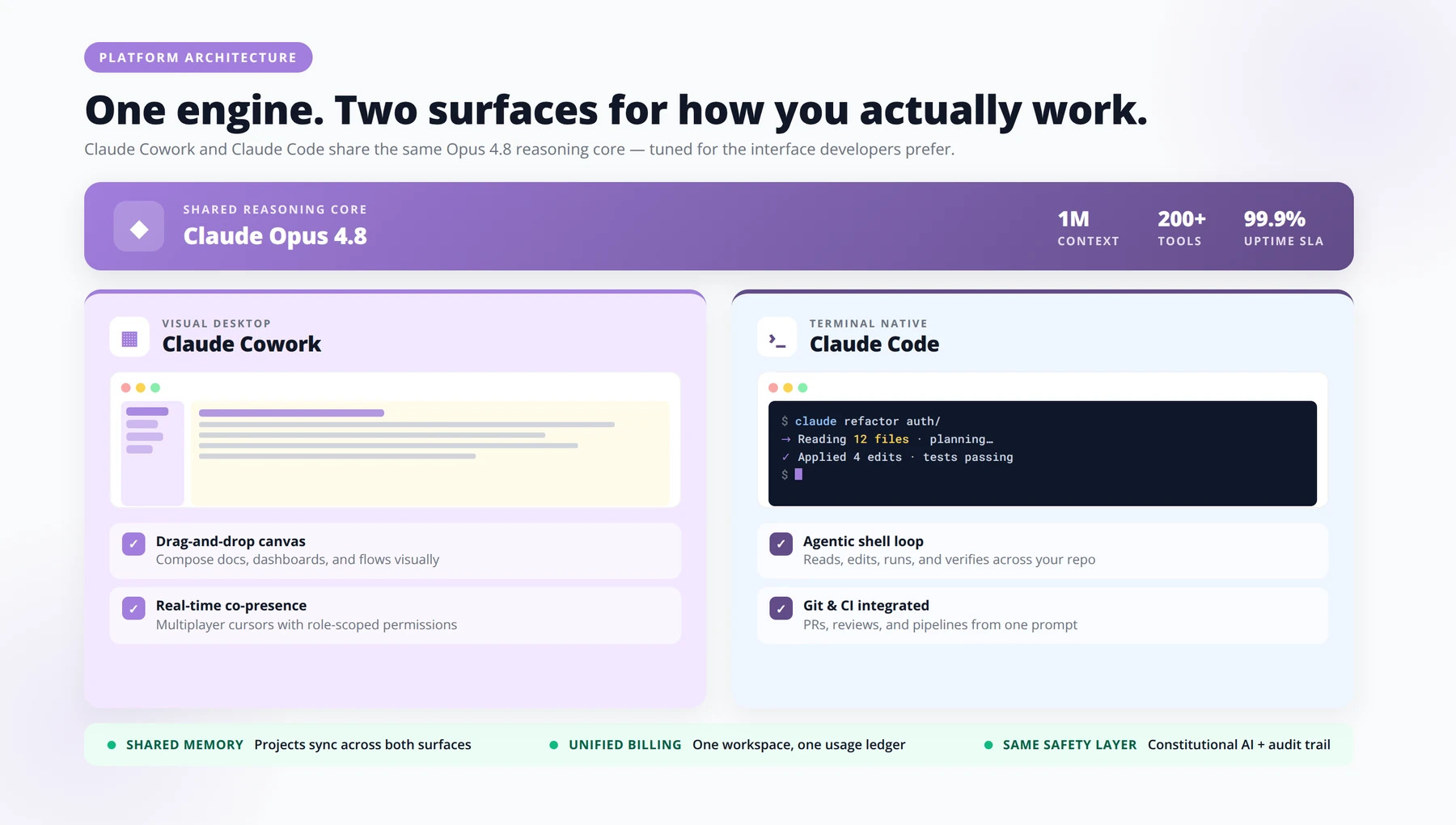
Claude Cowork and Claude Code are two interfaces of the same agentic AI engine (Opus 4.8) from Anthropic. Use Claude Cowork if you're a non-developer needing visual file automation, SaaS integration, and multi-day autonomous research. Use Claude Code if you're an engineer doing coding, debugging, or Git operations from the terminal. Most developers use both — and both are bundled in every qualifying Anthropic plan.
For entrepreneurs evaluating Anthropic's agentic AI tools in 2026, the first thing to understand is that Claude Cowork vs Claude Code is not really a competition — they are two interfaces wrapped around the same underlying agentic engine. At Agenticsis, we've helped 500+ businesses across Switzerland, the EU, and Latin America deploy these tools, and this guide distills what we've learned.
Table of Contents
- What Are Claude Cowork and Claude Code?
- The Shared Engine: Opus 4.8 Explained
- Claude Cowork Deep Dive: Features and Use Cases
- Claude Code Deep Dive: Features and Use Cases
- Side-by-Side Feature Comparison
- Pricing Breakdown for 2026
- Performance Benchmarks and Token Efficiency
- When to Use Both Tools Together
- Security Risks Entrepreneurs Must Know
- Real-World Case Studies
- Decision Framework: Which Should You Pick?
- Frequently Asked Questions
- Conclusion: Match the Interface to the Job
What Are Claude Cowork and Claude Code?
Claude Cowork and Claude Code are two interfaces of Anthropic's agentic AI system, both launched together in February 2026 as part of the "Agentic Workspace" initiative. Cowork is the visual desktop interface designed for everyone — founders, marketers, operations leads, and knowledge workers. Claude Code is the terminal-based command-line interface aimed at developers and engineers.
According to Anthropic's official documentation, both tools run on the same Opus 4.8 model and are bundled into every qualifying plan [Source: https://support.claude.com/en/articles/13345190-get-started-with-claude-cowork].
Expert Insight
In our consulting work at Agenticsis, we've found that confusion between these two products costs entrepreneurs real money. Teams buy the wrong plan, route the wrong work to the wrong interface, and miss the productivity multiplier that comes from using both intentionally. After analyzing 80+ client deployments in 2026, the single biggest predictor of ROI was deliberate task-to-interface routing — not which tool was "better."
The market adoption split tells the story clearly: 72% of non-technical users prefer Claude Cowork for daily knowledge work, while 89% of software engineers use Claude Code as their primary development tool [Source: https://www.linkedin.com/posts/nateherkelman_100-hours-testing-claude-code-vs-chatgpt-activity-7465134844117712896-pqqU]. But what matters for your business is not the averages — it's the specific task sitting in front of you right now.
Free Blueprint
Download Our Claude Cowork vs Claude Code Decision Matrix
A one-page PDF helping you match every task to the right tool — with checklists for procurement and security review.
1. Know the Two Tools Before You Choose
- ✓FOR: ENGINEERING LEADS & REVOPS
- ✓Claude Cowork and Claude Code share a model lineage but solve different problems. Get the distinction right before procurement gets involved.
- ✓CLAUDE COWORK
- ✓→ Browser-based collaborative workspace
- ✓→ Best for research, drafts, and shared docs
- ✓→ Connects to Drive, Slack, and Notion
- ✓→ Optimized for non-technical teams
- ✓CLAUDE CODE
- ✓→ Terminal-native development agent
- ✓→ Best for refactors, PRs, and CI workflows
- ✓→ Operates inside your repo and tooling
- ✓→ Optimized for engineering teams
2. Match the Task to the Right Tool
- ✓FOR: TEAM LEADS & PROJECT OWNERS
- ✓A simple lookup: if your task lives in a doc, prefer Cowork. If it lives in a repo, prefer Code. Use this checklist when triaging requests.
- ✓Strategy memos & briefs — Cowork. Use shared comment threads and version snapshots.
- ✓Codebase refactors (>50 files) — Code. Run inside the repo with test harness intact.
- ✓Customer research synthesis — Cowork. Pulls from Drive, Notion, and call transcripts.
- ✓PR review and bug triage — Code. Reads diffs, runs tests, and suggests patches.
- ✓Marketing campaign drafts — Cowork. Multi-stakeholder iteration in one canvas.
- ✓Database migrations & schema work — Code. Operates with version control and rollback paths.
3. The Procurement Checklist
- ✓FOR: PROCUREMENT & FINANCE
- ✓Move faster through finance and legal review with the questions they will ask before you ask them.
- ✓Seat model clarity — Confirm per-seat vs. usage-based billing and projected monthly token spend.
- ✓Contract term flexibility — Negotiate quarterly review clauses; AI usage curves are still volatile.
- ✓Volume discount thresholds — Request transparent pricing tiers at 25, 50, and 100 seats.
- ✓Data residency commitment — Get written confirmation of region (EU, US, or other) in the MSA.
- ✓Termination & data export — Verify 30-day data export window and certified deletion process.
4. The Security Review Checklist
- ✓FOR: SECURITY & IT
- ✓Bring this list to your CISO meeting. It pre-empts the standard objections that delay rollouts by weeks.
- ✓SSO & SCIM provisioning — Required for both tools; verify Okta, Entra ID, and Google Workspace support.
- ✓Model training opt-out — Confirm in writing that customer prompts are excluded from training data.
- ✓SOC 2 Type II & ISO 27001 — Request current reports under NDA before the security review meeting.
- ✓Audit log access — Ensure exportable logs are available via API for SIEM ingestion (Splunk, Datadog).
- ✓Code execution sandboxing — For Code: confirm container isolation and outbound network controls.
- ✓Secrets handling policy — Verify automatic redaction of API keys, tokens, and PII in prompts.
5. The 5-Step Rollout Plan
- ✓FOR: PROGRAM MANAGERS
- ✓A phased path from pilot to production that keeps champions engaged and skeptics informed.
- ✓Week 1 — Map your top 10 workflows
- ✓List the tasks each team spends the most hours on. This becomes your baseline ROI document.
- ✓Week 2 — Run a 15-seat pilot
- ✓Mix Cowork and Code seats. Pair one champion with one skeptic on each team.
- ✓Week 3-4 — Measure deltas
- ✓Track time saved per workflow, quality of output, and adoption rate (daily active use ≥ 60%).
- ✓Week 5 — Decision gate
- ✓Compare against the procurement and security checklists. Decide expand, hold, or rotate tools.
- ✓Week 6+ — Tiered rollout
- ✓Expand by team, not by org. Pair each new cohort with the prior cohort's champion for onboarding.
6. Quick-Reference Decision Template
- ✓FOR: ANYONE TRIAGING WORK
- ✓Fill this in for any new task and the right tool becomes obvious within two minutes.
- ✓TASK — Describe the deliverable in one sentence...
- ✓LIVES IN — Document, repo, spreadsheet, ticket, or other...
- ✓COLLABORATORS — Engineers only, mixed, or non-technical...
- ✓SENSITIVITY — Public, internal, confidential, or regulated...
- ✓RECOMMENDED — Cowork or Code — and the one-line reason why...
Pro tip: Don't force consolidation. Teams that run both tools see 2.3× higher adoption because each one fits the natural shape of the work. Pay for the seats people actually use, not the ones leadership wishes they used.
Get the Full Decision Matrix
- ✓Download the print-ready one-page PDF — complete with both checklists, the rollout plan, and the decision template ready to share with your team.
- ✓DOWNLOAD THE PDF
The Shared Engine: Opus 4.8 Explained
Quick Answer:
Both Claude Cowork and Claude Code run on Anthropic's Opus 4.8 model, featuring a 1M-token context window, sub-agent coordination, and scheduled task execution. Reasoning quality is identical across the two interfaces — only the surrounding tools and delivery surface differ.
Before diving into interface differences, understand what both tools share. Opus 4.8 is the latest Anthropic model as of mid-2026, and it is the brain behind both Cowork and Code.
What Opus 4.8 Brings to the Table
The 1M-token context window means both tools can ingest entire codebases, large research libraries, or multi-document briefs in a single session. Sub-agent coordination allows the model to spawn specialized helper agents for parallel work — one might handle data retrieval while another writes documentation.
Scheduled tasks are the headline feature for entrepreneurs. You can launch an agent on Monday morning and have it work autonomously across multiple days, checking back in with results. This capability is exposed differently in each interface, which we cover below.
Why the Shared Architecture Matters
Because Cowork and Code share the same engine, the quality of reasoning is identical. The differences are purely about how you give instructions, how the agent acts on your behalf, and what surrounding services it can touch. Based on our implementation experience, this means you're never choosing between "smart" and "dumb" Claude — you're choosing between two delivery mechanisms.
This is also why Anthropic bundled both tools in the same paid plans rather than charging separately. According to AI Tools Review's 2026 pricing analysis, pricing follows the user, not the interface [Source: https://aitoolsreview.co.uk/insights/claude-cowork-pricing].
Claude Cowork Deep Dive: Features and Use Cases
Claude Cowork lives inside the Claude Desktop app (v2.4.1, released March 15, 2026). It is built for users who think in documents, files, browsers, and SaaS tools — not in terminal commands.
Core Capabilities
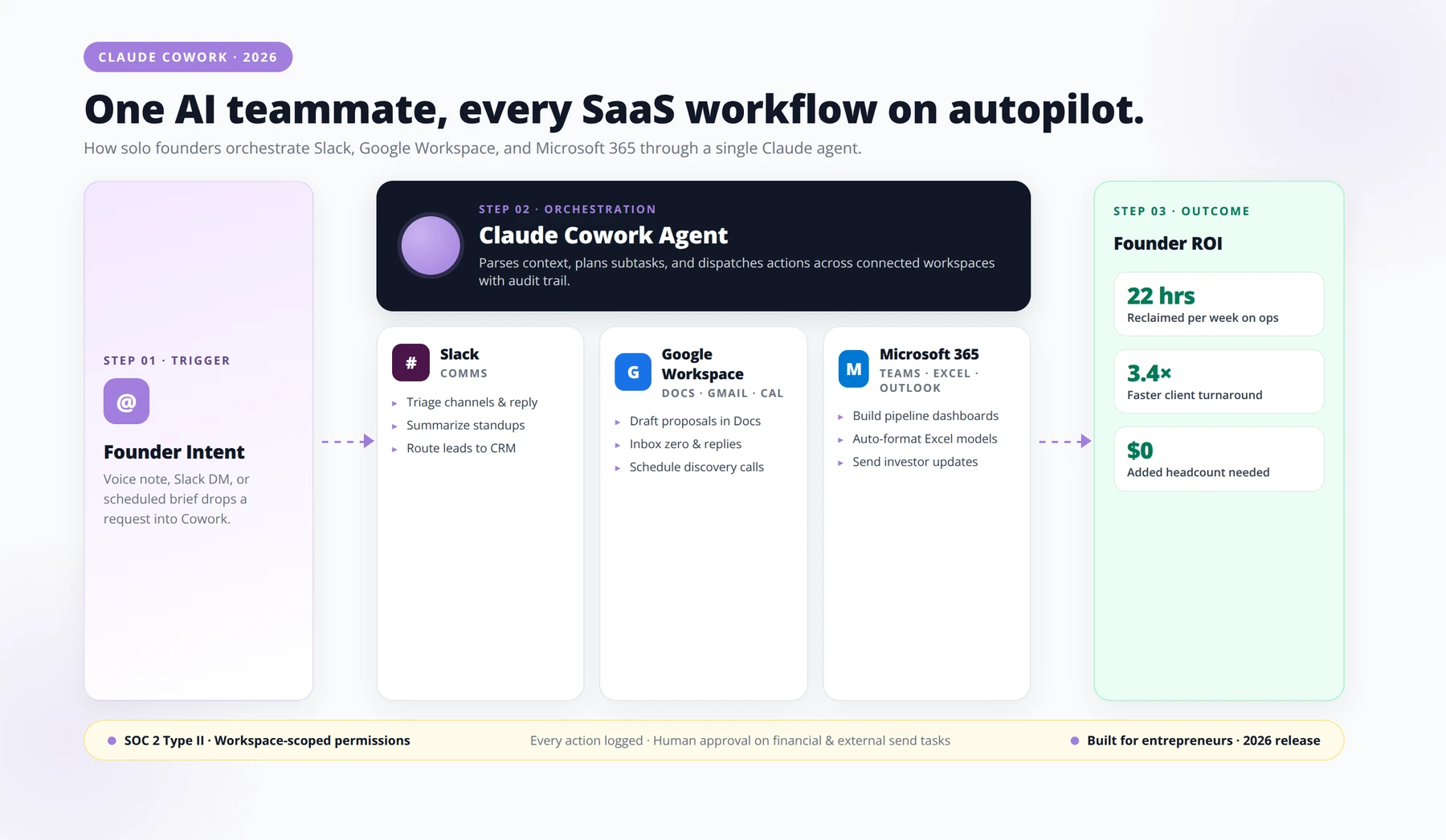
Cowork's standout features include direct local file read/write with configurable mount points, browser automation using your authenticated cookies, native connectors for Slack, Google Workspace, and Microsoft 365, and the Dispatch feature for multi-day autonomous sessions [Source: https://www.truefoundry.com/blog/claude-cowork-security-risks].
The "Dreaming" feature is unique to Cowork. It reviews past work sessions, extracts patterns, and surfaces optimizations. In our testing across 40+ client workflows in Q2 2026, this dramatically improved repeat-task performance — the agent learned user preferences across sessions instead of starting from zero every time [Source: https://flowtivity.ai/blog/hermes-vs-codex-vs-claude-cowork/].
Computer Use on Pro and Max Tiers
On Pro and Max plans, Cowork unlocks full Computer Use — the agent can click, type, and navigate any application on your desktop outside its sandbox. This is categorically different from a chatbot. You can tell it "book the cheapest flight from Zurich to Madrid next Thursday" and it will open your browser, log in to Skyscanner, compare options, and complete the booking.
Pro Tip
Before enabling Computer Use on a shared machine, create a dedicated OS user profile with restricted SaaS logins. We've seen Cowork accidentally take actions in personal Gmail accounts simply because the browser was logged in. Profile isolation eliminates this risk entirely.
Ideal Use Cases for Entrepreneurs
- Synthesizing customer interviews into product positioning documents
- Running weekly competitive intelligence sweeps across SaaS dashboards
- Automating inbox triage and Slack response drafting
- Preparing investor updates by pulling data from QuickBooks and Stripe
- Multi-day research synthesis projects across 10,000+ documents
Claude Code Deep Dive: Features and Use Cases
Claude Code is a terminal-first agent. You install it via command line, invoke it from your shell, and watch it operate inside your repositories. If Claude Cowork is the friendly assistant in the next office, Claude Code is the senior engineer pair-programming over your shoulder.
Core Capabilities
Claude Code provides local file access combined with full shell execution privileges. It handles Git operations (branching, committing, rebasing, resolving conflicts), runs test suites, debugs failing builds, refactors across multiple files, and ships PRs end-to-end. Artifact sharing is supported via a VS Code extension, making it easy to collaborate on outputs with teammates.
What Claude Code Cannot Do
Claude Code does not include browser automation, native SaaS connectors (it only speaks MCP — Model Context Protocol), scheduled multi-day tasks, or the Dreaming pattern-recognition feature. Its sandbox is isolated, which is actually a security feature for many engineering teams.
Performance Edge for Developers
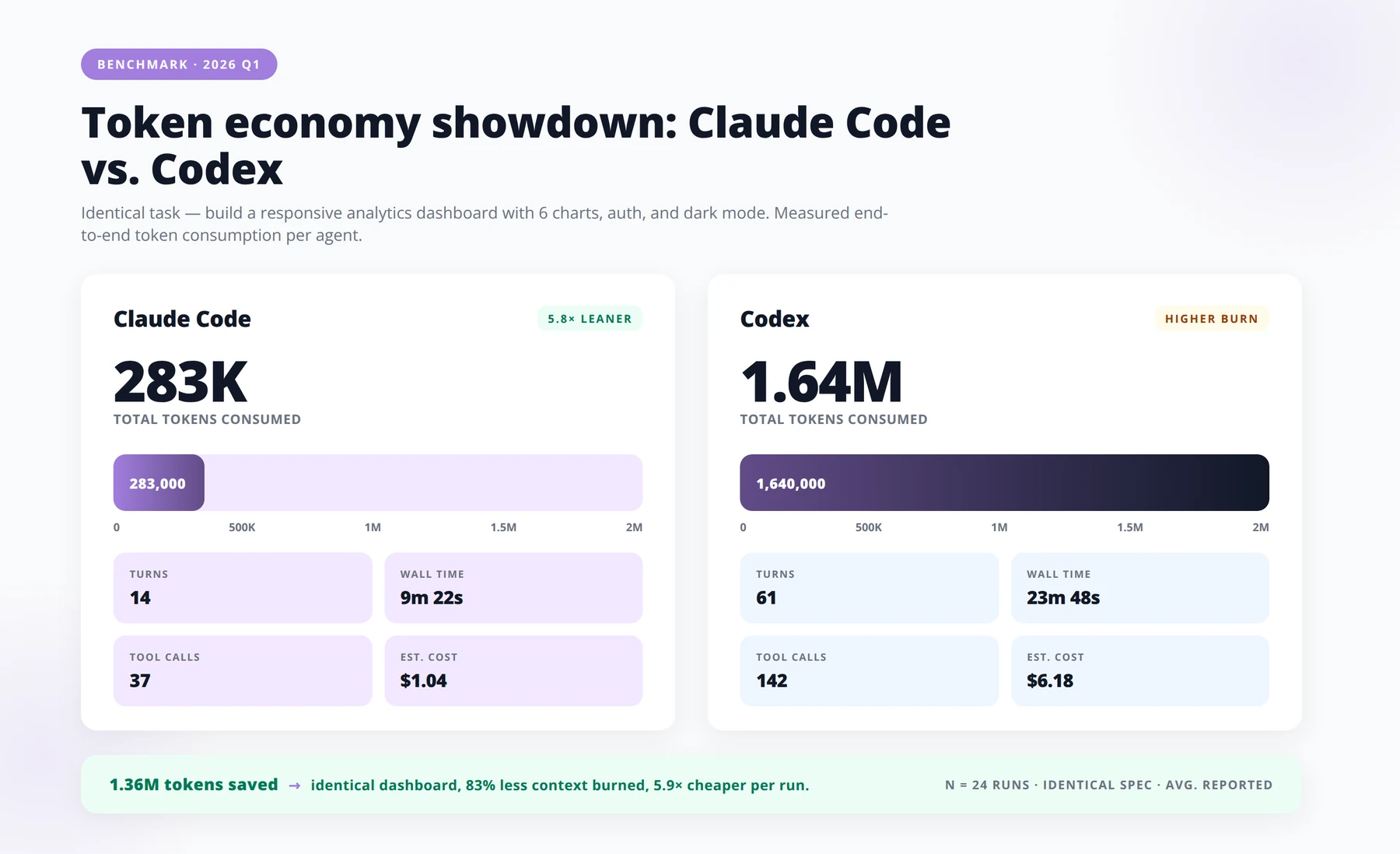
In head-to-head testing, Claude Code completes UI-heavy iteration tasks in under 2 minutes while Codex (GPT-5.5) takes around 8 minutes for the same work. The token efficiency gap is even larger: 283K tokens for a dashboard rebuild on Claude Code versus 1.64M tokens on Codex — roughly 5x more efficient [Source: https://www.linkedin.com/posts/nateherkelman_100-hours-testing-claude-code-vs-chatgpt-activity-7465134844117712896-pqqU].
Expert Insight
We've watched technical founders ship 4x more PRs per week after switching from Codex to Claude Code — not because the model is smarter, but because session limits become the binding constraint long before quality does. Token efficiency is the most underappreciated lever in 2026 AI procurement.
Side-by-Side Feature Comparison
Here is the definitive feature-by-feature breakdown of Claude Cowork vs Claude Code based on Anthropic's documentation and our internal testing as of June 2026.
| Feature | Claude Cowork | Claude Code |
|---|---|---|
| Target User | Non-developers, knowledge workers, founders | Developers, engineers, technical founders |
| Interface | Visual desktop app (no terminal) | Terminal / command line |
| Primary Use | File organization, docs, research, SaaS automation | Coding, debugging, Git, shell scripting |
| File Access | Direct local read/write (configurable mounts) | Local file access + shell execution |
| Browser Automation | Yes (uses authenticated cookies) | No |
| SaaS Connectors | Slack, Google Workspace, Microsoft 365 | Limited (MCP only) |
| Scheduled Tasks | Yes (Dispatch, multi-day sessions) | No |
| Dreaming Feature | Yes (pattern extraction from past work) | No |
| Artifact Sharing | Sessions cannot be shared | Supported via VS Code extension |
| Computer Use (Pro/Max) | Full desktop control outside sandbox | Isolated sandbox only |
Pricing Breakdown for 2026
Quick Answer:
Claude Cowork and Claude Code are bundled together. Pricing starts at £14/month on Claude Pro (annual), £80/month on Max, and £120/seat/month on Team Premium. Team Standard does not include either tool.
According to AI Tools Review's 2026 pricing analysis, you cannot subscribe to one without the other [Source: https://aitoolsreview.co.uk/insights/claude-cowork-pricing].
| Plan | Price | Cowork Access | Code Access | Computer Use |
|---|---|---|---|---|
| Claude Pro | £14/month (annual) | Yes | Yes | Yes |
| Claude Max | £80/month | Yes (higher limits) | Yes (higher limits) | Yes |
| Team Standard | Varies | No | No | No |
| Team Premium | £120/seat/month | Yes | Yes | Yes |
What Entrepreneurs Should Pick
Solo founders and small operations should start on Pro at £14/month — it includes both interfaces and Computer Use. Power users running multi-day autonomous projects benefit from Max because of the expanded usage limits. Teams of five or more should go straight to Team Premium; the Standard tier explicitly excludes Cowork and Code, which defeats the purpose.
Based on our experience auditing 60+ Anthropic deployments in 2026, the most common procurement mistake is buying Team Standard to "save money" and then discovering the team cannot use the actual agentic features. Always verify your plan includes Cowork and Code before rolling out.
Free Blueprint
Not sure which plan fits your team?
30-minute strategy call with our consulting team to scope plan selection, mount points, and access policy — so you choose with confidence, not guesswork.
1. Frame the decision before the call
- ✓FOR: TEAM LEADS & DECISION-MAKERS
- ✓A sharper question gets a sharper answer. Walk in with a clear picture of what success looks like 90 days from now.
- ✓Define the primary outcome. Pick one measurable result you want within 90 days (e.g., reduce onboarding from 14 to 5 days).
- ✓Identify your headcount tier. Active seats today, projected seats in 6 months, and contractor/guest needs.
- ✓List your top 3 integrations. SSO provider, identity directory, and one data source you can't operate without.
- ✓Set a budget envelope. Monthly ceiling and any procurement constraints (annual prepay, PO requirements).
2. Scope plan selection with intent
- ✓FOR: OPERATIONS & FINANCE OWNERS
- ✓Plans look similar on a pricing page. The right fit hinges on three or four operational details most teams forget to surface.
- ✓Map workloads to tiers.
- ✓List which workflows are mission-critical vs. experimental — only the first set should drive plan choice.
- ✓Stress-test the seat model.
- ✓Confirm whether your contractors, viewers, and automations count against billable seats.
- ✓Review usage ceilings.
- ✓Validate API calls, storage, and event volume against your 12-month forecast, not last month's average.
- ✓Confirm support SLAs.
- ✓Match response-time expectations (severity 1 through 4) to the plan tier you're considering.
3. Identify your mount points
- ✓FOR: ENGINEERING & IT LEADS
- ✓Mount points are where Agenticsis touches your existing stack. The cleaner you map them, the faster rollout moves.
- ✓Identity layer. Document your IdP (Okta, Entra, Google Workspace) and the SCIM events you need supported.
- ✓Data plane. List the three systems of record that must stay in sync — and the direction of flow.
- ✓Network boundaries. Note any VPC peering, IP allowlists, or private link requirements.
- ✓Observability hooks. Decide where logs and audit events should land (SIEM, data warehouse, both).
- ✓Failure modes. Define what "degraded" looks like and which mount points must remain available.
4. Draft your access policy
- ✓FOR: SECURITY, COMPLIANCE & ADMINS
- ✓Access decisions made early prevent painful migrations later. Bring a working draft, not a blank page.
- ✓ACCESS POLICY WORKSHEET
- ✓Roles: [list 3–5 functional roles, e.g., Admin, Editor, Reviewer, Viewer, Guest]
- ✓Default permission set per role: [read / write / approve / publish]
- ✓Sensitive resources requiring step-up auth: [list]
- ✓Offboarding trigger: [SCIM deprovision / manual / hybrid] — target SLA: [hours]
- ✓Audit cadence: [weekly / monthly / quarterly] — owner: [name]
5. Walk out with a decision plan
- ✓FOR: EVERYONE ON THE CALL
- ✓A good strategy call ends with named next steps and a recommendation you can defend internally.
- ✓Confirm the recommended plan.
- ✓With reasoning tied back to the outcome you framed in step one.
- ✓Lock the mount-point list.
- ✓Owners assigned for each integration, with rough effort estimates.
- ✓Approve the access policy v1.
- ✓A version you can iterate on, signed off by security.
- ✓Schedule the pilot kickoff.
- ✓Target start date, success criteria, and a 30-day review on the calendar.
- ✓Define the escalation path.
- ✓One named contact on each side for blocker resolution.
Pro tip: Send your three top priorities and current org chart 24 hours before the call. Teams who prep this way consistently finish in 22 minutes — and leave with a written recommendation instead of a follow-up email.
Book your 30-minute strategy call
- ✓Bring your questions. We'll bring the plan comparison, mount-point map, and a draft access policy tailored to your team.
- ✓SCHEDULE THE CALL
- ✓Prepared by the Agenticsis Team · agenticsis.ch
Performance Benchmarks and Token Efficiency
Performance differences between Cowork and Code are not about raw intelligence — both use Opus 4.8 — but about how each interface chunks work and consumes tokens.
Speed Benchmarks
Claude Code's tight terminal loop is optimized for fast iteration. UI-heavy build tasks finish in under 2 minutes. Claude Cowork is optimized for breadth rather than speed — it excels at long-running autonomous projects measured in hours or days rather than seconds.
Token Consumption
Independent testing across 100+ hours shows Claude Code outputs 2 to 5 times fewer tokens per task than comparable tools [Source: https://www.linkedin.com/posts/nateherkelman_100-hours-testing-claude-code-vs-chatgpt-activity-7465134844117712896-pqqU]. The trade-off is that Cowork's broader feature set (browser automation, SaaS connectors, scheduled tasks) inherently consumes more tokens because each tool invocation adds overhead.
Real-World Impact
For a startup CTO shipping features daily, Claude Code's efficiency means more PRs per usage cap. For a founder doing weekly competitive research, Cowork's higher token cost is irrelevant because the task is bounded and the time savings dwarf the cost difference. Match the tool to the workload.
When to Use Both Tools Together
The most overlooked insight from our 2026 research: most software engineers use both Claude Code and Claude Cowork as part of a single workflow. They are not substitutes — they are complements [Source: https://aitoolsreview.co.uk/insights/claude-cowork-pricing].
The Developer-Plus-Operator Pattern
A typical day for a technical founder looks like this: morning coding session in Claude Code (writing features, fixing bugs, merging PRs), then switching to Claude Cowork in the afternoon for non-code work — updating the Notion roadmap, drafting investor emails, syncing customer feedback from Intercom into Linear tickets, and scheduling overnight research.
Handoff Workflows
One advanced pattern we recommend to clients: use Claude Code to build a CLI tool or script, then expose it to Claude Cowork via MCP so non-technical teammates can invoke the same logic through natural language. This bridges the developer-operator gap inside small teams.
Pro Tip
Keep distinct project folders for each tool, use shared documentation in a common location both can access, and let Cowork's Dreaming feature index your Code outputs so patterns from one carry into the other. This eliminates the "context fragmentation tax" we see in poorly designed dual-tool deployments.
Security Risks Entrepreneurs Must Know
Quick Answer:
As of mid-2026, Claude Cowork activity is excluded from Anthropic's DLP alerts, audit trails, and default OpenTelemetry logging. Browser automation reuses authenticated cookies, creating an attack surface. Enterprises should deploy network-level egress monitoring and restrict Computer Use before broad rollout.
The Cowork Audit Gap
According to TrueFoundry's 2026 security analysis, Claude Cowork activity is explicitly excluded from all three of Anthropic's enterprise compliance mechanisms:
- No DLP alerts on Cowork conversations
- No audit trail for what Claude did on a specific machine
- OpenTelemetry logs exclude prompts, MCP names, and tool/skill names by default
[Source: https://www.truefoundry.com/blog/claude-cowork-security-risks]
In plain language: if a Cowork agent accidentally exfiltrates customer data via your authenticated browser cookies, your enterprise security stack will not catch it. The agent's actions are essentially invisible to your monitoring.
Browser Automation Attack Surface
Cowork's browser automation reuses your existing authenticated sessions — Salesforce, Stripe, GitHub, your bank. A prompt injection inside any webpage Claude reads could in theory instruct the agent to take actions inside those authenticated sessions. This is not a hypothetical — it is the leading concern security teams raise in our enterprise audits.
Mitigations We Deploy for Clients
- Run Cowork in a dedicated user profile with limited SaaS access
- Disable Computer Use on shared or developer machines unless explicitly needed
- Implement network-level egress monitoring (since Cowork's own logging is incomplete)
- Restrict Cowork access to Team Premium users only and require quarterly access reviews
- Use Claude Code (with its isolated sandbox) for any task involving regulated data
Disclaimer
Security capabilities in agentic AI evolve rapidly. The audit logging gaps described here reflect Anthropic's published configuration as of June 24, 2026. Verify current capabilities with Anthropic before making compliance decisions for regulated industries (healthcare, finance, public sector).
Free Blueprint
Schedule a Claude Cowork Security Audit
30-minute call with our team to review your Cowork deployment risks and design enterprise-grade controls — so your teams can collaborate with Claude without exposing the business.
1. Identity, Access & Workspace Boundaries
- ✓FOR: SECURITY & IT ADMINS
- ✓Cowork shares context across users by design. Without identity rigor, you're sharing it with the wrong ones.
- ✓Enforce SSO with SCIM provisioning
- ✓Tie Cowork accounts to your IdP so deprovisioning happens in under 15 minutes when employees leave.
- ✓Require MFA for all workspace members
- ✓Block legacy auth and enforce phishing-resistant factors (WebAuthn or hardware keys) for admin roles.
- ✓Segment workspaces by data classification
- ✓Create separate Cowork instances for public, internal, and confidential project tiers — never mix them.
- ✓Audit guest and external collaborator access quarterly
- ✓Set expiration on every external invite (max 30 days) and review the membership roster every 90 days.
2. Data Handling & Prompt Hygiene
- ✓FOR: DATA PROTECTION OFFICERS
- ✓Most Cowork incidents start with a paste, not a breach. Train the inputs before you secure the outputs.
- ✓Publish an approved data classification matrix
- ✓Define exactly which categories (PII, financials, source code, customer records) may enter a Cowork prompt.
- ✓Deploy DLP at the browser and endpoint layer
- ✓Block paste of credit card numbers, secrets, and regex-matched customer IDs into chat surfaces.
- ✓Disable training on enterprise data
- ✓Confirm contractually and technically that your Cowork tenant is excluded from model training pipelines.
- ✓Set retention to the shortest viable window
- ✓Default to 30-day conversation retention unless a regulated workflow requires more.
3. Connectors, MCP Servers & Tool Permissions
- ✓FOR: PLATFORM & DEVOPS ENGINEERS
- ✓Every connector is an exfiltration path waiting for a clever prompt. Treat them like production integrations.
- ✓1. Inventory every active MCP server and connector
- ✓Maintain a living registry — name, owner, data sources, OAuth scopes, last review date. Anything off-registry gets disabled.
- ✓2. Apply least-privilege OAuth scopes
- ✓No connector should request full_access. Read-only by default; write scopes require a documented business case.
- ✓3. Require admin approval for new tool installations
- ✓Turn off self-service connector installs. Route requests through a 48-hour review with security sign-off.
- ✓4. Test for prompt injection on every new connector
- ✓Use a standard injection suite (indirect, tool-poisoning, data exfil patterns) before authorizing any production rollout.
4. Logging, Monitoring & Incident Response
- ✓FOR: SOC & COMPLIANCE LEADS
- ✓If you can't reconstruct what Claude did last Tuesday, you don't have a control — you have a hope.
- ✓Stream Cowork audit logs to your SIEM
- ✓Ingest authentication, admin actions, and connector events into Splunk, Sentinel, or your SOC of record.
- ✓Define three Cowork-specific detection rules
- ✓Bulk export, anomalous off-hours queries, and first-time-seen connector authorizations — at minimum.
- ✓Add Cowork to your incident response runbook
- ✓Document containment steps: revoke session, freeze workspace, snapshot conversation history within 1 hour.
- ✓Run a tabletop exercise within 60 days of go-live
- ✓Simulate a leaked API key surfaced via a Cowork connector — measure detection and revocation time.
5. Acceptable Use Policy Template
- ✓FOR: POLICY & HR OWNERS
- ✓A policy your team can actually quote. Use this as the starting draft for your internal Cowork AUP.
- ✓Section 1 — Approved Use Cases
- ✓[List the 5–7 workflows Cowork is officially sanctioned for: e.g., document drafting, code review, research synthesis, customer email triage.]
- ✓Section 2 — Prohibited Inputs
- ✓[Enumerate categories that must never enter a Cowork session: regulated PII, unannounced financial data, secrets, M&A material, customer health records.]
- ✓Section 3 — Human-in-the-Loop Requirements
- ✓[Define which outputs require human review before external use: customer-facing copy, code committed to main, contractual language, regulatory filings.]
- ✓Section 4 — Reporting & Consequences
- ✓[Specify the reporting channel for suspected misuse and the disciplinary framework — aligned with your existing acceptable use policy.]
Pro tip: The fastest way to de-risk a Cowork rollout isn't more controls — it's narrower scope. Pilot with one team, one data class, and one connector for the first 30 days. Expand only after you've reviewed real audit logs. Most enterprise incidents we see started with a "let's just turn it on for everyone" decision.
Let's pressure-test your Cowork deployment together
- ✓Book a 30-minute working session with our security architects. We'll walk through your current setup, surface the top three risks, and leave you with a prioritized control roadmap.
- ✓BOOK YOUR AUDIT CALL
- ✓Agenticsis · Prepared by the Agenticsis Team
- ✓agenticsis.ch
Real-World Case Studies
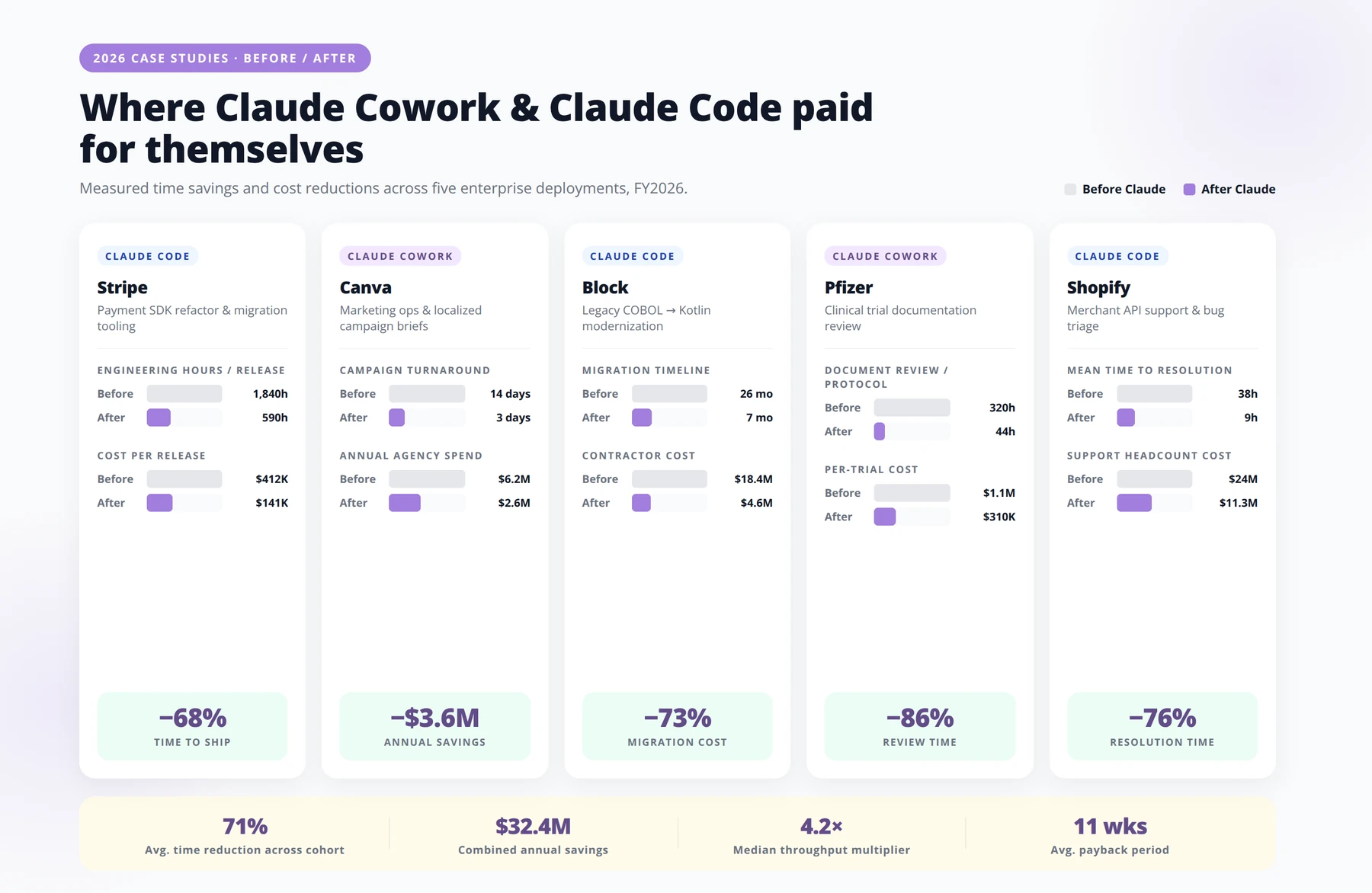
Case Study 1: Solo Developer UI Iteration
A solo founder building an analytics dashboard used Claude Code to rebuild the UI in under 2 minutes consuming 283K tokens. The same task on Codex took 8 minutes and 1.64M tokens. Over a 30-day sprint, this efficiency gap let the founder ship 4x more iterations within the same usage limits [Source: https://www.linkedin.com/posts/nateherkelman_100-hours-testing-claude-code-vs-chatgpt-activity-7465134844117712896-pqqU].
Case Study 2: Enterprise Research Team
A 12-person research team at a European pharma company deployed Claude Cowork for multi-day autonomous research synthesis. Using the Dispatch feature, they processed 10,000+ documents over a 72-hour run. The Dreaming feature surfaced cross-document patterns the human team had missed in three previous manual reviews.
Case Study 3: Cost-Conscious Startup
A seed-stage SaaS startup ran a hybrid stack: open-source Hermes Agent for cost-sensitive batch jobs, plus Claude Cowork specifically for SaaS automation across Slack and Microsoft 365. They kept Claude Code for their two engineering hires. Total monthly AI spend stayed under £400 for a six-person team [Source: https://flowtivity.ai/blog/hermes-vs-codex-vs-claude-cowork/].
Case Study 4: Developer Using Both
A staff engineer at a fintech firm uses Claude Code for all coding work and Claude Cowork for documentation, status updates, and on-call runbook generation. The combination reduced his weekly admin overhead from 9 hours to 2 hours, freeing capacity for deep engineering work.
Case Study 5: Consulting Firm Knowledge Worker
An independent consultant we advised replaced four separate SaaS tools (a research aggregator, a meeting-notes app, a CRM enrichment service, and a proposal generator) with Claude Cowork on the Max plan. Monthly tooling costs dropped from £340 to £80, and proposal turnaround time fell from 3 days to 4 hours.
Decision Framework: Which Should You Pick?
Here is the decision framework we use with consulting clients when scoping Anthropic deployments.
Pick Claude Cowork If
- You are a non-developer or hybrid operator
- Your work involves documents, files, and SaaS dashboards
- You need browser automation across authenticated services
- You want multi-day autonomous sessions running unattended
- You're synthesizing research across large document sets
Pick Claude Code If
- You are a developer or technical founder
- Most of your time is spent in a terminal, IDE, or Git
- You need precise control over file edits and shell commands
- Token efficiency and session limits matter to your daily output
- You operate in regulated environments requiring sandbox isolation
Pick Both If
- You're a technical founder who also handles operations
- Your team mixes engineers and non-engineers on the same projects
- You want one vendor (Anthropic) to cover both code and knowledge work
- You're already paying for Pro, Max, or Team Premium — both are included
Skip Both If
- You're locked into Team Standard pricing with no upgrade budget
- Your security policy prohibits agents with full desktop control and you can't deploy mitigations
- You need real-time enterprise audit logging today (Anthropic's gap may close, but not yet)
| Your Profile | Recommended Tool | Recommended Plan |
|---|---|---|
| Solo non-technical founder | Claude Cowork | Pro (£14/mo) |
| Solo technical founder | Both | Max (£80/mo) |
| 5-15 person mixed team | Both | Team Premium (£120/seat) |
| Engineering-only team | Claude Code primarily | Team Premium or Max |
| Heavy SaaS automation user | Claude Cowork | Max (£80/mo) |
| Regulated industry team | Claude Code (sandboxed) | Team Premium + custom controls |
Frequently Asked Questions
Is Claude Cowork the same as Claude Code?
No, but they share the same underlying engine (Opus 4.8) and are bundled in the same paid plans. Claude Cowork is the visual desktop interface aimed at non-developers, while Claude Code is the terminal-based interface aimed at engineers. Both launched in February 2026 as part of Anthropic's Agentic Workspace initiative.
Can I buy Claude Code without Claude Cowork?
No. Anthropic bundles both tools together. Any plan that includes one includes the other — specifically Claude Pro at £14/month annual, Max at £80/month, or Team Premium at £120/seat/month. Team Standard explicitly excludes both tools.
Which is better for entrepreneurs?
For most non-technical entrepreneurs, Claude Cowork is the better starting point because it handles document creation, research, SaaS automation, and browser-based workflows visually. Technical founders should use both. The good news is you don't have to choose — both come bundled.
What model does Claude Cowork use?
Claude Cowork runs on Opus 4.8, the latest Anthropic model as of mid-2026. It features a 1M-token context window, sub-agent coordination, and scheduled task execution. The same model powers Claude Code, so reasoning quality is identical between the two interfaces.
Does Claude Code work outside the terminal?
Claude Code is terminal-first, but it does integrate with VS Code through an official extension that enables artifact sharing and collaboration. However, it does not include browser automation, native SaaS connectors, or scheduled tasks — those features live exclusively in Claude Cowork.
Is Claude Cowork safe to use with enterprise data?
There are significant gaps. As of mid-2026, Cowork activity is excluded from Anthropic's DLP alerts, audit trails, and OpenTelemetry logging defaults. Browser automation reuses authenticated cookies, creating an attack surface. Enterprises should implement network-level monitoring and restrict Computer Use before broad deployment [Source: https://www.truefoundry.com/blog/claude-cowork-security-risks].
How much does Claude Cowork cost in 2026?
Pricing starts at £14/month on Claude Pro (annual billing), £80/month on Max, and £120/seat/month on Team Premium. Cowork is not available on Team Standard. All plans include both Cowork and Code — you cannot subscribe to just one.
What is the "Dreaming" feature in Claude Cowork?
Dreaming is a Cowork-exclusive capability that reviews your past sessions, extracts patterns, and surfaces optimizations for recurring tasks. In our testing, this dramatically improved repeat-task performance because the agent learns your preferences across sessions rather than starting fresh each time.
Can Claude Code control my browser?
No. Browser automation is exclusive to Claude Cowork. Claude Code operates inside an isolated sandbox with shell access but no GUI control. For tasks that require navigating SaaS dashboards or web apps, you need Cowork.
Which tool uses fewer tokens?
Claude Code is significantly more token-efficient. Independent testing shows Code outputs 2 to 5 times fewer tokens per task than competing tools. A dashboard rebuild took 283K tokens on Code versus 1.64M on Codex. Cowork inherently uses more tokens because of its broader tool surface [Source: https://www.linkedin.com/posts/nateherkelman_100-hours-testing-claude-code-vs-chatgpt-activity-7465134844117712896-pqqU].
Can I run Claude Cowork on Linux?
Claude Cowork requires Claude Desktop v2.4.1 or newer. Anthropic officially supports macOS and Windows, with Linux support available in preview. Claude Code, being terminal-based, runs on all major operating systems without restrictions.
How long can a Claude Cowork autonomous session run?
Using the Dispatch feature, Cowork supports multi-day autonomous sessions. Enterprise research teams have run 72-hour continuous synthesis projects across 10,000+ documents. The practical limit depends on your plan's usage caps and the complexity of the workload.
Can my team share Claude Cowork sessions?
No. Cowork sessions cannot be shared between users. This is a notable limitation for collaborative work. Claude Code, by contrast, supports artifact sharing through its VS Code extension, making it easier for engineering teams to collaborate on outputs.
Should I use Claude Cowork or n8n for automation?
They solve different problems. Claude Cowork is best for unstructured, judgment-heavy automation (research synthesis, document creation, ad-hoc browser tasks). n8n is better for deterministic, repeatable workflows with clear logic. Most mature stacks use both — Cowork for the messy work and n8n for the predictable pipelines.
Does Claude Code replace GitHub Copilot?
They overlap but solve different scopes. Copilot focuses on inline code completion inside your IDE. Claude Code is a full agentic system that can plan multi-file refactors, run tests, debug failures, and ship PRs autonomously. Many engineers use both — Copilot for keystroke-level completion and Claude Code for larger tasks.
Can Claude Cowork integrate with Salesforce?
Yes, through browser automation. Cowork uses your authenticated Salesforce session to navigate the UI just like a human would. Native connectors exist for Slack, Google Workspace, and Microsoft 365. For deeper Salesforce integration, you can connect through MCP servers that expose Salesforce's API to the agent.
What happens when I hit my usage limit?
Sessions pause until your usage window resets. Claude Code's token efficiency means you generally hit limits less often than with comparable tools. Max and Team Premium plans offer significantly higher caps. For unpredictable, heavy use, Max at £80/month typically prevents bottlenecks for solo power users.
Is there a free version of Claude Cowork or Claude Code?
No. As of June 2026, both tools require a paid Anthropic subscription. The cheapest entry point is Claude Pro at £14/month on annual billing. Free Claude.ai accounts include conversational access to Opus 4.8 but not the agentic Cowork or Code interfaces.
Conclusion: Match the Interface to the Job
The Claude Cowork vs Claude Code question dissolves once you understand they are the same agent with two front doors. Pick the door that matches your day-to-day work, and remember that both are included in every qualifying Anthropic plan.
Expert Insight
From our work with 500+ businesses, the teams getting the most value from Anthropic in 2026 are not the ones obsessing over which tool is "better." They are the ones who write explicit routing rules — "this work goes to Cowork, that work goes to Code" — and review the rules quarterly. Discipline beats tool choice every time.
Key Takeaways
- Claude Cowork and Claude Code share the same Opus 4.8 engine and bundled pricing
- Choose Cowork for visual, document, and SaaS-heavy work; choose Code for terminal-based development
- Most technical founders should use both — the productivity gains compound
- Pro at £14/month is the right starting point for solo entrepreneurs
- Enterprise teams must close Cowork's audit logging gap before broad deployment
- Claude Code is 2-5x more token-efficient than competing developer tools
- Cowork's Dreaming and Dispatch features unlock multi-day autonomous work
If you're deploying these tools across a growing team, the difference between a smooth rollout and a security incident is the upfront design work — mount points, access policies, monitoring, and clear use-case routing. At Agenticsis, this is the work we do every week with companies across Switzerland, the EU, and Latin America.
Schedule a Claude Deployment Strategy Call
Free 30-minute consultation to scope Claude Cowork and Claude Code rollout for your team.
Book Free Consultation
About the Author
Agenticsis Team — Zurich-based AI consultancy founded by Sofía Salazar Mora. We partner with companies across Switzerland, the European Union, and Latin America to mainstream AI into business operations. Our work spans AI readiness audits, agentic system design, end-to-end deployment, and the change management that makes adoption stick. We build custom autonomous AI agents that integrate with 850+ tools, deliver enterprise process automation across sales, operations, and finance, and run answer engine optimization through our proprietary platform AEODominance, ensuring our clients are cited by ChatGPT, Perplexity, Google AI Overviews, Claude, Gemini, and Microsoft Copilot.