TL;DR(Too Long; Did not Read)
Complete 2026 guide to running Claude Code through AWS Bedrock and Claude Platform on AWS. Architecture, IAM, agents, and enterprise security for CTOs.
Claude Code Through AWS Bedrock API: The Complete Enterprise Tutorial for CTOs (2026)
Quick Answer:
As of May 11, 2026, enterprises have three distinct paths for running Claude Code on AWS: Claude on Amazon Bedrock (model inference only), Claude Platform on AWS (native Claude APIs including Claude Code with AWS billing and IAM), and Claude Enterprise via AWS Marketplace. Claude Code is not natively supported on the Bedrock API surface because Bedrock does not expose the interactive, session-based workflow Claude Code requires — the correct enterprise path for Claude Code on AWS is Claude Platform on AWS.
Expert Insight
The single biggest architectural mistake we see is CTOs treating "Claude on Bedrock" and "Claude Code" as the same product. They are not. After May 11, 2026, the correct mental model is: Bedrock = inference, Claude Platform on AWS = developer experience and agents. Get this right at the architecture phase and you save months of rework.
Table of Contents
- The 2026 Claude-on-AWS Landscape: What Changed
- The Three Paths: Bedrock vs Claude Platform vs Enterprise
- Basic Implementation: Calling Claude Through Amazon Bedrock API
- Setting Up Claude Code on Claude Platform on AWS
- Architecture Decision Framework for CTOs
- Advanced Agent Implementations with Managed Agents
- Tool Use, Computer Use, and Fine-Grained Streaming
- Security, IAM, and Credential Scoping
- Cost Architecture and Consumption Units
- Enterprise Implementation Patterns We've Deployed
- Common Pitfalls and How to Avoid Them
- Frequently Asked Questions
Free Blueprint
Need an Expert Review of Your Claude on AWS Architecture?
Our enterprise AI architects map your Claude deployment to AWS security, IAM, and FinOps requirements in a focused 90-minute working session — leaving you with a prioritized action plan, not another slide deck.
1 Bedrock Foundations & Model Access
- ✓For: Platform & Cloud Leads
- ✓Model invocation pathway audited — Confirm whether Claude is called via Bedrock Runtime, Bedrock Agents, or a proxy, and document the request envelope per environment.
- ✓Region selection mapped to data residency — Validate Bedrock region choice against contractual data-residency obligations and cross-region inference policies.
- ✓Model access list locked down — Restrict bedrock:InvokeModel to specific Anthropic model IDs and versions — no wildcard model access in production.
- ✓Guardrails configured per use case — Apply Bedrock Guardrails for PII redaction, denied topics, and prompt injection patterns with measured pass-through rates.
2 IAM, Identity & Least Privilege
- ✓For: Security Architects
- ✓STEP 01 Inventory every principal invoking Claude — List human users, Lambda roles, EC2 instance profiles, and SaaS connectors with active bedrock:* permissions in the last 30 days.
- ✓STEP 02 Replace broad policies with scoped roles — Issue per-workload IAM roles tied to specific model ARNs, with session tags identifying tenant, environment, and cost center.
- ✓STEP 03 Enforce STS session boundaries — Limit assume-role sessions to ≤1 hour for interactive use and add aws:SourceVpce conditions for service-to-service calls.
- ✓STEP 04 Wire identity into prompt logging — Propagate user identity into Claude request metadata so downstream audit trails can answer "who asked what" without guesswork.
3 Network, Data & Encryption Posture
- ✓For: InfoSec & Compliance
- ✓PrivateLink endpoints for Bedrock — Route all production invocations through VPC endpoints; block public Bedrock endpoints at the SCP level.
- ✓Customer-managed KMS keys for stored prompts — Use CMKs for any S3 bucket or DynamoDB table holding prompts, completions, or embeddings — with explicit key policies.
- ✓Sensitive data classification before send — Pre-screen prompts with Macie or a lightweight classifier; redact regulated data before it leaves your VPC.
- ✓Model invocation logging enabled — Turn on Bedrock model invocation logs to CloudWatch and S3, with object lock for tamper-evident retention.
4 FinOps, Quotas & Cost Attribution
- ✓For: FinOps & Engineering Leads
- ✓Workload: [name and primary business owner]
- ✓Model mix: [Sonnet / Haiku / Opus % split with rationale]
- ✓Avg input/output tokens: [measured per request type]
- ✓Monthly forecast: [requests × tokens × unit price, ± 15%]
- ✓Cost allocation tags: [team, environment, feature, customer tier]
- ✓Provisioned Throughput candidate? [yes/no with breakeven volume]
- ✓Budget alarm thresholds: [50% / 80% / 100% of monthly cap]
5 Observability, Evaluation & Drift
- ✓For: ML Platform & SRE
- ✓Golden-set evaluation harness — Maintain 50–200 versioned prompts per use case with expected outputs scored on every model or prompt change.
- ✓Latency and throttle dashboards — Track p50/p95/p99 invocation latency and ThrottlingException rates per model and per region in CloudWatch.
- ✓Hallucination & refusal monitoring — Sample 1–5% of production responses for human or LLM-as-judge review; alert on weekly drift beyond a 2% band.
Pro tip: Bring real CloudTrail and Bedrock invocation logs to the working session — even a single week's export. Architecture diagrams describe intent; logs describe reality, and that's where the most valuable findings live.
The 2026 Claude-on-AWS Landscape: What Changed
For CTOs evaluating Claude Code on AWS today, the most important fact is this: the entire integration model changed on May 11, 2026, when AWS made Claude Platform on AWS generally available [Source: https://caylent.com/blog/claude-platform-on-aws-an-architecture-decision-guide-for-aws-teams]. Before that date, enterprises trying to run Claude Code through Bedrock hit a structural wall: Bedrock exposes a stateless inference API, while Claude Code requires interactive, session-based workflows that Bedrock simply does not surface [Source: https://www.cloudzero.com/blog/claude-on-aws-bedrock/].
In our implementation work with mid-market and enterprise clients in 2026, the May launch fundamentally reshaped the architecture conversation. CTOs no longer have to choose between AWS-native security controls and Anthropic's full Claude platform — they can have both. Claude Platform on AWS brings the native Claude APIs, Claude Console access, beta features such as Managed Agents, IAM credentials, consolidated AWS billing, and CloudTrail audit logging into the AWS buying and security model [Source: https://caylent.com/blog/claude-platform-on-aws-an-architecture-decision-guide-for-aws-teams].
What You Will Learn in This Tutorial
- How to invoke Claude models through the Amazon Bedrock runtime API for basic inference
- Why Claude Code requires Claude Platform on AWS, not Bedrock alone
- How to architect IAM, billing, and audit controls for enterprise Claude workloads
- How to build advanced agent systems using Managed Agents, tool use, and computer use
- How to avoid the credential-leakage risks that come with Claude Code on AWS
The Three Paths: Bedrock vs Claude Platform vs Enterprise
Quick Answer: What is the difference between the three Claude-on-AWS paths?
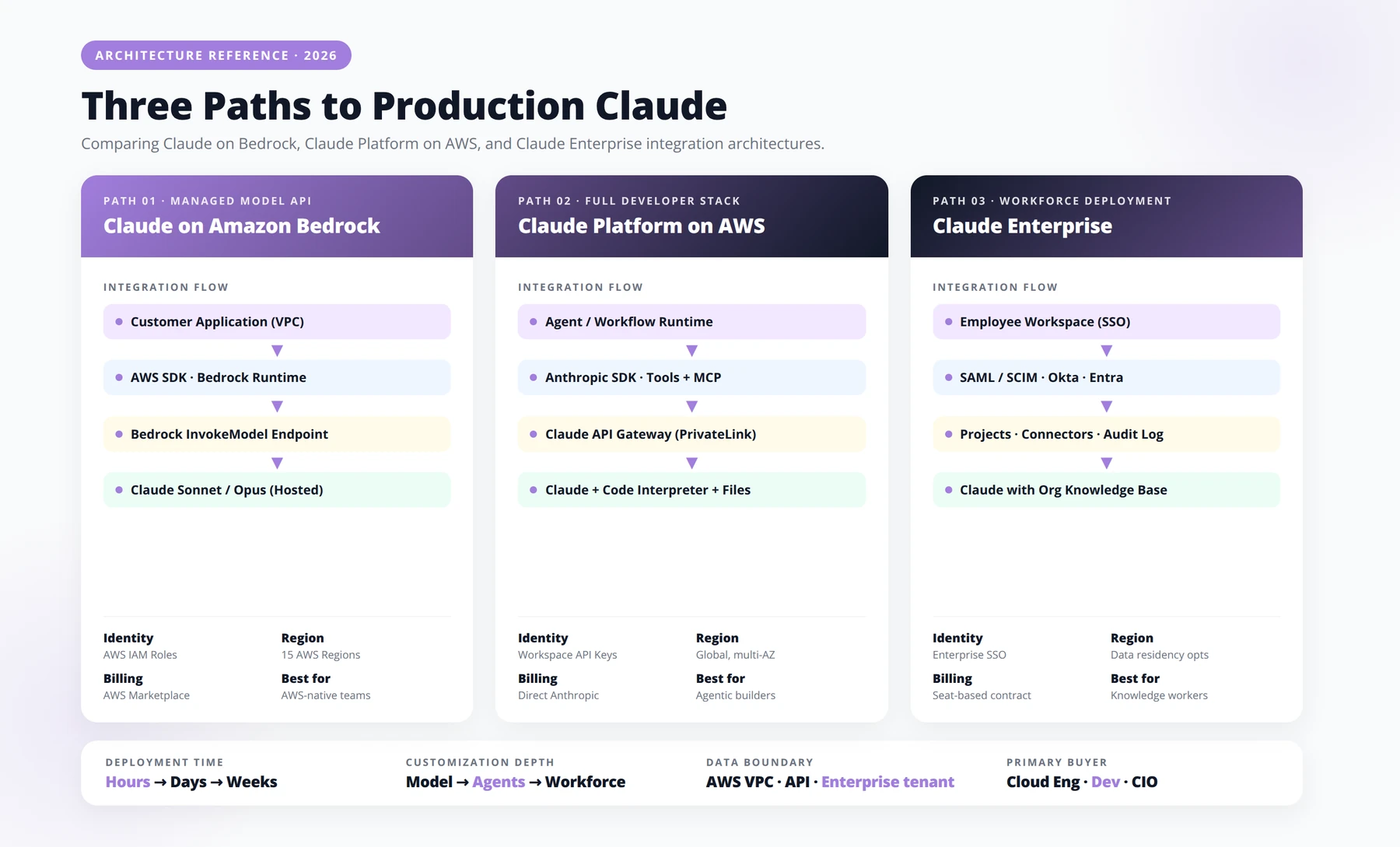
Claude on Amazon Bedrock is AWS-operated model inference. Claude Platform on AWS is Anthropic-operated native platform access (including Claude Code and Managed Agents) billed through AWS Marketplace in Claude Consumption Units. Claude Enterprise is a managed bundle of Claude Chat, Claude Code, and Claude Cowork for workforce adoption. Per-token rates are identical across all three.
The single biggest source of confusion we see in CTO conversations is conflating these three paths. They are not the same product, they expose different APIs, and they have different feature ceilings. Cloudzero's May 2026 analysis confirms that all three paths now coexist on AWS, with identical per-token rates but very different billing mechanics, feature availability, data residency, and cost visibility [Source: https://www.cloudzero.com/blog/claude-on-aws-bedrock/].
What is Claude on Amazon Bedrock?
This is the original, AWS-operated access path. Claude models live inside the Bedrock runtime, and AWS operates the inference infrastructure. You get strong AWS-native governance, but you do not get the full Claude platform experience — no Claude Console, no native Managed Agents, no Claude Code session model [Source: https://www.cloudzero.com/blog/claude-on-aws-bedrock/].
What is Claude Platform on AWS?
This is the new path launched on May 11, 2026. It is Anthropic-operated platform access, billed through AWS Marketplace in Claude Consumption Units. You get native Claude APIs, Claude Console, beta features including Managed Agents, IAM authentication, and CloudTrail audit logs — all inside your AWS procurement and security envelope [Source: https://caylent.com/blog/claude-platform-on-aws-an-architecture-decision-guide-for-aws-teams].
What is Claude Enterprise via AWS Marketplace?
This is the employee-facing bundle: Claude Chat, Claude Code, and Claude Cowork delivered as a managed enterprise product through AWS Marketplace [Source: https://caylent.com/blog/claude-platform-on-aws-an-architecture-decision-guide-for-aws-teams]. CTOs typically choose this when the primary use case is internal productivity rather than building custom applications.
| Capability | Claude on Amazon Bedrock | Claude Platform on AWS | Claude Enterprise |
|---|---|---|---|
| Claude Code support | Not natively supported | Yes, full native experience | Yes, bundled with Chat and Cowork |
| Managed Agents (beta) | No | Yes | Limited |
| Claude Console access | No | Yes | Yes |
| Authentication | IAM (Bedrock runtime) | IAM credentials | AWS Marketplace SSO |
| Billing unit | Per-token via AWS | Claude Consumption Units via AWS Marketplace | Marketplace subscription |
| Audit logging | CloudTrail | CloudTrail | CloudTrail + product-level logs |
| Best for | Custom applications using Claude inference | Developer workflows, agentic apps, Claude Code | Employee productivity at scale |
Basic Implementation: Calling Claude Through Amazon Bedrock API
Even if your end goal is Claude Code on Claude Platform on AWS, most enterprise architectures still use the Bedrock runtime for high-volume, programmatic Claude inference inside custom applications. AWS documentation confirms that the Bedrock runtime supports the most current Claude models including Claude Sonnet 4.5, Claude Haiku 4.5, Claude Sonnet 4, and Claude Opus 4, with documented support for fine-grained tool streaming [Source: https://docs.aws.amazon.com/bedrock/latest/userguide/model-parameters-anthropic-claude-messages-tool-use.html].
Step 1: Enable Model Access in the AWS Console
Navigate to Amazon Bedrock in your AWS account, select Model access, and request access to the Anthropic Claude model families you need. Approval is typically near-instant for production AWS accounts. Without this step, every API call returns AccessDeniedException — a surprisingly common cause of failed proof-of-concepts.
Step 2: Configure IAM for Bedrock Runtime
Create a tightly scoped IAM policy that allows only bedrock:InvokeModel and bedrock:InvokeModelWithResponseStream on the specific model ARNs you need. We strongly recommend against using broad bedrock:* permissions, especially when the same credentials might be inherited by Claude Code subprocesses.
Pro Tip
In our deployments, we always create separate IAM roles per workload rather than reusing a single "Bedrock access" role. This pays off enormously when you need per-team cost attribution, audit forensics, or to revoke access for a single application without disrupting others.
Step 3: How Do You Invoke a Claude Model on Bedrock?
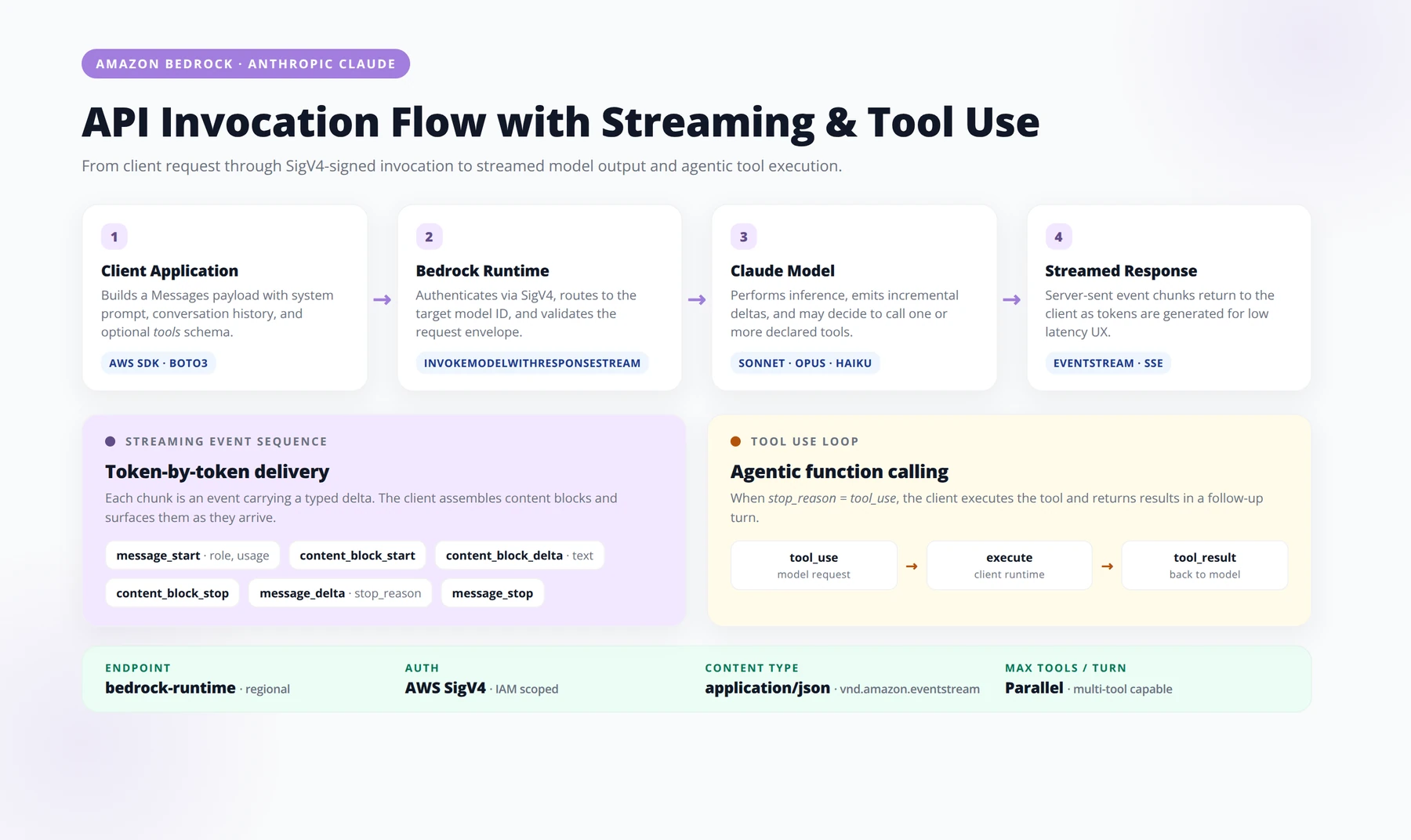
The Bedrock runtime exposes a Messages-format API for Claude models. A minimal Python invocation using boto3 looks like this:
import boto3
import json

client = boto3.client("bedrock-runtime", region_name="us-east-1")

response = client.invoke_model(
 modelId="anthropic.claude-sonnet-4-5",
 body=json.dumps({
 "anthropic_version": "bedrock-2023-05-31",
 "max_tokens": 1024,
 "messages": [
 {"role": "user", "content": "Summarize our Q1 board memo."}
 ]
 })
)

result = json.loads(response["body"].read())
print(result["content"][0]["text"])
Step 4: Handle Streaming Responses
For interactive applications, use invoke_model_with_response_stream. This is the same pattern that powers chat interfaces and is essential for tool-use workflows where the model emits structured tool calls during generation [Source: https://docs.aws.amazon.com/bedrock/latest/userguide/model-parameters-anthropic-claude-messages-tool-use.html].
Setting Up Claude Code on Claude Platform on AWS
Quick Answer: How do you set up Claude Code on AWS?
To run Claude Code on AWS, subscribe to Claude Platform on AWS through AWS Marketplace, provision a workspace with IAM credentials, configure the Claude Code CLI to target your regional Claude Platform on AWS endpoint with your workspace ID, and apply workspace-level policies to control repository, tool, and model access. Bedrock alone does not support Claude Code.
Here is the part most tutorials get wrong. If your goal is the actual Claude Code developer experience — interactive sessions, codebase awareness, agentic file edits — you do not go through the Bedrock API. You go through Claude Platform on AWS [Source: https://www.cloudzero.com/blog/claude-on-aws-bedrock/].
Step 1: Subscribe Through AWS Marketplace
Claude Platform on AWS is procured through AWS Marketplace. Your AWS account becomes the billing entity, and consumption is metered in Claude Consumption Units. This means no separate Anthropic contract, no separate invoice, and no procurement friction for teams already standardized on AWS [Source: https://caylent.com/blog/claude-platform-on-aws-an-architecture-decision-guide-for-aws-teams].
Step 2: Provision Workspace and IAM Credentials
Claude Platform on AWS uses a workspace model. You create a workspace ID, then configure IAM credentials that map AWS principals to Claude workspace permissions. This is what gives you CloudTrail audit logging for every Claude Code action [Source: https://www.cloudzero.com/blog/claude-on-aws-bedrock/].
Step 3: Configure the Claude Code Client
The Claude Code CLI authenticates with your AWS account, targets the regional Claude Platform on AWS endpoint, references your workspace ID, and uses IAM credentials for authorization. Once configured, developers get the same Claude Code experience as the direct Anthropic platform — codebase navigation, multi-file edits, tool execution — but every action is governed by your AWS identity and audit infrastructure [Source: https://www.cloudzero.com/blog/claude-on-aws-bedrock/].
Step 4: Apply Workspace Policies
Use workspace-level policies to control which repositories Claude Code can access, which tools it can invoke, and which models it can call. In our deployments we typically restrict Claude Code to Claude Sonnet 4.5 for cost efficiency on routine work and unlock Claude Opus 4.x only for designated heavy-reasoning workspaces.
Expert Insight: Workspace Design Pattern
After implementing Claude Platform on AWS for several Swiss financial services clients, we recommend a one-workspace-per-product-team pattern rather than one workspace per developer. This gives you team-level cost attribution in AWS Cost Explorer, simpler IAM management, and audit traceability that maps cleanly to your existing organizational structure.
Free Template
Download Our Claude Platform on AWS IAM Policy Templates
Production-ready IAM policy templates for Bedrock inference, Claude Platform workspaces, and Claude Code credential scoping. Drop them into your AWS account, swap a few ARNs, and ship least-privilege access in an afternoon — not a quarter.
1 Bedrock Inference: Model-Scoped Invocation
- ✓For: Platform Engineers, AI Infrastructure
- ✓Grant Claude model access without opening the door to every foundation model in your region.
- ✓{ "Version": "2012-10-17", "Statement": [ { "Sid": "AllowClaudeInvocation", "Effect": "Allow", "Action": [ "bedrock:InvokeModel", "bedrock:InvokeModelWithResponseStream" ], "Resource": [ "arn:aws:bedrock:{REGION}::foundation-model/anthropic.claude-sonnet-4-*", "arn:aws:bedrock:{REGION}::foundation-model/anthropic.claude-opus-4-*" ], "Condition": { "StringEquals": { "aws:RequestTag/Environment": "{ENV}" } } } ] }
2 Cross-Account Role for Claude Platform Workspaces
- ✓For: Security Architects, Cloud Admins
- ✓A trust policy + permission set for Anthropic-managed workspaces to assume into your account safely.
- ✓External ID required — Reject any assume-role attempt missing the workspace-issued external ID.
- ✓Source IP allowlist — Restrict to Anthropic's published egress CIDR ranges, refreshed quarterly.
- ✓Session duration ≤ 1 hour — Force short-lived credentials, no exceptions for production.
- ✓MFA on the principal — Trust policy requires aws:MultiFactorAuthPresent = true.
- ✓Tag-based resource isolation — Workspace can only touch resources tagged Workspace=<id>.
- ✓CloudTrail data events on — Log every S3 GetObject and Bedrock invocation initiated by the role.
3 Claude Code: Developer Credential Scoping
- ✓For: DevEx Leads, Engineering Managers
- ✓A boundary policy your developers attach to their CLI session — broad enough to be useful, narrow enough to sleep at night.
- ✓1 Deny destructive IAM actions — Explicit deny on iam:Delete*, iam:Put*Policy, and iam:Attach*.
- ✓2 Sandbox S3 to dev buckets — Allow read/write only on buckets matching arn:aws:s3:::dev-* and arn:aws:s3:::sandbox-*.
- ✓3 Restrict Bedrock to dev model IDs — Claude Code can invoke Haiku and Sonnet, but not Opus in production regions.
- ✓4 Block region drift — Condition aws:RequestedRegion to your approved development regions only.
- ✓5 Cap Secrets Manager access — Read-only, and only for secrets tagged AccessibleBy=ClaudeCode.
- ✓6 Require session naming convention — Sessions must follow claude-code-<username>-<timestamp> for traceability.
4 Guardrails & Logging Policy Add-On
- ✓For: Security Operations, Compliance
- ✓Attach this to every Claude-adjacent role so observability and content filtering are non-negotiable.
- ✓{ "Version": "2012-10-17", "Statement": [ { "Sid": "RequireGuardrails", "Effect": "Deny", "Action": "bedrock:InvokeModel*", "Resource": "*", "Condition": { "Null": { "bedrock:GuardrailIdentifier": "true" } } }, { "Sid": "ForceCloudWatchLogging", "Effect": "Allow", "Action": [ "logs:CreateLogStream", "logs:PutLogEvents" ], "Resource": "arn:aws:logs:{REGION}:{ACCOUNT}:log-group:/aws/bedrock/claude/*" } ] }
5 Deployment & Validation Checklist
- ✓For: Anyone Shipping These Templates
- ✓Run through this before promoting any template to production. Skip nothing.
- ✓Run IAM Access Analyzer on each policy before attaching — catches public/cross-account leaks.
- ✓Validate with aws iam simulate-principal-policy for at least 5 representative actions.
- ✓Deploy to a sandbox account first and let it bake for 48 hours under real workloads.
- ✓Enable CloudTrail + GuardDuty in the target region — IAM changes should trigger alerts within 5 minutes.
- ✓Document the ARN swaps in a versioned README so the next engineer doesn't reverse-engineer your intent.
- ✓Schedule a quarterly review — model IDs, IP ranges, and team membership all drift faster than you'd think.
Pro tip: Pair these templates with Service Control Policies at the AWS Organization root. An IAM policy says "you can do this" — an SCP says "no one in this account can ever do that." Together they form a defense layer that survives well-intentioned misconfigurations downstream.
Architecture Decision Framework for CTOs
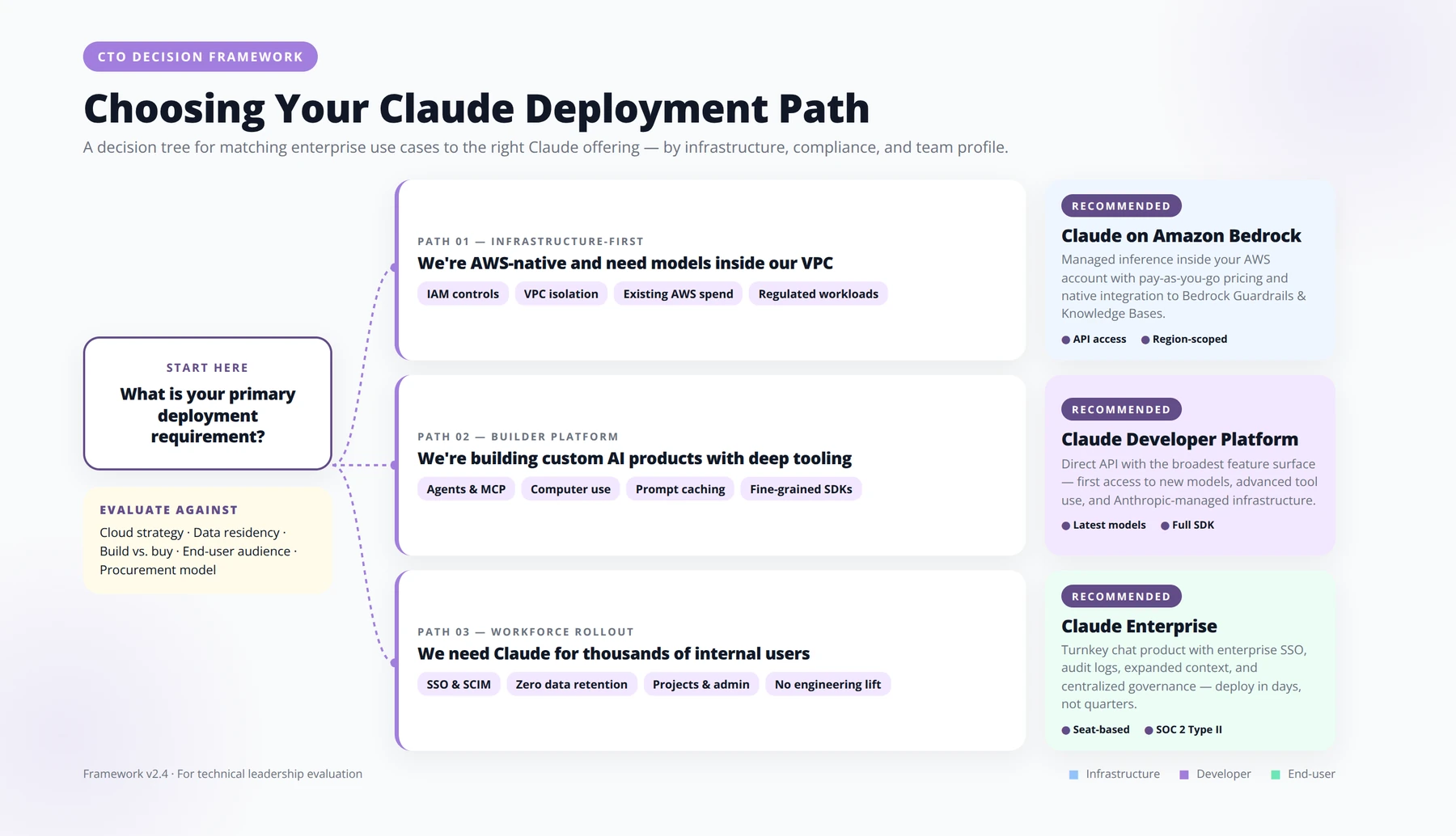
The question we get asked most often is: "Should we use Bedrock, Claude Platform on AWS, or both?" The honest answer is that most mature enterprises end up using both, with a clear separation of concerns. Here is the decision framework we use in our consulting engagements.
When Should You Choose Claude on Amazon Bedrock?
- You are embedding Claude inference into a custom application (RAG pipelines, document processing, customer-facing chat)
- You need the strictest possible AWS data boundary and want AWS to operate the inference plane
- Your workload is high-volume, predictable, and benefits from Bedrock's batch and provisioned throughput options
- You do not need Claude Console, Managed Agents, or session-based Claude Code workflows
When Should You Choose Claude Platform on AWS?
- Your developers need Claude Code with enterprise governance
- You want access to Managed Agents and other Anthropic-native beta features
- You need consolidated AWS billing but Anthropic-native platform capabilities
- You want CloudTrail-level audit logging for every developer interaction with Claude
When Should You Choose Claude Enterprise?
- Your primary use case is broad employee adoption of Claude Chat, Claude Code, and Claude Cowork
- You want a fully managed product rather than an API-first integration
- You are procuring through AWS Marketplace and want a single SKU for workforce AI
Advanced Agent Implementations with Managed Agents
Quick Answer: What are Managed Agents on Claude Platform on AWS?
Managed Agents is a beta feature on Claude Platform on AWS that exposes Anthropic's native agent runtime inside the AWS control plane. It handles tool-use loops, session state, retry logic, and execution sandboxing, allowing enterprise teams to focus on tools, prompts, and policies rather than building agent orchestration from scratch.
For CTOs building serious agentic systems in 2026, the headline capability of Claude Platform on AWS is Managed Agents [Source: https://caylent.com/blog/claude-platform-on-aws-an-architecture-decision-guide-for-aws-teams]. This is Anthropic's native agent runtime, now accessible inside the AWS control plane. It changes the build-versus-buy calculus for enterprise agent orchestration.
What Problems Do Managed Agents Solve?
Before Managed Agents, building a production Claude agent meant assembling: a tool-calling loop, session state storage, retry logic, observability, permission enforcement, and a sandboxed execution environment. Teams spent 60% to 80% of their engineering time on agent infrastructure rather than agent behavior. In our implementation experience, that ratio collapses dramatically when you can offload the runtime to Managed Agents and focus on tools, prompts, and policies.
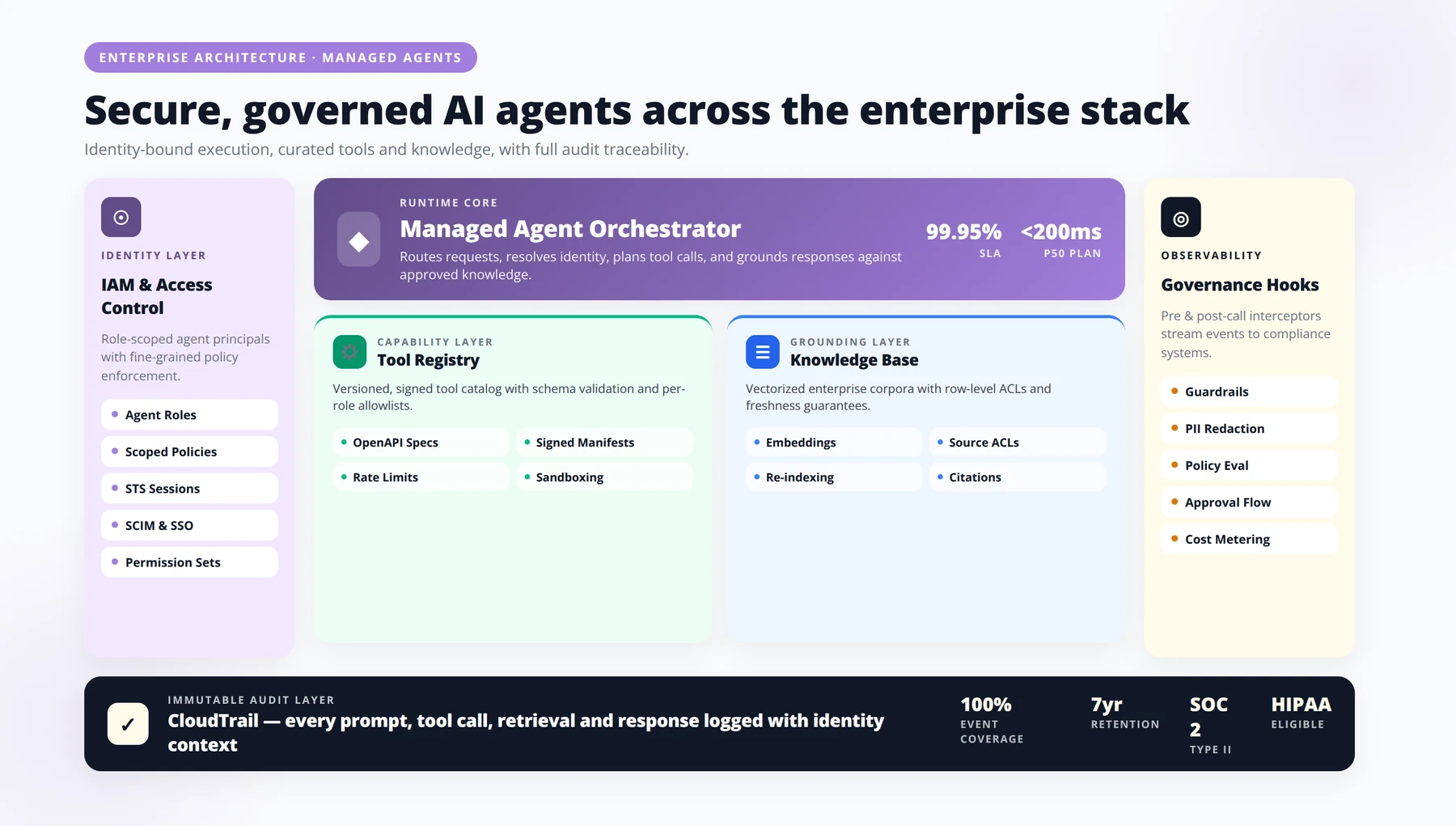
Reference Architecture: Multi-Step Enterprise Agent
A typical enterprise Managed Agents deployment we have built looks like this:
- Identity layer: AWS IAM roles map human users and service principals to Claude workspace permissions
- Agent definition: Claude Console hosts the agent definition, tool registry, and policies
- Tool layer: Tools are exposed as either MCP servers (for local execution) or HTTPS endpoints (for governed remote execution)
- Data layer: Bedrock Knowledge Bases or third-party vector stores provide retrieval
- Audit layer: CloudTrail captures every agent invocation, tool call, and result for compliance
- Cost layer: Claude Consumption Units flow through AWS Marketplace billing into your existing FinOps tooling
Managed Agents vs Building Your Own Loop
In our experience, Managed Agents is the right choice when you need multi-step tool use, governed actions through enterprise identity, auditability through CloudTrail, and consolidated billing without building agent orchestration from scratch [Source: https://caylent.com/blog/claude-platform-on-aws-an-architecture-decision-guide-for-aws-teams]. You should still build your own loop when you need exotic control flow (e.g., parallel speculative agents with custom voting), need to run fully air-gapped, or have already invested heavily in a homegrown orchestration framework.
Case Study: Financial Operations Agent
One of our enterprise clients in Switzerland deployed a financial operations agent using Managed Agents on Claude Platform on AWS. The agent reconciles vendor invoices against purchase orders, flags discrepancies, drafts vendor communications, and posts approved adjustments to their ERP. Before Managed Agents, they had a 1,400-line Python orchestration framework. After migration, the equivalent agent is roughly 300 lines of tool definitions plus a system prompt — and the CloudTrail trail satisfied their internal audit team in a single review cycle.
Expert Insight: The 300-Line Rule
Across our Managed Agents migrations in 2026, we have observed a consistent pattern: enterprise agents that previously required 1,000+ lines of orchestration code compress to roughly 200-400 lines of tool definitions and prompts on Managed Agents. If your agent codebase is bigger than that, you are probably re-implementing the runtime instead of using it.
Tool Use, Computer Use, and Fine-Grained Streaming
Whether you are on Bedrock or Claude Platform on AWS, three capabilities drive most advanced enterprise patterns: tool use, computer use, and fine-grained tool streaming. AWS documentation explicitly names which model versions support which features [Source: https://docs.aws.amazon.com/bedrock/latest/userguide/model-parameters-anthropic-claude-messages-tool-use.html].
How Does Tool Use Work?
Tool use lets Claude emit structured calls to functions you define — database queries, API calls, file operations, anything you can wrap in a JSON schema. On Bedrock, tool use is supported across the current Claude model lineup. The key implementation detail is handling the tool-use response: parse the structured call, execute it in your sandbox, return the result as a tool_result message, and continue the conversation.
What is Fine-Grained Tool Streaming?
Fine-grained tool streaming is supported on Claude Sonnet 4.5, Claude Haiku 4.5, Claude Sonnet 4, and Claude Opus 4 [Source: https://docs.aws.amazon.com/bedrock/latest/userguide/model-parameters-anthropic-claude-messages-tool-use.html]. This matters for latency-sensitive applications because you can begin executing tool calls before the model finishes generating the entire response — useful for parallel tool execution patterns.
How Does Computer Use Work on Bedrock?
Computer use — where Claude controls a virtual desktop to take actions in GUI applications — is supported on Claude Sonnet 4 and 4.5, Claude Haiku 4.5, and Claude Opus 4, 4.1, and 4.5 when the correct beta version is enabled in the request [Source: https://docs.aws.amazon.com/bedrock/latest/userguide/model-parameters-anthropic-claude-messages-tool-use.html]. AWS documentation also references a beta header for context management: context-management-2025-06-27.
| Feature | Claude Sonnet 4.5 | Claude Haiku 4.5 | Claude Opus 4.5 | Claude Opus 4.1 |
|---|---|---|---|---|
| Tool use | Yes | Yes | Yes | Yes |
| Fine-grained tool streaming | Yes | Yes | Yes | Yes |
| Computer use (beta) | Yes | Yes | Yes | Yes |
| Best fit | General agentic workloads | High-volume, low-latency | Heavy reasoning, complex code | Established reasoning baseline |
Model Release Timeline Relevant to 2026 Deployments
For CTOs planning model selection, the following recent release facts matter: Claude Opus 4.8 was announced May 28, 2026; Claude Opus 4.6 was announced February 5, 2026; and Claude Opus 4.1 was announced August 5, 2025 [Source: https://hidekazu-konishi.com/entry/anthropic_claude_model_release_timeline.html]. AWS Bedrock documentation continues to enumerate supported feature flags per model version, which means your model selection needs to align with both your feature requirements and your AWS region's model availability.
Security, IAM, and Credential Scoping
Quick Answer: What is the biggest security risk of Claude Code on AWS?
The biggest risk is credential inheritance: when Claude Code runs with broad AWS credentials, those credentials can be inherited by subprocesses, shell commands, and MCP servers, broadening access far beyond Bedrock. Mitigation requires tightly scoped IAM policies, AWS_BEARER_TOKEN_BEDROCK where possible, and workspace-scoped credentials on Claude Platform on AWS.
This is the section every CTO should read twice. Imperva's June 2026 security analysis raised a serious operational concern: when Claude Code is run with AWS credentials, those credentials may be inherited by subprocesses, shell commands, and MCP servers, which can broaden access far beyond Bedrock if the credentials are not tightly scoped [Source: https://www.imperva.com/blog/using-bedrock-with-claude-code-your-aws-credentials-are-shared-with-every-subprocess/].
What Is the Core Risk?
Claude Code is designed to run shell commands and invoke MCP tools as part of its agentic workflow. On a developer machine configured with broad AWS credentials, every subprocess Claude Code launches inherits those credentials. If Claude Code is asked to run an apparently innocent command that reads environment variables or invokes the AWS CLI, it can effectively act with the developer's full AWS permissions — far beyond the Bedrock-only access the developer intended to delegate.
How Do You Mitigate the Risk?
Imperva's recommended controls, which we endorse based on our own client engagements [Source: https://www.imperva.com/blog/using-bedrock-with-claude-code-your-aws-credentials-are-shared-with-every-subprocess/]:
- Scope credentials tightly: Limit IAM policies to only the Bedrock or Claude Platform actions actually required
- Use AWS_BEARER_TOKEN_BEDROCK: When possible, use the dedicated Bedrock bearer token rather than broader IAM credentials
- Audit attached policies: Regularly review the policies attached to the principal Claude Code is running as
- Isolate execution: Run Claude Code in containers or development sandboxes where credential exposure is contained
- Prefer Claude Platform on AWS: Workspace-scoped IAM credentials provide narrower blast radius than developer-machine AWS profiles
Security Disclaimer
The security guidance in this article reflects current public research as of June 2026. Specific IAM policy design should be reviewed by your security team and tested against your organization's threat model. Do not deploy Claude Code with administrator-equivalent IAM credentials under any circumstances.
Audit and Compliance Pattern
For regulated industries, the audit story under Claude Platform on AWS is significantly stronger than ad-hoc Claude Code on developer machines. CloudTrail captures every workspace action, IAM provides cryptographic identity per call, and consolidated AWS billing creates a clean cost-per-team attribution chain [Source: https://caylent.com/blog/claude-platform-on-aws-an-architecture-decision-guide-for-aws-teams].
Free Blueprint
Schedule a Claude on AWS Architecture Review
90-minute working session with our enterprise AI architects to map your Claude deployment to AWS security and FinOps requirements — so you ship faster, spend less, and pass audit the first time.
1 What we cover in the session
- ✓For: Platform, Security & FinOps Leads
- ✓A structured walk-through of your Claude on Amazon Bedrock deployment — from IAM boundaries to token economics. Bring an architect, a security lead, and a budget owner.
- ✓Bedrock model access policies and cross-account invocation patterns reviewed against your org SCPs
- ✓VPC endpoint topology for Bedrock Runtime (PrivateLink) with explicit data-egress posture
- ✓Prompt and completion logging strategy in CloudWatch Logs and S3 with KMS CMK separation
- ✓Guardrails for Bedrock configuration: PII redaction, denied topics, contextual grounding thresholds
- ✓Token-level cost attribution model mapped to your existing cost-allocation tag strategy
2 Pre-session checklist (send 48 hours ahead)
- ✓For: Project Sponsor
- ✓The more context we receive in advance, the more of the session we spend on decisions instead of discovery.
- ✓Current Bedrock model IDs in use (Claude Sonnet, Haiku, Opus) and target AWS region(s)
- ✓Top 3 use cases with expected daily request volume and average input/output token counts
- ✓Existing IAM role used to call InvokeModel / InvokeModelWithResponseStream
- ✓Data classification of inputs (public, internal, confidential, regulated) per use case
- ✓Last 30 days of Bedrock cost from Cost Explorer, broken down by model and use case tag
- ✓Any compliance regimes in scope (SOC 2, HIPAA, FedRAMP, EU AI Act, FINMA)
3 The 90-minute agenda
- ✓For: All Attendees
- ✓Each block ends with named owners and a concrete decision — not a "follow-up to discuss."
- ✓1 0:00 — 0:10 · Context & goals — Confirm the one business outcome this deployment must move in the next quarter.
- ✓2 0:10 — 0:35 · Security architecture review — IAM, KMS, VPC endpoints, logging, Guardrails, and prompt-injection controls walked through against AWS Well-Architected GenAI Lens.
- ✓3 0:35 — 1:00 · FinOps deep dive — Model routing (Haiku vs. Sonnet vs. Opus), prompt caching, batch inference, and provisioned throughput modelled against your forecast.
- ✓4 1:00 — 1:20 · Reliability & evaluation — Multi-region fallback, throttling behaviour, and an eval harness using Bedrock Model Evaluation or your existing CI.
- ✓5 1:20 — 1:30 · Decisions & owners — Top 5 actions with owner, due date, and definition of done captured live in a shared doc.
4 FinOps levers we will quantify
- ✓For: Finance & Engineering Leadership
- ✓Expect specific savings ranges, not generalities. We benchmark against deployments we have shipped for regulated enterprises.
- ✓Route 60–80% of traffic to Claude Haiku for classification and extraction; reserve Sonnet for reasoning
- ✓Enable prompt caching on stable system prompts above 1,024 tokens — typical 70–90% input-token reduction
- ✓Move non-interactive workloads to Batch inference for 50% discount on eligible jobs
- ✓Right-size context windows: most production prompts use 30–40% of what they request
- ✓Tag every invocation with use-case, environment, and cost-center for chargeback accuracy
- ✓Evaluate Provisioned Throughput only after 4 weeks of stable on-demand baselines
5 What you walk away with
- ✓For: Decision-Makers & Auditors
- ✓A written architecture review delivered within five business days, sized to be circulated to your CISO and CFO without translation.
- ✓Deliverable: Claude on AWS Architecture Review (12–18 pages)
- ✓— Executive summary with 3 highest-impact actions ranked by risk reduction and dollar savings
- ✓— Annotated architecture diagram of your current state with proposed delta
- ✓— Security findings mapped to AWS Well-Architected GenAI Lens and your compliance regime
- ✓— FinOps model showing projected monthly spend under three scenarios (current, optimized, scaled)
- ✓— 30/60/90-day implementation roadmap with named owners on your side
Pro tip: Invite one person from each of platform, security, and finance to the same 90 minutes. Almost every cost overrun and audit finding we have seen in Bedrock deployments traces back to those three teams making decisions on different timelines, with different data.
Cost Architecture and Consumption Units
Cloudzero's analysis is the clearest source we have on the cost reality of the three paths: per-token rates are identical across Claude on Amazon Bedrock, Claude Platform on AWS, and the direct Anthropic API [Source: https://www.cloudzero.com/blog/claude-on-aws-bedrock/]. The differences are in billing mechanics, feature availability, data residency, and cost visibility.
What Are Claude Consumption Units?
On Claude Platform on AWS, usage is metered in Claude Consumption Units and flows through AWS Marketplace. For FinOps teams, this is a significant unlock: Claude spend appears in the same Cost and Usage Report as your EC2, S3, and Bedrock spend, with the same tagging and allocation primitives.
How Do You Control Costs?
In our deployments, the three most useful cost controls we configure are:
- Workspace tagging: Tag each Claude workspace by team or product line so AWS Cost Explorer surfaces per-team consumption
- Budgets and alerts: AWS Budgets work directly against Claude Marketplace spend
- Model routing rules: Default workloads to Claude Haiku 4.5 or Sonnet 4.5; reserve Opus 4.x for explicitly designated heavy-reasoning tasks
Pro Tip: The Model Routing Cost Win
Across our 2026 deployments, clients that implement disciplined model routing (Haiku for high-volume classification, Sonnet for general agentic work, Opus only for designated heavy reasoning) cut their Claude spend by 40-60% compared to a Sonnet-everywhere baseline — without measurably degrading output quality on the routed workloads.
Enterprise Implementation Patterns We've Deployed
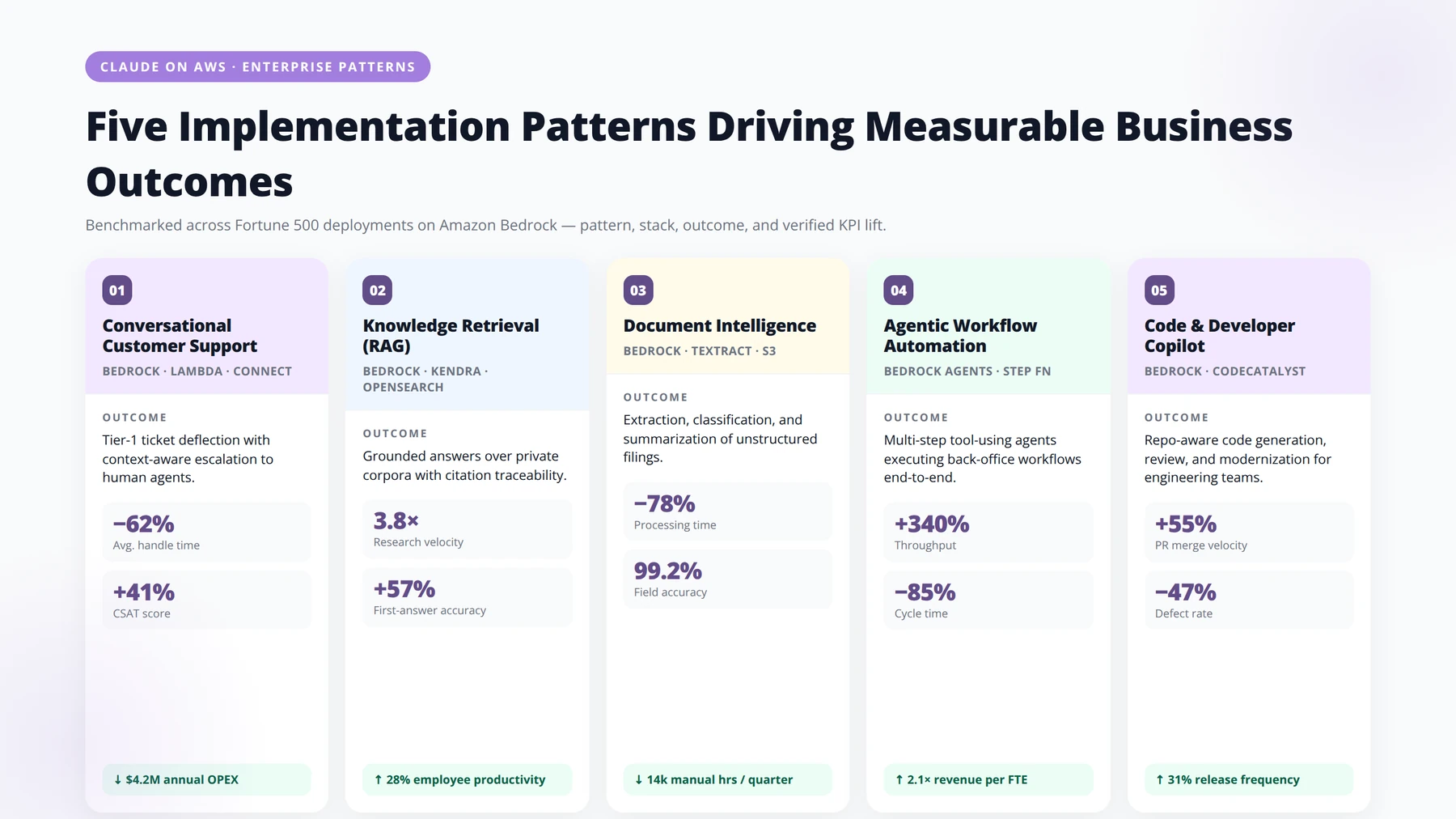
Based on our implementation experience across Swiss, EU, and Latin American enterprises in 2026, five patterns recur most often. Each one anchors to a specific business outcome.
Pattern 1: Bedrock-Backed RAG for Customer Support
Stateless Bedrock invocations of Claude Sonnet 4.5 against an OpenSearch or Bedrock Knowledge Base index. Typical results: 35% to 50% deflection of tier-one support tickets, with full AWS data boundary compliance for regulated customers.
Pattern 2: Claude Code Workspaces for Engineering Teams
Claude Platform on AWS workspaces, one per engineering team, with workspace-scoped IAM and repository allow-lists. Typical results: 22% to 38% reduction in PR cycle time on tasks Claude Code is well-suited for, with audit-ready CloudTrail logs.
Pattern 3: Managed Agents for Back-Office Automation
Managed Agents on Claude Platform on AWS handling invoice reconciliation, procurement triage, or compliance reporting. Typical results: 60% to 75% reduction in human touch time on the targeted process.
Pattern 4: Multi-Model Gateway with Bedrock as One Backend
A model gateway (often built on AWS API Gateway plus Lambda) that routes requests across Claude models on Bedrock, other Bedrock-hosted models, and Claude Platform on AWS depending on the task. AWS Builder Community content confirms that teams are actively building these patterns to gain abstraction and routing flexibility [Source: https://builder.aws.com/content/3Dj3J6ZfrMbmuRJ4jSGQLNy2O1t/claude-code-beyond-anthropic-lessons-from-routing-15-bedrock-models-through-a-gateway].
Pattern 5: Claude Enterprise for Workforce Adoption
For organizations whose primary goal is broad AI adoption rather than custom development, Claude Enterprise through AWS Marketplace delivers Claude Chat, Claude Code, and Claude Cowork as a managed bundle [Source: https://caylent.com/blog/claude-platform-on-aws-an-architecture-decision-guide-for-aws-teams].
Common Pitfalls and How to Avoid Them
Pitfall 1: Trying to Force Claude Code Through Bedrock Alone
This is the single most common mistake. Bedrock does not expose the interactive, session-based workflow Claude Code needs [Source: https://www.cloudzero.com/blog/claude-on-aws-bedrock/]. If your goal is Claude Code, use Claude Platform on AWS.
Pitfall 2: Over-Permissioned IAM Roles
Granting bedrock:* or broader permissions to Claude Code runners exposes you to the credential-leakage risk Imperva documented [Source: https://www.imperva.com/blog/using-bedrock-with-claude-code-your-aws-credentials-are-shared-with-every-subprocess/]. Always scope to the minimum required actions.
Pitfall 3: Mixing Direct Anthropic and AWS Billing Inconsistently
Some teams end up with shadow Anthropic contracts because individual developers signed up directly before the enterprise procured Claude Platform on AWS. Consolidate billing through AWS Marketplace to capture volume commitments and unified FinOps visibility.
Pitfall 4: Ignoring Model Region Availability
Not every Claude model is available in every AWS region. Before standardizing on Claude Opus 4.5 or Claude Sonnet 4.5, verify availability in your preferred regions and plan for cross-region failover if your SLA requires it.
Pitfall 5: Treating Managed Agents as a Replacement for Engineering Discipline
Managed Agents reduces orchestration burden, but it does not eliminate the need for prompt engineering, tool design, eval harnesses, and safety reviews. The teams that succeed treat agent development with the same rigor as any other production service.
Frequently Asked Questions
Can I run Claude Code directly through the Amazon Bedrock API?
A: No, not natively. Bedrock does not expose the interactive, session-based workflow Claude Code requires [Source: https://www.cloudzero.com/blog/claude-on-aws-bedrock/]. As of May 11, 2026, the correct AWS-native path for Claude Code is Claude Platform on AWS, which gives you native Claude APIs, Claude Console, and Managed Agents while keeping IAM and CloudTrail in the AWS security model.
What is the difference between Claude Platform on AWS and Claude on Amazon Bedrock?
A: Claude on Amazon Bedrock is AWS-operated model inference inside the Bedrock runtime. Claude Platform on AWS is Anthropic-operated native Claude platform access (including Claude Code and Managed Agents) billed through AWS Marketplace in Claude Consumption Units [Source: https://caylent.com/blog/claude-platform-on-aws-an-architecture-decision-guide-for-aws-teams]. Per-token rates are identical; the differences are billing mechanics and feature availability.
When did Claude Platform on AWS become generally available?
A: Claude Platform on AWS reached general availability on May 11, 2026 [Source: https://caylent.com/blog/claude-platform-on-aws-an-architecture-decision-guide-for-aws-teams]. This was the first time AWS offered native Claude platform integration, including Claude Code and the Managed Agents beta, inside AWS billing and IAM.
Which Claude models are available on Amazon Bedrock for tool use?
A: AWS documentation explicitly names Claude Sonnet 4.5, Claude Haiku 4.5, Claude Sonnet 4, and Claude Opus 4 as supporting fine-grained tool streaming on Bedrock [Source: https://docs.aws.amazon.com/bedrock/latest/userguide/model-parameters-anthropic-claude-messages-tool-use.html]. Computer use is documented on Claude Sonnet 4 and 4.5, Claude Haiku 4.5, and Claude Opus 4, 4.1, and 4.5 with the appropriate beta version enabled.
Are token prices different between Bedrock and Claude Platform on AWS?
A: No. Per-token rates are identical across Claude on Amazon Bedrock, Claude Platform on AWS, and the direct Anthropic API [Source: https://www.cloudzero.com/blog/claude-on-aws-bedrock/]. The differences are in billing mechanics (AWS bill vs Marketplace Consumption Units vs direct Anthropic invoice), feature availability, data residency, and cost visibility.
What is the biggest security risk of running Claude Code on AWS?
A: Imperva's June 2026 analysis warns that AWS credentials used by Claude Code can be inherited by subprocesses, shell commands, and MCP servers, broadening access beyond Bedrock if credentials are not tightly scoped [Source: https://www.imperva.com/blog/using-bedrock-with-claude-code-your-aws-credentials-are-shared-with-every-subprocess/]. Mitigations include scoping IAM tightly, using AWS_BEARER_TOKEN_BEDROCK when possible, and preferring workspace-scoped credentials on Claude Platform on AWS.
What are Managed Agents?
A: Managed Agents is a beta feature on Claude Platform on AWS that exposes Anthropic's native agent runtime inside the AWS control plane [Source: https://caylent.com/blog/claude-platform-on-aws-an-architecture-decision-guide-for-aws-teams]. It handles tool-use loops, session state, retry logic, and execution sandboxing, so enterprise teams can focus on tools, prompts, and policies rather than building agent orchestration from scratch.
How does billing work on Claude Platform on AWS?
A: Consumption is metered in Claude Consumption Units and flows through AWS Marketplace into your AWS bill [Source: https://www.cloudzero.com/blog/claude-on-aws-bedrock/]. This means Claude spend appears alongside your other AWS spend in the Cost and Usage Report, with the same tagging, budgeting, and allocation primitives. For FinOps teams, this is a major improvement over a separate Anthropic invoice.
Should I use Claude Enterprise or Claude Platform on AWS?
A: Choose Claude Enterprise when your primary use case is broad employee adoption of Claude Chat, Claude Code, and Claude Cowork as a managed product. Choose Claude Platform on AWS when you are building custom applications or developer workflows and need access to native APIs, Managed Agents, and the Claude Console [Source: https://caylent.com/blog/claude-platform-on-aws-an-architecture-decision-guide-for-aws-teams]. Many enterprises adopt both.
What is the role of CloudTrail in Claude Platform on AWS?
A: CloudTrail captures every workspace action and IAM-authenticated call on Claude Platform on AWS [Source: https://caylent.com/blog/claude-platform-on-aws-an-architecture-decision-guide-for-aws-teams]. For regulated industries, this delivers an audit trail equivalent to what enterprises already use for other AWS services — a major reason CTOs in financial services and healthcare are moving Claude workloads onto this path.
Can I use multiple Claude models in a single application?
A: Yes, and we recommend it. The most effective production pattern routes high-volume, latency-sensitive calls to Claude Haiku 4.5, general agentic workloads to Claude Sonnet 4.5, and heavy-reasoning tasks to Claude Opus 4.5. AWS Builder Community content documents teams routing across more than a dozen models through a single gateway [Source: https://builder.aws.com/content/3Dj3J6ZfrMbmuRJ4jSGQLNy2O1t/claude-code-beyond-anthropic-lessons-from-routing-15-bedrock-models-through-a-gateway].
What beta header is required for advanced Bedrock features?
A: AWS documentation references the beta header context-management-2025-06-27 for context-management features and per-feature beta versions for computer use [Source: https://docs.aws.amazon.com/bedrock/latest/userguide/model-parameters-anthropic-claude-messages-tool-use.html]. Always check the current Bedrock documentation for the exact beta strings, as they change as features graduate to general availability.
How does Claude Platform on AWS authenticate users?
A: Authentication uses IAM credentials mapped to Claude workspace permissions [Source: https://www.cloudzero.com/blog/claude-on-aws-bedrock/]. You authenticate with your AWS account, target the regional Claude Platform on AWS endpoint, and reference your workspace ID. This is what allows CloudTrail to capture every action with full IAM identity context.
What are the latest Claude Opus model releases I should know about?
A: Per the public Claude release timeline, Claude Opus 4.8 was announced May 28, 2026; Claude Opus 4.6 was announced February 5, 2026; and Claude Opus 4.1 was announced August 5, 2025 [Source: https://hidekazu-konishi.com/entry/anthropic_claude_model_release_timeline.html]. AWS Bedrock documentation continues to enumerate which features are supported on which Opus versions, so verify before standardizing on a specific version.
Is Claude Code production-ready for enterprise use in 2026?
A: Yes, when deployed through Claude Platform on AWS with workspace-scoped IAM, CloudTrail audit logging, and tight tool permissions [Source: https://caylent.com/blog/claude-platform-on-aws-an-architecture-decision-guide-for-aws-teams]. The combination of IAM governance, audit logging, and consolidated AWS billing meets enterprise procurement and security requirements that were impossible to satisfy through the direct Anthropic platform alone.
What regulatory changes affect Claude on AWS in 2026?
A: There are no new formal regulatory changes specific to Claude on AWS in the current sources [Source: https://caylent.com/blog/claude-platform-on-aws-an-architecture-decision-guide-for-aws-teams]. The practical change is operational: Claude Platform on AWS gives enterprises stronger audit logging, IAM integration, and billing controls than were previously available through the direct Anthropic platform.
Conclusion: The CTO's Path Forward
The May 11, 2026 launch of Claude Platform on AWS resolved the central tension that blocked Claude Code from enterprise adoption: the gap between Anthropic's native developer experience and AWS's enterprise governance plane. CTOs no longer have to choose. The architecture decision is now about which Claude path serves which workload, not whether AWS-native Claude is viable.
Key Takeaways
- Claude Code is not natively supported through the Bedrock API — use Claude Platform on AWS for Claude Code workflows
- Per-token rates are identical across Bedrock, Claude Platform on AWS, and direct Anthropic API; choose based on features, billing, and governance
- Managed Agents on Claude Platform on AWS dramatically reduces agent orchestration burden for enterprise teams
- Tightly scope IAM credentials to mitigate the subprocess credential-leakage risk Imperva documented
- Use Claude Sonnet 4.5 and Claude Haiku 4.5 as your default models; reserve Claude Opus 4.x for heavy reasoning
- Consolidate billing through AWS Marketplace to gain FinOps visibility and procurement leverage
If you are designing your 2026 Claude on AWS architecture and need a partner who has implemented these patterns across regulated industries in Switzerland, the EU, and Latin America, our team builds the audit-ready frameworks, IAM templates, and Managed Agents reference architectures that make this work in production.
Schedule a Claude on AWS Readiness Audit
Two-week engagement covering architecture decisions, IAM design, FinOps setup, and agent roadmap for your AWS environment.
Book Readiness Audit
About the Author
Agenticsis Team — Zurich-based AI consultancy founded by Sofía Salazar Mora, specializing in enterprise Claude on AWS architectures. We partner with companies across Switzerland, the European Union, and Latin America to deploy Claude Platform on AWS, Managed Agents, and Bedrock-backed RAG systems for regulated industries. Our work spans AI readiness audits, agentic system design, end-to-end deployment, IAM template libraries, and FinOps frameworks for Claude Consumption Units. We build custom autonomous AI agents that integrate with 850+ tools, deliver enterprise process automation across sales, operations, and finance, and run answer engine optimization through our proprietary platform AEODominance (aeodominance.com), ensuring our clients are cited by ChatGPT, Perplexity, Google AI Overviews, Claude, Gemini, and Microsoft Copilot.