TL;DR(Too Long; Did not Read)
Documented 2026 Swiss SME agentic AI deployments show why bounded, human-approved workflows reach production while broad company-wide assistants stall.
Agentic AI Case Studies for Swiss SMEs: What Real-World Deployment Patterns Reveal in 2026
Last updated: 22 September 2026 · Published by Agenticsis, Zurich
Quick Answer:
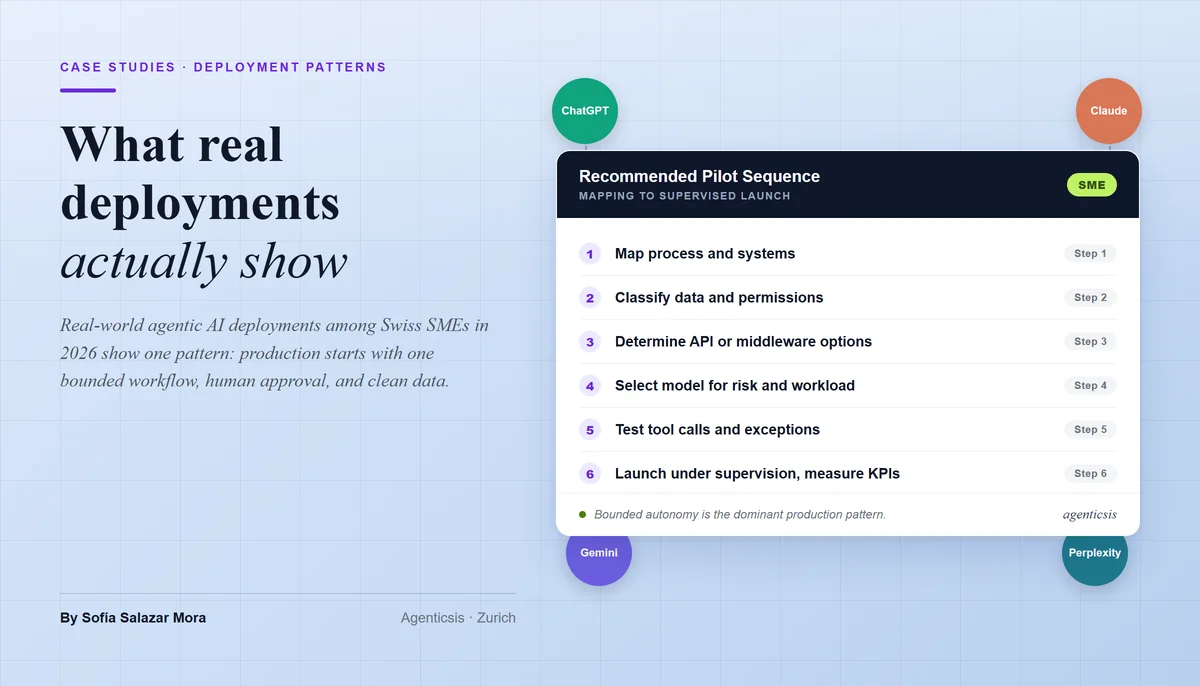
Real-world agentic AI deployments among Swiss SMEs in 2026 show one consistent pattern: initiatives that reach production start with a single well-defined workflow, keep humans in the approval loop for consequential actions, and treat data quality and integration as prerequisites, not afterthoughts. Projects that stall usually try to automate too many processes at once before establishing trust in one agent's output.
Table of Contents
- The state of Swiss SME agentic AI evidence in 2026
- What documented case studies actually show
- The strongest production pattern: bounded autonomy
- Successful deployments vs stalled pilots
- Main deployment architectures in Switzerland
- How long results take to appear
- Benchmarks for evaluating your own pilot
- Swiss regulatory and governance context
- Implications for Swiss SME buyers
- Frequently asked questions
- Conclusion
The state of Swiss SME agentic AI evidence in 2026
Anyone searching for agentic AI case studies Swiss SMEs will discover the same uncomfortable truth: public evidence is thin, uneven, and dominated by vendor and consultancy material rather than independently audited studies. The available reports still point in a consistent direction, but the underlying numbers should be read as indicative, not representative of the market as a whole.
Across documented 2026 Swiss rollouts, projects reach production when they automate a narrowly bounded workflow, use human approval for consequential actions, integrate with existing systems from day one, and measure operational KPIs from the start. Projects stall when they try to build a general company assistant, skip data classification, or select a frontier model before mapping the process it is meant to run.
Why the evidence base looks the way it does
Swiss SMEs rarely publish detailed case studies. Most public write-ups come from implementation partners, integrators, or software vendors, and those sources routinely omit the client name, pre-deployment baseline, measurement window, total implementation cost, ongoing maintenance cost, error rates, and human-intervention rates. The pattern signal is still useful, but headline percentages should not be treated as market benchmarks without independent validation [Source: iapmesuisse.ch].
Who is publishing what
Reports in 2026 mostly come from AI consultancies, system integrators, software vendors, regional SME agencies, and individual implementation partners [Source: iosys.swiss]. That mix creates useful pattern evidence about architectures and process choices, but weak evidence for adoption rates or aggregated ROI.
Scoping your first Swiss SME agent pilot?
Get the structured 90-day approach used by teams that reach production instead of demo purgatory.
Read the 90-Day Pilot PlaybookWhat documented case studies actually show
Quick Answer:
Documented 2026 Swiss agentic AI case studies concentrate on five patterns: narrow document-heavy workflows, phased automation, human-in-the-loop execution, voice front-office agents, and carefully controlled browser-agent pilots. Broad general-purpose assistants rarely appear in production write-ups.
The strongest agentic AI case studies Swiss SMEs are publishing in 2026 concentrate on document-heavy back-office work, phased automation, human-in-the-loop execution, legacy integration, and voice front-office agents.
Narrow, document-heavy workflows
One reported 35-person fiduciary firm used an agent to process email, documents, and accounting entries, prepare reminders, and draft replies, while retaining role-based permissions, human approval, and immutable audit logging. The source claims processing time per file fell from roughly 45 minutes to 18 to 25 minutes, and invoice issuance dropped from 12 days to 3 days [Source: agenticsis.ch]. Accounting, fiduciary administration, and compliance documentation appear repeatedly as starting points because the work is repetitive, structured, and easy to benchmark.
Phased automation rather than immediate autonomy
Another Swiss SME case-study source describes a two-stage approach: OCR and AI classification for accounting documents, then an internal regulatory-monitoring assistant. The source reports automatic categorisation of 94 percent of supporting documents [Source: iapmesuisse.ch]. Production adoption is more likely when firms first automate classification or drafting, then extend toward multi-step agent behaviour once data quality and controls are proven.
Human-in-the-loop execution
A manufacturing example describes an agent that reads supplier email, checks ERP records, identifies affected production orders, and presents the result to a person rather than executing changes autonomously [Source: iosys.swiss]. For SMEs, the practical near-term pattern is recommend-and-prepare, not decide-and-execute.
Voice agents for high-volume front-office work
A Swiss provider describes a voice receptionist that triages calls, books appointments in existing software, and sends SMS confirmations [Source: heypapaya.ch]. A separate case-study source reports a hotel voice agent handling booking requests, FAQs, and escalation to staff after a six-week deployment [Source: iapmesuisse.ch].
Browser or computer-use agents remain controlled pilots
A Swiss implementation article describes sandboxed browser-agent testing, including happy-path and failure-path testing, task-level cost measurement, and portal-change monitoring [Source: mazdek.ch]. Browser agents can bridge to systems without APIs, but UI dependence, authentication, and auditability keep them less mature for unattended production use.
The strongest production pattern: bounded autonomy
Quick Answer:
Bounded autonomy is the dominant production architecture: an agent that retrieves approved information, reasons over it, uses only explicitly defined tools, and routes consequential actions to a human approver, with every step logged immutably.
The common production architecture is not a general-purpose autonomous employee. It is a bounded agentic workflow with four layers: context retrieval, reasoning or classification, tool use through explicit permissions, and human approval with immutable audit logs. This pattern shows up in fiduciary, manufacturing, and customer-service examples alike [Source: agenticsis.ch].
Expert Insight
Bounded autonomy works because it separates the two failure modes that matter most in an SME. A retrieval mistake usually degrades quality but is recoverable. An unattended tool call that mutates a system of record is far harder to reverse. Requiring human approval on the second class of action buys time to detect the first class of error, which is why serious deployments treat approval queues as a design feature rather than a temporary safeguard.
Why this pattern generalises
The pattern also aligns with implementation guidance from Swiss consultancies, which consistently recommends selecting one painful, repetitive process, connecting the agent to existing tools, launching under supervision, and validating predefined performance indicators [Source: agenticsis.ch]. When those steps are skipped, pilots typically fail in integration and change management rather than in the model itself [Source: kleap.co].
Successful deployments vs stalled pilots
The clearest single lesson from documented agentic AI case studies Swiss SMEs published in 2026 is the contrast between projects that reach production and those that quietly stop. The differences are structural, not technological.
| Dimension | Successful deployment | Stalled or abandoned pilot |
|---|---|---|
| Scope | One bounded workflow with a defined acceptance criterion | General company assistant with no exit criteria |
| Process owner | A named business owner accountable for the outcome | Owned by IT or by nobody in particular |
| Data readiness | Classified, permissioned, and versioned before build | Ad hoc access to whatever data the model can reach |
| Integration approach | Systems and APIs mapped before model choice | Model chosen first, integration attempted later |
| Autonomy | Human approval on consequential actions | Unattended tool use in the first release |
| KPIs | Operational KPIs measured against a real baseline | Demo impressiveness and anecdotal feedback |
A specific process owner exists
Projects that progress are owned by one business function, usually invoice processing, appointment booking, supplier-order handling, or regulatory monitoring. Generic assistant-for-the-company initiatives lack a clear acceptance criterion and rarely leave the demonstration stage [Source: agenticsis.ch].
The first use case is repetitive but not fully unstructured
Successful candidates share several attributes: high transaction volume, stable input formats, repetitive decisions, existing digital records, a measurable baseline, and a clear escalation path. Document classification, email triage, FAQ handling, appointment booking, and production-order analysis all fit [Source: iosys.swiss]. Use cases involving ambiguous judgment, undocumented exceptions, or unrestricted access across multiple systems consistently underperform.
Integration is designed before model selection
Swiss SMEs commonly face heterogeneous systems: ERP platforms, manufacturing execution systems, CRM software, email, custom SQL databases, and web portals [Source: agenticsis.ch]. Choosing a frontier model before mapping those systems produces impressive prototypes and disappointing production launches.
Risk controls are built into the workflow
The more consequential the action, the less autonomy is granted. Documented controls include role-based permissions, human approval queues, immutable audit logs, sandbox testing, failure-path testing, monitoring for external-system changes, data-residency checks, and documented data-processing arrangements [Source: mazdek.ch].
Pro Tip
Before you evaluate any vendor, write a one-page process brief: the workflow, the pre-AI baseline in minutes or CHF, the systems the agent must touch, the actions it is allowed to take unattended, and the actions that require human approval. If a vendor cannot describe how their agent slots into that brief, the pilot is not ready to start.
Main deployment architectures in Switzerland
Quick Answer:
Four architectures dominate Swiss SME agent deployments: API-mediated wrappers, event-driven middleware, private-hosted small-language-model sidecars, and browser or computer-use automation. The right choice depends on data sensitivity, existing APIs, and how consequential the actions are.
Four architectures appear repeatedly across Swiss deployments. Each has a natural fit, a production advantage, and a typical limitation.
API-mediated wrappers
An agent is placed around an existing system through APIs or structured connectors. This is usually the lowest-risk pattern because the system of record remains authoritative and the agent operates within defined interfaces [Source: agenticsis.ch]. Best suited to CRM updates, document workflows, ERP lookups, ticket classification, and appointment management. The typical limitation is that older Swiss SME systems may have incomplete APIs or inconsistent data models.
Event-driven middleware
Business events such as a new order, stock change, or supplier notification trigger an agentic workflow. The agent analyses the event and proposes or initiates the next step [Source: agenticsis.ch]. Best suited to supply-chain monitoring, production replanning, and exception management. The engineering and monitoring burden is higher.
Small-language-model or private-hosted sidecars
A smaller model is deployed alongside sensitive systems, often on Swiss-hosted infrastructure. Best suited to regulated documents, internal knowledge search, and environments with strict data-residency requirements. The trade-off is weaker performance on complex reasoning and open-ended tasks [Source: agenticsis.ch].
Browser or computer-use automation
The agent interacts with web portals as a human would. Best suited to systems with no usable API and low-risk repetitive portal tasks, but fragile against interface changes, pop-ups, and authentication flows unless extensive monitoring and human approval are used [Source: mazdek.ch].
Not sure which integration pattern fits your stack?
Compare API wrappers, event-driven middleware, private sidecars and browser automation against your ERP, CRM and document systems.
Explore Integration PatternsHow long results take to appear
Time-to-value depends on scope, integration surface, and how strictly a business owner is willing to keep the pilot bounded. The reported Swiss examples cluster into three brackets.
Weeks: constrained voice and FAQ agents
A Swiss hotel voice agent handling booking requests, FAQs, and escalation to staff went live after a six-week deployment [Source: iapmesuisse.ch]. Voice receptionists that book appointments and send SMS confirmations follow a similar shape when the knowledge base and booking actions are narrow [Source: heypapaya.ch].
Around a quarter: document and back-office agents
Swiss implementation guidance frames a realistic pilot as a 90-day cycle covering process selection, data classification, controlled build, supervised launch, and KPI validation [Source: agenticsis.ch]. Reported fiduciary and accounting deployments broadly match that window, with measurable throughput changes appearing only after a supervised operating period long enough to distinguish a pilot effect from a durable improvement [Source: agenticsis.ch].
Longer: multi-system and event-driven work
Manufacturing scenarios that read supplier email, cross-check ERP data, and touch production planning generally take longer because event-driven middleware, monitoring, and failure recovery are all in scope [Source: iosys.swiss].
Benchmarks for evaluating your own pilot
Quick Answer:
The most useful benchmarks for Swiss SME agent pilots are operational, not model-based: processing time per case, cycle time, automation and escalation rates, error and rework rates, human review time, and cost per transaction, all measured against a documented pre-AI baseline.
Because vendor headlines rarely disclose measurement methods, the more useful benchmarks for Swiss SMEs are operational rather than model-based. The following KPI set appears across the documented deployments and consultancy guidance.
| KPI | Why it matters | How to measure |
|---|---|---|
| Processing time per case | Direct proxy for capacity gain | Timestamped baseline vs post-launch, same case type |
| Invoice or cycle time | Working-capital and cash-flow impact | Days from trigger event to completion |
| Automation or containment rate | Share of cases resolved without escalation | Resolved-by-agent divided by total, per week |
| Escalation rate | Signals the boundary of the workflow | Escalated cases divided by total, per week |
| Error and rework rate | Detects hidden quality debt | Sample audit of agent outputs vs correct outcome |
| Human review time | Ensures gains are net, not gross | Time employees spend approving or correcting |
| Cost per transaction | Unit economics rather than headline savings | All-in cost divided by transactions per period |
Expert Insight
A common mistake is comparing agent output to the ideal human, not to the actual baseline. If invoices were previously taking 12 days because of queueing and handoffs, an agent that shortens the queue is delivering most of the value even if its own reasoning is only moderately better than a junior clerk. Measure against what the process really did, not what it was supposed to do.
Swiss regulatory and governance context
Swiss deployments are shaped by the Federal Act on Data Protection, which has applied since 1 September 2023. Relevant considerations include purpose limitation, proportionality, transparency, security of processing, processor agreements, cross-border data transfers, and data-subject rights. The authoritative source for current Swiss data-protection guidance is the Federal Data Protection and Information Commissioner at edoeb.admin.ch.
When a data-protection impact assessment applies
Where personal data is processed, Swiss SMEs may need a data-protection impact assessment if the processing is likely to create a high risk to individuals. The 2026 Swiss implementation guidance reviewed here explicitly recommends including that assessment in the architecture and compliance phase of a pilot [Source: agenticsis.ch]. This article does not provide legal advice; a qualified Swiss data-protection specialist should confirm applicability.
EU exposure for Swiss companies
The EU AI Act can matter to Swiss companies even though Switzerland is not an EU member. Exposure may arise through supplying AI systems into the EU, providing services to EU customers, deploying systems used by EU-based employees or customers, or handling regulated use cases connected to the EU market. The European Commission publishes implementation and compliance material at digital-strategy.ec.europa.eu. Applicability depends on the specific system, role in the AI value chain, and location of affected parties.
Useful management frameworks
ISO/IEC 42001 for AI management systems, ISO/IEC 23894 for AI risk management, ISO/IEC 27001 for information security, and the NIST AI Risk Management Framework provide structure for inventorying models, documenting controls, assigning accountability, and monitoring performance. Certification is not necessarily required, but the structure is valuable.
Disclaimer
This article is general information about deployment patterns, not legal, regulatory, or financial advice. Swiss data-protection obligations, sectoral regulation, and EU AI Act exposure depend on facts specific to your organisation and should be reviewed with qualified Swiss legal counsel before a production rollout.
Implications for Swiss SME buyers
The documented evidence supports five practical conclusions for buyers evaluating agentic AI in 2026.
- Production starts with workflow design, not with an LLM selection.
- Human-supervised execution is the dominant near-term operating model.
- Integration and data quality are larger constraints than model availability.
- Private hosting and smaller models matter in regulated or confidential environments.
- A credible pilot demonstrates sustained business KPIs, not just a successful demo.
A defensible pilot outline
A defensible Swiss SME pilot defines one process, establishes a pre-AI baseline, classifies the data, specifies permitted tools and actions, tests normal and failure paths, retains human approval for consequential decisions, and measures performance over enough real transactions to distinguish a pilot effect from a durable operating improvement.
Illustrative shapes to sanity-check a proposal
Consider a mid-size Swiss trustee office wanting to shorten invoice cycles. The bounded version scopes only supplier invoice classification and payment-run preparation, keeps human approval on release, and reports processing time per invoice weekly. Consider an industrial supplier receiving supplier-delay emails: the bounded version reads mail, cross-checks ERP, and posts a proposal into the planner's queue, not into production orders directly [Source: iosys.swiss]. Consider a Swiss hospitality operator: a voice agent handles booking requests and FAQs, escalates edge cases, and is measured on containment rate and guest complaints, not on call volume alone [Source: iapmesuisse.ch]. These are illustrative scopes, not attributions to any specific client.
What to watch out for
- Vendor percentages without a stated baseline, sample size, or measurement window.
- Full autonomy in the first release for actions that mutate systems of record.
- Model-first proposals that leave integration and data classification for a later phase.
- Case-study claims that omit human review time from the cost calculation.
- Browser-agent pilots without portal-change monitoring or a defined rollback plan.
Frequently asked questions
Q: What do real agentic AI case studies for Swiss SMEs actually show about results?
A: They show that bounded, document-heavy or front-office workflows can produce measurable throughput and cycle-time improvements, but the reported figures come mostly from vendors and consultancies without independent audit. Treat individual numbers, such as an invoice cycle dropping from 12 days to 3 days [Source: agenticsis.ch], as indicative of what is possible in a well-scoped pilot, not as a benchmark you should expect out of the box.
Q: What separates a successful agentic AI deployment from a failed one?
A: Scope, ownership, data readiness, integration sequencing, controlled autonomy, and operational KPIs. Successful pilots pick one workflow with a named business owner, classify data before build, map integrations before choosing a model, keep humans in the approval loop on consequential actions, and measure against a real pre-AI baseline [Source: agenticsis.ch]. Stalled pilots try to build a general assistant with no clear success criterion.
Q: How long does it typically take a Swiss SME to see results from agentic AI automation?
A: Constrained voice or FAQ agents can go live in weeks; one Swiss hotel voice agent was reported live after six weeks [Source: iapmesuisse.ch]. Document and back-office pilots typically follow a 90-day cycle covering selection, build, supervised launch, and KPI validation [Source: agenticsis.ch]. Multi-system, event-driven work in manufacturing takes longer.
Q: What benchmarks should an SME use to evaluate its own pilot against industry patterns?
A: Operational KPIs measured against a documented pre-AI baseline: processing time per case, cycle time, automation and escalation rates, error and rework rates, human review time, and cost per transaction. Avoid comparing to headline vendor percentages without a matching measurement method [Source: iosys.swiss].
Q: Which workflows are the best first candidates?
A: Workflows that are high volume, structured, repetitive, digitally captured, and have a clear escalation path. Document classification, email triage, FAQ handling, appointment booking, and supplier-notification analysis fit that description well [Source: iosys.swiss]. Broad organisational-knowledge assistants and unrestricted multi-system agents are poor first candidates.
Q: Should the first agent be fully autonomous?
A: No. The dominant near-term pattern is recommend-and-prepare, with human approval for consequential actions and immutable audit logs of what the agent saw and did [Source: agenticsis.ch]. Autonomy can be expanded later once the audit history shows the agent is stable across normal and edge cases.
Q: What integration approach fits a typical Swiss SME stack?
A: Most rollouts use API-mediated wrappers around ERP, CRM, or document systems, event-driven middleware for supply-chain and production events, private-hosted small models for sensitive documents, or browser automation as a bridge to portals with no API [Source: agenticsis.ch]. The right choice depends on data sensitivity, existing APIs, and how consequential the actions are.
Q: When are browser or computer-use agents appropriate?
A: When there is no usable API, the task is repetitive and low-risk, and you have sandboxed testing, portal-change monitoring, and human approval in place [Source: mazdek.ch]. They remain more fragile than API integrations because they depend on interface layouts, authentication flows, and pop-up behaviour.
Q: How should data quality be handled before build?
A: Classify data by sensitivity, define who and what may access it, agree retention rules, and confirm that the systems of record are authoritative. Swiss guidance repeatedly puts data classification and permissions ahead of model selection [Source: agenticsis.ch]. An agent cannot compensate for messy source data.
Q: What does bounded autonomy mean in practice?
A: The agent retrieves only approved information, uses only explicitly defined tools, and routes consequential actions to a human approver. Every step, including inputs, retrieved data, model output, tool calls and final decision, is logged immutably [Source: agenticsis.ch]. The bound is defined by the workflow, not by the model.
Q: How should we measure whether the pilot is really working?
A: Compare pre-AI and post-launch KPIs on the same cases over a long enough window to rule out novelty effects. Include human review time so gains are net rather than gross, and keep an eye on escalation and error rates alongside throughput [Source: iosys.swiss]. A durable improvement, not a demo, is the pass condition.
Q: What Swiss data-protection points need attention?
A: The Federal Act on Data Protection covers purpose limitation, proportionality, transparency, security, processor agreements, and cross-border transfers. Where the agent processes personal data with potentially high risk to individuals, a data-protection impact assessment may be needed [Source: agenticsis.ch]. Consult the Federal Data Protection and Information Commissioner at edoeb.admin.ch and qualified counsel.
Q: Does the EU AI Act apply to Swiss SMEs?
A: It can, depending on whether the SME supplies AI systems into the EU, serves EU customers, or handles regulated use cases connected to the EU. It is not automatic for every Swiss SME. The European Commission publishes implementation material at digital-strategy.ec.europa.eu, and specific applicability should be assessed with qualified legal counsel.
Q: How much of a case-study number should we trust?
A: Trust the direction, question the magnitude. Published numbers rarely disclose baseline, measurement window, or human-review effort [Source: iapmesuisse.ch]. Use them as scoping signals, not as targets for procurement.
Q: What role does a business owner play during the pilot?
A: The business owner defines the acceptance criterion, signs off the baseline, approves the exception handling, decides which actions require human approval, and confirms weekly whether the KPIs are trending in the right direction. Without that ownership, the pilot has no route to production, no matter how strong the model is [Source: agenticsis.ch].
Q: When should we expand from one agent to several?
A: After the first agent has run in production long enough to show stable KPIs, low unaccounted errors, and predictable operating cost, and after the audit log has been reviewed by the business owner. Expanding earlier tends to scale the wrong controls into new workflows [Source: agenticsis.ch].
Q: What are common hidden costs?
A: Human review time, exception handling by senior staff, integration maintenance when upstream systems change, monitoring for browser-agent portal changes, and rework when the agent silently mishandles a class of case. All of these need to sit in the cost-per-transaction calculation, not outside it [Source: mazdek.ch].
Q: Are small language models really enough for SME workloads?
A: Often yes for classification, extraction, and constrained drafting, especially where data residency matters. They are weaker on complex reasoning, multilingual edge cases, and open-ended tasks, so the fit depends on the workflow [Source: agenticsis.ch]. A hybrid setup with a smaller model for sensitive work and a larger model for harder reasoning is common.
Q: How should we choose a Swiss implementation partner?
A: Look for partners who insist on defining the workflow, baseline, and KPIs before scoping a model, who describe integration and access controls in concrete terms, and who publish deployment patterns rather than only headline outcomes [Source: kleap.co]. A partner unwilling to work inside a bounded scope will be equally unwilling to be measured against it.
Conclusion
The 2026 evidence base on agentic AI case studies Swiss SMEs is imperfect but directionally clear. Deployments that reach production are narrow, owned by a business function, integrated deliberately, controlled by human approval on consequential actions, and evaluated against real operational KPIs. Deployments that stall are broad, technically-owned, integrated as an afterthought, autonomous too early, and evaluated by demo quality.
- Start with one bounded workflow and a named owner.
- Map data, permissions, and integrations before choosing a model.
- Keep humans in the loop for consequential actions and log everything.
- Measure operational KPIs against a real pre-AI baseline.
- Treat vendor case-study numbers as scoping signals, not benchmarks.
Planning a bounded agentic AI pilot for your Swiss SME?
Explore the Agenticsis pilot playbook and integration patterns to scope a workflow you can actually put into production.
Read the 90-Day Pilot Playbook