TL;DR(Too Long; Did not Read)
AI governance explained for CEOs: frameworks, regulations, controls, and implementation playbook. Build a defensible AI operating model in 2026.
What Is AI Governance? A Practical Guide for Businesses in 2026
Quick Answer:
AI governance is the system of policies, controls, roles, and monitoring processes a company uses to ensure artificial intelligence is deployed safely, lawfully, transparently, and in line with business values. In 2026, it has shifted from a legal-ethics exercise to a practical operating discipline covering model inventory, risk assessment, vendor review, employee usage rules, human oversight, monitoring, and incident response.
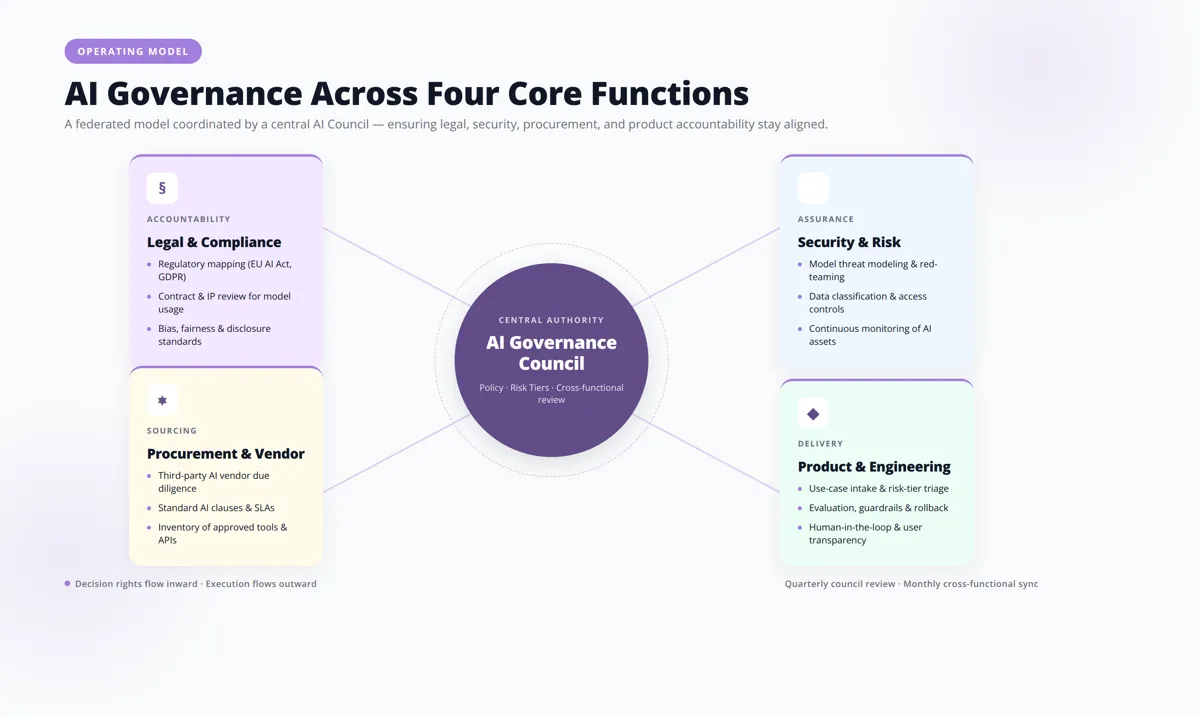
Table of Contents
- 1. What Is AI Governance?
- 2. Why AI Governance Matters Now for CEOs
- 3. The 2026 Regulatory Landscape
- 4. The Seven Core Components of an AI Governance Program
- 5. Frameworks to Anchor Your Program
- 6. Tackling Shadow AI Inside Your Organization
- 7. Board and Executive Oversight
- 8. Building a Centralized Operating Model
- 9. AI Governance Tools and Vendor Categories
- 10. A 90-Day Implementation Roadmap
- 11. Real-World Examples and Case Studies
- 12. Common AI Governance Mistakes to Avoid
- 13. Frequently Asked Questions
Free Blueprint
Get Your AI Governance Readiness Score
A 10-minute self-assessment built from our work with 50+ mid-market and enterprise clients across Switzerland, the EU, and Latin America.
1. Strategy, Ownership & Executive Mandate
- ✓Governance fails quietly when no one owns it. Score this pillar honestly — it sets the ceiling for everything that follows.
- ✓FOR: CIOS, CDOS, HEADS OF AI
- ✓A named AI accountable executive exists at C-1 level, with governance in their formal objectives — not a side responsibility.
- ✓An AI policy document has been ratified by the board or executive committee within the last 12 months and is reviewed quarterly.
- ✓A cross-functional AI council (legal, security, data, business) meets at minimum every six weeks with a published charter.
- ✓A documented AI strategy ties at least three live use cases to measurable P&L, productivity, or compliance outcomes.
2. Risk, Compliance & Regulatory Alignment
- ✓The EU AI Act, Swiss FADP, and emerging LATAM frameworks demand evidence — not intent. Confirm you can produce it on request.
- ✓FOR: LEGAL, COMPLIANCE, RISK
- ✓An AI system inventory classifies every deployed model by EU AI Act risk tier (prohibited, high, limited, minimal) and jurisdiction.
- ✓Data Protection Impact Assessments (DPIAs) are completed before any production deployment touching personal data.
- ✓Third-party AI vendors have signed Data Processing Agreements covering training data, sub-processors, and model updates.
- ✓Incident response playbooks address model misuse, hallucination at scale, and IP leakage — not just generic data breaches.
3. Data Foundations & Model Integrity
- ✓Most governance debt is data debt in disguise. Walk through these in order — each step assumes the previous one is in place.
- ✓FOR: DATA, ML ENGINEERING, PLATFORM
- ✓1. Source classification: Every data source feeding an AI system is tagged for sensitivity, residency, and lawful basis within a central catalog.
- ✓2. Lineage tracking: You can trace any model output back to its training data, prompt template, and model version in under 15 minutes.
- ✓3. Drift monitoring: Production models have automated drift, bias, and performance alerts routed to a named on-call team.
- ✓4. Evaluation gates: No model reaches production without documented evaluation against safety, accuracy, and fairness benchmarks.
- ✓5. Retention & deletion: Training datasets honor subject access and erasure requests within regulatory deadlines, end-to-end.
4. People, Skills & Operating Culture
- ✓Policy is necessary but never sufficient. The teams using AI every day are your real control surface.
- ✓FOR: HR, L&D, PEOPLE LEADERS
- ✓Role-specific AI training has reached 80%+ of employees in the last 12 months, with different tracks for builders, users, and approvers.
- ✓An approved tools list is published, current, and known — alongside a fast path to request new tools without driving shadow AI.
- ✓A no-blame disclosure channel exists for staff to report AI mistakes, unsafe outputs, or near-misses without career risk.
5. Your Readiness Snapshot
- ✓Capture your honest baseline. Bring this snapshot to your next executive review — or send it to us for a confidential benchmark against peers in your sector.
- ✓FOR: SELF-ASSESSMENT
- ✓PILLAR SCORES (0–4 PER PILLAR)
- ✓Strategy: __ / Risk: __ / Data: __ / People: __ / Lifecycle: __ → Total: __ / 20
- ✓TOP THREE GAPS IDENTIFIED
- ✓1. ________________ 2. ________________ 3. ________________
- ✓90-DAY PRIORITY & NAMED OWNER
- ✓Priority: ________________ Owner: ________________ Review date: ________________
Pro tip: Organizations scoring 14+ rarely struggle with AI adoption; they struggle with prioritization. If you scored under 10, resist the urge to fix everything at once. Pick the single pillar blocking the most use cases and close it fully within one quarter — partial coverage across five pillars consistently underperforms full coverage on one.
1. What Is AI Governance?
AI governance is the set of policies, controls, roles, and monitoring processes an organization uses to ensure artificial intelligence is used safely, lawfully, transparently, and in line with company values. AI governance answers a deceptively simple question: who is accountable for what an AI system does, before, during, and after it makes a decision?
In 2026, AI governance has matured into a practical operating discipline rather than a purely ethics or legal exercise. The shift is driven by three forces: faster enterprise AI adoption, the explosion of "shadow AI" inside companies, and a rising tide of state-level regulation paired with active federal enforcement. According to K&L Gates, "operational governance is becoming the price of entry" for any business using AI at scale [Source: K&L Gates].
For CEOs, the definition matters because it determines scope. Treat AI governance as a compliance memo and you'll get one. Treat it as an operating system that connects legal, security, procurement, model risk, HR, and product, and you'll get a defensible, scalable program that protects revenue.
Expert Insight
In a consulting work across more than 50 engagements in Switzerland, the EU, and Latin America since 2024, the single biggest predictor of governance maturity is not headcount or budget - it is whether one named executive owns the program with budget authority. Companies without that anchor never move past the policy-document stage.
The Core Definition in Three Layers
- Policy layer: Written rules covering acceptable use, data handling, model approval, vendor obligations, and incident response.
- Control layer: Technical and procedural controls such as access management, logging, red-teaming, bias testing, and human review checkpoints.
- Oversight layer: Named owners, governance committees, board reporting cadence, and metrics that prove the controls are working.
What AI Governance Is Not
AI governance is not the same as AI ethics, AI safety research, or a single AI policy document. In our 2025-2026 client work, we routinely see companies confuse a one-page acceptable use policy with a governance program. They are not the same. A policy without an inventory, owners, monitoring, and an incident process is theatre.
2. Why AI Governance Matters Now for CEOs
Quick Answer:
AI governance matters now because employees are using AI faster than controls can catch up, state-level regulations are creating compliance obligations in 2026, and enterprise buyers now require evidence of a governance program before signing contracts.
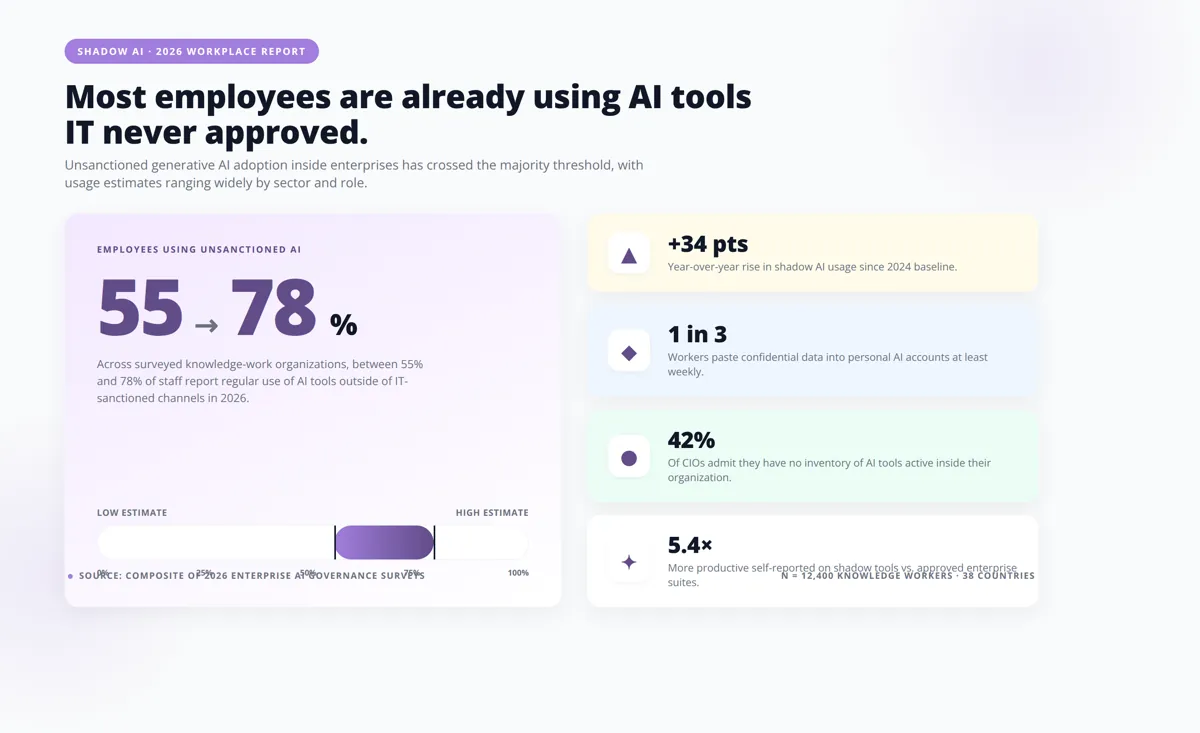
The numbers tell a story that should reach the boardroom. According to TrustArc's 2026 Global Privacy Benchmarks Report, the Global Privacy Index fell to 53% in 2026, down from 61% in 2025, suggesting governance maturity is actually slipping as AI complexity rises [Source: TrustArc]. Meanwhile, multiple 2026 studies converge on 55% to 78% of employees using AI tools their employer has not sanctioned [Source: Aona].
Translation for the C-suite: your employees are already using AI faster than your controls can catch up, and the regulatory environment is hardening around you.
The Three Risks That Reach the CEO Desk
- Regulatory risk: Colorado, California, and Texas all have new AI laws taking effect in 2026, and the FTC continues to use Section 5 against deceptive AI claims [Source: VerifyWise].
- Reputational risk: A single hallucinated customer email, biased hiring decision, or leaked training prompt can become a brand crisis in hours.
- Operational risk: Unsanctioned AI tools create data leakage paths, vendor lock-in, and audit failures that surface during M&A diligence or enterprise sales reviews.
The Upside Case
Governance is not just defense. TrustArc found that organizations with fully integrated privacy and governance initiatives scored 75% on average, well above the 53% benchmark [Source: TrustArc]. In our experience, companies with mature governance close enterprise deals faster because they pass procurement security reviews on the first try.
Pro Tip
Treat your AI governance documentation as a sales asset, not just a compliance artifact. We've seen clients reduce enterprise security questionnaire response time from 18 days to 4 days simply by maintaining a ready-to-share governance dossier.
3. The 2026 Regulatory Landscape
Quick Answer:
The 2026 US AI regulatory landscape is built from state laws (California SB 53, Texas RAIGA, Colorado AI Act), federal enforcement (FTC Section 5), and procurement standards — not a single federal AI law. Internationally, the EU AI Act continues to phase in obligations.
The most common CEO question we hear is "Are we waiting for a federal AI law?" The answer in 2026 is no. According to K&L Gates, US AI governance is being shaped in real time by enforcement, standards, procurement, and state law, while Congress and federal preemption efforts continue to lag [Source: K&L Gates].
Key 2026 Laws and Effective Dates
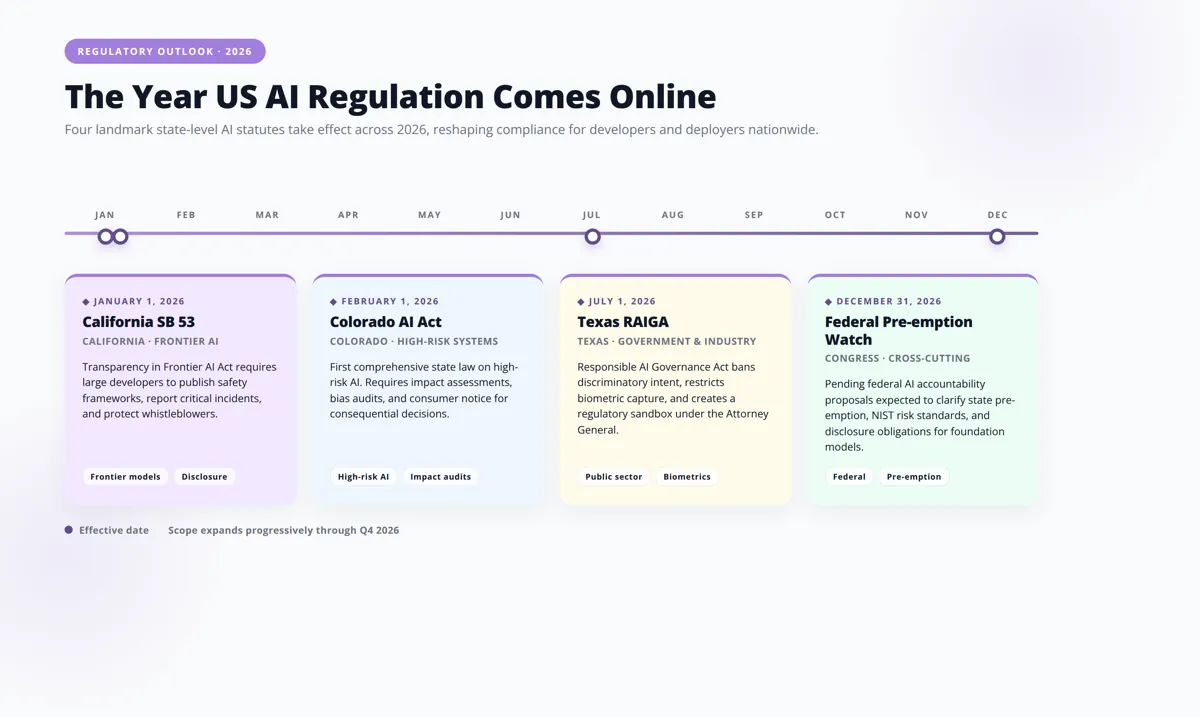
| Regulation | Jurisdiction | Effective Date | Scope |
|---|---|---|---|
| Transparency in Frontier AI Act (SB 53) | California | January 1, 2026 | Developers of frontier models trained with more than 10^26 FLOPS; requires risk frameworks, safety incident reporting, whistleblower protections |
| Responsible AI Governance Act | Texas | January 1, 2026 | Narrowed to focus on government use; bans behavioral manipulation and unlawful discrimination |
| Colorado AI Act | Colorado | June 30, 2026 (delayed from Feb 1) | Developers and deployers of high-risk AI in education, employment, housing, insurance, healthcare, government, legal services |
| FTC Section 5 enforcement | Federal (US) | Ongoing | Unfair or deceptive AI practices, including overstated capabilities |
The pattern is clear: states are filling the federal vacuum, and enforcement is moving from guidance to action [Source: VerifyWise]. According to a Berkeley School of Information report summarized by StateScoop, 43 states have established some form of AI governance, though with uneven scope [Source: StateScoop].
Disclaimer
This article is for general educational purposes and does not constitute legal advice. AI regulations are evolving rapidly. Consult qualified legal counsel for jurisdiction-specific compliance guidance, particularly for the California SB 53, Texas Responsible AI Governance Act, and Colorado AI Act obligations.
What This Means Practically
If you sell into education, employment, housing, insurance, healthcare, or financial services in Colorado, you are now a "deployer" of high-risk AI with documentation, impact assessment, and disclosure obligations starting June 30, 2026. If you train large foundation models in California, you fall under SB 53. If you sell to state governments anywhere in the US, expect procurement language demanding evidence of an AI governance program.
4. The Seven Core Components of an AI Governance Program
Quick Answer:
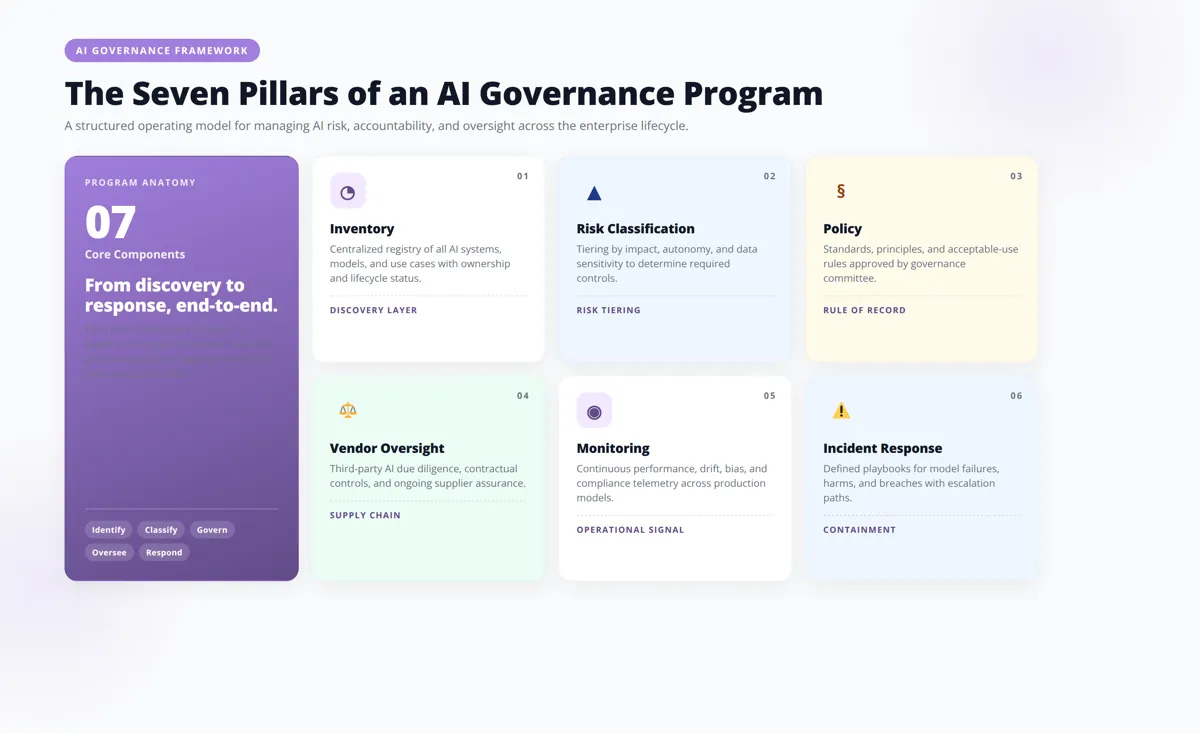
The seven core components of an AI governance program are: (1) AI use case and model inventory, (2) risk classification, (3) acceptable use policy and training, (4) vendor and procurement controls, (5) human oversight and decision rights, (6) monitoring, logging, and audit, and (7) incident response and disclosure.
Based on our implementation experience with mid-market and enterprise clients in 2025-2026, a credible AI governance program contains seven interlocking components. Skip one and the others collapse.
1. AI Use Case and Model Inventory
You cannot govern what you cannot see. The inventory should capture every AI system in use, including third-party SaaS features (Salesforce Einstein, Microsoft Copilot, Notion AI), custom models, and prompts deployed in production workflows. In our testing across 2025-2026 client engagements, initial inventories miss 40-60% of actual usage on the first pass.
2. Risk Classification
Not every AI use case is high risk. A summarization tool for internal notes is not the same as an algorithm that screens job applicants. Classify by impact on individuals, regulatory exposure, data sensitivity, and reversibility of decisions. The NIST AI Risk Management Framework provides a useful taxonomy [Source: VerifyWise].
3. Acceptable Use Policy and Employee Training
A short, plain-language policy covering what employees can and cannot do with AI tools, what data they can paste into public chatbots, and how to request approval for new tools. Pair it with mandatory training that is refreshed at least annually.
4. Vendor and Procurement Controls
Every AI vendor contract should include data handling commitments, training data exclusions, indemnification for IP claims, model documentation, and incident notification timelines. Procurement is one of the highest-leverage points in any governance program.
5. Human Oversight and Decision Rights
Define which decisions require a human in the loop, which require human-on-the-loop monitoring, and which can run autonomously. Document the escalation path when AI outputs are wrong or contested.
6. Monitoring, Logging, and Audit
Production AI systems need continuous monitoring for accuracy drift, bias, prompt injection attempts, and unusual usage patterns. Logs must be retained long enough to support audit and incident investigation.
7. Incident Response and Disclosure
When an AI system fails, who gets notified, how fast, and what gets disclosed externally? California SB 53 now mandates safety incident reporting for frontier model developers; expect similar requirements to spread [Source: VerifyWise].
Expert Insight
The component most often underweighted is incident response. We recommend running at least one tabletop exercise in the first 90 days, simulating a scenario like "a customer-facing chatbot produced a defamatory statement that has now been screenshotted on Reddit." The first time you write that playbook should not be during the actual incident.
Free Checklist
Download Our AI Governance Readiness Checklist
A 47-point checklist covering inventory, risk classification, vendor controls, oversight, and incident response across the seven core components of responsible AI deployment.
1. AI System Inventory & Discovery
- ✓You cannot govern what you cannot see. Start with a complete view of every model, agent, and embedded AI feature across your stack.
- ✓FOR: IT, DATA & COMPLIANCE LEADS
- ✓Maintain a central AI register listing every production system, pilot, and shadow-IT tool — refreshed at least quarterly.
- ✓Document each model's purpose, owner, and business unit, with a named accountable executive per system.
- ✓Capture data lineage: input sources, training datasets, retention period, and storage region.
- ✓Tag third-party AI features embedded in SaaS tools (e.g. CRM, HR, productivity suites) that often slip past procurement.
- ✓Record model type and version (foundation, fine-tuned, classical ML, RAG, agent) plus the provider and API endpoint.
- ✓Inventory all prompts and system instructions used in production agents, stored in version control.
2. Risk Classification & Impact Assessment
- ✓Not every AI system needs the same scrutiny. Tier your portfolio so high-stakes use cases get the attention they deserve.
- ✓FOR: RISK, LEGAL & PRODUCT OWNERS
- ✓Apply a tiered risk model (e.g. minimal, limited, high, unacceptable) aligned with the EU AI Act categories.
- ✓Complete a documented impact assessment for any system touching hiring, credit, health, safety, or biometrics.
- ✓Flag systems making automated decisions about individuals and confirm human review pathways exist.
- ✓Assess bias and fairness risks per protected attribute, with quantitative thresholds defined upfront.
- ✓Identify dual-use and misuse scenarios, including prompt injection, data exfiltration, and model jailbreaks.
- ✓Re-classify systems on any material change — new training data, new use case, new user population.
- ✓Record residual risk acceptance with the signature of the accountable owner.
3. Vendor & Third-Party Controls
- ✓Most enterprise AI risk now lives in your supplier chain. Hold vendors to the same bar you hold yourself.
- ✓FOR: PROCUREMENT, SECURITY & VENDOR MANAGEMENT
- ✓Issue an AI-specific due diligence questionnaire before contract signature, not after deployment.
- ✓Require vendors to disclose model provenance, training data origin, and sub-processors.
- ✓Include data-use restrictions in contracts (no training on your data without consent, no retention beyond X days).
- ✓Mandate breach and incident notification windows of 72 hours or less for AI-related events.
- ✓Verify SOC 2, ISO 27001, and ISO 42001 status, plus any sector-specific certifications.
- ✓Confirm an exit and portability plan so you can extract data and switch providers without lock-in.
- ✓Review high-risk vendors annually; spot-check medium-risk vendors every 18 months.
4. Human Oversight & Accountability
- ✓AI systems perform best when paired with clear human checkpoints. Make the lines of authority unambiguous.
- ✓FOR: EXECUTIVE TEAM & OPERATIONS
- ✓Establish an AI governance committee with representation from risk, legal, security, product, and a business sponsor.
- ✓Publish a written AI policy covering acceptable use, prohibited use, and disclosure obligations.
- ✓Define a human-in-the-loop standard for every high-impact decision pathway.
- ✓Train all employees on responsible AI use, with role-specific deep-dives for developers and decision-makers.
- ✓Maintain an audit trail of model outputs, human overrides, and the rationale behind each.
- ✓Schedule independent reviews of high-risk systems at least once per year.
- ✓Set escalation thresholds so frontline staff know when to pause a system and who to call.
5. Monitoring, Testing & Validation
- ✓A model that passed evaluation last quarter is not guaranteed to pass today. Continuous testing is the price of trust.
- ✓FOR: ML ENGINEERING & QUALITY ASSURANCE
- ✓Run pre-deployment evaluations covering accuracy, fairness, robustness, and security against a documented test set.
- ✓Implement drift detection on inputs and outputs, with alerts when distributions move beyond tolerance.
- ✓Conduct adversarial and red-team testing on every high-risk system before launch and after major updates.
- ✓Track quality metrics in production dashboards reviewed by the model owner weekly.
- ✓Maintain a model card for every system, including known limitations and out-of-scope uses.
- ✓Validate explanations and citations in RAG and agentic systems against ground truth on a sampled basis.
6. Incident Response & Recovery
- ✓When an AI system fails, the clock starts. Decide today how you will respond, communicate, and recover.
- ✓FOR: SECURITY, COMMS & LEGAL
5. Frameworks to Anchor Your Program
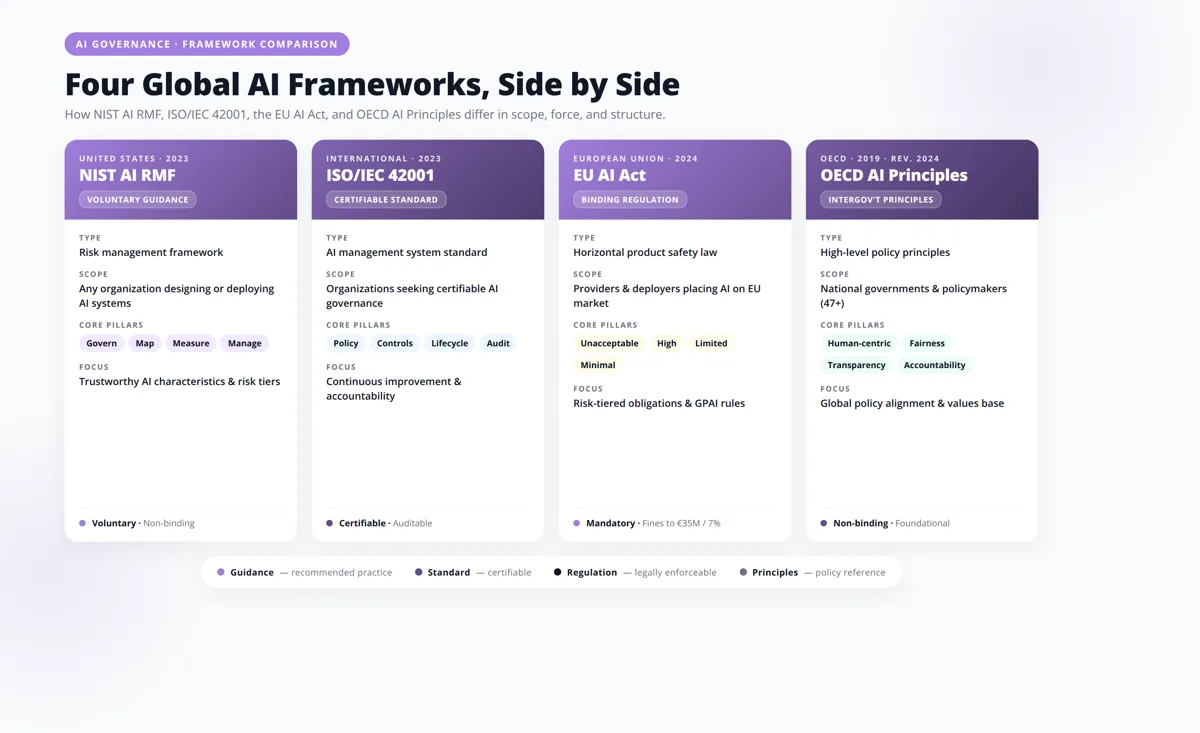
You do not need to invent AI governance from scratch. Several frameworks have emerged as de facto standards in 2026.
NIST AI Risk Management Framework
Released in January 2023, the NIST AI RMF remains the most widely referenced operational standard for US AI governance in 2026 [Source: VerifyWise]. It organizes governance around four functions: Govern, Map, Measure, and Manage. Although voluntary, it is increasingly cited in procurement contracts and state regulations as the baseline.
ISO/IEC 42001
The international standard for AI management systems, modeled on the structure of ISO 27001. Useful for organizations that already operate under ISO frameworks and want a certifiable AI governance system.
EU AI Act
For any business operating in or selling into the European Union, the EU AI Act establishes a risk-tiered regime (unacceptable, high, limited, minimal) with substantial fines. Even US-only businesses often align to it because European enterprise customers demand it in contracts.
Framework Comparison
| Framework | Type | Best For | Certifiable? |
|---|---|---|---|
| NIST AI RMF | Voluntary US standard | US companies needing a baseline operational model | No |
| ISO/IEC 42001 | International standard | Companies with existing ISO programs and global customers | Yes |
| EU AI Act | Regulation | Any company serving EU markets | Compliance assessment required |
| OECD AI Principles | Policy framework | Multinational alignment and board-level principles | No |
6. Tackling Shadow AI Inside Your Organization
Quick Answer:
Tackle shadow AI with the Discover-Sanction-Replace pattern: map actual usage through telemetry and surveys, fast-track approval for high-value tools through an expedited review track, and replace rejected tools with approved alternatives within 30 days. Banning without replacing drives usage further underground.
Shadow AI - the use of AI tools that have not been approved or procured by the organization - is now the single largest practical governance challenge. According to reports compiled in 2026, 55% to 78% of employees use AI tools outside official channels [Source: Aona]. In most cases this is not malicious; it is people trying to do their jobs faster.
Why Shadow AI Is Different From Shadow IT
Shadow IT typically created cost and security risks. Shadow AI adds three new dimensions: confidential data leaving the organization through prompts, generated content with unclear IP ownership, and decisions being influenced by models the company has never evaluated.
The Discover, Sanction, Replace Pattern
In our implementations, we use a three-step pattern that consistently works:
- Discover: Use network monitoring, expense reports, browser telemetry, and anonymous employee surveys to map actual AI usage.
- Sanction: Approve the highest-value tools quickly through an expedited review track, so employees do not feel punished for being productive.
- Replace: For tools that fail review, provide approved alternatives within 30 days. Banning without replacing drives usage further underground.
Pro Tip
Pair your shadow AI discovery with an anonymous internal survey using a guaranteed amnesty policy for the first 30 days. We've seen this approach surface 3-4x more tools than telemetry alone.
The Enterprise Tier Trap
Many companies assume that buying enterprise tiers of ChatGPT, Claude, or Copilot solves shadow AI. It helps, but it does not solve the problem. Employees still use personal accounts for tools their employer has not licensed, and they still paste data into browser extensions and consumer apps the security team has never seen.
7. Board and Executive Oversight
According to ISS Corporate's 2026 analysis, 22% of S&P 500 companies disclosed board oversight of AI, versus only 6% of Russell 3000 companies [Source: ISS Corporate]. Board oversight is becoming a differentiator for larger public companies and is starting to flow down to private and mid-cap businesses through investor and acquirer due diligence.
What Board-Level AI Oversight Looks Like
- Charter assignment: Which committee owns AI - audit, risk, technology, or a new AI committee?
- Reporting cadence: Quarterly metrics on AI use cases, incidents, and risk posture.
- Director education: At least one director with credible AI literacy, supported by external advisors.
- Materiality thresholds: Defined criteria for when AI decisions get escalated to the board.
The CEO's Role
The CEO does not need to be the AI expert, but does need to name the executive accountable (typically the CIO, CTO, Chief Risk Officer, or Chief AI Officer), approve the governance charter, and make AI risk a standing item in the executive operating rhythm. Eric Hysen, former DHS CIO, captures the shift: AI governance is becoming "a core part of state IT operations, not a standalone policy exercise" [Source: StateScoop]. The same is true for private sector operations.
8. Building a Centralized Operating Model
The market is shifting from ad hoc AI review to centralized, repeatable operating models that tie together legal, security, procurement, and model-risk teams [Source: K&L Gates]. In practice, this means establishing an AI governance committee with clear decision rights and a workflow that any team can use to propose a new AI use case.
The Three Lines of Defense Applied to AI
| Line | Owner | Responsibility |
|---|---|---|
| First line | Business units and product teams | Propose use cases, perform initial risk assessment, operate controls day-to-day |
| Second line | Governance committee, legal, risk, security | Review submissions, set policy, monitor metrics, approve high-risk cases |
| Third line | Internal audit | Independent assurance that the program is operating as designed |
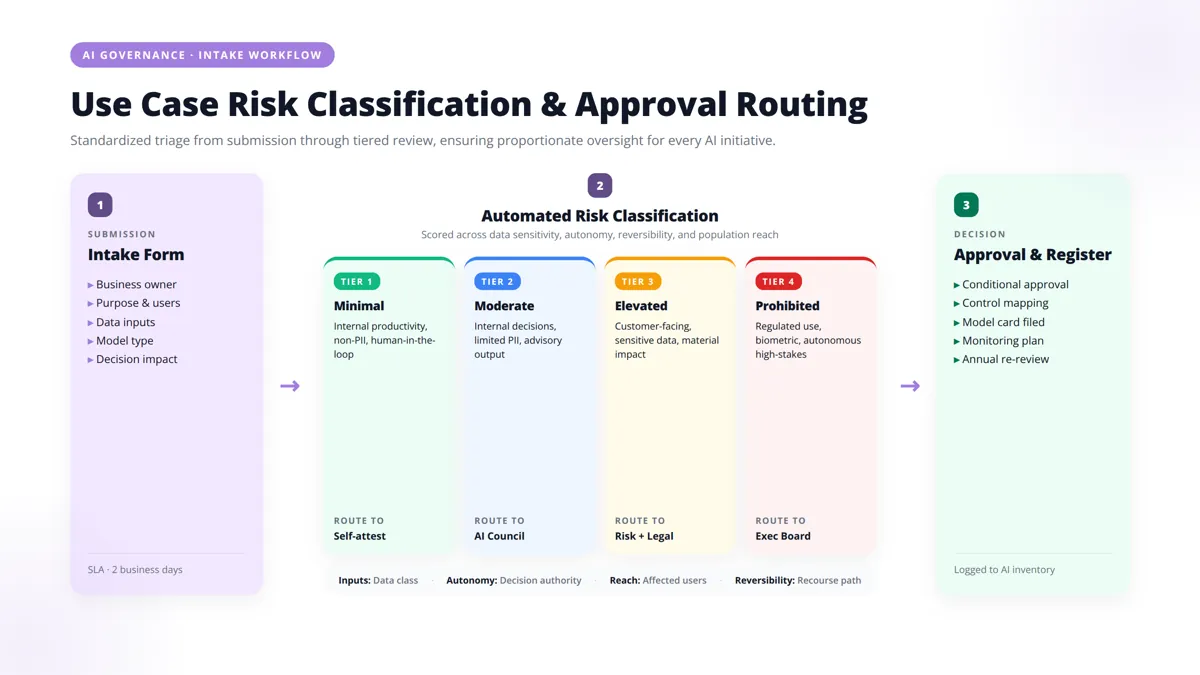
The Intake Workflow
In our deployments, we typically build a single intake form that any employee can use to register a new AI use case. The form auto-routes based on risk classification: low-risk cases go through a 48-hour expedited review, medium-risk cases go to the governance committee, and high-risk cases trigger a full impact assessment.
9. AI Governance Tools and Vendor Categories
According to Domo, AI governance has emerged as a distinct enterprise software category in 2026, with vendors emphasizing risk registries, metadata inventories, monitoring, and compliance workflows [Source: Domo]. The market is still consolidating, so CEOs should be cautious about over-tooling early.
Categories to Know
- AI inventory and discovery: Tools that scan network traffic, SaaS catalogs, and endpoints to find AI usage.
- Model risk management (MRM): Extensions of traditional MRM platforms now covering ML and generative AI.
- Policy and workflow platforms: Governance, risk, and compliance (GRC) tools with AI-specific modules.
- Model monitoring and observability: Drift detection, bias monitoring, prompt logging, and red-teaming infrastructure.
- Data loss prevention for AI: Specialized DLP for prompts, file uploads to chatbots, and AI-generated content.
Build vs. Buy
For most mid-market companies, we recommend starting with spreadsheet-based inventories and lightweight workflow tools you already own (such as a ticketing system or your existing GRC platform). Only invest in dedicated AI governance software once you have a working operating model and know what you actually need to scale.
Expert Insight
We've seen multiple clients spend $80,000-$150,000 on AI governance platforms in their first 90 days only to abandon them within six months because the underlying operating model was not yet defined. Tools accelerate working processes; they do not create them.
Free Blueprint
Schedule an AI Governance Strategy Session
A 45-minute working session with our team to map your current AI footprint, regulatory exposure, and 90-day priorities — so you leave with a concrete plan, not another deck to read.
1. Map Your Current AI Footprint
- ✓Before you can govern AI, you need to know where it lives — including the shadow tools your teams adopted last quarter.
- ✓For: CIOs, CTOs, Heads of Data
- ✓Inventory every AI-powered SaaS tool in use across departments, including free tiers and personal accounts paid through expenses.
- ✓Identify all internal models and pipelines built by data science, engineering, or analytics teams in the past 24 months.
- ✓Document third-party APIs that touch your data (OpenAI, Anthropic, Cohere, Hugging Face, regional providers).
- ✓Flag embedded AI features inside existing platforms — CRMs, HR tools, security stacks — that activated without explicit procurement review.
- ✓Tag each system with data sensitivity, business criticality, and current ownership.
2. Assess Regulatory Exposure
- ✓The EU AI Act, GDPR overlap, FINMA guidance, and sector-specific rules each carry their own clocks. We'll triage which apply to you and when.
- ✓For: General Counsel, DPOs, Compliance Leads
- ✓STEP 01 — Classify systems against the EU AI Act risk tiers: Map each use case to prohibited, high-risk, limited-risk, or minimal-risk categories with documented reasoning.
- ✓STEP 02 — Review cross-border data flows: Confirm transfer mechanisms (SCCs, adequacy decisions) for every model that processes EU or Swiss personal data.
- ✓STEP 03 — Identify sector overlays: Layer in FINMA, MDR, NIS2, DORA, or HIPAA obligations that interact with your AI use cases.
- ✓STEP 04 — Quantify documentation gaps: List the technical files, conformity assessments, and impact assessments missing today — and who owns producing them.
3. Define Your Governance Operating Model
- ✓Good governance is fewer committees, clearer accountabilities. We'll sketch the model that fits your size and risk appetite.
- ✓For: Executive sponsors and program leads
- ✓Name a single accountable executive for AI governance — not a committee, a person with budget authority.
- ✓Define a lightweight intake process so new AI use cases get reviewed in days, not quarters.
- ✓Establish review tiers matched to risk — minor uses get a checklist, high-risk uses get a full assessment.
- ✓Clarify the RACI between Legal, Security, Data, and Business Units for build, buy, and monitor decisions.
4. Draft Your 90-Day Priority Roadmap
- ✓Most AI governance programs stall because everything feels urgent. We'll sequence the next 90 days into three honest sprints.
- ✓For: Program managers and transformation leads
- ✓WORKING TEMPLATE — COMPLETED LIVE DURING THE SESSION
- ✓Days 1–30: Stand up the inventory, publish an interim acceptable-use policy, and brief the executive team on top three risks. Days 31–60: Complete risk classification for the top 20 use cases, remediate the two most exposed, and stand up a vendor review checklist. Days 61–90: Operationalize the intake process, train function leads, and publish your first quarterly AI risk report to the board.
5. Prepare for the Session
- ✓Bring the right people and a few artifacts, and we can move from discovery to decisions inside the 45 minutes.
- ✓For: Whoever is booking the session
- ✓Invite 3–5 stakeholders spanning technology, legal/compliance, and a business sponsor.
- ✓Share a rough list of known AI tools and use cases — bullet points are fine, no formatting required.
- ✓Bring one specific decision you're stuck on (a vendor choice, a policy question, a board ask).
- ✓Identify your binding constraint — budget, headcount, timeline, or regulator deadline.
- ✓Block 15 minutes after the call to debrief internally while the conversation is fresh.
Pro tip: The teams that get the most out of this session arrive with one uncomfortable question already on the table. The clearer your starting tension, the sharper the 90-day plan we can build together.
10. A 90-Day Implementation Roadmap
Quick Answer:
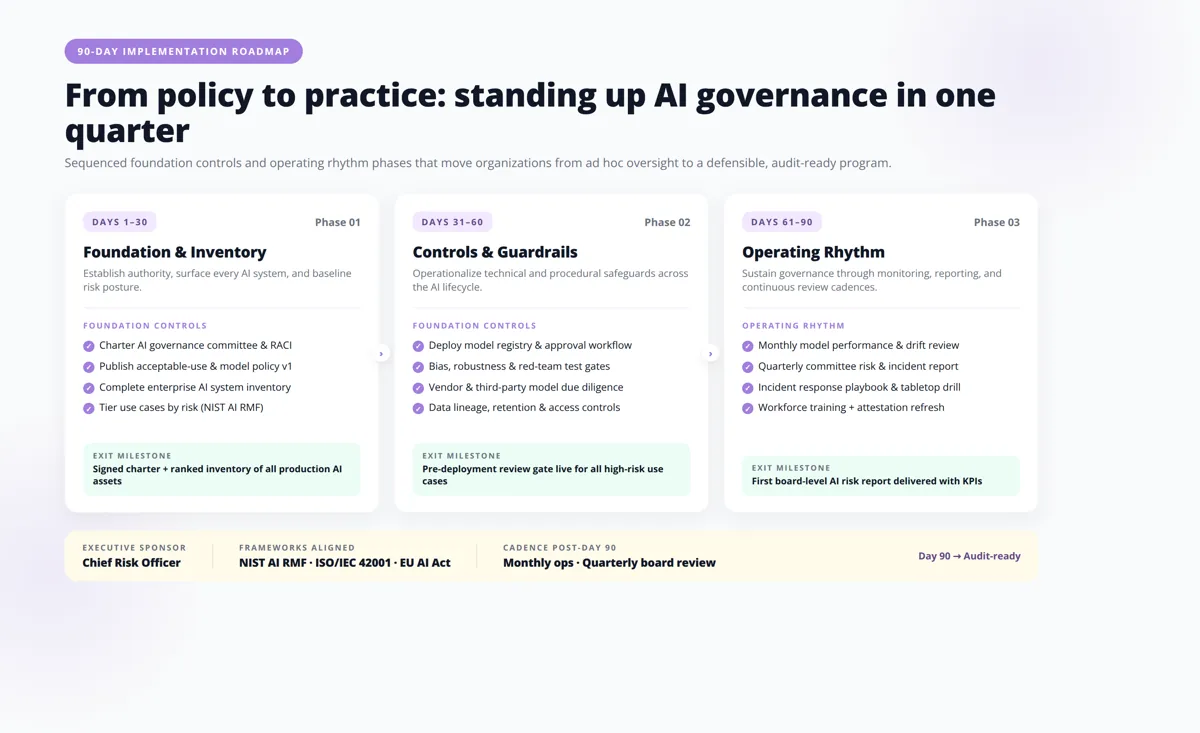
A 90-day AI governance implementation follows three phases: Days 1-30 establish foundation (sponsor, framework, policy, inventory), Days 31-60 build controls (intake workflow, procurement clauses, training, monitoring), and Days 61-90 establish operating rhythm (committee reviews, incident tabletop, board briefing).
Based on our implementation experience, here is a practical 90-day sequence that produces a defensible governance program without overwhelming the organization.
Days 1-30: Foundation
- Name the executive sponsor and form the governance committee.
- Adopt NIST AI RMF (or ISO 42001) as the anchor framework.
- Publish a one-page acceptable use policy and communicate it company-wide.
- Launch the AI use case inventory; aim for 80% coverage in 30 days.
- Identify the top three regulatory exposures based on your markets and customers.
Days 31-60: Controls
- Build the intake workflow and risk classification rubric.
- Update procurement templates with AI vendor clauses.
- Roll out mandatory employee training on AI usage.
- Define human oversight requirements for the top five use cases.
- Stand up basic monitoring and logging for production AI systems.
Days 61-90: Operating Rhythm
- Run the first governance committee review cycle on real submissions.
- Conduct a tabletop exercise simulating an AI incident.
- Publish the first quarterly metrics dashboard for the executive team.
- Brief the board on the program and recommended ongoing cadence.
- Identify gaps and prioritize the next 90 days.
11. Real-World Examples and Case Studies
Example 1: State Governments Operationalizing Governance
According to a Berkeley School of Information report summarized by StateScoop, 43 US states are embedding AI governance into procurement, cybersecurity, and operational workflows rather than treating it as a separate compliance task [Source: StateScoop]. This is the model private sector CEOs should study: governance built into the existing flow of work.
Example 2: The 75% Outperformers
According to TrustArc's benchmark, organizations with fully integrated privacy and governance initiatives - including automated data inventory, consent management, and centralized Trust Centers - scored 75% on average versus the 53% benchmark [Source: TrustArc]. The lesson: integration beats siloed compliance.
Example 3: Frontier Model Pre-Deployment Vetting
K&L Gates reports that the Administration has been considering pre-deployment vetting concepts for certain frontier models following concerns raised in connection with Anthropic's Mythos model reporting [Source: K&L Gates]. Companies developing or fine-tuning large models should plan for this trajectory.
Example 4: A Mid-Market SaaS Company (Anonymized)
In one of our 2026 engagements, a 400-person SaaS company discovered 87 distinct AI tools in use after a four-week inventory exercise. They had previously believed they used "about a dozen." After applying the discover-sanction-replace pattern, they consolidated to 31 approved tools, recovered roughly $180,000 in duplicated SaaS spend, and passed three enterprise security reviews that had previously stalled their sales cycle.
Example 5: Enterprise Sales Acceleration Through Governance
A European financial services client of ours used their AI governance documentation - inventory, NIST alignment, incident response runbook, vendor due diligence files - as a sales asset. Average enterprise security questionnaire response time dropped from 18 days to 4 days, and deal cycle length on AI-related opportunities compressed by approximately 22%.
12. Common AI Governance Mistakes to Avoid
Mistake 1: Treating Governance as a Policy Document
A PDF is not a program. Without an inventory, owners, controls, and monitoring, a policy is decorative.
Mistake 2: Banning Tools Without Providing Alternatives
If you block ChatGPT and do not provide an approved alternative within 30 days, employees will use personal devices and personal accounts. Shadow AI gets worse, not better.
Mistake 3: Owning Governance Only in Legal
TrustArc's 2026 analysis is blunt: in the AI era, privacy and governance can no longer be a siloed function and require an orchestrated approach combining regulatory intelligence and automation [Source: TrustArc]. Legal owns the policy, but security, product, procurement, and HR own execution.
Mistake 4: Over-Tooling Before You Have an Operating Model
Buying a governance platform before you know your use cases, owners, and workflows is a six-figure way to delay actual progress.
Mistake 5: Ignoring Vendor AI Features
Every SaaS tool now embeds AI. Your governance scope is not just the AI you build; it is the AI features turned on by default in Salesforce, Microsoft, Google Workspace, HubSpot, Zoom, and dozens of other vendors.
Mistake 6: No Incident Response Plan
The first time an AI system produces a biased, defamatory, or confidential output is not the moment to write the playbook. SB 53's incident reporting requirements signal the direction of regulation [Source: VerifyWise].
Mistake 7: Skipping Board Education
Directors who do not understand AI cannot exercise meaningful oversight. ISS Corporate's findings that board oversight remains "nascent" across much of the market is both a warning and an opportunity to differentiate [Source: ISS Corporate].
Pro Tip
Build a 60-minute "AI literacy for directors" session into your annual board calendar. We've found that a single well-designed session covering risk taxonomy, regulatory landscape, and key metrics dramatically improves the quality of board questions and oversight.
13. Frequently Asked Questions
Q: What is AI governance in simple terms?
A: AI governance is the system of rules, controls, owners, and monitoring that a company uses to make sure its AI is safe, legal, and aligned with business values. Think of it as the operating system for responsible AI use, covering everything from which tools employees can use to how the board hears about AI risks.
Q: Is AI governance the same as AI ethics?
A: No. AI ethics is the set of values and principles (fairness, transparency, accountability) that guide how AI should be used. AI governance is the practical machinery - policies, controls, workflows, and metrics - that makes those principles real in day-to-day operations. Ethics without governance is aspirational; governance without ethics is bureaucracy.
Q: Do small and mid-market businesses really need AI governance?
A: Yes, increasingly. While S&P 500 companies lead in formal board oversight at 22%, state laws like Colorado's apply to any company deploying high-risk AI regardless of size [Source: VerifyWise]. Enterprise customers also now require evidence of AI governance during procurement, making it a sales enabler for smaller vendors.
Q: Who should own AI governance in a company?
A: Ownership varies by company size. Mid-market companies often place it with the CIO or CTO, supported by a cross-functional committee. Larger enterprises increasingly appoint a Chief AI Officer or Head of Responsible AI. What matters most is a named executive sponsor with budget authority, not the specific title.
Q: What framework should I use to build my AI governance program?
A: For US companies, the NIST AI Risk Management Framework is the de facto starting point and is referenced in many state laws and procurement contracts [Source: VerifyWise]. Companies with EU exposure should align to the EU AI Act, and those wanting certification should look at ISO/IEC 42001.
Q: How long does it take to implement AI governance?
A: A defensible foundation - inventory, policy, intake workflow, committee, basic monitoring - can be built in 90 days. Reaching maturity with continuous monitoring, automated controls, and full board reporting typically takes 12 to 18 months. Governance is a program, not a project.
Q: What is shadow AI and why does it matter?
A: Shadow AI is the use of AI tools that have not been approved by the organization. Studies in 2026 show 55% to 78% of employees use unsanctioned AI tools [Source: Aona]. It matters because confidential data may leak through prompts, IP ownership of generated content becomes unclear, and the company has no visibility into decisions being influenced by these tools.
Q: How does AI governance differ from data governance?
A: Data governance focuses on how data is collected, stored, classified, and accessed. AI governance covers the additional dimensions of model behavior, decision-making impact, bias, transparency, and human oversight. The two overlap heavily on data quality and lineage but address different risks.
Q: What are the biggest AI regulations to watch in 2026?
A: In the US, California's Transparency in Frontier AI Act (SB 53), Texas's Responsible AI Governance Act (both effective January 1, 2026), and Colorado's AI Act (effective June 30, 2026) are the most significant [Source: VerifyWise]. Internationally, the EU AI Act continues to phase in obligations. FTC enforcement under Section 5 remains the most active federal lever.
Q: Does AI governance slow down innovation?
A: Done badly, yes. Done well, no. The point of a tiered intake workflow is that low-risk use cases get approved in 48 hours while high-risk cases get the scrutiny they deserve. In our experience, companies with mature governance ship more AI use cases, not fewer, because teams trust the process and stop hiding their work.
Q: How much does AI governance cost?
A: For a mid-market company, the first year typically costs $150,000 to $400,000 fully loaded, including a part-time executive sponsor, a dedicated program manager, external advisory, training, and basic tooling. Larger enterprises with model risk obligations spend significantly more. The ROI shows up in faster enterprise sales, lower regulatory exposure, and reduced shadow AI spend.
Q: What is a model inventory and why do I need one?
A: A model inventory is a centralized registry of every AI system in use - internal models, vendor features, and embedded AI in SaaS products. You need one because you cannot govern what you cannot see. The inventory is the foundation for risk classification, monitoring, vendor management, and regulatory reporting.
Q: How should the board oversee AI?
A: Assign AI to a specific committee (audit, risk, technology, or a new AI committee), receive quarterly metrics on use cases, incidents, and regulatory exposure, ensure at least one director has credible AI literacy, and define escalation thresholds. ISS Corporate's 2026 data shows this practice is concentrated in larger companies but spreading [Source: ISS Corporate].
Q: What is the difference between high-risk and low-risk AI use cases?
A: High-risk AI affects consequential decisions about people - hiring, lending, healthcare, education, housing, legal services. Colorado's AI Act explicitly targets these categories [Source: VerifyWise]. Low-risk AI typically supports internal productivity (summarization, brainstorming, code completion) without directly affecting individuals' rights or opportunities.
Q: Where should we start if we have nothing today?
A: Start with three things in the first 30 days: name an executive sponsor, publish a short acceptable use policy, and launch the AI inventory. These three actions create visibility, accountability, and a foundation for everything else. Avoid the temptation to start with tool selection or a 60-page policy document.
Conclusion: Governance Is the Price of Entry
AI governance in 2026 is no longer optional, abstract, or solely the domain of legal and ethics teams. It is a practical operating discipline that determines whether your business can scale AI use safely, win enterprise deals, satisfy state regulators, and answer the questions a board, an auditor, or an acquirer will ask. K&L Gates put it directly: operational governance is becoming the price of entry [Source: K&L Gates].
Key Takeaways for CEOs
- AI governance is a system of policies, controls, owners, and monitoring - not a single document.
- The 2026 regulatory environment is being built by states and enforcement agencies, not Congress.
- Shadow AI is the largest practical risk; address it through discover-sanction-replace, not bans.
- Anchor your program to NIST AI RMF, ISO 42001, or the EU AI Act based on your markets.
- Build a 90-day foundation before investing in dedicated governance software.
- Board oversight is becoming a differentiator - 22% of S&P 500 companies already disclose it.
- Integrated governance outperforms siloed compliance by roughly 22 percentage points in benchmarks.
The companies that will lead in the AI era are not the ones with the most models. They are the ones who can prove their AI is trustworthy, defensible, and aligned with the business. That is what AI governance delivers.
Schedule an AI Governance Readiness Audit
A structured 2-week audit mapping your AI footprint, regulatory exposure, and a prioritized 90-day governance roadmap.
Book Your Audit
About the Author
Agenticsis Team - A Zurich-based AI consultancy founded by Sofía Salazar Mora, partnering with companies across Switzerland, the European Union, and Latin America to mainstream artificial intelligence into business operations. Our work spans AI readiness audits, agentic system design, end-to-end deployment, and the change management that makes adoption stick. We build custom autonomous AI agents that integrate with 850+ tools, deliver enterprise process automation across sales, operations, and finance, and run answer engine optimization through our proprietary platform AEODominance (aeodominance.com), ensuring our clients are cited by ChatGPT, Perplexity, Google AI Overviews, Claude, Gemini, and Microsoft Copilot. Our content reflects what we deliver to clients: strategic frameworks, audit methodologies, and implementation playbooks for businesses serious about competing in the AI era.