TL;DR(Too Long; Did not Read)
What early Swiss SME agentic AI deployments reveal about document-heavy back-office automation, governance, and ROI in 2026. Research-backed guide.
Document-Heavy Back-Office Workflows: What Early Swiss SME Agentic AI Deployments Show in 2026
Published by Agenticsis. Last updated: 11 November 2026.
Quick Answer:
Early Swiss SME agentic AI deployments in 2026 focus on bounded automation of document-heavy back-office tasks: intake, extraction, validation, routing, and drafting, with human review retained for consequential decisions. Reported productivity gains include administrative time reductions of around 58 percent in a referenced small-firm case study, but public, independently audited Swiss datasets remain limited. Private processing and integration with Abacus, bexio, and Microsoft 365 are the practical differentiators. [Source: ai-outsourcing.ch]
Table of Contents
- 1. The State of Swiss SME Agentic AI Adoption in 2026
- 2. What "Document-Heavy Back-Office Workflow" Actually Means
- 3. The Emerging Deployment Pattern: Bounded Agents, Not Autonomy
- 4. Reported Results from Early Deployments
- 5. Private Processing: Keeping Documents In-House
- 6. Integration With Abacus, bexio, and Microsoft 365
- 7. Governance Under the Revised FADP and the Council of Europe Framework
- 8. Human-in-the-Loop as the Default Operating Model
- 9. Sector Use Cases: Fiduciary, Insurance, Pensions, Procurement
- 10. A Practical Implementation Roadmap for Swiss SMEs
- 11. Risks, Pitfalls, and What Early Adopters Got Wrong
- 12. Frequently Asked Questions
1. The State of Swiss SME Agentic AI Adoption in 2026
Quick Answer:
Roughly two-thirds of Swiss SMEs plan to integrate at least one AI tool in 2026, but only a small proportion have a structured implementation plan. Most early agentic AI projects focus on document-heavy back-office work because it is high-volume, low-visibility, and bounded by stable templates. [Source: swissaisummit.com]
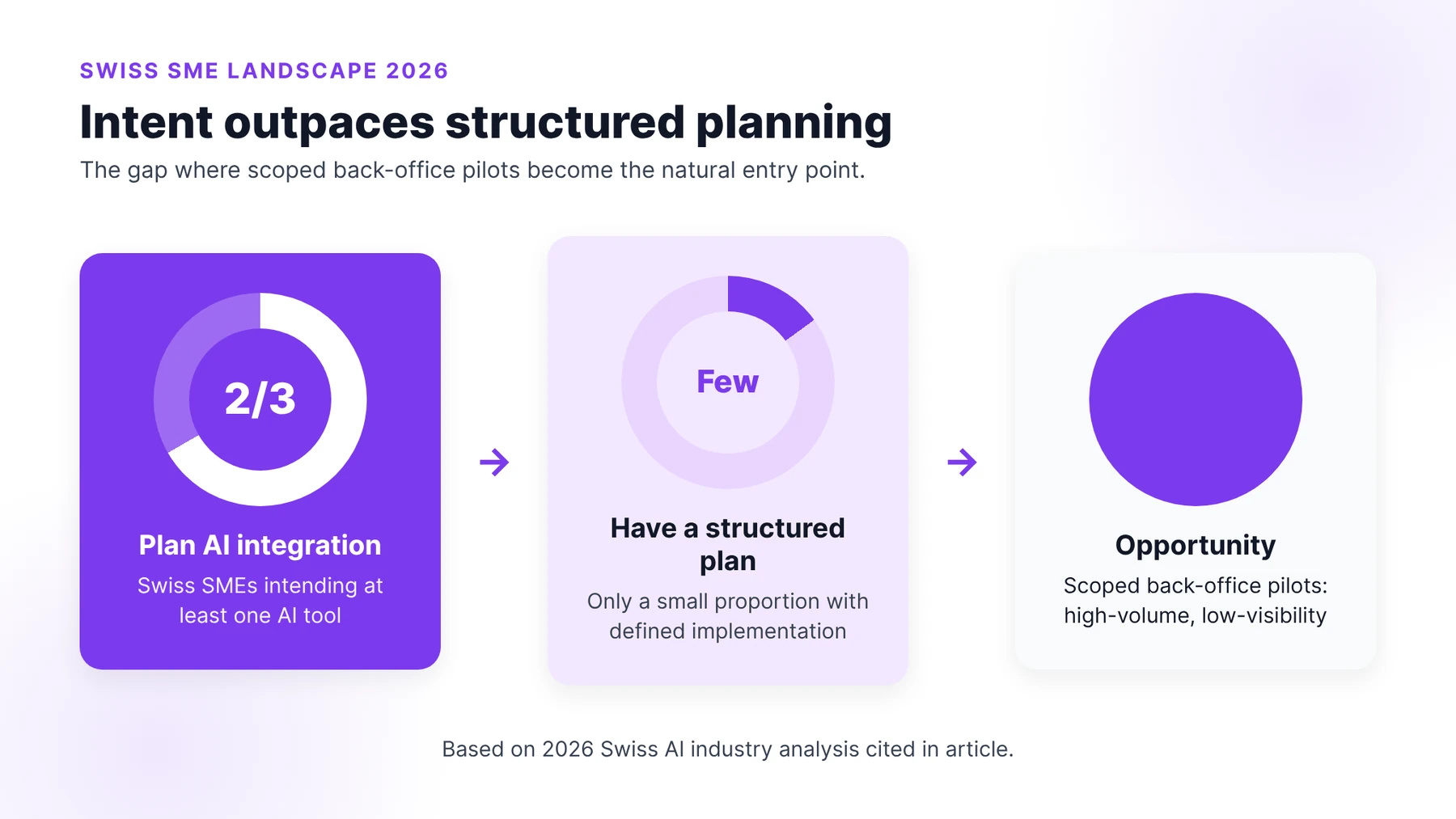
A 2026 Swiss AI industry analysis reports that roughly two-thirds of Swiss SMEs plan to integrate at least one AI tool, while only a small proportion have a structured implementation plan [Source: swissaisummit.com]. That gap between intent and planning defines the current moment. Interest is broad, execution is uneven, and document-heavy back-office work is where most early projects actually start.
The reason is practical. Swiss SMEs across fiduciary services, insurance brokerage, pension administration, manufacturing procurement, and professional services spend significant hours on repetitive document handling. Invoices arrive by email and post. Contracts need field extraction. Pension files require cross-checking against master data. Supplier onboarding demands validation. These tasks are rules-based, document-intensive, and well-suited to the pattern of bounded agents that the 2026 market is converging on.
What distinguishes agentic AI from earlier RPA or single-prompt tooling is orchestration. Instead of one macro executing a fixed sequence, a set of specialized agents classify, extract, compare, route, and draft, each with a narrow scope and a defined handoff. This structure fits Swiss SME requirements for traceability and human oversight far better than attempts to replace entire processes with a single autonomous system.
Why back-office first?
Back-office document work carries three attributes that make it the natural entry point. It is high-volume, which creates measurable return. It is low-visibility, which limits reputational risk if something misfires in pilot. And it is bounded by existing forms and templates, which gives agents stable inputs to work against.
Why does structured planning lag intent?
The planning deficit reflects three constraints: unclear ROI modelling for agentic systems, uncertainty about Swiss and EU regulatory exposure, and limited internal capacity to specify agent boundaries. These are solvable, but they explain why deployment is more cautious than headlines suggest.
Expert Insight
The gap between SMEs that plan AI integration and those with a structured plan is the single most important market signal in Swiss 2026 agentic AI. It means most competitive advantage in the next 18 months will come not from model selection, but from operational scoping: picking one bounded workflow, classifying its data under FADP, and resisting the urge to widen scope until the first workflow is stable.
2. What "Document-Heavy Back-Office Workflow" Actually Means
The phrase gets used loosely. In the context of early Swiss SME deployments, it refers to workflows where the primary inputs are unstructured or semi-structured documents, where human staff spend most of their time reading, extracting, comparing, and typing, and where downstream systems like ERP or accounting software need clean structured data to proceed.
Typical examples include accounts payable invoice processing, insurance claim intake, pension file maintenance, supplier onboarding, quotation preparation, and compliance documentation. In each case the agent's job is not to make the business decision. Its job is to turn documents into reliable structured data, flag exceptions, and prepare a draft for human approval.
The four document operations agents handle well
- Classification: Deciding whether a document is an invoice, a credit note, a contract, or a form.
- Extraction: Pulling specific fields such as VAT number, line items, dates, and counterparties.
- Validation: Comparing extracted values against ERP, CRM, or master data.
- Routing and drafting: Sending the result to the right queue, drafting a reply, or generating a summary.
What do agents still struggle with?
Handwritten annotations, non-standard scan quality, documents in mixed languages with Swiss-specific terminology, and edge cases that involve legal interpretation remain challenging. Early deployments handle these by lowering the confidence threshold and sending more items to human review rather than attempting full autonomy.
Pro Tip
Before scoping any agent, inventory one month of real documents for the target workflow and label them into four buckets: standard, variant, edge case, and outright exception. The ratio tells you whether the workflow is ready for agentic automation or whether template consolidation should come first.
3. The Emerging Deployment Pattern: Bounded Agents, Not Autonomy
Quick Answer:
Early Swiss SME deployments use multi-agent architectures where each agent has a narrow scope (classification, extraction, validation, drafting) with explicit, logged handoffs. This bounded pattern is easier to audit and governs better under FADP than a single autonomous agent. [Source: ai-outsourcing.ch]
The 2026 evidence from early deployments points consistently to a multi-agent architecture rather than a single generalist. A reported micro-business deployment illustrates the model: multiple specialized agents handled different administrative stages rather than one general-purpose agent controlling the entire process [Source: ai-outsourcing.ch].
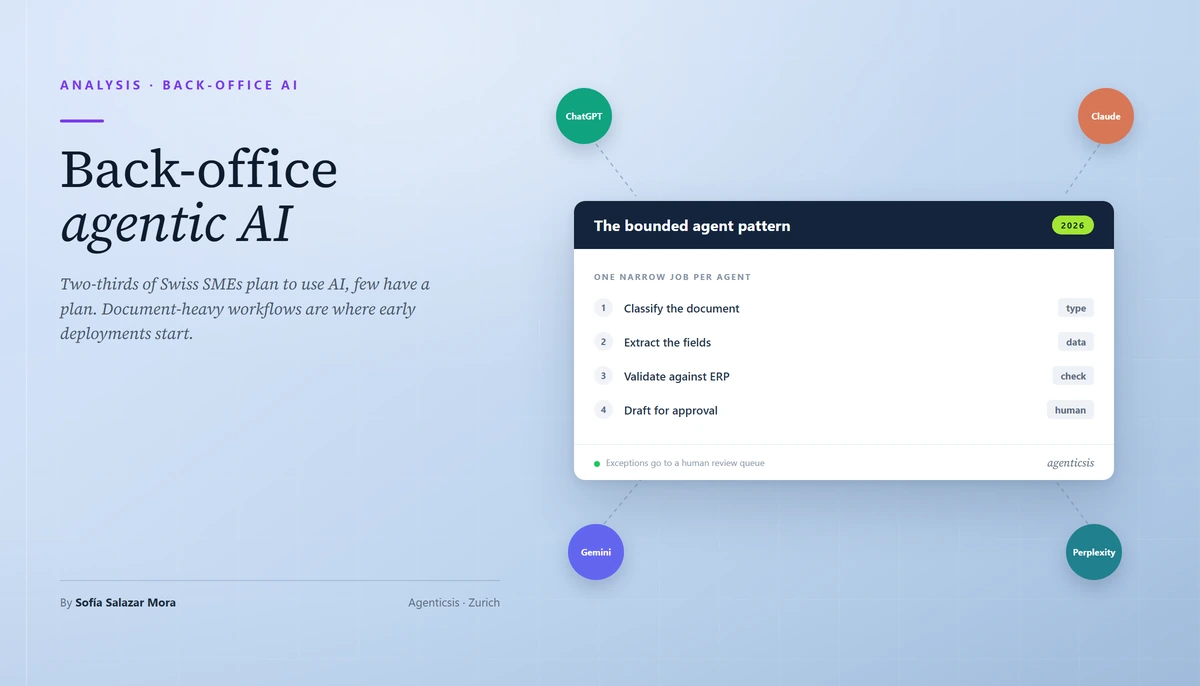
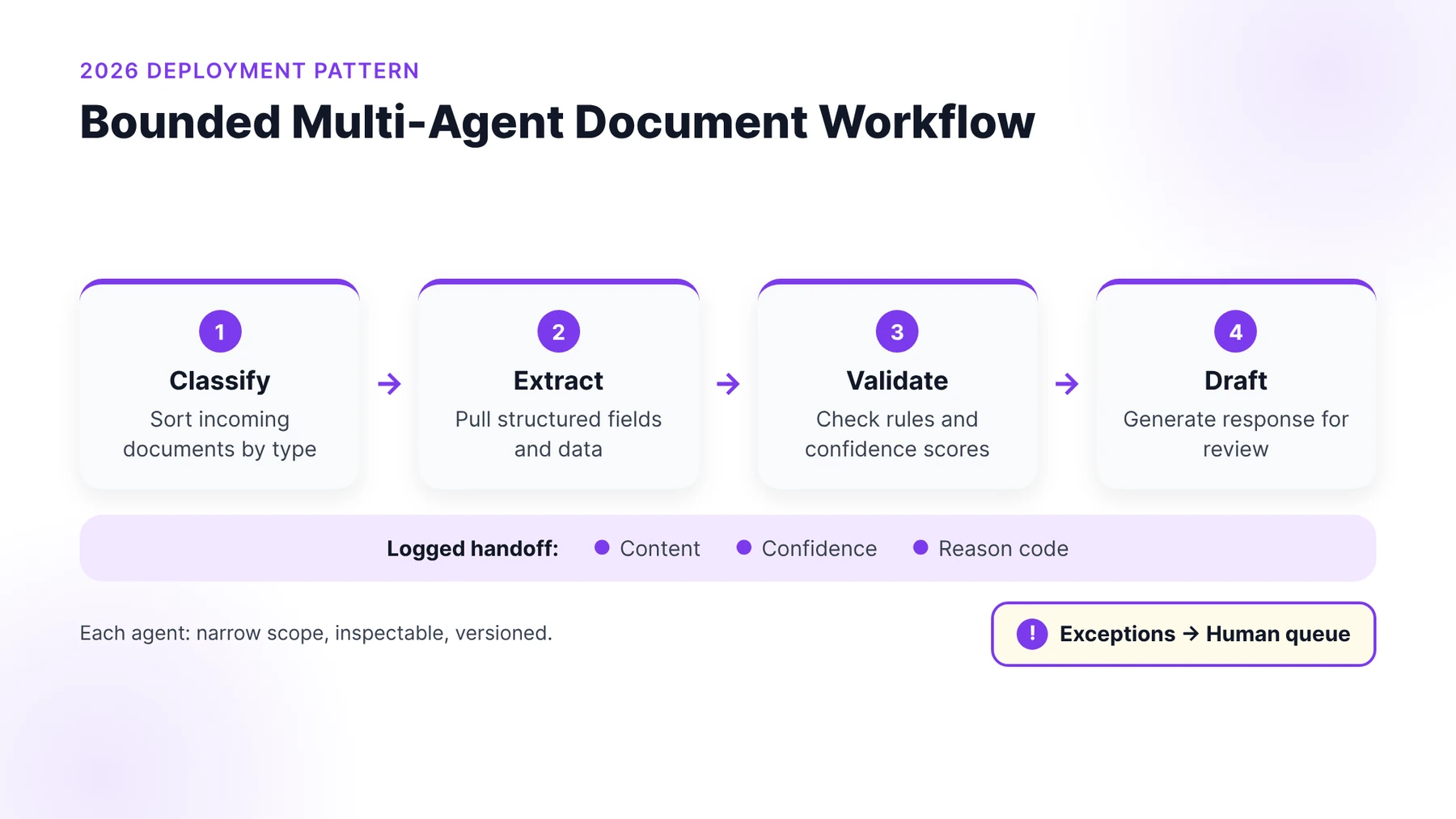
Each agent has a narrow scope: one for classification, one for extraction, one for validation, one for drafting. Handoffs are explicit, logged, and inspectable. Exceptions are routed to a human queue. This architecture is harder to build than a single prompt chain but dramatically easier to govern, audit, and improve over time.
Why does bounded beat autonomous?
Autonomous agents that decide what to do next are hard to test and harder to audit. Bounded agents with defined inputs, outputs, and handoffs can be unit tested, versioned, and rolled back. For a Swiss SME subject to the revised FADP, the ability to document exactly what each agent did with which data on which date is not a nice-to-have. It is a compliance requirement.
How do handoffs get structured?
In working deployments, handoffs carry three pieces of information: the extracted or generated content, a confidence score, and a reason code. The confidence score drives whether the next step is automated or sent to review. The reason code supports audit, retraining, and error analysis.
Expert Insight
Confidence scores are only useful if they are calibrated against your own data, not the vendor's benchmark. The same model can report a similar score on a clean supplier invoice and on a handwritten expense claim while being far less accurate on the second. Set thresholds per document type, not per workflow, and recalibrate quarterly.
4. Reported Results from Early Deployments
Quick Answer:
A reported French two-person retirement-advisory firm case shows administrative work per file dropping from 6 hours to 2.5 hours (58 percent reduction), conversion rising from 28 percent to 41 percent, and per-file costs falling 30 to 35 percent. These are directional case numbers, not representative Swiss SME benchmarks. [Source: ai-outsourcing.ch]
A reported case involving a two-person French retirement-advisory firm used three AI agents to reduce administrative work per file from 6 hours to 2.5 hours, a 58 percent reduction. The same report claims conversion rose from 28 percent to 41 percent and per-file costs fell by 30 to 35 percent [Source: ai-outsourcing.ch].
These numbers are striking, but they come from a single small-firm case report, not from a representative Swiss SME dataset. The firm is French rather than Swiss, the case was first published by France Num in May 2026, and the figures are the firm's own reported results. They are useful as a directional signal about what is possible in document-heavy advisory work with careful scoping, not as a benchmark to promise boards.
How to read the figures honestly
The 58 percent time reduction reflects a situation where the baseline was manual processing by a small team. SMEs with existing partial automation will see smaller marginal gains. SMEs with highly variable documents will see slower ramp. The point of the case is the operating model, not the specific percentage.
| Metric | Reported Before | Reported After | Change |
|---|---|---|---|
| Administrative time per file | 6 hours | 2.5 hours | 58 percent reduction |
| Conversion rate | 28 percent | 41 percent | Increase of 13 percentage points |
| Per-file cost | Baseline | 30 to 35 percent lower | 30 to 35 percent reduction |
Figures reported in the referenced case study [Source: ai-outsourcing.ch]. Treat as directional, not representative.
Disclaimer
Productivity figures throughout this article are drawn from single-firm or vendor-adjacent case reports. Public, independently audited Swiss SME datasets for agentic AI deployments remain limited as of 2026. SMEs should validate expected gains with their own pilot measurements before committing to roll-out budgets.
5. Private Processing: Keeping Documents In-House
Data residency and confidentiality are the two concerns that come up first in every serious Swiss SME conversation about agentic AI. The market is responding. In November 2026, Swiss document-AI provider Parashift announced a partnership with onprem.ai to make its document model Dokumentli available on on-premises infrastructure [Source: parashift.ai].
This is one of several signals that Swiss document-AI is moving toward deployment options that keep processing inside controlled infrastructure. For SMEs handling confidential client files, professional-secrecy material, or sensitive personnel data, on-premises or Swiss private-cloud processing is increasingly a baseline requirement rather than a premium option.
Deployment options SMEs actually consider
| Deployment Model | Data Location | Typical Use Case | Key Trade-off |
|---|---|---|---|
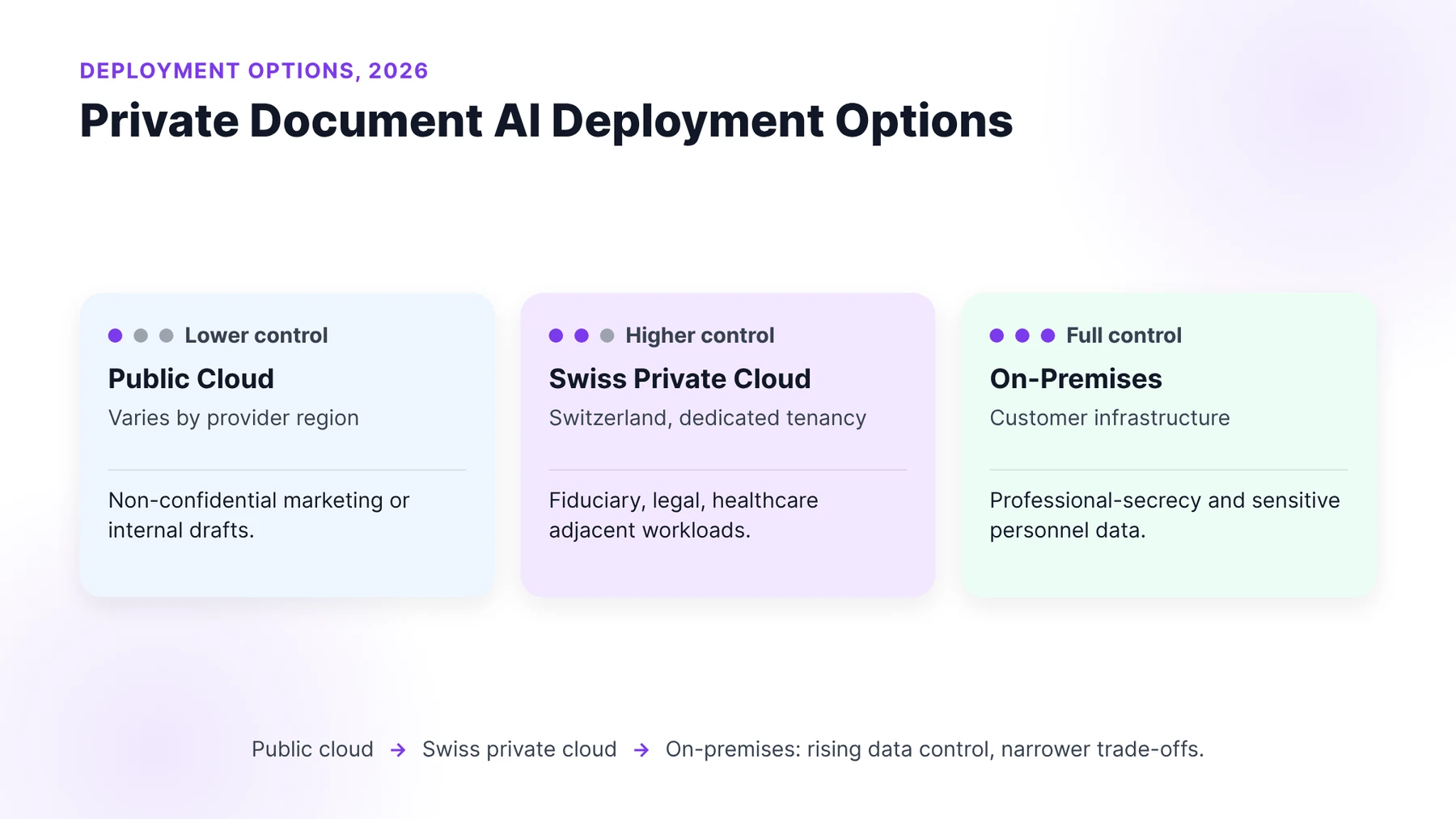
| Public cloud, standard | Varies by provider region | Non-confidential marketing or internal drafts | Weakest control over data residency |
| Business cloud with contractual controls | EU or Switzerland, provider-managed | General business documents under FADP | Dependent on processor contracts and configuration |
| Swiss private cloud | Switzerland, dedicated tenancy | Fiduciary, legal, healthcare adjacent workloads | Higher cost, narrower model choice |
| On-premises | Customer infrastructure | Professional secrecy, highly regulated data | Operational complexity, capex investment |
What does on-premises availability change?
The Parashift and onprem.ai arrangement matters because it reduces one of the standard objections: that best-in-class document extraction forces public-cloud processing [Source: parashift.ai]. For firms that cannot or will not route confidential documents through a conventional public cloud, this kind of infrastructure option expands the realistic scope of what agentic AI can automate.
6. Integration With Abacus, bexio, and Microsoft 365
The available evidence points toward agents being deployed as an orchestration layer around existing systems, not as replacements for ERP platforms. Deployment guidance for Swiss SMEs specifically identifies platforms such as Abacus, bexio, and Microsoft 365 as integration considerations [Source: ai-outsourcing.ch].
This matters because the business case for agentic AI collapses if the agent cannot read from and write to the systems that actually run the business. A perfectly extracted invoice that cannot post into the accounting ledger is not automation. It is a very expensive text summary.
Integration patterns in practice
- Read from ERP: Agents retrieve supplier master data, open purchase orders, and contract terms to validate extracted document fields.
- Write to ERP: After human approval, structured data is posted into the accounting or ERP system through supported APIs or import formats.
- Document store: Original documents and extraction outputs are archived with links to the posted transaction.
- Microsoft 365 surface: Approval queues, exception reviews, and summaries appear in Outlook, Teams, or SharePoint where staff already work.
Why is integration the hidden cost?
Vendors sometimes understate the integration work. In practice, mapping document fields to Abacus or bexio structures, handling tax codes, managing supplier identifiers, and reconciling edge cases typically takes longer than the agent configuration itself. SMEs that budget for the extraction model but not the integration layer run out of runway before the system reaches production.
Pro Tip
Budget the integration work at least as carefully as the agent itself, and ask vendors for reference deployments in your specific ERP edition. Generic "we support Abacus" claims often mean read-only API access, not posting-ready writes with tax-code handling.
7. Governance Under the Revised FADP and the Council of Europe Framework
Quick Answer:
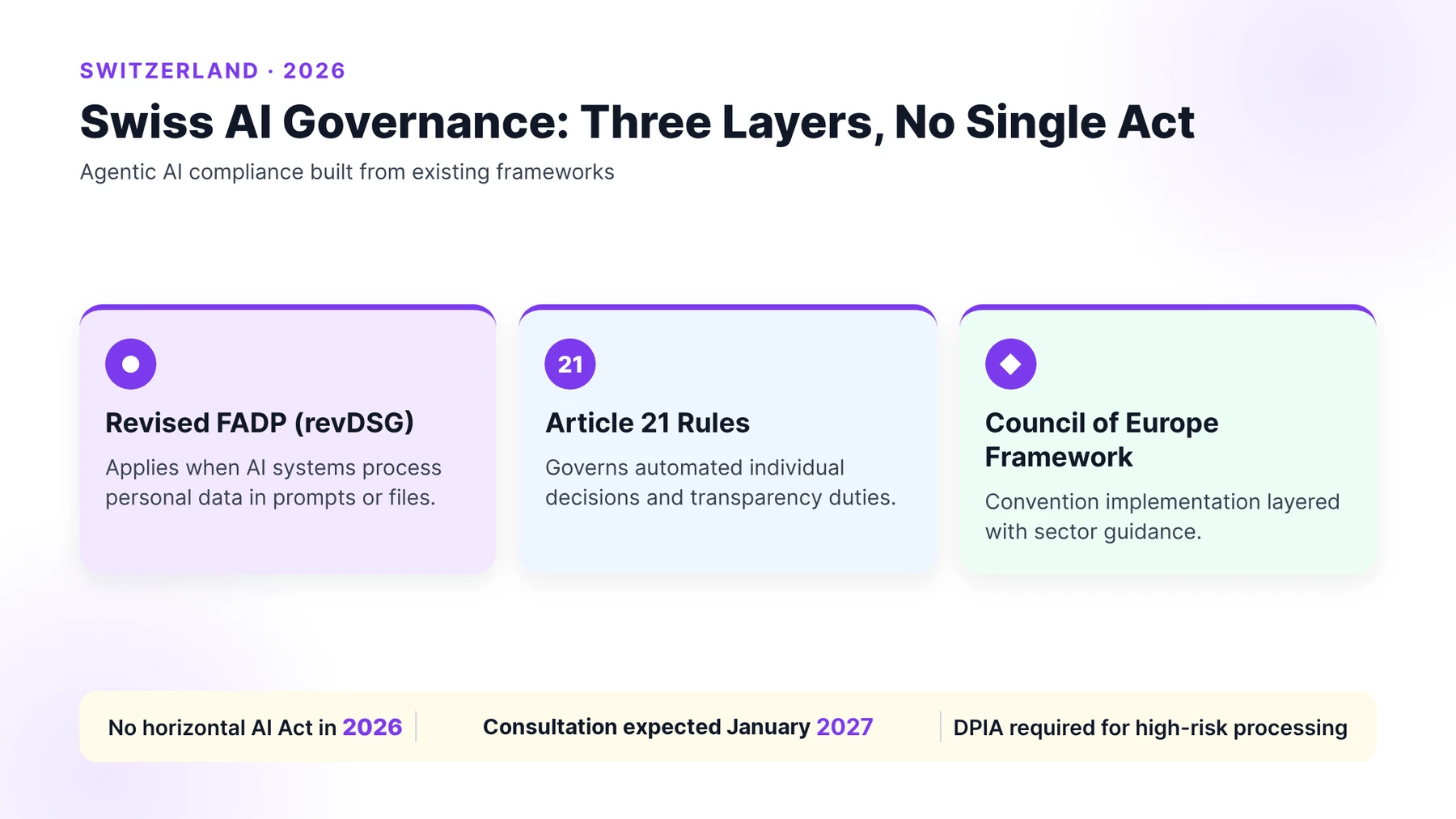
Switzerland has no horizontal AI Act in 2026. Agentic AI is governed through the revised FADP (revDSG), Article 21 rules on automated decisions, sector regulation, and ongoing Council of Europe Framework Convention implementation. The federal consultation is expected in January 2027. [Source: bacs.admin.ch]
Switzerland still does not have a single horizontal AI Act comparable to the EU AI Act in the material available for 2026 [Source: odcus.com] [Source: hikariblue.com] [Source: bacs.admin.ch]. Instead, AI use is governed through existing data-protection rules and developing sector guidance.
The revised Federal Act on Data Protection (FADP, also known as revDSG) applies when AI systems process personal data, including information entered into prompts or used during AI processing [Source: bacs.admin.ch]. For a document-heavy back-office workflow, this means almost every production deployment touches FADP obligations, because invoices, contracts, and client files routinely contain personal data.
Core obligations SMEs must address
- Transparency: Inform data subjects where AI processing is used in ways that affect them.
- Purpose limitation and proportionality: Use only the data needed for the defined task.
- Data security: Apply appropriate technical and organizational measures.
- Processor controls: Contractually bind suppliers that process data on the SME's behalf.
- Data-protection impact assessments: Carry out a DPIA where the processing presents a high risk [Source: odcus.com].
Article 21 and automated decisions
Article 21 of the revised Swiss data-protection framework requires information about decisions based exclusively on automated processing when they have legal consequences or significantly affect an individual [Source: odcus.com]. For back-office agents, the practical implication is simple: avoid designing workflows where an agent alone makes a consequential decision about a person. Retain human review for anything that affects rights or obligations.
The Council of Europe Framework Convention
Switzerland is pursuing ratification and domestic implementation of the Council of Europe Framework Convention on Artificial Intelligence. The Federal Council tasked the Federal Department of Justice and Police with preparing legally binding measures covering transparency, data protection, non-discrimination, supervision, and risk assessment [Source: bacs.admin.ch].
The Federal Office for Cybersecurity wrote in October 2026 that the consultation is expected in January 2027, with a sector-specific, risk-based approach rather than one horizontal law [Source: bacs.admin.ch]. SMEs planning multi-year deployments should design for transparency, oversight, and risk assessment now rather than retrofitting later.
Confidential documents and professional secrecy
Confidential documents, contracts, internal strategies, and information covered by professional or official secrecy require approved systems and appropriate technical and contractual safeguards [Source: mtf.ch]. In practice this pushes many fiduciary, legal-adjacent, and healthcare-adjacent SMEs toward Swiss private cloud or on-premises deployment.
EU AI Act exposure
Swiss companies operating in EU markets may also fall within the EU AI Act's scope, depending on their role, system, users, and market activity [Source: hikariblue.com]. An SME selling into Germany or France needs to assess EU AI Act obligations on top of Swiss rules, not instead of them.
Expert Insight
The combination of FADP Article 21 and the forthcoming Council of Europe Framework implementation effectively mandates the human-in-the-loop model for consequential back-office decisions. Designing an agent to post transactions, approve claims, or finalize contracts without human review is not just a product choice. It is a legal-design choice that may become harder to defend as domestic implementation progresses.
Governance first, then the agent
Agenticsis designs data classification, human review points and logging before an agent is built, following EU AI Act requirements, with data processed under GDPR and Swiss FADP.
See our AI governance approach8. Human-in-the-Loop as the Default Operating Model
Early deployments appear to prioritize exception handling and approval workflows rather than full autonomy. Fully autonomous posting of transactions, contract decisions, or legally consequential decisions creates higher risks under data-protection, employment, contractual, and sector-specific rules. The pattern is consistent across the 2026 material: agents do the heavy lifting, humans approve the decisions that matter.
Where humans stay in the loop
- Low-confidence extractions below a defined threshold.
- Transactions above a monetary threshold.
- New suppliers or counterparties not in master data.
- Documents flagged as potentially sensitive or legally significant.
- Any output that will be sent externally without further editing.
Where automation can run end-to-end
High-confidence extraction of standard invoice fields from known suppliers, routine internal summaries, and classification of inbound documents into existing queues can typically run without per-item human approval, provided there is sampling-based quality control and a clear audit trail.
Designing the review queue
The review queue is where agentic AI projects succeed or fail operationally. A well-designed queue prioritizes exceptions by financial or compliance impact, surfaces the agent's reasoning and extracted fields, and lets the reviewer approve, edit, or reject with minimal clicks. A poorly designed queue becomes a dumping ground that staff ignore.
9. Sector Use Cases: Fiduciary, Insurance, Pensions, Procurement
The most credible early use cases cluster in sectors where document volume is high, structures are repetitive, and the business already understands process control.
Fiduciary and accounting services
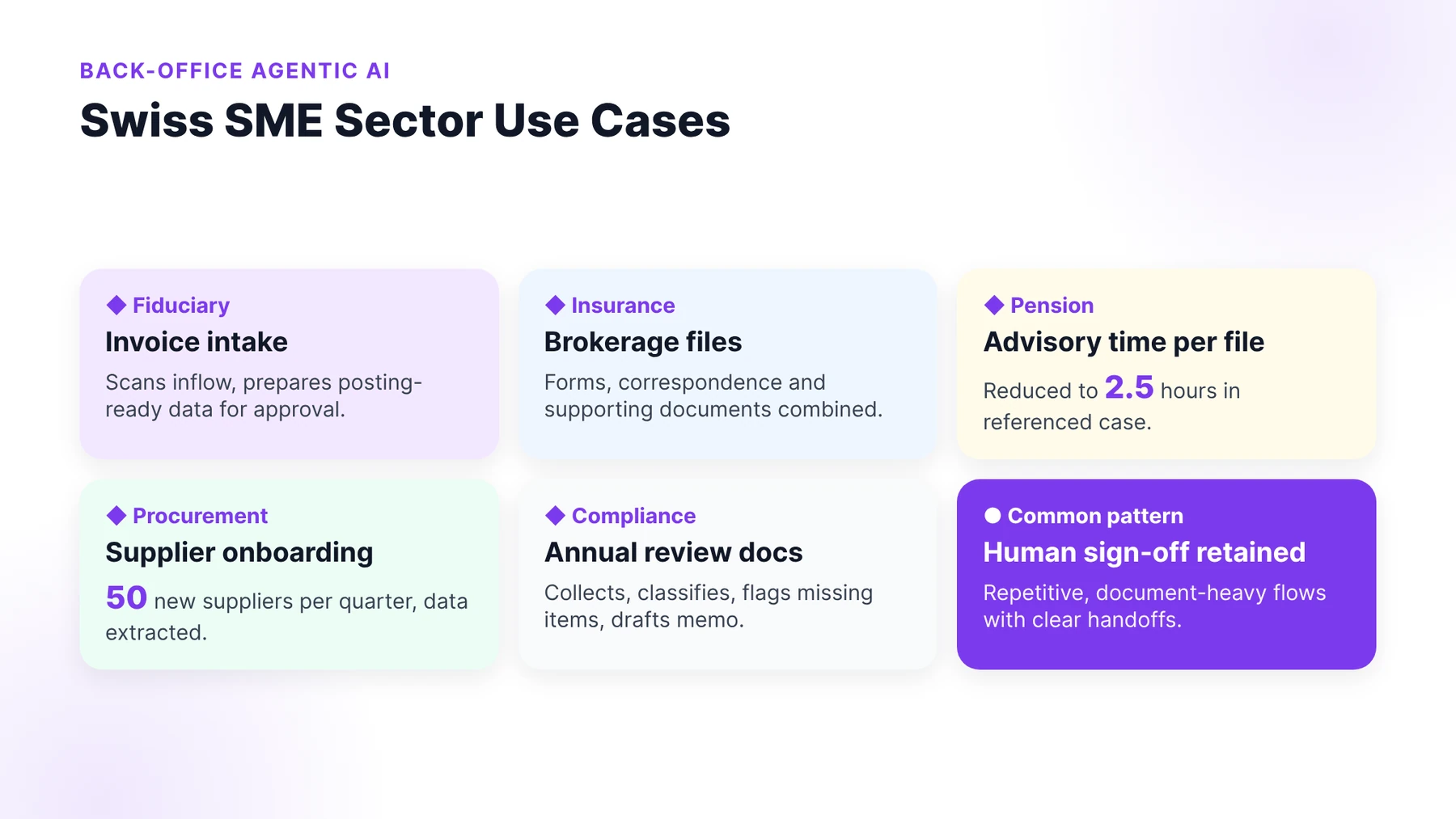
Consider a mid-size fiduciary firm managing accounting for 300 Swiss SME clients. Monthly invoice volumes per client range from a few dozen to several hundred. A classification and extraction agent routed by client, with validation against each client's supplier master, can take the raw email and scan inflow and prepare posting-ready data for staff approval. The time saving is largest on the most standard invoice flows and smallest on edge cases, which is where human attention concentrates.
Insurance and pension administration
The referenced case of a retirement-advisory firm reducing administrative time per file from 6 hours to 2.5 hours illustrates the pattern for file-based advisory work [Source: ai-outsourcing.ch]. Although the firm is French, the workflow is directly relevant to Swiss SMEs in insurance brokerage, pillar 3 advisory, and pension administration where client files combine standardized forms with correspondence and supporting documents.
Supplier onboarding and procurement
Consider a Swiss industrial SME onboarding 50 new suppliers per quarter. An agent reads the supplier questionnaire, extracts legal form, VAT number, bank details, and certifications, validates against public registers where possible, and prepares the master data record for procurement approval. The agent does not approve the supplier. It removes the typing.
Compliance documentation
An agent can collect, classify, and summarize documents required for annual compliance reviews, flag missing items, and draft the cover memo. Human reviewers retain final sign-off on the compliance conclusion, which keeps the workflow within FADP and sector-regulator expectations.
10. A Practical Implementation Roadmap for Swiss SMEs
The structured planning deficit identified in the 2026 Swiss AI analysis [Source: swissaisummit.com] is best addressed with a phased roadmap that treats governance and integration as first-class work alongside the agent itself.
Phase 1: Workflow selection and data classification
Pick one back-office workflow with high volume, stable document structures, and clear handoffs. Classify the data involved under FADP: ordinary personal data, sensitive personal data, confidential or secrecy-protected information. The classification drives the deployment option.
Phase 2: Governance baseline
Define the purpose and operating boundaries of each agent, assess supplier and processor safeguards, and document retention, access, logging, and deletion rules [Source: bacs.admin.ch]. Carry out a DPIA where warranted. Decide whether data will be processed in Switzerland, the EU, or elsewhere, and justify the choice.
Phase 3: Prototype with real documents
Prototype against a sample of real documents, not synthetic ones. Measure extraction accuracy, routing accuracy, and reviewer time on exceptions. Be honest about failure modes. The prototype's job is to surface what you did not expect.
Phase 4: Integration and controlled rollout
Build the read and write integrations with Abacus, bexio, Microsoft 365, or other core systems [Source: ai-outsourcing.ch]. Roll out to one team first, with clear confidence thresholds and a staffed review queue. Measure cycle time, exception rate, and reviewer load.
Phase 5: Scale and continuous audit
Expand to additional workflows only after the first one is stable. Maintain ongoing logging and sampling-based quality review. Retrain staff on information security and AI use [Source: bacs.admin.ch]. Reassess the DPIA when the scope changes.
| Phase | Primary Objective | Indicative Duration | Key Risk |
|---|---|---|---|
| 1. Selection and classification | Pick the right workflow and classify data | 2 to 4 weeks | Choosing a workflow with too much variability |
| 2. Governance baseline | FADP alignment and vendor assessment | 3 to 6 weeks | Treating governance as an afterthought |
| 3. Prototype | Validate accuracy on real documents | 4 to 8 weeks | Over-indexing on happy-path examples |
| 4. Integration and rollout | Connect to ERP and go live with one team | 6 to 12 weeks | Underestimating integration work |
| 5. Scale and audit | Expand scope with ongoing oversight | Continuous | Letting monitoring lapse |
11. Risks, Pitfalls, and What Early Adopters Got Wrong
The most common failure patterns in 2026 Swiss SME deployments are predictable and avoidable.
Overestimating the generality of a single agent
Attempts to have one agent handle classification, extraction, validation, and drafting across multiple document types tend to produce mediocre results on everything. The bounded multi-agent pattern reported in early deployments [Source: ai-outsourcing.ch] outperforms the generalist model in both accuracy and auditability.
Treating FADP as a legal checkbox
Firms that assign data-protection compliance entirely to external counsel at the end of the project typically discover design changes they cannot afford. Transparency, purpose limitation, and processor controls [Source: odcus.com] need to shape the architecture from the beginning.
Ignoring the review queue as a product
If the exception queue is clumsy, staff stop using it properly. Approvals become rubber stamps or the queue grows until it is abandoned. The reviewer experience is as important as the extraction accuracy.
Underestimating change management
Staff whose work is being automated need clarity about how their roles change. Swiss public-sector guidance recommends training staff in AI use and information-security practices [Source: bacs.admin.ch]. That training is also what builds the trust required for the human-in-the-loop model to work.
Assuming vendor case numbers will transfer
A 58 percent administrative time reduction in a two-person advisory firm [Source: ai-outsourcing.ch] does not mean a 50-person fiduciary will see the same figure. Baselines, document diversity, and existing automation all affect outcomes.
Choosing the wrong deployment model
Routing professional-secrecy documents through a standard public-cloud service may violate sectoral obligations and contractual confidentiality. The Parashift and onprem.ai on-premises availability [Source: parashift.ai] exists precisely because the deployment model is not a cosmetic decision.
12. Frequently Asked Questions
Q: What is agentic AI in the context of a Swiss SME back office?
A: Agentic AI refers to multiple specialized software agents that coordinate to handle a workflow. In a Swiss SME back office, this typically means separate agents for classifying documents, extracting fields, validating against ERP data, routing exceptions to staff, and drafting replies or summaries. The pattern reported in early 2026 deployments uses bounded agents with explicit handoffs rather than a single autonomous system [Source: ai-outsourcing.ch].
Q: How many Swiss SMEs are actually using agentic AI in 2026?
A: A 2026 Swiss AI industry analysis reports that roughly two-thirds of Swiss SMEs plan to integrate at least one AI tool, while only a small proportion have a structured implementation plan [Source: swissaisummit.com]. Public, independently verified figures on live agentic deployments specifically remain limited, so most quantitative claims come from individual case reports rather than representative samples.
Q: Does Switzerland have an AI Act like the EU?
A: Not in the material available for 2026. Switzerland does not have a single horizontal AI Act comparable to the EU AI Act [Source: odcus.com] [Source: hikariblue.com]. Instead, AI use is governed through existing rules, primarily the revised FADP, with sector-specific requirements layered on top [Source: bacs.admin.ch].
Q: When is Switzerland expected to adopt binding AI legislation?
A: The Federal Council tasked the Federal Department of Justice and Police with preparing legally binding measures covering transparency, data protection, non-discrimination, supervision, and risk assessment, in line with the Council of Europe Framework Convention on Artificial Intelligence. The Federal Office for Cybersecurity expects the consultation in January 2027 [Source: bacs.admin.ch].
Q: Does the EU AI Act apply to Swiss SMEs?
A: It can. Swiss companies operating in EU markets may fall within the EU AI Act's scope depending on their role, the system, users, and market activity [Source: hikariblue.com]. An SME providing or using AI systems that affect people in the EU should assess EU AI Act obligations in parallel with Swiss requirements rather than assuming one framework replaces the other.
Q: What is Article 21 of the revised FADP and why does it matter?
A: Article 21 requires information about decisions based exclusively on automated processing when they have legal consequences or significantly affect an individual [Source: odcus.com]. For back-office agents, this means workflows should be designed so that consequential decisions about people retain human involvement, not just a formal review step. It is one of the main reasons the human-in-the-loop model is the default.
Q: Can Swiss SMEs use public cloud AI for back-office documents?
A: It depends on the data. Ordinary business data with appropriate processor contracts, data residency configuration, and security measures can often be processed in business cloud services under contract. Confidential documents, contracts, internal strategies, and information covered by professional or official secrecy require approved systems with appropriate technical and contractual safeguards [Source: mtf.ch], which often pushes SMEs toward Swiss private cloud or on-premises options.
Q: What is Dokumentli and why is on-premises availability significant?
A: Dokumentli is a Parashift document model. In November 2026, Parashift announced a partnership with onprem.ai to make Dokumentli available on on-premises infrastructure [Source: parashift.ai]. The significance is that SMEs with strict data residency or confidentiality requirements no longer have to choose between advanced document extraction and keeping processing inside their own infrastructure.
Q: How do agents integrate with Abacus, bexio, and Microsoft 365?
A: Abacus, bexio, and Microsoft 365 are identified as potential integration targets in Swiss SME agent deployments [Source: ai-outsourcing.ch]. Typical integrations involve reading master data and reference records, writing approved transactions back to the accounting or ERP system, archiving documents with links to posted entries, and surfacing approval queues inside Outlook, Teams, or SharePoint. Specific editions and versions vary and should be confirmed with each vendor.
Q: What productivity gains should a Swiss SME realistically expect?
A: The most prominent reported case shows administrative work per file falling from 6 hours to 2.5 hours, a 58 percent reduction, with per-file costs down 30 to 35 percent [Source: ai-outsourcing.ch]. This is a single case report from a two-person firm and should be treated as directional. Realistic SME expectations depend on baseline automation, document variability, and reviewer capacity. Pilot measurement is the only reliable estimate.
Q: What back-office workflows are best suited to agentic AI first?
A: Workflows that are repetitive, rules-based, and document-intensive. The most common first candidates are accounts payable invoice processing, insurance or pension administration, supplier onboarding, quotation processing, and compliance documentation. These share high volume, stable templates, clear handoffs to downstream systems, and a well-understood exception pattern that fits human review queues.
Q: Do we need a DPIA for a document-processing agent?
A: Often yes. Organizations must address transparency, purpose limitation, proportionality, data security, processor controls, and, where applicable, data-protection impact assessments [Source: odcus.com] [Source: bacs.admin.ch]. A back-office agent that processes personal data at scale, uses a new technology, or combines datasets in novel ways typically triggers the DPIA threshold. Document the assessment and keep it current as the scope changes.
Q: How do we handle supplier and processor controls for AI vendors?
A: Contractually bind suppliers that process data on the SME's behalf, verify data location, and confirm that customer data is not used for model training unless explicitly agreed [Source: bacs.admin.ch]. Request documentation of security measures, sub-processor arrangements, and incident response. For confidential or secrecy-protected data, insist on approved systems with appropriate technical and contractual safeguards [Source: mtf.ch].
Q: Will agentic AI replace back-office staff?
A: The early deployment pattern does not support that framing. Agents absorb repetitive extraction and routing, while staff shift toward exception handling, quality control, client communication, and higher-value analysis. Swiss public-sector guidance recommends training staff in AI use and information-security practices [Source: bacs.admin.ch], which reflects a model of augmented work rather than wholesale replacement.
Q: What model and version numbers should we standardize on?
A: The available research does not provide reliable current model or version numbers for the underlying agent orchestration systems, large language models, OCR engines, or the exact editions of Abacus, bexio, or Microsoft 365 used in Swiss SME deployments. Confirm versions directly with each vendor and in your own procurement process rather than relying on third-party summaries that may be out of date.
Q: How should we evaluate vendors for Swiss document AI?
A: Evaluate on data location, deployment options including on-premises or Swiss private cloud, processor contract terms, auditability of agent actions, integration coverage for Abacus, bexio, and Microsoft 365, extraction accuracy on your own document sample, reviewer workflow quality, and alignment with FADP and Council of Europe Framework expectations [Source: bacs.admin.ch] [Source: parashift.ai]. Price matters, but it is rarely the differentiator.
Q: What is the biggest mistake Swiss SMEs make in early deployments?
A: Starting with ambition rather than scope. Trying to automate an entire function in one project typically fails on governance, integration, or accuracy. Starting with one workflow, one team, and a clear human review model, then expanding, is the pattern that the 2026 evidence supports. The structured planning gap identified in the Swiss 2026 analysis [Source: swissaisummit.com] is best closed by narrowing the first project, not widening it.
Q: How do we document and audit what the agents did?
A: Each agent action should produce a log entry capturing input, output, confidence score, reason code, and timestamp. Store original documents with links to extracted data and downstream postings. Retain records in line with FADP retention and deletion rules [Source: bacs.admin.ch]. Sample outputs for ongoing quality review and keep an incident log for errors, near misses, and user feedback.
Q: Is a sector-specific or horizontal approach better for Swiss AI rules?
A: The 2026 Swiss AI discussion favors a sector-specific, risk-based approach rather than a single set of rules for every AI application [Source: bacs.admin.ch]. For SMEs, the practical implication is to monitor the regulator relevant to their sector in parallel with general FADP obligations and Council of Europe Framework implementation work.
Conclusion
Early Swiss SME agentic AI deployments in 2026 tell a consistent story. The technology works best when scoped to document-heavy back-office workflows, structured as bounded multi-agent systems, integrated with the ERP and productivity tools the business already runs, and governed under the revised FADP with human review for consequential decisions.
Key takeaways:
- Two-thirds of Swiss SMEs plan AI integration, but only a minority have structured plans. The planning gap is the opportunity [Source: swissaisummit.com].
- Reported productivity gains such as the 58 percent administrative time reduction are directional, not representative [Source: ai-outsourcing.ch].
- Private processing options such as Dokumentli on-premises via onprem.ai expand the realistic scope of confidential-document automation [Source: parashift.ai].
- FADP, Article 21, and the forthcoming Council of Europe Framework implementation shape architecture decisions today, with the consultation expected in January 2027 [Source: bacs.admin.ch].
- Integration with Abacus, bexio, and Microsoft 365 is the hidden cost that determines whether a prototype becomes production [Source: ai-outsourcing.ch].
- Human-in-the-loop is the default. Agents handle the volume, staff own the consequential decisions.
If your Swiss SME is weighing where to start with agentic AI in back-office operations, the most productive next step is a focused review of one workflow, its data classification, and the governance baseline it will need. Agenticsis works with Swiss SMEs on exactly that scoping.
Related reading
- Agentic AI case studies for Swiss SMEs: the deployment patterns that reached production
- How Swiss SMEs put AI into production: from pilot to a defensible deployment
- AI agent compliance frameworks: FADP, EU AI Act, NIST AI RMF and ISO 42001 for Swiss SMEs
- How to evaluate an agentic system vendor: a due-diligence guide for the DACH region
Start with one back-office workflow
In a discovery call we look at your highest-volume document workflow, the data it touches and where people must stay in the loop.
Book a discovery call