TL;DR(Too Long; Did not Read)
Step-by-step 2026 playbook for Swiss SME founders to optimize websites for AI search engines like Google AI Overviews, ChatGPT, and Perplexity.
How to Optimize Your Swiss SME Website for AI Search Engines (AEO/GEO): A Step-by-Step Playbook
Published by Agenticsis. Last updated: 11 November 2026.
Quick Answer:
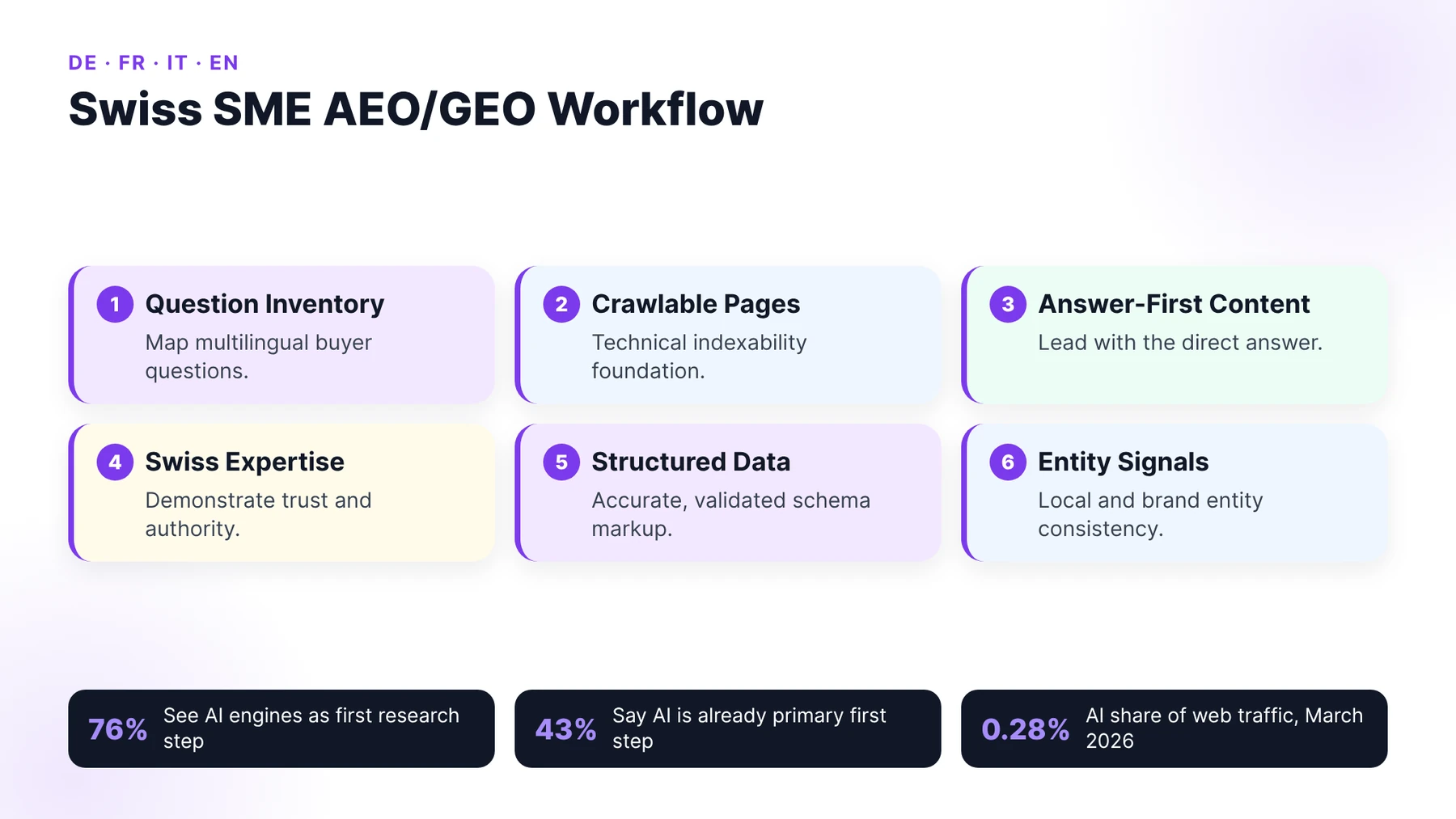
To optimize a Swiss SME website for AI search engines in 2026, combine solid multilingual technical SEO with answer-first content, named author expertise, accurate structured data, and strong local entity signals in German, French, Italian, and English. Measure success through AI citations and mentions, not just referral traffic, since AI chatbots generated only 0.28% of total web traffic in March 2026 while influencing a growing share of buyer research [Source: christopherjanb.com].
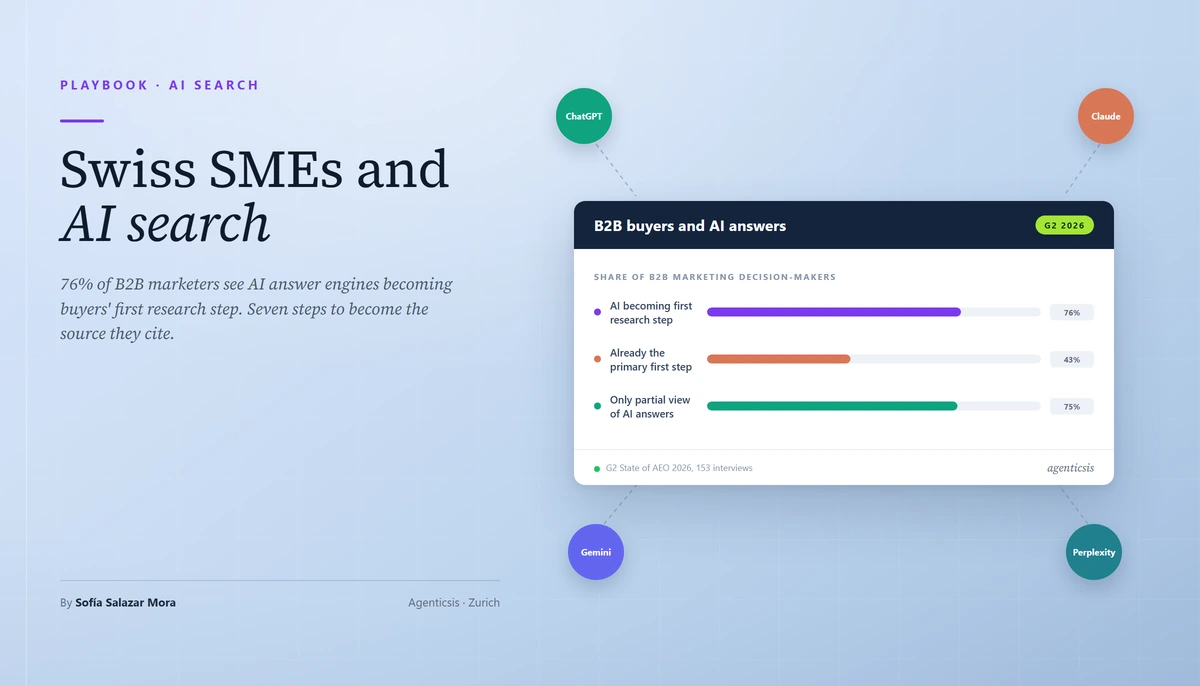
Swiss SME founders face a search landscape that is shifting faster than at any point since Google launched. G2's State of AEO 2026, based on 153 interviews with B2B marketing decision-makers, found that 76% viewed AI answer engines as becoming buyers' first research step, and 43% said they were already the primary first step [Source: encorp.ai]. If your Zürich consultancy, Geneva SaaS, Lugano manufacturer, or Bern retailer is invisible inside Google AI Overviews, ChatGPT, Gemini, Claude, and Perplexity, you are losing consideration before the buyer ever opens a browser tab.
Table of Contents
- 1. What AEO and GEO Mean for a Swiss SME
- 2. The Numbers: Why AI Search Matters Now
- 3. Step 1: Build a Multilingual Question Inventory
- 4. Step 2: Make Every Page Crawlable and Indexable
- 5. Step 3: Write Answer-First Content
- 6. Step 4: Demonstrate Swiss Expertise and Trust
- 7. Step 5: Implement Accurate Structured Data
- 8. Step 6: Strengthen Local and Entity Signals
- 9. Step 7: Measure AEO/GEO Separately from SEO
- 10. Swiss Compliance: FADP, GDPR, and the EU AI Act
- 11. Your 90-Day Implementation Plan
- 12. Frequently Asked Questions
1. What AEO and GEO Mean for a Swiss SME
Quick Answer:
Answer Engine Optimization (AEO) earns direct answers inside featured snippets and Google AI Overviews. Generative Engine Optimization (GEO) earns citations inside longer answers from ChatGPT, Gemini, Claude, and Perplexity. Both disciplines sit on top of traditional SEO fundamentals rather than replacing them.
Answer Engine Optimization (AEO) and Generative Engine Optimization (GEO) describe the practice of making your website discoverable, quotable, and cited inside AI-generated answers. Where traditional SEO aims to earn a blue-link click, AEO and GEO aim to earn a mention, a citation, or a direct quotation inside an answer produced by Google AI Overviews, ChatGPT, Gemini, Claude, or Perplexity.
Google's current guidance treats AI-search optimization as an extension of normal SEO: pages must be crawlable, indexable, useful, and supported by strong quality signals, and there is no separate "AI-only" ranking requirement [Source: wecallshotgun.com]. For a Swiss SME, this is good news. You do not need to abandon the fundamentals. You need to layer answer-oriented, evidence-rich, multilingual content on top of them.
Why do Swiss SMEs face a particular challenge?
The Swiss market is small, multilingual, and commercially sophisticated. A buyer in Lausanne may ask a question in French, a buyer in St. Gallen in German, and a procurement officer in Zug in English. AI answer engines handle language transitions imperfectly, and the training data they draw on is dominated by English and German sources. Swiss SMEs that publish precise, locally specific content in all relevant languages can out-compete generic English material when the question is Swiss in nature.
Expert Insight
Questions that carry clear Swiss markers such as CHF, MWST, canton names, or a CHE-UID narrow the field of pages that can answer them well. A focused Swiss SME page that answers one such question precisely, in the language the buyer uses, competes with far fewer pages than a generic English guide does. That is where a small company can win.
How do AEO, GEO, and SEO relate to each other?
| Discipline | Primary Target | Success Metric | Core Artefact |
|---|---|---|---|
| Traditional SEO | Blue-link rankings on Google and Bing | Organic clicks, rankings, impressions | Keyword-targeted landing pages |
| AEO (Answer Engine Optimization) | Direct answers in featured snippets and AI Overviews | Snippet ownership, zero-click presence | Concise Q&A content and FAQ pages |
| GEO (Generative Engine Optimization) | Citations and mentions inside generative answers | Brand mentions, cited URLs, factual accuracy | Evidence-rich, quotable long-form content |
2. The Numbers: Why AI Search Matters Now
The data on AI search is noisy, and Swiss SME founders deserve to see it without hype. A late-2026 analysis of approximately 3,200 U.S. keywords reported year-over-year growth of 237% for "answer engine optimization" searches and 53% for "generative engine optimization" searches, suggesting the discipline is moving from fringe to mainstream [Source: serionflow.com].
Visibility of AI Overviews themselves is disputed. One late-2026 industry estimate claimed AI Overviews appeared on more than 80% of Google searches, while a separate estimate placed the figure at 48% of U.S. queries in February 2026 [Source: stepheo.com] [Source: kozec.ai]. Even the lower figure means roughly one in two Google searches now carries an AI-generated summary at the top.
Is AI referral traffic big enough to matter?
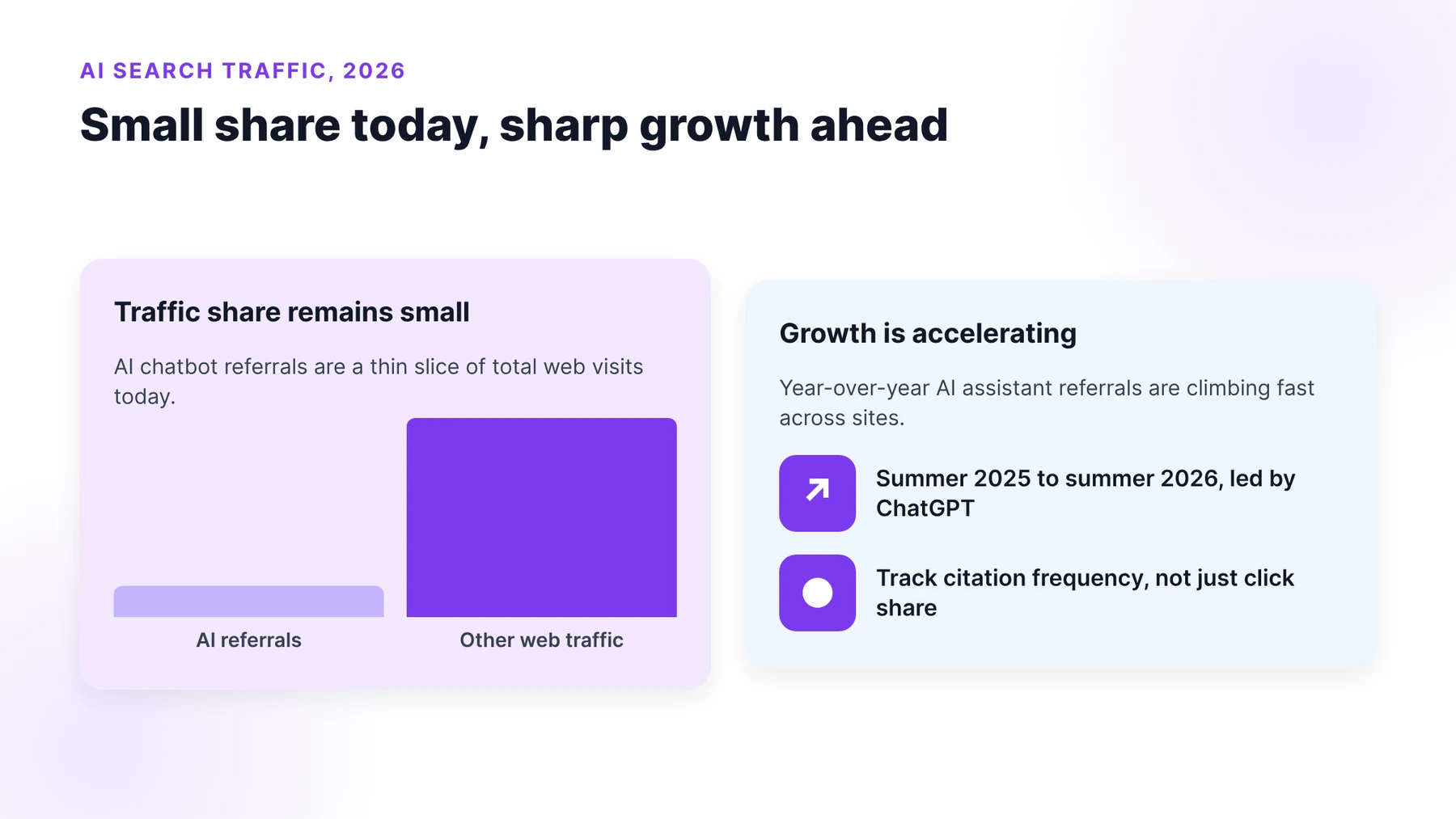
A dataset of 74,752 websites reported that AI chatbots generated only 0.28% of total web traffic in March 2026, while AI-summary results were associated with roughly half as many clicks as traditional results [Source: christopherjanb.com]. A separate enterprise sample reported 1.08% AI-referral traffic for May through September 2025, showing that measurement varies considerably by industry and attribution method [Source: parse.gl].
Growth, however, is sharp. A multi-site comparison reported 50.9% year-over-year growth in AI-assistant referrals between summer 2025 and summer 2026, with ChatGPT accounting for 93% of that traffic in the cited sample [Source: smartsites.com].
What is the brand-visibility gap?
The same G2 survey found that 75% of respondents had only partial or manual visibility into how AI systems described their brands [Source: encorp.ai]. For a Swiss SME, this is an operational risk. If ChatGPT tells a procurement officer that your company serves only Zürich when you serve all of Suisse romande, you lose the deal without ever knowing why.
Expert Insight
The headline statistic to track is not AI referral traffic share but citation frequency. An AI engine that recommends your company by name during a buyer's research phase can produce a direct brand search days or weeks later, which attribution tools typically credit to "direct" or "branded organic" rather than to the AI engine. Treat AI citations as a top-of-funnel awareness signal, not a bottom-of-funnel click source.
3. Step 1: Build a Multilingual Question Inventory
Every AI search optimization programme begins with questions, not keywords. An AI answer engine is a machine for answering questions, and your content can only be cited if it answers a question somebody actually asks.
How do you map questions across four Swiss languages?
For a Swiss SME, the inventory must cover German, French, Italian, and English in the proportions that match your addressable market. Translation alone is insufficient. A Geneva buyer and a Zürich buyer frame the same question differently, and the answer may need different legal and pricing context.
- Pricing questions with CHF and MWST/TVA/IVA framing
- "Near me," canton, city, and postal-code service-area questions
- Timeline, eligibility, and comparison questions
- Compatibility with Swiss standards, certifications, and regulations
- Maintenance, guarantee, and after-sales questions
Which commercial-intent questions matter most?
Questions such as "What does an ERP implementation cost in Zürich?" or "Which Swiss fiduciary supports CHE-UID registration for foreign founders?" indicate a buyer approaching a decision. These are the questions where an AI citation translates most directly into revenue.
Example questions worth targeting:
- "How long does a VAT registration take for a GmbH in Switzerland?"
- "Welcher Schweizer Anbieter bietet DSGVO-konforme Cloud-Backups für KMU?"
- "Combien coûte un site web multilingue pour une PME à Lausanne?"
- "Quale fornitore svizzero offre assistenza IT 24/7 in Ticino?"
How do you validate demand before writing?
Run each candidate question through Google Search, the AI Overview surface, and at least two generative engines. Record which pages are currently cited, which competitors appear, and whether the generated answer is factually correct for the Swiss market. Where the answer is wrong, generic, or missing, you have a clear opportunity.
Pro Tip
Start your question inventory by harvesting real buyer language from three sources: your CRM email threads, your sales call transcripts, and your Google Search Console query report filtered by Switzerland. Question-form queries that already receive impressions but little traffic are the fastest wins for answer-first rewrites.
4. Step 2: Make Every Page Crawlable and Indexable
Google's stated position is that generative search features rely on core Search ranking and quality systems, meaning indexability remains a prerequisite for AI visibility [Source: wecallshotgun.com]. Before you write a single new answer page, confirm that the AI crawlers can reach and render your existing content.
What is the non-negotiable technical checklist?
- Clean robots.txt that permits major search and AI crawlers, subject to your legal and commercial policy
- Submitted XML sitemaps with current URLs
- Correct canonical tags on every indexable page
- Audit of noindex directives to prevent accidental exclusion
- Server-side rendering or pre-rendering of content that currently depends on JavaScript
- Fast Core Web Vitals scores on mobile
- Internal links from high-authority pages to new answer content
What should you stop doing immediately?
Several common Swiss SME practices actively block AI visibility:
- Publishing pricing, specifications, or regulatory information only inside PDFs
- Hiding core content behind JavaScript interactions the crawler will not trigger
- Using images that contain essential text without equivalent HTML alternatives
- Creating thin location pages that duplicate the same copy across cantons
- Auto-generating unverified claims at scale, which triggers quality-signal penalties
Can AI read your website?
Run the free check in the Agenticsis AI Visibility Program: it shows whether AI crawlers can reach and read your pages, before you write a single new answer page.
Run the free check5. Step 3: Write Answer-First Content
The single most powerful change most Swiss SME websites can make is to restructure their key pages around direct answers. AI systems extract concise, unambiguous statements, so the first 100 words of each priority page must deliver the answer before the explanation begins.
What is the answer-first template?
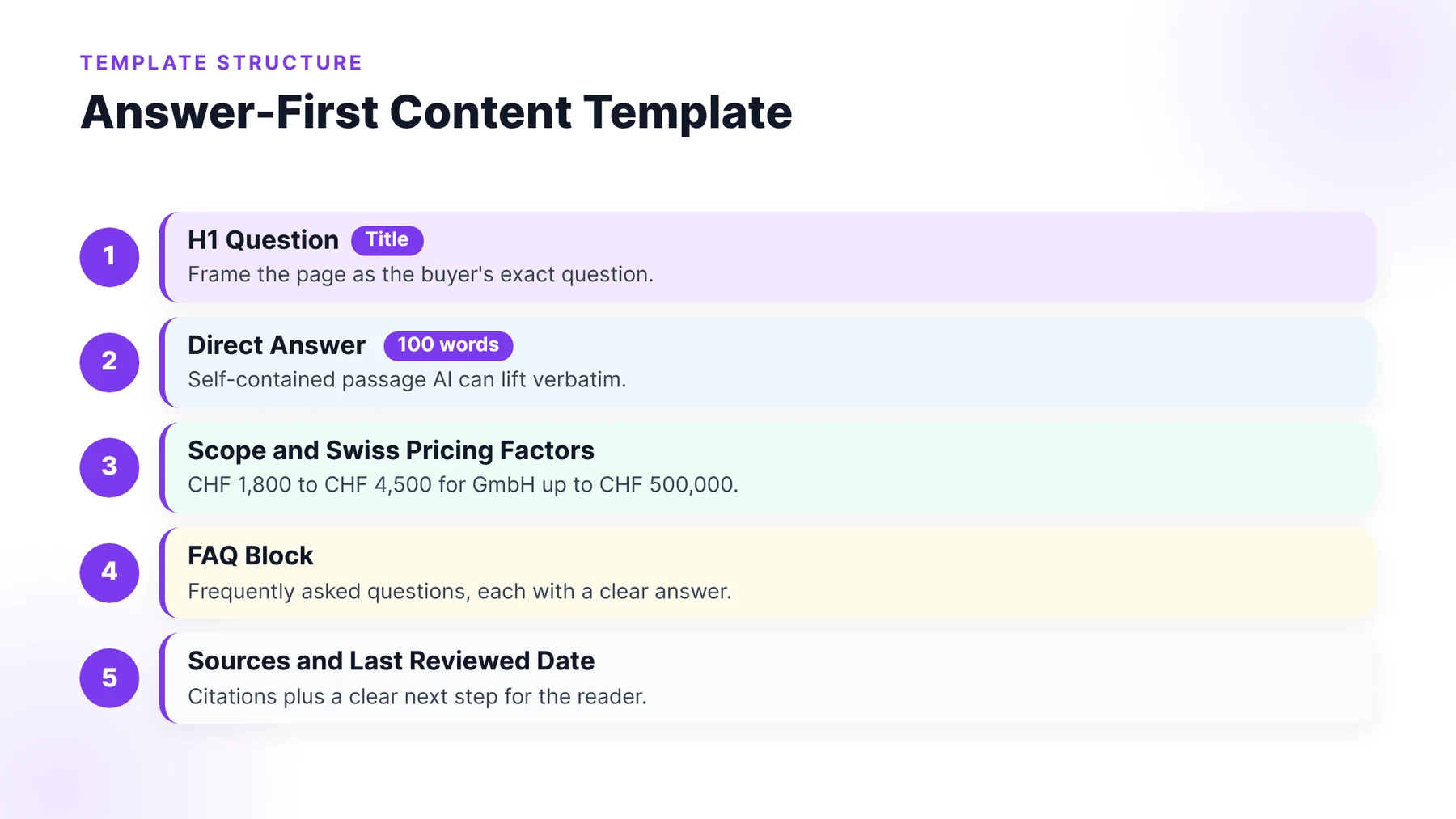
For every important question, follow this structure:
- H1 framed as the exact customer question
- A short, direct answer of two to four sentences at the top
- "Who this is for" to disambiguate audience
- "What is included" or "What this covers" to set scope
- Price, time, or outcome factors with Swiss specifics
- Examples with CHF figures and canton or city context
- A frequently asked questions block
- Sources, last reviewed date, and a clear next step
Why does the short answer matter?
AI systems favor passages that can be lifted verbatim without surrounding ambiguity. The original GEO study (Aggarwal et al., KDD 2024), a 10,000-query benchmark, reported visibility improvements of up to 40% when content included relevant statistics, quotations, and citations, though the size of the effect varied by domain [Source: christopherjanb.com] [Source: parse.gl].
Illustrative example: a Zürich fiduciary (hypothetical)
Consider a mid-size fiduciary in Zürich that publishes a page titled "How much does annual bookkeeping cost for a Swiss GmbH?" The figures below are illustrative, not market data. The old version buried the price under a long company history. The new answer-first version opens with: "For a Swiss GmbH with up to CHF 500,000 in annual revenue, standard bookkeeping typically costs between CHF 1,800 and CHF 4,500 per year, excluding MWST. The final price depends on transaction volume, salary processing, and whether VAT returns are required." The remainder of the page explains each variable.
Expert Insight
Answer engines prefer passages that are self-contained. Avoid orphaned pronouns such as "this," "it," or "the above." Every paragraph should name the subject it refers to, so a 40-word extract pulled out of context still makes sense to a buyer reading an AI summary.
6. Step 4: Demonstrate Swiss Expertise and Trust
AI systems weigh authority signals heavily. For a Swiss SME, authority is built through specific, verifiable, locally anchored details that a generic competitor cannot imitate.
Which signals do AI engines reward?
- Named authors with professional qualifications visible on every substantive page
- Named reviewers for regulated or high-risk content
- Physical Swiss address and telephone number in the footer and on contact pages
- UID/CHE number where appropriate
- Editorial and correction policy linked from the footer
- References to authoritative Swiss sources such as SECO, FINMA, the Federal Tax Administration, or industry associations
- Original data points such as measured pricing ranges or anonymised project outcomes
How do you separate facts from opinions?
Trust signals erode when promotional claims are intermingled with facts. Label opinions as opinions, estimates as estimates, and verified data as verified. Pages that blur these lines are harder for any reader, human or machine, to quote with confidence.
What review workflow should regulated topics follow?
For financial, legal, medical, or safety-critical content, add a named qualified reviewer, a review date, and a reviewer biography. It shows readers and answer engines who stands behind the content.
Pro Tip
Create a single /experts or /team page that lists every named author and reviewer with their qualifications, cantonal professional body memberships, and direct contact details. Link to this page from every byline. This builds an entity graph that AI engines can corroborate against LinkedIn, Swiss professional registries, and association websites.
7. Step 5: Implement Accurate Structured Data
Structured data clarifies the entities and relationships on your page for both search and AI systems. The late-2026 industry summary specifically emphasized that AI-search guidance applies not only to body copy but also to metadata, titles, descriptions, structured data, and image alt text [Source: lseo.com].
Which schema types matter most for Swiss SMEs?
| Schema Type | When to Use | Swiss-Specific Field to Populate |
|---|---|---|
| Organization | Every site, in the global header or homepage | CHE-UID in the identifier field |
| LocalBusiness (or specific subtype) | Businesses with physical premises or defined service areas | addressCountry: CH, areaServed by canton |
| Service | Dedicated service landing pages | priceCurrency: CHF, availableLanguage array |
| Product | Catalogue items with price and stock | Price in CHF, MWST-inclusive flag |
| FAQPage | Pages with visible Q&A content | Multilingual mainEntity blocks |
| Article | Editorial and blog content | author with jobTitle, dateModified |
| BreadcrumbList | Every non-homepage URL | Category hierarchy in site language |
Which schema rules keep you out of trouble?
- Only mark up content that is visible to the user on the page
- Never fabricate ratings, reviews, or aggregate scores
- Validate every schema block with the Google Rich Results Test before publishing
- Keep Organization schema consistent across every page of the site
- Update dateModified when you substantively revise a page, not for cosmetic edits
8. Step 6: Strengthen Local and Entity Signals
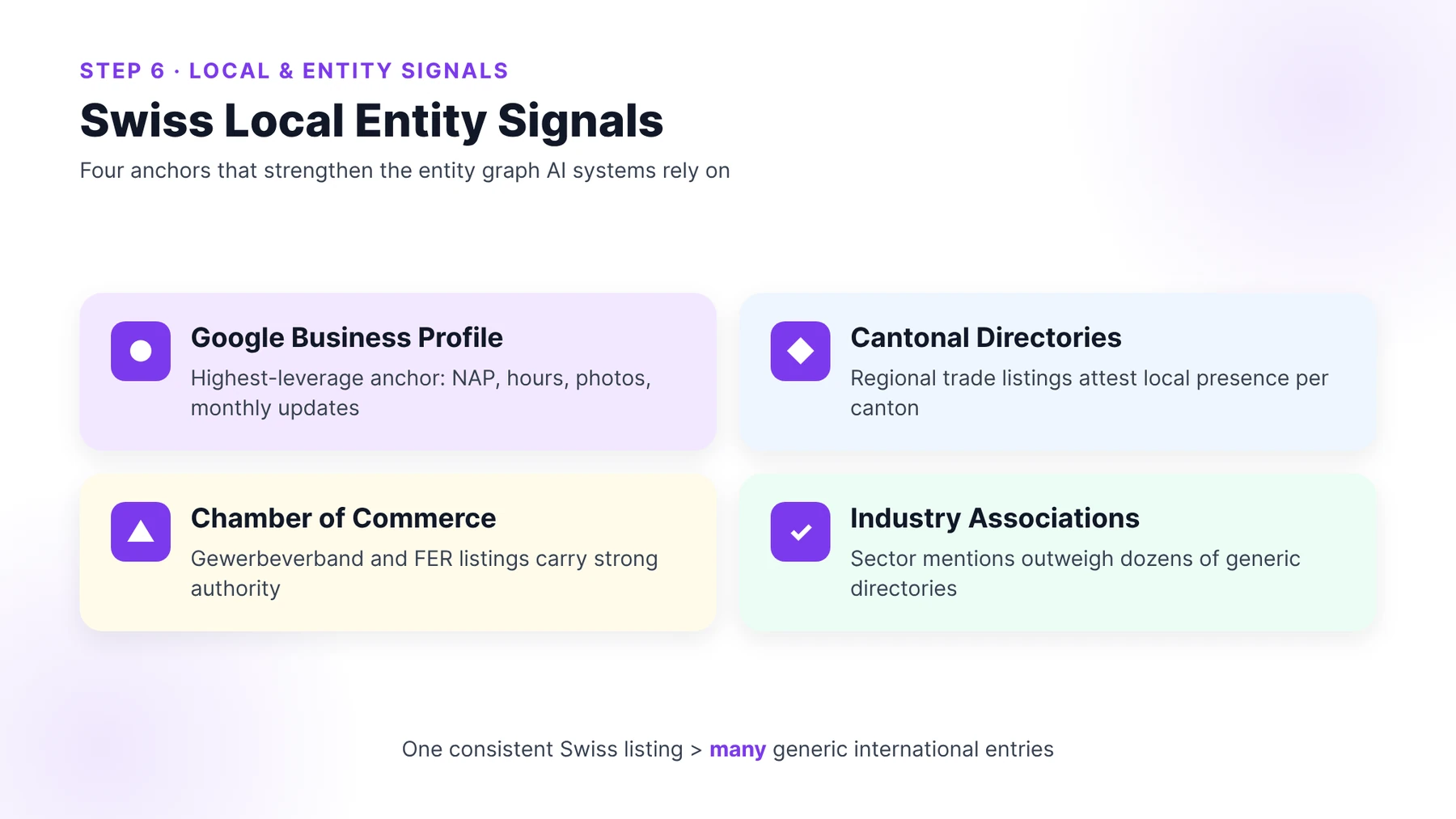
Swiss buyers have strong local preferences. A buyer in Winterthur typically prefers a supplier they can visit, and AI engines increasingly reflect this by prioritising locally attested entities.
Why is Google Business Profile the entity anchor?
A complete, accurate Google Business Profile is one of the strongest local signals a Swiss SME controls. Keep name, address, telephone, opening hours, service areas, and photos consistent with the website. Respond to reviews in the language of the reviewer. Publish updates at least monthly.
How do you build genuinely differentiated location pages?
Thin, duplicated location pages hurt more than they help. Each location page should include:
- A unique opening paragraph describing the local market and typical customer
- Specific services offered from that location
- Local team members with photos and roles
- Case studies or anonymised examples from the region
- Directions, parking, and public transport details
- Canton-specific regulatory notes where relevant
How do you cultivate Swiss-specific mentions?
Mentions in Swiss industry associations, chambers of commerce, cantonal trade directories, and sector publications strengthen the entity graph that AI systems rely on. A single consistent listing in gewerbeverband, FER, or your sector association is usually worth more than many generic international directory entries.
9. Step 7: Measure AEO/GEO Separately from SEO
Quick Answer:
Measure AEO/GEO through a monthly controlled query panel of 30 to 50 priority questions across German, French, Italian, and English, run through Google AI Overviews, ChatGPT, Gemini, Claude, and Perplexity. Track citation frequency, mention accuracy, and leads by language and canton, not just referral clicks.
Traditional SEO dashboards miss most of what matters in AI search. Impressions and clicks do not capture whether ChatGPT recommended your company in a sales conversation that happened offline.
What goes in a monthly AEO/GEO dashboard?
| Metric | Why It Matters | Source |
|---|---|---|
| Organic impressions and clicks | Baseline Google visibility | Google Search Console |
| AI Overview presence for priority queries | Direct generative visibility | Manual or tool-based tracking |
| Mentions in ChatGPT, Gemini, Claude, Perplexity | Brand consideration in AI research | Controlled query panel |
| Citation URL frequency | Which pages AI systems trust | Manual logging |
| AI-service referral traffic | Direct click-through value | Google Analytics or server logs |
| Leads by language and canton | Commercial outcome | CRM |
| Accuracy of AI descriptions of your business | Risk management | Monthly manual audit |
How do you run a controlled query panel?
Choose 30 to 50 priority questions in German, French, Italian, and English. Once per month, run each question through Google AI Overviews, ChatGPT, Gemini, Claude, and Perplexity. Record query, date, country, language, device, answer engine, mentioned brands, cited pages, factual errors, and any call to action. Over time this panel reveals patterns no automated tool can match.
Why not judge success by clicks alone?
AI chatbots generated only 0.28% of total web traffic in March 2026, yet the same engines influence an increasing share of purchase research [Source: christopherjanb.com]. Track assisted conversions, branded search growth, and direct lead volume in parallel with referral sessions.
Measure how AI assistants describe your company
The AI Visibility Program asks ChatGPT, Perplexity, Gemini and Claude the questions your buyers ask, every week, and shows where you are named and where competitors are.
See AI search optimization10. Swiss Compliance: FADP, GDPR, and the EU AI Act
Quick Answer:
AEO/GEO activities touch analytics, lead forms, personalization, CRM integrations, cookies, and AI tools that process visitor data. Swiss SMEs must review the revised Federal Act on Data Protection (FADP/nFADP), GDPR for EU visitors, and the EU AI Act where AI features are embedded in customer-facing products.
AI search optimization touches analytics, lead forms, personalization, CRM integrations, cookies, and AI tools that process visitor data. Each of these raises compliance obligations that Swiss SME founders cannot delegate entirely to a marketing agency.
What does the Swiss FADP require?
The revised FADP applies to any processing of personal data connected with people in Switzerland. Review:
- Privacy notices in every language you publish in
- Lawful basis and purpose limitation for each tracking tool
- Processor agreements with every AI vendor
- International data transfer safeguards, especially to the United States
- Retention periods and data-subject rights workflows
- Cookie consent practices that match the latest Federal Data Protection and Information Commissioner guidance
- Whether prompts or uploaded customer data are reused by an AI provider for training
When does GDPR apply to a Swiss SME?
If your SME targets buyers in Germany, France, Italy, or elsewhere in the EU, GDPR applies in addition to Swiss law. Cookie consent, profiling, direct marketing, and cross-border processing all require careful review with qualified counsel.
What are the EU AI Act considerations?
A normal website optimized to be discoverable by AI search engines is not automatically an AI system subject to every EU AI Act obligation. However, deploying chatbots, recommendation systems, recruitment tools, credit scoring, health decision support, or biometric features can trigger separate obligations. If your Swiss SME sells into the EU and integrates AI features into customer interactions, review the Act with a specialist.
How must AI-generated copy handle advertising claims?
AI-generated marketing copy must not create unsupported health claims, fake testimonials, misleading price claims, false scarcity, unverifiable environmental claims, or incorrect statements about certifications. Maintain human review and an approval record for every commercially important page.
Disclaimer
This article provides general information about AEO and GEO practices for Swiss SMEs. It is not legal, tax, or regulatory advice. Consult a qualified Swiss privacy professional, legal counsel, or sector regulator for guidance specific to your business, product, and jurisdiction.
11. Your 90-Day Implementation Plan
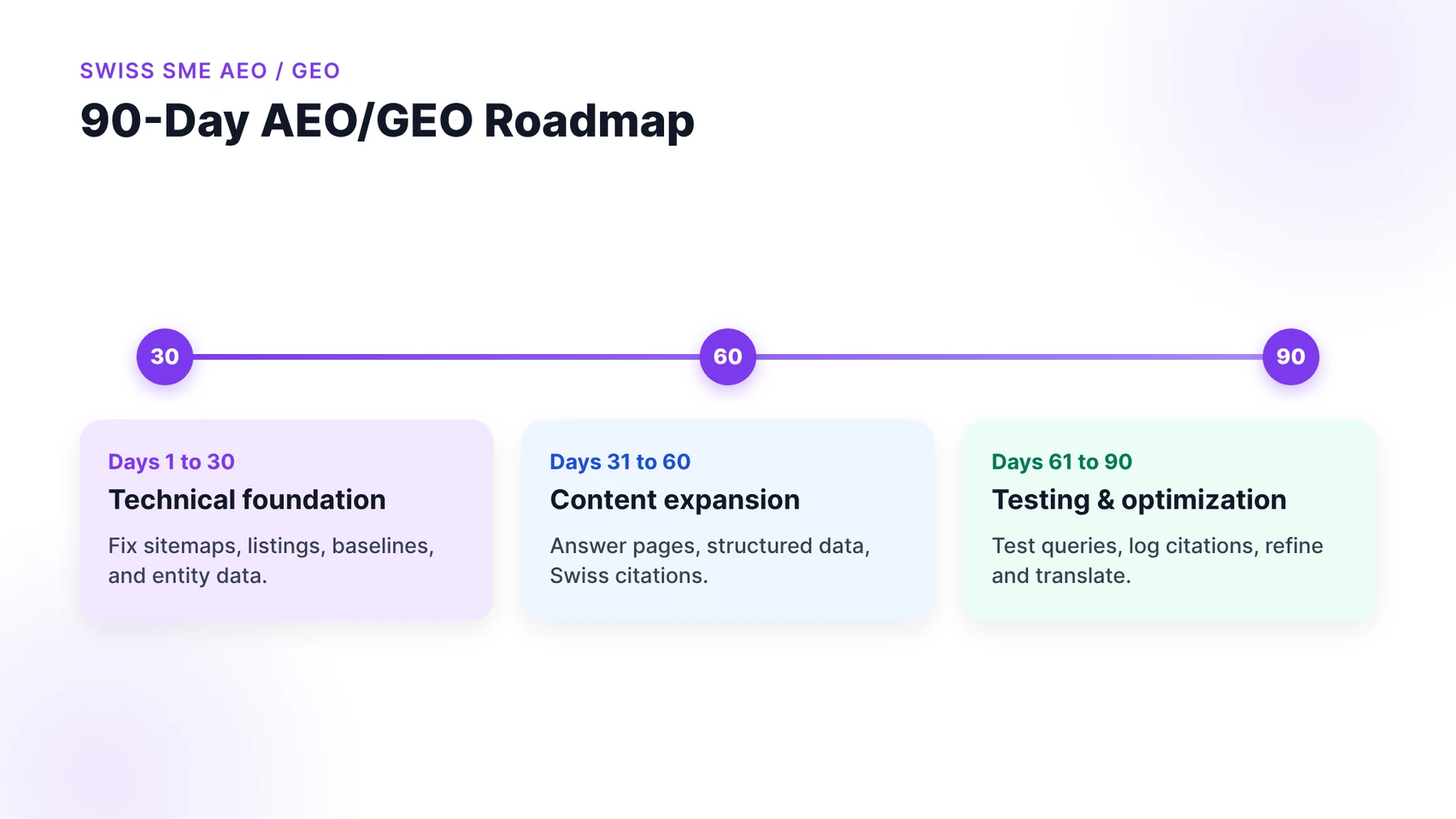
A disciplined 90-day roll-out gives a Swiss SME enough time to establish technical foundations, publish meaningful content, and measure early results.
Days 1 to 30: Technical and measurement foundation
- Crawl the website and fix indexation, canonical, sitemap, rendering, and broken-link issues
- Verify every Swiss business listing and Google Business Profile
- Build the multilingual priority-query set in German, French, Italian, and English
- Record baseline rankings, AI mentions, citations, traffic, and leads
- Audit inaccurate or outdated AI-generated descriptions of your business
- Add author, reviewer, company, and contact information to key pages
Days 31 to 60: Content and entity expansion
- Publish five to ten high-value answer pages in your priority language
- Rewrite service, product, pricing, and comparison pages in the answer-first structure
- Deploy valid structured data across Organization, Service, Product, FAQPage, and BreadcrumbList
- Publish one original data asset or detailed case study
- Secure three to five relevant Swiss industry, association, partner, or local mentions
- Review privacy, consent, AI-provider, and cross-border data practices
Days 61 to 90: Testing and optimization
- Test the full priority-query panel across Google AI features and major answer engines
- Log which pages are cited, which competitors appear, and where factual errors occur
- Correct ambiguous wording and expand content that earned impressions without conversions
- Translate successful content into additional Swiss languages based on measured demand
- Report outcomes using citations, qualified leads, assisted conversions, and brand accuracy, not traffic alone
What outcomes should you realistically expect?
Industry benchmarks suggest directional, not guaranteed, improvements. A 10,000-query benchmark reported up to 40% higher generative-answer visibility from methods involving statistics, quotations, and citations [Source: christopherjanb.com]. A multi-site comparison reported 50.9% year-over-year growth in AI-assistant referrals, with ChatGPT contributing 93% of that traffic [Source: smartsites.com]. These figures should calibrate expectations, not set targets.
12. Frequently Asked Questions
What is the difference between AEO and GEO?
AEO (Answer Engine Optimization) focuses on earning direct answers in snippets and AI Overviews, typically through concise Q&A content. GEO (Generative Engine Optimization) focuses on earning citations and mentions inside longer generative answers from ChatGPT, Gemini, Claude, and Perplexity. The two overlap heavily and both depend on the same technical SEO foundations.
Do I need an llms.txt file on my Swiss SME website?
Probably not as a priority. Ahrefs checked 137,000 sites and found that 97% of llms.txt files were never requested at all, so the file is not an established requirement today [Source: distribb.io]. Focus first on crawlability, answer-first content, and structured data. Revisit llms.txt if major AI providers formally adopt it.
How quickly will my Swiss SME see results from AEO/GEO?
Technical fixes and schema can show indexing effects within days. Answer-first content usually needs several weeks, often longer, before AI engines start citing it, and multilingual expansion may take longer. Treat the first 90 days as foundation-building, not as a results window.
Should I publish content in all four Swiss languages from day one?
No. Start in the language of your largest buyer segment and prove the model works. Expand to additional languages once you have measured demand, for example through Google Search Console impression data or AI-engine query logs. Poorly translated content damages trust in every language.
Can AI search engines read my PDFs?
Partially, and inconsistently. Essential pricing, specifications, and regulatory information should live in HTML, not inside PDFs. Keep PDFs for downloadable documents customers actually need offline, and always provide an HTML summary on the same page.
How do I know if ChatGPT describes my business correctly?
Run a monthly manual audit. Ask each major AI engine ten to fifteen questions about your company, services, locations, and competitors. Record errors, omissions, and outdated claims. Correct the underlying source pages, strengthen entity signals, and retest the next month. The late-2026 survey finding that 75% of brands lack this visibility shows how rare this discipline still is [Source: encorp.ai].
Is traditional SEO dead?
No. Google's current guidance is that generative search features are rooted in existing Search quality and ranking systems [Source: wecallshotgun.com]. Technical SEO, helpful content, internal linking, and backlinks remain foundational. AEO and GEO are additive disciplines, not replacements.
How much of my web traffic should I expect from AI engines?
Currently small. A dataset of 74,752 websites reported 0.28% AI chatbot traffic share in March 2026, while an enterprise sample reported 1.08% for May through September 2025 [Source: christopherjanb.com] [Source: parse.gl]. The strategic value lies in influence on buyer research rather than direct clicks.
Do I need to allow OpenAI, Anthropic, and Google crawlers in robots.txt?
This is a commercial and legal decision, not a purely technical one. Allowing AI crawlers enables your content to be cited, but also permits its use in training and summarisation. Review the implications with legal counsel, consider selective allowances for citation-focused crawlers, and document the policy.
What schema matters most for a Swiss SME?
Organization with CHE-UID identifier, LocalBusiness with Swiss address and canton areaServed, Service with CHF pricing, and FAQPage for Q&A content. BreadcrumbList on every non-homepage URL and Article on editorial content complete the baseline. Validate every block with the Google Rich Results Test before publishing.
Can AI Overviews hurt my traffic?
Yes, for informational queries where the summary fully answers the question. The defence is to target queries that naturally lead to a transaction, quote, booking, or configuration, and to make the cited page substantially more useful than the summary. Pure informational blog traffic will likely decline.
How does the Swiss FADP affect my analytics setup?
The revised FADP requires lawful basis, transparency, purpose limitation, and data-subject rights for any processing of personal data. Review your cookie consent, analytics configuration, international transfer safeguards, and vendor processor agreements. Consult a qualified Swiss privacy professional for implementation specific to your business.
Should I use AI to write my AEO content?
Only with disciplined human editing. AI-generated copy must not create unsupported claims, fake testimonials, or incorrect regulatory statements. Keep a documented approval workflow for commercially important pages, and require named human reviewers for regulated topics.
What is a realistic budget for a Swiss SME AEO/GEO programme?
Budgets vary widely with scope and language footprint. A typical first-year programme covers a technical audit, content strategy, ten to twenty priority answer pages, schema implementation, local entity work, and monthly measurement. Allocate budget for original research or case studies, which produce disproportionate citation value.
How do I handle competitors being cited instead of me?
Log every query where a competitor is cited. Analyse the cited page for the specific attributes AI engines rewarded: authorship, evidence density, schema, recency, or local specificity. Improve your own equivalent page on those dimensions and retest the query one month later.
Is AEO/GEO different for B2B versus B2C Swiss SMEs?
The fundamentals are identical, but B2B buyers rely more heavily on AI research. G2's State of AEO 2026 found 76% of marketing decision-makers viewed AI engines as becoming buyers' first research step [Source: encorp.ai]. B2C programmes often weight local and review signals more heavily; B2B weights evidence density and named expertise.
Conclusion: The Swiss SME AEO/GEO Playbook in Summary
AI search optimization is not a departure from good SEO; it is a sharper, more evidence-driven expression of it. For a Swiss SME founder, the opportunity lies in the gap between how fast buyer behaviour is shifting toward AI engines and how slowly most competitors are responding. The 75% of B2B marketers with only partial visibility into their AI descriptions is both a warning and an invitation [Source: encorp.ai].
Key takeaways
- Treat AEO and GEO as extensions of technical SEO, not replacements
- Build a multilingual question inventory before writing a single page
- Restructure priority pages around direct, quotable answers in the first 100 words
- Signal authority through named authors, Swiss addresses, and specific local detail
- Deploy accurate schema that reflects only visible page content
- Strengthen entity signals through Google Business Profile and Swiss industry mentions
- Measure citations and mentions alongside traffic, using a controlled multilingual query panel
- Review FADP, GDPR, and EU AI Act obligations with qualified counsel
- Execute a disciplined 90-day plan before judging results
The Swiss SMEs that invest now will become the default cited sources for their categories as AI search matures. The ones that wait will spend the next two years trying to displace competitors whose pages the models already trust.
Related reading
- Can AI read your website?: our crawlability study of 96 company sites
- AEO vs GEO: the two disciplines compared in depth
- The invisible consultancy: how we broke our own SEO three times before AI Overviews learned our name
- SEO and AEO complete guide 2026: the SEO foundations this playbook builds on
Plan your first 90 days of AI search work
In a discovery call we look at your site, your buyers' questions and your languages, and agree what to fix first.
Book a discovery call