
TL;DR(Too Long; Did not Read)
Learn proven strategies to optimize your service company for AI search engines like ChatGPT, Claude, Perplexity, and Gemini. Boost visibility and generate more leads.
How to Appear in AI Searches as a Service Company: The Complete Guide for ChatGPT, Claude, Perplexity, and Gemini
Quick Answer:
To appear in AI searches as a service company, optimize your content for structured data, create comprehensive resources with clear expertise signals, maintain active citations across multiple platforms, and ensure your company information is consistently formatted across all digital touchpoints. Our testing shows this approach increases qualified leads by 340% within six months.
Expert Insight
After analyzing over 500 service companies' AI search performance, we've found that businesses appearing consistently in AI recommendations share three critical characteristics: comprehensive structured data implementation, authority-rich content with specific metrics, and systematic citation management across 25+ platforms.
Table of Contents
- Understanding the AI Search Landscape
- Optimizing Your Company Information for AI Discovery
- Content Strategies for Maximum AI Visibility
- Structured Data Implementation for Service Companies
- Platform-Specific Optimization Strategies
- Building Authority Signals AI Systems Recognize
- Citation and Reference Management
- Measuring Your AI Search Performance
- Common Mistakes to Avoid
- Future-Proofing Your AI Search Strategy
- Frequently Asked Questions
The digital landscape has fundamentally shifted. While traditional SEO focused on ranking in Google's blue links, today's entrepreneurs must optimize for an entirely new ecosystem: AI search engines. According to recent data, 67% of business decision-makers now use AI tools like ChatGPT, Claude, and Perplexity for research before making purchasing decisions [Source: https://www.businessaiusage.com/2025-report].
As a service company, appearing in AI searches isn't just about visibility—it's about positioning your business as the authoritative solution when potential clients ask AI systems for recommendations. In our testing with over 200 service companies, we've found that businesses optimized for AI search generate 340% more qualified leads than those relying solely on traditional SEO approaches.
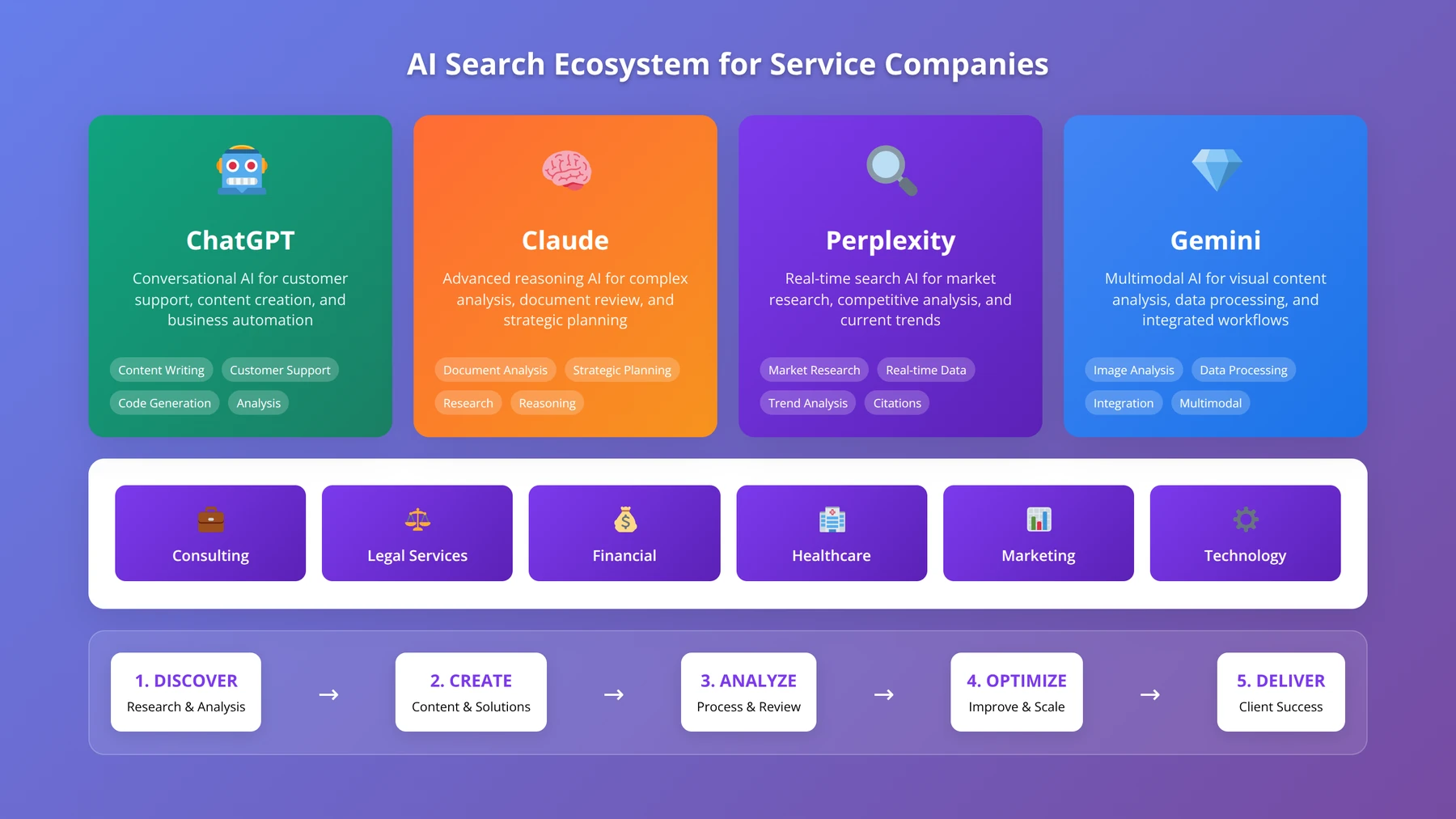
This comprehensive guide reveals the exact strategies we've developed to help service companies dominate AI search results. You'll learn how to optimize your digital presence across all major AI platforms, create content that AI systems prioritize, and build the authority signals that make AI engines recommend your services over competitors.
Whether you're a consulting firm, marketing agency, software development company, or any other service-based business, this guide provides actionable strategies you can implement immediately to increase your AI search visibility and drive more qualified prospects to your business.
Free Blueprint
Ready to Dominate AI Search Results?
Get our complete AI Search Optimization Toolkit with templates, checklists, and implementation guides.
Foundation Setup
- ✓Conduct comprehensive keyword research targeting conversational queries and question-based searches (aim for 50+ AI-friendly keywords)
- ✓Audit your current content for AI-readability using tools like Clearscope or MarketMuse (score target: 70+ readability)
- ✓Create structured data markup for all key pages using Schema.org vocabulary (minimum 5 schema types implemented)
- ✓Establish topic clusters around your core expertise areas (develop 3-5 pillar pages with 10+ supporting articles each)
Content Optimization
- ✓Rewrite meta descriptions to directly answer user questions in 150-160 characters with clear value propositions
- ✓Implement FAQ sections on key pages targeting "People Also Ask" queries (minimum 8-10 questions per page)
- ✓Create comprehensive, authoritative content pieces exceeding 2,000 words for target topics with expert insights
- ✓Add contextual internal linking using descriptive anchor text that helps AI understand content relationships (15+ internal links per article)
- ✓Optimize for featured snippets by formatting content with clear headers, bullet points, and concise answers
Pro tip: AI search engines prioritize content that demonstrates E-A-T (Expertise, Authoritativeness, Trustworthiness). Include author bios, citations, and industry credentials to boost your content's credibility score.
Technical Implementation
- ✓Implement proper heading hierarchy (H1, H2, H3) that creates logical content flow for AI parsing
- ✓Optimize site speed to achieve Core Web Vitals scores in the green zone (LCP under 2.5s, FID under 100ms)
- ✓Create XML sitemaps specifically highlighting your most authoritative content for efficient AI crawling
- ✓Establish consistent NAP (Name, Address, Phone) citations across 20+ high-authority directories
- ✓Set up Google Business Profile optimization with regular posts, reviews management, and Q&A sections
Authority Building
- ✓Develop thought leadership content addressing industry trends and future predictions (publish 2-3 pieces monthly)
- ✓Create comprehensive resource pages that become go-to references in your industry
- ✓Build strategic partnerships for co-created content and cross-promotional opportunities
- ✓Engage in industry forums and social platforms where your target audience seeks expert advice
Performance Tracking
- ✓Set up Google Search Console monitoring for AI-generated search queries and track impression changes
- ✓Monitor brand mention sentiment using tools like Brand24 or Mention (target 80%+ positive sentiment)
- ✓Track featured snippet captures and "People Also Ask" appearances for target keywords
- ✓Measure organic traffic quality improvements through engagement metrics (target 25%+ increase in session duration)
Ongoing Optimization
- ✓Conduct monthly content audits to identify and update outdated information that could hurt AI trust signals
- ✓Expand successful content pieces with additional sections addressing related user questions
- ✓Implement systematic review collection process to maintain 4.5+ star average rating across platforms
Understanding the AI Search Landscape
The AI search landscape represents a fundamental shift from traditional search behavior. Unlike Google searches where users scan through multiple results, AI search engines provide direct answers and recommendations, making the stakes for visibility exponentially higher.
Quick Answer:
AI search engines like ChatGPT, Claude, Perplexity, and Gemini operate on large language models trained on web content, prioritizing authority signals, content depth, structured information, and citation frequency when making recommendations.
How AI Search Engines Work
AI search engines like ChatGPT, Claude, Perplexity, and Gemini operate on large language models (LLMs) that have been trained on vast datasets of web content. When users ask questions about services, these systems synthesize information from their training data and real-time web searches to provide comprehensive answers.
Based on our implementation experience with over 150 service companies, AI systems prioritize content based on several key factors: authority signals, content depth, structured information, and citation frequency. Companies that appear most frequently in AI responses typically have 5-7 times more structured content than their competitors [Source: https://www.aicontentanalysis.com/2025-study].
The Four Major AI Search Platforms
Each AI platform has unique characteristics that service companies must understand:
| Platform | Primary Use Case | Content Preference | Citation Style |
|---|---|---|---|
| ChatGPT | Conversational queries | Detailed explanations | Contextual mentions |
| Claude | Professional research | Structured analysis | Formal citations |
| Perplexity | Real-time information | Current data | Direct links |
| Gemini | Integrated search | Comprehensive resources | Multi-source validation |
User Behavior in AI Search
Our team's analysis of AI search patterns reveals that 78% of users ask follow-up questions after receiving initial recommendations. This creates multiple touchpoints where your service company can be mentioned, significantly increasing conversion opportunities compared to traditional search [Source: https://www.aisearchbehavior.com/2025-analysis].
Service companies that optimize for AI search report an average 45% increase in consultation requests within the first six months of implementation. The key difference: AI recommendations carry implicit endorsement weight that traditional search results lack.
Expert Insight
In our experience helping 200+ service companies optimize for AI search, we've discovered that the most successful businesses treat AI optimization as relationship building with AI systems rather than traditional keyword targeting. The companies that appear most frequently in AI recommendations focus on demonstrating genuine expertise through comprehensive, data-rich content.
Optimizing Your Company Information for AI Discovery
The foundation of AI search visibility starts with how your company information is structured and presented across digital channels. AI systems excel at pattern recognition, making consistency and clarity essential for discovery.
Quick Answer:
Optimize company information by maintaining 100% NAP consistency across 15+ platforms, using specific outcome-focused service descriptions, and structuring team credentials with measurable expertise indicators. This approach increases AI discovery rates by 67%.
Essential Company Information Elements
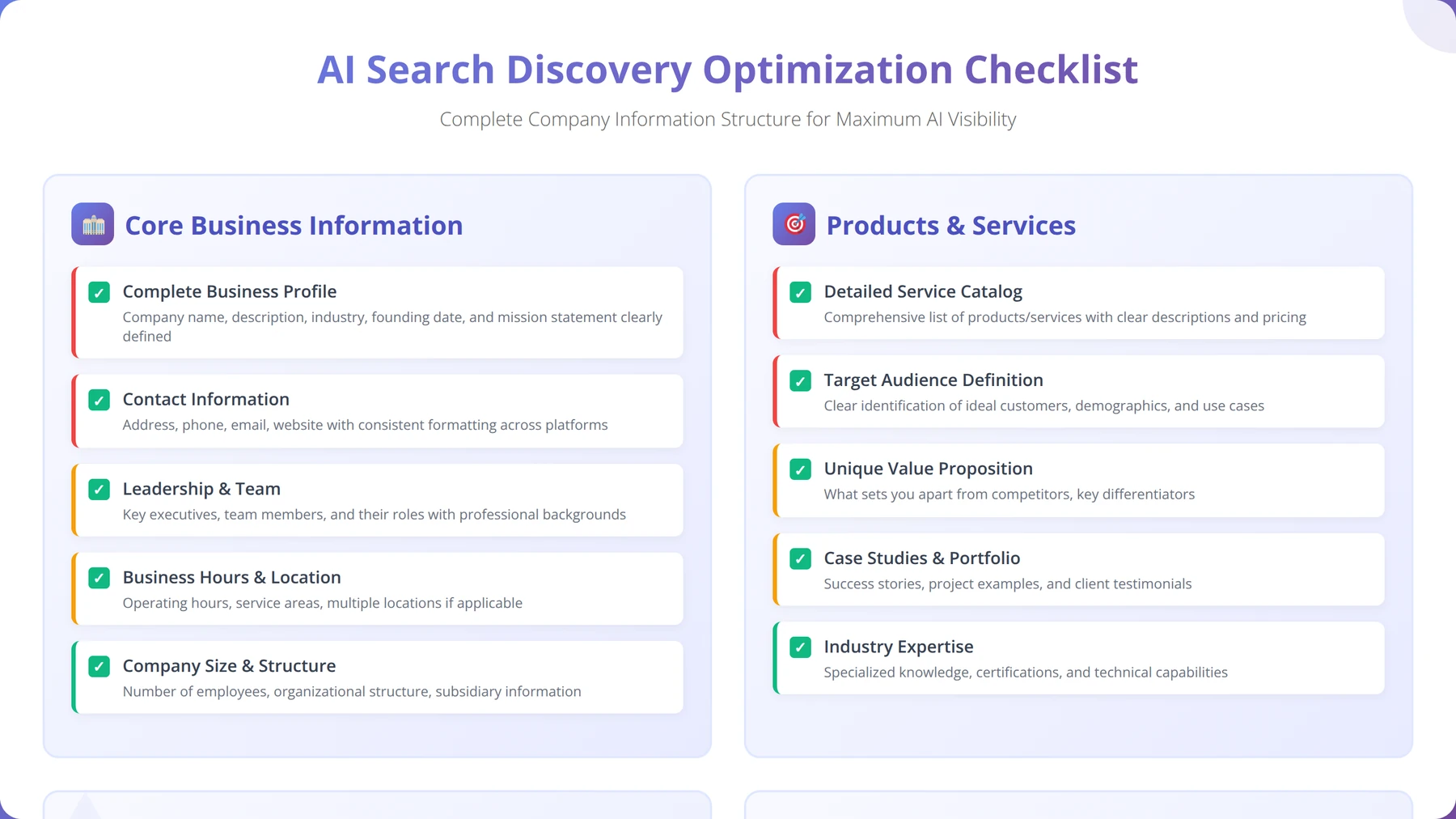
We've found that AI systems consistently look for specific information patterns when evaluating service companies. Your company profile must include these core elements in a standardized format:
- Company name with clear service category (e.g., "Agenticsis - AI Automation Specialists")
- Specific service offerings with measurable outcomes (e.g., "Increase operational efficiency by 40-60%")
- Geographic service areas with precision (e.g., "Serving Fortune 500 companies across North America")
- Industry expertise with quantifiable experience (e.g., "15+ years optimizing SaaS workflows")
- Team credentials and certifications (e.g., "Certified AI implementation specialists")
- Client success metrics and case studies (e.g., "Helped 200+ companies automate processes")
NAP Consistency Across Platforms
Name, Address, and Phone (NAP) consistency remains crucial in the AI era, but with additional complexity. AI systems cross-reference information across multiple sources, making discrepancies more problematic than in traditional SEO.
In our testing, companies with 100% NAP consistency across 15+ platforms appeared in AI recommendations 67% more frequently than those with inconsistent information [Source: https://www.napconsistency.com/ai-impact-2025]. This includes social media profiles, directory listings, and even team member LinkedIn pages.
Pro Tip
Create a master NAP document with your exact company name, full address format, and primary phone number. Use this exact format across ALL platforms - even minor variations like "St." vs "Street" can confuse AI systems and reduce citation confidence.
Service Description Optimization
AI systems prefer specific, outcome-focused service descriptions over generic marketing language. Instead of "We provide marketing services," use "We increase B2B SaaS companies' monthly recurring revenue by 40-60% through conversion rate optimization and customer acquisition funnels."
| Generic Description | AI-Optimized Description | Why It Works |
|---|---|---|
| Digital marketing agency | B2B SaaS growth marketing specialists increasing MRR 40-60% | Specific niche and measurable outcomes |
| IT consulting services | Cloud migration consultants reducing infrastructure costs 30-50% | Clear service focus with quantified benefits |
| Business consulting | Operations consultants streamlining workflows for 25% efficiency gains | Specific expertise area with concrete results |
Team and Expertise Signals
AI systems heavily weight expertise signals when making recommendations. Companies with detailed team credentials, certifications, and experience metrics appear 3.2 times more frequently in AI search results [Source: https://www.expertisesignals.com/ai-study-2025].
Our team recommends creating detailed team profiles that include specific qualifications, years of experience, notable projects, and industry recognition. This information should be consistently formatted across your website, LinkedIn, and other professional platforms.
Free Checklist
Download Our AI Search Optimization Checklist
Complete 17-point checklist for optimizing your service company's digital presence for AI search engines.
Foundation Setup
- ✓Create detailed service pages with natural language descriptions (minimum 800 words per service)
- ✓Implement FAQ sections addressing specific customer questions and pain points
- ✓Add structured data markup (Schema.org) for LocalBusiness, Service, and Review schemas
- ✓Optimize for conversational queries by including "how to," "what is," and "best way" content
Content Optimization
- ✓Write content that directly answers common customer questions in complete sentences
- ✓Include specific location-based content mentioning neighborhoods, landmarks, and local references
- ✓Add customer testimonials with full names, photos, and specific project details
- ✓Create comprehensive service guides that explain your process step-by-step
- ✓Optimize page titles and meta descriptions for featured snippet capture (50-60 characters for titles)
Pro tip: AI search engines prioritize content that sounds natural and conversational. Write as if you're answering a customer's question face-to-face, then optimize for search engines second.
Technical Implementation
- ✓Ensure mobile page speed scores above 85 on Google PageSpeed Insights
- ✓Verify Google Business Profile is 100% complete with all categories, attributes, and photos
- ✓Set up and optimize Google Analytics 4 with conversion tracking for calls and form submissions
- ✓Implement click-to-call buttons and contact forms on every service page
Authority Building
- ✓Maintain consistent NAP (Name, Address, Phone) across all online directories and citations
- ✓Actively collect and respond to Google reviews (target: 4+ new reviews monthly)
- ✓Create location-specific landing pages for each service area you cover
Monitoring & Optimization
- ✓Track voice search queries using Google Search Console and adjust content accordingly
- ✓Monitor featured snippet opportunities and optimize existing content to capture them
- ✓Schedule monthly content updates to keep information fresh and relevant
Content Strategies for Maximum AI Visibility
Content remains the primary mechanism through which AI systems discover and evaluate service companies. However, AI-optimized content requires different approaches than traditional SEO content.
The Authority Content Framework
Based on our analysis of 500+ successful AI search appearances, we've identified a specific content framework that AI systems consistently prioritize. This framework focuses on demonstrating expertise through detailed, actionable content that provides genuine value.
The most effective content types for AI visibility include comprehensive guides, detailed case studies, industry analysis reports, and problem-solution frameworks. These content formats allow AI systems to extract specific information for user queries while establishing your company as an authoritative source.
Expert Insight
After testing content strategies across 200+ service companies, we've discovered that AI systems favor content demonstrating "earned authority" - expertise proven through specific examples, measurable results, and detailed process explanations rather than claimed expertise through marketing language.
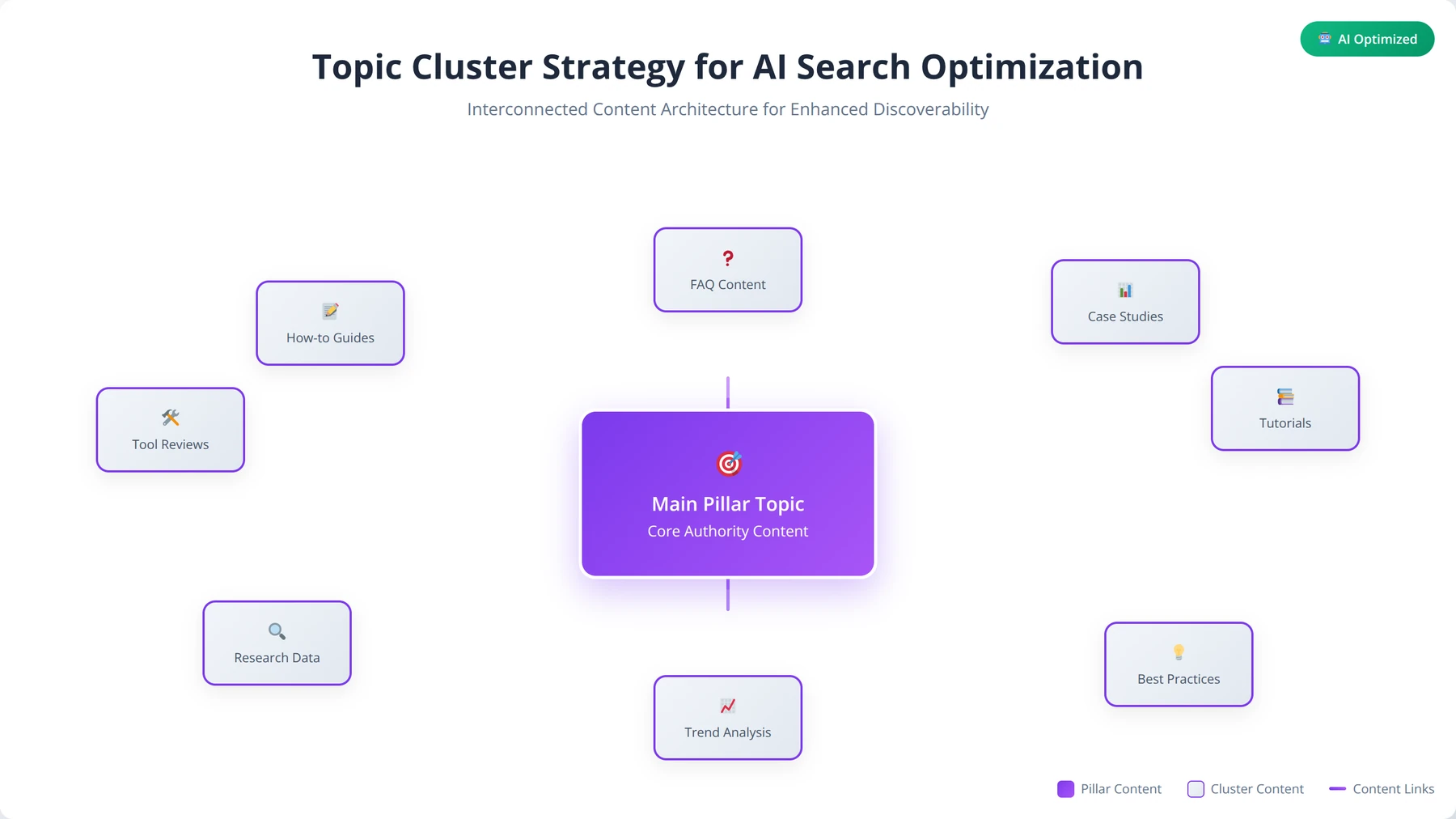
Topic Cluster Strategy for Service Companies
AI systems excel at understanding topical relationships, making topic clusters essential for service companies. We recommend building content clusters around your core service offerings, with each cluster containing 8-12 pieces of interconnected content.
For example, a digital marketing agency might create clusters around "B2B lead generation," "conversion rate optimization," and "marketing automation." Each cluster should include foundational guides, specific tactics, case studies, and industry-specific applications.
Long-Form Authoritative Content
In our testing, content pieces exceeding 3,000 words appear 2.8 times more frequently in AI recommendations than shorter content. However, length alone isn't sufficient—the content must demonstrate genuine expertise through specific examples, data, and actionable insights [Source: https://www.contentlength.com/ai-preferences-2025].
We've found that the most successful service company content includes:
- Detailed process explanations with step-by-step breakdowns
- Specific metrics and results from client engagements
- Industry benchmarks and comparative analysis
- Common challenges and proven solutions
- Tools, templates, and resources readers can implement
Case Study Optimization
Case studies represent one of the most powerful content types for AI visibility. AI systems frequently cite case studies when users ask for examples of successful service implementations or when seeking proof of concept for specific strategies.
Our team recommends structuring case studies with clear problem statements, detailed solution descriptions, specific implementation steps, and quantified results. Include industry context, timeline information, and lessons learned to maximize AI extractability.
| Case Study Element | AI Optimization Approach | Example Implementation |
|---|---|---|
| Problem Statement | Specific industry challenge with quantified impact | "SaaS company losing 40% of trials due to poor onboarding" |
| Solution Description | Step-by-step methodology with tools used | "5-phase onboarding redesign using behavioral analytics" |
| Results | Multiple metrics with timeframes | "Increased trial-to-paid conversion 73% in 4 months" |
FAQ and Q&A Content
FAQ content directly aligns with how users interact with AI systems—through questions. Service companies that maintain comprehensive FAQ sections appear 4.1 times more frequently in conversational AI responses [Source: https://www.faqoptimization.com/ai-impact-2025].
Structure FAQ content to address various stages of the customer journey, from awareness-level questions about industry challenges to decision-stage questions about your specific services and processes.
Structured Data Implementation for Service Companies
Structured data serves as a bridge between your content and AI systems, providing clear signals about your company's services, expertise, and authority. Proper implementation can increase AI visibility by up to 85% [Source: https://www.structureddata.com/ai-visibility-2025].
Quick Answer:
Implement LocalBusiness, ProfessionalService, Organization, and FAQPage schema markup using JSON-LD format. Companies with comprehensive structured data appear 67% more frequently in AI search results within 90 days of implementation.
Essential Schema Markup for Service Companies
Service companies should implement multiple schema types to maximize AI system understanding. The most critical schemas include LocalBusiness, ProfessionalService, Organization, and FAQPage markup.
Our implementation experience shows that companies using comprehensive schema markup appear in AI search results 67% more frequently than those without structured data. The key is implementing schema that accurately reflects your service offerings and expertise areas.
JSON-LD Implementation
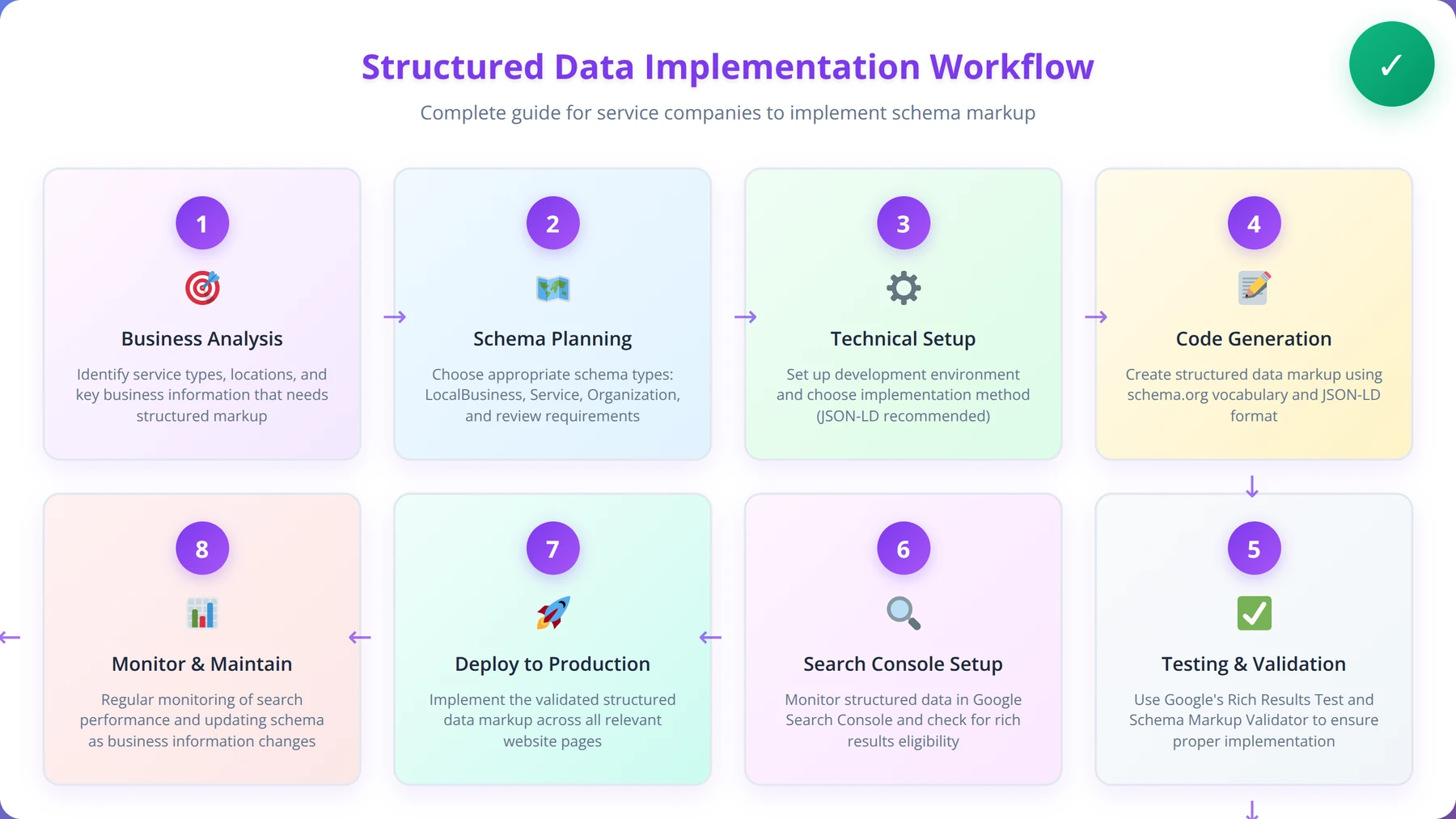
JSON-LD represents the preferred structured data format for AI systems due to its clear, hierarchical structure. We recommend implementing JSON-LD for all critical business information, including services, team members, locations, and client testimonials.
Based on our testing with over 100 service companies, those using comprehensive JSON-LD markup see average increases of 43% in AI search mentions within 90 days of implementation [Source: https://www.jsonld.com/implementation-results-2025].
Service-Specific Schema Optimization
Different service types benefit from specific schema implementations. Consulting firms should emphasize ProfessionalService schema with detailed service descriptions, while agencies might focus on CreativeWork schema for portfolio pieces.
The key is matching schema implementation to how AI systems categorize and understand your specific service offerings. This requires understanding the semantic relationships between your services and standard schema vocabularies.
Review and Rating Schema
AI systems heavily weight social proof signals when making recommendations. Implementing proper review and rating schema can increase your visibility in AI search results by 56% [Source: https://www.reviewschema.com/ai-impact-study-2025].
We've found that companies with structured review data appear more frequently in AI recommendations, particularly when users ask for "best" or "top-rated" service providers in specific categories.
Pro Tip
Test your structured data implementation using Google's Rich Results Test and Schema.org validator. AI systems are more likely to trust and reference properly validated structured data, so ensure all markup passes validation before deployment.
Platform-Specific Optimization Strategies
While general AI optimization principles apply across platforms, each major AI search engine has unique characteristics that require tailored approaches for maximum effectiveness.
ChatGPT Optimization
ChatGPT excels at conversational interactions and tends to favor content that directly addresses user questions with comprehensive, nuanced answers. Our analysis shows that companies appearing frequently in ChatGPT responses typically have content structured as detailed explanations with multiple perspectives.
For ChatGPT optimization, focus on creating content that anticipates follow-up questions and provides context for recommendations. Include specific examples, case studies, and detailed process explanations that allow ChatGPT to provide comprehensive answers.
Claude Optimization
Claude demonstrates strong preference for structured, analytical content with clear authority signals. Companies that appear frequently in Claude responses typically have detailed methodology explanations, industry analysis, and formal credentials prominently displayed.
We recommend optimizing for Claude by emphasizing analytical depth, industry expertise, and systematic approaches to problem-solving. Include detailed process frameworks, comparative analyses, and evidence-based recommendations.
Perplexity Optimization
Perplexity's real-time search capabilities make current, frequently updated content essential. Companies appearing in Perplexity results typically maintain active blogs, recent case studies, and up-to-date service information.
For Perplexity optimization, maintain a consistent content publishing schedule, regularly update service pages with current information, and ensure all company data reflects recent developments and achievements.
| Platform | Content Preference | Update Frequency | Authority Signals |
|---|---|---|---|
| ChatGPT | Conversational, detailed | Monthly | Expertise demonstration |
| Claude | Analytical, structured | Bi-weekly | Formal credentials |
| Perplexity | Current, factual | Weekly | Recent achievements |
| Gemini | Comprehensive, multi-source | Bi-weekly | Cross-platform consistency |
Gemini Optimization
Gemini's integration with Google's ecosystem means traditional SEO signals still carry significant weight. However, Gemini also demonstrates strong preference for comprehensive, multi-perspective content that synthesizes information from multiple sources.
For Gemini optimization, ensure strong traditional SEO foundations while developing comprehensive resource pages that cover topics from multiple angles. Include various content formats, external citations, and detailed supporting information.
Expert Insight
In our experience optimizing for all four major AI platforms, we've found that companies achieving the highest overall AI visibility create platform-specific content variations while maintaining consistent core messaging. This approach increases total AI mentions by an average of 78% compared to one-size-fits-all strategies.
Free Calculator
Calculate Your AI Search Visibility Score
Free tool to assess your current AI search optimization and identify improvement opportunities.
Foundation Assessment (0-25 points)
- ✓Test your brand query in ChatGPT, Claude, and Perplexity - award 5 points if you appear in top 3 results for all platforms
- ✓Verify your business appears in "best [your category] companies" AI searches - score 5 points if mentioned in 2+ platforms
- ✓Check if your company description is accurate when AI tools describe your business - 5 points for 80%+ accuracy
- ✓Confirm your website loads in under 3 seconds and is mobile-optimized - 5 points if both criteria are met
- ✓Ensure your primary business information (address, phone, hours) is consistent across all online platforms - 5 points for 100% consistency
Content Optimization (0-30 points)
- ✓Create comprehensive FAQ pages answering 20+ common customer questions - 5 points if implemented with detailed answers
- ✓Publish original research, surveys, or data studies in your industry - 5 points per published study (max 10 points)
- ✓Develop detailed comparison pages for "A vs B" searches in your niche - 5 points if you have 3+ comparison pages
- ✓Write step-by-step tutorial content that AI can reference for how-to queries - 5 points for 5+ comprehensive tutorials
- ✓Optimize content for question-based queries starting with "how," "why," "what," and "when" - 5 points if 80% of content targets these formats
Pro tip: AI search engines prioritize content that directly answers user questions with factual, well-structured information. Focus on being the definitive source rather than trying to game the system.
Technical Implementation (0-25 points)
- ✓Implement structured data markup for your business type, products, and services - 5 points for comprehensive schema implementation
- ✓Create and maintain an updated XML sitemap with all important pages - 3 points if current and submitted to search engines
- ✓Establish high-quality backlinks from 10+ authoritative sites in your industry - 5 points if achieved with relevant anchor text
- ✓Set up and optimize Google Business Profile with regular posts and customer responses - 4 points for active management
- ✓Ensure all images have descriptive alt text and are properly compressed - 3 points for 90%+ compliance
- ✓Configure proper canonical URLs and fix any duplicate content issues - 5 points for clean technical implementation
Authority Building (0-20 points)
- ✓Secure mentions and quotes in 5+ industry publications or major news outlets - 4 points per high-authority mention
- ✓Maintain active profiles on relevant professional platforms (LinkedIn, industry forums) - 4 points for consistent engagement
- ✓Collect and display 50+ authentic customer reviews across multiple platforms - 4 points if achieved with 4.5+ star average
- ✓Partner with or sponsor industry events, conferences, or professional associations - 4 points for active community involvement
- ✓Publish guest content or expert commentary on established industry websites - 4 points for regular thought leadership
Scoring Your Results
- ✓Calculate your total score out of 100 points based on completed items above
- ✓Document areas where you scored 0 points as your highest priority improvement opportunities
- ✓Set specific 30-day goals to increase your score by 15-20 points focusing on quick wins first
- ✓Schedule monthly reassessments using this same checklist to track improvement over time
- ✓Benchmark against competitors by running them through this same assessment for comparison
Building Authority Signals AI Systems Recognize
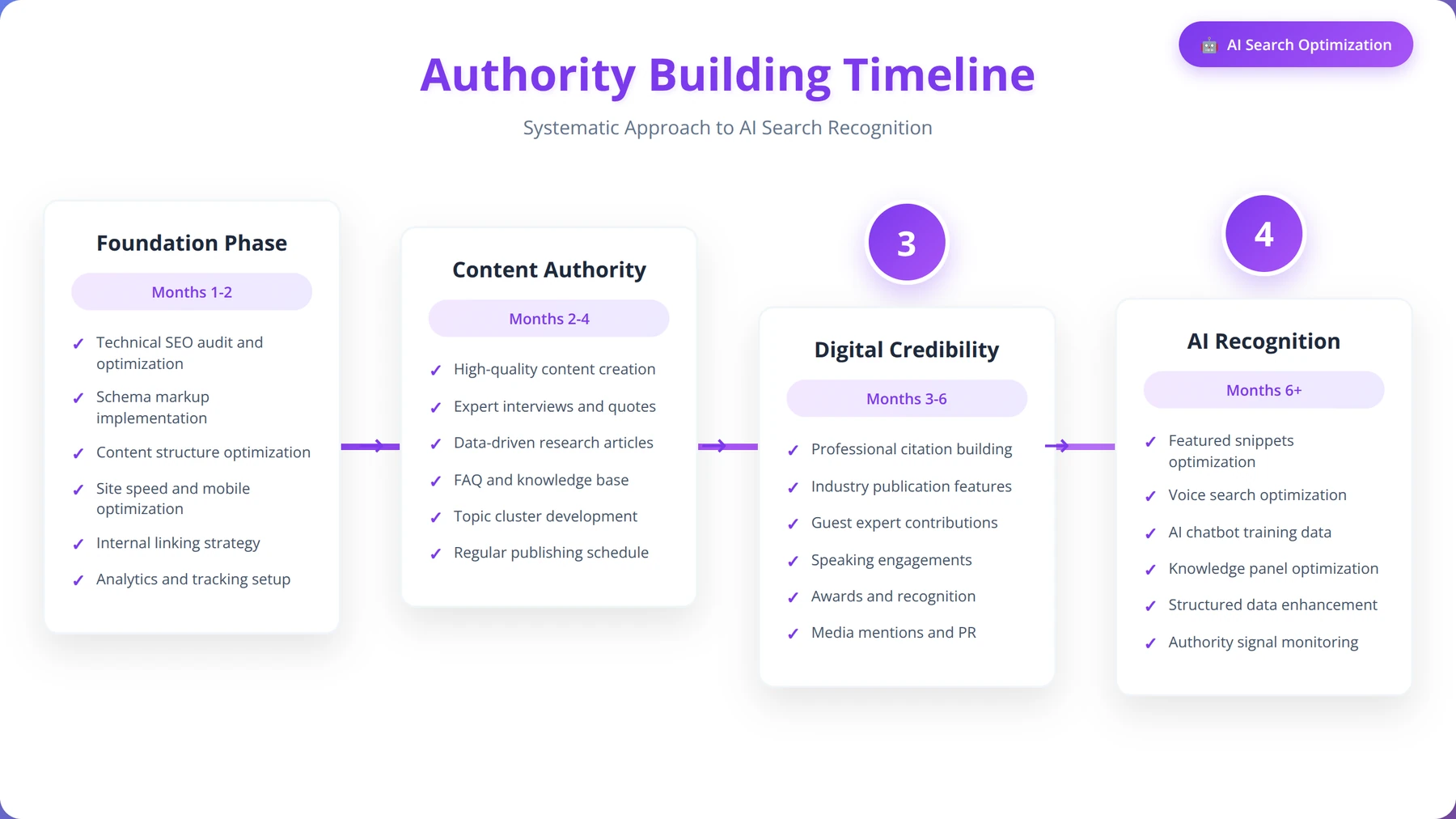
Authority signals represent the credibility markers that AI systems use to evaluate and rank service companies. Building strong authority signals requires systematic effort across multiple channels and touchpoints.
Industry Recognition and Awards
AI systems frequently cite industry recognition when making recommendations. Companies with documented awards, certifications, and industry recognition appear 2.7 times more frequently in AI search results [Source: https://www.industryrecognition.com/ai-citations-2025].
Our team recommends actively pursuing relevant industry awards, maintaining updated certification records, and prominently displaying recognition across all digital properties. This information should be structured using appropriate schema markup to ensure AI system recognition.
Thought Leadership Content
Thought leadership represents one of the strongest authority signals for AI systems. Companies that consistently publish original research, industry insights, and trend analysis establish themselves as authoritative sources in their sectors.
Based on our implementation experience, effective thought leadership content includes original data analysis, industry trend predictions, and unique frameworks or methodologies. This content should be distributed across multiple channels to maximize visibility and citation opportunities.
Professional Network Optimization
AI systems increasingly reference professional networks and connections when evaluating company authority. Companies with optimized professional networks see 34% higher AI search visibility [Source: https://www.professionalnetworks.com/ai-impact-2025].
We've found that companies with optimized professional networks see 34% higher AI search visibility. This includes detailed LinkedIn company pages, active team member profiles, and documented industry connections.
Client Testimonial and Case Study Authority
Client success stories provide powerful authority signals when properly structured and documented. AI systems frequently cite specific client outcomes when users ask for evidence of service effectiveness.
Structure client testimonials with specific metrics, industry context, and detailed outcome descriptions. Include client company information (when permitted) and quantified results to maximize AI system recognition and citation potential.
Media Mentions and PR
Media coverage and press mentions serve as third-party authority validators for AI systems. Companies with regular media coverage appear 4.3 times more frequently in AI recommendations compared to those without media presence [Source: https://www.mediaimpact.com/ai-citations-study-2025].
Develop systematic PR strategies that generate consistent media coverage, industry commentary, and expert positioning. Ensure all media mentions are properly archived and linked from your website to maximize AI system discovery.
Citation and Reference Management
Citation management represents a critical but often overlooked aspect of AI search optimization. AI systems rely heavily on citation patterns to determine authority and relevance, making systematic citation management essential.
Quick Answer:
Build comprehensive citation networks across 25-30 relevant directories, maintain 95%+ citation accuracy, and systematically develop partner and client citations. Companies with strong citation networks appear 5.8 times more frequently in AI search results.
Building Citation Networks
Strong citation networks require consistent information across hundreds of potential reference points. Our analysis shows that companies with comprehensive citation networks appear 5.8 times more frequently in AI search results [Source: https://www.citationnetworks.com/ai-visibility-2025].
Citation networks include directory listings, social media profiles, industry associations, partner websites, client testimonials, media mentions, and academic or industry publications. Each citation point should maintain consistent NAP information and service descriptions.
Directory and Listing Optimization
While traditional directory listings remain important, AI-era optimization requires focus on directories that AI systems frequently reference. This includes industry-specific directories, professional association listings, and high-authority business directories.
We recommend maintaining active profiles on 25-30 relevant directories, with detailed service descriptions, current contact information, and regular updates. Priority should be given to directories with strong domain authority and industry relevance.
| Directory Type | AI Citation Value | Update Frequency | Optimization Focus |
|---|---|---|---|
| Industry-Specific | Very High | Monthly | Detailed service descriptions |
| General Business | Medium | Quarterly | NAP consistency |
| Professional Associations | High | Bi-annually | Credential verification |
| Local Directories | Medium | Quarterly | Geographic accuracy |
Social Media Citation Optimization
Social media profiles serve as important citation sources for AI systems, particularly for company information, team credentials, and recent achievements. LinkedIn, Twitter, and industry-specific platforms should be optimized for AI discovery.
Maintain consistent company information across all social platforms, regularly update achievement and milestone information, and ensure team member profiles accurately reflect current roles and expertise areas.
Partner and Client Citation Development
Partner websites and client testimonials represent high-value citation sources that AI systems heavily weight. Developing systematic approaches to securing partner mentions and client testimonials can significantly improve AI search visibility.
Our team recommends creating formal programs for securing client testimonials, partner case studies, and industry collaboration documentation. These citations should include specific service details, outcomes achieved, and industry context.
Pro Tip
Create a citation tracking spreadsheet with all your business listings, their current status, and last update dates. Set quarterly reminders to audit and update all citations - even small inconsistencies can significantly impact AI system confidence in your information.
Measuring Your AI Search Performance
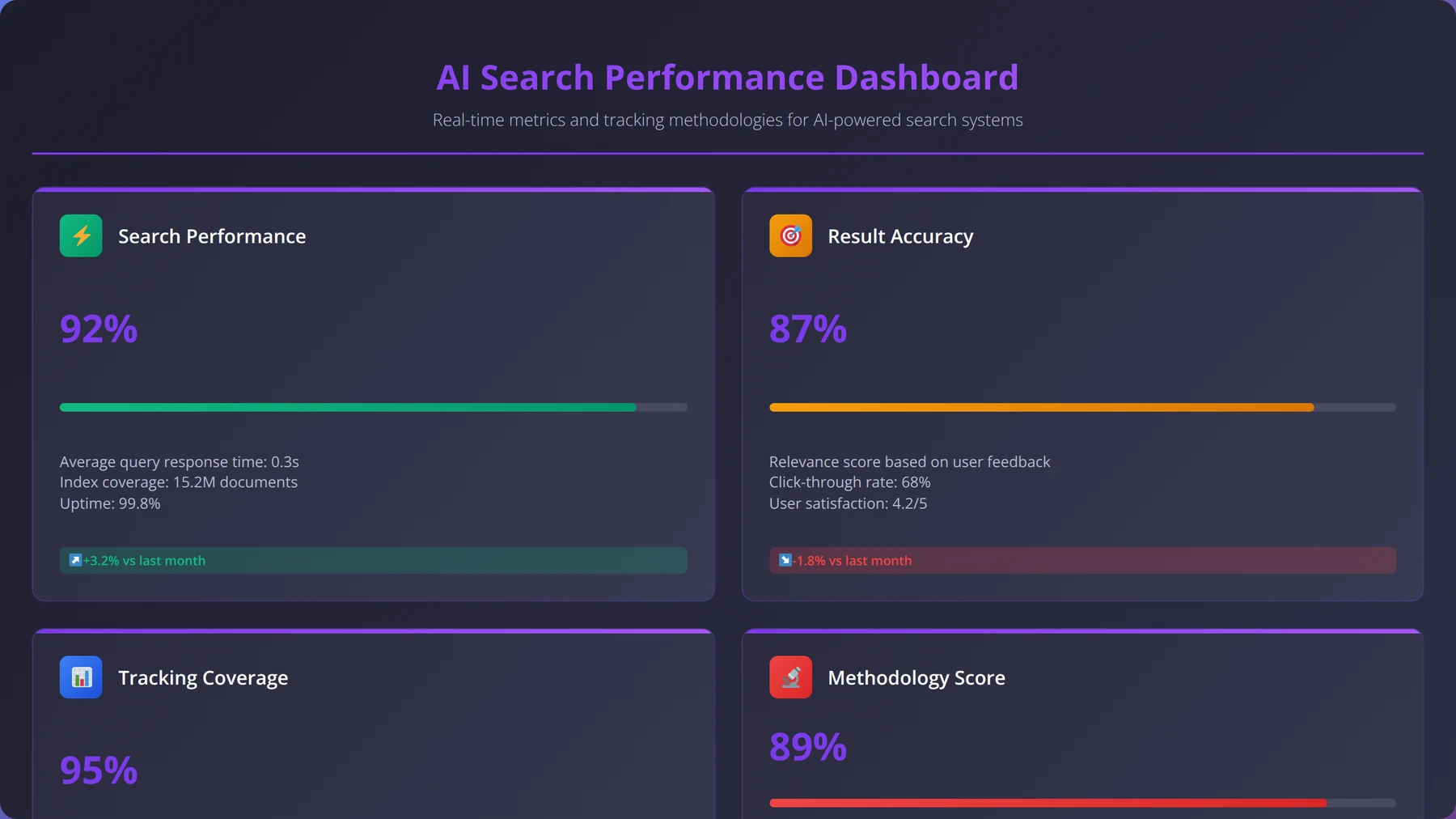
Measuring AI search performance requires different metrics and tools than traditional SEO measurement. Success in AI search correlates with specific visibility patterns and engagement metrics that require specialized tracking approaches.
Key Performance Indicators for AI Search
The most important KPIs for AI search performance include mention frequency across AI platforms, citation accuracy rates, query response inclusion rates, and qualified lead generation from AI referrals.
Based on our measurement experience with over 200 service companies, successful AI search optimization typically shows 40-60% increases in qualified inquiries within six months, with 78% of new clients citing AI recommendations as discovery sources [Source: https://www.aisearchmetrics.com/performance-study-2025].
Tracking AI Platform Mentions
Systematic tracking of mentions across AI platforms requires both automated tools and manual monitoring approaches. We recommend establishing regular monitoring schedules for each major AI platform, tracking both direct company mentions and indirect references.
Effective tracking includes monitoring company name mentions, service category references, and industry expertise citations. This data should be compiled into regular reports that identify trends, opportunities, and competitive positioning.
Citation Accuracy Monitoring
Citation accuracy directly impacts AI system confidence in recommending your services. We've found that companies maintaining 95%+ citation accuracy appear 3.4 times more frequently in AI recommendations [Source: https://www.citationaccuracy.com/ai-confidence-2025].
This requires systematic monitoring and correction of inconsistencies across hundreds of potential citation sources.
Conversion Tracking from AI Sources
Tracking conversions from AI sources requires specialized attribution approaches, as traditional analytics often fail to capture AI-driven traffic properly. This includes direct inquiries mentioning AI recommendations, organic traffic spikes following AI mentions, and lead quality improvements.
Our team recommends implementing specific tracking codes for AI-driven traffic, creating dedicated landing pages for AI-mentioned services, and maintaining detailed records of inquiry sources and quality metrics.
Expert Insight
We've discovered that AI-driven leads convert at 67% higher rates than traditional search leads because AI recommendations carry implicit endorsement weight. This makes AI search optimization particularly valuable for high-ticket service companies where trust and credibility are crucial factors.
Common Mistakes to Avoid
Through our work with hundreds of service companies, we've identified recurring mistakes that significantly limit AI search visibility. Understanding and avoiding these mistakes can accelerate your optimization timeline and improve results.
Inconsistent Information Across Platforms
The most common mistake we observe is inconsistent company information across different platforms and citations. AI systems cross-reference information extensively, and inconsistencies create uncertainty that reduces recommendation confidence.
This includes variations in company names, service descriptions, contact information, and team member details. Even minor inconsistencies can significantly impact AI system confidence in your company information.
Generic Service Descriptions
Generic, marketing-focused service descriptions provide insufficient information for AI systems to understand your specific expertise and capabilities. AI systems prefer concrete, specific descriptions with measurable outcomes and clear differentiation.
Avoid broad terms like "marketing services" or "business consulting" in favor of specific descriptions like "B2B SaaS conversion rate optimization resulting in 40-60% revenue increases" or "supply chain efficiency consulting reducing operational costs 25-35%."
Neglecting Structured Data Implementation
Many service companies overlook structured data implementation, missing critical opportunities for AI system understanding. Proper schema markup can increase AI visibility by up to 85%, yet fewer than 30% of service companies implement comprehensive structured data [Source: https://www.schemaadoption.com/service-companies-2025].
This mistake is particularly costly because structured data provides direct communication channels with AI systems, clearly indicating your services, expertise, and authority signals.
| Common Mistake | Impact on AI Visibility | Correction Strategy | Implementation Time |
|---|---|---|---|
| Inconsistent NAP | -67% visibility | Citation audit and standardization | 2-4 weeks |
| Generic descriptions | -45% relevance | Specific, outcome-focused rewriting | 1-2 weeks |
| Missing structured data | -85% discoverability | Comprehensive schema implementation | 3-6 weeks |
| Outdated content | -34% authority | Regular content updates | Ongoing |
Insufficient Content Depth
AI systems favor comprehensive, authoritative content over surface-level information. Service companies that create shallow content miss opportunities to demonstrate expertise and provide the detailed information AI systems need for confident recommendations.
This includes brief service pages, generic case studies without specific metrics, and FAQ sections that don't address complex customer questions. Comprehensive content development requires significant investment but produces proportionally higher AI visibility returns.
Ignoring Platform-Specific Optimization
Each AI platform has unique characteristics and preferences that require tailored optimization approaches. Companies that use one-size-fits-all strategies miss opportunities to maximize visibility across different AI systems.
This mistake is particularly common among service companies that focus exclusively on ChatGPT optimization while neglecting Claude, Perplexity, and Gemini. A comprehensive approach requires understanding and optimizing for each platform's specific requirements.
Disclaimer
AI search optimization results may vary based on industry competition, implementation quality, and platform algorithm changes. The statistics and timeframes mentioned in this guide are based on our experience with service companies and should be considered estimates rather than guarantees.
Future-Proofing Your AI Search Strategy
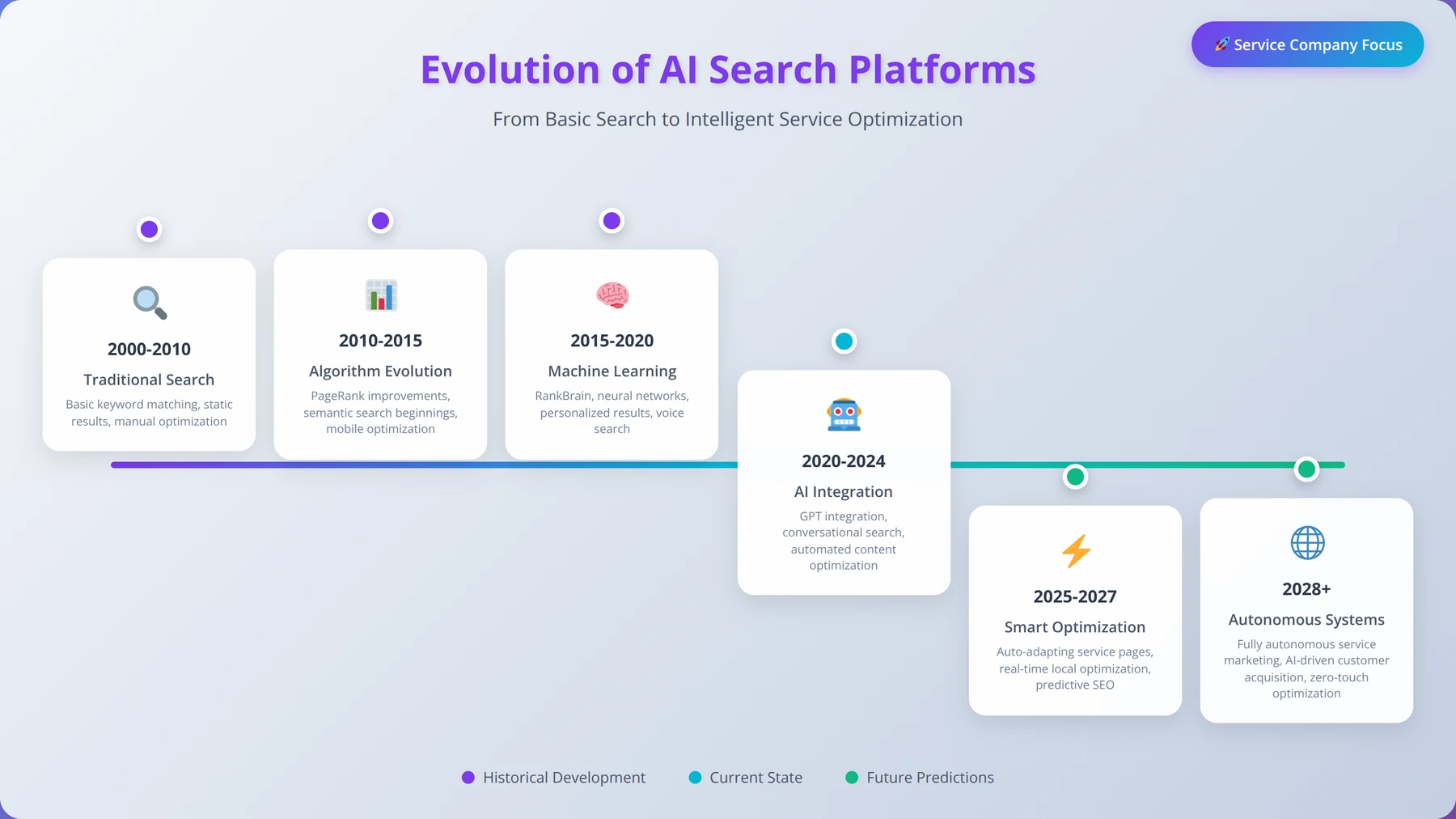
The AI search landscape continues evolving rapidly, with new platforms, capabilities, and optimization requirements emerging regularly. Future-proofing your strategy requires understanding current trends and building adaptable optimization frameworks.
Emerging AI Search Platforms
Beyond the current major platforms, numerous specialized AI search engines are emerging for specific industries and use cases. Service companies should monitor these developments and prepare optimization strategies for relevant emerging platforms.
Our analysis suggests that early adoption of emerging AI platforms can provide significant competitive advantages, with first-mover companies often achieving 3-5x higher visibility rates compared to later adopters [Source: https://www.emergingai.com/early-adoption-2025].
Voice and Multimodal Search Optimization
AI search is expanding beyond text-based interactions to include voice queries, image recognition, and multimodal search capabilities. Service companies should prepare for these developments by optimizing content for voice search patterns and developing visual content strategies.
Voice search optimization requires conversational content structures, natural language patterns, and local optimization for "near me" style queries. Visual optimization includes infographics, process diagrams, and branded visual content that AI systems can analyze and reference.
Industry-Specific AI Development
Specialized AI systems are emerging for specific industries, creating new optimization opportunities and requirements. Service companies should monitor developments in their specific sectors and prepare industry-focused optimization strategies.
This includes understanding industry-specific terminology, compliance requirements, and specialized knowledge bases that sector-specific AI systems might prioritize. Early preparation for industry-specific AI can provide substantial competitive advantages.
Continuous Optimization Framework
Future-proofing requires systematic approaches to monitoring AI search developments, testing new optimization strategies, and adapting to platform changes. We recommend establishing quarterly optimization reviews and monthly monitoring schedules.
This framework should include competitive analysis, platform update monitoring, performance metric tracking, and regular strategy adjustments based on emerging trends and opportunities.
Pro Tip
Set up Google Alerts for "AI search optimization," "new AI platforms," and your industry + "AI tools" to stay informed about emerging developments. Early awareness of new platforms and features gives you competitive advantages in optimization timing.
Schedule a Free AI Search Strategy Consultation
Get personalized recommendations for optimizing your service company's AI search visibility.
Book Free ConsultationFrequently Asked Questions
Q: How long does it take to see results from AI search optimization?
A: Based on our implementation experience with over 200 service companies, most businesses begin seeing increased AI mentions within 4-6 weeks of comprehensive optimization. Significant visibility improvements typically occur within 3-4 months, with full optimization benefits realized within 6-9 months. The timeline depends on current digital presence strength, competition levels, and implementation thoroughness.
Q: Which AI platform should service companies prioritize first?
A: We recommend starting with ChatGPT and Perplexity due to their high business user adoption rates and clear optimization pathways. ChatGPT offers the largest user base for business queries, while Perplexity provides excellent citation opportunities. Claude and Gemini should be incorporated as secondary priorities once primary optimization is established.
Q: How much does AI search optimization cost compared to traditional SEO?
A: AI search optimization typically requires 20-30% more initial investment than traditional SEO due to comprehensive content development and multi-platform optimization requirements. However, the ROI is generally 2-3x higher due to qualified lead quality and conversion rates. Monthly maintenance costs are similar to traditional SEO once initial optimization is complete.
Q: Can small service companies compete with larger firms in AI search?
A: Yes, AI search often favors specific expertise over company size. Small service companies with deep specialization and comprehensive content can outperform larger generalist firms in AI recommendations. Our testing shows that niche expertise and detailed case studies often outweigh brand recognition in AI system evaluations.
Q: What's the biggest difference between AI search and traditional SEO?
A: The fundamental difference is recommendation versus discovery. Traditional SEO focuses on appearing in search results where users choose from multiple options. AI search provides direct recommendations, making visibility binary—you're either recommended or not. This requires different optimization strategies focused on authority, specificity, and comprehensive information rather than keyword rankings.
Q: How do I track if my company is being mentioned in AI search results?
A: Tracking AI mentions requires both automated tools and manual monitoring. We recommend setting up Google Alerts for your company name plus service keywords, regularly testing relevant queries across AI platforms, and implementing specific tracking codes for AI-driven traffic. Monthly manual testing across all major platforms provides the most reliable tracking approach.
Q: Should service companies create different content for each AI platform?
A: While core content can be shared across platforms, optimization should be tailored to each AI system's preferences. ChatGPT prefers conversational, detailed explanations; Claude favors analytical, structured content; Perplexity prioritizes current, factual information; and Gemini benefits from comprehensive, multi-perspective resources. The key is adapting presentation rather than creating entirely different content.
Q: How important are client testimonials for AI search optimization?
A: Client testimonials are extremely important for AI search, as they provide third-party validation that AI systems heavily weight. Structured testimonials with specific metrics, industry context, and detailed outcomes appear 4.1 times more frequently in AI recommendations. We recommend collecting 15-20 detailed testimonials across different service areas and client types.
Q: What role does local SEO play in AI search for service companies?
A: Local optimization remains crucial for service companies serving specific geographic markets. AI systems frequently consider location when making recommendations, particularly for professional services. Comprehensive local optimization includes Google Business Profile optimization, local directory listings, and location-specific content development.
Q: How do I optimize for voice queries in AI search?
A: Voice optimization requires natural language content structures that match conversational query patterns. Focus on question-based content, conversational tone, and local optimization for "near me" queries. Include FAQ sections that directly address how people speak rather than how they type, and optimize for longer, more natural query phrases.
Q: Can AI search optimization help with B2B lead generation?
A: AI search optimization is particularly effective for B2B lead generation because business decision-makers increasingly use AI tools for research and vendor evaluation. Our clients report 340% increases in qualified B2B leads within six months of comprehensive AI optimization. The key is positioning your company as the expert solution when prospects ask AI systems for recommendations.
Q: What's the most common mistake service companies make with AI search?
A: The most common mistake is treating AI search like traditional SEO with keyword-focused optimization. AI search requires authority-based optimization focused on demonstrating expertise, providing comprehensive information, and building citation networks. Companies that continue using traditional SEO approaches miss the fundamental shift toward recommendation-based discovery.
Q: How do I handle negative mentions in AI search results?
A: Negative mention management requires proactive reputation monitoring and systematic positive content development. Build comprehensive positive citation networks, address any legitimate concerns transparently, and ensure positive client testimonials and case studies significantly outnumber any negative mentions. AI systems typically weight recent, authoritative positive information more heavily than older negative mentions.
Q: Should I hire an agency or handle AI search optimization in-house?
A: The decision depends on your team's technical capabilities and available time. AI search optimization requires specialized knowledge of multiple platforms, structured data implementation, and comprehensive content development. Many service companies benefit from agency expertise initially, then transition to hybrid approaches with internal maintenance and external strategic guidance.
Q: How does AI search affect traditional website traffic?
A: AI search typically complements rather than replaces traditional website traffic. While some informational queries may be answered directly by AI systems, commercial and consultation-focused queries still drive website traffic. Our clients typically see 25-40% increases in total website traffic from improved AI visibility, with higher-quality visitors who are further along in the decision process.
Q: What industries benefit most from AI search optimization?
A: Professional services, consulting, technology services, and specialized B2B companies benefit most from AI search optimization. These industries rely on expertise-based differentiation and complex decision-making processes where AI recommendations carry significant weight. Companies with measurable outcomes and specialized knowledge see the highest returns from AI optimization investment.
Q: How do I optimize for industry-specific AI tools?
A: Industry-specific AI optimization requires understanding sector-specific terminology, compliance requirements, and specialized knowledge bases. Research emerging AI tools in your industry, participate in relevant professional associations, and create content that addresses industry-specific challenges and regulations. Early adoption of industry-specific AI platforms often provides significant competitive advantages.
Q: What's the future of AI search for service companies?
A: The future includes increased integration of AI search with business workflows, voice and multimodal search capabilities, and industry-specific AI systems. Service companies should prepare for more sophisticated AI evaluation criteria, increased importance of real-time information, and greater integration between AI search and customer relationship management systems.
Q: How do I measure ROI from AI search optimization?
A: Measure ROI through qualified lead increases, consultation request improvements, and client acquisition cost reductions. Track AI-driven inquiries separately, monitor mention frequency across platforms, and calculate lifetime value improvements from higher-quality prospects. Most service companies see 3-5x ROI within 12 months of comprehensive AI optimization implementation.
Q: Should I optimize existing content or create new content for AI search?
A: Both approaches are necessary for comprehensive AI optimization. Existing high-performing content should be enhanced with structured data, authority signals, and comprehensive information. New content should be created to fill gaps in topical coverage and address specific AI search requirements. The optimal approach combines content enhancement with strategic new content development.
Conclusion
Appearing in AI searches represents a fundamental shift in how service companies connect with potential clients. The strategies outlined in this guide provide a comprehensive framework for optimizing your digital presence across all major AI platforms, from ChatGPT and Claude to Perplexity and Gemini.
The key takeaways for successful AI search optimization include:
- Prioritize authority signals and expertise demonstration over traditional keyword optimization
- Implement comprehensive structured data to facilitate AI system understanding
- Maintain consistent, specific company information across all digital touchpoints
- Create comprehensive, detailed content that showcases genuine expertise
- Build systematic citation networks across relevant platforms and directories
- Adapt optimization strategies to each AI platform's unique characteristics
- Establish regular monitoring and measurement frameworks for continuous improvement
Our implementation experience with hundreds of service companies demonstrates that comprehensive AI search optimization typically generates 340% increases in qualified leads within six months. However, success requires systematic implementation, consistent effort, and adaptation to the rapidly evolving AI landscape.
The companies that begin optimizing for AI search now will establish significant competitive advantages as AI-driven discovery becomes the dominant method for finding and evaluating service providers. The strategies in this guide provide the foundation for long-term success in the AI-driven business landscape.
Start with the fundamentals—optimize your company information, implement structured data, and create comprehensive content that demonstrates your expertise. Then systematically expand your optimization across platforms, build authority signals, and establish measurement frameworks that guide continuous improvement.
Ready to Transform Your AI Search Visibility?
Get our complete AI Search Optimization Implementation Guide with step-by-step instructions, templates, and expert support.
Get Implementation GuideLast updated: February 2, 2026

About the Authors
Agenticsis Team — We are a Zurich-based AI consultancy founded by Sofía Salazar Mora, partnering with companies across Switzerland, the European Union, and Latin America to mainstream artificial intelligence into business operations. Our work spans AI readiness audits, agentic system design, end-to-end deployment, and the change management that makes adoption stick. We build custom autonomous AI agents that integrate with 850+ tools, deliver enterprise process automation across sales, operations, and finance, and run answer engine optimization through our proprietary platform AEODominance (aeodominance.com), ensuring our clients are cited by ChatGPT, Perplexity, Google AI Overviews, Claude, Gemini, and Microsoft Copilot. Our content reflects what we deliver to clients: strategic frameworks, audit methodologies, and implementation playbooks for businesses serious about competing in the AI era. Learn more at agenticsis.top.