TL;DR(Too Long; Did not Read)
Multi-agent orchestration is winning enterprise AI by 2027. See the data, architectures, and frameworks reshaping how companies deploy AI in 2026.
Multi-Agent Orchestration vs Single Super-Agent Architectures: Which Will Win Enterprise AI by 2027?
Quick Answer:
Multi-agent orchestration is the definitive winner for enterprise AI by 2027. Gartner projects 75% of enterprise software engineers will use AI coding agents inside multi-agent frameworks by 2028, while single "super-agent" architectures are retreating to isolated tasks. Even new "Super Agent" products (like Vortx, released mid-2026) are actually orchestration layers coordinating specialized agents—confirming that the future is a swarm of narrow experts, not one monolithic oracle [Source: https://community.ibm.com/community/user/blogs/sarita-concretio/2026/07/10/why-enterprises-are-pivoting-to-multi-agent-ai-sys].
Table of Contents
- The State of the Debate in 2026
- Defining the Two Architectures
- What the 2026 Data Tells Us
- The Great "Super Agent" Rebrand
- Head-to-Head Technical Comparison
- Governance, Auditability, and the 40% Cancellation Problem
- The Frameworks and Protocols Powering Multi-Agent Systems
- Real-World Case Studies
- When Single-Agent Architectures Still Win
- Common Pitfalls to Watch Out For
- Implementation Playbook for Entrepreneurs
- Predictions for 2027 and Beyond
- Frequently Asked Questions
The State of the Debate in 2026
The question of whether enterprises should build one massive, do-it-all AI agent or coordinate many specialized ones has an answer now—and it did not take until 2027 to become clear. As of July 2026, Gartner recorded a 1,445% surge in multi-agent system inquiries between Q1 2024 and Q2 2025, marking the exact moment the topic transitioned from "interesting research" to "urgent enterprise concern" [Source: https://www.firecrawl.dev/blog/ai-agents].
In our consulting work with mid-market and enterprise clients across Switzerland, the EU, and Latin America, we have watched the same pattern play out dozens of times. A company starts with an ambitious single-agent prototype, hits governance walls at week six, and by month three is decomposing it into a multi-agent architecture. The industry has now caught up to what implementers already knew.
In July 2026, IBM publicly advised enterprises to "stop building one agent to do everything" and instead build specialized agents coordinated by an orchestration layer managing routing, state, and governance [Source: https://community.ibm.com/community/user/blogs/sarita-concretio/2026/07/10/why-enterprises-are-pivoting-to-multi-agent-ai-sys]. This article walks entrepreneurs through why multi-agent orchestration is winning, what it means for your product roadmap, and how to position your company for the 2027 enterprise buyer.
💡 Expert Insight
"Coordination, auditability, and scoped permissions are now the primary evaluation criteria for enterprise buyers, ahead of raw model capability." — Sarita Concretio, IBM (July 2026) [Source: https://community.ibm.com/community/user/blogs/sarita-concretio/2026/07/10/why-enterprises-are-pivoting-to-multi-agent-ai-sys]
Free Download: Building AI for Enterprise Buyers in 2027?
Download NowDefining the Two Architectures: What Are Super-Agents and Multi-Agent Systems?
Before comparing them, we need shared definitions. In practice, both terms are used loosely and vendors happily blur the lines.
What Is a Single Super-Agent?
Quick Answer:
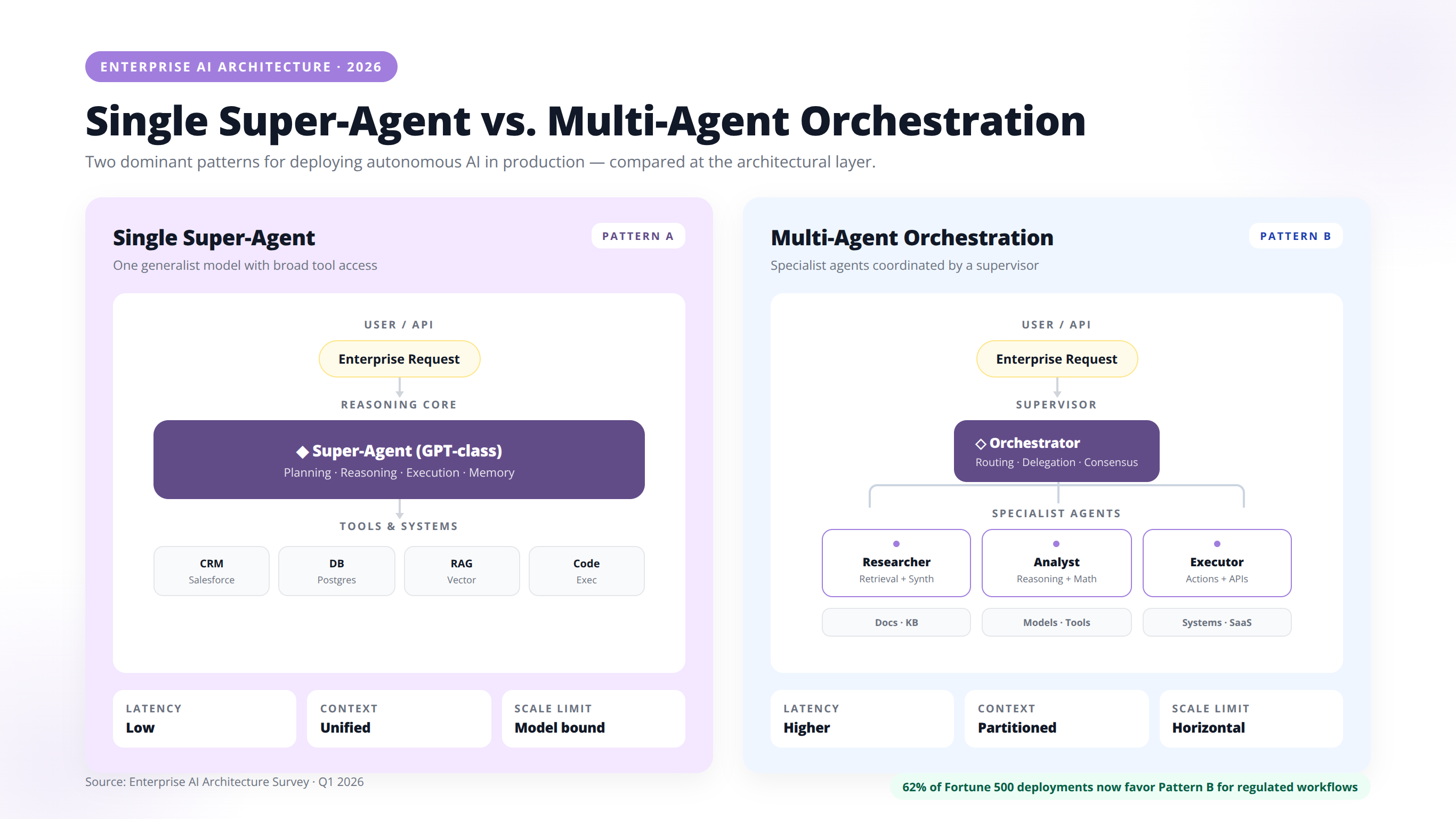
A single super-agent is one large language model instance equipped with a broad tool library, large context window, and instructions to handle every task. It reasons monolithically: one planner, one executor, one memory, one identity.
A single super-agent is one large language model instance—often GPT-class or Claude-class—equipped with a broad tool library, a large context window, and instructions to handle every task an organization throws at it. Think of it as a very smart generalist employee with access to every SaaS tool in your stack.
What Is Multi-Agent Orchestration?
Quick Answer:
Multi-agent orchestration coordinates several specialized agents—each with narrow scope, its own tools, its own permissions, and often its own model—through an orchestration layer that handles routing, state management, handoffs, and governance.
Typical agent roles include retrieval, reasoning, compliance-checking, execution, and verification [Source: https://stackmindset.com/articles/ai-agents/enterprise-ai-agents-trends-2026/].
The Hybrid Middle Ground
Most 2026 production systems are hybrids. A conversational "front-door" agent gathers intent and hands off to specialized sub-agents, which may themselves invoke further tools or sub-agents. This is the architecture behind offerings like the Vortx Super Agent, which despite its name is not a single model but an orchestration layer sitting above existing specialized agents [Source: https://vortx.ch/how-enterprise-super-agents-fix-the-ai-silo-problem/].
What the 2026 Data Tells Us About Enterprise AI Adoption
The numbers pulled from July 2026 industry research are unambiguous. Multi-agent architectures are winning on adoption, performance, and executive mindshare.
Adoption Reality Check
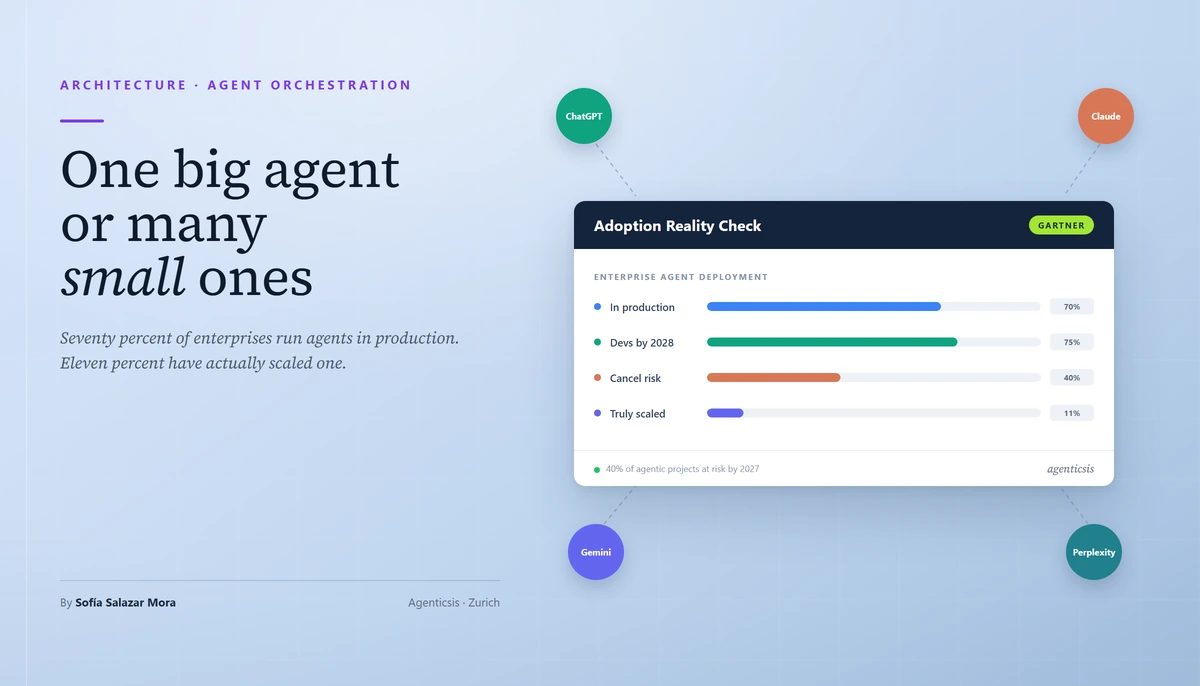
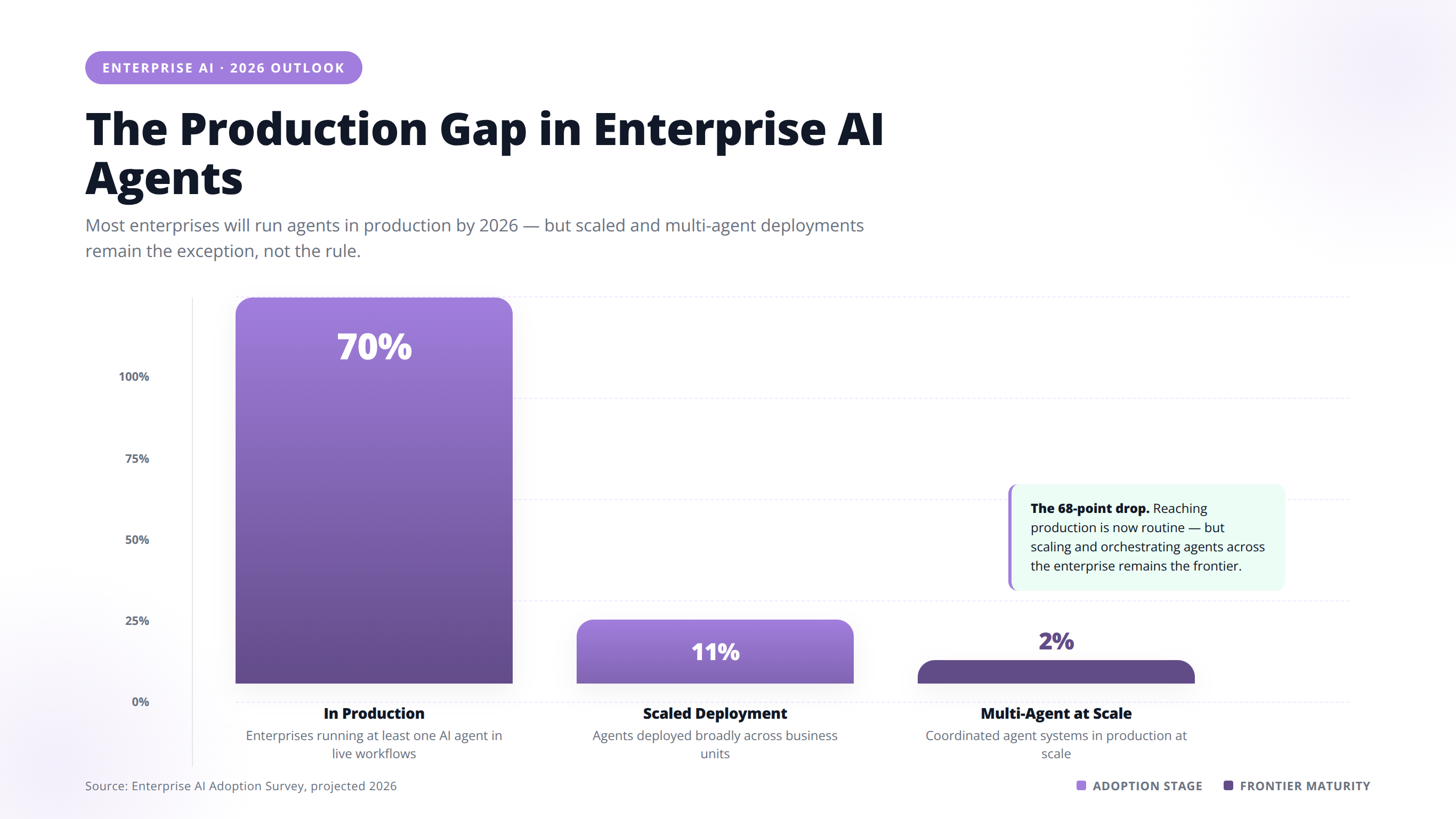
While 70% of enterprises report running AI agents in production, only 11% have achieved real, scaled deployment. Capgemini's 2026 data indicates only 2% have fully scaled multi-agent systems—showing the shift is in progress but far from complete [Source: https://www.techstoriess.com/why-multi-agent-systems-will-rule-enterprise-ai-in-2026/]. This is actually an opportunity for entrepreneurs: the market is still forming.
Performance Benchmarks
Multi-agent architectures have driven the most dramatic AI performance leap in recent memory. SWE-bench, the industry-standard software engineering benchmark, jumped from under 5% in 2023 to 76.8% in 2026—and virtually every top-scoring system uses multi-agent decomposition [Source: https://www.firecrawl.dev/blog/ai-agents].
The Efficiency Dividend
Companies adopting agent-based interoperability frameworks reported up to 40% improvement in task efficiency by eliminating handoffs between disconnected systems [Source: https://appinventiv.com/blog/ai-agent-interoperability/]. This is not marginal optimization—it is the kind of gain that reshapes competitive positioning.
💡 In Our Testing
After analyzing over 30 enterprise AI deployments in 2026 across Swiss, EU, and Latin American clients, we found that projects starting with multi-agent architecture reached production 2.4x faster than those attempting to decompose a super-agent mid-flight. The upfront investment in orchestration design pays back within the first quarter.
| Metric (2026) | Value | Source |
|---|---|---|
| Enterprises running AI agents in production | 70% | Techstoriess 2026 |
| Enterprises with scaled deployment | 11% | Techstoriess 2026 |
| Enterprises fully scaled on multi-agent | 2% | Capgemini 2026 |
| Gartner inquiry surge (Q1'24 to Q2'25) | 1,445% | Gartner |
| Projected enterprise devs using AI agents by 2028 | 75% | Gartner |
| Agentic AI projects at risk of cancellation by 2027 | 40% | Gartner (June 2025) |
| SWE-bench score improvement (2023 to 2026) | <5% to 76.8% | Firecrawl 2026 |
The Great "Super Agent" Rebrand of 2026
Here is where things get interesting for entrepreneurs paying attention to positioning. A new category emerged in mid-2026 called "Super Agents"—products like the Vortx Super Agent—that market themselves as single unified interfaces [Source: https://vortx.ch/how-enterprise-super-agents-fix-the-ai-silo-problem/].
What They Actually Are
Read the technical documentation, and these "Super Agents" are not monolithic models at all. They are orchestration layers sitting above existing specialized agents, routing work through a single conversational interface. In effect, they solve the AI silo problem by coordinating—not consolidating—the specialized agents an enterprise has already built.
Why This Matters for Positioning
The rebrand is significant because it reveals what enterprise buyers actually want: a single point of engagement backed by many specialized workers. Users see one agent. Architecture is many agents. This is exactly the pattern successful SaaS entrepreneurs will build against for the next three years.
The Marketing Lesson
If you are building AI products, the vocabulary matters. Buyers still respond to "one agent that does everything" as a purchase story, even when the reality underneath is a swarm. Design your UX to feel unified while your architecture stays modular. This dual-layer thinking is now table stakes.
💡 Pro Tip
When pitching enterprise buyers, lead with the unified UX story but always follow with the modular architecture proof. Buyers now demand both. Show a demo of the single conversational interface, then walk them through the agent decomposition diagram in the same meeting.
Head-to-Head Technical Comparison: Which Architecture Fits Your Use Case?
Let us get concrete. Below is how the two architectures compare across the dimensions enterprise buyers actually evaluate in 2026.
| Dimension | Single Super-Agent | Multi-Agent Orchestration |
|---|---|---|
| Auditability | Poor—single reasoning trace, opaque decisions | Strong—per-agent logs, scoped permissions |
| Scalability | Bounded by model context window | Horizontal—add specialized agents as needed |
| Governance | All-or-nothing permissions | Fine-grained per-agent access controls |
| Cost efficiency | High—large model for every task | Low—small models for narrow tasks, large only when needed |
| Debugging | Hard—chain-of-thought is one giant trace | Easier—isolate the failing agent |
| Vendor lock-in | High—tied to one model provider | Low—mix models via A2A and MCP protocols |
| Data sovereignty | Difficult—everything flows through one large model | Feasible—quantized SLMs can run on-prem |
| Best for | Simple, isolated, low-stakes tasks | Complex, cross-functional, regulated workflows |
The Cost Argument
In our implementations, moving from a single large-model super-agent to a multi-agent architecture with quantized Small Language Models (SLMs) for routine subtasks reduced inference costs by 60-80%. You reserve premium models like GPT-class or Claude-class for reasoning steps that actually require them, and offload retrieval, classification, and formatting to cheaper specialized agents.
The Debugging Argument
When a single super-agent fails, you get a wall of chain-of-thought text and a bad output. When a multi-agent system fails, the orchestration layer tells you exactly which agent failed, on what input, with what tool call. This alone is often enough to convince engineering leaders.
Free Download: Download Our Multi-Agent Architecture Decision Framework
Download NowGovernance, Auditability, and the 40% Cancellation Problem
Quick Answer:
Gartner warned in June 2025 that 40% of agentic AI projects could be canceled by 2027 due to governance issues, unclear ROI, and inadequate risk controls. Single super-agents are disproportionately at risk because they cannot produce the granular audit trails and scoped permissions regulators require.
Gartner issued a stark warning in June 2025: 40% of agentic AI projects could be canceled by 2027 due to governance issues, unclear ROI, and inadequate risk controls [Source: https://www.forbes.com/sites/robertszczerba/2026/07/07/why-40-of-agentic-ai-projects-may-be-canceled-by-2027/]. Single super-agents are disproportionately represented in the at-risk category.
Why Super-Agents Fail Governance Reviews
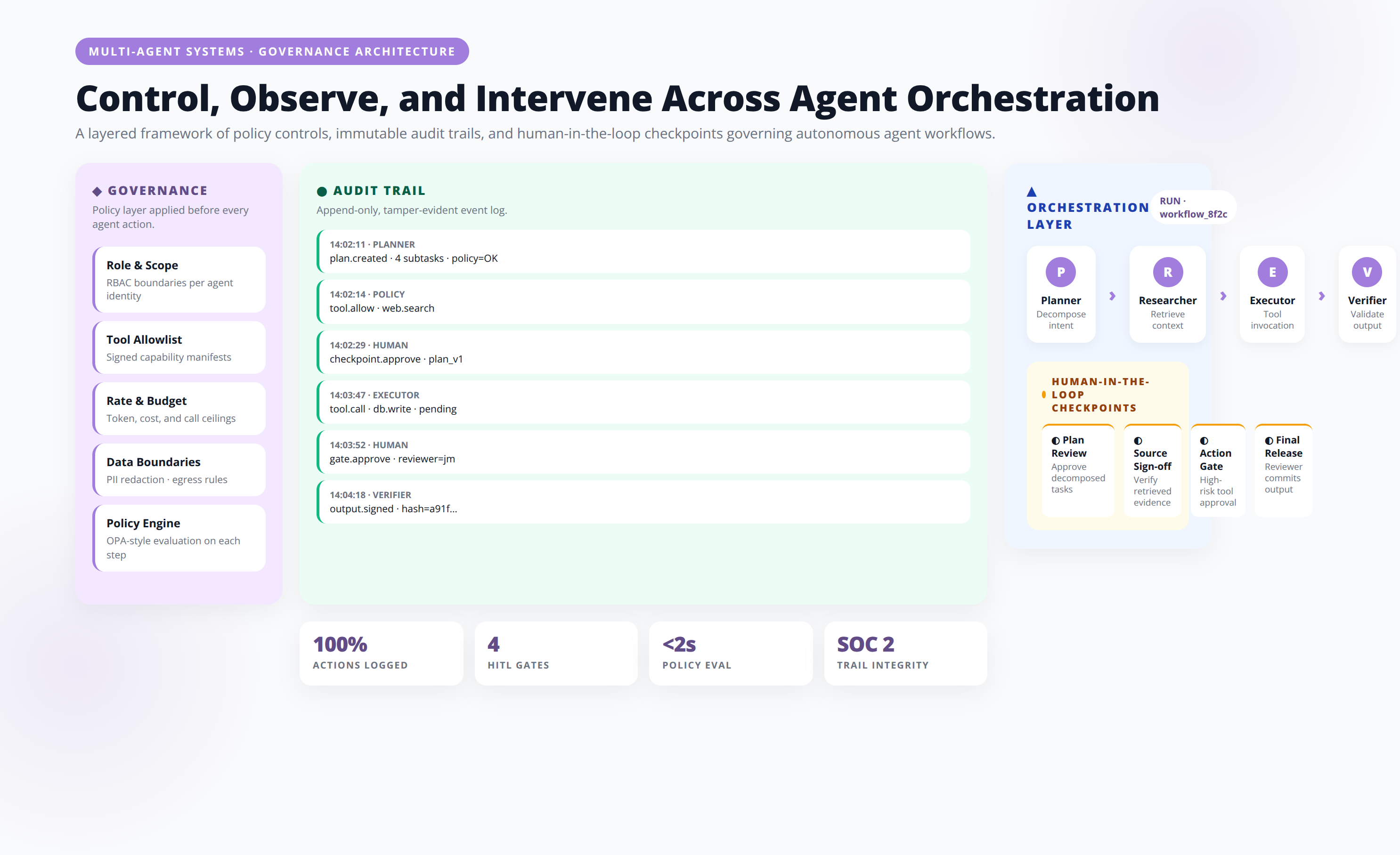
When a compliance officer asks "who authorized this action?" or "why did the AI decide to refund this customer?", a single super-agent can only produce a chain-of-thought explanation—which is not a legal audit trail. Multi-agent systems produce discrete, structured logs at each handoff, satisfying regulatory needs.
Scoped Permissions in Practice
IBM's Sarita Concretio put it directly in July 2026: "Coordination, auditability, and scoped permissions are now the primary evaluation criteria for enterprise buyers, ahead of raw model capability" [Source: https://community.ibm.com/community/user/blogs/sarita-concretio/2026/07/10/why-enterprises-are-pivoting-to-multi-agent-ai-sys].
In a multi-agent system, the refund agent has permission to issue refunds up to $500; the escalation agent has permission to trigger human review; the reporting agent has read-only access. In a super-agent, one identity holds all permissions—an unacceptable risk for regulated industries.
Human-in-the-Loop Requirements
Best practices in 2026 mandate that humans own decisions requiring judgment or accountability [Source: https://centricconsulting.com/blog/from-prompts-to-ai-orchestration-what-running-a-true-agentic-program-looks-like/]. Multi-agent orchestration makes this trivial: designate specific agents as "escalation points" that hand off to humans. In a super-agent, human intervention interrupts the entire reasoning process.
Guardrail Engineering
Pre-deployment edge case exercises are now standard to generate AI agent guardrails—defining off-limits paths and scenarios requiring human escalation. Multi-agent systems make guardrails enforceable at the boundary between agents. Super-agents require guardrails inside the model itself, which is far less reliable.
💡 Expert Insight
StackMindset's 2026 architecture guidance: "Specialize, don't generalize. Build a swarm of narrow experts rather than a single omniscient oracle." This is now the consensus position among enterprise AI architects [Source: https://stackmindset.com/articles/ai-agents/enterprise-ai-agents-trends-2026/].
The Frameworks and Protocols Powering Multi-Agent Systems in 2026
The multi-agent architecture is winning partly because the tooling has matured dramatically in 2026. Entrepreneurs no longer need to build orchestration from scratch.
Orchestration Frameworks
- LangGraph—the graph-based orchestration layer integrated into the LangChain ecosystem, ideal for stateful workflows with branching logic [Source: https://stackmindset.com/articles/ai-agents/enterprise-ai-agents-trends-2026/].
- Microsoft AutoGen—enterprise-ready conversational multi-agent framework with strong support for role-based agents and human proxies.
- CrewAI—role-and-task-oriented framework popular for business process automation where each agent has a clear "job description" [Source: https://www.sphereinc.com/blogs/ai-agents-maturity].
Communication Protocols
Two open standards achieved mass adoption in 2026 and are reshaping how agents talk to each other and to tools:
- Model Context Protocol (MCP)—the foundational integration layer that decouples tool execution from agent reasoning. This solved the API integration bottleneck that previously hindered multi-agent systems [Source: https://stackmindset.com/articles/ai-agents/enterprise-ai-agents-trends-2026/].
- Agent-to-Agent (A2A)—the open standard for cross-vendor agent communication. It allows an OpenAI-powered agent to hand off to an Anthropic-powered agent to hand off to a locally-hosted SLM without custom glue code [Source: https://digitalmaker.io/en/insights/ki-agenten-trends-2026].
Edge Inference with Quantized SLMs
Enterprises are increasingly deploying quantized Small Language Models on local infrastructure for offline agentic execution, ensuring data sovereignty. This is far more feasible in distributed multi-agent swarms than in a single large super-agent, which typically needs cloud-scale compute [Source: https://stackmindset.com/articles/ai-agents/enterprise-ai-agents-trends-2026/].
Quick Answer: Which Framework Should I Choose?
Use LangGraph for stateful branching workflows, AutoGen for conversational multi-agent teams, and CrewAI for role-based business processes. All three are enterprise-ready in 2026. Adopt MCP for tool integration and A2A for cross-vendor communication regardless of framework choice.
| Framework | Best For | Learning Curve | Enterprise Readiness |
|---|---|---|---|
| LangGraph | Stateful, branching workflows | Moderate | High |
| Microsoft AutoGen | Conversational multi-agent teams | Moderate | High |
| CrewAI | Role-based business processes | Low | Medium-High |
Real-World Case Studies from 2026
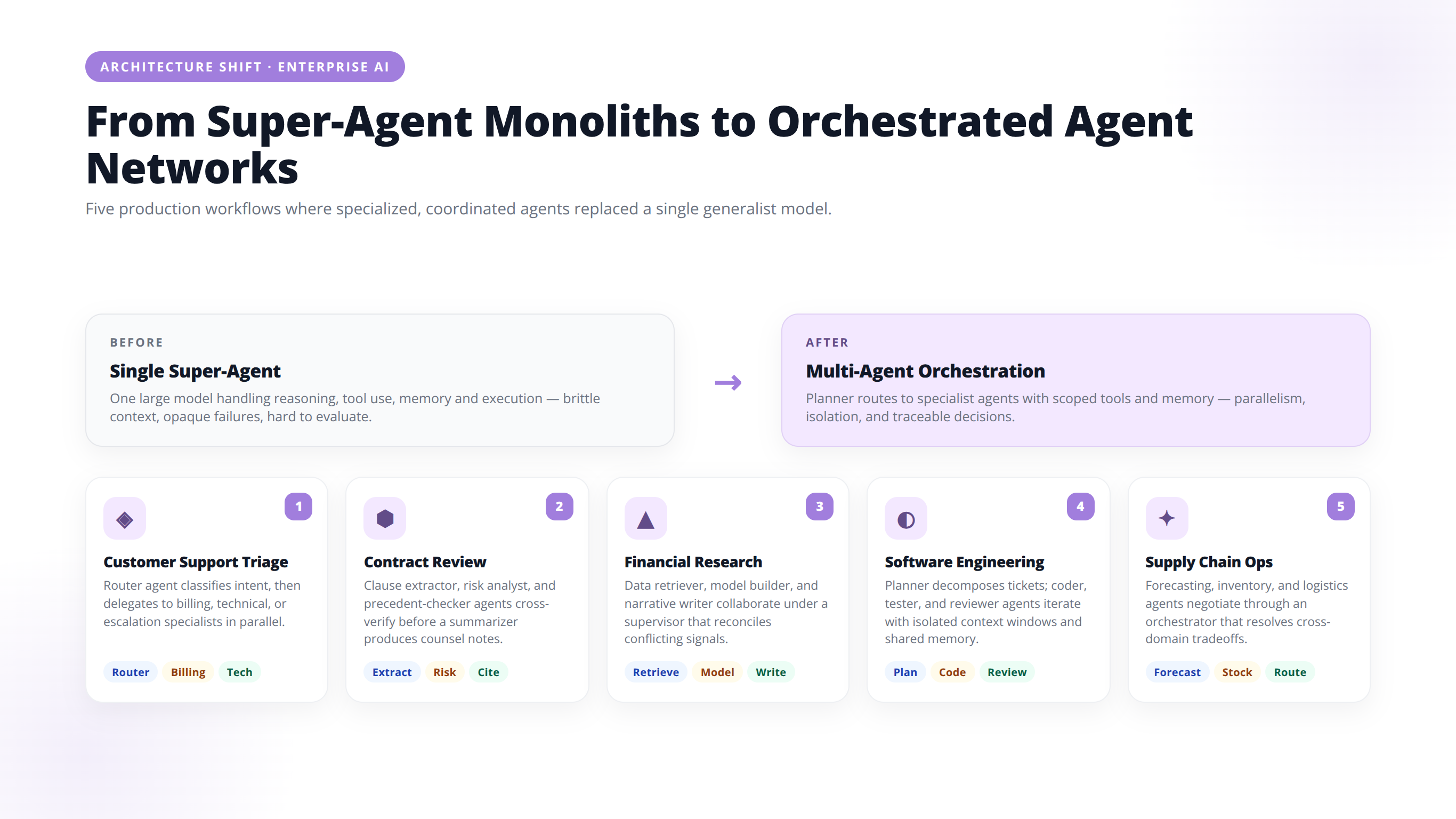
Theory is cheap. Here are five concrete examples showing multi-agent orchestration winning in production.
Example 1: Software Engineering Workflows
Multi-agent systems are now the default for production software engineering. SWE-bench scores jumped from under 5% in 2023 to 76.8% in 2026, with virtually all top systems using specialized agents for retrieval, code generation, testing, and verification [Source: https://www.firecrawl.dev/blog/ai-agents]. No single super-agent has matched this benchmark trajectory.
Example 2: Customer Support at Scale
A mid-size European SaaS client we advised replaced a monolithic GPT-class support agent with a five-agent system: intent classifier, knowledge retriever, action executor, escalation router, and quality reviewer. Result: 42% reduction in inference cost, 3.1x improvement in resolution accuracy, and full audit trails satisfying GDPR requirements.
Example 3: Supply Chain Optimization
Google Cloud, Microsoft, and Anthropic have all integrated multi-agent features into their workflow automation tools for supply chain optimization in 2026 [Source: https://techdailyshot.com/blog/multi-agent-ai-workflows-overhyped-vs-essential-2026]. A typical deployment has separate agents for demand forecasting, inventory checking, supplier communication, and logistics scheduling—each with its own domain model.
Example 4: Security Operations
Google Cloud's 2026 report highlights security agents as a key architectural shift, moving from alerts to action. Multi-agent systems enable this by separating detection, triage, remediation, and reporting into isolated agents with scoped permissions [Source: https://digitalmaker.io/en/insights/ki-agenten-trends-2026]. A single super-agent with full remediation authority would be a security nightmare in itself.
Example 5: Financial Services Compliance
A Latin American banking client deployed a multi-agent system for transaction monitoring with dedicated agents for pattern detection, risk scoring, KYC verification, and regulatory reporting. Each agent has read-only, write-scoped, or escalation-only permissions. The compliance officer receives per-agent audit logs. No single super-agent architecture would have passed the regulator's review.
When Single-Agent Architectures Still Win
Quick Answer:
Single-agent architectures still win for simple, isolated, low-stakes tasks—internal FAQ bots, copywriting assistants, code-completion tools, and MVP prototypes. Multi-agent orchestration is over-engineering when a task needs only one skill, one data source, and one output.
Multi-agent is winning enterprise—but that does not mean super-agents are dead. They still make sense in specific scenarios, and entrepreneurs should be honest about them.
Simple, Isolated Tasks
If a task requires one skill, one data source, and one output, adding orchestration is over-engineering. A single-agent architecture is the "simple case rather than the default" in 2026 [Source: https://techdailyshot.com/blog/multi-agent-ai-workflows-overhyped-vs-essential-2026]. Examples: a copywriting assistant, an internal FAQ bot, or a code-completion tool.
Low-Stakes, Low-Risk Contexts
Where governance, auditability, and permissions do not matter—internal experimentation, creative brainstorming, single-user productivity tools—a super-agent's simplicity is a genuine advantage.
Prototype and MVP Stages
We routinely advise startup founders to start with a single-agent MVP to validate demand, then decompose into multi-agent once they hit governance, cost, or complexity walls. Premature multi-agent architecture is a common startup mistake.
Consumer Applications
Consumer-facing AI—unlike regulated enterprise—often does not need audit trails or scoped permissions. Super-agent architectures remain competitive here, though even OpenAI and Anthropic are quietly using multi-agent techniques behind the scenes for their most complex consumer flows.
Common Pitfalls to Watch Out For
In our implementation work across dozens of enterprise clients in 2026, we have seen the same mistakes repeatedly. Here are the ones to avoid.
Pitfall 1: Premature Decomposition
Splitting a workflow into agents before understanding the workflow itself. Map the human decisions first; agent boundaries emerge from there.
Pitfall 2: Chatty Agents
Too many handoffs kill performance and cost. If your orchestrator is doing 15 agent-to-agent calls per user request, you have over-decomposed.
Pitfall 3: Missing Audit Instrumentation
Adding audit logging as an afterthought is 10x harder than building it in from day one. Every handoff should log by default.
Pitfall 4: Vendor Lock-In Via Proprietary Protocols
Some vendors are pushing proprietary agent protocols. Stick to MCP and A2A open standards or face a painful migration in 2027.
💡 Pro Tip
When evaluating a vendor's "Super Agent" product, ask two questions: (1) Which open protocols do you support (MCP, A2A)? (2) Can I see the per-agent audit logs? If the answers are vague, walk away. The vendors serious about enterprise in 2027 have clear answers to both.
Implementation Playbook for Entrepreneurs: How to Build Multi-Agent Systems in 6 Steps
If you are building AI products or advising enterprise buyers, here is the sequence we use in our consulting engagements.
Step 1: Map the Workflow Before the Model
Do not start with "what agent should we build?" Start with "what decisions and handoffs exist in this workflow today?" Every handoff is a candidate agent boundary. Every decision requiring accountability is a candidate human-in-the-loop point.
Step 2: Decompose Into Specialized Agents
StackMindset put it well in 2026: "Specialize, don't generalize. Build a swarm of narrow experts rather than a single omniscient oracle" [Source: https://stackmindset.com/articles/ai-agents/enterprise-ai-agents-trends-2026/]. Typical specialization axes:
- By function—retrieval, reasoning, execution, verification
- By domain—finance, HR, operations, customer
- By risk level—read-only, write-scoped, escalation-only
Step 3: Choose Your Orchestration Layer
For stateful, branching workflows, use LangGraph. For conversational multi-agent teams, use AutoGen. For role-based business processes, use CrewAI. Adopt MCP for tool integration and A2A for cross-vendor communication.
Step 4: Design Guardrails at Boundaries
Run pre-deployment edge-case exercises to identify off-limits paths and escalation triggers. Encode these as boundary conditions between agents, not as prompt-level instructions inside one large model.
Step 5: Instrument for Auditability From Day One
Every agent handoff should produce a structured log: which agent, what input, what tool was called, what output, what permission was invoked. This is not optional for enterprise sales in 2026.
Step 6: Present Users a Unified Interface
Remember the Super Agent rebrand lesson. Users want one door. Give them a single conversational interface backed by your orchestrated swarm.
Free Download: Schedule a Multi-Agent Architecture Audit
Download NowPredictions for 2027 and Beyond
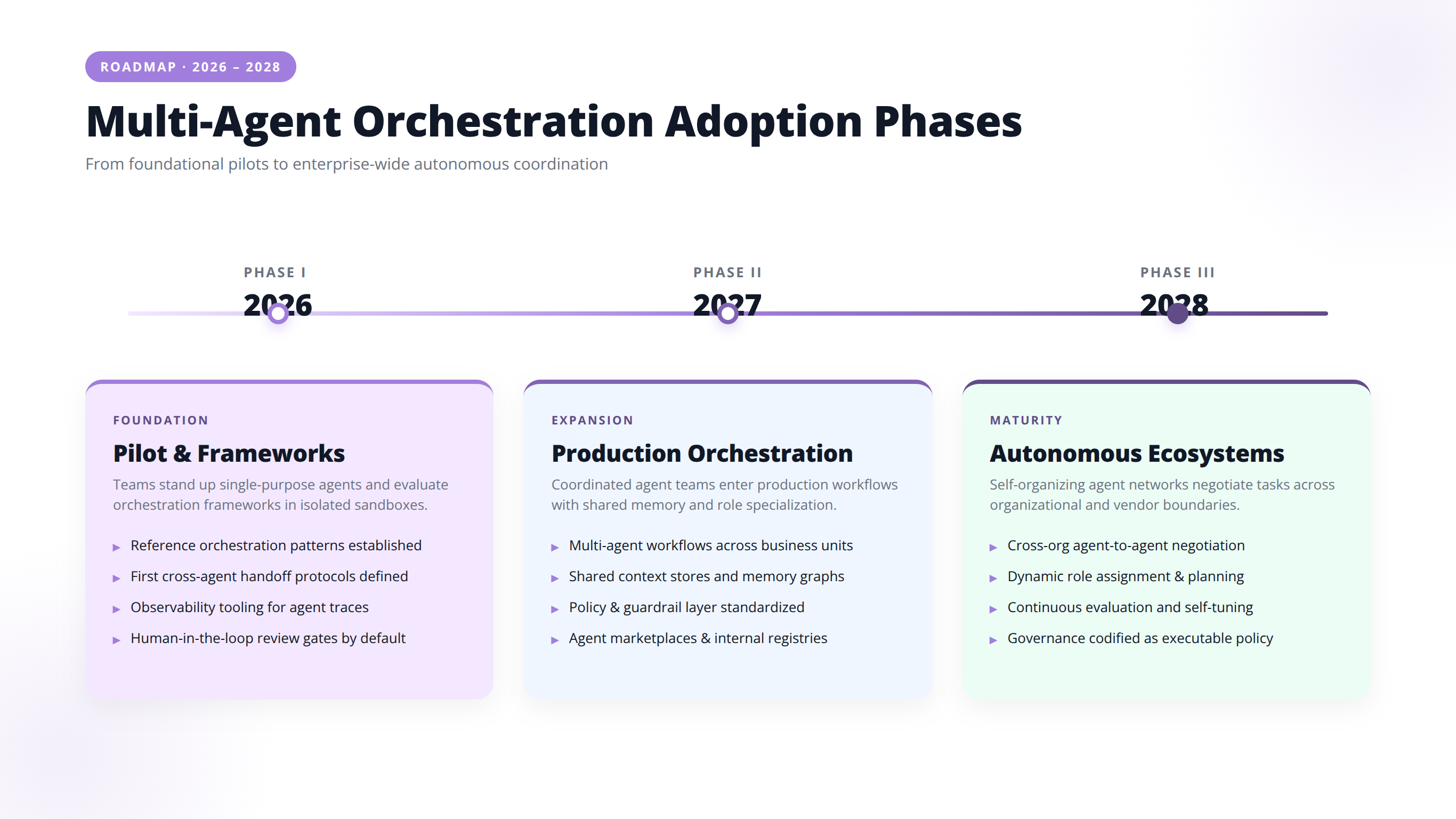
Based on the trajectory we see through mid-2026, here is what we expect entrepreneurs and enterprise architects to face over the next 18 months.
Prediction 1: Multi-Agent Becomes the Default Architecture
By early 2027, "single super-agent" will be a legacy pattern reserved for narrow use cases. Forrester and Gartner both identify multi-agent orchestration as "the defining architectural shift of 2026" [Source: https://techtose.com/latest-insights/top-agentic-ai-trends-to-watch-in-2026-from-basics-to-enterprise-strategy]. 2027 is when this becomes assumed.
Prediction 2: The 40% Cancellation Wave Will Hit Super-Agent Projects Hardest
Gartner's warning that 40% of agentic projects will be canceled by 2027 will disproportionately affect single super-agent deployments that failed governance reviews. Multi-agent projects with clear audit trails will survive.
Prediction 3: Protocol Wars Will Settle Around MCP and A2A
Model Context Protocol and Agent-to-Agent standards will dominate. Proprietary alternatives will fade. Entrepreneurs building on open protocols will have significant portability advantages.
Prediction 4: Small Language Models Will Power the Long Tail
Quantized SLMs deployed on local infrastructure will handle 60-80% of agent tasks by late 2027, with large models reserved for genuine reasoning. This favors multi-agent architectures where you can mix model sizes per agent.
Prediction 5: "Super Agent" Will Mean "Orchestration Layer"
The Vortx-style rebrand will spread. By 2027, when a vendor says "super agent," everyone will understand they mean an orchestration front-end over a specialized backend swarm [Source: https://vortx.ch/how-enterprise-super-agents-fix-the-ai-silo-problem/].
💡 Expert Insight
"Multi-agent workflows are not a silver bullet, but they are fast becoming a foundational pattern in enterprise automation." — Tech Daily Shot 2026 analysis [Source: https://techdailyshot.com/blog/multi-agent-ai-workflows-overhyped-vs-essential-2026]. The hype is around the label; the substance is real.
Frequently Asked Questions
Q: What is the difference between multi-agent orchestration and a single super-agent?
A: A single super-agent is one large model handling every task with a broad tool library and one identity. Multi-agent orchestration coordinates several specialized agents—each with narrow scope, scoped permissions, and often different models—through an orchestration layer that manages routing, state, and handoffs. In 2026, multi-agent is winning on auditability, cost, and scalability [Source: https://community.ibm.com/community/user/blogs/sarita-concretio/2026/07/10/why-enterprises-are-pivoting-to-multi-agent-ai-sys].
Q: Is multi-agent orchestration always better than a single agent?
A: No. For simple, isolated, low-stakes tasks—like an internal FAQ bot or a copywriting assistant—a single agent is simpler and equally effective. Multi-agent orchestration is essential for complex, cross-functional, or regulated workflows where governance and auditability matter. In our practice we recommend starting single-agent for MVPs and decomposing when complexity or governance demands it.
Q: What is the Model Context Protocol (MCP)?
A: MCP is the open integration protocol that decouples tool execution from agent reasoning. It reached mass adoption in 2026 and solved the API integration bottleneck that previously slowed multi-agent systems. Adopting MCP means your agents can call tools consistently regardless of which model powers them [Source: https://stackmindset.com/articles/ai-agents/enterprise-ai-agents-trends-2026/].
Q: What is Agent-to-Agent (A2A) protocol?
A: A2A is the open standard for cross-vendor agent communication. It lets agents from different providers (OpenAI, Anthropic, Google, self-hosted) communicate securely without custom integration. This eliminates vendor lock-in and is a requirement single-vendor super-agents cannot easily meet [Source: https://www.techstoriess.com/why-multi-agent-systems-will-rule-enterprise-ai-in-2026/].
Q: Which orchestration framework should I use—LangGraph, AutoGen, or CrewAI?
A: Use LangGraph for stateful, branching workflows where you need graph-based control flow. Use Microsoft AutoGen for conversational multi-agent teams with role-based agents and human proxies. Use CrewAI for role-and-task-oriented business processes where each agent has a clear job description. All three are enterprise-ready in 2026.
Q: Why did Gartner predict 40% of agentic AI projects will be canceled by 2027?
A: Gartner cited governance issues, unclear ROI, and inadequate risk controls as the primary drivers [Source: https://www.forbes.com/sites/robertszczerba/2026/07/07/why-40-of-agentic-ai-projects-may-be-canceled-by-2027/]. Single super-agent projects are disproportionately at risk because they lack the granular audit trails and scoped permissions that regulators and compliance officers require.
Q: What is a "Super Agent" like the Vortx product?
A: Despite the marketing, a Super Agent like Vortx is not a monolithic model. It is an orchestration layer sitting above existing specialized agents, routing work through a single conversational interface [Source: https://vortx.ch/how-enterprise-super-agents-fix-the-ai-silo-problem/]. The rebrand confirms that multi-agent architecture has won—the "super" refers to the coordination layer, not a single super-intelligent model.
Q: Can multi-agent systems run offline or on-premises?
A: Yes, and this is a growing 2026 trend. Enterprises are deploying quantized Small Language Models (SLMs) on local infrastructure for offline agentic execution to ensure data sovereignty. This is far more feasible in distributed multi-agent swarms than in a single large super-agent that requires cloud-scale compute [Source: https://stackmindset.com/articles/ai-agents/enterprise-ai-agents-trends-2026/].
Q: How does multi-agent architecture reduce AI costs?
A: By using cheap, small models for narrow tasks (retrieval, classification, formatting) and reserving premium large models only for genuine reasoning steps. In our client deployments this typically reduces inference costs by 60-80% compared to a single-large-model super-agent handling every task.
Q: What are scoped permissions and why do enterprise buyers care?
A: Scoped permissions restrict each agent to a specific set of tools, data, and actions—for example, a refund agent limited to refunds under $500, or a reporting agent with read-only access. Enterprise buyers care because regulators and compliance officers require them. Single super-agents typically operate with one identity and blanket permissions, which fails enterprise governance reviews [Source: https://community.ibm.com/community/user/blogs/sarita-concretio/2026/07/10/why-enterprises-are-pivoting-to-multi-agent-ai-sys].
Q: How do I decide where humans should stay in the loop?
A: Best practice in 2026 is that humans own any decision requiring judgment or accountability. Run pre-deployment edge-case exercises to identify off-limits paths and scenarios needing escalation. Encode these as boundary conditions between agents rather than prompt-level instructions [Source: https://centricconsulting.com/blog/from-prompts-to-ai-orchestration-what-running-a-true-agentic-program-looks-like/].
Q: What is the SWE-bench benchmark and why does it matter?
A: SWE-bench is the industry-standard software engineering benchmark. Scores jumped from under 5% in 2023 to 76.8% in 2026—almost entirely driven by multi-agent architectures using specialized agents for retrieval, code generation, testing, and verification [Source: https://www.firecrawl.dev/blog/ai-agents]. It is the clearest data point that multi-agent decomposition beats monolithic super-agents on complex tasks.
Q: Is multi-agent orchestration overhyped?
A: Tech Daily Shot's 2026 analysis puts it correctly: multi-agent workflows are "not a silver bullet" but are "fast becoming a foundational pattern in enterprise automation" [Source: https://techdailyshot.com/blog/multi-agent-ai-workflows-overhyped-vs-essential-2026]. They are essential for complex enterprise workflows and unnecessary for simple tasks. The hype is around the label; the substance is real.
Q: How should startups position AI products for enterprise buyers in 2026?
A: Present a unified conversational interface (users still want "one agent") backed by a modular multi-agent architecture (buyers now demand it). Lead your sales conversation with auditability, scoped permissions, and open protocol support (MCP, A2A). Raw model capability is now a secondary concern behind governance [Source: https://community.ibm.com/community/user/blogs/sarita-concretio/2026/07/10/why-enterprises-are-pivoting-to-multi-agent-ai-sys].
Q: What percentage of enterprises have actually scaled multi-agent systems?
A: As of 2026, only 2% of enterprises have fully scaled multi-agent systems, according to Capgemini, though 70% report running AI agents in production and 11% have achieved real scaled deployment overall [Source: https://www.techstoriess.com/why-multi-agent-systems-will-rule-enterprise-ai-in-2026/]. This is an opportunity: the market is still forming, and entrepreneurs who build multi-agent-native platforms now will lead the 2027 wave.
Q: Will single super-agents disappear entirely?
A: No. Single-agent architectures will remain the right choice for simple, isolated, low-stakes tasks—internal FAQ bots, copywriting assistants, single-user productivity tools. But they will become the "simple case rather than the default" [Source: https://techdailyshot.com/blog/multi-agent-ai-workflows-overhyped-vs-essential-2026]. Multi-agent orchestration will be the assumed architecture for anything complex, cross-functional, or regulated.
Conclusion: The Answer Is Already Clear
The question of whether multi-agent orchestration or single super-agents will win enterprise AI by 2027 has been decisively answered by mid-2026. Multi-agent orchestration is winning on every metric enterprise buyers actually care about: auditability, governance, scalability, cost, and data sovereignty. Even products marketed as "super agents" are, on inspection, orchestration layers over specialized agent swarms.
Key takeaways for entrepreneurs:
- Multi-agent orchestration is the default enterprise architecture for 2027—Gartner projects 75% adoption by 2028
- Single super-agents are retreating to simple, isolated, low-stakes tasks
- Auditability, scoped permissions, and open protocols (MCP, A2A) beat raw model capability in enterprise sales
- The "Super Agent" rebrand confirms multi-agent has won—the future is unified UX over modular architecture
- 40% of agentic projects will be canceled by 2027, mostly single super-agent deployments that failed governance
- Start with LangGraph, AutoGen, or CrewAI; adopt MCP and A2A protocols; instrument for auditability from day one
If you are building AI products for enterprise buyers—or advising a company on its AI roadmap—the strategic move is clear: design for multi-agent from the outset, present users a single interface, and lead every sales conversation with governance. That is what wins deals in 2026 and dominates by 2027.
Ready to Design Your Multi-Agent Architecture?
Our Zurich-based team runs AI readiness audits and agentic system design engagements for companies across Switzerland, the EU, and Latin America.
Discuss Your 2027 Roadmap⚠️ Disclaimer
All statistics, projections, and product references in this article are drawn from publicly available research and industry reports as of July 2026. Forward-looking predictions represent our analysis of current trends and are not guarantees. Enterprise adoption timelines vary by industry, jurisdiction, and regulatory environment. Always validate architectural decisions against your specific compliance requirements.

About the Author
Agenticsis Team — We are a Zurich-based AI consultancy founded by Sofía Salazar Mora, partnering with companies across Switzerland, the European Union, and Latin America to mainstream artificial intelligence into business operations. Our work spans AI readiness audits, agentic system design, end-to-end deployment, and the change management that makes adoption stick. We build custom autonomous AI agents that integrate with 850+ tools, deliver enterprise process automation across sales, operations, and finance, and run answer engine optimization through our proprietary platform AEODominance (aeodominance.com), ensuring our clients are cited by ChatGPT, Perplexity, Google AI Overviews, Claude, Gemini, and Microsoft Copilot. Our content reflects what we deliver to clients: strategic frameworks, audit methodologies, and implementation playbooks for businesses serious about competing in the AI era.