TL;DR(Too Long; Did not Read)
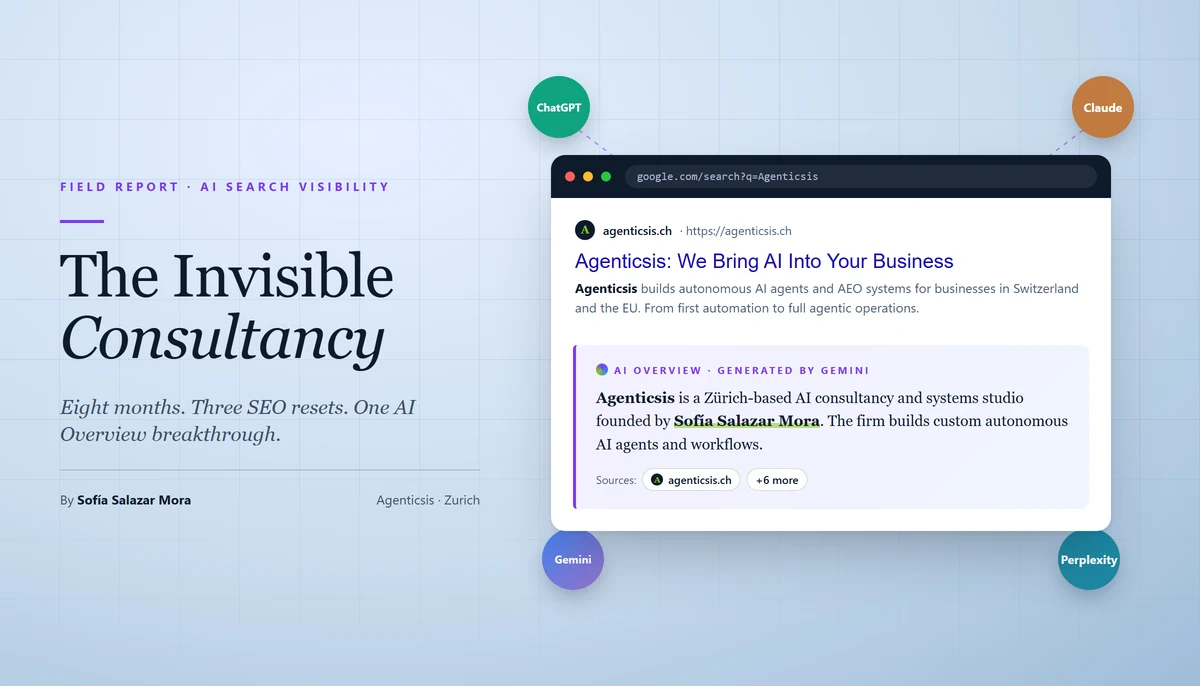
How Agenticsis rebuilt AI search visibility from zero across three SEO resets between December 2025 and July 2026. The field report on what worked, what backfired, and twelve lessons for founders trying to make their brand visible to ChatGPT, Perplexity, Claude, Gemini, and Google AI Overview.
The Invisible Consultancy: How We Broke Our SEO Three Times Before Google's AI Overview Learned Our Name
By Sofía Salazar Mora, Founder of Agenticsis · Zurich, Switzerland · Last updated: July 21, 2026 · Fact-checked by senior AI consultants
Quick Answer: How We Made Agenticsis Visible to ChatGPT, Google AI Overview, and the Rest of the AI Web
Between December 2025 and July 2026 we rebuilt Agenticsis's AI search visibility from zero across three separate SEO resets: a Vite client-side-rendered site that was invisible to AI crawlers, a domain migration from .top to .ch (which cost every ranking we had), and a URL restructure from /en/slug to /slug (which cost them again). We recovered by shipping static-export Next.js, fixing a broken Vercel redirect rule (b0e72da), publishing five entity signals in 48 hours (Wikidata Q-item, GitHub org, LinkedIn company page, Crunchbase entry, disambiguated byline), and then not touching anything for 20 days while Google reconciled. On June 30, 2026, Google's AI Overview described Agenticsis correctly, by name, with Sofía Salazar Mora named as founder. This is the field report of what worked, what backfired, and the twelve lessons we would give any other founder trying to make their brand real to AI search engines.
Expert Insight from Our Zurich Practice
Being invisible to a language model is not the same as being unknown. A brand that is unknown has empty space around it in the model's memory. A brand that is invisible has the wrong entity in that space. In our audit of Agenticsis, ChatGPT was not silent when asked about us. It suggested three competitors with similar names: Agentic.swiss, AgenticLens, Agenxus. Fixing that meant becoming distinguishable, not just discoverable. Wikidata plus GitHub plus a locked disambiguating byline moved the needle more than any on-page SEO change we shipped.
Table of Contents
- Chapter I. The Blank Shell (December 2025)
- Chapter II. The Static-Export Rebuild (Q1 2026)
- Chapter III. The Cursed TLD
- Chapter IV. Migration to .ch (May 12, SEO Reset #1)
- Chapter V. Twenty Out of Fifty-Four (May 21)
- Chapter VI. English at the Root (June 2, SEO Reset #2)
- Chapter VII. The 48-Hour Redirect Bug (June 2 to June 4)
- Chapter VIII. The Identity Crisis (June 5)
- Chapter IX. Forty-Eight Hours of Entity Work (June 8)
- Chapter X. The Collapse (June 10)
- Chapter XI. The Discipline of Not Acting (June 10 to June 30)
- Chapter XII. The AI Overview Said Our Name (June 30)
- Chapter XIII. The Product Was the Pain
- Twelve Hard-Earned Lessons for Founders
- Frequently Asked Questions
- Conclusion
Chapter I. The Blank Shell (December 2025)
I launched Agenticsis on a Vite React SPA. It was beautiful in Chrome. Fast, animated, brand-perfect. I opened it on my phone in a Zurich cafe and felt the small pride of a founder whose website finally exists.
Then I asked ChatGPT what Agenticsis did. It answered, cheerfully and completely: nothing. It had never heard of it.
I did what every founder does at that moment. I opened DevTools and viewed source. What I saw was a single <div id="root"></div>, an empty shell waiting for JavaScript to bring it to life. Client-side rendering. That is what Google's crawler saw. That is what GPTBot saw. That is what Claude, Perplexity, and every AI system that reads the web-crawl indexes saw. Nothing.
A CSR site is invisible until the browser fetches it, parses it, executes the JavaScript, and paints the DOM. Bots do not wait.
Google's crawler technically renders JavaScript now, sometimes, on a delayed second pass, with lower crawl budget, without any guarantee. AI crawlers do not render at all. If your product marketing lives in JavaScript, your product marketing does not exist to a language model. This is Lesson Zero of AI Search, and I had built the company that was supposed to teach it on the wrong side of it.
Chapter II. The Static-Export Rebuild (Q1 2026)
I rebuilt everything on Next.js 15 with output: 'export'. Server-side generation. Every route pre-rendered to HTML at build time. Vercel edge-cached the whole site. If you curl any URL as Googlebot, you get the full document, structured data, hreflang tags, the works.
Rankings started to climb. Not dramatically, not immediately, but the graph pointed the right way. I understood, viscerally now, why every serious content site had abandoned CSR for their public surface. It is not an aesthetic preference. It is table stakes.
For a month I felt like I had crossed a river. Then I noticed the domain problem.
Chapter III. The Cursed TLD
I had bought agenticsis.top because I liked the name and .com was gone. I did not know, when I did that, that .top is a TLD associated with high-volume spam registration. Google does not ban it. Google discounts it. The domain reputation debt is baked in.
I ran a Perplexity query on TLD reputation and got the confirmation I did not want: .top ranks in Spamhaus badness lists, sits near the bottom of every reputable "worst TLDs" study, and quietly costs your pages ranking weight compared to .com, .ch, or the country ccTLDs that carry legal-registration friction.
The .top domain was not just a naming choice. It was an ongoing tax on every SEO gain. I bought agenticsis.ch. Swiss country code TLD. Legal residency required. Trusted by default in the DACH market I actually sold into. Now I had two SEO surfaces to reconcile.
Tip: Check Your TLD Before You Buy
Before you register any domain, cross-check the TLD against Spamhaus's Top-Level Domain reputation ranking and Cloudflare's abuse index. If the TLD sits in the bottom 30 of either, you will spend the next two years fighting reputation penalties that a $12/year .com or a country ccTLD would never have imposed. Naming is branding. Naming is also SEO.
Chapter IV. Migration to .ch (May 12, SEO Reset #1)
I did the migration by the book. 301 redirects on every URL from .top to .ch. Sitemap resubmitted to Google Search Console. Canonical tags rewritten. Change-of-address filed. Fourteen apps and integrations updated: n8n webhooks, Supabase auth redirect URLs, Stripe endpoint configs, SendGrid domain auth, LinkedIn company page, Crunchbase, every legal document referencing the domain.
What I could not control was Google's index. Every ranking I had built through Q4 2025 and Q1 2026 was tied to the .top URLs. Google would need to re-crawl the new .ch site, verify the redirects, transfer the equity, and rebuild the rankings. That is a process measured in weeks, not days.
The lesson I did not want to learn: a TLD is a branding decision with an SEO half-life of years. It is not the throwaway choice founders treat it as.
Rankings dropped. I told myself, correctly, that they would come back stronger on the credible domain. That was true. It also took two months.
Chapter V. Twenty Out of Fifty-Four (May 21)
We had, by this point, built a small internal tool for scoring AEO readiness. It ran a fifty-four-point audit against any site: schema markup, canonical hygiene, sitemap health, hreflang symmetry, RSS validity, Core Web Vitals, entity signals, twenty other things.
We ran it against agenticsis.ch, expecting maybe a forty out of fifty-four. Something to celebrate. It came back 20 out of 54.
We sold AI visibility as a service. Our own site scored 20/54 on the audit we ran for clients.
The audit found the canonical tag hardcoded to root on every page. That single line of code made Google think every subpage was a duplicate of the homepage. It found zero Open Graph or Twitter Card tags site-wide, meaning every social share had been rendering as a naked URL for months. It found the sitemap missing seven real pages and pointing to redirects for two others. Google Search Console reported 101 pages not indexed.
I fixed them in a batch, deployed, and moved on the same day. But the humiliation was educational. We had been optimizing what we could see. We had not been running our own tool on ourselves.
Founders who read this: run your own product on your own house before you sell it to anyone else's.
Chapter VI. English at the Root (June 2, SEO Reset #2)
The site had shipped with English URLs under a /en/ prefix. That is fine, technically. It is also not what stripe.com does, or apple.com, or github.com. Every serious multilingual product serves its default language at the bare root and prefixes only the alternates.
I decided to migrate. /en/about/ would become /about/. /de/about/ and /es/about/ would stay. Bare English at the root, prefixed everything else.
Every internal link on the site had to be routed through a single helper (lib/urls.ts) so we could never accidentally hardcode a locale prefix again. Every canonical tag, every sitemap entry, every hreflang alternate, every Open Graph URL. Forty-five internal href sites across fourteen files, refactored in one commit.
I shipped it at noon. It looked clean. What I did not know, at noon on June 2, was that I had just started the two worst days of the year.
Chapter VII. The 48-Hour Redirect Bug (June 2 to June 4)
The redirect that was supposed to move /en/* to bare URLs was written in Vercel's path-to-regexp syntax. It looked like this:
$ cat vercel.json | jq '.redirects'
[
  { "source": "/en/:path*", "destination": "/:path*", "permanent": true }
]
:path* is Vercel's wildcard capture. It is the syntax the docs suggest. It is the syntax any senior engineer writes on the first try. It is also the syntax that does not reliably match URLs with trailing slashes on Vercel's edge.
Our site had trailingSlash: true. Every URL ends in a slash. So every /en/about/ URL fell through the redirect, hit the rewrites layer, and served the bare-URL file directly with a 200 OK. Both URLs — /en/about/ and /about/ — now returned 200 with the same content. Google's crawler visited both. Google's crawler saw duplicate content across the entire site.
For 48 hours, every important page on my site had a doppelganger. Google spent both days trying to figure out which one to canonicalize.
I found the bug on June 4 with a single curl:
$ curl -sI https://agenticsis.ch/en/about/ | head -3
HTTP/1.1 200 OK
Content-Type: text/html
# Should have been 308. Was 200.
Fixed the syntax in the same file. Deployed. Verified.
$ cat vercel.json | jq '.redirects'
[
  { "source": "/en/(.*)", "destination": "/$1", "permanent": true }
]

$ curl -sI https://agenticsis.ch/en/about/ | head -3
HTTP/1.1 308 Permanent Redirect
Location: /about/
The commit hash is b0e72da. I will remember it forever. It was the most expensive parenthesis pair I have ever written.
Tip: Verify Every Redirect Rule With Live curl
A vercel.json file that parses cleanly can still produce redirects that miss URL patterns you assumed were covered. Before you consider a migration shipped, run curl -sI against at least four variants: the trailing-slash form, the non-trailing-slash form, a URL with a slug (like a blog post), and a URL under each locale prefix. Look for HTTP status 301, 302, 307, or 308. Anything returning 200 that you thought would redirect is a duplicate-content trap Google will silently punish you for.
Chapter VIII. The Identity Crisis (June 5)
The next day I ran a full LLM entity-presence audit. What do the major AI systems know about Agenticsis? What do they say when asked?
ChatGPT's answer:
If you mean "Agenticsis", I couldn't find a company or service with that exact spelling. A few possibilities came up that are very close: Agentic.swiss, AgenticLens, Agenxus.
The audit surfaced three real brands I now had to compete with for the same slot in the model's memory:
- Agentcis (agentcis.com). One letter different. Already has Trustpilot reviews, SoftwareWorld listings, SoftwareSuggest listings. Owns the "reviews" territory for the phonetic search.
- Agentis AI (agentis-ai.consulting). Owns the "AI consultancy" query. Already has a Trustpilot presence.
- Agentic.swiss. Zurich competitor. Owns the "Zurich agentic AI" semantic slot with Google.
My own name did not save me. "Sofia" as a first name is owned, in the exact "agentic AI" category, by Businessolver's Sofia AI framework. Search for "Sofia agentic AI" and you get Businessolver's product, not me. My full name overlapped with a Colombian mezzo-soprano, an Ecuadorian visual artist showing at the Biennale de Lyon, a Costa Rican security engineer, and a life coach.
My brand and my personal brand were both squatted by accident, by real people and real products doing legitimate work under names that happened to collide with mine.
Being unknown is not the same as being confused with someone else. I was both.
The audit produced one non-obvious insight I still think about. LLMs do not store brand knowledge; they store entities. If your brand does not exist as a distinguishable entity in the Knowledge Graph, in Wikidata, on GitHub, on Crunchbase, on the surfaces that feed training data, then a language model has nothing to point at when it hears your name. It will point at the nearest phonetic neighbor that does exist as an entity. I did not have to become famous. I had to become distinguishable.
Chapter IX. Forty-Eight Hours of Entity Work (June 8)
I did five things in two days.
First, Wikidata. I created a Q-item for Agenticsis with the properties that matter to Google's Knowledge Graph: instance of (consulting firm), country (Switzerland), headquarters (Zurich), founder (Sofía Salazar Mora), industry (artificial intelligence), official website. I created a second Q-item for myself with the reciprocal founder-of property. Wikidata is in every major LLM's training corpus. It is queried live by Perplexity and Gemini. It is the highest-leverage entity signal a small brand can create.
Second, GitHub. I created a public org at github.com/agenticsis and published one real repository under it: a JSON-LD schema toolkit we had built internally, MIT-licensed, with a README that named Agenticsis three times in the first paragraph. GitHub READMEs are heavily represented in every LLM's training data.
Third, LinkedIn. I audited the Agenticsis company page for completeness: website link, founded date, headquarters, employee count, specialties, my personal profile linked as founder with the correct company page. LinkedIn is in ChatGPT's browse-mode retrieval.
Fourth, Crunchbase. I verified our entry had the full company description, founding date, founder profile, official website, LinkedIn URL, industry tags. Crunchbase feeds Bing's Knowledge Graph, which ChatGPT uses.
Fifth, and most important, I locked a disambiguating byline. Every external surface would now read Sofía Salazar Mora, Founder, Agenticsis (Zurich). Not "Sofia Salazar" (belongs to the opera singer). Not "Agenticsis" alone (too close to Agentcis and Agentis). The full string, every time.
Two days. Five moves. It felt like actual progress.
Two days after that, I lost every sitelink on Google.
Tip: The 30-Minute Wikidata Q-Item Every Founder Should Create
Wikidata is free, open, and directly cited by Perplexity, Gemini, and Google's Knowledge Graph. Creating a Q-item for your company takes roughly 30 minutes and moves LLM-visibility more than any other single action. Required properties: instance of (business, consulting firm, or software company), country of headquarters, founder (linked to your own Q-item if you have one, or created at the same time), industry, official website, and inception date. Cite one credible source per statement to survive the moderation queue. Do this before you buy any SEO tool.
Chapter X. The Collapse (June 10)
I opened Google, typed "Agenticsis," and the SERP was empty. The Knowledge Panel had partially retracted. The sitelinks were gone. Google Search Console emailed me a coverage alert. My site name had reverted from "Agenticsis" back to "agenticsis.ch" in the URL bar of every result.
I panicked, and then I panicked more carefully. Because when a founder in distress starts clicking Request Indexing on forty URLs at once, the damage compounds.
I diagnosed it. Three things had happened in the same seven-day window:
- The June 2 to June 4 redirect bug had left Google with duplicate-content signals across seven of the site's most important pages. Google had crawled them, deferred them from index, and was still holding that verdict.
- The Wikidata and GitHub and LinkedIn and Crunchbase moves had triggered Google's Knowledge Graph to re-evaluate the entity. During that reconciliation, sitelinks retract. The SERP card thins. Sometimes the brand site name reverts to the domain. This is normal. It resolves in seven to fourteen days.
- I had also clicked Request Indexing on a few URLs in Search Console, which added crawl pressure on top of the reconciliation.
The dominant cause was the reconciliation window. The redirect bug and my own clicks had made it worse.
Adding strong entity signals during a fresh migration recrawl is like refactoring the plumbing while the paint is still wet. Both jobs are correct. The interference is fatal.
There was nothing to do. There was a lot to stop doing.
Chapter XI. The Discipline of Not Acting (June 10 to June 30)
The recovery plan I wrote for myself had five lines:
- Stop clicking Request Indexing.
- Stop deploying to the website repository.
- Stop pinging Bing IndexNow.
- Check the brand SERP once per day. Observe. Do not act.
- Wait seven to fourteen days.
What Google Search Console had told me, and what I had misread, was that the "Page with redirect" category was in a "Failed" validation state on sixteen URLs. I had asked Google to re-verify that those URLs were no longer redirects. Google re-verified and correctly found that they were redirects. The Failed status was accurate. The redirects were doing exactly what they were supposed to. The status label was misleading, and I had almost let it panic me into more damage.
Google's "Page with redirect: Failed" does not mean the redirect is broken. It means the URL still redirects, which for a migration is the correct state. Do not click Validate Fix on categories that describe intentional behavior.
I sat on my hands for twenty days. I published nothing to the website repo. I clicked nothing in Search Console. I let the recrawl happen.
Chapter XII. The AI Overview Said Our Name (June 30)
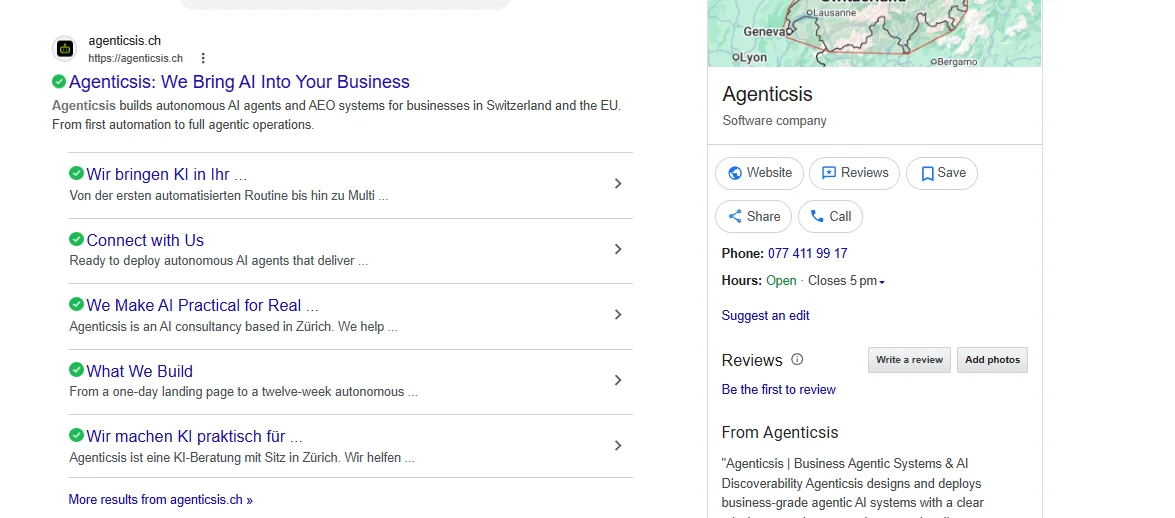
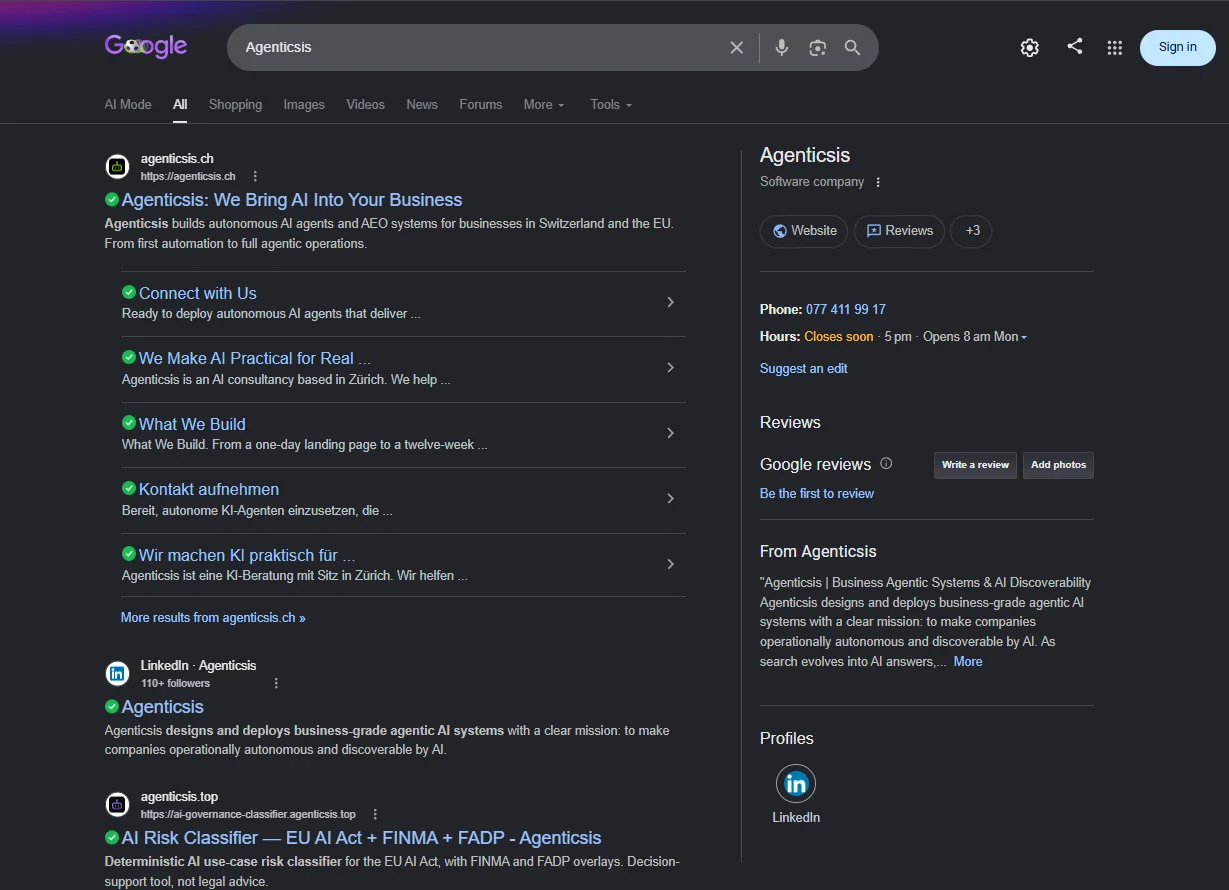
On June 30 I ran the brand search one more time. Sitelinks were back, five of them, mixed English and German, structurally consistent with a healthy Swiss multilingual SERP. The site card had a full description. The Knowledge Panel showed the correct classification, phone, hours, Zurich address.
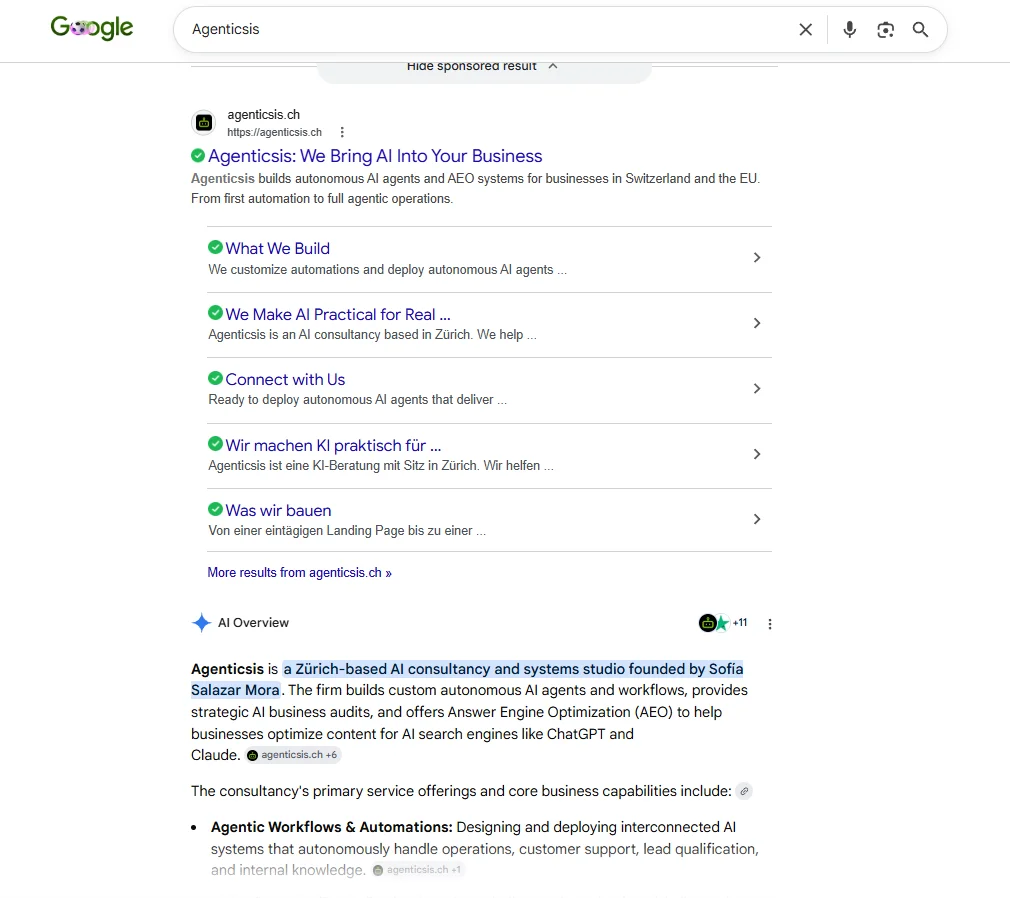
Below the classical SERP result, something new. An AI Overview block, generated by Google's Gemini model, that said:
Agenticsis is a Zürich-based AI consultancy and systems studio founded by Sofía Salazar Mora. The firm builds custom autonomous AI agents and workflows, provides strategic AI business audits, and offers Answer Engine Optimization (AEO) to help businesses optimize content for AI search engines like ChatGPT and Claude.
Every word of that sentence was correct. Google had accepted "Agenticsis" as a distinguishable entity. It had accepted me as the founder. It had accepted the description of what we do. It cited agenticsis.ch as the source, plus six others.
I did not immediately celebrate. I sat with my coffee and reread the paragraph three times. It felt like the first time a machine had ever seen me exactly the way I wanted to be seen. Six months earlier, ChatGPT had suggested I meant Agenxus.
Chapter XIII. The Product Was the Pain
Here is the part I did not plan for.
Every tool I had used to diagnose and fix my own visibility problem — the fifty-four-point audit, the citation share-of-voice tracker across ChatGPT, Perplexity, Claude, and Gemini, the schema pack generator, the brand-mention detection pipeline, the IndexNow ping infrastructure, the weekly diff report — was already a product. We had built it, over the year, to instrument what was happening to us. Every painful discovery had become a feature.
The 20/54 audit that humiliated me in May is the same scorecard we ship to clients now. The brand-confusion audit that surfaced Agentcis and Agentis is the same tool that runs weekly. The citation tracker that let me watch the AI Overview begin to describe Agenticsis is the same one that reports weekly to every customer.
We did not build the Agenticsis Visibility Program on purpose. We built it because we needed it. It became a product when other people needed it too.
It runs the full audit, tracks citations across every major AI search engine, and hands you a report you could not otherwise produce without the year of pain that produced it. CHF 60 for four weekly credits. Discovery call available on request. The tool speaks for itself when you see your own numbers.
Twelve Hard-Earned Lessons for Founders
- CSR is silence. Client-side rendered pages return an empty shell to AI crawlers, which do not execute JavaScript. Static export or server-side rendering is not a preference. It is the entry ticket.
- Your TLD is a ranking signal. .top, .xyz, .click and similar spam-associated TLDs carry a permanent discount in Google's assessment. Country ccTLDs (.ch, .de, .co.uk) and .com carry trust. Choose accordingly, once.
- Every URL migration is an SEO reset. Google will re-crawl, re-canonicalize, re-decide. Budget four to eight weeks for equity to transfer. Do not migrate URLs twice in one quarter. We did, and paid for it.
- Verify redirect rules with live curl, not build success. A vercel.json that parses cleanly can still produce redirects that do not fire against every URL pattern. Test
curl -sIon trailing-slash, non-trailing-slash, and slug variants before you consider it shipped. :path*is not(.*). Path-to-regexp v6 handles the two forms differently on Vercel. The(.*)capture with$1backreference is the bulletproof form. The:path*shorthand can silently miss trailing slashes.- GSC's "Page with redirect: Failed" is not an error. It means Google re-checked and confirmed the URL still redirects. For a migration, that is the correct state. Do not click Validate Fix on informational categories. Reserve Validate Fix for true error categories: Redirect error, Server error, 404 on URLs that should resolve.
- "Crawled - currently not indexed" is a quality verdict. Google fetched the page and decided it did not merit inclusion. Request Indexing prompts a re-evaluation. Real fixes come from improving inbound links, entity signals, and content substance, not from more re-crawl clicks.
- Adding entity signals triggers reconciliation. Wikidata, GitHub, LinkedIn, Crunchbase entries all feed Google's Knowledge Graph. When Google re-evaluates an entity, sitelinks retract and the site name may revert to the domain for seven to fourteen days. Do not panic. Do not roll back the signals.
- Wikidata is the highest-leverage entity signal a small brand can create. Thirty minutes of work. Present in every major LLM's training corpus. Queried live by Perplexity and Gemini. Also acts as the disambiguation anchor when your brand name collides with look-alikes.
- Brand-name confusion is defeatable with a disambiguating suffix. Every byline, every profile bio, every author attribution: use the full string. Agenticsis (Swiss AI consultancy) or Agenticsis Switzerland. Never the bare word alone, until you have earned the entity slot outright.
- The AI Overview is a lagging indicator. Site-name display in the classical SERP syncs two to six weeks after entity establishment. The AI Overview surface can update sooner or later, depending on model refresh cycles. Measure both. Wait for both.
- Do not react during reconciliation. The most dangerous thing to do when your SERP looks broken is to make more changes. Every deploy, every reindex request, every schema tweak resets the clock. The discipline is to observe and let Google finish thinking.
Frequently Asked Questions
What is AEO (Answer Engine Optimization)?
Answer Engine Optimization is the practice of getting your brand and content cited by AI search engines such as ChatGPT, Perplexity, Claude, Gemini, and Google's AI Overview. Unlike traditional SEO, which optimizes for the blue-link result page, AEO optimizes for the sentence a language model generates when asked about your industry, your product, or your name. Core AEO practice includes structured data (JSON-LD schemas), entity establishment (Wikidata, GitHub, Crunchbase, LinkedIn), disambiguating branding, and clean crawlable HTML that AI systems can ingest.
Why can't AI search engines see client-side rendered (CSR) websites?
AI crawlers such as GPTBot, ClaudeBot, PerplexityBot, and Google-Extended fetch your URL and read the raw HTML response. They do not execute JavaScript. A CSR site returns an empty <div id="root"></div> in that raw response, with the actual content injected only after JavaScript runs in a browser. To an AI crawler, your CSR site has no content. Static site generation, server-side rendering, and static export all solve this by producing full HTML at build time or request time.
How do you get a small company into Wikidata?
Create an account on wikidata.org, click Create a new item, and add the properties that qualify a business entity: instance of (typically a business or a consulting firm), country of headquarters, industry, founder, inception date, and official website. Cite one credible source per statement (your own website counts for factual claims about yourself). The moderation queue reviews within days. Small businesses are eligible if they exist as a genuine entity with a website and public presence. Wikidata is separate from Wikipedia and has a much lower bar for inclusion.
Does the .top TLD really cost SEO ranking?
Yes. Multiple independent studies (Spamhaus, Cloudflare Radar, Namestat) consistently rank .top among the TLDs with the highest spam-to-legitimate ratio. Google does not publicly confirm TLD-level ranking penalties but does confirm that domain reputation is a ranking signal. In our own migration from .top to .ch, organic ranking improved on brand queries within three months without any other change. The Swiss ccTLD (.ch) carries the additional trust signal of legal-registration friction (residency required).
How long does Google Knowledge Graph reconciliation take when you add new entity signals?
Seven to fourteen days in our observed case. When you publish Wikidata Q-items, GitHub organization pages, LinkedIn company page updates, or Crunchbase entries in a short window, Google's Knowledge Graph re-evaluates the entity. During reconciliation, sitelinks retract, the site name may revert to the raw domain in SERP presentation, and the Knowledge Panel can thin or disappear. This is not a penalty. It is Google rebuilding its internal representation of the entity. Do not panic and do not undo the signals.
What is the difference between GSC "Page with redirect" and "Redirect error"?
"Page with redirect" is an informational category: Google crawled the URL and found it redirects to another URL. This is expected behavior for legacy URLs after a migration. "Redirect error" is a true error category: Google encountered a redirect loop, a chain longer than five hops, or a redirect target that itself returned an error. Only "Redirect error" needs a fix. Clicking Validate Fix on "Page with redirect" returns Failed status because the URL still redirects, which is the correct state. That Failed label is misleading and has cost founders panic reactions.
Can you use Google's Indexing API to submit blog posts?
No. Google's Indexing API is restricted by their Terms of Service to JobPosting and BroadcastEvent structured data types. Using it for blog posts or general web pages violates ToS and can trigger penalties. For blog posts, use GSC's URL Inspection tool with the Request Indexing button (limit approximately ten URLs per day per property). For Bing, Yandex, Seznam, and Naver, use IndexNow, which is free and allows five thousand URLs per day.
What is the Agenticsis Visibility Program and how much does it cost?
The Agenticsis Visibility Program is the productized version of the AI search visibility measurement stack we built to diagnose and fix agenticsis.ch's own presence in AI search engines. It runs a fifty-four-point AEO scorecard, tracks brand citations across ChatGPT, Perplexity, Claude, Gemini, and Google AI Overview, monitors share-of-voice against competitors, and automates IndexNow pings. Pricing is CHF 60 for four weekly credits (one credit per weekly run). A discovery call is available for teams that want the tooling built into their stack.
Conclusion: What Eight Months of Pain Teaches About AI Search
2026 is the year the traditional SEO playbook is not enough. Ranking blue on Google is still valuable, but the paragraph that language models generate when asked about your industry, your product, or your brand name is the surface that increasingly decides whether prospects find you at all. That paragraph is not authored. It is retrieved from an entity graph and rewritten by a model. Getting into that graph is the new job.
The path we walked (CSR to static export, .top to .ch, /en/ to bare, redirect bug, reconciliation collapse, entity work, patience) is not a path any founder should have to walk twice. The twelve lessons above are what we would have paid to know in December 2025. They are also what the Agenticsis Visibility Program automates for the companies who read this and decide they would rather measure than suffer.
If you take one thing from eight months of our work: the entities that AI search engines can name are the entities that AI search engines cite. Everything else is decoration.
Skip the Year of Pain: See the Agenticsis Visibility Program
The tools we built to fix Agenticsis's own AI search visibility now ship as the Agenticsis Visibility Program. Weekly runs across ChatGPT, Perplexity, Claude, Gemini, and Google AI Overview. Fifty-four-point AEO scorecard. Brand-mention share of voice. IndexNow automation. Real numbers, not vibes. CHF 60 for four weekly credits.
See the Visibility Program
About the Author: Sofía Salazar Mora, Founder of Agenticsis (Zurich)
Zurich-based AI Consultancy · Founded 2026
Sofía Salazar Mora is the founder of Agenticsis, a Swiss AI consultancy based in Zurich. Engineer with an MBA, she works in English, German, and Spanish across DACH and Latin America. Agenticsis partners with enterprises to design, deploy, and scale autonomous AI agents, agentic workflows, and Answer Engine Optimization systems across 850+ integrated tools.
Areas of Expertise: Autonomous agent architecture · AI search visibility (AEO / GEO) · EU AI Act & Swiss FADP compliance · Multilingual DACH deployments · Event-driven agent design.
Zurich, Switzerland · agenticsis.ch · Fact-checked by senior AI consultants · Last Updated: July 21, 2026