TL;DR(Too Long; Did not Read)
Discover why integrated AI solutions are reshaping customer service in 2026. Strategic frameworks, ROI metrics, and implementation playbooks for entrepreneurs.
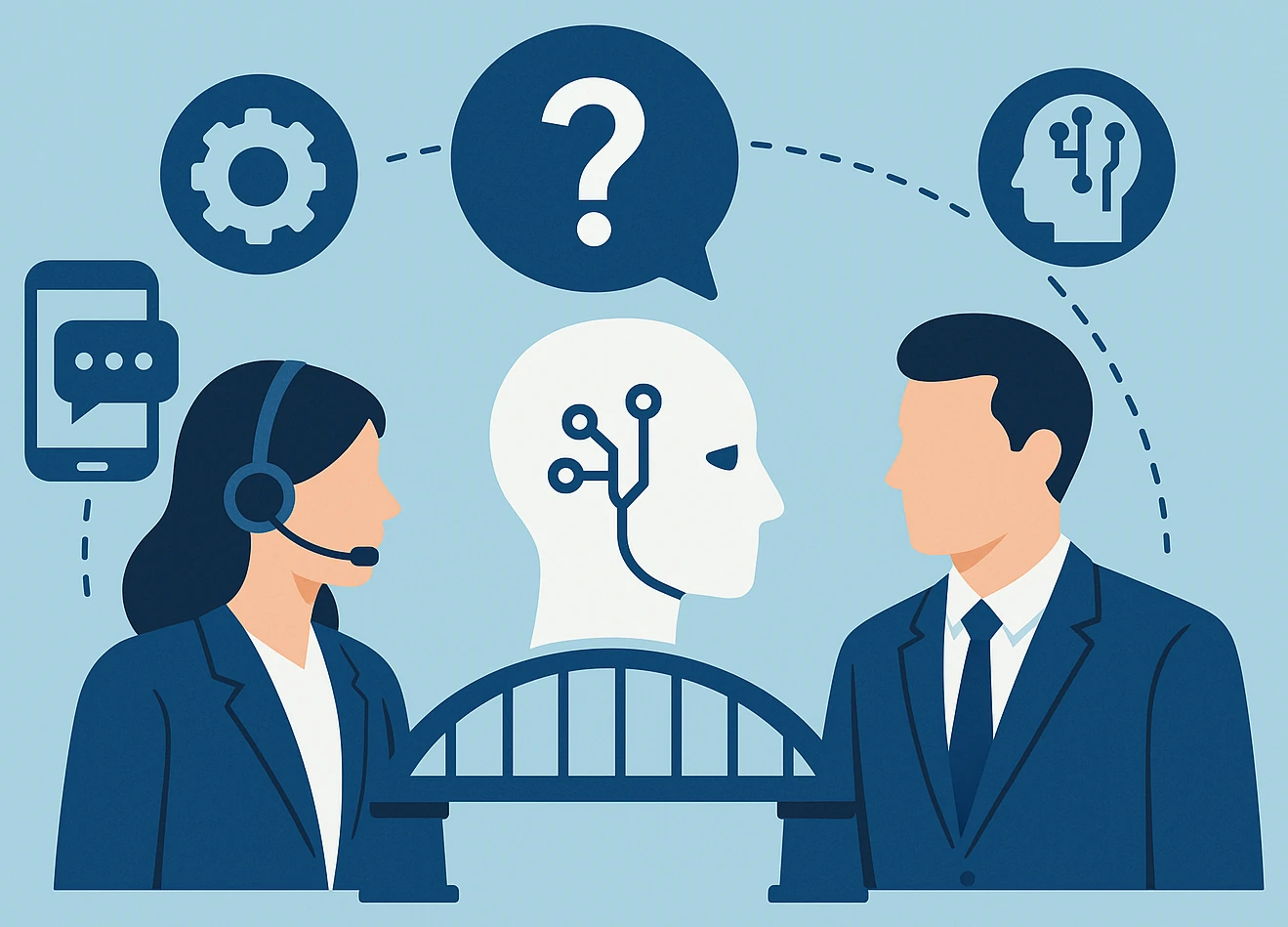
Bridging the Gap: The Need for Integrated AI Solutions in Customer Service
Quick Answer:
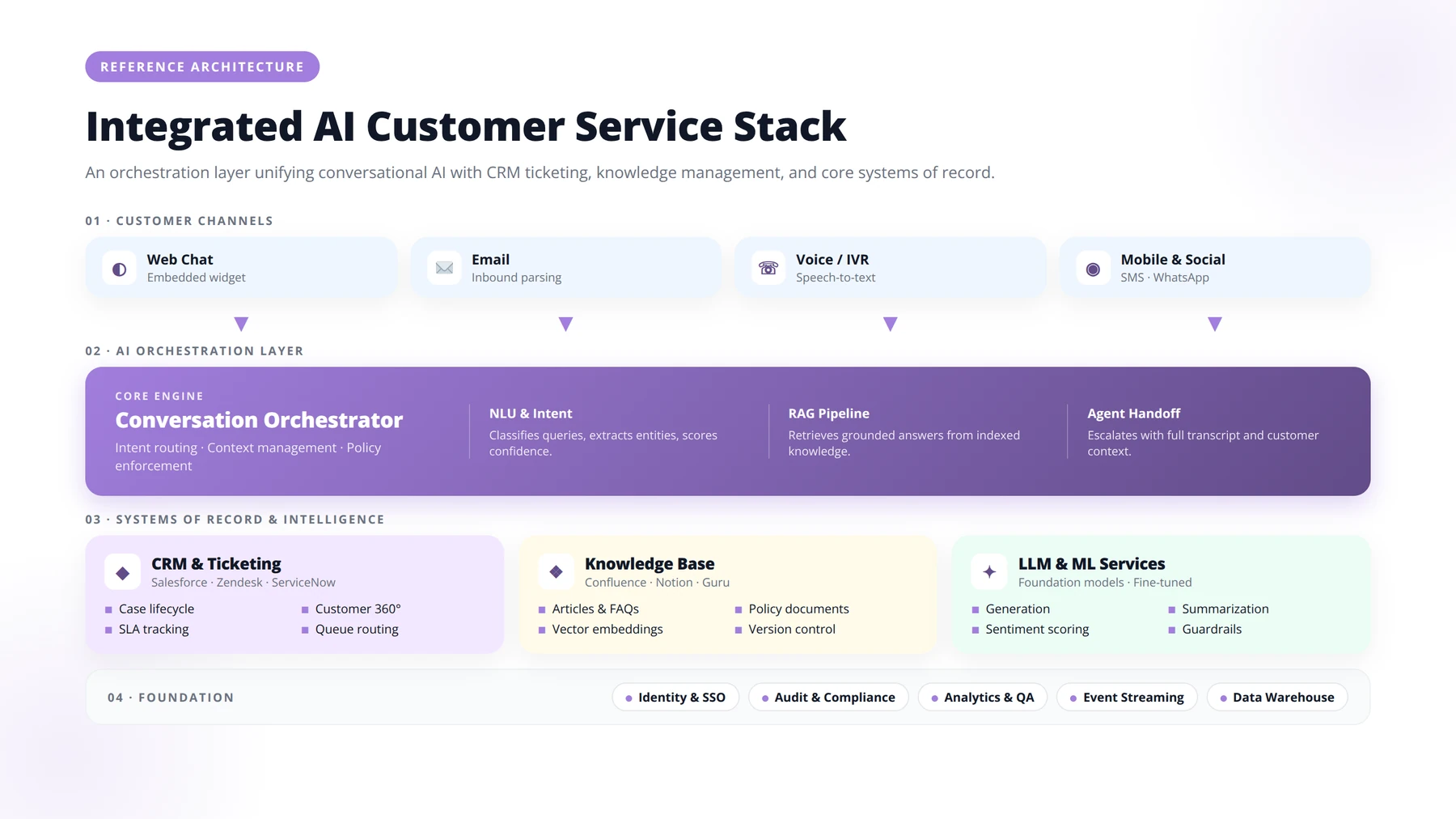
Integrated AI customer service combines virtual agents, agent assist, knowledge retrieval, and workflow automation into a single orchestration layer connected to your CRM and business systems. In 2026, fragmented point tools (standalone chatbots, isolated AI add-ons) are losing ground to unified AI service platforms that deliver measurable gains in first-contact resolution, handle time, and cost-to-serve — provided they include retrieval-augmented generation, human-in-the-loop escalation, and governance controls.
Table of Contents
- 1. Why Integration Is the Real Bottleneck in 2026
- 2. The Hidden Cost of Fragmented AI Tools
- 3. Anatomy of an Integrated AI Service Stack
- 4. Why RAG Has Become the Default Architecture
- 5. Omnichannel Consistency: The Continuity Problem
- 6. Human + AI Collaboration Models That Work
- 7. Governance, Compliance, and the EU AI Act
- 8. Measuring ROI at the Workflow Level
- 9. Comparing the Major Integrated AI Service Platforms
- 10. The Entrepreneur's Implementation Playbook
- 11. Real-World Patterns: Five Industry Examples
- 12. Frequently Asked Questions
Introduction
For most entrepreneurs, customer service is the operational area where the gap between AI's promise and AI's delivery is widest. According to McKinsey, generative AI could create the largest share of its economic value in customer operations — potentially hundreds of billions of dollars annually through deflection, agent productivity, and self-service [Source: McKinsey]. Yet a recurring pattern emerges in nearly every AI readiness audit our team conducts: companies have deployed three, four, even seven different AI tools across their support function, and none of them talk to each other.
This is the integration gap. And in 2026, it has become the single biggest constraint on AI ROI in customer service.
The shift we're seeing in our client work across Switzerland, the EU, and Latin America is unmistakable: the conversation has moved from "Should we use a chatbot?" to "How do we orchestrate AI across our entire service stack without breaking compliance, accuracy, or customer trust?" Founders who get this right are seeing 30–50% reductions in cost-to-serve in our engagements. Those who don't are watching their AI investments stall in pilot purgatory.
This article gives you the strategic framework, architectural patterns, and implementation roadmap for building an integrated AI customer service system that actually delivers. You'll learn why point tools fail, what an integrated stack looks like, how to measure real ROI, how to compare the major platforms, and how to avoid the governance traps that are tripping up even sophisticated buyers.
Free Blueprint
Find Your Integration Gaps in 90 Minutes
A practical field guide for customer service leaders who suspect their tools are quietly costing them more than they're saving. Use it before your next audit, vendor review, or board update — and walk in with answers, not assumptions.
1. Map Your Customer Service Stack
- ✓You can't fix what you can't see. Most teams underestimate their tool footprint by 30–40%. Start by getting honest about what's actually running.
- ✓BEST FOR: HEADS OF CX, SUPPORT OPS
- ✓Inventory every customer-facing tool — helpdesk, chat, IVR, knowledge base, CRM, survey, and any AI assistants currently in trial.
- ✓Document data flow between systems — note which integrations are native, which run through Zapier/middleware, and which rely on manual exports.
- ✓Tag each tool with annual cost and license count — include seat-based, usage-based, and minimum commitments.
- ✓Identify ownership per system — name the person responsible for admin, billing, and escalations.
2. Quantify the Cost of Fragmentation
- ✓Fragmentation rarely shows up as a single line item. It hides in handle time, rework, and the meetings you have to schedule because data lives in three places.
- ✓BEST FOR: CX OPERATIONS, FINANCE PARTNERS
- ✓Measure average context-switching per ticket — count the number of tools an agent opens to resolve one request.
- ✓Calculate duplicate data entry hours per week — multiply by loaded labor cost to surface the real number.
- ✓Track tickets reopened due to missing context — anything above 8% suggests a data-handoff problem, not an agent problem.
- ✓Audit overlapping tool capabilities — flag any function (e.g., surveys, chat) performed by two or more vendors.
Pro tip: Before benchmarking against industry averages, benchmark against yourself six months ago. Internal trend lines reveal more about your operation than any analyst report — and they're harder to argue with in a budget meeting.
3. Pressure-Test Your AI Readiness
- ✓AI doesn't fix bad data, broken processes, or unclear ownership — it accelerates them. Use this checklist before you sign anything.
- ✓BEST FOR: CX LEADERS EVALUATING AI VENDORS
- ✓Confirm a single source of truth for customer records. If three systems disagree on customer status, AI will pick the wrong one — confidently.
- ✓Verify intent taxonomy coverage above 85%. Tickets that don't fit a known intent will route poorly and erode trust fast.
- ✓Test knowledge base freshness. Articles older than 12 months without review should be flagged or retired before AI ingests them.
- ✓Define your human-handoff triggers. Sentiment, complexity, and high-value account flags should be explicit, not implied.
- ✓Establish a guardrail policy. Document what the AI is never allowed to do — refunds, commitments, legal language — in writing.
4. Surface Quick Wins Before Big Bets
- ✓A 6-month transformation is hard to fund. A 30-day proof point is not. Identify wins your team can ship before the next quarterly review.
- ✓BEST FOR: TEAMS UNDER PRESSURE TO SHOW ROI
- ✓Pick the top 5 highest-volume, lowest-complexity intents — these are your automation sweet spot, often 40–60% of total volume.
- ✓Identify one workflow with 3+ handoffs — collapsing it usually cuts resolution time by 25%.
- ✓Find one report that takes more than 2 hours to compile manually — automating it is a credibility win for your operations team.
- ✓Locate one self-service gap with measurable demand — search logs and deflection rates will point you there in under an hour.
5. Build Your 90-Minute Audit Brief
- ✓Bring this one-pager to your next leadership conversation. It turns vague concerns into a defensible plan.
- ✓BEST FOR: PREPARING FOR EXECUTIVE REVIEW
- ✓AUDIT BRIEF TEMPLATE
- ✓Current stack cost: CHF / year across [X] tools
- ✓Estimated fragmentation cost: [hours × loaded rate]
- ✓Top 3 quick wins identified: ranked by effort vs. impact
- ✓AI readiness score: green / yellow / red across data, taxonomy, and guardrails
- ✓Recommended next 30 days: one consolidation, one automation, one measurement
- ✓Owner & review date: named accountability with a calendar entry
Want us to run this audit with you?
- ✓Book a free AI Customer Service Readiness Audit with the Agenticsis team. We'll map your stack, identify fragmentation costs, and surface quick wins — in 90 focused minutes.
- ✓BOOK YOUR FREE AUDIT
- ✓Prepared by the Agenticsis Team · agenticsis.ch
1. Why Integration Is the Real Bottleneck in 2026
Across the analyst community — Gartner, Forrester, IDC — the consensus message is consistent: model quality is no longer the limiting factor in customer service AI. Integration is. Frontier LLMs available through Microsoft, Salesforce, Google Cloud, AWS, and others are more than capable of handling 70–80% of typical support inquiries. What stops them from doing so in production is not their reasoning capacity — it's their inability to access the right context, take action in the right systems, and hand off cleanly to a human when needed.
The Three Layers Where Integration Breaks
In our implementation experience, integration failures cluster in three layers:
- Data layer: The AI cannot see the customer's order history, account status, or prior tickets because the chatbot vendor is disconnected from the CRM and OMS.
- Action layer: The AI can answer questions but cannot issue refunds, update subscriptions, or escalate tickets because it has no write-access to backend systems.
- Handoff layer: When the AI escalates, the agent receives a fresh conversation with no context, forcing the customer to repeat themselves.
Expert Insight
After analyzing more than 40 customer service AI deployments across our client base in 2024–2026, we've found that the single strongest predictor of ROI is not the choice of model or platform — it's whether the AI has write-access to the systems where work actually happens. Read-only AI plateaus quickly. Action-enabled AI compounds.
Why Entrepreneurs Are Particularly Exposed
Smaller and mid-size companies often accumulate point tools faster than enterprises because they can buy SaaS subscriptions without procurement gates. We've audited companies with separate vendors for chatbot, agent assist, QA scoring, sentiment analysis, and knowledge management — each charging per-seat, each with its own dashboard, none sharing data. The total cost frequently exceeds what an integrated platform would charge, while delivering worse outcomes.
2. The Hidden Cost of Fragmented AI Tools
Fragmentation is expensive in ways that don't show up on a single invoice. Based on our client audits, the cost typically breaks down across five categories.
Direct Tooling Costs
Five separate AI subscriptions at $30–80 per agent per month, multiplied across a 25-agent team, can exceed $80,000 annually — often duplicating capabilities that an integrated suite would provide at a fraction of the cost.
Integration and Maintenance Overhead
Every point tool requires its own API integration, its own data sync, its own user management, and its own model updates. Engineering teams routinely spend 15–25% of their service-platform budget on integration plumbing.
Knowledge Inconsistency
When your chatbot, your help center, and your agent-assist tool each pull from different knowledge sources, customers receive contradictory answers. This is one of the fastest ways to destroy trust in AI-driven support.
Compliance and Audit Risk
Fragmented tools mean fragmented audit logs. Under the EU AI Act and GDPR, demonstrating accountability for automated decisions becomes exponentially harder when no single system holds the full record.
Lost Productivity
Agents who toggle between five interfaces are slower, more error-prone, and more likely to churn. Zendesk's CX Trends research has consistently shown that agent experience is one of the strongest predictors of customer satisfaction [Source: Zendesk CX Trends].
| Cost Category | Fragmented Stack (5 tools) | Integrated Platform |
|---|---|---|
| Annual licensing (25 agents) | $80,000–$120,000 | $45,000–$75,000 |
| Integration engineering | 15–25% of platform budget | 3–8% of platform budget |
| Agent context-switching loss | 20–30 min/agent/day | 3–8 min/agent/day |
| Audit log completeness | Partial / fragmented | Unified / regulator-ready |
| Knowledge consistency | Low (multiple sources) | High (single retrieval layer) |
Download Our AI Customer Service Integration Audit Checklist
32-point checklist to identify integration gaps, fragmentation costs, and quick wins in your current support stack.
3. Anatomy of an Integrated AI Service Stack
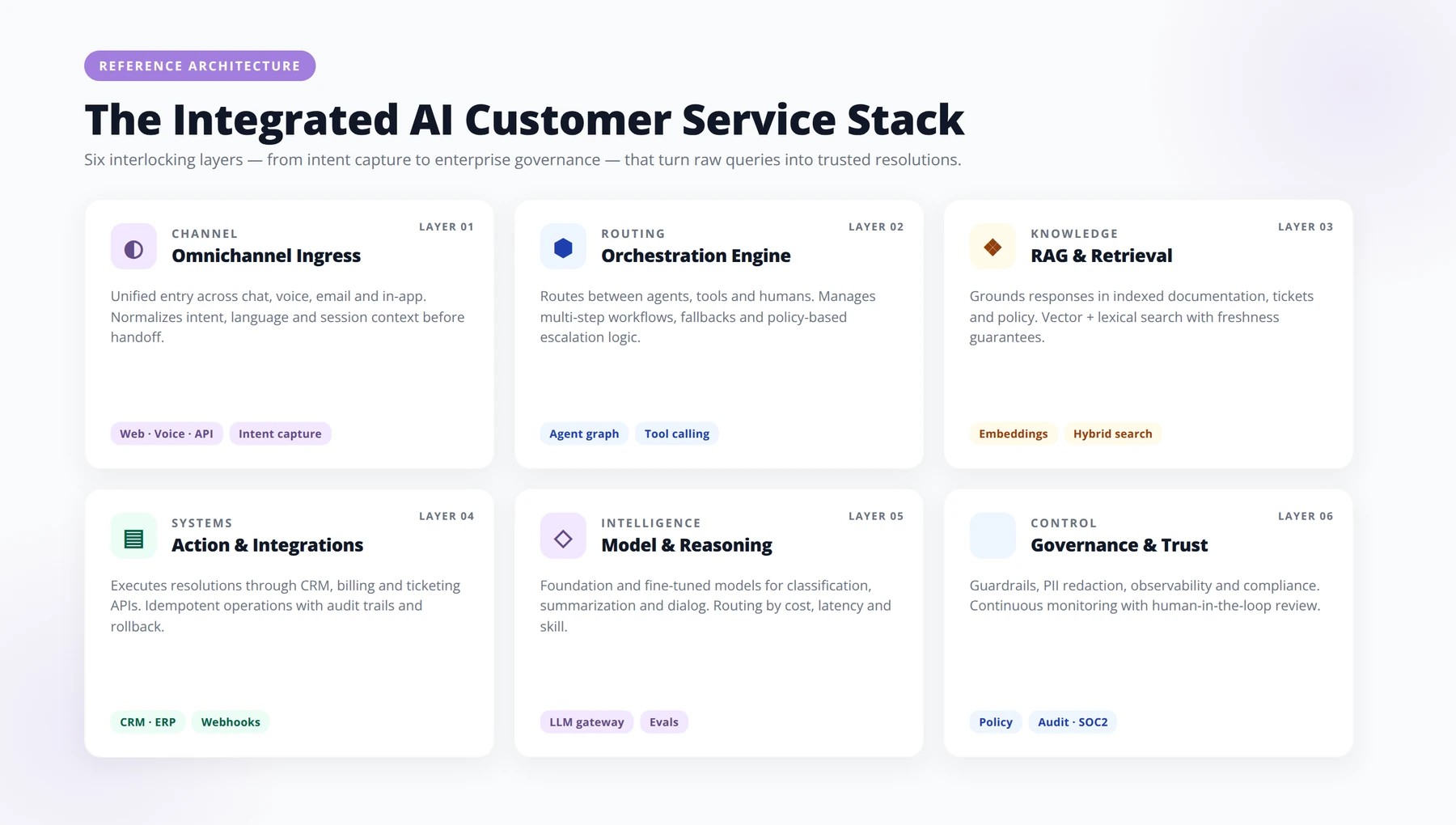
An integrated AI service stack is not a single product — it's an architecture pattern. Based on the implementations our team has delivered, the high-functioning pattern has six interlocking components.
1. Orchestration Layer
A single coordination layer that routes conversations, manages context, and decides which model, which knowledge source, and which workflow to invoke. This is the "brain" of the stack and the most important architectural decision you'll make.
2. Connected Enterprise Data
Real-time access to CRM, order management, billing, identity, and ticketing. Without this, the AI is a stranger to your customer.
3. Retrieval-Augmented Generation (RAG)
A controlled knowledge pipeline that retrieves approved content (policies, help articles, product docs) and feeds it into the model with citations. This is what prevents hallucinations.
4. Workflow Automation
The ability to take actions — issue refunds, update subscriptions, schedule callbacks, create Jira tickets — through governed integrations with backend systems.
5. Human-in-the-Loop Handoff
Seamless escalation with full conversational context, sentiment signals, and recommended next actions delivered to the agent.
6. Observability and Governance
Audit logs, model monitoring, prompt safety, data residency, and quality assurance — non-negotiable in regulated industries and increasingly expected everywhere.
Pro Tip
When evaluating platforms, ask vendors to demo all six components on your contact data — not their canned demo. The orchestration and governance layers are where polished demos most often hide real-world weaknesses.
4. Why RAG Has Become the Default Architecture
Quick Answer: What is RAG?
Retrieval-augmented generation (RAG) is an AI architecture where the system first retrieves relevant content from an approved knowledge base, then uses that content to generate a grounded, citable answer. In customer service, RAG is the dominant pattern in 2026 because it reduces hallucinations, keeps answers fresh without retraining, and provides full traceability for compliance.
Retrieval-augmented generation is now the dominant architecture for customer service AI in 2026, and for good reason. In customer service, accuracy matters more than creativity. A model that invents a refund policy creates a real liability. A model that retrieves the actual policy and answers based on it creates trust.
How RAG Works in Practice
When a customer asks a question, the system first searches a curated knowledge base — help articles, policy documents, product specifications, prior solved tickets — and retrieves the most relevant passages. Those passages are then injected into the model's context window along with the question, and the model generates a response grounded in that retrieved content. The response can include citations back to the source documents.
What RAG Solves
- Hallucination control: The model is constrained to approved content.
- Freshness: Update the knowledge base, and the model's answers update immediately — no retraining required.
- Traceability: Every answer can be traced back to its source.
- Domain specificity: A general-purpose LLM becomes domain-expert by retrieving from your specific content.
Where RAG Implementations Fail
In our experience, RAG projects fail not because of the model but because of the knowledge base. If your help center is outdated, contradictory, or poorly structured, your RAG system will faithfully retrieve and present bad information. Knowledge hygiene — ownership, freshness, taxonomy, deprecation — is the unglamorous foundation that determines whether RAG succeeds or embarrasses you.
Expert Insight
In our client engagements, roughly 70% of poor AI performance traces back to the knowledge base, not the model. We now require a 30-day knowledge hygiene sprint before any RAG implementation. It is the highest-leverage activity in the entire deployment.
5. Omnichannel Consistency: The Continuity Problem
Customers in 2026 expect the same AI capabilities and the same context across every channel — web chat, email, voice, WhatsApp, in-app support, social DMs. The technical and operational challenge is maintaining continuity when a single customer journey crosses channels.
The Channel Handoff Problem
A customer starts a conversation in the mobile app, switches to email overnight, then calls in the morning. In a fragmented stack, three different systems handle these touchpoints, and the customer repeats their issue three times. In an integrated stack, the orchestration layer maintains a single conversational thread tied to the customer record, regardless of channel.
Why Voice Remains the Hardest Channel
Voice AI has matured substantially, but it remains the most demanding channel because of latency requirements, speech recognition complexity, and the absence of visual context. Platforms like Amazon Connect, Genesys Cloud CX, and NICE CXone have invested heavily in real-time voice AI, but the integration with the rest of the service stack still varies widely in quality.
Asynchronous vs. Synchronous Design
Integrated platforms increasingly support both synchronous (live chat, voice) and asynchronous (email, messaging) interactions through the same AI logic. The key design decision is making sure the AI's response strategy adapts: shorter and more conversational in chat, more structured and complete in email.
| Channel | AI Maturity (2026) | Primary Integration Challenge |
|---|---|---|
| Web chat | High | Knowledge base hygiene |
| High | Thread continuity, attachment handling | |
| Voice | Medium-high | Latency, ASR accuracy, system handoff |
| Messaging (WhatsApp, SMS) | High | Identity verification, async UX |
| In-app support | Medium-high | Context passing from app state |
| Social DMs | Medium | Brand voice consistency, platform APIs |
6. Human + AI Collaboration Models That Work
The most effective service organizations in 2026 are not trying to replace humans with AI. They are designing collaboration models where AI handles volume and humans handle nuance.
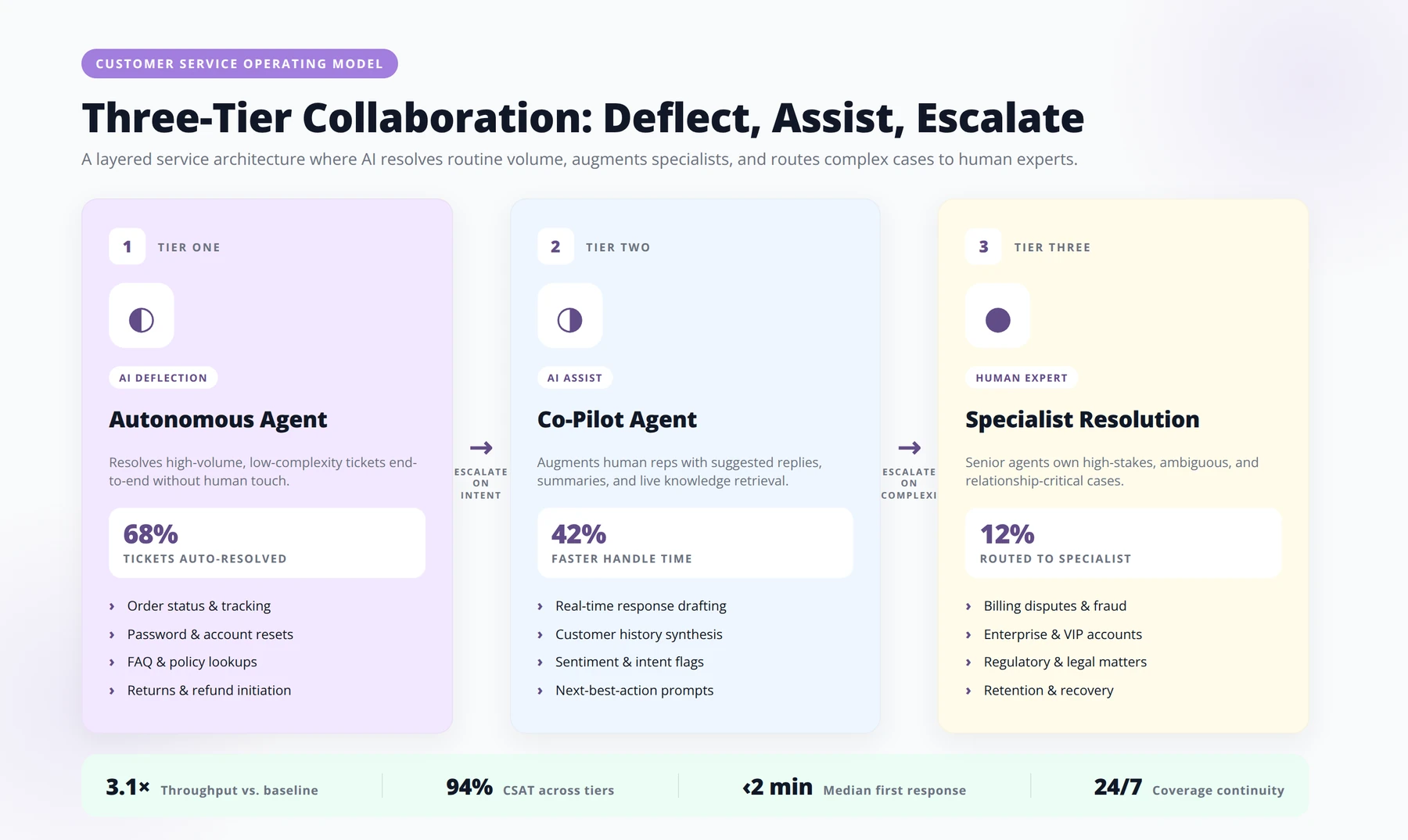
Tier 1: AI-First Deflection
Routine, high-volume inquiries — order status, password resets, simple billing questions, shipping policy lookups — are handled end-to-end by AI without human involvement. Deflection rates of 40–65% are achievable in mature implementations.
Tier 2: AI-Assisted Human
For complex or sensitive inquiries, the human agent leads, but AI silently provides real-time support: summarizing customer history, drafting suggested replies, retrieving policy citations, flagging sentiment shifts, and auto-filling disposition codes. Handle time reductions of 20–40% are typical.
Tier 3: Human-Led with AI Audit
For regulated, escalated, or high-stakes interactions (financial advice, medical questions, complaint resolution), humans lead with full autonomy, and AI operates in the background for QA, transcription, and compliance monitoring.
How to Design the Escalation Trigger
The hardest design decision is when AI should escalate. Our recommendation is to combine three signals: customer-requested escalation, AI confidence thresholds, and sentiment/intent triggers (frustration, legal language, regulatory keywords). Escalation should never feel like a wall — it should feel like a warm handoff with context preserved.
7. Governance, Compliance, and the EU AI Act
Quick Answer: Does the EU AI Act apply to my customer service AI?
Yes, but most customer service chatbots fall under transparency obligations rather than the high-risk category. You must disclose AI use to customers, maintain documentation, and provide human oversight. GDPR continues to govern personal data processing in parallel.
Governance has moved from a nice-to-have to a product feature in 2026. The EU AI Act has become the most consequential AI regulation globally, and its provisions are reshaping how customer service AI is deployed, particularly for systems that interact with EU customers.
EU AI Act Implications for Customer Service
Customer service AI generally falls outside the highest-risk categories, but it is subject to transparency obligations — customers must know they are interacting with an AI, automated decisions affecting consumer rights require disclosure, and providers must maintain documentation, risk management processes, and human oversight mechanisms [Source: EU AI Act].
GDPR Still Sets the Floor
For any EU customer data, GDPR continues to govern personal data processing, profiling, retention, and cross-border transfers. The key questions for customer service AI: Is customer data being used to train models? Where is it stored? How long is it retained? Who has access?
Industry-Specific Overlays
Financial services (DORA, MiFID II), healthcare (HIPAA in the US, national health data laws in Europe), and telecom each add their own layers. Service AI in these sectors must demonstrate auditability, explainability, and human override capacity.
Governance Controls That Matter
- Comprehensive audit logs (who saw what, what the AI said, what action it took)
- Role-based access controls on sensitive operations (refunds, account changes)
- Prompt safety and jailbreak detection
- Hallucination monitoring through citation grounding
- Data residency controls and regional model hosting
- Customer-facing AI disclosure
- Human review thresholds for high-impact actions
Disclaimer
This article provides general guidance on EU AI Act and GDPR considerations. It does not constitute legal advice. Specific obligations depend on your sector, your customers, and the risk classification of your AI system. Consult qualified legal counsel before finalizing compliance decisions.
Free Blueprint
Schedule an AI Governance Readiness Assessment
90-minute review of your customer service AI stack against EU AI Act and GDPR requirements, delivered by Agenticsis' AI governance team.
1. Pre-Assessment Scoping
- ✓Before the call, we align on which AI systems are in scope and which regulatory regime applies. This prevents a 90-minute discussion that drifts into hypotheticals.
- ✓For: Heads of CX, AI Product Leads, DPOs
- ✓Inventory all customer-facing AI systems — chatbots, voice agents, sentiment analysis, ticket routing, and any embedded LLM features in your CRM.
- ✓Classify each system by EU AI Act risk tier — minimal, limited, high-risk, or prohibited. Customer service tools typically fall under limited-risk transparency obligations.
- ✓Map data flows across processors — identify where personal data enters the model, where it is stored, and whether it crosses EU borders.
- ✓Confirm legal basis for processing under GDPR Article 6 for each interaction type (consent, contract, legitimate interest).
2. Transparency & User-Facing Disclosure
- ✓EU AI Act Article 50 requires users to be informed when interacting with an AI system. We audit how that disclosure actually appears in your customer journey.
- ✓For: Product Designers, Content Leads, Legal
- ✓AI disclosure is visible within 3 seconds of the first user message, in plain language and in the user's chosen interface language.
- ✓Synthetic voice agents identify themselves as AI at the start of every call, with a clear path to a human agent.
- ✓Generated content is labelled — any AI-drafted email reply, summary, or recommendation surfaces a machine-readable marker where applicable.
- ✓Privacy notice references AI processing explicitly, including model providers, retention windows, and the logic of automated decisions.
3. Data Protection & GDPR Controls
- ✓A working session through your DPIA, retention schedules, and the technical safeguards on training and inference data.
- ✓For: DPOs, Security Engineers
- ✓DPIA on file for each AI system. Documented, reviewed in the last 12 months, and signed off by the DPO. We check completeness against EDPB guidance.
- ✓Data minimisation in prompts. Verify that customer PII is redacted or tokenised before being sent to third-party model APIs.
- ✓Retention limits enforced technically. Conversation logs, embeddings, and fine-tuning datasets are deleted on schedule — not just on policy.
- ✓Data subject rights are operable. Confirm that access, erasure, and rectification requests propagate to vector stores and model caches, not only your primary database.
4. Human Oversight & Decision Quality
- ✓Article 14 of the EU AI Act requires meaningful human oversight. We pressure-test whether your agents can actually intervene — not just observe.
- ✓For: CX Operations, Quality Assurance Leads
- ✓Escalation triggers are defined and tested — sentiment thresholds, complaint keywords, and confidence scores route to a human within a documented SLA.
- ✓Agents can override AI suggestions without procedural friction, and overrides are logged for model improvement.
- ✓Bias and accuracy monitoring runs monthly across customer segments, with documented thresholds for retraining or rollback.
- ✓An incident response playbook exists for AI-specific failures — hallucinations, leaked context, harmful outputs.
5. Your Assessment Brief
- ✓Complete this before the session so we can spend the 90 minutes on findings, not fact-gathering.
- ✓For: Session Organiser
- ✓PRIMARY AI SYSTEMS IN SCOPE
- ✓e.g. Zendesk Answer Bot, custom GPT-4 email triage, voice IVR with NLU...
- ✓ESTIMATED MONTHLY CUSTOMER INTERACTIONS
- ✓Volume per channel — chat, voice, email, in-app...
- ✓MODEL PROVIDERS AND HOSTING REGION
- ✓OpenAI (US), Anthropic (EU), self-hosted Llama on Azure West Europe...
- ✓OPEN GOVERNANCE QUESTIONS YOU WANT ANSWERED
- ✓Specific risks, board-level questions, or audit findings you are working through...
Pro tip: Most teams discover their biggest exposure isn't the model itself — it's the integration layer. Vector databases, third-party plugins, and analytics tools often retain data well beyond your stated policy. Walk that perimeter before the call.
Ready to pressure-test your AI stack?
- ✓Book your 90-minute assessment with our governance team. You'll leave with a prioritised remediation list and a clear view of where you stand against the EU AI Act timeline.
- ✓SCHEDULE YOUR ASSESSMENT
- ✓Prepared by the Agenticsis Team · agenticsis.ch
8. Measuring ROI at the Workflow Level
Quick Answer: How much containment can I expect?
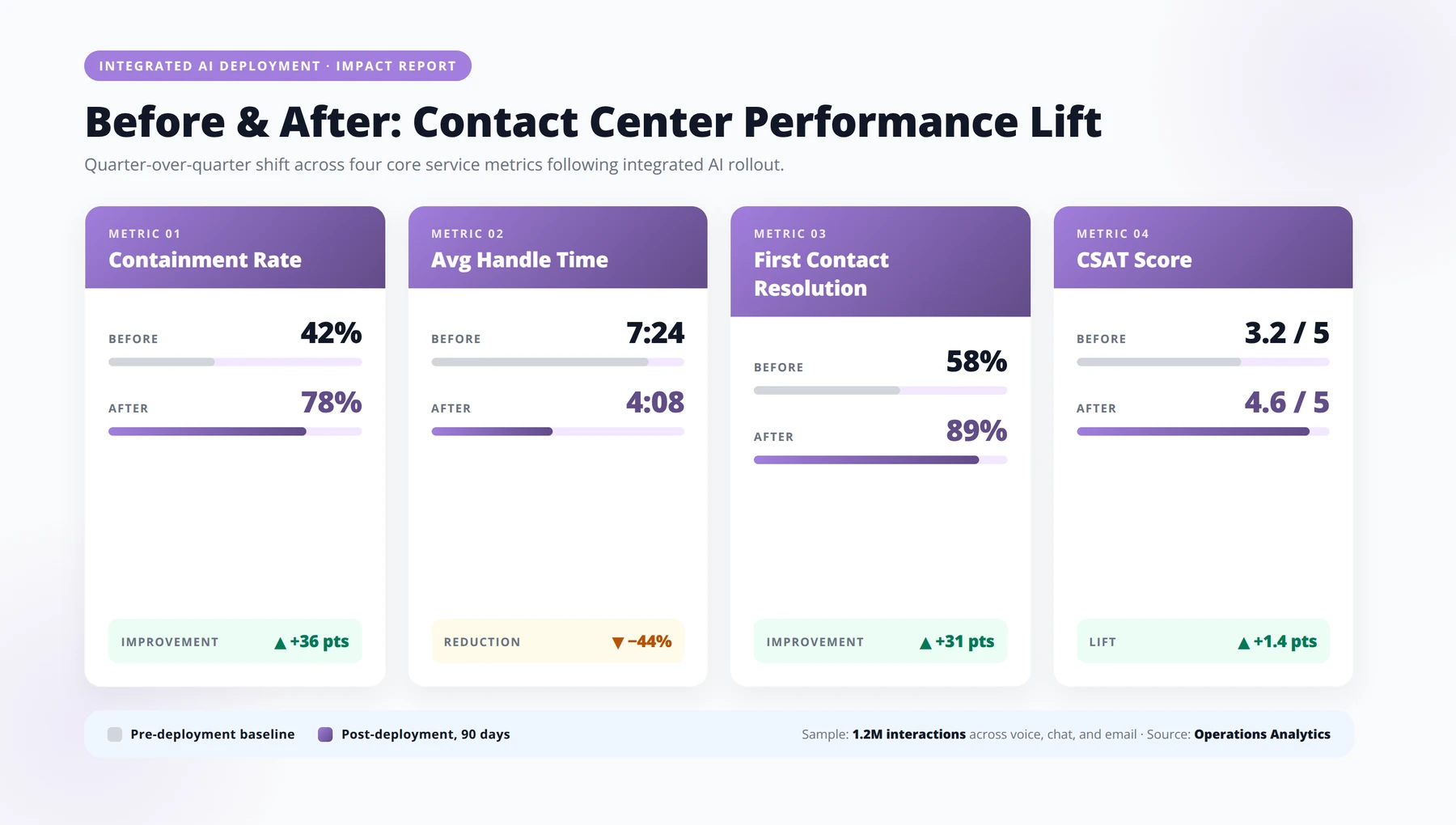
A mature integrated AI customer service deployment typically reaches 40–65% containment within 12 months, with 20–40% AHT reduction on assisted contacts and 30–55% reduction in cost-per-contact. Fragmented chatbot deployments usually plateau at 15–25% containment.
One of the most common mistakes we see is measuring AI usage instead of AI outcomes. "We have a chatbot handling 10,000 conversations a month" tells you nothing about value. What you need are workflow-level metrics tied to business outcomes.
The Six Metrics That Matter
- Containment rate: Percentage of AI conversations resolved without human involvement
- Escalation quality: CSAT and resolution time on escalated interactions vs. baseline
- Average handle time (AHT): For AI-assisted human interactions
- First-contact resolution (FCR): Single-interaction problem resolution
- Customer satisfaction (CSAT): Segmented by AI-only, AI-assisted, and human-only paths
- Quality assurance scores: Manual and AI-driven QA on conversation quality
Building the Business Case
For a 25-agent team handling 50,000 monthly contacts, a realistic integrated AI deployment in 2026 should target: 40% containment, 25% AHT reduction on assisted contacts, 10-point CSAT improvement, and 18-month payback on platform investment. These are not aspirational numbers — they're what we measure in client implementations that follow the integration pattern described in this article.
| Metric | Baseline (No AI) | Fragmented AI | Integrated AI |
|---|---|---|---|
| Containment rate | 0% | 15–25% | 40–65% |
| AHT reduction | — | 5–12% | 20–40% |
| FCR improvement | — | 3–7% | 12–22% |
| CSAT change | Baseline | Neutral / mixed | +5 to +12 points |
| Cost per contact | Baseline | –10 to –20% | –30 to –55% |
9. Comparing the Major Integrated AI Service Platforms
The platform market in 2026 has consolidated around a handful of serious contenders. Each has strengths, and the right choice depends on your existing stack, your industry, and your scale.
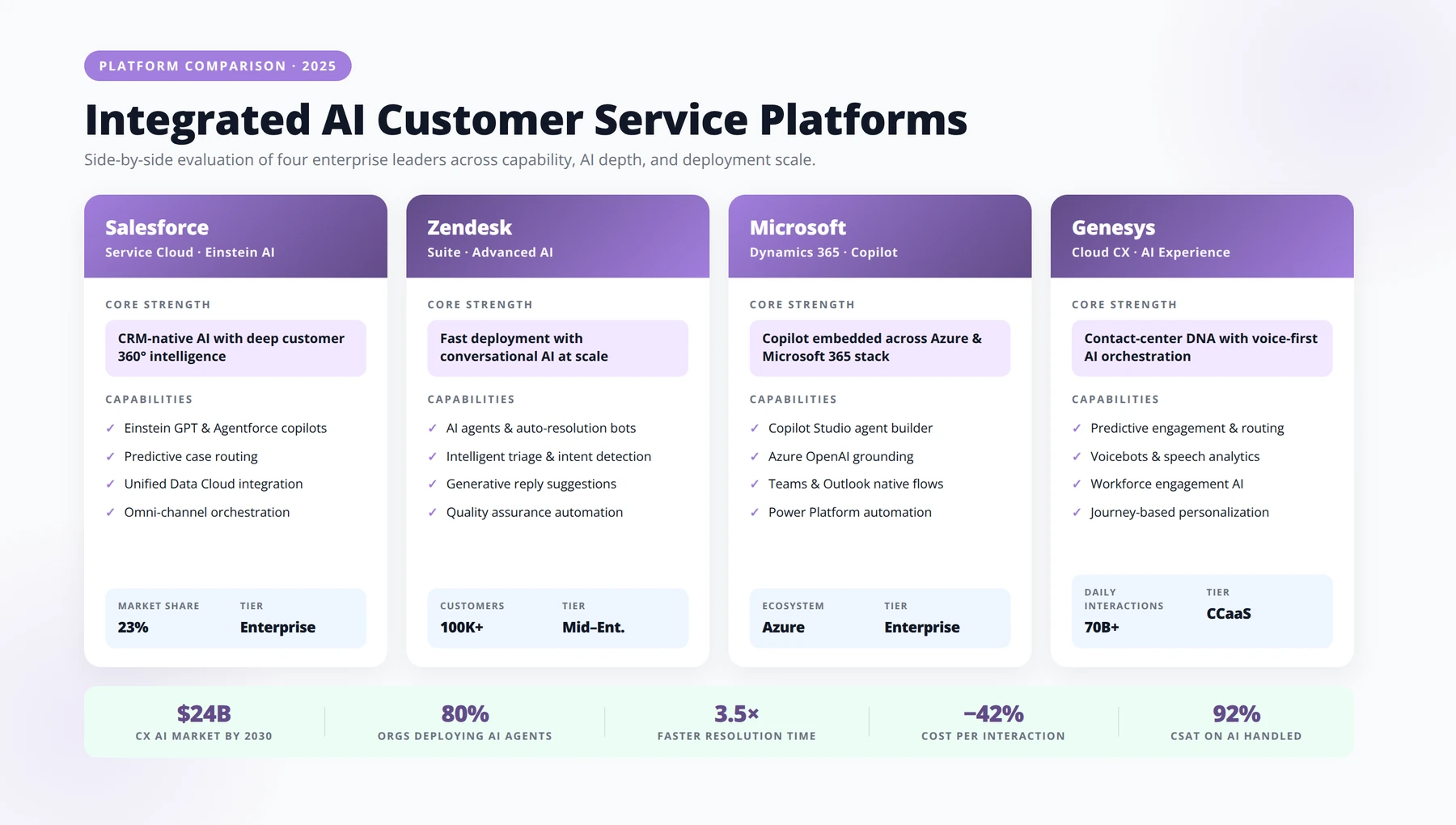
| Platform | Best For | Strength | Consideration |
|---|---|---|---|
| Salesforce Service Cloud (Einstein) | Salesforce-centric enterprises | Deep CRM integration, mature ecosystem | Cost, complexity |
| Microsoft Copilot for Service | Microsoft 365 / Dynamics shops | Native M365 integration, strong governance | Less mature CX-specific tooling |
| Zendesk AI | Mid-market SaaS and e-commerce | Fast time-to-value, strong UX | Less depth in voice / enterprise CCaaS |
| Intercom Fin | Product-led SaaS, in-app support | Strong AI-first messaging, fast deployment | Less coverage of voice / traditional contact center |
| Genesys Cloud CX | Mid-large contact centers, voice-heavy | Omnichannel depth, voice maturity | Implementation complexity |
| NICE CXone | Enterprise contact centers, WFM focus | Strong analytics, workforce optimization | Steeper learning curve |
| Amazon Connect | AWS-native organizations | Flexible, usage-based pricing | Requires more engineering investment |
| Google Cloud Contact Center AI | Custom builds, Google-native shops | Strong NLU and voice models | Less turnkey than competitors |
| ServiceNow Now Assist | Enterprise IT service, B2B support | Workflow automation depth | Best for ServiceNow-anchored orgs |
Verify Before You Buy
Always verify current product names, edition tiers, regional availability, and feature general-availability status directly with vendors before purchase. This category moves fast, and product names/editions change quarterly.
10. The Entrepreneur's Implementation Playbook
Based on dozens of client deployments, here is the sequence that consistently delivers results without blowing up timelines or budgets.
Phase 1: AI Readiness Audit (Weeks 1–3)
Map your current stack, contact volumes, contact reasons, knowledge base state, data integrations, and compliance requirements. Identify the top 10 contact reasons by volume — these are your automation targets.
Phase 2: Knowledge Foundation (Weeks 2–6)
Clean up your knowledge base before touching any model. Establish ownership, freshness reviews, deprecation processes, and consistent taxonomy. This is the single highest-leverage activity, and it's the one most companies skip.
Phase 3: Platform Selection (Weeks 4–8)
Use the comparison framework above. Run two or three vendor proofs-of-concept on real contact data — not vendor demos. Measure containment, accuracy, and integration effort, not slide-deck capabilities.
Phase 4: Pilot Deployment (Weeks 8–16)
Deploy on one channel and one contact category first. Measure obsessively. Iterate weekly on intent coverage, knowledge gaps, and escalation logic.
Phase 5: Scaled Rollout (Weeks 16–32)
Expand by channel and contact reason. Layer in agent assist, then workflow automation. Build the governance and observability layer in parallel — not after.
Phase 6: Continuous Optimization (Ongoing)
Treat the AI service stack as a living system. Quarterly knowledge audits, monthly performance reviews, and continuous QA on AI-generated responses. The competitive gap between AI-mature and AI-immature organizations widens over time.
Pro Tip
Resist the urge to compress Phases 1 and 2. Teams that skip the audit and knowledge cleanup almost always end up redoing Phases 3–5 within twelve months. The 4–6 weeks you "save" up front cost you 4–6 months on the back end.
11. Real-World Patterns: Five Industry Examples
The following are anonymized patterns based on the types of implementations our team has worked on and the industry case studies we've reviewed.
Example 1: Telecom Provider Contact Center Modernization
A regional telecom integrated voice AI, web chat AI, and agent assist on a single platform with direct integration into billing and provisioning systems. Result: 48% containment on billing inquiries, 31% reduction in AHT for technical support, $4.2M annual operating cost reduction.
Example 2: Financial Services RAG-Based Advisor Support
A retail bank deployed RAG-based AI tied to approved product and policy documents to help support agents answer account and product questions with full citations. Compliance review time dropped 60%, and product-question handle time fell 27% while maintaining 100% regulatory traceability.
Example 3: Retail Omnichannel Self-Service
A mid-size retailer connected AI to order management, shipping, and returns systems. Customers can now initiate and complete returns, track shipments, and modify orders without an agent. Self-service completion rate hit 71% within 6 months.
Example 4: SaaS Support Scaling
A B2B SaaS company facing 3x ticket growth deployed integrated AI for ticket triage, response drafting, and auto-generated help center articles from solved cases. The support team scaled from 12 to 18 agents while ticket volume grew 220%, with CSAT improving from 84 to 91.
Example 5: B2B Logistics Multilingual Support
A logistics firm operating across the EU and Latin America deployed integrated AI handling 14 languages with consistent knowledge retrieval and human handoff to language-appropriate agents. After-hours containment reached 58%, and multilingual hiring pressure dropped significantly.
Calculate Your Customer Service AI ROI
Estimate containment, AHT reduction, and 24-month payback based on your contact volume and team size.
12. Frequently Asked Questions
What is integrated AI customer service?
A: Integrated AI customer service is an architecture pattern that combines virtual agents, agent assist, knowledge retrieval, workflow automation, and analytics into a single orchestration layer connected to your CRM, ticketing, and business systems. Unlike standalone chatbots or isolated AI add-ons, integrated systems share context, data, and governance across channels — delivering consistent customer experiences and significantly better ROI.
How is integrated AI different from a chatbot?
A: A standalone chatbot answers questions on one channel using its own knowledge source. Integrated AI orchestrates conversations across all channels, retrieves from a unified knowledge base, takes actions in your backend systems (refunds, updates, escalations), assists human agents in real time, and maintains full audit logs. The chatbot is one feature inside the integrated system — not the system itself.
What is RAG and why does it matter for customer service?
A: RAG stands for retrieval-augmented generation. It's an architecture where the AI first retrieves relevant content from your approved knowledge base, then uses that content to generate a grounded answer with citations. In customer service, RAG dramatically reduces hallucinations, keeps answers fresh without retraining, and provides traceability — all of which are essential for accuracy, trust, and compliance.
How much containment can I realistically expect?
A: A mature integrated deployment typically reaches 40–65% containment within 12 months, meaning that share of conversations is resolved end-to-end without human involvement. Containment depends heavily on contact mix (transactional vs. complex), knowledge base quality, and the depth of system integrations. Fragmented chatbot deployments often plateau at 15–25%.
Does the EU AI Act apply to my customer service chatbot?
A: Customer service chatbots generally fall under the EU AI Act's transparency obligations rather than the high-risk category. You must disclose that customers are interacting with AI, maintain documentation, and provide human oversight mechanisms. If your AI makes automated decisions affecting consumer rights — denying claims, terminating services — additional obligations may apply. GDPR continues to govern personal data processing in parallel.
Should I build or buy my AI customer service stack?
A: For the vast majority of entrepreneurs, buy the platform and build the integrations. Major platforms have invested hundreds of millions into orchestration, RAG, governance, and channel coverage that you cannot replicate. Where building makes sense is in custom workflow automation, industry-specific compliance overlays, and proprietary intelligence — bolted onto a commercial platform foundation.
How long does an integrated AI deployment take?
A: A focused pilot on one channel and one contact category typically takes 8–16 weeks. Scaled rollout across channels and contact reasons takes another 16–24 weeks. Mature, optimized operation is reached around 9–14 months. Companies that try to deploy everything at once usually take longer and produce worse results than those who follow a phased approach.
What's the biggest mistake entrepreneurs make with customer service AI?
A: Buying tools before fixing the knowledge base. In our experience, about 70% of poor AI performance in customer service traces back to outdated, contradictory, or poorly structured knowledge content. No model — no matter how advanced — can compensate for a broken knowledge foundation. Spend the first 30 days on knowledge hygiene, not vendor demos.
How do I keep AI from giving customers wrong information?
A: Use RAG architecture so the AI is constrained to retrieve from approved sources. Implement citation grounding so every answer references its source. Set confidence thresholds that trigger human escalation when the AI is unsure. Monitor a sample of AI responses with QA scoring. And maintain rigorous knowledge base hygiene — outdated content is the most common cause of "wrong" AI answers.
What is agent assist and how does it differ from a chatbot?
A: Agent assist is AI that supports human agents during live customer interactions, rather than interacting with customers directly. It can summarize conversation history, draft suggested replies, retrieve relevant knowledge, flag sentiment changes, and auto-complete post-contact documentation. Where chatbots aim to deflect, agent assist aims to make humans faster and more accurate.
Will integrated AI replace my support team?
A: No — but it will reshape it. The pattern we see is that teams handle significantly higher volumes with similar headcount, but the work shifts toward complex, sensitive, and high-value interactions. Empathy, judgment, complaint resolution, and relationship-building remain firmly human. Routine, repetitive volume is what AI handles.
How do I measure AI customer service ROI?
A: Measure at the workflow level, not the usage level. Track containment rate, AHT, FCR, CSAT (segmented by AI-only vs. assisted vs. human), QA scores, and escalation quality. Compare against pre-deployment baselines on the same contact categories. Calculate cost-per-contact across the segments.
How do voice AI capabilities compare to chat AI in 2026?
A: Voice AI has matured significantly but remains harder than chat. Latency requirements, speech recognition accuracy in noisy environments, and lack of visual context all add complexity. The major contact center platforms — Genesys, NICE, Amazon Connect, Five9 — have made real progress, but voice deployments typically require more tuning and longer pilot periods than chat or messaging.
What does an AI service stack cost?
A: For a 25-agent team, integrated platforms in 2026 typically range from $45,000 to $150,000 annually, depending on edition, AI features, and channel coverage. Implementation services often add 30–80% on top in year one. Total cost of ownership is usually lower than fragmented stacks — but only if you commit to consolidation rather than layering integrated AI on top of existing point tools.
Can integrated AI handle multilingual support?
A: Yes, and this is one of the strongest use cases. Modern LLMs handle 50+ languages with reasonable fluency, and integrated platforms can route conversations to language-appropriate agents when escalation is needed. For entrepreneurs operating across regions — EU, Latin America, North America — multilingual integrated AI can dramatically reduce the cost and complexity of regional support coverage.
How does AEO (Answer Engine Optimization) relate to customer service AI?
A: Increasingly, customers research products and resolve simple questions through AI assistants like ChatGPT, Perplexity, Claude, and Google AI Overviews before contacting support. Making sure these answer engines surface accurate information about your company, products, and policies is now a form of pre-contact deflection. AEO and customer service AI are converging — both are about being the trusted, accessible source of answers.
Conclusion: Closing the Integration Gap
In 2026, the question for entrepreneurs is no longer whether to deploy AI in customer service. The question is whether to deploy it as a fragmented collection of point tools or as an integrated operating layer. The data, the analyst consensus, and our own implementation experience all point the same direction: integration is where the ROI lives.
Key Takeaways
- Integration — not model quality — is the primary constraint on customer service AI ROI in 2026.
- Fragmented stacks cost more, deliver less, and create compliance risk compared to integrated platforms.
- RAG architecture has become the default pattern for accuracy, traceability, and freshness.
- Human + AI collaboration models outperform pure-automation or pure-human approaches.
- Knowledge base hygiene is the highest-leverage activity, and the one most companies underinvest in.
- Governance and EU AI Act compliance are now product features, not afterthoughts.
- Measure workflow-level outcomes — containment, AHT, FCR, CSAT — not AI usage vanity metrics.
Final Expert Insight
The companies winning in customer service in 2026 aren't the ones with the most AI tools — they're the ones with the fewest, best-integrated AI tools. Consolidation is the strategy. Integration is the moat.
Entrepreneurs who close the integration gap in the next 12 months will operate with structurally lower cost-to-serve, better customer experience, and more flexibility to scale. Those who don't will find themselves competing against rivals whose service economics they cannot match.
Free Blueprint
Ready to Close Your Integration Gap?
Our team partners with entrepreneurs across Switzerland, the EU, and Latin America to design and deploy integrated AI customer service systems. Start with a free 90-minute strategy session.
1. Diagnose Where Your Service Stack Is Bleeding
- ✓Most integration gaps don't announce themselves. They show up as delayed responses, lost context, and quietly churning customers. Start by surfacing them.
- ✓FOR: FOUNDERS & OPERATIONS LEADS
- ✓Map every customer touchpoint across email, chat, WhatsApp, voice, and social — note which systems own the data for each.
- ✓Measure your first-response time per channel for the last 30 days. Anything above 4 hours in business channels is a signal.
- ✓Count manual handoffs between tools (CRM, helpdesk, billing). Each handoff is a leak point for context and SLA.
- ✓Audit your ticket re-open rate. A rate above 8% usually means context is being lost between agents or systems.
2. Define the Conversations Worth Automating
- ✓AI customer service isn't about replacing humans — it's about removing the repetitive 60% so your team can focus on the 40% that builds loyalty.
- ✓FOR: CX & SUPPORT LEADERS
- ✓Automation Candidate Template
- ✓Conversation type: [e.g. order status, password reset, refund eligibility]
- ✓Monthly volume: [number of tickets / chats]
- ✓Average handle time: [minutes per interaction]
- ✓Required data sources: [CRM, OMS, billing, knowledge base]
- ✓Risk if mishandled: [low / medium / high]
- ✓Decision: [automate fully / assist agent / leave human-led]
3. Design the Integration Architecture
- ✓A working AI agent is only as good as the systems it can reach. Architecture decisions made now will determine your unit economics for years.
- ✓FOR: TECHNICAL FOUNDERS & CTOS
- ✓1. Choose a single source of truth for customer identity — typically your CRM. Every other system reads from it.
- ✓2. Document your API surface. List read and write endpoints for orders, accounts, billing, and tickets before selecting an AI layer.
- ✓3. Pick the orchestration pattern. Decide between agent-per-channel or a unified agent fronting all channels — the latter scales better past 5 channels.
- ✓4. Define escalation thresholds. Confidence below 80%, sensitive topics, or high-value accounts should route to humans automatically.
- ✓5. Build the feedback loop. Every escalated conversation becomes training data — without this, your agent plateaus in 90 days.
4. Launch With Guardrails, Not Hopes
- ✓A 2-week pilot with clear metrics beats a 6-month rollout based on vendor demos. Set the rules before you switch anything on.
- ✓FOR: PROJECT OWNERS
- ✓Start with one channel and one workflow. Resist the urge to launch everywhere — early focus compounds learning.
- ✓Set a CSAT floor of 4.2/5 for AI-handled conversations. Below that, throttle traffic and investigate.
- ✓Cap automation at 40% of volume in week one, then increase by 10% weekly if quality holds.
- ✓Instrument every conversation with sentiment, resolution status, and a human-review flag for the first 60 days.
5. Measure What Actually Moves the Business
- ✓Vanity metrics like "tickets deflected" hide the truth. Track outcomes that connect directly to revenue, retention, and team capacity.
- ✓FOR: EXECUTIVES & FINANCE PARTNERS
- ✓1. Track cost-per-resolution end to end — including AI infrastructure, escalations, and human review time.
- ✓2. Measure resolution time for AI-handled vs. human-handled tickets. Target a 60%+ reduction within 90 days.
- ✓3. Monitor CSAT delta between AI and human resolutions. A gap under 5 points means your agent is ready for more volume.
- ✓4. Report agent capacity reclaimed in hours per week, then redeploy that time toward retention and upsell motions.
- ✓5. Review quarterly with finance to convert reclaimed capacity into a clear ROI line — this is what unlocks further investment.
Pro tip: The fastest path to ROI isn't a bigger model — it's tighter integration. Teams that connect their AI agent to billing, CRM, and OMS in the first 30 days see 3x faster payback than teams that bolt those systems on later.
Let's Map Your Integration Gap Together
- ✓Bring your current setup, your three biggest service bottlenecks, and one ambitious goal. We'll spend 90 minutes building a deployment plan you can act on the same week.
- ✓BOOK YOUR STRATEGY SESSION
- ✓Prepared by the Agenticsis Team · agenticsis.ch

About the Author
Agenticsis Team — Zurich-based AI consultancy founded by Sofía Salazar Mora, partnering with companies across Switzerland, the European Union, and Latin America to mainstream artificial intelligence into business operations. Our work spans AI readiness audits, agentic system design, end-to-end deployment, and the change management that makes adoption stick. We build custom autonomous AI agents that integrate with 850+ tools, deliver enterprise process automation across sales, operations, and finance, and run answer engine optimization through our proprietary platform AEODominance, ensuring our clients are cited by ChatGPT, Perplexity, Google AI Overviews, Claude, Gemini, and Microsoft Copilot.