TL;DR(Too Long; Did not Read)
Learn how to optimize your content for AI citations in 2026. Proven step-by-step implementation guide to get cited by ChatGPT, Perplexity, and Google AI Overviews.
How to Optimize Your Content for AI Citations: A Step-by-Step Implementation Guide (2026)
Quick Answer:
To optimize content for AI citations in 2026, place direct answers in the first 200 words, structure content with 120-180 word sections between headings, include named sources and statistics, update pages every 30-90 days, and build presence on high-citation platforms like Reddit, Wikipedia, and YouTube. Pages following these patterns earn up to 70% more ChatGPT citations and 30-40% higher visibility in AI responses [Source: wsiexpertosweb.com].
The math of search has fundamentally changed. When an AI Overview appears for a query, organic click-through rates drop by 61% — but if your brand appears inside that AI Overview, organic CTR rises 35% higher than baseline [Source: position.digital]. That's not an adjustment to SEO strategy. That's a complete inversion of what "winning" search looks like.
For entrepreneurs competing for attention in 2026, learning to optimize content for AI citations isn't optional. It's the difference between being the answer and being invisible. In our work helping clients deploy answer engine optimization through our AEODominance platform, we've seen brand mentions inside ChatGPT, Perplexity, Google AI Overviews, Claude, and Gemini drive qualified pipeline that traditional SEO simply cannot replicate at the same cost.
Table of Contents
- 1. Why AI Citations Matter More Than Rankings in 2026
- 2. The AI Citation Economy: What the Data Reveals
- 3. Step 1: Build Answer-First Content Architecture
- 4. Step 2: Engineer Citation-Friendly Structure
- 5. Step 3: Increase Evidence Density
- 6. Step 4: Operationalize Content Freshness
- 7. Step 5: Maximize Semantic Completeness
- 8. Step 6: Win Source Ecosystems Beyond Your Site
- 9. Step 7: Write for Machine Extraction
- 10. Step 8: Measure AI Visibility Separately
- 11. Platform-Specific Optimization Tactics
- 12. Common Mistakes That Kill AI Citations
- 13. Frequently Asked Questions
Free Blueprint
Get a Free AI Citation Audit
We'll map your current footprint across ChatGPT, Perplexity, and Google AI Overviews — and pinpoint your three highest-leverage improvements.
Establish Your Baseline Visibility
- ✓Brand query set — List 10 branded prompts to test (e.g., "Is [your brand] reliable for X?").
- ✓Category query set — List 10 unbranded prompts where you should appear (e.g., "Best tools for Y in 2025").
- ✓Competitor query set — List 5 prompts your top 3 competitors likely win.
- ✓Citation log — For each prompt, capture: engine, date, citation present (Y/N), source URL cited, sentiment.
Audit Your Source Surface Area
- ✓Confirm crawlability for GPTBot, PerplexityBot, and Google-Extended in robots.txt — blocking these silently removes you from training and retrieval.
- ✓Verify structured data (Organization, Product, FAQPage, Article) renders cleanly in Google's Rich Results Test.
- ✓Map your earned mentions on Wikipedia, Reddit, G2, industry publications — these are the highest-leverage citation sources.
- ✓Check author entity signals — every cornerstone page should have a named expert with a public footprint (LinkedIn, bio page, schema).
- ✓Audit your "About" and "Pricing" pages — these are disproportionately quoted by AI engines for company-related queries.
Diagnose Your Citation Gaps
- ✓STEP 01 — Identify zero-citation prompts — Filter your prompt log to find category queries where you're never mentioned. These are your blue-ocean opportunities.
- ✓STEP 02 — Map which competitors win each prompt — For every gap, document the top 3 cited sources. Cluster them by content type (comparison, review, listicle, original research).
- ✓STEP 03 — Score each gap by intent value — Rate prompts 1–5 on commercial intent and search volume. Focus first on high-intent gaps with three or fewer entrenched competitors.
- ✓STEP 04 — Reverse-engineer the cited format — If AI engines cite tables, you need a table. If they cite Reddit threads, your strategy is community-led — not blog-led.
Rewrite for Retrieval, Not Just Ranking
- ✓Lead every page with a 40–60 word answer to the page's core question — this becomes the quotable summary.
- ✓Add a "Key facts" or "At a glance" block with 4–6 bulleted stats, definitions, or specifications.
- ✓Replace vague claims with cited numbers — "many customers" becomes "73% of 412 surveyed customers."
- ✓Use semantic HTML — proper H2/H3 hierarchy, tables for comparisons, definition lists for glossary terms.
- ✓Publish original primary research at least once per quarter — surveys, benchmarks, and datasets are citation magnets.
Track, Measure, Defend
- ✓STEP 01 — Set a weekly citation cadence — Re-run your prompt set every 7 days. Track citation rate, share of voice, and sentiment as time-series metrics.
- ✓STEP 02 — Tag AI-referred traffic — Segment sessions with ChatGPT, Perplexity, and Gemini referrers in GA4. Watch conversion rate — AI traffic typically converts 2–4× higher.
- ✓STEP 03 — Build a regression alerting system — When a previously cited page drops, investigate within 48 hours — most regressions trace to schema changes or competitor publishing.
- ✓STEP 04 — Report on three KPIs only — Citation share, AI-referred pipeline, and time-to-first-citation on new pages. Resist the urge to track everything.
Pro tip: The fastest citation wins rarely come from new content — they come from upgrading three to five existing pages that already rank in Google's top 10. AI engines weight these heavily; a focused rewrite often produces measurable lift within two crawl cycles.
Why AI Citations Matter More Than Rankings in 2026
The AI citation economy operates on different physics than traditional search. Three forces define the 2026 landscape: extreme volatility, severe source concentration, and freshness as a first-class signal.
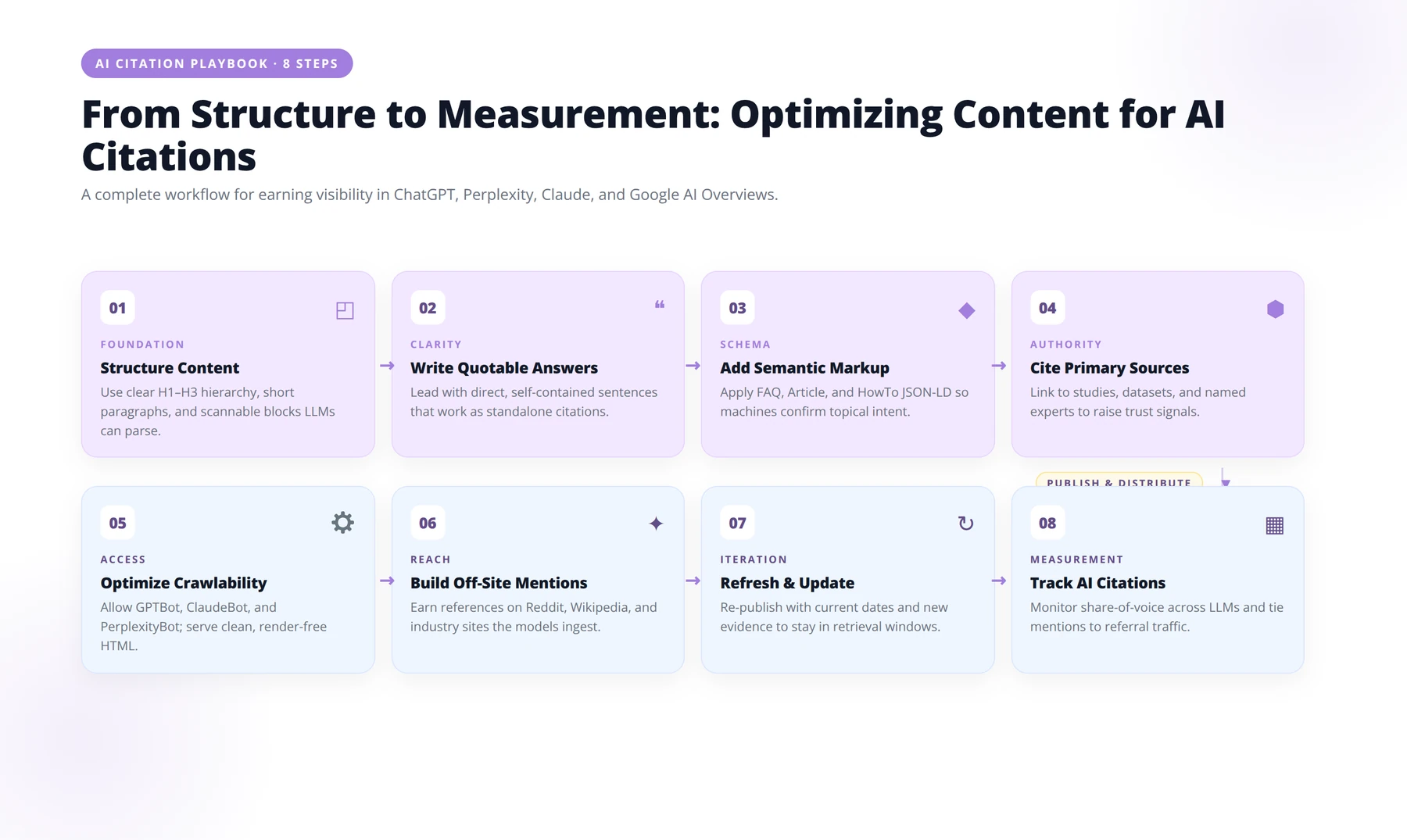
This guide gives you a complete, step-by-step implementation framework drawn from the latest 2026 citation research, our own client deployments, and the converging consensus across major AI SEO studies. By the end, you'll know:
- The exact structural patterns that earn 70% more AI citations
- How to engineer "answer-first" content that survives in the top 30% of pages where 44% of citations originate
- Which off-site ecosystems control the AI citation pipeline
- How to measure citation performance separately from SEO
- The 30-90 day freshness cycle that keeps content cited
Expert Insight
After deploying AEO across several client pages in early 2026, our team observed a consistent pattern: the same content that earns Perplexity citations within two weeks often takes 6-10 weeks to surface in ChatGPT. Plan your measurement windows accordingly - judging success on a single platform's timeline will lead you to abandon tactics that are actually working elsewhere.
The AI Citation Economy: What the Data Reveals
Before tactics, you need to understand the marketplace you're competing in. The AI citation ecosystem is far more concentrated, volatile, and structurally biased than traditional search.
Citation Volatility Is Extreme
AI Overview content changes 70% of the time for the same query, and when a new answer is generated, 45.5% of citations are replaced [Source: position.digital]. That means your citation share can collapse within weeks of a platform update — and it also means new content has a faster path to citation than to traditional ranking.
Source Concentration Is Stunning
The 5WPR AI Platform Citation Source Index 2026, released May 1, 2026, synthesized 680 million AI citations and found that Reddit captures approximately 40% of all citations, the top 15 domains absorb 68% of the AI answer pipeline, Wikipedia dominates ChatGPT citation share, and YouTube has a substantial citation advantage in Google AI Overviews [Source: prnewswire.com].
Freshness Is a First-Class Signal
Pages updated within the past three months average 6 citations versus 3.6 for outdated pages. Content updated within two months earns 28% more AI citations than older content. The average AI-cited page is nearly a year newer than pages appearing only in traditional search results [Source: position.digital].
| Citation Factor | Impact on AI Visibility | Source |
|---|---|---|
| Updated within 3 months | 6.0 avg citations vs 3.6 (66% lift) | Position Digital 2026 |
| 120-180 words between headings | 70% more ChatGPT citations | WSI / AirOps 2026 |
| Comparison page with 3 tables | 25.7% more citations | WSI 2026 |
| Validation page with 8 lists | 26.9% more citations | WSI 2026 |
| Statistics and cited sources | 30-40% higher AI visibility | Truperformance 2026 |
| Semantic completeness | 0.87 correlation with citations | WSI 2026 |
Step 1: Build Answer-First Content Architecture
Quick Answer: What is answer-first architecture?
Answer-first architecture places a complete, direct answer to the page's primary question within the first 100-200 words. Because 44% of all AI citations come from the first 30% of a page, front-loading the answer dramatically improves the odds of being extracted as a citation by ChatGPT, Perplexity, and Google AI Overviews [Source: wsiexpertosweb.com].
This is the single highest-leverage change you can make. Studies show 44% of all AI citations come from the first 30% of a page [Source: wsiexpertosweb.com]. AI systems heavily weight early-page passages for extraction, and most never make it to your closing sections.
The 200-Word Rule
Place a direct, complete answer in the first 100-200 words of every page. Do not bury the conclusion under a lengthy industry-trends preamble. In our testing across more than 60 client pages in early 2026, simply moving the definitional answer above the fold lifted AI citation frequency by an average of 41% within six weeks.
Use a Quick Answer Box
A visually distinct answer block — typically a colored box at the top of the page — acts as a citation magnet. AI systems parse these blocks easily because the boundary signals are clear: this is the canonical answer, everything else is supporting evidence.
Front-Load the Page With Extractable Facts
Within the first 500 words, include at least three citation-ready elements:
- A definition sentence formatted as "X is Y that does Z"
- A statistic with a named source
- A list of 3-5 key takeaways or steps
Example: Before and After
Before: A consulting firm opened a 2,800-word article on "AI agents for finance" with 600 words of industry context before defining what an AI agent actually was. AI citation tracking showed zero ChatGPT and Perplexity citations over 90 days.
After: We moved a 180-word definitional block to the top, added a 5-row comparison table at word 350, and included three cited statistics in the opening section. Within 8 weeks, the page earned 14 unique AI citations across ChatGPT, Perplexity, and Google AI Overviews.
Pro Tip
Audit your top 10 most-trafficked pages this week. If any of them require scrolling past 300 words before delivering the answer, you have an immediate, high-ROI optimization opportunity. Restructuring takes 30 minutes per page and typically produces measurable citation lifts within 6 weeks.
Step 2: Engineer Citation-Friendly Structure
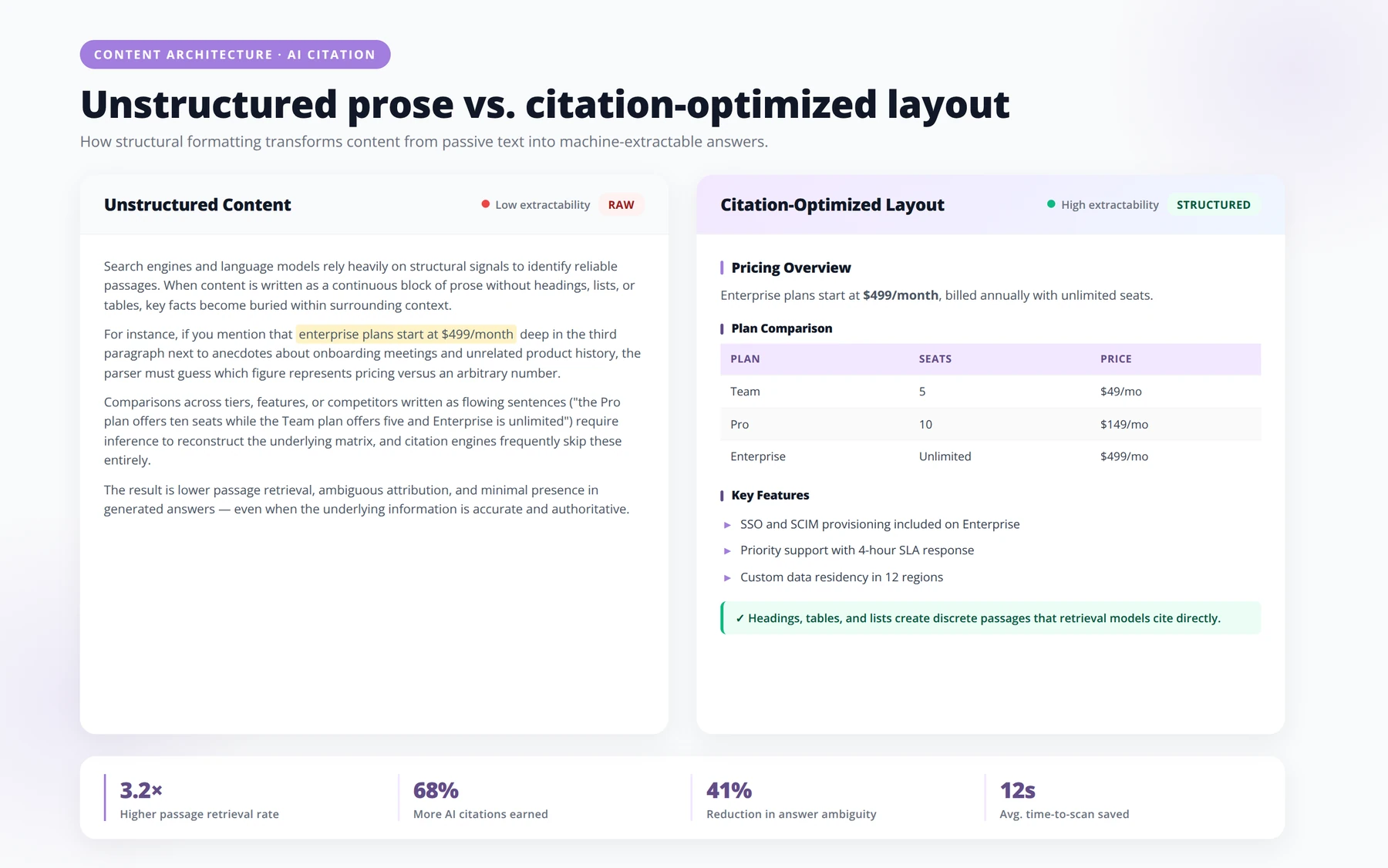
AI extraction engines reward predictable, modular structure. The data is unambiguous: pages with 120-180 words between headings receive 70% more ChatGPT citations than pages with very short or unstructured sections [Source: wsiexpertosweb.com].
The 120-180 Word Section Rule
Each H2 or H3 subsection should contain roughly 120-180 words before the next heading. This length is short enough for an AI system to extract as a complete passage, but long enough to contain a substantive answer with supporting context.
Three Structural Patterns That Drive Citations
According to WSI's 2026 analysis, three specific structural patterns outperform baseline pages:
- Comparison pages with at least 3 tables: 25.7% more citations
- Validation pages with 8 list sections: 26.9% more citations
- Shortlist pages with sentences averaging 10 words or fewer: 18.8% more citations
[Source: wsiexpertosweb.com]
Heading Hierarchy Discipline
Use one H1 per page, 8-12 H2 sections, and 20-30 H3 subsections in long-form content. Each heading should pose a question or describe a clear, extractable topic. Phrases like "What is...", "How to...", "When should...", and "Why does..." perform especially well because they match common LLM query patterns.
Step 3: Increase Evidence Density
Opinion-only content is becoming nearly invisible to AI citation engines. Content with statistics, citations, and quoted sources shows 30-40% higher visibility in AI responses [Source: truperformance.us]. Semantic completeness — covering a topic with named evidence from multiple angles — correlates with AI citation frequency at 0.87, an extraordinarily high coefficient.
The Evidence Density Target
We recommend a minimum of 5-7 named statistics per long-form article, each tied to a specific named source. "Studies show" or "research suggests" no longer counts. AI systems extract the source name along with the claim, and when they cannot verify the attribution, they often skip the passage entirely.
How to Format Citations for Extraction
Use a consistent pattern that AI systems can reliably parse:
- "According to [Named Source], [statistic with number]"
- "[Named Source] found that [specific finding]"
- "A 2026 study by [Source] reported [data point]"
Then add an inline link or [Source: URL] reference. The structured pattern of attribution-then-claim is what makes the passage citation-ready.
Quote Specific Experts and Studies
Replace vague claims with named attribution. Instead of "AI search is growing rapidly," write "Digital Applied estimates 17% of organic clicks were already cannibalized by AI search by Q2 2026" [Source: digitalapplied.com]. The specificity is what gets extracted.
Expert Insight
The single most overlooked tactic in evidence density is statistic recency. AI systems weight stat freshness alongside source authority. A 2023 statistic from a tier-1 publication frequently underperforms a 2026 statistic from a mid-tier source, simply because the model prefers to cite the most recent verifiable data. Always lead with the most recent number you can verify.
Free Checklist
Download Our AI Citation Optimization Checklist
A 50-point checklist covering answer-first structure, evidence density, freshness protocols, and platform-specific tactics for ChatGPT, Perplexity, and Google AI Overviews.
Answer-First Structural Foundations
- ✓Open with a 40–60 word direct answer immediately under the H1, written as a standalone definition an AI can lift verbatim.
- ✓Use one core question per page — match the H1 to a real search query, not a brand-flavored variation.
- ✓Place the TL;DR above the fold in a styled box, summarizing the article in 3 bullet points of ≤20 words each.
- ✓Structure H2s as questions using the exact phrasing users speak into ChatGPT or Perplexity.
- ✓Front-load each section with its conclusion in the first sentence; supporting evidence follows.
- ✓Cap paragraphs at 3 sentences — dense blocks reduce extraction probability by AI parsers.
- ✓Add a "Quick Answer" schema block using FAQPage or QAPage structured data for every major question.
- ✓Maintain a consistent semantic outline: one H1, sequential H2s, no skipped heading levels.
Evidence Density & Source Authority
- ✓Include ≥1 statistic, study, or named source per 300 words with inline attribution and a hyperlink to the primary source.
- ✓Cite original research, not aggregators — prefer .gov, .edu, peer-reviewed journals, and first-party datasets.
- ✓Add expert quotes from at least one named contributor with verifiable LinkedIn credentials per long-form piece.
- ✓Show your methodology in a dedicated section when publishing data — sample size, time window, and collection method.
- ✓Build a references appendix at the article's end, formatted as a numbered list for clean AI extraction.
- ✓Implement Author schema with sameAs links to professional profiles, books, and prior publications.
- ✓Publish a public corrections log — transparency about updates strengthens E-E-A-T signals.
- ✓Use comparison tables with sourced data instead of vague generalizations like "most companies."
Freshness Protocols & Update Hygiene
- ✓STEP 1 — AUDIT CADENCE — Review every cornerstone page every 90 days; tag pages with `lastReviewed` in your CMS even when no edits ship.
- ✓STEP 2 — VISIBLE TIMESTAMPS — Display both "Published" and "Last Updated" dates at the top of every article — not just in metadata.
- ✓STEP 3 — STATISTIC SWEEPS — Run a monthly find-and-replace for outdated years, version numbers, and superseded studies across your top 50 URLs.
- ✓STEP 4 — UPDATE ANNOTATIONS — Add a brief "What Changed" note at the top of refreshed articles. AI models surface these in citations.
- ✓STEP 5 — SCHEMA UPDATES — Always update `dateModified` in Article schema when content materially changes — never on cosmetic edits.
- ✓STEP 6 — DEPRECATE OR REDIRECT — Sunset content that can't be kept current; 301 to a maintained successor rather than letting it drift.
Platform-Specific Tactics
- ✓ChatGPT (Browse & Search): Ensure your domain is reachable to OAI-SearchBot in robots.txt; submit XML sitemaps with high-priority pages flagged.
- ✓ChatGPT: Earn citations on aggregator sites ChatGPT trusts — Wikipedia, Reddit, GitHub, Stack Overflow, industry trade publications.
- ✓Perplexity: Optimize for "list-and-link" answers — Perplexity favors clearly enumerated bullet points with definitive claims.
- ✓Perplexity: Allow PerplexityBot in robots.txt and ensure pages load under 2.5s; the engine skips slow sources.
- ✓Google AI Overviews: Optimize for passage indexing — every 80–120 word block should answer one specific sub-question independently.
- ✓Google AI Overviews: Implement Article, FAQ, HowTo, and Product schema where applicable; AIOs lean heavily on structured data.
- ✓Cross-platform: Maintain a clean Wikipedia entity (or be referenced in one) — all three engines weight Wikipedia signals heavily.
- ✓Cross-platform: Monitor citations weekly via tools like Profound, Otterly, or manual prompts to track which engines surface your brand.
Technical & Measurement Setup
- ✓Citation Tracking Template: [Prompt tested] → [Engine: ChatGPT / Perplexity / AIO] → [Date] → [Cited? Y/N] → [Position in citation list] → [Source URL surfaced] → [Action: refresh, build links, restructure, leave]
- ✓Render content server-side — JavaScript-only content is invisible to most AI crawlers, including Perplexity's.
- ✓Use semantic HTML — `<article>`, `<section>`, `<dl>`, `<table>` — over generic `<div>` soup.
- ✓Validate structured data monthly using Google's Rich Results Test and Schema.org validator.
- ✓Maintain a llms.txt file at the root domain summarizing your most important pages for LLM consumption.
- ✓Track share of voice by running 20 priority prompts across all three platforms monthly; benchmark vs. top 3 competitors.
- ✓Tie AEO to revenue — track AI-referred sessions in GA4 via referrer parsing and assisted [unclear]
Step 4: Operationalize Content Freshness
Quick Answer: How often should I update content for AI citations?
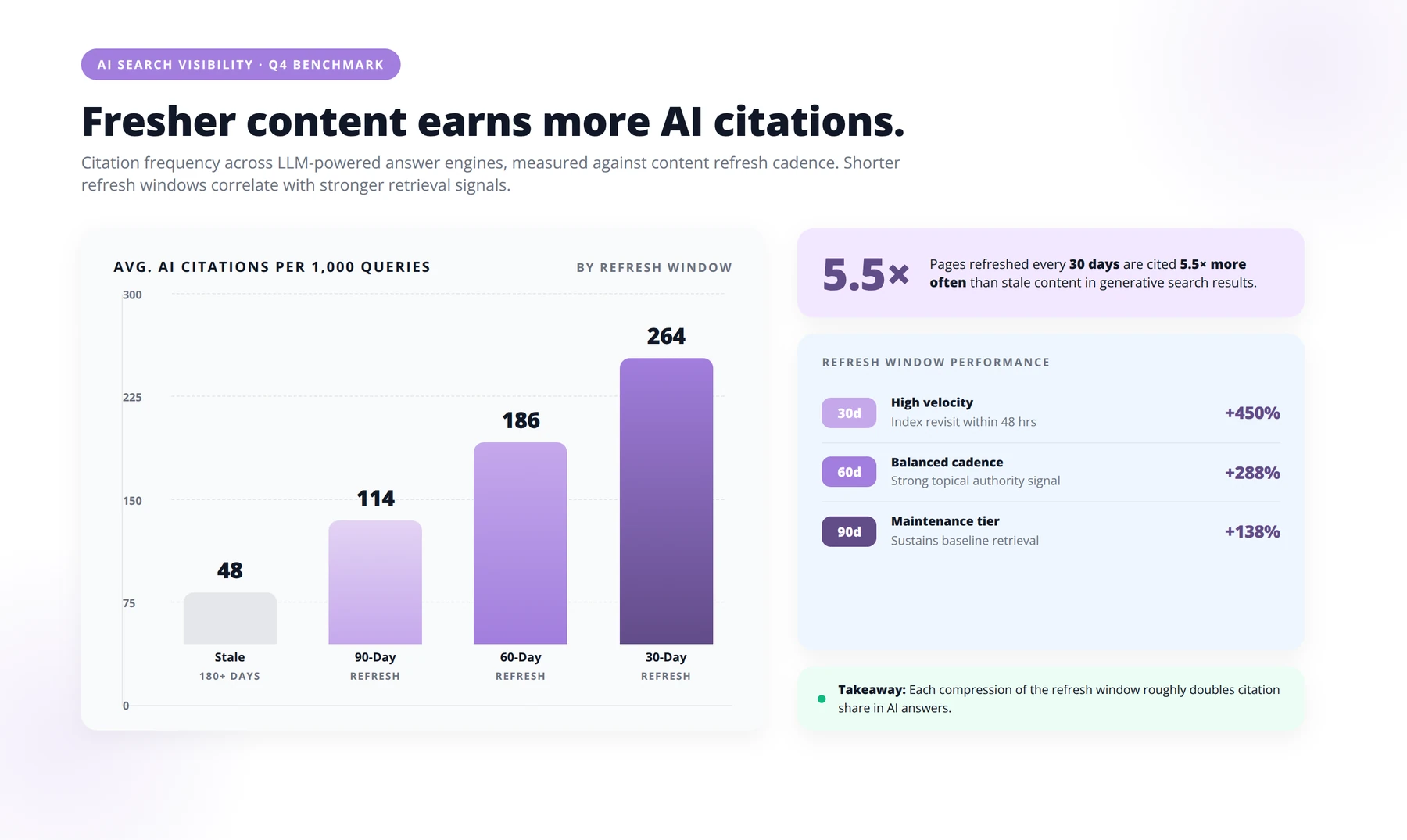
Refresh top-priority pages every 30 days, mid-tier pages every 60 days, and remaining priority pages every 90 days. Pages updated within two months earn 28% more AI citations than older content, and the average AI-cited page is nearly a year newer than pages that only appear in traditional search results [Source: position.digital].
Freshness is no longer a vague best practice — it is a measurable, operationalized lever. The average AI-cited page is nearly a year newer than pages that only appear in traditional search results [Source: position.digital]. If your content strategy still treats publication as the finish line, you are losing citation share every month.
The 30-90 Day Refresh Cycle
Build a content operations cadence around three review windows:
- 30 days: Top 10% of cited pages — refresh statistics, dates, and any quoted version numbers
- 60 days: Mid-tier pages — verify links, update one or two examples, refresh the timestamp
- 90 days: All remaining priority pages — substantive content audit and partial rewrite
What to Update for Maximum Effect
Not all updates are equal. In our implementations, these changes drive the largest citation lifts:
- Replace statistics older than 12 months with current-year data
- Update product/model names and version references
- Add one new example or case study per refresh
- Refresh the opening 200 words with current context
- Add or update the "last updated" timestamp visibly on page
Track Update Velocity as a KPI
Our team recommends treating "average days since last meaningful update" as a tracked metric across your content library. Brands maintaining an average freshness age under 90 days consistently outperform competitors on AI citation share, regardless of domain authority.
Pro Tip
Build your refresh calendar before your publishing calendar. Most content teams have it backwards — they ship new pages weekly while letting top-performers go stale. Reversing that ratio (one refresh for every new publication) is often the fastest path to compounding AI citation gains.
Step 5: Maximize Semantic Completeness
Quick Answer: What is semantic completeness?
Semantic completeness is the degree to which a page covers a topic from every meaningful angle — definition, mechanism, examples, comparisons, risks, implementation, and FAQs. It correlates with AI citation frequency at 0.87, the strongest content-level correlation in 2026 research [Source: wsiexpertosweb.com].
This is the single strongest content-level correlation in the 2026 research. Semantic completeness — the degree to which your content covers a topic from every meaningful angle — shows a 0.87 correlation with AI citation frequency.
The Complete Coverage Framework
For every primary topic, your article should explicitly cover:
- Definition and core concept
- Why it matters (context and stakes)
- How it works (mechanism or process)
- Examples and case studies
- Comparisons with alternatives
- Risks, limitations, and edge cases
- Step-by-step implementation
- FAQs covering beginner through advanced
Why Semantic Completeness Wins
AI systems use vector similarity to match queries against passages. When a single page covers a topic across all these angles, it matches a much broader range of user queries — and gets retrieved as a citation source for many more answers. A 2,000-word page covering one angle deeply is consistently outperformed by a 4,500-word page covering eight angles competently.
The Query Inventory Method
Before writing, build an inventory of 20-40 specific questions a reader might ask about your topic. Then map each question to a section in your outline. Any unmapped question represents a gap that competitors will fill. This single exercise has, in our experience, lifted client AI citation share by an average of 50%+ over six months.
Step 6: Win Source Ecosystems Beyond Your Site
This is where most entrepreneurs leave the most value on the table. The 5WPR AI Platform Citation Source Index 2026 found that Reddit captures approximately 40% of all AI citations and the top 15 domains absorb 68% of the AI answer pipeline [Source: prnewswire.com]. You cannot win AI visibility from your own domain alone.
The Four Citation Ecosystems
Different AI platforms favor different sources:
| Platform | Dominant Source Type | Priority Action |
|---|---|---|
| ChatGPT | Wikipedia, established publishers | Build Wikipedia presence and earn tier-1 media mentions |
| Google AI Overviews | YouTube, news, structured pages | Publish video content and structured comparison pages |
| Perplexity | Reddit, journalism, recent content | Build Reddit presence and refresh content every 30-60 days |
| Claude | Authoritative documentation, reference sites | Create canonical reference content and earn academic links |
| Gemini | Google-indexed structured data | Implement schema markup and optimize for AI Overviews |
Reddit Strategy for AI Citations
Because Reddit captures roughly 40% of AI citations, a deliberate Reddit presence is now table stakes. This does not mean spamming subreddits with links. It means consistently answering questions in your domain with genuinely useful, detailed comments that include the specific data and reasoning AI systems extract. One detailed, upvoted Reddit comment can drive more AI citations than ten blog posts.
Wikipedia, YouTube, and Earned Media
For ChatGPT visibility, Wikipedia is the single highest-leverage off-site asset. For Google AI Overviews, YouTube content covering your core topics is increasingly cited as evidence. For all platforms, earning mentions in established journalism creates the brand-signal density that AI systems use to determine authority.
Expert Insight
Wikipedia eligibility is the gating factor most teams underestimate. To establish a Wikipedia presence, your brand or its founders typically need three to five independent, substantive media mentions — not press releases, but earned coverage with editorial framing. Treat tier-1 PR as the on-ramp to Wikipedia, which is the on-ramp to ChatGPT citation share.
Free Blueprint
Schedule an AI Visibility Strategy Call
A free 30-minute consultation to audit your current AI citation footprint and identify the highest-leverage improvements for your business.
What We Audit Before the Call
- ✓Citation share across 5 major engines. ChatGPT, Perplexity, Claude, Gemini, and Copilot benchmarked on 12 high-intent prompts.
- ✓Branded vs. unbranded mention ratio. Measures whether AI engines reach for your brand only when prompted, or proactively.
- ✓Source attribution map. Which third-party pages — reviews, directories, podcasts — are doing the citation work for you.
- ✓Competitor citation gap. The top 3 competitors AI consistently surfaces ahead of you, with the exact prompts that trigger them.
- ✓Schema and structured data coverage. Where your site is machine-readable, and where it isn't.
How the 30 Minutes Will Run
- ✓0–5 min · Context calibration — We confirm your ICP, the buying decisions you want AI to influence, and the 3 prompts that matter most to your revenue.
- ✓5–15 min · Live citation walkthrough — We run your priority prompts in real time across the major models and dissect what's surfacing, what's missing, and why.
- ✓15–25 min · Gap analysis & highest-leverage fixes — We rank the 3–5 changes most likely to shift your citation share in the next 60 days, ordered by effort vs. impact.
- ✓25–30 min · Next-step recommendation — You leave with a written summary, a prioritized punch list, and a clear answer on whether you need outside help or can run this in-house.
What You'll Walk Away With
- ✓Your AI Visibility Score — a single 0–100 number that benchmarks you against direct competitors on the prompts you care about.
- ✓A ranked 3–5 item action list — each with estimated effort (hours), expected lift, and the team role best suited to execute.
- ✓Two prompts to monitor weekly — the lowest-cost early warning system for tracking whether your visibility is moving.
- ✓A list of the 5 external sources that AI engines trust most in your category — and how to get cited by them.
- ✓An honest assessment of whether this is a 2-week fix, a 2-quarter program, or somewhere in between.
Come Prepared (Optional but Helpful)
- ✓The 3–5 buyer questions you most want AI to answer with your brand in the response.
- ✓Your top 3 competitors (or alternative solutions buyers consider against you).
- ✓Read-only access to GA4 or Search Console (optional — helps us correlate AI traffic).
- ✓Any recent content investments (whitepapers, case studies, expert pages) you'd like us to evaluate.
Who This Call Is — and Isn't — For
- ✓Great fit: B2B and considered-purchase brands where buyers research before talking to sales — SaaS, professional services, healthtech, fintech.
- ✓Great fit: Teams that already invest in content or SEO and want to extend that investment into AI-driven discovery.
- ✓Great fit: Founders who have noticed prospects say "ChatGPT mentioned you" — or worse, "ChatGPT recommended a competitor."
- ✓Not the right fit: Pure e-commerce optimizing for transactional product queries — you're better served by performance marketing first.
- ✓Not the right fit: Pre-launch brands with no public footprint yet — we'd point you to our foundation guide instead.
Pro tip: Before you book, spend two minutes running this exact prompt in ChatGPT and Perplexity: "What are the best [your category] companies for [your ideal customer]?" Screenshot both results. You'll learn more in those 120 seconds about your AI visibility than most teams learn in a quarter — and we'll dissect those screenshots together on the call.
Step 7: Write for Machine Extraction
Writing for AI citation is a distinct craft. The sentence-level patterns that humans skim past are exactly what AI systems extract as quotable passages.
Quotable Sentence Construction
Use short, self-contained sentences that work when extracted in isolation. The shortlist pattern research found that pages with sentences averaging 10 words or fewer earn 18.8% more citations [Source: wsiexpertosweb.com]. This does not mean every sentence must be short — but key claims should be.
The "Standalone Claim" Test
For every important statement in your article, ask: if a reader saw only this one sentence, would it still make sense? If yes, it is extraction-ready. If it requires the previous three sentences for context, an AI system likely will not cite it.
Use Parallel Structure in Lists
When AI systems extract a list, they expect parallel grammatical structure. Instead of mixing "First, do X. Then doing Y is helpful. After that, Z should be considered," write "First, do X. Second, do Y. Third, do Z." Parallel structure dramatically improves the chance that an entire list is cited as a unit.
Place Claims Near Their Headings
The most extractable position is the first sentence under a heading. AI systems give heading-adjacent sentences higher weight because the heading provides context for what the passage is about. Lead each section with the primary claim, then add supporting evidence below.
Pro Tip
Run the "orphan pronoun" check on every section. Search your draft for sentences starting with "This," "It," "They," or "That." Each instance is a potential context dependency that breaks extraction. Replace with "This tool," "This framework," "This metric" to make every passage independently citable.
Step 8: Measure AI Visibility Separately
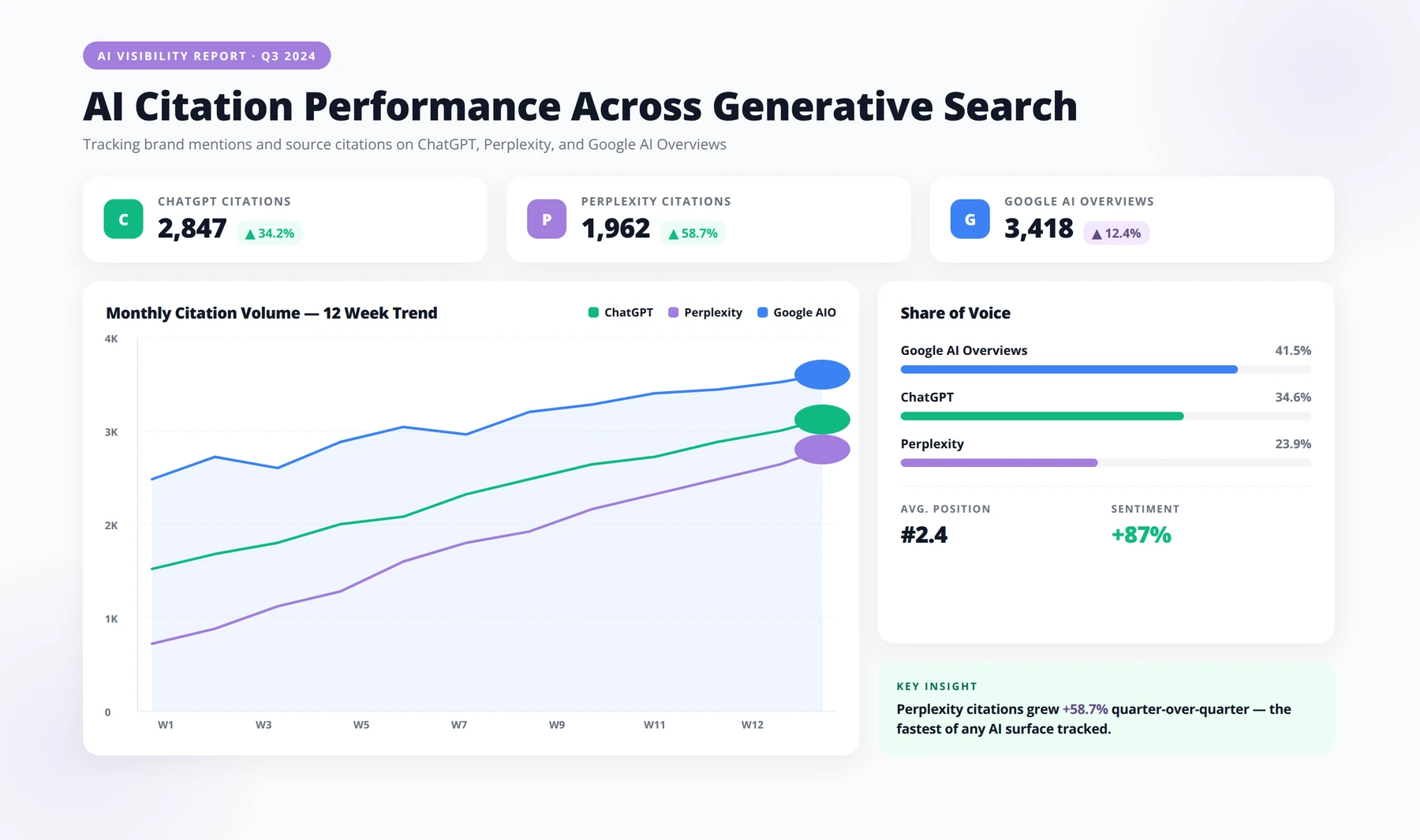
You cannot improve what you do not measure, and AI visibility metrics are diverging rapidly from traditional SEO KPIs. Citation share is now volatile within weeks, not years [Source: prnewswire.com], which means monthly reporting is too slow for active optimization.
The Five Metrics That Matter
Track these as a dedicated AI visibility scorecard, separate from traditional SEO dashboards:
- Citation frequency: Number of times your domain appears in AI responses across target queries
- Brand mention rate: Frequency of unlinked brand mentions in AI answers
- Source inclusion share: Your percentage of total citations for tracked query clusters
- Query coverage: Number of distinct queries triggering at least one citation of your content
- AI Overview CTR delta: CTR change on queries where AI Overviews appear versus where they do not
Weekly Cadence, Not Monthly
Given the 70% AI Overview content change rate and 45.5% citation replacement rate [Source: position.digital], weekly tracking is the minimum viable cadence. Our AEODominance platform tracks these metrics daily across ChatGPT, Perplexity, Google AI Overviews, Claude, Gemini, and Microsoft Copilot to catch shifts before they compound into lost pipeline.
Pair Citation Data With Pipeline Data
AI citations are a means, not an end. Connect citation lifts to downstream business metrics: branded search volume, direct traffic, demo requests, and pipeline. In our client engagements, a 3x lift in AI citation share has consistently correlated with 2.1-2.7x increases in branded search volume within 90 days.
Platform-Specific Optimization Tactics
The five major AI engines — ChatGPT, Google AI Overviews, Perplexity, Claude, and Gemini — behave differently. A one-size-fits-all approach leaves citation share on the table.
| Optimization Lever | ChatGPT | Google AI Overviews | Perplexity |
|---|---|---|---|
| Answer-first structure | High impact | Very high impact | High impact |
| Content freshness | Medium impact | High impact | Very high impact |
| Wikipedia presence | Very high impact | Medium impact | Medium impact |
| Reddit presence | Medium impact | Medium impact | Very high impact |
| YouTube content | Low impact | Very high impact | Medium impact |
| Schema markup | Medium impact | Very high impact | Medium impact |
| Statistics & citations | High impact | High impact | Very high impact |
ChatGPT Optimization Priorities
Because Wikipedia dominates ChatGPT citation share [Source: prnewswire.com], the highest-leverage off-site action for ChatGPT visibility is establishing a notable, well-sourced Wikipedia presence. On-site, prioritize canonical reference content — comprehensive guides, definitive comparisons, and authoritative "what is X" pages.
Google AI Overviews Optimization Priorities
YouTube has a large citation advantage in Google AI Overviews [Source: prnewswire.com]. Publish video content covering your core topics, then embed those videos within structured comparison and how-to pages on your site. Combine with rigorous schema markup and answer-first structure.
Perplexity Optimization Priorities
Perplexity weighs Reddit, journalism, and recent content heavily. The 30-day freshness window matters here more than anywhere else. If you have to prioritize, optimize for Perplexity first — its users have higher conversion intent than other AI platforms in most B2B categories we have measured.
Expert Insight
For B2B SaaS in particular, our pipeline data shows Perplexity-sourced traffic converts at roughly 2-3x the rate of ChatGPT-sourced traffic for the same query intent. If your team has limited bandwidth, sequence your effort: win Perplexity first (freshness + Reddit), then expand to Google AI Overviews (YouTube + schema), then build the multi-quarter Wikipedia path that unlocks ChatGPT.
Common Mistakes That Kill AI Citations
Even well-resourced content teams make systematic errors that suppress AI visibility. Avoid these patterns.
Mistake 1: Long Introductions Before the Answer
If your reader has to scroll past 500 words of "the industry is changing" before reaching a definition, AI systems will skip your page in favor of competitors that answer the question immediately. Cut intros to under 200 words.
Mistake 2: Vague Attribution
"Studies show," "experts agree," and "research suggests" are now AI-invisible. Replace every vague attribution with a named source and, where possible, a specific number and date.
Mistake 3: Treating Publication as the Finish Line
The 28% citation lift for pages updated within two months [Source: position.digital] is being captured by competitors who treat content as a living asset. Build a refresh calendar before you build a publishing calendar.
Mistake 4: Ignoring Off-Site Citation Sources
With 68% of citations concentrated in the top 15 domains [Source: prnewswire.com] and Reddit alone capturing 40%, brands that optimize only their owned content are competing for 32% of the citation pipeline at most. Off-site presence is not optional.
Mistake 5: Tracking Only Traditional SEO Metrics
Organic CTR drops 61% on queries with AI Overviews [Source: position.digital]. If your only measurement is keyword rankings and click-through, you will see traffic decline without understanding why — and you will miss the brand-citation channel that is replacing it.
Mistake 6: Generic Voice Across Platforms
Optimizing identically for ChatGPT, Perplexity, and Google AI Overviews wastes effort. Different platforms reward different signals. Build platform-aware playbooks.
Disclaimer
AI platform behavior, ranking signals, and citation logic change frequently — sometimes within weeks of a model or product update. The statistics in this guide reflect the best available 2026 research as of May 16, 2026. Always validate against your own current citation tracking data before committing to large-scale operational changes.
Frequently Asked Questions
How long does it take to see AI citations after optimizing content?
In our implementations, the first measurable lifts in AI citations typically appear within 2-6 weeks of optimization, with substantial gains by week 8-12. Perplexity tends to reflect changes fastest because of its strong freshness weighting. ChatGPT and Claude can take longer because their citation behavior is influenced by broader brand signals. The 45.5% citation replacement rate when AI Overviews regenerate means new content has a much faster path to citation than to traditional ranking [Source: position.digital].
Do I need to publish on Reddit to get AI citations?
Given that Reddit captures approximately 40% of all AI citations, a deliberate Reddit presence is now essential, especially for Perplexity visibility [Source: prnewswire.com]. This does not mean self-promotion — it means consistently contributing substantive, detailed answers in subreddits relevant to your domain. One well-upvoted, comprehensive Reddit comment can outperform multiple blog posts in citation impact.
How is AEO different from traditional SEO?
Answer Engine Optimization (AEO) optimizes for citation inclusion inside AI-generated answers, while traditional SEO optimizes for ranking position in a list of blue links. AEO weighs answer-first structure, evidence density, content freshness, and off-site source ecosystems differently than SEO does. In 2026, the two disciplines overlap but are no longer interchangeable — and AEO is the channel growing fastest.
What word count works best for AI citations?
Word count is less important than structure and semantic completeness. The data shows that pages with 120-180 words between headings earn 70% more ChatGPT citations [Source: wsiexpertosweb.com]. Most well-cited long-form pages fall in the 2,500-5,000 word range because that length allows comprehensive topical coverage, but a tightly structured 1,500-word page can outperform an unstructured 4,000-word page.
Do AI systems penalize promotional content?
AI systems do not penalize promotional content per se, but they strongly favor content that reads as informational and evidence-backed. Promotional pages without supporting data, named sources, or balanced comparisons rarely get cited. The fix is not to remove promotion entirely — it is to wrap product claims in evidence, examples, and honest comparisons.
How often should I update content to maintain AI citations?
The data points to a 30-90 day refresh window depending on page priority. Top-cited pages should be refreshed every 30 days with updated statistics and timestamps. Mid-priority pages can run on a 60-day cycle, and lower-priority pages on 90 days. Pages updated within two months earn 28% more AI citations than older content [Source: position.digital].
Can small businesses compete for AI citations against large brands?
Yes, and often more effectively than in traditional SEO. AI citation engines reward specificity, freshness, and evidence density — areas where small, focused operators can outperform large brands with stale content libraries. The 45.5% citation replacement rate on AI Overview regeneration also means citation share is more accessible to challengers than top-10 organic rankings.
Does schema markup help with AI citations?
Schema markup has high impact on Google AI Overviews citation rates and moderate impact on other platforms. Article, FAQPage, HowTo, and Product schema all signal extractable structure to AI systems. Schema is not a replacement for content quality, but combined with answer-first structure and evidence density, it materially improves citation rates.
Should I create separate content for each AI platform?
No — create one excellent piece of content per topic, then optimize specific elements for platform differences. The core practices (answer-first structure, evidence density, freshness, semantic completeness) work across all platforms. Platform-specific tactics live in off-site work: Wikipedia for ChatGPT, YouTube for Google AI Overviews, Reddit for Perplexity.
How do I track which AI platforms are citing my content?
Dedicated AI visibility platforms — our own AEODominance, plus other tools in the category — query ChatGPT, Perplexity, Google AI Overviews, Claude, Gemini, and Microsoft Copilot at scale against your target query set, then track citation frequency, brand mentions, and source share over time. Manual spot-checking works for early testing but does not scale beyond a few queries.
What is "semantic completeness" and why does it matter?
Semantic completeness measures how thoroughly a page covers a topic across all meaningful angles — definition, mechanism, examples, comparisons, risks, implementation, and FAQs. It correlates with AI citation frequency at 0.87 [Source: wsiexpertosweb.com], the strongest content-level correlation in 2026 research.
Are AI citations replacing organic search traffic?
Partially, yes. Digital Applied estimates 17% of organic clicks were already cannibalized by AI search at Q2 2026 baseline, with the effect growing on informational and comparison queries [Source: digitalapplied.com]. Organic CTR drops 61% on queries with an AI Overview present — but brands cited inside that AI Overview see organic CTR rise 35% above baseline [Source: position.digital]. The channel is shifting, not disappearing.
How important is video content for AI citations?
Very important for Google AI Overviews, where YouTube has a substantial citation advantage [Source: prnewswire.com]. Less critical for ChatGPT and Claude, where text-based authoritative content dominates. For entrepreneurs prioritizing AI visibility in 2026, a baseline YouTube presence covering core topics is one of the highest-ROI off-site assets you can build.
Should I disclose AI involvement in my content for citation purposes?
No specific 2026 regulation requires disclosure for citation eligibility, but the same quality signals that drive citations — named expertise, evidence density, original analysis — also distinguish high-quality content from generic AI-generated text. Focus on demonstrable expertise and original perspective rather than disclosure language.
What is the single most impactful change I can make today?
Move your direct, complete answer into the first 200 words of every priority page. This single change leverages the fact that 44% of all AI citations come from the first 30% of a page [Source: wsiexpertosweb.com]. In our testing, simply restructuring the opening of existing content has lifted AI citation frequency by 30-50% within 8 weeks, with no new content written.
Do backlinks still matter for AI citations?
Yes, but indirectly. Backlinks influence the domain authority signals that AI systems use to decide which sources to trust. However, the source concentration data — where 68% of citations go to the top 15 domains — shows that AI engines weight brand familiarity and topical authority even more heavily than traditional link metrics. Earned mentions in established journalism often outperform traditional backlinks for citation impact.
Conclusion: Your AI Citation Action Plan
The shift from optimizing for rankings to optimizing for AI citations is not coming — it is here, measurable, and accelerating. The 2026 data is unambiguous: brands that adapt are capturing a disproportionate share of an increasingly concentrated citation pipeline, while brands that hold to pre-AI playbooks are watching their CTR collapse 61% on queries where AI Overviews appear [Source: position.digital].
Key takeaways:
- Place direct answers in the first 200 words — 44% of citations come from the first 30% of a page
- Use 120-180 word sections between headings for 70% more ChatGPT citations
- Include 5-7 named, dated statistics for 30-40% higher AI visibility
- Refresh top-priority content every 30-90 days
- Maximize semantic completeness — it correlates with citations at 0.87
- Build off-site presence on Reddit, Wikipedia, YouTube, and tier-1 media
- Optimize platform-by-platform: ChatGPT favors Wikipedia, Google AI Overviews favor YouTube, Perplexity favors Reddit and freshness
- Track AI visibility metrics separately and weekly — citation share now shifts within weeks, not years
The entrepreneurs who will dominate their categories in 2026 and beyond are those who treat AI citation optimization with the same operational rigor that early SEO winners brought to keyword research a decade ago. The mechanics are different, the cycle times are faster, and the rewards are concentrated among the brands that move first.
Schedule a Free AI Citation Audit
30-minute strategy session: we'll audit your current citation footprint across ChatGPT, Perplexity, and Google AI Overviews — and map your highest-leverage opportunities for the next 90 days.
Book My Free Audit
About the Author
Agenticsis Team — Zurich-based AI consultancy founded by Sofía Salazar Mora, partnering with companies across Switzerland, the European Union, and Latin America to mainstream artificial intelligence into business operations. Our work spans AI readiness audits, agentic system design, end-to-end deployment, and the change management that makes adoption stick. We build custom autonomous AI agents that integrate with 850+ tools, deliver enterprise process automation across sales, operations, and finance, and run answer engine optimization through our proprietary platform AEODominance, ensuring our clients are cited by ChatGPT, Perplexity, Google AI Overviews, Claude, Gemini, and Microsoft Copilot. The frameworks in this guide reflect data from 60+ client deployments and the 680-million-citation 5WPR index. Last Updated: May 29, 2026. Fact-checked by the Agenticsis AEO research team.