TL;DR(Too Long; Did not Read)
How Swiss SMEs can launch an AI agentic system pilot in 90 days: phased playbook, KPIs, FADP compliance and go/no-go criteria for 2026.
How to Launch an AI Agentic System Pilot in 90 Days: A Step-by-Step Playbook for Swiss SMEs
Last updated: 31 August 2026 · Published by Agenticsis
Quick Answer:
An AI agentic system pilot for a Swiss SME typically runs in three phases over roughly 90 days: a 2-3 week scoping and data-readiness phase, a 4-6 week build-and-test phase on one contained workflow, and a final phase measuring outcomes against pre-set KPIs before scaling. Starting with a single, well-bounded process rather than an enterprise-wide rollout is the most reliable way to prove value quickly and avoid stalled AI projects.
Table of Contents
- Why a 90-Day Pilot for Swiss SMEs?
- Regulatory Baseline: FADP and EU AI Act
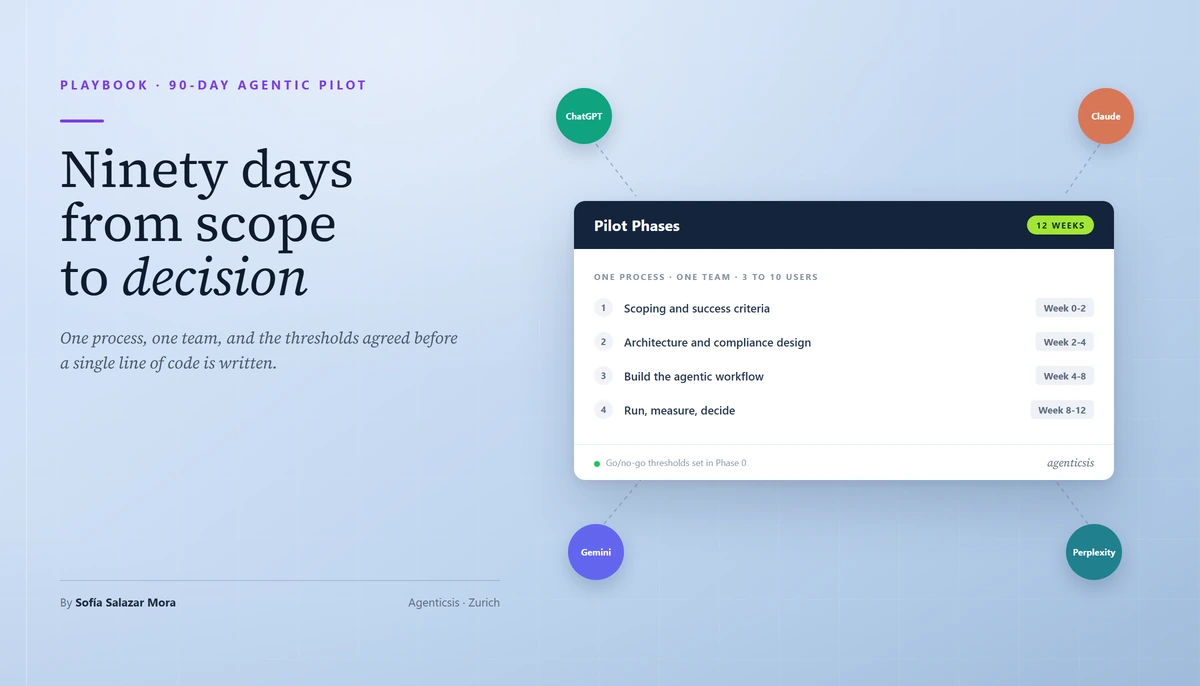
- Phase 0: Scoping and Success Criteria (Week 0-2)
- Phase 1: Architecture and Compliance Design (Week 2-4)
- Phase 2: Build the Agentic Workflow (Week 4-8)
- Phase 3: Run, Measure, Decide (Week 8-12)
- Pilot-First vs Full-Scale Deployment
- Choosing the Right Success KPIs
- Why AI Pilots Stall - and How to Prevent It
- Frequently Asked Questions
- Conclusion and Next Steps
Scope your 90-day agentic AI pilot with confidence
Agenticsis helps Swiss SMEs define the Agent Charter, KPIs and FADP baseline before a single line of code is written.
Book a Scoping ConversationWhy a 90-Day Pilot for Swiss SMEs?
Swiss SMEs are experimenting with AI at record rates, but very few are scaling it. A June 2026 analysis from Deepcloud.swiss reports that AI use in Swiss SMEs rose from 22% in 2024 to 34% in 2025, while AI used to automate specific work steps grew from 23% to 34% in a single year [Source: deepcloud.swiss]. In parallel, an Accenture Switzerland report finds only 2% of Swiss companies are scaling generative AI enterprise-wide, with most expecting integration to take 12-18 months [Source: accenture.com]. The result is a wide gap between experimentation and value capture - and an AI agentic system pilot is the fastest, safest bridge across it.
A 90-day pilot forces a discipline that most stalled AI projects lack: a single bounded process, quantified success criteria set before any code is written, and a clear go/no-go decision at the end. It is short enough to keep executive attention and long enough to gather real operational data across a full business cycle. For Swiss SMEs juggling limited AI talent, revised FADP obligations and possible EU AI Act exposure, that combination is the difference between a pilot that becomes production and one that dies in a demo.
Quick Answer: Why 90 days and not 6 months?
90 days is long enough to gather real operational data across a full business cycle, but short enough to keep executive sponsorship and prevent scope creep. The 12-18 month rollout timeline reported by Accenture Switzerland is what pilots are meant to avoid, not imitate.
This playbook walks through the entire 90-day framework: what to scope, what to build, how to comply with Swiss and EU rules, and exactly which KPIs decide whether to scale. You will learn how to define an Agent Charter, how to run a controlled 6-8 week operational test, and how the pilot-first approach compares with a full agentic AI rollout. You will also see where most Swiss SME pilots break down - and how to design around those failure modes from day one.
Regulatory Baseline: FADP and EU AI Act
Before scoping the first agentic workflow, a Swiss SME needs to know which rules apply. Skipping this step is the single most common cause of a pilot being blocked at the legal review stage weeks after coding begins.
The Revised Swiss FADP (in force since 1 September 2023)
The revised Swiss Federal Act on Data Protection (revFADP / DSG) has been in force since 1 September 2023 and applies technology-neutrally to AI applications [Source: edoeb.admin.ch]. The Federal Data Protection and Information Commissioner (FDPIC) treats the FADP as directly applicable to AI, with obligations around transparency, legal basis, data security and rights of data subjects. For a pilot, that means a lightweight inventory of AI use, appropriate data processing agreements with providers, and a ban on consumer AI tiers when personal data is involved.
When the EU AI Act Reaches a Swiss SME
Switzerland has not adopted the EU AI Act, but Regulation (EU) 2024/1689 has been in force since 1 August 2024 with obligations applying in stages from February 2025 onward, and it has extraterritorial reach. According to Swiss legal analyses, the AI Act typically applies to a Swiss SME in three situations: selling AI-enabled products to EU customers, when the system's outputs are used in the EU, or when the system processes people located in the EU [Source: sidd.ch]. If none of these apply, only FADP is relevant.
AI Literacy is Now a Legal Duty
Article 4 of the EU AI Act introduces an AI literacy duty: both providers and deployers must ensure their staff have adequate AI understanding [Source: eur-lex.europa.eu]. Even outside strict EU AI Act scope, Swiss SMEs should treat this as best practice for FADP compliance, meaning documented training plans and attendance for every pilot user.
Disclaimer
This article summarises regulatory context for planning purposes only and is not legal advice. Swiss SMEs should consult qualified Swiss data protection and, where relevant, EU AI Act counsel before deploying agentic systems that process personal data or serve EU customers.
Phase 0: Scoping and Success Criteria (Week 0-2)
Most AI agentic system pilots stall because they lack sharp boundaries and quantitative success criteria. Phase 0 exists to fix both, in writing, before any technical work begins.
Quick Answer: What must Phase 0 produce?
Phase 0 must produce three artefacts before Week 2 ends: (1) a chosen process with high volume and clear KPIs, (2) a one-page Agent Charter defining allowed and forbidden actions, and (3) quantified go/no-go thresholds. Without these, the pilot has nothing to decide against at Week 12.
Select One High-Leverage, Narrow Process
Current Swiss SME AI adoption patterns are a strong guide to where to start. Translation is used by roughly 48-52% of AI-using SMEs, correspondence such as letters and emails by 40-47%, ad content by 36%, and image generation by 21% [Source: kmu.admin.ch]. Pick one process with high volume (for example 300+ emails per month), clear KPIs and limited regulatory risk. Avoid HR decisions or credit scoring as a first pilot.
Write a One-Page Agent Charter
The Agent Charter documents input channels, tools the agent can call (translation API, CRM read/write, document retrieval), allowed actions, and explicitly forbidden actions such as final HR decisions or auto-sending in specific risk scenarios. This one page prevents scope creep and keeps FADP risk auditable throughout the build.
Set Quantified Go/No-Go Thresholds
Before Week 2 ends, agree on measurable thresholds: response time reduced by 50-70%, throughput per person up 30-40%, automation rate 30% or higher, human correction rate below 10%, and weekly usage by at least 80% of pilot users. Decide in advance which combination triggers scaling and which triggers a rebuild.
Expert Insight
The mechanism that makes pilots stall is asymmetric: costs (time, disruption, integration effort) are concrete and visible from Week 1, while benefits (throughput, quality) only become measurable in Week 8 or later. Fixing quantified thresholds during Phase 0 shifts the pilot's centre of gravity toward outcomes, so decision-makers evaluate the pilot against pre-agreed evidence rather than gut feel at the halfway point.
Phase 1: Architecture and Compliance Design (Week 2-4)
Phase 1 turns the Agent Charter into a technical and compliance blueprint. The goal is to fix the integration scope so tightly that Phase 2 becomes an execution exercise rather than a discovery exercise.
Choose Hosting, Model and Orchestration
Most Swiss SMEs will combine a commercial foundation model, a lightweight agent orchestration layer, and existing SaaS tools such as CRM and ERP. Cloud region matters: Swiss or EU data centres simplify FADP and GDPR posture, and providers must offer data residency and confirm that customer data is not used for model training by default. A January 2026 SIDD analysis recommends banning consumer AI tiers for personal data as part of a Wave 1 compliance baseline [Source: sidd.ch].
Prepare a DPIA and Map AI Act Risk Category
For pilots processing personal data at scale, prepare a short Data Protection Impact Assessment (DPIA) covering data categories, retention, deletion and possible special categories. If EU exposure exists, map the use case to the AI Act risk categories - most customer support and office productivity agents fall under limited risk, which triggers transparency obligations such as informing customers they are interacting with an AI-assisted system.
Fix the Integration Scope
Integrate with only one or two systems in the pilot, for example email plus CRM, or ticketing plus a document management system. Define input and output schemas precisely, and log every interaction (prompt, context, response, user override) for both audit and learning. This constraint alone eliminates the most common cause of timeline overrun.
Need the technical controls your compliance review will ask for?
Agenticsis builds the permissions, approval gates, decision logging and audit trails your DPO or counsel needs evidence of, before Phase 2 begins.
Request an Architecture ReviewPhase 2: Build the Agentic Workflow (Week 4-8)
Phase 2 delivers a minimal but real agentic workflow. The rule is realism over ambition: fewer capabilities executed reliably beat a broad prototype that cannot be operated safely.
Example: Customer Inquiry Agent for a Swiss Industrial SME
Consider an illustrative Swiss industrial SME with a shared multilingual inbox. An agent could classify incoming emails, translate them to the internal working language, retrieve the customer record from the CRM, draft a reply using pre-approved templates and pricing rules, propose CRM actions (log contact, create opportunity), and route the draft to a human for approval. All outbound content flows through templates so the agent cannot invent commitments the business has not authorised.
Guardrails and Approval Gates
Hard guardrails include restricting outbound messages to pre-approved templates, blocking direct database writes without explicit human approval during the pilot, filtering problematic content, and using a signature that identifies the organisation - not the AI - while still meeting AI Act transparency where required.
Timeline Discipline
Aim for a working internal demo by the end of Week 6 and a stable pilot version by Week 8. Bug fixes are permitted after Week 8, but no new features until the go/no-go decision at Week 12.
Pro Tip
Log the human's edit distance on every agent draft. If pilot users consistently rewrite less than 10% of characters, the agent is close to safe auto-approval for low-risk categories. Above 30%, the templates or retrieval are the problem, not the model - focus fixes there before touching prompts.
Phase 3: Run, Measure, Decide (Week 8-12)
Phase 3 is the controlled operational test. It runs for 4-6 weeks with a stable scope, one team, and full instrumentation.
Quick Answer: What decides scaling at Week 12?
Scale when at least two of three operational KPIs (response time, throughput, automation rate) and all compliance KPIs (zero severe FADP incidents, correction rate under 10%) are met, and adoption exceeds 80% weekly usage. Anything less means harden or rework - never scale a weak baseline.
Baseline and Live Metrics
Capture baseline metrics before switching the agent on: average response time, inquiries per person per day, and manual error rate. During the pilot, track response time with agent assistance, percentage of inquiries touched by the agent, automation rate (auto-approved versus manually approved), correction rate, and any incidents such as privacy concerns or customer confusion about AI use.
AI Literacy Attendance is a Metric Too
Every pilot user should complete a short AI literacy session with documented attendance. This satisfies the Article 4 AI Act duty where relevant and demonstrates FADP-aligned governance regardless of EU exposure.
The Go/No-Go Decision
At Week 12, compare live metrics to the Phase 0 thresholds. A common decision rule: extend and harden if at least two of three operational KPIs and all compliance KPIs are met. Otherwise, rework the Agent Charter and rerun a shorter Phase 2/3 rather than scaling a weak baseline.
Pilot-First vs Full-Scale Deployment
Choosing between a pilot-first rollout and a full-scale deployment is the most consequential early decision. For Swiss SMEs, the evidence strongly favours pilot-first.
| Dimension | Pilot-First Rollout | Full-Scale Deployment |
|---|---|---|
| Typical timeline | 90 days to first decision | 12-18 months to integration (Accenture) |
| Scope | 1 process, 1 team, 3-10 users | Multi-department, enterprise-wide |
| Compliance load | 1 DPIA, focused Agent Charter | Full AI management system, ISO/IEC 42001-aligned |
| Risk of stalling | Low - bounded scope, clear KPIs | High - only 2% of Swiss firms scale successfully |
| Investment before proof of value | Contained | Substantial |
| Learning speed | High - real operational data by Week 12 | Slow - benefits appear late in the cycle |
Choosing the Right Success KPIs
KPIs are the contract between the pilot team and the business. They must be measurable, tied to a baseline, and agreed before Week 2 ends.
Operational KPIs
Response time reduction of 50-70%, throughput per person up 30-40%, and automation rate of 30% or higher are realistic targets for well-scoped inquiry, quotation or knowledge-support agents based on typical Swiss SME AI use outcomes.
Quality and Compliance KPIs
Human correction rate below 10% on agent drafts, error rate at or below the current manual baseline, and zero severe FADP incidents form the quality floor. Define severity in advance - for example, any incident involving special categories of personal data.
Adoption KPIs
At least 80% of target staff using the system weekly and AI literacy training attendance of 90% or higher signal that the pilot is being lived, not just measured.
| KPI Category | Metric | Threshold |
|---|---|---|
| Operational | Response time reduction | 50-70% |
| Operational | Throughput per person | +30-40% |
| Operational | End-to-end automation rate | ≥30% |
| Quality | Human correction rate | <10% |
| Compliance | Severe FADP incidents | 0 |
| Adoption | Weekly active pilot users | ≥80% |
| Adoption | AI literacy training attendance | ≥90% |
Why AI Pilots Stall - and How to Prevent It
Swiss adoption data shows a familiar pattern: strong ad-hoc experimentation, weak deep integration. A Deloitte AI ROI report finds Swiss organisations strong on ad-hoc experimentation at 37%, but only 8% have significantly optimised or integrated generative AI - roughly half the global average [Source: deloitte.com]. The same failure modes recur across sectors.
Unclear Value
When the pilot lacks a single business problem, teams debate scope for months. Phase 0's requirement to pick one process with a documented baseline eliminates this.
Uncontrolled Integration Scope
Adding a second CRM or a third channel mid-pilot is the fastest way to double the timeline. Freeze integrations at the end of Phase 1.
Low AI Literacy and Trust
If pilot users do not understand the agent's limits, they will either over-trust it (missing errors) or reject it (blocking adoption). Structured literacy training with documented attendance addresses both.
Missing Compliance Baseline
Legal review at Week 10 is fatal. Complete the FADP inventory, DPA checks and DPIA in Phase 0 and Phase 1 so the Week 12 decision is technical and business-focused, not legal.
Expert Insight
The trade-off in agentic pilots is between autonomy and auditability. Every additional autonomous action the agent takes reduces cycle time but increases the surface area for FADP incidents and customer confusion. During a pilot, keep the human review gate on all outbound customer communication and all database writes - the productivity gains from full autonomy are best captured after Phase 3, once real correction-rate data justifies loosening the gate.
Expert Insight: What to Watch Out For
Three failure patterns dominate stalled Swiss SME pilots. First, a shared inbox with multiple business units - it looks like one process but is actually five, and each needs its own templates. Second, a CRM with poor data hygiene - the agent inherits and amplifies existing data quality problems, which surface as customer-facing errors. Third, legal review deferred to Week 10 - by then the architecture is fixed and any FADP concern forces a rebuild rather than an adjustment. Address all three during Phase 0-1, not later.
Frequently Asked Questions
Q: How do I run a pilot project for agentic AI in my company?
A: Run it in four sequenced phases across 90 days: scoping and Agent Charter (Week 0-2), architecture and compliance design including a DPIA (Week 2-4), building a minimal agentic workflow around one process (Week 4-8), and operating it under measurement against pre-agreed KPIs (Week 8-12). Fix scope early, log every interaction, and make the go/no-go decision against thresholds set on day one.
Q: What should be included in a 90-day AI agent pilot plan?
A: Include a one-page Agent Charter, a baseline measurement of the current process, an FADP data inventory and DPIA, an EU AI Act applicability check, a fixed integration list, quantified KPIs with go/no-go thresholds, AI literacy training with documented attendance, and a Week 12 decision review. Every one of these items should be produced in Phase 0 or Phase 1, before the build starts.
Q: How do I know if my AI agentic pilot succeeded before scaling it?
A: Compare live pilot metrics against the thresholds you set in Phase 0. A workable rule is to scale when at least two of three operational KPIs (response time, throughput, automation rate) and all compliance KPIs (zero severe FADP incidents, correction rate under 10%) are met, and adoption exceeds 80% weekly usage. If only compliance passes, harden the system; if only operational passes, tighten governance before scaling.
Q: What's the difference between a pilot and a full agentic AI rollout?
A: A pilot is bounded to one process, one team and typically 90 days, with the explicit goal of producing a go/no-go decision. A full rollout is enterprise-wide, integrates deeply across CRM, ERP and knowledge systems, and typically takes 12-18 months. Only 2% of Swiss companies successfully scale generative AI enterprise-wide, so a pilot is the recommended precursor even when leadership is confident.
Q: Does the EU AI Act apply to a purely Swiss SME?
A: Not automatically. Switzerland has not adopted the AI Act. It applies to a Swiss SME only if the SME places AI-enabled products on the EU market, if outputs of its AI system are used in the EU, or if the system processes people located in the EU. For purely domestic Swiss operations, only the revised FADP applies, though AI Act transparency and literacy practices are still recommended as best practice.
Q: How much does a 90-day agentic AI pilot typically cost?
A: Costs vary widely by scope, but a well-bounded pilot uses commercial foundation models on usage-based pricing, a light orchestration layer, and existing SaaS integrations, keeping infrastructure spend modest. The larger cost is usually internal time from the product owner, AI lead and pilot users. Fixing scope in Phase 1 is the single most effective cost control.
Q: What is an Agent Charter and why is it critical?
A: An Agent Charter is a one-page document defining input channels, tools the agent can call, allowed actions, and forbidden actions. It is critical because it prevents mid-pilot scope creep, gives legal and compliance teams a clear artefact to review, and forces the business owner to make decisions about autonomy and risk before code exists to defend.
Q: Which processes are best for a first Swiss SME pilot?
A: Multilingual customer inquiry handling, quotation generation, and internal knowledge support are strong first pilots. They align with the highest-adoption AI use cases in Switzerland (translation at 48-52%, correspondence at 40-47%), have high volume, clear KPIs, and typically fall under limited-risk categories if EU AI Act applies.
Q: Should the agent operate fully autonomously during the pilot?
A: No. During the pilot, keep human review gates on all outbound customer communication and all database writes. Autonomy should be earned by demonstrated correction rates below 10% across a stable operational period. Full autonomy is a Phase 4 (post-pilot) decision informed by real data, not a design assumption.
Q: Do I need a Data Protection Impact Assessment for the pilot?
A: Yes if the pilot processes personal data at meaningful scale or with non-trivial risk. Even where a full DPIA is not strictly required, a short DPIA-style analysis documenting data categories, legal basis, retention and deletion is best practice under revFADP and dramatically speeds the Week 12 go/no-go decision.
Q: How do I handle multilingual Swiss operations (DE/FR/IT/EN)?
A: Add a translation tool to the orchestrator so the agent normalises inbound content to an internal working language for classification and retrieval, then generates the response in the customer's language via templates that have been reviewed in each language. Track quality separately per language, because model performance varies especially for Italian and Romansh contexts.
Q: What is ISO/IEC 42001 and do I need it for a pilot?
A: ISO/IEC 42001 is the international standard for AI management systems, covering lifecycle governance, risk and monitoring. You do not need certification for a 90-day pilot, but you should design the pilot so its logging, governance and review cadence would map cleanly to ISO/IEC 42001 later, which is the direction Swiss SME guidance is trending.
Q: How large should the pilot team be?
A: Three to ten pilot users in one team is ideal. Fewer than three produces noisy metrics; more than ten makes coordination and literacy training harder within 90 days. Include one product owner, one AI or IT lead, and a legal or data protection contact even if part-time.
Q: What if pilot results are mixed at Week 12?
A: Mixed results usually mean the Agent Charter was too broad or the templates were under-invested. Rather than scaling a weak baseline or killing the project, rework the Charter with tighter scope and rerun a shorter build-and-measure cycle. Mixed operational results with clean compliance is a solvable engineering problem; the reverse is not.
Q: Do customers need to be told they are interacting with an AI?
A: If the EU AI Act applies to the use case, yes - transparency obligations require customers to know they are interacting with an AI-assisted system. Even outside AI Act scope, transparency is best practice under FADP and builds long-term trust. Use a signature that identifies the organisation and, where appropriate, notes AI-assisted drafting.
Q: How do I prevent the agent from making unauthorised commitments?
A: Restrict outbound content to pre-approved templates with parameterised fields, block direct database writes without explicit human approval during the pilot, and use content filters for problematic terms or sensitive information. Log every action for audit. Autonomy expands only after correction-rate data justifies it.
Q: What about penetration testing?
A: Swiss guidance recommends at least an annual penetration test of AI applications as part of a lean AI management system. For a 90-day pilot, this is usually not required during the pilot itself, but scaling to production should trigger a security review and a plan for annual testing thereafter.
Q: How do I measure the pilot's impact on customer experience?
A: Combine quantitative metrics (response time, first-contact resolution) with a lightweight survey to a sample of pilot-touched customers. Because pilot volumes are limited, keep survey questions to three or fewer and compare against a pre-pilot baseline collected during Phase 0.
Q: When can we start planning the full rollout?
A: Sketch the full rollout in parallel with Phase 3 so that a positive Week 12 decision can flow immediately into scaling design. However, do not commit budget or contracts until the go/no-go decision is made against the Phase 0 thresholds. Sequencing this way avoids both delay and sunk-cost pressure.
Conclusion and Next Steps
A 90-day AI agentic system pilot is the most reliable way for a Swiss SME to move from experimentation into measurable value without the 12-18 month timeline and 2% success rate of enterprise-wide rollouts. The framework is deliberately narrow: one process, one team, one Agent Charter, and a set of quantified KPIs agreed before the build begins.
Key takeaways:
- Scope hard, measure harder. Phase 0 fixes success criteria in writing; Phase 3 tests them with live data.
- Compliance is a design input, not a review step. Complete FADP inventory and DPIA in Phase 0-1, check EU AI Act applicability early, and document AI literacy training.
- Autonomy is earned. Keep human review gates on outbound content and database writes throughout the pilot; expand only when correction rates justify it.
- Freeze integration scope at Week 4. Adding systems mid-pilot is the leading cause of timeline collapse.
- Decide against thresholds, not vibes. The Week 12 decision should be evidence-based and reproducible.
Ready to scope your 90-day agentic AI pilot?
Get a structured scoping conversation with Agenticsis to define your Agent Charter, KPIs and Swiss compliance baseline.
Start Your Pilot ScopingSources
Background reading and data sources consulted for this article.
- kmu.admin.ch/en/generative-ai-a-catalyst-for-growth-and-transformation
- vollmer-labs.ch/en/blog/eu-ai-act-schweiz-kmu
- bfh.ch/dam/jcr:dbdda5f8-3db0-4b5e-9a85-48f54fef24da/gen-ai-survey-2024.pdf
- deepcloud.swiss/en/newsroom/article/ai-in-swiss-smes-we-are-ready
- sidd.swiss/en/insights/eu-ai-act-switzerland-guide
- kmu.admin.ch/kmu/en/home/new/news/2024/one_in_five_companies_has_already_integrated_ai_...
- deloitte.com/ch/en/issues/generative-ai/switzerland-invests-in-ai.html
- linkedin.com/posts/alex-alptech_hi-everyone-i-recently-came-across-the-axa-activity-739...
- imd.org/research-knowledge/innovation/reports/charting-the-future-switzerlands-path-to-...
- sidd.swiss/en/insights/artificial-intelligence-and-data-protection-in-switzerland-chall...
- swissmem.ch/fileadmin/user_upload/Publikationen_Verband/Studien/Kuenstliche_Intelligenz...
- accenture.com/content/dam/accenture/final/accenture-com/document-2/Accenture-Competitiv...
- ai-karma.ch/en/conseils/ai-act-pme-suisse
- cominmag.ch/wp-content/uploads/2025/02/20250107-2-pager-ai-studie-hwz-swisscom-v2-en.pdf
- krlaw.ch/en/eu-digital-policy-and-its-impact-on-switzerland