TL;DR(Too Long; Did not Read)
How Swiss SMEs move agentic AI from pilot to production in 2026: integration patterns, governance controls, KPIs and one documented Swiss deployment.
Agentic AI Pilot to Production: What Swiss SMEs Need to Get Right in 2026
Published by Agenticsis. Last updated: 1 September 2026.
Quick Answer:
Moving an agentic AI pilot to production means the system runs continuously inside real workflows with defined KPIs, ownership and error-handling, not a sandbox demo. Per digitalswitzerland's SME AI playbook, the practical gap for most Swiss SMEs isn't building a pilot but institutionalising it into daily operations with measurable business cases [Source: digitalswitzerland.com]. 2026 case evidence shows the transition typically requires re-scoping the workflow, assigning an internal process owner and setting concrete success metrics before scaling.
Table of Contents
- Why the pilot-to-production gap matters in 2026
- What production-grade actually means
- Swiss SME adoption: from 22% to 34%
- Three integration patterns that reach production
- Documented case: a governed business agent
- What to measure, and what the figures support
- Common failure points when scaling
- FADP, GDPR and EU AI Act obligations
- How Swiss SMEs measure ROI
- Frequently asked questions
- Conclusion and next steps
Why the pilot-to-production gap matters in 2026
AI usage in Swiss SMEs rose from 22% in 2024 to 34% in 2025, according to the AXA annual labour-market study of 300 Swiss SMEs conducted by Sotomo [Source: kmu.admin.ch]. Yet that figure aggregates all AI, and the share of SMEs running truly agentic AI pilot to production workflows, meaning multi-step autonomous systems in live operations, is almost certainly a small fraction of that headline number.
The gap is structural, not technical. Building a working demo of an agentic system on top of GPT-class models is now routine. Institutionalising that demo into a governed, KPI-tracked, human-supervised workflow inside a Swiss SME running SAP, DATEV or PostFinance Pay is a different problem entirely. It touches data protection under the Swiss Federal Act on Data Protection (FADP), integration with legacy ERP and MES systems, and change management inside teams that were never trained to supervise autonomous software.
This article draws on documented 2026 deployments and the digitalswitzerland SME AI playbook to explain what the agentic AI pilot to production transition actually looks like inside Swiss SMEs. The reader will learn the operational criteria that separate a stalled proof-of-concept from a production system, three integration patterns that consistently reach live use, the reported outcomes of one documented Swiss deployment, the FADP and EU AI Act obligations that shape architecture choices, and a KPI framework for measuring ROI.
Scoping your first production-grade agent?
Agenticsis helps Swiss SMEs translate pilots into governed, FADP-aligned production workflows with measurable KPIs.
Book a use-case reviewWhat production-grade actually means for Swiss SMEs
Quick Answer:
Production-grade agentic AI in a Swiss SME requires four things: concrete high-value use cases with defined KPIs, sustainable and responsible AI infrastructure with governance, integration into daily workflows, and scaling beyond a single proof-of-concept [Source: digitalswitzerland.com]. Without all four, the system remains an experiment.
The digitalswitzerland SME AI playbook, published with Implement Consulting Group, defines the production threshold explicitly for Swiss SMEs. A pilot that never crosses those four thresholds remains an experiment, regardless of how impressive the underlying model is [Source: digitalswitzerland.com].
Pilot-stage AI vs production-grade agentic AI
| Dimension | Pilot stage | Production-grade agentic AI |
|---|---|---|
| Scope | Single task, sandboxed data | Multi-step workflow across live systems |
| Users | Project team only | Whole department or function |
| Data access | Copied sample data | Live ERP, CRM, MES via APIs or events |
| Uptime expectation | Demo-only | Business hours or 24/7 with monitoring |
| Error handling | Manual retry | Defined fallback and escalation paths |
| Governance | Informal | AI inventory, logs, human approval |
| KPIs | Model accuracy | Business KPIs: time, cost, error rate |
| Ownership | IT or vendor | Named internal process owner |
Why the operational shift is harder than the model shift
Most stalled Swiss SME pilots do not fail because the model is wrong. They fail because no one owns the process the agent now touches, because the data pipeline breaks the first time a supplier changes an invoice format, or because there is no audit log to show a FADP-conscious auditor. Production-grade means solving those operational problems before the demo becomes the daily tool.
Swiss SME adoption: from experimentation to scaled use
The move from 22% to 34% SME AI adoption between 2024 and 2025 [Source: kmu.admin.ch] tells one part of the story. The other part is that Swiss-focused advisory content in 2026 still leads with pilot-to-production framing, which strongly suggests most adopters are stuck at proof-of-concept. Swiss SME AI guides consistently structure their recommendations as strategy, then pilot projects, then scaling and long-term success, which implies that few SMEs have reached the third phase.
Where agentic AI is actually reaching production
Documented Swiss SME deployments cluster in four functional areas: document-heavy back-office workflows, finance and accounts payable, manufacturing operations, and customer support triage [Source: digitalswitzerland.com]. These areas share three properties that make them well-suited to agentic AI pilot to production transitions: they involve repeatable multi-step processes, they have measurable baseline KPIs, and they can tolerate human-in-the-loop review without destroying the business case.
Where pilots are stalling
Pilots aimed at open-ended "AI transformation" or at fully autonomous customer-facing decisions consistently fail to reach production in the Swiss SME context. The regulatory weight of FADP and the extraterritorial reach of the EU AI Act make unsupervised customer-facing agents risky, and the ROI is harder to defend when the baseline is not a discrete measurable workflow.
Expert Insight
The mechanism behind pilot failure is usually a missing feedback loop, not a weak model. A production agentic system needs three loops: an execution loop that runs the workflow, a supervision loop where a human approves consequential actions, and a learning loop that captures corrections and feeds them back into prompts, tools or retraining. Pilots that skip the supervision or learning loops look convincing in demos but degrade quickly under real data drift.
Three integration patterns that reach production
Quick Answer:
Three integration patterns dominate Swiss SME agentic AI deployments: API-mediated wrappers for fast, bounded deployment; event-driven middleware for real-time multi-system workflows; and Small Language Model (SLM) sidecars for on-premise data sovereignty under FADP [Source: digitalswitzerland.com].
Agenticsis's own analysis of Swiss SME AI agent integration identifies three dominant technical patterns used to connect agents to legacy systems such as SAP, DATEV, SQL databases, TWINT and PostFinance Pay [Source: agenticsis.ch]. Each pattern trades off deployment speed, autonomy and data sovereignty differently.
Pattern 1: API-mediated wrappers
API wrappers expose legacy systems through defined interfaces that agents call to execute multi-step workflows, for example pulling data from SAP, triggering an action, and updating a CRM record. Deployment is fast because core systems are not refactored, and the risk surface is bounded by the API scope. This is the most common entry pattern for Swiss SMEs starting their first production agent.
Pattern 2: Event-driven middleware
Middleware such as Azure Event Grid in the Switzerland North region captures events from ERP, MES and CRM. Agents subscribe to relevant event streams and generate actions or recommendations in real time. This pattern supports genuinely multi-step, cross-system agentic workflows, and it is the pattern that operational, real-time use cases tend to require.
Pattern 3: Small Language Model sidecars
When data cannot leave on-premise infrastructure under FADP obligations, SMEs deploy small language models as sidecars alongside existing applications. Sidecars process internal documents and plan tasks locally, keeping sensitive data inside the perimeter. The trade-off is model capability against sovereignty, and the pattern suits regulated domains such as MedTech, legal services and private banking.
Documented case: a governed business agent at a Swiss fiduciary firm
Quick Answer:
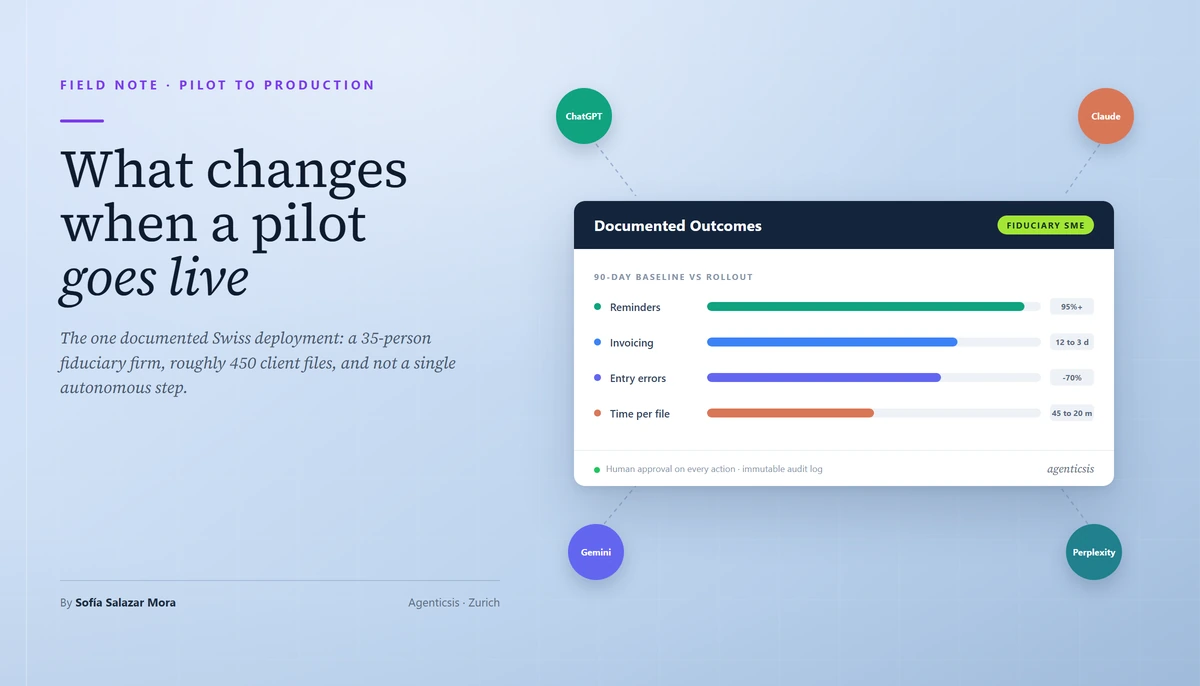
The clearest publicly documented Swiss SME agentic deployment is a 35-person fiduciary services firm managing roughly 450 client files. Its agent reads incoming email, documents and accounting entries, prepares entries, reminders and draft replies, and executes only inside role-based permissions, a human approval queue and an immutable audit log. Over a 90-day comparison, processing time per file fell from about 45 minutes to 18 to 25 minutes and invoice issuance went from 12 days to 3 [Source: advisory.numezis.com].
Swiss SME agentic deployments are rarely written up in public, which is exactly why this one is worth reading closely. It is a back-office workflow of the most ordinary kind, and it reached production without ever becoming autonomous.
What the agent actually does
The agent reads context from incoming email, documents and accounting entries, then prepares actions: accounting entries, client reminders and draft replies. Every one of those actions passes through a human approval queue before it executes. Access is segregated by legal entity and by client file, so the agent operating on one client cannot read another. Where the model's confidence falls below a threshold, the item is routed to human review rather than being attempted [Source: advisory.numezis.com].
The governance mechanics that made it production-grade
Four controls, not model quality, are what moved this system from pilot to production. Role-based permissions bound what the agent may touch. No outbound action was permitted without human approval for the first three months. Models were called with no retention and no training on client data. And an immutable audit log was kept and reviewed with the firm's external auditors, alongside monthly governance reviews covering errors, cost and drift [Source: advisory.numezis.com].
That last point is the one Swiss SMEs consistently underestimate. A fiduciary firm is audited. An agent that cannot produce a per-decision record for an auditor is not deployable in that setting regardless of how well it performs, which is why the audit log was designed in from the start rather than added later.
Reported outcomes
The figures below are the firm's own reported before-and-after measurements over 90-day periods.
| Metric | Before | After |
|---|---|---|
| Processing time per client file | ~45 minutes | 18 to 25 minutes |
| Invoice issuance | 12 days | 3 days |
| Data-entry errors | baseline | 70% fewer |
| On-time reminders | ~60% | Above 95% |
| Staff adoption | - | 9 of 12 intended users |
| Autonomous execution | None | None, human approval throughout |
What this case does not tell you
Two things. First, no cost or build-duration figure is published for this deployment, so it cannot be used as a budget anchor. Second, a 35-person fiduciary firm is a specific setting: document-heavy, already audited, with a clean per-file unit of work. A manufacturer with the same headcount and a shop floor would not map onto these numbers, and treating one deployment as a sector benchmark is how planning assumptions go wrong.
Adoption at 9 of 12 intended users is also worth noting rather than glossing over. Even a well-governed agent with strong measured outcomes did not reach every intended user inside the measurement window.
Pro Tip
Before building anything, publish a one-page agent charter for each candidate workflow. The charter names the process owner, the KPIs, the actions the agent may take autonomously, the actions that require human approval, and the escalation path when the agent is uncertain. If the SME cannot write this page in an afternoon, the workflow is not ready for a production pilot.
What to measure, and what the published figures support
Quick Answer:
Published Swiss SME agentic AI benchmarks are scarce, and most numbers circulating in vendor material are not traceable to a named deployment. The figures that are documented come from a single fiduciary-sector case: processing time per file down from about 45 minutes to 18 to 25 minutes, invoice issuance from 12 days to 3, and 70% fewer data-entry errors [Source: advisory.numezis.com]. Treat everything else as a target to set, not a result to expect.
This is the least satisfying section of any honest article on this subject. The Swiss SME segment does not yet have a body of published, comparable agentic AI outcome data. What exists is one well-documented deployment, a set of sector playbooks that recommend measurement without publishing results, and a large volume of vendor claims with no traceable deployment behind them.
The practical consequence: do not plan against someone else's numbers. Measure your own baseline before the pilot starts, because the baseline is the only benchmark that is definitely about your business.
KPI targets worth setting
The ranges below are targets to agree on before a pilot begins, drawn from Swiss SME AI playbook guidance and ordinary process-improvement practice. They are not documented outcomes, and the table labels which is which.
| Function | Primary KPI | Target range | Basis |
|---|---|---|---|
| Document-heavy back office | Processing time per file | 40 to 60% reduction | Documented in the fiduciary case |
| Billing and invoicing | Days to issue | Substantial reduction | Documented in the fiduciary case |
| Accounts payable | Manual invoice handling time | 50 to 70% reduction | Advisory guidance, not measured |
| Email and document triage | Time per item processed | Set from your own baseline | Advisory guidance, not measured |
| Customer support triage | Time to first response | Set from your own baseline | Advisory guidance, not measured |
| Any function | Data-entry error rate | Below the manual baseline | Documented in the fiduciary case |
On cost and timeline
No credible published first-year cost figure exists for Swiss SME agentic AI deployments, and the fiduciary case does not disclose one. Any specific franc figure presented as a Swiss SME benchmark should be treated as unsourced until the underlying deployment is named.
What can be said honestly is what the cost is made of: platform and model usage, integration work against each connected system, supervision time during the approval-gated period, and a monitoring reserve for drift and error review after go-live. Integration and supervision, not model licences, dominate. For transparent engagement bands rather than borrowed benchmarks, Agenticsis publishes its own tiers on the what we build page.
On timeline, the pattern across the sources reviewed here is that governance setup and human-in-the-loop testing determine the schedule, not model work. The fiduciary deployment ran a three-month period in which no outbound action executed without human approval, which is a useful shape to plan for even though it is one case.
Common failure points when scaling an agentic AI pilot
Four failure modes recur in Swiss SME advisory content and case commentary. Understanding them in advance is the cheapest way to protect a pilot budget.
No named process owner
When the agent replaces or augments a workflow that belongs to no single team, integration stalls at the political layer. The digitalswitzerland playbook stresses leadership with clear KPIs as a precondition for scaling, which in practice means naming a business-side owner, not an IT owner, for every production agent [Source: digitalswitzerland.com].
Data pipelines that break silently
Agents that depend on parsing supplier invoices, ERP exports or CRM records fail the first time a format changes. Production systems need monitoring on data-quality inputs, not just model outputs, and a fallback path that pauses the agent rather than acts on garbage data.
Missing AI inventory and audit logs
Building an AI inventory is required for EU AI Act compliance, and Swiss SMEs serving EU customers must prepare for these obligations even without formal Swiss enforcement [Source: digitalswitzerland.com]. Pilots that skip the inventory step cannot be audited and cannot be scaled without a rebuild.
Over-scoping the first production release
Guides for Swiss SMEs consistently warn against "boiling the ocean" pilots. A production system that starts with three or four bounded use cases and clear KPIs is easier to defend than one that promises to reshape a whole function.
FADP, GDPR and EU AI Act obligations
Regulation shapes architecture. Swiss SMEs cannot treat compliance as a documentation exercise added at the end because the choice between API wrappers, event-driven middleware and SLM sidecars depends on where sensitive data may reside.
FADP data residency
The Swiss Federal Act on Data Protection pushes SMEs toward Swiss cloud regions and on-premise SLM sidecars for personal or commercially sensitive data. Practical advice includes securing written confirmation of Swiss data residency and signed data processing agreements from every vendor in the stack [Source: digitalswitzerland.com].
EU AI Act extraterritorial reach
Swiss SMEs selling into the EU inherit EU AI Act obligations even though Switzerland is not an EU member. Building an AI inventory, classifying use cases by risk, and documenting human oversight mechanisms are recommended baseline steps regardless of formal Swiss enforcement [Source: digitalswitzerland.com].
Disclaimer
This article summarises publicly available guidance on FADP, GDPR and the EU AI Act as of September 2026. It is not legal advice. Swiss SMEs should consult qualified Swiss counsel before finalising data-residency, vendor and risk-classification decisions for production agentic AI systems.
How Swiss SMEs measure ROI from agentic AI in production
ROI measurement separates production systems from pilots more sharply than any technical criterion. A production agent has a named KPI baseline, a target, and monthly review. A pilot usually has none of these.
KPIs recommended by Swiss SME playbooks
The digitalswitzerland playbook and related SME guides consistently recommend KPIs such as time to resolution, error rate, throughput, employee satisfaction, and time reallocated from repetitive work to higher-value tasks [Source: digitalswitzerland.com]. These are business KPIs, not model KPIs, and they anchor the business case that justifies scaling.
A simple ROI framework
| Component | What to measure |
|---|---|
| Baseline cost | Hours per month on the target workflow, multiplied by fully loaded labour cost |
| Post-deployment cost | Residual hours plus platform, integration and supervision cost |
| Quality gain | Reduction in error rate or SLA breaches, priced against downstream cost |
| Risk reserve | Budget for monitoring, incident response and periodic re-validation |
| Payback period | First-year cost divided by monthly net saving |
Expert Insight
The most common ROI error is counting only labour time saved. A production agentic system also changes error rates, cycle times and downstream costs. In the documented fiduciary case, cutting processing time per file from about 45 minutes to 18 to 25 minutes matters less for the clerk's hourly cost and more for the 70% drop in data-entry errors and the shift from 12 days to 3 in invoice issuance to production and delivery commitments. Model the second-order effects, or the business case will underestimate the true value.
Frequently asked questions
Q: How long does it typically take to move an AI pilot to production for an SME?
A: Plan on months rather than weeks, and expect the schedule to be set by integration, governance setup and human-in-the-loop testing rather than model work. The one documented Swiss case ran a three-month period in which no outbound action executed without human approval before trust was widened. Simpler single-system back-office agents reach production faster than multi-system operational ones.
Q: What are the common failure points when scaling an agentic AI pilot?
A: Four failure points recur: no named business-side process owner, data pipelines that break when input formats change, missing AI inventory and audit logs required for EU AI Act readiness, and over-scoped first releases that try to solve too many workflows at once. Each of these can be mitigated before build starts by writing a one-page agent charter and running a data-quality audit.
Q: What benchmarks indicate a successful agentic AI deployment?
A: Published Swiss SME figures are scarce, so the honest answer is that you benchmark against your own pre-pilot baseline. The one documented Swiss case reports processing time per file falling from about 45 minutes to 18 to 25 minutes, invoice issuance from 12 days to 3, and 70% fewer data-entry errors [Source: advisory.numezis.com]. Beyond time savings, look for stable error rates, complete audit logs, human approval rates trending down as trust grows, and business KPIs improving in monthly reviews.
Q: How do Swiss SMEs measure ROI from agentic AI systems in production?
A: Swiss SME playbooks recommend business KPIs including time to resolution, error rate, throughput, employee satisfaction, and time reallocated from repetitive work [Source: digitalswitzerland.com]. A defensible ROI calculation includes baseline labour cost, residual labour cost, platform and supervision cost, downstream quality gains, and a risk reserve for monitoring and re-validation.
Q: Do Swiss SMEs need to comply with the EU AI Act?
A: Swiss SMEs serving EU customers are effectively subject to EU AI Act obligations because the regulation applies extraterritorially. Recommended baseline steps include building an AI inventory, classifying use cases by risk category, documenting human oversight mechanisms, and confirming vendor data residency and processing terms [Source: digitalswitzerland.com].
Q: Which integration pattern should a Swiss SME start with?
A: Most Swiss SMEs start with API-mediated wrappers around a single legacy system because deployment is fast and the risk surface is bounded. Event-driven middleware suits multi-system operational workflows that must react in real time. Small Language Model sidecars are chosen when FADP or sector rules require sensitive data to stay on-premise.
Q: Where does agentic AI reach production first in Swiss SMEs?
A: Documented deployments cluster in document-heavy back-office workflows, finance and accounts payable, manufacturing operations, and customer support triage. These functions share repeatable multi-step processes, measurable baseline KPIs, and tolerance for human-in-the-loop review, which together make them the highest ROI-to-risk entry points.
Q: How much should a Swiss SME budget for a first production agent?
A: No credible published Swiss SME figure exists, and the one documented case does not disclose its cost, so treat any specific franc benchmark you are shown as unsourced until the deployment behind it is named. Budget by component instead: platform and model usage, integration work per connected system, supervision time during the approval-gated period, and a monitoring reserve for drift and error review. Integration and supervision dominate, not model licences. Agenticsis publishes its own engagement bands on the what we build page.
Q: What does human-in-the-loop mean for a production agent?
A: Human-in-the-loop means the agent generates recommendations or draft actions, and a named human approves them before execution. In the documented Swiss fiduciary case, no outbound action executed without human approval for the first three months, and no step was ever fully autonomous [Source: advisory.numezis.com]. This model aligns with FADP obligations and EU AI Act risk-management expectations for higher-consequence workflows.
Q: Is a Small Language Model good enough for agentic workflows?
A: Small Language Models can be adequate for bounded agentic workflows on internal documents where data cannot leave on-premise infrastructure. The trade-off is capability against sovereignty. For workflows requiring broader reasoning or tool use, most SMEs pair an SLM sidecar for sensitive processing with a larger model in a Swiss cloud region for less sensitive tasks.
Q: What is an AI inventory and why does it matter?
A: An AI inventory is a catalogue of every AI model and application in use, with risk classification, data flows and ownership. Swiss SME advisory content states that building this inventory is required for EU AI Act compliance and is a precondition for defensible scaling [Source: digitalswitzerland.com]. Pilots that skip this step often need a rebuild before they can be audited.
Q: How should Swiss SMEs choose their first agentic use case?
A: Prioritise use cases with high ROI, low risk, and a measurable baseline. Invoice processing, email and document triage, and predictive quality control in manufacturing are the recurring winners. Avoid open-ended AI transformation pilots or fully autonomous customer-facing decisions in the first release, because both have poor ROI-to-risk profiles under FADP and EU AI Act constraints.
Q: What KPIs should the pilot report before scaling to production?
A: The pilot should report cycle time reduction against baseline, error rate, human approval rate, incident count, and any downstream quality metrics. Swiss SME playbooks add employee satisfaction and time reallocated from repetitive work as leading indicators of sustainable adoption [Source: digitalswitzerland.com]. Model accuracy alone is insufficient because it does not predict business impact.
Q: How do agentic AI systems handle data protection under FADP?
A: Practical steps include hosting in Swiss cloud regions or on-premise, using SLM sidecars for sensitive data, securing written confirmation of Swiss data residency from vendors, and signing data processing agreements. Swiss SME integration guidance emphasises documenting every legacy system in scope and classifying data before any agent gains access [Source: digitalswitzerland.com].
Q: Can existing staff supervise a production agentic system?
A: Yes, but with targeted training. The digitalswitzerland playbook stresses employee enablement and change management as core to scaling [Source: digitalswitzerland.com]. Practical steps include short micro-credential modules on supervising AI, clear escalation paths for uncertain outputs, and periodic review sessions where supervisors discuss edge cases they have handled.
Q: What is the biggest difference between agentic AI and a chatbot?
A: A chatbot answers questions. An agentic system executes multi-step workflows across live business systems, calling tools, updating records and coordinating actions. The documented fiduciary agent is agentic because it reads incoming email, documents and accounting entries and then prepares entries, reminders and replies for approval. A chatbot would answer questions about an invoice; the agent prepares the invoice.
Q: How mature is agentic AI adoption in Swiss SMEs today?
A: Overall Swiss SME AI adoption reached 34% in 2025, up from 22% in 2024 [Source: kmu.admin.ch], but this figure covers all AI including analytics and chatbots. Truly agentic production deployments are a smaller subset. The dominant reality in 2026 is still a large gap between pilots that work in demos and systems that run continuously inside daily operations.
Q: What role do industry playbooks play in the transition?
A: The Swiss AI Action Plan 2026 recommends industry-specific playbooks with use-case libraries, compliance checklists and ROI models for financial services, MedTech, manufacturing and retail [Source: digitalswitzerland.com]. For SMEs, these playbooks compress the discovery phase because sector peers have already validated which use cases move to production and which stall.
Conclusion and next steps
The 2026 evidence for a successful agentic AI pilot to production transition in Swiss SMEs is consistent even though the sample of documented cases is still small. The direction of travel is clear: production means integrated workflows, named process owners, measurable business KPIs, human-in-the-loop supervision, and governance that satisfies FADP obligations and EU AI Act preparation.
Key takeaways for Swiss SME decision-makers:
- Treat digitalswitzerland's SME AI playbook as the reference model for what production-grade means.
- Start with high ROI, low risk workflows in finance, back-office, manufacturing operations or support triage.
- Choose an integration pattern based on data sovereignty: API wrappers for speed, event-driven middleware for multi-system workflows, SLM sidecars for sensitive on-premise data.
- Anchor the business case on your own measured baseline, not on borrowed benchmarks. Published Swiss SME figures are scarce, and any franc figure presented as a sector benchmark should name the deployment behind it.
- Write the AI inventory, agent charter and audit logging plan before build starts, not after go-live.
- Measure business KPIs monthly and treat human approval rates as a trust curve that should trend downward over time.
Planning your agentic AI pilot to production transition?
Agenticsis works with Swiss SMEs to scope, build and scale agentic AI systems with human oversight, decision logging and audit trails engineered in. Start with a structured use-case review.
Talk to AgenticsisSources
Background reading and data sources consulted for this article.
- digitalswitzerland.com/news/digitalswitzerland-launches-ai-playbook-for-sme
- digitalswitzerland.com/assets/ai-playbook_ez.pdf
- digitalswitzerland.com/news
- digitalswitzerland.com/media
- implementconsultinggroup.com/article/the-swiss-ai-handbook
- ai-outsourcing.ch/insights/swiss-ai-action-plan-2026-what-the-national-roadmap-means-fo...
- iosys.swiss/blog/10-ki-tools-fertigungs-kmu
- linkedin.com/posts/frank-dannacher-370bb6_now-it-is-out-the-handbook-on-generative-acti...
- agenticsis.ch/blog/swiss-sme-ai-agent-legacy-integration-patterns
- tytos.ch/blog/ai-agents-schweizer-kmu-leitfaden-2026
- advisory.numezis.com/en/work/business-agent-platform-sme
- what.digital/ai-agents-use-cases-swiss-smes
- deepcloud.swiss/en/newsroom/article/ai-in-swiss-smes-we-are-ready
- zdigitalagency.com/ai-trends-swiss-companies-2025-2026