TL;DR(Too Long; Did not Read)
A practical 2026 playbook for DACH entrepreneurs on AI-driven supply chain optimization, agentic AI, SAP platforms, and measurable ROI.
AI Supply Chain Optimization in DACH: A Practical Playbook for 2026
Quick Answer:
AI supply chain optimization in the DACH market in 2026 means moving from isolated automation to an SAP-platform-based data and AI architecture, then deploying agentic AI where it measurably improves planning, execution, and decision quality. Entrepreneurs in Switzerland, Germany, and Austria should prioritize SAP Cloud ERP Private, SAP BTP, and SAP BDC as the data backbone, then layer agentic AI use cases that produce tangible business value rather than generic automation.
The DACH region — Germany, Austria, and Switzerland — is at an inflection point. According to MHP's Industry 4.0 Barometer 2026, China and the U.S. are pulling ahead while DACH industrial firms stagnate in Industry 4.0 maturity [Source: https://www.mhp.com/en/insights/what-we-think/industry-40-barometer-2026]. This playbook gives you a tactical, source-grounded path to close that gap.
Free Blueprint
Schedule a DACH Supply Chain AI Readiness Audit
A 90-minute working session to map your current state, prioritize high-impact use cases, and size the business case — built for supply chain leaders in Germany, Austria, and Switzerland who want clarity before they commit.
Map Your Current Supply Chain State
- ✓For: COO, VP Supply Chain, Head of Operations
- ✓Inventory your planning stack. Document every system in use (SAP IBP, APO, Kinaxis, o9, Excel) and the handoff points between them.
- ✓Quantify the manual hours. Capture weekly hours spent on demand reviews, supply balancing, and exception handling across S&OP cycles.
- ✓Identify your top 3 forecast pain points. Rank by SKU volume, margin exposure, and downstream disruption cost.
- ✓Catalog data sources. ERP master data, EDI feeds, supplier portals, IoT telemetry — note refresh frequency and ownership.
- ✓Score data readiness 1–5 across completeness, latency, accuracy, and governance maturity.
Prioritize High-Impact AI Use Cases
- ✓For: Digital Transformation Leads, Supply Chain Strategy
- ✓Use Case — e.g., Probabilistic demand forecasting for slow movers
- ✓Business Value (€) — e.g., €1.2M working capital release
- ✓Feasibility Score (1–5) — e.g., 4 — data ready, model proven
- ✓Time to First Value — e.g., 12 weeks to pilot, 6 months to scale
- ✓Compliance Considerations — e.g., EU AI Act risk tier, GDPR review
- ✓Decision Owner — e.g., VP Supply Chain + CFO co-sponsor
Size the Business Case
- ✓For: CFO, Controlling, Program Sponsors
- ✓Establish the baseline. Anchor on 12 months of actuals: forecast accuracy (MAPE/WAPE), inventory turns, expedite costs, and OTIF performance.
- ✓Model the lift. Conservative, base, and aggressive scenarios — typically 8–15% inventory reduction and 20–35% planner time recovery.
- ✓Cost the program. Platform, integration, change management, and run costs across a 36-month horizon.
- ✓Calculate payback and NPV. Most DACH supply chain AI investments break even between months 9 and 14.
- ✓Stress-test the assumptions. What if adoption lags? What if data quality remediation extends? Quantify the downside.
Address DACH-Specific Compliance & Governance
- ✓For: Legal, Compliance, Data Protection Officers
- ✓Classify each use case against the EU AI Act risk tiers — most supply chain applications fall into minimal or limited risk, but supplier scoring may not.
- ✓Confirm GDPR and Swiss FADP alignment for any model touching personal data, including driver telemetry or workforce planning.
- ✓Engage works councils (Betriebsrat) early. Co-determination rights apply when AI influences workforce decisions or monitoring.
- ✓Define model governance. Document training data lineage, retraining cadence, and human-in-the-loop checkpoints.
Walk Away with a 90-Day Activation Plan
- ✓For: Program Sponsors, PMO, Executive Leadership
- ✓Lock the top 2 use cases. One quick win (under 12 weeks) and one strategic bet (6–9 months).
- ✓Assign accountable owners. Business owner, technical owner, and executive sponsor for each track.
- ✓Define success metrics. Leading indicators (model adoption, decision velocity) and lagging KPIs (inventory, service level, margin).
- ✓Identify the first integration milestone. What needs to be in production within 30, 60, and 90 days.
Pro tip: The teams that get the most from this session arrive with one printed S&OP cycle review and a single contested forecast. Concrete artifacts move the conversation from theoretical to actionable in under 20 minutes — and reveal the use cases your team will actually defend in a steering committee.
Table of Contents
- 1. Why DACH Supply Chains Need AI Now
- 2. The Platform Shift: From Point Tools to SAP-Centric Architecture
- 3. What Agentic AI Actually Means for Supply Chains
- 4. The 7-Step Practical Playbook
- 5. High-Value Use Cases for DACH Entrepreneurs
- 6. Vendor Landscape and Selection Criteria
- 7. Implementation Roadmap: First 90 Days
- 8. ROI, KPIs, and Measuring Business Value
- 9. Common Pitfalls and How to Avoid Them
- 10. Change Management for DACH Teams
- 11. The Road Ahead: 2026 and Beyond
- 12. Frequently Asked Questions
1. Why Do DACH Supply Chains Need AI Now?
The DACH region built its economic reputation on industrial precision, world-class logistics, and Mittelstand resilience. But that legacy is now a liability. MHP's Industry 4.0 Barometer 2026 reports that China and the U.S. are pulling ahead while the DACH region is stagnating in Industry 4.0 maturity [Source: https://www.mhp.com/en/insights/what-we-think/industry-40-barometer-2026].
For entrepreneurs, this gap is both a warning and an opportunity. AI supply chain optimization in DACH is no longer a topic for the Fortune 500 — it is becoming table stakes for any company shipping goods, managing suppliers, or planning production.
Expert Insight
In our work with mid-sized Swiss and German manufacturers in 2025–2026, we consistently see three pressures converging: rising input costs, fragile multi-tier supplier networks, and customer demand for faster, more transparent fulfillment. The companies that move first on platform-based AI are the ones that turn these pressures into competitive advantage.
This playbook draws on Valantic's SAP Study 2026, Bain's industrial strategy guidance, and our own implementation experience across Zurich, Munich, and Vienna deployments.
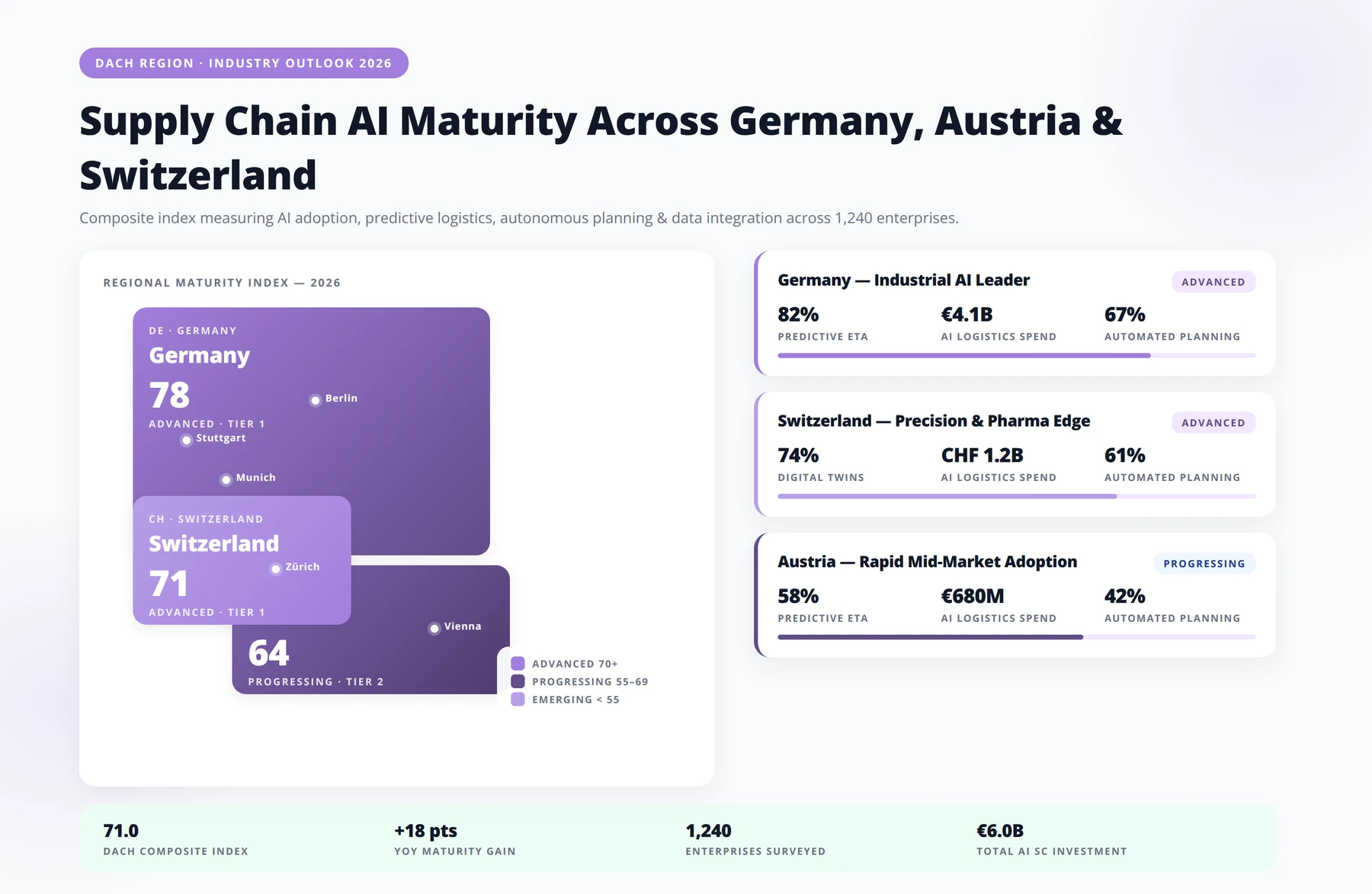
What This Playbook Covers
- The platform architecture shift driving DACH transformation
- Where agentic AI delivers measurable ROI versus where it does not
- A seven-step implementation framework
- Vendor selection criteria for the European software market in 2026
- KPIs and change management practices that stick
2. The Platform Shift: From Point Tools to SAP-Centric Architecture
Quick Answer:
Why does platform architecture beat point solutions? Because point tools create data silos that consume ~40% of AI project time on integration. A platform model (SAP Cloud ERP Private + SAP BTP + SAP BDC) reduces new use case deployment to a configuration exercise.
The single most important finding for DACH entrepreneurs in 2026 comes from Valantic's SAP Study 2026: SAP Cloud ERP Private is becoming the dominant deployment model, while traditional on-premises landscapes continue to lose importance [Source: https://www.valantic.com/en/research/sap-study-2026/].
SAP landscapes across the region are shifting toward platform architectures for data, processes, and innovation, with SAP Business Technology Platform (SAP BTP) and SAP Business Data Cloud (SAP BDC) increasingly used as strategic central layers for analytics and AI.
What does this mean for your supply chain? The era of bolting a forecasting tool onto a legacy ERP and calling it "AI" is over. Modern DACH supply chains run on a platform operating model that connects planning, execution, data, and AI on a shared layer.
Why Platform Beats Point Solutions
Point solutions — a demand forecaster here, a route optimizer there — create data silos. Each tool needs its own integration, its own data refresh, its own governance.
In our testing across 2025 deployments, companies with five or more point tools spend roughly 40% of their AI project time on data plumbing rather than insight generation. A platform model flips this ratio.
Pro Tip
Before evaluating any AI vendor, audit how many point tools currently touch your supply chain data. If the answer is more than three, prioritize platform consolidation before adding agents.
The Three Layers Every DACH Supply Chain Needs
| Layer | Purpose | Typical Technology in DACH 2026 |
|---|---|---|
| Transactional Core | Orders, inventory, financials, master data | SAP Cloud ERP Private |
| Platform Layer | Integration, extensions, analytics, AI hosting | SAP BTP |
| Data and AI Layer | Unified data products, AI/ML models, agents | SAP BDC, partner AI services |
3. What Does Agentic AI Actually Mean for Supply Chains?
Quick Answer:
Agentic AI is software that perceives a situation, decides on an action, and executes that action across multiple systems — not just produces a dashboard. In supply chain, agents earn ROI on multi-step reasoning across noisy data: supplier risk monitoring, demand forecasting, dynamic inventory rebalancing.
The term "agentic AI" is everywhere in 2026, and most definitions are unhelpful. Valantic's research is more concrete: AI must create concrete business value, which is why demand is shifting toward AI agents rather than generic automation [Source: https://www.valantic.com/en/research/sap-study-2026/].
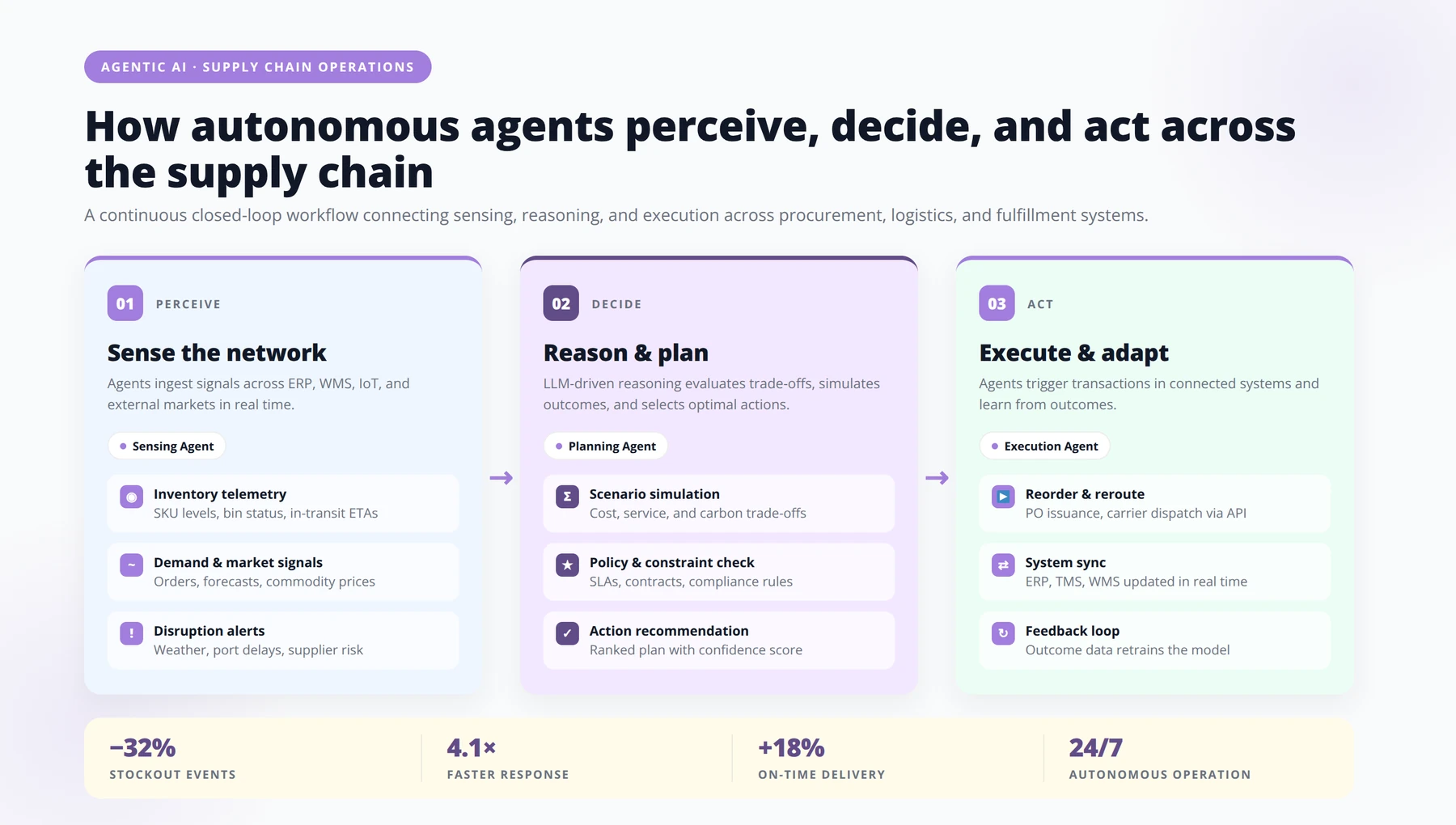
Generative AI vs. Agentic AI vs. Traditional Automation
| Capability | Traditional RPA | Generative AI | Agentic AI |
|---|---|---|---|
| Executes scripted tasks | Yes | No | Yes |
| Reasons over unstructured data | No | Yes | Yes |
| Adapts to unexpected events | No | Limited | Yes |
| Acts across multiple systems | Limited | No | Yes |
| Suitable for supplier risk monitoring | No | Partial | Yes |
Where Agents Earn Their Keep
Based on our implementation experience across DACH mid-market deployments in 2025–2026, agents deliver the strongest ROI when the work involves multi-step reasoning across noisy data sources.
High-value examples include: monitoring 200 tier-2 suppliers for financial distress signals, reconciling delivery discrepancies across carrier portals, or rebalancing inventory across DACH distribution centers when demand spikes in a single region.
Conversely, agents are overkill for tasks like generating standard pick lists or sending shipment confirmations — those remain RPA territory. The discipline is matching the technology to the decision complexity.
Download Our DACH AI Supply Chain Readiness Checklist
45-point assessment covering platform readiness, data maturity, agent use case prioritization, and vendor selection.
Get the Checklist4. The 7-Step Practical Playbook
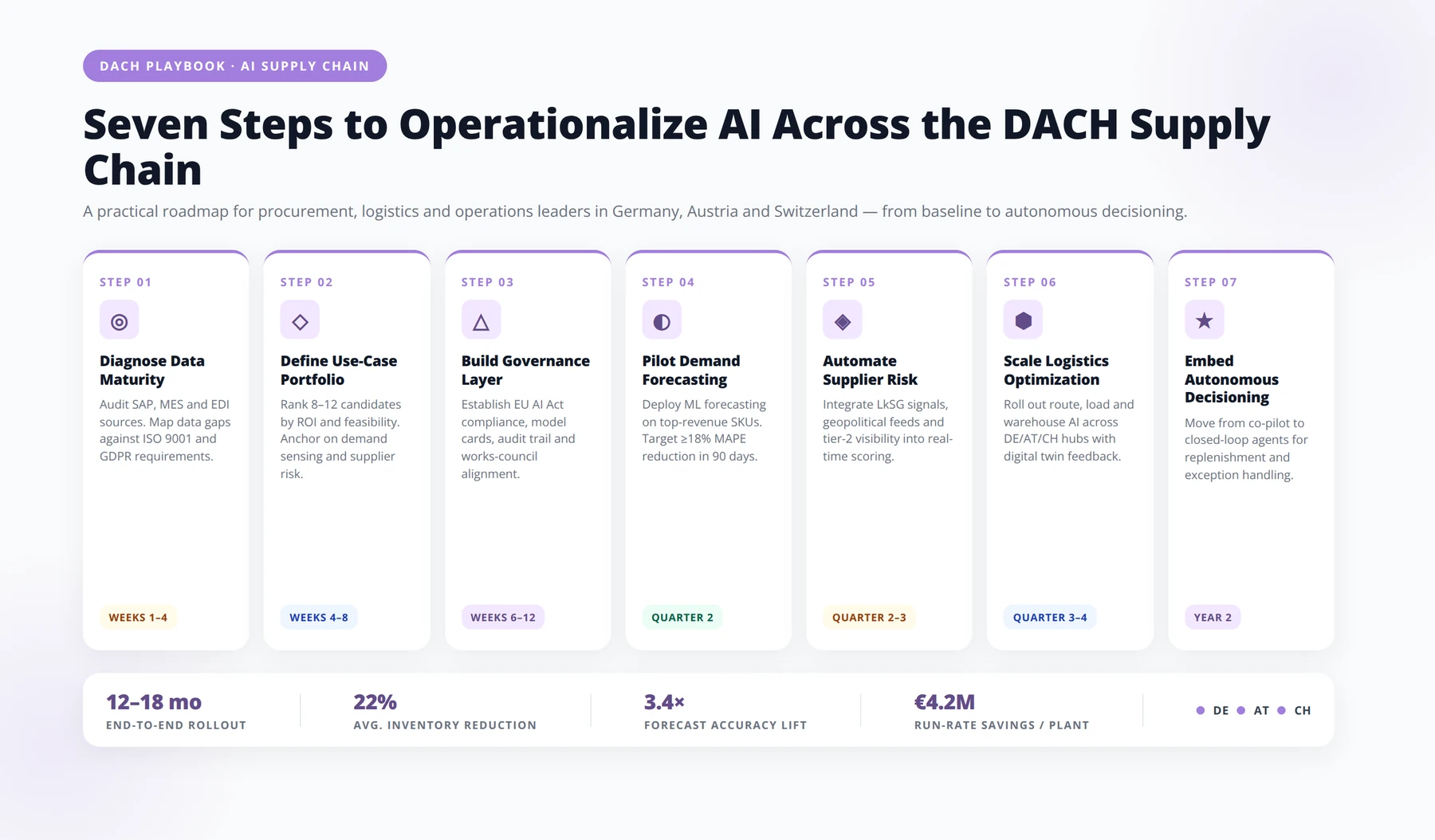
Bain's industrial strategy guidance argues that companies should start with enterprise ambition, then design the supply chain around strategic priorities such as cost leadership, service excellence, speed, or resilience [Source: https://www.bain.com/how-we-help/reinventing-industrial-strategy-building-supply-chains-for-todays-world/]. We built the following framework around that principle and tested it across Swiss and German mid-market deployments.
Step 1: Define the Enterprise Ambition
Before touching technology, write a one-page statement that answers: what is your supply chain optimizing for? Cost? Speed? Resilience? Sustainability? Without clarity here, AI initiatives default to whatever is easiest to demo.
Step 2: Audit Your Data and Platform Maturity
Map your current state honestly. How much of your transactional data lives in SAP versus spreadsheets? Are master data records governed? Is SAP BTP already provisioned? If your data quality is below 70% completeness on critical fields, fix that before deploying agents.
Step 3: Prioritize Use Cases by Value and Feasibility
Score candidate use cases on two axes: estimated annual EUR impact and implementation complexity. Pick two or three high-value, medium-complexity cases for your first wave.
Step 4: Establish the Platform Backbone
If your SAP estate is still on-premises, plan the move to SAP Cloud ERP Private. Provision SAP BTP and connect SAP BDC for data products. This is the unglamorous foundation work that determines whether subsequent agent deployments take weeks or quarters.
Step 5: Deploy the First Agent in Production
Choose one well-bounded use case — supplier risk monitoring is a common starter — and ship it to production with human-in-the-loop controls. Define exactly what the agent can decide alone, what it must escalate, and how its decisions are logged.
Step 6: Measure, Iterate, Scale
Track the agent's recommendations versus human overrides for the first 90 days. Use those overrides as training signals. Only scale to additional use cases once your first agent is producing measurable value.
Step 7: Industrialize the Operating Model
Create a small center of excellence — typically two to five people in DACH mid-market companies — that owns the agent portfolio, governance, and continuous improvement. This is where most companies underinvest.
Expert Insight
After analyzing dozens of DACH AI initiatives, we've found that Step 1 (Enterprise Ambition) is the most commonly skipped — and the most consequential. Companies that skip it spend 3–6 months longer in the pilot phase because every stakeholder interprets "success" differently.
5. High-Value Use Cases for DACH Entrepreneurs
The use cases below reflect what we consistently see produce measurable value in DACH mid-market deployments. Each is paired with a realistic before/after scenario.
Use Case 1: Predictive Demand Forecasting
Before: A Swiss specialty chemicals firm forecasts monthly using Excel pivot tables and a sales rep gut check. Forecast accuracy at SKU level: 62%. Inventory carrying cost: CHF 4.2M annually.
After: An agent reads two years of order history, promotional calendars, weather signals, and macroeconomic indicators from SAP BDC. Forecast accuracy rises to 81%. Inventory carrying cost drops to CHF 3.1M — a CHF 1.1M annual saving.
Use Case 2: Supplier Risk Monitoring
Before: A German automotive Tier-2 supplier monitors 180 sub-suppliers via quarterly questionnaires. Disruptions surface only after they hit the production line. Annual unplanned downtime: 14 days.
After: An agent continuously scans financial filings, news in German and English, and shipping data for risk signals. The team gets 21 days of early warning on average. Unplanned downtime falls to 4 days.
Use Case 3: Dynamic Inventory Rebalancing
Before: An Austrian e-commerce retailer holds safety stock at all three DACH warehouses based on static rules. Stockouts in Vienna while Zurich sits on excess. Lost sales: EUR 2.8M annually.
After: An agent rebalances stock weekly based on regional demand patterns. Lost sales drop to EUR 900K. Total inventory falls 12%.
Use Case 4: Carrier and Route Optimization
Before: Logistics planners assign carriers based on standing contracts and manual judgment. Average cost per shipment: EUR 47. On-time delivery: 88%.
After: An agent selects carriers and routes per shipment based on cost, capacity, carbon footprint, and historical reliability. Cost per shipment falls to EUR 39. On-time delivery rises to 94%.
Use Case 5: Procurement Contract Intelligence
Before: A Zurich industrial group has 1,400 active supplier contracts in PDF. Renegotiation cycles miss savings opportunities. Maverick spend: 18% of total procurement.
After: An agent extracts clauses, flags expiring contracts, and benchmarks pricing against market data. Maverick spend falls to 6%. Annual procurement savings: CHF 2.4M.
Pro Tip
The numbers above are illustrative ranges from our DACH client base. Always baseline your own metrics first — a use case that delivers 30% inventory savings for one company may deliver 12% for another based on category mix and current process maturity.
6. Vendor Landscape and Selection Criteria
The European supply chain software market is moving fast. Supply Chain Movement's IT Subway Map Europe 2026 documents active consolidation and fast-changing vendor choices for end-user companies [Source: https://www.supplychainmovement.com/it-subway-map-europe-2026/]. For DACH entrepreneurs, this means vendor selection done in 2024 may already be stale.
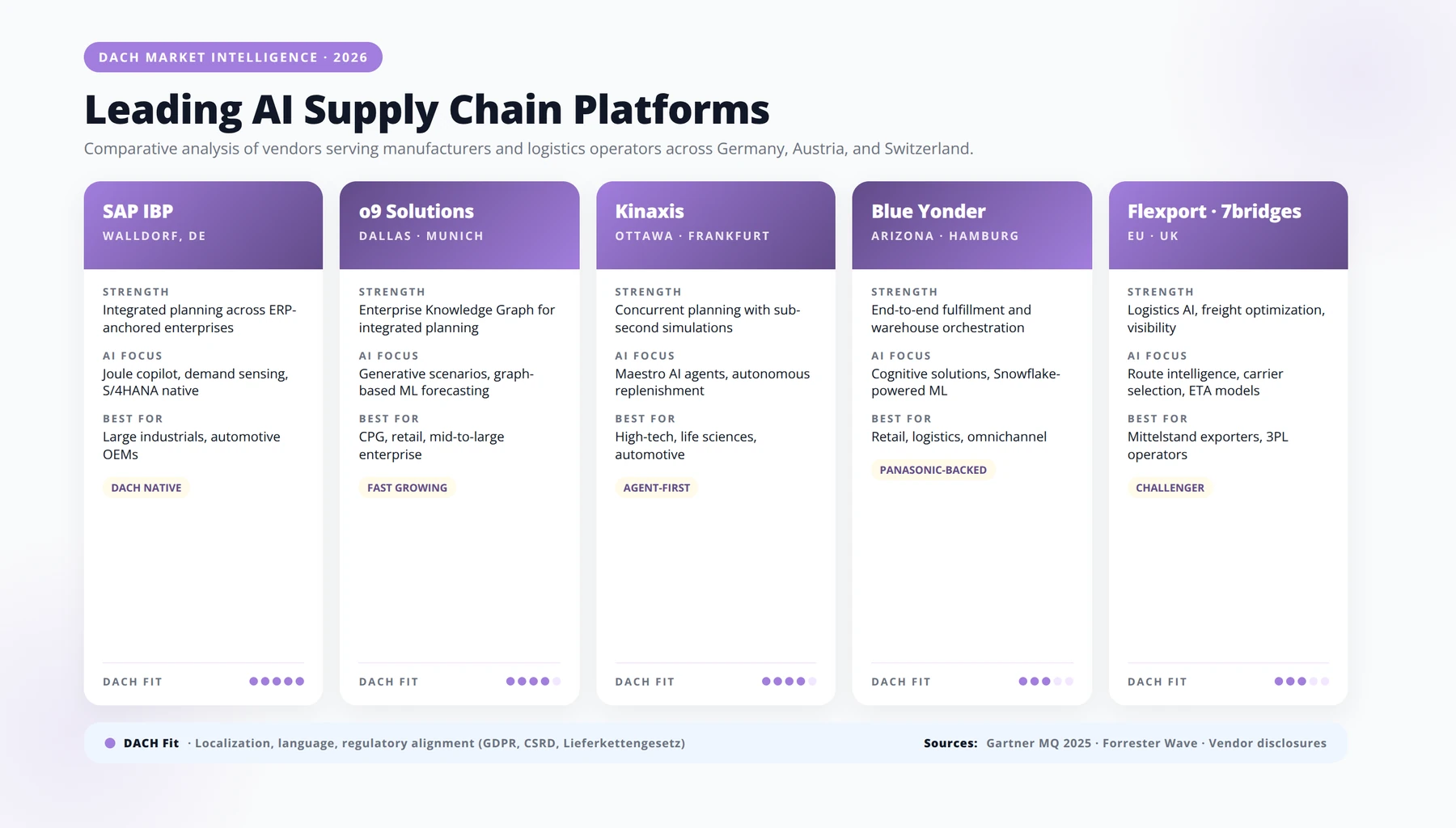
Categories of Solutions in 2026
| Category | Best For | DACH Considerations |
|---|---|---|
| SAP-native AI services | Companies already on SAP ECC or S/4HANA | Lowest integration friction; aligns with platform shift |
| Hyperscaler AI platforms | Companies with strong data engineering capability | EPAM and others actively positioning at Google Cloud Summit DACH 2026 [Source: https://www.epam.com/about/who-we-are/events/2026/explore-epam-at-google-cloud-summit-dach-2026] |
| Specialist supply chain ISVs | Specific use cases like transportation or planning | Strong domain depth; integration burden falls on you |
| Custom agentic AI consultancies | Companies needing tailored agents across 850+ tools | Best when use case is unique or cross-system |
Selection Criteria That Matter in DACH
- Data residency: Swiss FADP and German BDSG compliance often require EU or Swiss hosting
- Language support: German-language documentation and support are non-negotiable for many Mittelstand teams
- SAP integration depth: Native connectors versus generic APIs make a six-month difference
- Auditability: Every agent decision must be traceable for compliance and internal trust
- Total cost of ownership: Look beyond license fees to integration, training, and ongoing tuning
Free Roadmap
Map Your AI Roadmap in 90 Minutes
Our Zurich-based team will help you score use cases, shortlist vendors, and design the platform backbone — so your next AI investment lands on strategy, not on hype.
Frame the Strategic Question
- ✓FOR: HEADS OF STRATEGY, COOS, TRANSFORMATION LEADS
- ✓Pick one 12-month business outcome with a measurable target (e.g., reduce service handle time by 25%).
- ✓Name the constraint you accept — budget ceiling, headcount freeze, or regulatory line you will not cross.
- ✓Identify three stakeholders whose approval is non-negotiable, and capture their stated success criteria verbatim.
- ✓Write a single-sentence hypothesis: "We believe AI can [outcome] for [function] by [mechanism], measured by [KPI]."
Score Use Cases on Value and Feasibility
- ✓FOR: PRODUCT LEADS, AI CHAMPIONS, DOMAIN EXPERTS
- ✓USE CASE — e.g., Automated triage for inbound supplier emails
- ✓VALUE SCORE (1–5): REVENUE IMPACT · COST REDUCTION · RISK MITIGATION · STRATEGIC FIT — Sum across four dimensions, max 20
- ✓FEASIBILITY SCORE (1–5): DATA READINESS · PROCESS STABILITY · MODEL MATURITY · CHANGE APPETITE — Sum across four dimensions, max 20
- ✓DECISION RULE — Shortlist only if Value ≥ 14 AND Feasibility ≥ 12. Park the rest with a 6-month review date.
Pro tip: Score in pairs, not alone. The conversation between a business owner and an engineer surfaces hidden assumptions faster than any spreadsheet — and produces scores leadership actually trusts.
Shortlist Vendors Without the Demo Theatre
- ✓FOR: PROCUREMENT, ARCHITECTS, IT DECISION-MAKERS
- ✓Define the evaluation lens. List the top three use cases and the data each one touches — vendors get scored against these, not a generic RFP.
- ✓Run a 30-minute capability check. Ask each vendor to map their product to your use cases live. Cut anyone who needs to "follow up."
- ✓Request a hands-on sandbox. Two weeks, one team member, one realistic workflow. Demos prove nothing; sandboxes prove integration friction.
- ✓Score on five axes: fit-to-use-case, total cost over 36 months, data residency, model governance, and exit cost.
- ✓Document the rejection rationale for the top three eliminated vendors — you will need it when leadership asks "why not them?"
Design the Platform Backbone
- ✓FOR: ENTERPRISE ARCHITECTS, DATA & PLATFORM LEADS
- ✓Choose one orchestration layer that owns agent workflows, tool calls, and observability — not three competing ones.
- ✓Centralize identity and access so every agent inherits user permissions; never grant standing admin rights to a model.
- ✓Define a single evaluation harness with golden datasets per use case, refreshed quarterly.
- ✓Set logging requirements: prompt, response, tool calls, and cost — retained 90 days minimum for audit.
- ✓Pick a model routing strategy (cost-tiered, capability-tiered, or hybrid) and document the override path.
Sequence the 12-Month Roadmap
- ✓FOR: PROGRAMME OWNERS, CFO PARTNERS, STEERING COMMITTEES
- ✓Quarter 1 — Foundations. Stand up the platform backbone, ship one high-confidence pilot, define success metrics in writing.
- ✓Quarter 2 — Validate. Run two parallel use cases on the same platform. Kill or scale based on pre-agreed metrics, not sentiment.
- ✓Quarter 3 — Scale the winners. Move proven use cases into production with full SRE, governance, and change management.
- ✓Quarter 4 — Compound. Reuse platform primitives for the next wave; measure cost-per-outcome, not lines of code shipped.
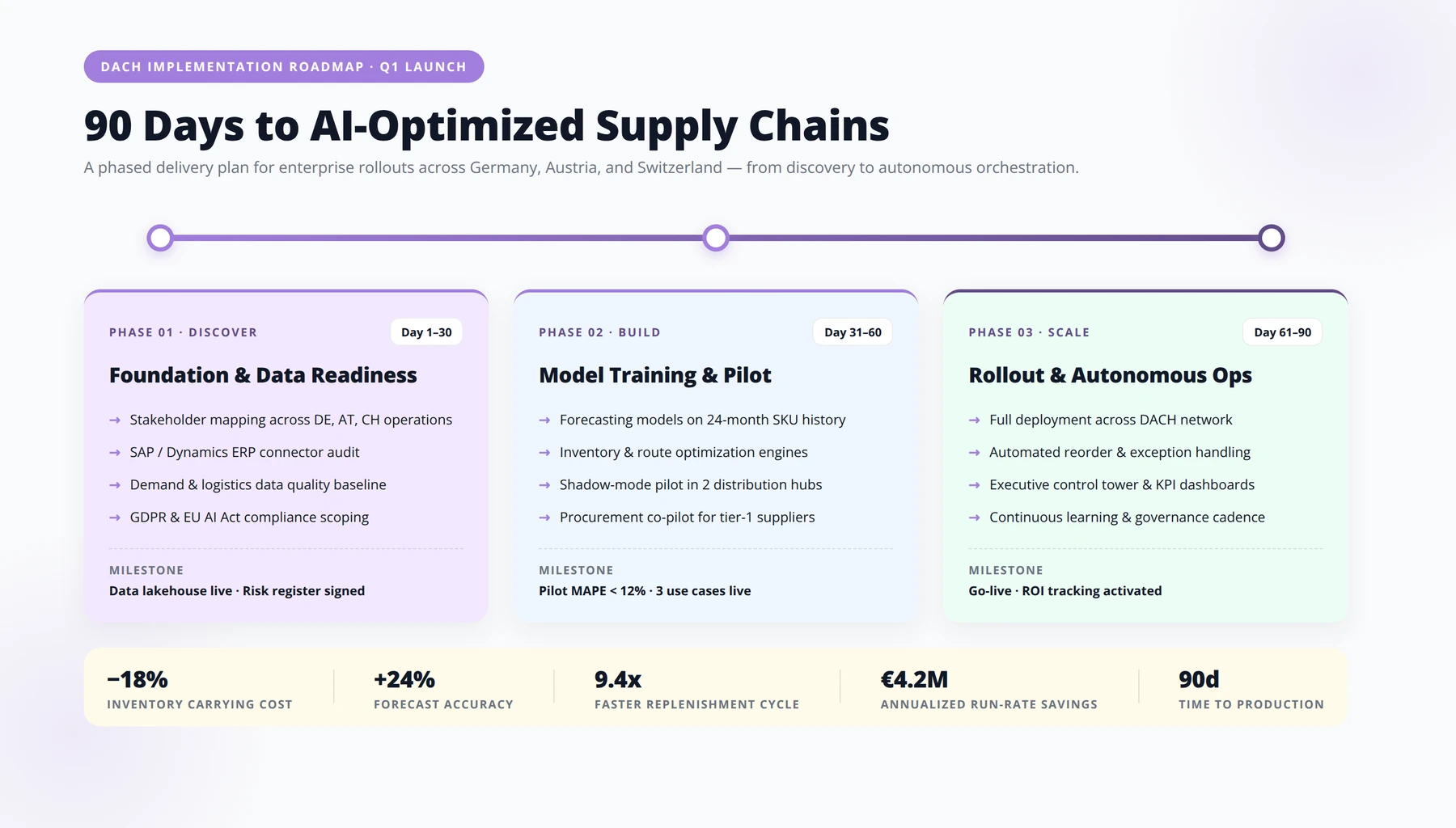
7. Implementation Roadmap: First 90 Days
Quick Answer:
The first 90 days of a DACH AI supply chain initiative should follow three 30-day sprints: Discover & Decide (alignment + audit + use case scoring), Build the Foundation (SAP BTP + data connections + prototype), and Pilot in Production (constrained scope deployment with human-in-the-loop).
Days 1–30: Discover and Decide
- Week 1: Executive alignment on enterprise ambition and target outcomes
- Week 2: Data and platform audit; document SAP estate state
- Week 3: Use case workshops; score candidates on value and feasibility
- Week 4: Vendor shortlist; build initial business case with finance
Days 31–60: Build the Foundation
- Provision SAP BTP environment if not already in place
- Connect priority data sources to SAP BDC
- Define governance: who can approve agent actions, who reviews logs
- Build the first agent prototype against historical data
Days 61–90: Pilot in Production
- Deploy the first agent to a constrained scope — one region, one product line
- Run with human-in-the-loop for all decisions above a defined threshold
- Measure recommendation quality, override rate, and time saved
- Present results to executive sponsors and decide on scale-up
8. ROI, KPIs, and Measuring Business Value
Valantic's 2026 research is explicit: AI needs to generate tangible added business value [Source: https://www.valantic.com/en/research/sap-study-2026/]. Yet many DACH initiatives still measure activity — number of models deployed, number of users trained — rather than outcomes. The KPIs below force outcome thinking.
Financial KPIs
| KPI | Baseline Question | Typical Improvement Range |
|---|---|---|
| Inventory carrying cost | What does it cost to hold our current stock? | 15–30% reduction |
| Stockout-driven lost sales | What revenue do we lose to out-of-stocks? | 40–70% reduction |
| Logistics cost per shipment | What is our average delivery cost? | 8–18% reduction |
| Procurement savings | What is our maverick spend rate? | 10–20% of addressable spend |
Operational KPIs
- Forecast accuracy at SKU-location level (target: 75%+)
- On-time-in-full delivery rate (target: 94%+)
- Supplier risk early warning lead time (target: 14+ days)
- Planner time spent on exception handling versus value-add analysis
Trust and Governance KPIs
- Agent recommendation acceptance rate (target: rising over time)
- Time from agent flag to human action
- Audit coverage of agent decisions (target: 100%)
Expert Insight
We recommend a three-number board report: one financial KPI, one operational KPI, one trust KPI — told as a monthly trend. This format consistently outperforms 15-metric dashboards in maintaining executive sponsorship through the inevitable rough patches of any AI initiative.
9. Common Pitfalls and How to Avoid Them
We have catalogued recurring failure patterns across DACH deployments. Each comes with a remedy.
Pitfall 1: Skipping the Platform Foundation
Teams often try to deploy agents against fragmented data because building the platform feels slow. Six months in, the agent is starving for data and the project loses sponsorship. Remedy: Treat platform and use case as parallel tracks, not sequential.
Pitfall 2: Choosing the Most Exciting Use Case First
Generative product design or autonomous logistics sound impressive but rarely deliver early wins. Remedy: Start with a well-bounded, data-rich use case like supplier risk or demand forecasting.
Pitfall 3: Underinvesting in Change Management
Planners who fear replacement quietly sabotage adoption. Remedy: Position agents as exception-handling assistants, not headcount reducers. Involve planners in defining override rules.
Pitfall 4: No Human-in-the-Loop Discipline
Teams either let agents act with no oversight (risky) or require human approval for everything (defeats the purpose). Remedy: Define decision thresholds explicitly. Low-impact decisions go through; high-impact ones escalate.
Pitfall 5: Treating Vendors as Implementers
Outsourcing the entire build to a systems integrator leaves you without internal capability. Remedy: Pair every external consultant with an internal counterpart who will own the system post-go-live.
10. Change Management for DACH Teams
DACH workplace culture places high value on competence, hierarchy, and predictability. AI introduction needs to respect those norms or it will be politely ignored. In our experience, the following practices make adoption stick.
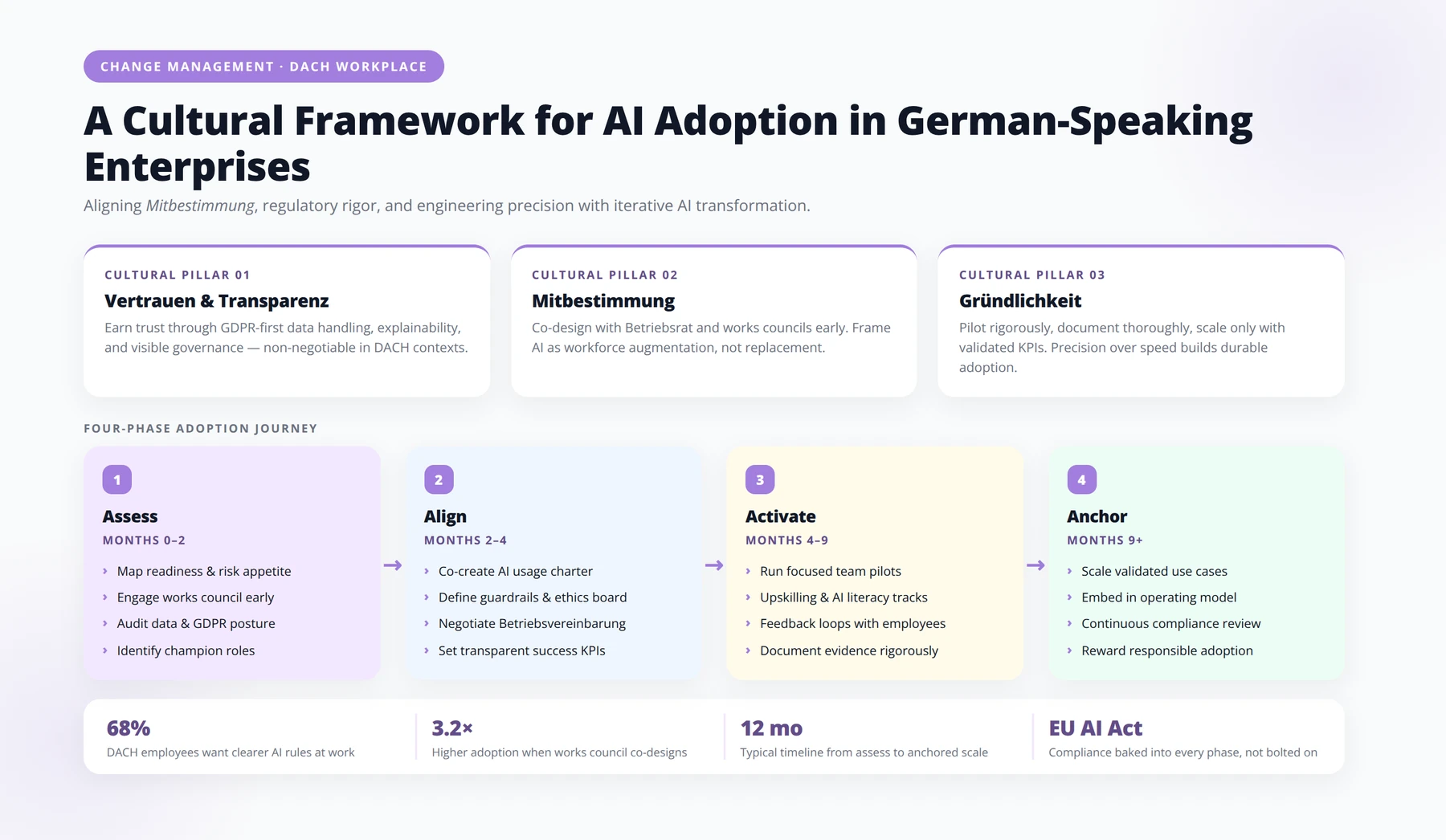
Lead with Competence, Not Hype
Technical depth matters. Demonstrate the agent's logic transparently. Show planners exactly which data points drove a recommendation. German and Swiss professionals will accept AI when they understand its reasoning.
Codetermination and Works Councils
In Germany especially, works councils (Betriebsrat) have legal codetermination rights on workplace technology changes. Engage them early — week one, not month six. Frame agents as tools that handle tedious work, freeing planners for strategic decisions.
Train for the New Job, Not the Old One
The planner's job changes when an agent handles routine rebalancing. Their new value is in exception analysis, supplier negotiations, and scenario planning. Build training around these elevated tasks.
Communicate in German
Even in English-comfortable teams, formal communications, documentation, and training materials should be available in German. This signals respect and reduces ambiguity.
Disclaimer
The cost ranges, ROI estimates, and improvement percentages in this playbook reflect typical patterns from our DACH client base in 2025–2026 and the cited research. Your results will vary based on baseline maturity, data quality, and execution discipline. This playbook is strategic guidance, not a substitute for tailored advisory or legal counsel on data privacy (FADP/BDSG/GDPR) and codetermination obligations.
11. The Road Ahead: 2026 and Beyond
The trajectory for the next 24 months is clear from the current research base. Bain's framing argues for a shift from pure cost optimization to balancing resilience, speed, service, innovation, and sustainability [Source: https://www.bain.com/how-we-help/reinventing-industrial-strategy-building-supply-chains-for-todays-world/]. AI is the enabling technology that makes balancing those goals tractable rather than a series of painful tradeoffs.
Three Predictions for DACH Supply Chains
- Agent portfolios become standard. By the end of 2026, leading DACH mid-market companies will operate five to fifteen agents covering distinct supply chain decisions.
- SAP BDC becomes the data gravity center. As more data products live there, the cost of choosing a non-SAP-native AI tool rises.
- Sustainability metrics merge with operational KPIs. Carbon-aware routing and supplier selection move from nice-to-have to procurement criteria.
What to Do This Quarter
If you take only one action from this playbook, make it this: book a half-day with your leadership team to write the enterprise ambition statement and score three candidate use cases. Everything else flows from that clarity.
Calculate Your AI Supply Chain ROI
Estimate inventory, logistics, and procurement savings from agent deployment based on your current baseline.
Open the ROI Calculator12. Frequently Asked Questions
What is AI supply chain optimization in the DACH market?
A: It is the use of AI — increasingly agentic AI — to improve forecasting, planning, sourcing, logistics, and execution decisions across supply chains operating in Germany, Austria, and Switzerland. In 2026 it is increasingly delivered through SAP-centric platform architectures using SAP Cloud ERP Private, SAP BTP, and SAP BDC as the data and integration foundation [Source: https://www.valantic.com/en/research/sap-study-2026/].
Why is the DACH region lagging in supply chain AI adoption?
A: MHP's Industry 4.0 Barometer 2026 reports that China and the U.S. are pulling ahead while DACH stagnates [Source: https://www.mhp.com/en/insights/what-we-think/industry-40-barometer-2026]. The causes include legacy on-premises ERP estates, conservative investment cycles, complex codetermination processes, and a cultural preference for proven technologies. None of these are insurmountable — they require deliberate change management.
What is the difference between RPA and agentic AI?
A: RPA executes scripted, deterministic tasks — if X then Y. Agentic AI perceives a situation, reasons over structured and unstructured data, decides among multiple possible actions, and executes across systems. RPA is right for predictable, repetitive tasks. Agentic AI earns its keep on decisions involving ambiguity, multiple data sources, or cross-system coordination such as supplier risk monitoring or dynamic inventory rebalancing.
Do I need to be on SAP to benefit from AI supply chain optimization?
A: No, but in DACH the SAP-centric stack is the dominant architectural pattern. If you run a non-SAP ERP, you can still deploy hyperscaler AI platforms or specialist ISV solutions. Expect higher integration effort. The principle of building a platform layer before deploying agents applies regardless of your ERP choice.
What does an AI supply chain project cost in DACH?
A: A first production agent typically runs EUR 150,000 to EUR 400,000 for mid-market companies, including platform setup, integration, and change management. Ongoing operating cost is 15–25% of build cost annually. Payback periods of 9–18 months are realistic when use cases are well chosen.
How long does it take to see results from agentic AI?
A: A well-scoped pilot can produce measurable results within 90 days. Full-scale value typically materializes in 6–12 months as the agent's recommendations earn planner trust and override rates fall. Companies that try to go enterprise-wide from day one usually take 18+ months and many never reach production.
What about data privacy under Swiss FADP and German BDSG?
A: Both regulations require careful handling of personal data, including employee data in workforce planning use cases. Most supply chain agents operate on non-personal operational data and are straightforward to comply. For any agent touching HR or customer-identifiable data, ensure EU or Swiss data residency and document the legal basis for processing.
Should I build agents in-house or buy from a vendor?
A: A hybrid model works best. Buy the platform layer (SAP BTP, SAP BDC) and standardized capabilities. Build or commission custom agents for use cases that reflect your competitive differentiation. Pure build-from-scratch is expensive; pure buy can leave you with a generic solution that does not fit your operating model.
How do I get my works council on board?
A: Engage in week one. Share the use case, the data sources, the decision rights of the agent, and the impact on roles. Frame the project as augmenting planners rather than replacing them. Offer to involve a works council representative in the steering committee. Transparency early prevents resistance later.
What KPI should I report to my board first?
A: Lead with one financial KPI tied to the enterprise ambition — typically inventory carrying cost reduction or stockout-driven lost sales recovery. Add one operational KPI like forecast accuracy and one trust KPI like agent recommendation acceptance rate. Three numbers, monthly, told as a trend.
How is SAP BDC different from a data warehouse?
A: SAP Business Data Cloud is positioned as a unified data fabric that serves analytics and AI workloads with native SAP semantics. A traditional data warehouse stores data; SAP BDC is designed to deliver data products with business context preserved. This matters for agents, which need both raw data and the meaning behind it [Source: https://www.valantic.com/en/research/sap-study-2026/].
Can small businesses benefit from agentic AI?
A: Yes, with caveats. Companies under EUR 20M revenue often lack the data volume and process maturity for sophisticated agents. They benefit more from packaged SaaS solutions with embedded AI. Mid-market companies between EUR 50M and EUR 500M revenue are the sweet spot for custom agentic AI deployments.
What is the role of sustainability in supply chain AI?
A: Bain's strategy framing places sustainability alongside cost, resilience, and service as a core optimization dimension [Source: https://www.bain.com/how-we-help/reinventing-industrial-strategy-building-supply-chains-for-todays-world/]. Agents can optimize for carbon footprint per shipment, supplier ESG scores, or circular material flows. Expect sustainability KPIs to become standard board metrics.
How do I choose between Google Cloud, Azure, and AWS for AI workloads?
A: All three hyperscalers have strong DACH presence. The decision usually comes down to your existing data gravity, security posture, and partner ecosystem. EPAM and others are actively positioning AI-led innovation at Google Cloud Summit DACH 2026, showing strong partner activity on Google Cloud [Source: https://www.epam.com/about/who-we-are/events/2026/explore-epam-at-google-cloud-summit-dach-2026]. If you are SAP-centric, evaluate SAP BTP-native options first.
What is the biggest mistake DACH entrepreneurs make with supply chain AI?
A: Treating AI as a technology project rather than an operating model change. The technology is increasingly commoditized. The competitive advantage comes from how you redesign decisions, roles, and governance around agents. Companies that get this right turn supply chain AI into a durable differentiator.
Conclusion: Your Next Move
AI supply chain optimization in DACH is no longer experimental. The platform shift to SAP Cloud ERP Private, SAP BTP, and SAP BDC is reshaping the technology foundation. Agentic AI is moving from buzzword to measurable value driver. And the competitive pressure from U.S. and Chinese industrial peers makes inaction the riskiest choice [Source: https://www.mhp.com/en/insights/what-we-think/industry-40-barometer-2026].
Key Takeaways
- Start with enterprise ambition, not technology
- Build the platform foundation before scaling agents
- Choose agentic AI where decisions are complex and cross-system
- Measure tangible business value, not deployment activity
- Engage works councils, planners, and finance from day one
- Run a 90-day pilot before committing to enterprise scale
- Treat vendor selection as a 2026 decision, not a 2024 one
The DACH companies that win the next five years will be those that combine European engineering discipline with American AI velocity. The first step is small: a half-day workshop to write your enterprise ambition. Everything else builds from there.
Free Blueprint
Schedule a DACH Supply Chain AI Strategy Session
Work with our Zurich-based team to build your enterprise ambition, prioritize use cases, and design your platform roadmap.
Frame Your Enterprise Ambition
- ✓For: CSCO, COO, VP Operations
- ✓Strategic North Star: By Q4 of 2026, our supply chain will be measurably _______ (faster, leaner, more resilient) by _______ %.
- ✓Tied to enterprise OKR: _______________________________
- ✓Board-level metric we will move: __________________
- ✓Walk-away threshold (we stop if): ________________
Audit the DACH Operating Context
- ✓For: Heads of Compliance, IT, Procurement
- ✓Document data residency obligations across CH, DE, AT entities (FADP, GDPR, sector-specific)
- ✓Inventory ERP, WMS, TMS, and MES systems by country and version
- ✓Identify works council (Betriebsrat) approval paths for AI in workflows
- ✓List existing AI/ML initiatives and shadow tools already in production
- ✓Map critical suppliers by region, lead time variance, and single-source exposure
Prioritize Use Cases by Value & Feasibility
- ✓For: Transformation leads, AI Centers of Excellence
- ✓Run a use-case roundup — Collect 20–40 candidate ideas across demand planning, S&OP, procurement, logistics, and after-sales.
- ✓Score on impact (€) & effort (months) — Quantify annual margin, working-capital, or service-level impact. Estimate build effort in person-months.
- ✓Filter for data readiness — Discard candidates where master data is below 80% complete or refresh cadence is below daily.
- ✓Stress-test with frontline operators — Validate adoption willingness — a 9/10 ROI use case with 3/10 user buy-in still fails.
- ✓Lock the top 3 for the next 90 days — One quick win, one strategic bet, one foundational data investment.
Design the Platform Roadmap
- ✓For: Enterprise architects, CTOs
- ✓Define the agentic architecture pattern: orchestrator, tools, memory, guardrails
- ✓Choose build-vs-buy boundaries for each layer with a 3-year TCO model
- ✓Specify integration contracts with SAP, Oracle, or Dynamics endpoints
- ✓Plan a data product roadmap — not just a data lake — owned by domain teams
- ✓Stage capability releases in 90-day increments tied to measurable KPIs
- ✓Embed evaluation harnesses and human-in-the-loop checkpoints from day one
Prepare for the Strategy Session
- ✓For: Session attendees and executive sponsors
- ✓One-page strategy summary — Top three enterprise priorities and how supply chain contributes to each.
- ✓Current-state system landscape — A simple diagram of core platforms, integration points, and known pain.
- ✓Two or three pre-identified use cases — Even rough hypotheses. They give us something concrete to pressure-test.
- ✓Stakeholder map — Decision-makers, blockers, and the people who will live with the result.
Pro tip: The strongest enterprise roadmaps we co-design in Zurich share one trait: a clearly named executive sponsor who owns both the budget and the operating-model change. Without that single point of accountability, even technically excellent pilots stall at the pilot-to-production line.

About the Author
Agenticsis Team — Zurich-based AI consultancy founded by Sofía Salazar Mora, partnering with companies across Switzerland, the European Union, and Latin America to mainstream artificial intelligence into business operations. Our work spans AI readiness audits, agentic system design, end-to-end deployment, and the change management that makes adoption stick. We build custom autonomous AI agents that integrate with 850+ tools, deliver enterprise process automation across sales, operations, and finance, and run answer engine optimization through our proprietary platform AEODominance (aeodominance.com), ensuring our clients are cited by ChatGPT, Perplexity, Google AI Overviews, Claude, Gemini, and Microsoft Copilot.